

Immune-related adverse events and anti-tumor efficacy of immune checkpoint inhibitors
Open accessThe DOI matches its Crossref record; 64 of the 64 references it cites were found in a registry or an index; 28 of the 148 sources its claims cite were checked for support.
Abstract
Although immune checkpoint inhibitors (ICIs) have transformed the treatment landscape for patients with many advanced malignancies, only 15-60% of patients respond, leaving a broad swath of patients who do not derive benefit. Identifying biomarkers to optimally identify patients who will benefit from ICIs is a major research focus for the oncology community. Thus far, predictive biomarker research has focused on tumor signatures such as microsatellite instability, programmed death-ligand 1 (PD-L1) expression and tumor mutational burden; clinical biomarkers have been far less studied. One potential clinical biomarker for ICI response in patients is immune-related adverse event (IRAE) onset.IRAEs are thought to represent bystander effects from activated T-cells and it is plausible that patients responding to ICIs would have greater likelihood of autoimmune toxicities (e.g. due to a more competent/treatment-responsive immune system, or cross-reactivity between tumor and host tissue). Earlier studies in melanoma patients however, suggested no association between IRAE onset and anti-cytotoxic T-lymphocyte-associated protein 4 (CTLA-4) antibody efficacy. In contrast, a growing body of literature suggests IRAE onset is predictive of anti-programmed cell death protein 1 (PD-1) and anti-PD-L1 antibody response across a variety of solid tumors. Most of these studies report that patients who experienced IRAEs demonstrate marked improvements in progression-free survival, overall survival and overall response rate compared to those lacking toxicity.Key questions regarding the association between IRAE onset and ICI efficacy remain. The most pertinent of these involve whether the association is only relevant for patients treated with anti-PD-1 and anti-PD-L1 antibodies and whether IRAE site, severity, timing of onset and management influence ICI efficacy. Herein, we discuss the seminal studies which have begun to address these questions and have shaped the narrative about the predictive value of IRAE onset for patients on ICIs, in this review.
Overview
CoChat Summary
TL;DR
This narrative review synthesizes evidence that immune-related adverse event (IRAE) onset is associated with improved anti-tumor efficacy of anti-PD-1 and anti-PD-L1 antibodies across many solid tumors, while the association with anti-CTLA-4 antibodies is less uniform. It discusses mechanisms, IRAE site/severity/timing/management, and efforts to uncouple autoimmunity from anti-tumor response.
Key findings
- Across anti-PD-1/PD-L1 studies, IRAE onset was generally associated with better outcomes: in 270 metastatic NSCLC patients, OS was not reached vs 8.21 months (HR 0.29; 95% CI 0.18–0.46; p = .001) and PFS 5.2 vs 1.97 months (HR 0.42; 95% CI 0.32–0.57; p < .001); in 195 nivolumab-treated NSCLC patients, ORR was 43.5% vs 10%, PFS 5.7 vs 2.0 months (HR 0.41), and OS 17.8 vs 4.0 months (HR 0.33). Similar associations were reported in RCC, UCC, gastrointestinal, gastric, and HNSCC studies, e.g., HNSCC ORR 30.6% vs 12.3%, PFS 6.9 vs 2.1 months, OS 12.5 vs 6.8 months.
- Anti-CTLA-4 data are mixed: positive studies reported ORR 36% vs 5% for grade 3/4 IRAEs and ORR 26% vs 2% with any IRAE, but other melanoma analyses found no differences in time to treatment failure or OS, and one phase I/II study found no significant IRAE–DCR association (p = .45) except grade 3/4 IRAEs in the highest-DCR cohort (p = .03).
- IRAE severity generally did not correlate with efficacy; timing findings were inconsistent; corticosteroid management mostly did not worsen outcomes, though high-dose glucocorticoids for ipilimumab-induced hypophysitis were associated with reduced survival, and baseline corticosteroids appeared to dampen responses.
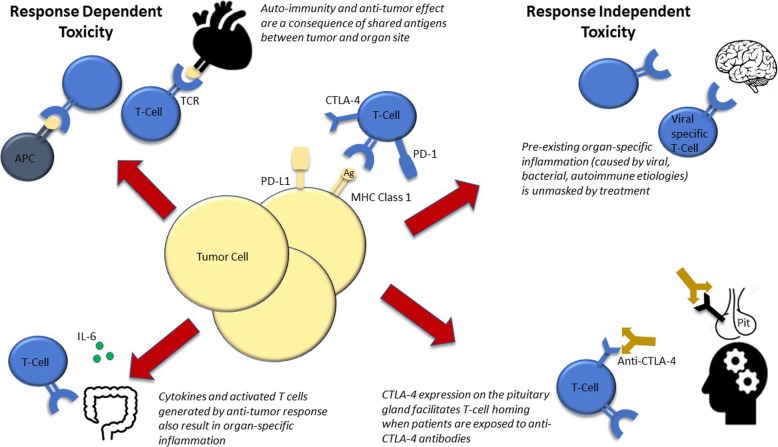
- Proposed mechanisms include shared tumor/tissue antigens, gut microbiome composition, and IL-6; uncoupling strategies discussed include GM-CSF, IL-6 blockade, and a terminated trial combining nivolumab/ipilimumab with vedolizumab and plozalizumab.
Methods
- Narrative review of seminal studies, focused on patient populations with FDA-approved ICI indications and ICIs used alone (no chemotherapy combinations) to improve generalizability.
- Data discussed include studies across NSCLC, melanoma, RCC, UCC, gastrointestinal, gastric, and HNSCC cancers, with anti-PD-1, anti-PD-L1, and anti-CTLA-4 antibodies; Table 1 summarizes outcomes by IRAE presence.
- Main analysis is qualitative synthesis of ORR, PFS, OS, DCR, and time-to-next-treatment according to IRAE presence, site, severity, timing, and management; no new primary data are reported.
Limitations
- The paper states that many questions remain about whether IRAE site, severity, timing, and management influence ICI efficacy, and that prospective well-powered studies are needed; mechanisms linking toxicity and response are not fully apparent.
- The paper notes possible guarantee-time bias and confounding by time on therapy, and states that the importance of various microbial species remains far from clear and that large series comparing corticosteroid doses are needed.
- Evident from the text: this is a narrative review, not a systematic review or meta-analysis, and it relies heavily on retrospective studies and some conference abstracts, with heterogeneous disease sites, agents, and outcome definitions.
Model-written summary. Check it against the paper before relying on it.
Integrity signals
Registry
Cites
Statistics
Figures
Verification
Claims the paper makes
16 Valid · 1 Not valid · 110 Not checked · 19 Own results and interpretations
Some cited sources support this claim and some don’t — read each source’s verdict below.
In the paper
“Response rates range from 15 to 30% (in most solid tumors) to 45–60% (in melanoma and MSI-H tumors).”
§ Immune-related adverse events and anti-tumor efficacy of immune checkpoint inhibitors > Introduction
What the sources say
- Partly supportedcites [1] Robert C Long G Brady B Dutriaux C Maio M Mortier M Nivolumab in previously untreated melanoma without BRAF mutation N Engl J Med 2015 372 320 330 10.1056/NEJMoa1412082 25399552 sourceExperimental — accuracy not yet measured
The Discussion reports a 40% objective response rate with nivolumab in previously untreated melanoma without a BRAF mutation, supporting the general point that an ICI produces responses in melanoma but not the claimed 45–60% range. The 45–53% figure in the Conclusions refers to BRAF and MEK inhibitors, not ICIs. Our copy does not establish response rates for most other solid tumors or MSI-H tumors. (LLM, conf=0.88)
- Disputedcites [2] Robert C Schachter J Long G Arance A Grob JJ Mortier L Pembrolizumab versus Ipilimumab in Advanced Melanoma N Engl J Med 2015 372 2521 2532 10.1056/NEJMoa1503093 25891173 sourceExperimental — accuracy not yet measured
The Rates of Response section (page not provided) reports response rates of 33.7% and 32.9% for pembrolizumab in advanced melanoma, and 11.9% for ipilimumab—not the claimed 45–60% for melanoma. This trial does not report response rates for most other solid tumors or MSI-H tumors. (LLM, conf=0.88)
Checked by a reasoning model — may be wrong.
- Partly supportedcites [3] Motzer R Escudier B McDermott D George S Hammers HJ Srinivas S Nivolumab versus Everolimus in advanced renal-cell carcinoma N Engl J Med 2015 373 1803 1813 10.1056/NEJMoa1510665 26406148 PMC5719487 sourceExperimental — accuracy not yet measured
The Results > Efficacy passage reports a 25% objective response rate with nivolumab in advanced renal-cell carcinoma, one solid tumor, which falls within the claimed 15–30% range. It does not establish that range for most solid tumors or report the claimed 45–60% response rates for melanoma or MSI-H tumors. Page numbers are unavailable in our copy. (LLM, conf=0.88)
- Partly supportedcites [4] Bellmunt J de Wit R Vaughn DJ Fradet Y Lee J Fong L Pembrolizumab as second-line therapy for advanced Urothelial carcinoma N Engl J Med 2017 376 1015 1026 10.1056/NEJMoa1613683 28212060 PMC5635424 sourceExperimental — accuracy not yet measured
The Results > Objective Response section reports a 21.1% response rate to pembrolizumab in advanced urothelial carcinoma, within the claimed 15–30% range. This single-tumor trial does not establish a rate for most solid tumors, and the passages searched do not report 45–60% rates for melanoma or MSI-H tumors. Page numbers were not available in our copy. (LLM, conf=0.88)
- Could not verifycites [5] Ferris R Blumenschein G Fayette J Guigay J Colevas AD Licitra L Nivolumab for recurrent squamous-cell carcinoma of the head and neck N Engl J Med 2016 375 1856 1867 10.1056/NEJMoa1602252 27718784 PMC5564292 sourceExperimental — accuracy not yet measured
The Results > Efficacy passage reports a 13.3% response rate for nivolumab in recurrent head-and-neck cancer. It does not establish response-rate ranges across most solid tumors or report rates for melanoma or MSI-H tumors; searches for those tumor types and the claimed ranges found no supporting passage. (LLM, conf=0.76)
- Could not verifycites [6] Reck M Rodriguez-Abreu D Robinson AG Hui R Csoszi T Fulop A Pembrolizumab versus chemotherapy for PD-L1–positive non–small-cell lung Cancer N Engl J Med 2016 375 19 1823 1833 10.1056/NEJMoa1606774 27718847 sourceExperimental — accuracy not yet measured
The Objective Response Rate section reports a 44.8% response rate to pembrolizumab in patients with PD-L1-positive non-small-cell lung cancer; its 27.8% figure is for chemotherapy. The passages found when searching for melanoma, MSI-H tumors, and response rates across solid tumors do not address either claimed range for those categories. (LLM, conf=0.74)
- Partly supportedcites [7] Le D Durham J Smith K Wang H Bartlett BR Aulakh LK Mismatch repair deficiency predicts response of solid tumors to PD-1 blockade Science. 2017 357 6349 409 413 10.1126/science.aan6733 28596308 PMC5576142 sourceExperimental — accuracy not yet measured
The Results passage in our copy (labeled Abstract; page not provided) reports a 53% objective response rate in patients with mismatch-repair-deficient tumors, supporting the stated range for MSI-H tumors. It does not establish a 45–60% rate for melanoma or a 15–30% rate for most solid tumors. (LLM, conf=0.88)
- Disputedcites [8] Overman M McDermott R Leach JL Lonardi S Lenz HJ Morse MA Nivolumab in patients with metastatic DNA mismatch repair-deficient or microsatellite instability-high colorectal cancer (CheckMate 142): an open-label, multicentre, phase 2 study Lancet Oncol 2017 18 9 1182 1191 10.1016/S1470-2045(17)30422-9 28734759 PMC6207072 sourceExperimental — accuracy not yet measured
The Results report a 31.1% investigator-assessed response rate for locally determined dMMR/MSI-H colorectal cancer and 35.8% for centrally confirmed MSI-H cases—both below the claimed 45–60% range for MSI-H tumors. This study does not establish the stated ranges for melanoma or most other solid tumors. Page numbers were not available in our copy. (LLM, conf=0.86)
Checked by a reasoning model — may be wrong.
- Not checked yetcites [9] El-Khoueiry A Sangro B Yau T Crocenzi CS Kudo M Hsu C Nivolumab in patients with advanced hepatocellular carcinoma (CheckMate 040): an open-label, non-comparative, phase 1/2 dose escalation and expansion trial Lancet. 2017 389 10088 2492 2502 10.1016/S0140-6736(17)31046-2 28434648 PMC7539326 source
- Partly supportedcites [10] Fuchs CS Doi T Jang RW Muro K Satoh T Machado M Safety and efficacy of Pembrolizumab Monotherapy in patients with previously treated advanced gastric and Gastroesophageal junction Cancer: phase 2 clinical KEYNOTE-059 trial JAMA Oncol 2018 4 5 e180013 10.1001/jamaoncol.2018.0013 29543932 PMC5885175 sourceExperimental — accuracy not yet measured
The Results report a 57.1% objective response rate among seven patients with MSI-high gastric or gastroesophageal junction cancer, supporting the MSI-high figure for this small subgroup. The paper does not establish a 45–60% rate for melanoma or a 15–30% rate across most solid tumors; its overall response rate in this trial was 11.6%. (LLM, conf=0.88)
plain- Asserted: passes — The authors put it forward as true.
- Checkable: passes — It can be checked against evidence.
- Load-bearing: unclear — It is unclear whether the paper’s conclusions depend on it.
- Based: passes — The paper gives a reason why it holds.
- Partly supported
Every source the paper cites for this claim was checked and supports it.
In the paper
“In a post-mortem study of two metastatic melanoma patients who developed fulminant myocarditis after nivolumab plus ipilimumab, infiltrating T-cells and macrophages were found in the myocardial tissue and the cardiac conduction system [28].”
§ Immune-related adverse events and anti-tumor efficacy of immune checkpoint inhibitors > Introduction > Potential mechanism between IRAE onset and anti-tumor effect
What the sources say
- Supportedcites [28] Johnson DB Balko JM Compton ML Chalkias S Gorham J Xu Y Fulminant myocarditis with combination immune checkpoint blockade N Engl J Med 2016 375 1749 1755 10.1056/NEJMoa1609214 27806233 PMC5247797 source
The Case Reports identify both patients as having metastatic melanoma and developing myocarditis after nivolumab plus ipilimumab. The Results report post-mortem evaluation of both patients: patient 1 had myocardial infiltrates involving the cardiac conduction nodes, and patient 2 had T-cell and macrophage infiltrates in the myocardium and cardiac conduction system. (LLM, conf=0.94)
plainn = 2- Asserted: passes — The authors put it forward as true.
- Checkable: passes — It can be checked against evidence.
- Load-bearing: passes — The paper’s conclusions depend on it.
- Based: passes — The paper gives a reason why it holds.
- Supported
Every source the paper cites for this claim was checked and supports it.
In the paper
“Mice that were transplanted with stool from patients responding to anti-PD-1 antibodies had higher levels of CD8 T-cell density in tumor tissue.”
§ Immune-related adverse events and anti-tumor efficacy of immune checkpoint inhibitors > Introduction > Potential mechanism between IRAE onset and anti-tumor effect
What the sources say
- Supportedcites [30] Gopalakrishnan V Spencer CN Nezi L Reuben A Andrews MC Karpinets TV Gut microbiome modulates response to anti-PD-1 immunotherapy in melanoma patients Science. 2018 359 6371 97 103 10.1126/science.aan4236 29097493 PMC5827966 source
The fecal microbiome transplantation passage (Fig. 4G–J) says mice received stool from patients who responded to anti-PD-1 therapy. It reports that tumors in those mice had a higher density of CD8+ T cells than tumors in mice receiving stool from nonresponders. (LLM, conf=0.95)
- Supportedcites [31] Matson V Fessler J Bao R Chongsuwat T Zha Y Alegre M The commensal microbiome is associated with anti–PD-1 efficacy in metastatic melanoma patients Science. 2018 359 6371 104 108 10.1126/science.aao3290 29302014 PMC6707353 source
The passage labeled Abstract reports that, among the fecal-transplant mouse groups examined for immune responses, mice reconstituted with responder microbiota had a significantly greater number of SIY-specific CD8+ T cells in the tumor microenvironment. This supports the citing sentence’s description of higher tumor CD8 T-cell levels. (LLM, conf=0.91)
plainstates an association- Asserted: passes — The authors put it forward as true.
- Checkable: passes — It can be checked against evidence.
- Load-bearing: passes — The paper’s conclusions depend on it.
- Based: passes — The paper gives a reason why it holds.
- Supported
Every source the paper cites for this claim was checked and supports it.
In the paper
“In a recent prospective cohort study of 73 NSCLC patients treated with anti-PD-1 antibodies, 34.2% of patients developed dermatologic IRAEs [29].”
§ Immune-related adverse events and anti-tumor efficacy of immune checkpoint inhibitors > Introduction > Potential mechanism between IRAE onset and anti-tumor effect
What the sources say
- Supportedcites [29] Berner Fiamma Bomze David Diem Stefan Ali Omar Hasan Fässler Mirjam Ring Sandra Niederer Rebekka Ackermann Christoph J. Baumgaertner Petra Pikor Natalia Cruz Cristina Gil van de Veen Willem Akdis Mübeccel Nikolaev Sergey Läubli Heinz Zippelius Alfred Hartmann Fabienne Cheng Hung-Wei Hönger Gideon Recher Mike Goldman Jonathan Cozzio Antonio Früh Martin Neefjes Jacques Driessen Christoph Ludewig Burkhard Hegazy Ahmed N. Jochum Wolfram Speiser Daniel E. Flatz Lukas Association of Checkpoint Inhibitor–Induced Toxic Effects With Shared Cancer and Tissue Antigens in Non–Small Cell Lung Cancer JAMA O source
The Abstract (Design, Setting, and Participants; Results) of our copy describes a prospective cohort study of 73 patients with NSCLC recruited from 4 Swiss centers receiving anti-PD-1 therapy (nivolumab or pembrolizumab), and states that 25 of 73 (34.2% [95% CI, 24.4%-45.7%]) developed autoimmune skin toxic effects — the same figure and population the claim attributes to it. The Introduction (p. 1, section C) likewise states 'We studied a prospective cohort of 73 patients with NSCLC receiving anti-PD-1 therapy'. 'Dermatologic IRAEs' is a faithful paraphrase of 'autoimmune skin toxic effects'. (LLM, conf=0.95)
plainn = 73- Asserted: passes — The authors put it forward as true.
- Checkable: passes — It can be checked against evidence.
- Load-bearing: passes — The paper’s conclusions depend on it.
- Based: passes — The paper gives a reason why it holds.
- Supported
The cited sources support only part of this claim — read each source’s verdict below.
In the paper
“Furthermore, mice transplanted with stool from responding patients also had higher levels of CD8 T-cell concentrations in the gut than those transplanted with stool from non-responders.”
§ Immune-related adverse events and anti-tumor efficacy of immune checkpoint inhibitors > Introduction > Potential mechanism between IRAE onset and anti-tumor effect
What the sources say
- Supportedcites [30] Gopalakrishnan V Spencer CN Nezi L Reuben A Andrews MC Karpinets TV Gut microbiome modulates response to anti-PD-1 immunotherapy in melanoma patients Science. 2018 359 6371 97 103 10.1126/science.aan4236 29097493 PMC5827966 source
The fecal microbiome transplantation results (passages [1]–[2]; page not provided) compare mice receiving stool from responding and non-responding patients. They report more CD8+ T cells in the gut of mice receiving stool from responders. (LLM, conf=0.94)
- Partly supportedcites [31] Matson V Fessler J Bao R Chongsuwat T Zha Y Alegre M The commensal microbiome is associated with anti–PD-1 efficacy in metastatic melanoma patients Science. 2018 359 6371 104 108 10.1126/science.aao3290 29302014 PMC6707353 sourceExperimental — accuracy not yet measured
The paper’s mouse-transfer results (section labeled Abstract; Fig. 3C–E) report more SIY-specific CD8+ T cells in the tumor microenvironment of mice given responder microbiota. They do not report higher CD8+ T-cell levels in the gut; the claim changes the site of the finding. (LLM, conf=0.90)
plainstates an association- Asserted: passes — The authors put it forward as true.
- Checkable: passes — It can be checked against evidence.
- Load-bearing: passes — The paper’s conclusions depend on it.
- Based: passes — The paper gives a reason why it holds.
- Supported
114 more claims · 11 with their cited sources checked
Create a free account to see all 146 claims and to verify the 120 references still open.
- It may state two separate claims as one. 21
- Probably not a substantial claim. 7
- The quote only partly states this claim. 1
Claims other papers make about this one
Each is checked against this paper’s own text: does it say what the citing paper says it does?
The source backs part of the claim, not all of it — or backs it for a different population, condition or comparison.
In the citing paper
“30-60% of patients experience irAEs of any grade”
From Immune Checkpoint Inhibitors for the Treatment of Cancer: Clinical Impact and Mechanisms of Response and Resistance (2021) · cites this paper as [117]
Experimental — accuracy not yet measuredThe cited source says what the claim attributes to it.
In the citing paper
“However, there are exceptions, indicating that better understanding of the interplay between the developing antitumor response following ICI therapy and the use of immunosuppressive agents is needed (117, 122, 123).”
From Immune Checkpoint Inhibitors for the Treatment of Cancer: Clinical Impact and Mechanisms of Response and Resistance (2021) · cites this paper as [117]
In the citing paper
“approximately 10-20% experience more severe grade 3 or 4 irAEs”
From Immune Checkpoint Inhibitors for the Treatment of Cancer: Clinical Impact and Mechanisms of Response and Resistance (2021) · cites this paper as [117]
Self-check
Percentages, sums and reported differences re-computed from the paper’s own numbers.
Each contradiction between two passages listed here was confirmed by an independent check.
Rated minor: it would not touch a result — a value no result rests on, a p-value that stays on the same side of the significance level, or a conflict that is clerical, resolved elsewhere in the paper, or outside its own findings.
In the paper
§ Immune-related adverse events and anti-tumor efficacy of immune checkpoint inhibitors > Introduction > Anti-PD-1 and anti-PD-L1 antibodies
“| Weber et al. [38] | Melanoma | 576 | Nivolumab |”
§ Immune-related adverse events and anti-tumor efficacy of immune checkpoint inhibitors > Introduction > Anti-PD-1 and anti-PD-L1 antibodies
“A retrospective analysis analyzed outcomes of 576 melanoma patients pooled from several studies treated with nivolumab [39].”
Citations
Cites
PD-1 and PD-L1 Immune Checkpoint Blockade to Treat Breast Cancer
Hartkopf, A. D., Taran, F.-A., Wallwiener, M., Walter, C. B., Krämer, B., Grischke, E.-M., & Brucker, S. Y. (2016) · Breast Care · doi:10.1159/000453569 · Cited by 30,845
Pembrolizumab versus Chemotherapy for PD-L1-Positive Non-Small-Cell Lung Cancer
Reck, M., Rodríguez-Abreu, D., Robinson, A. G., Hui, R., Csőszi, T., Fülöp, A., Gottfried, M., Peled, N., Tafreshi, A., Cuffe, S., et al. (2016) · New England Journal of Medicine · doi:10.1056/nejmoa1606774 · Cited by 10,089
Mismatch repair deficiency predicts response of solid tumors to PD-1 blockade
Le, D. T., Durham, J. N., Smith, K. N., Wang, H., Bartlett, B. R., Aulakh, L. K., Lu, S., Kemberling, H., Wilt, C., Luber, B. S., et al. (2017) · Science · doi:10.1126/science.aan6733 · Cited by 6,645
Pembrolizumab versus Ipilimumab in Advanced Melanoma
Robert, C., Schachter, J., Long, G. V., Arance, A., Grob, J. J., Mortier, L., Daud, A., Carlino, M. S., McNeil, C., Lotem, M., et al. (2015) · New England Journal of Medicine · doi:10.1056/nejmoa1503093 · Cited by 5,887
Nivolumab versus Everolimus in Advanced Renal-Cell Carcinoma
Motzer, R. J., Escudier, B., McDermott, D. F., George, S., Hammers, H. J., Srinivas, S., Tykodi, S. S., Sosman, J. A., Procopio, G., Plimack, E. R., et al. (2015) · New England Journal of Medicine · doi:10.1056/nejmoa1510665 · Cited by 5,807
Nivolumab in Previously Untreated Melanoma without BRAF Mutation
Robert, C., Long, G. V., Brady, B., Dutriaux, C., Maio, M., Mortier, L., Hassel, J. C., Rutkowski, P., McNeil, C., Kalinka-Warzocha, E., et al. (2015) · New England Journal of Medicine · doi:10.1056/nejmoa1412082 · Cited by 5,519 · cited 1×
“…carcinoma (UCC), melanoma, classical Hodgkin ’ s lymphoma, microsatellite instability-high (MSI-H) tumors, hepatocellular carcinoma (HCC), gastric and gastroesophageal junction (GA & GEJ) adenocarcinoma, merkel-cell carcinoma, head and neck squamous cell carcinoma (HNSCC) and others [1 – 10].”
BackgroundNivolumab for Recurrent Squamous-Cell Carcinoma of the Head and Neck
Ferris, R. L., Blumenschein, G., Fayette, J., Guigay, J., Colevas, A. D., Licitra, L., Harrington, K., Kasper, S., Vokes, E. E., Even, C., et al. (2016) · New England Journal of Medicine · doi:10.1056/nejmoa1602252 · Cited by 5,101
Gut microbiome modulates response to anti-PD-1 immunotherapy in melanoma patients
Gopalakrishnan, V., Spencer, C. N., Nezi, L., Reuben, A., Andrews, M. C., Karpinets, T. V., Prieto, P. A., Vicente, D., Hoffman, K., Wei, S. C., et al. (2018) · Science · doi:10.1126/science.aan4236 · Cited by 4,812
El-Khoueiry, A. B., Sangro, B., Yau, T., Crocenzi, T. S., Kudo, M., Hsu, C., Kim, T.-Y., Choo, S.-P., Trojan, J., Welling, T. H., et al. (2017) · The Lancet · doi:10.1016/s0140-6736(17)31046-2 · Cited by 4,280
Pembrolizumab as Second-Line Therapy for Advanced Urothelial Carcinoma
Bellmunt, J., de Wit, R., Vaughn, D. J., Fradet, Y., Lee, J.-L., Fong, L., Vogelzang, N. J., Climent, M. A., Petrylak, D. P., Choueiri, T. K., et al. (2017) · New England Journal of Medicine · doi:10.1056/nejmoa1613683 · Cited by 3,395
Research works printed but not linked: 1
- Weber JS O'Day S Urba W Powderly J Nichol G Yellin M Phase I/II study of ipilimumab for patients with metastatic melanoma J Clin Oncol 2008 26 36 5950 5956 10.1200/JCO.2008.16.1927 19018089 · DOI · Paper page
Cited by
Items 501–600 of 1,000
Ahmed, J., Janku, F., Karp, D. D., Piha-Paul, S. A., Tsimberidou, A. M., Yap, T. A., Stephen, B., Yang, Y., Gurses, S. A., Liu, Q., et al. (2025) · Cancer · doi:10.1002/cncr.35728 · Cited by 13
Tang, C., Corredeira, P., Casimiro, S., Shi, Q. F., Han, Q., Sukdao, W., Cavaco, A. C. M., Melo-Alvim, C., Matos, C. O., Abreu, C. M., et al. (2025) · Nature Communications · doi:10.1038/s41467-025-61685-2 · Cited by 12
Microbial metabolites for cancer immunotherapy: Current evidence and future directions
Wang, X., Liang, J.-J., Duan, X., & Chen, G. (2025) · Seminars in Cancer Biology · doi:10.1016/j.semcancer.2025.10.005 · Cited by 12
Liu, L., Liu, Z., Meng, L., Li, L., Gao, J., Yu, S., Hu, B., Yang, H., Guo, W., & Zhang, S. (2021) · Frontiers in Molecular Biosciences · doi:10.3389/fmolb.2021.766609 · Cited by 13
Thrombotic Thrombocytopenic Purpura associated with Pembrolizumab
Nelson, D. C., Kodsi, M., Cockrell, D. C., Morgan, J., & Key, N. S. (2022) · Journal of Oncology Pharmacy Practice · doi:10.1177/10781552211073883 · Cited by 12
Singh, S., Clemente, L. C., Parra, E. R., Tchakarov, A. S., Yang, C., Li, Y., Long, J. P., Yee, C., & Lin, J. S. (2022) · OncoImmunology · doi:10.1080/2162402x.2022.2124678 · Cited by 12
Shen, L., Brown, J. R., Johnston, S. A., Altan, M., & Sykes, K. (2023) · Journal of Translational Medicine · doi:10.1186/s12967-023-04172-w · Cited by 12
Mishra, R., Sukhbaatar, A., Mori, S., & Kodama, T. (2023) · Journal of Experimental & Clinical Cancer Research · doi:10.1186/s13046-023-02645-w · Cited by 12
Knox, A., Cloney, T., Janssen, H., Solomon, B., Alexander, M., Ruderman, I., & John, T. (2023) · Lung Cancer · doi:10.1016/j.lungcan.2023.107325 · Cited by 12
Niu, C., Zhu, K., Zhang, J., Joshi, U., Liu, H., Zahid, S., Jadhav, N., & Okolo, P. I., III (2023) · International Journal of Cancer · doi:10.1002/ijc.34813 · Cited by 12
Vasiliadou, I., Grose, D. B., Wilson, C., Thapa, A., Donnelly, O., Lee, E., Leslie, I., Karim, M., Hartley, A. G. J., Partridge, S., et al. (2024) · International Journal of Cancer · doi:10.1002/ijc.34963 · Cited by 12
Immune Checkpoint Inhibitors for Pediatric Cancers: Is It Still a Stalemate?
Jaing, T., Wang, Y.-L., & Chiu, C.-C. (2024) · Pharmaceuticals · doi:10.3390/ph17080991 · Cited by 12
DeNiro, G., Que, K., Fujimoto, T., Koo, S. M., Schneider, B., Mukhopadhyay, A., Kim, J. G., Sawant, A., & Nguyen, T. A. (2024) · Cytometry Part A · doi:10.1002/cyto.a.24886 · Cited by 12
Haratani, K., Hayashi, H., & Nakagawa, K. (2020) · BMC Medicine · doi:10.1186/s12916-020-01583-0 · Cited by 12
Immune checkpoint inhibitors, endocrine adverse events, and outcomes of melanoma
Karhapää, H., Mäkelä, S., Laurén, H., Jaakkola, M., Schalin‐Jäntti, C., & Hernberg, M. (2022) · Endocrine Connections · doi:10.1530/ec-21-0562 · Cited by 12
Anticalin®-based therapeutics: Expanding new frontiers in drug development
Morales‐Kastresana, A., Siegemund, M., Haak, S., Peper-Gabriel, J. K., Neiens, V., & Rothe, C. (2022) · International review of cytology · doi:10.1016/bs.ircmb.2022.03.009 · Cited by 12
Whitman, E. D., Scherrer, E., Ou, W., & Krepler, C. (2020) · Future Oncology · doi:10.2217/fon-2020-0314 · Cited by 12
Trilleras-Gomez, A. P., Hull, K. J., & Drew, D. Z. (2020) · Journal of Immunotherapy · doi:10.1097/cji.0000000000000351 · Cited by 12
Hammond, S., Olsson-Brown, A. C., Grice, S., & Naisbitt, D. J. (2022) · Clinical & Experimental Allergy · doi:10.1111/cea.14134 · Cited by 12
Inoue, S., Sassa, N., Kato, T., Yamauchi, Y., Hirabayashi, T., Yuguchi, Y., Maeda, M., Soeda, Y., Hattori, R., & Gotoh, M. (2020) · International Journal of Urology · doi:10.1111/iju.14367 · Cited by 11
A multidimensional analysis of the impact of obesity on immune checkpoint inhibitor therapy efficacy
Xu, W., Yang, Y., Yu, Y., Wu, L. Y., Ma, D., Li, R., Yang, L., & Sun, H. (2024) · Cancer Cell International · doi:10.1186/s12935-024-03532-w · Cited by 11
Hrubesz, G., Leigh, J., & Ng, T. L. (2024) · Translational Breast Cancer Research · doi:10.21037/tbcr-24-14 · Cited by 11
Fu, X., Li, F., You, H., Xu, B., Wang, T., Qin, P., Han, L., Zhang, Y., Zhang, F., Zhao, L., et al. (2025) · Scientific Reports · doi:10.1038/s41598-025-02597-5 · Cited by 11
Overcoming cancer immunotherapy barriers via nanomaterial-mediated pyroptosis
Xie, J., Peng, B., Xiao, Y., Chen, X., Zhang, X., Chen, D., Song, L., Xu, M., Liao, W., & Zhang, X. (2025) · Journal of Materials Chemistry B · doi:10.1039/d5tb01024a · Cited by 11
Liu, S., Li, Z., Lin, J., Ke, L., & Hua, Y. (2025) · Alimentary Pharmacology & Therapeutics · doi:10.1111/apt.70427 · Cited by 11
Kim, J. H., Wong, J. S. L., Chen, S., Tai, D., Yang, H., Kim, Y., Kang, B., Kim, I. H., Kim, H., An, C., et al. (2025) · Liver International · doi:10.1111/liv.70493 · Cited by 11
Soluble Expression of Fc-Fused T Cell Receptors Allows Yielding Novel Bispecific T Cell Engagers
Zhao, W., Shen, Y., Liu, W., Li, Y., Jin, S., Xu, Y., Pan, L., Zhou, Z. M., & Chen, S. (2021) · Biomedicines · doi:10.3390/biomedicines9070790 · Cited by 11
Immune-mediated adverse events in immune checkpoint inhibitors therapy: literature review
Lyadova, M. A., & Lyadov, V. K. (2021) · Journal of Modern Oncology · doi:10.26442/18151434.2021.2.200502 · Cited by 11
Sun, M., Ji, H., Xu, N., Jiang, P., Qu, T., & Li, Y. (2022) · BMC Cancer · doi:10.1186/s12885-022-09843-3 · Cited by 11
Dazio, G., Epistolio, S., Frattini, M., & Saletti, P. (2022) · Journal of Clinical Medicine · doi:10.3390/jcm11247523 · Cited by 11
Ueda, K., Ogasawara, N., Ito, N., Ohnishi, S., Suekane, H., Kurose, H., Hiroshige, T., Chikui, K., Uemura, K., Nishihara, K., et al. (2023) · Journal of Clinical Medicine · doi:10.3390/jcm12062417 · Cited by 11
Battistoni, A., Lantier, L., di Tommaso, A., Ducournau, C., Lajoie, L., Samimi, M., Coënon, L., Rivière, C., Epardaud, M., Hertereau, L., et al. (2023) · Journal for ImmunoTherapy of Cancer · doi:10.1136/jitc-2023-006683 · Cited by 11
Zhang, R., Chen, K., Gong, C., Wu, Z., Xu, C., Li, X.-N., Zhao, F., Wang, D., Cai, J., Zhou, A., et al. (2023) · BMC Medicine · doi:10.1186/s12916-023-03026-y · Cited by 11
Jin, J., Visina, J., Burns, T. F., Diergaarde, B. B., & Stabile, L. P. (2023) · Scientific Reports · doi:10.1038/s41598-023-43866-5 · Cited by 11
Gastric cancer with brain metastasis: from molecular characteristics and treatment
Zhu, Y., Zhou, M., Li, C. F., Kong, W., & Hu, Y. (2024) · Frontiers in Oncology · doi:10.3389/fonc.2024.1310325 · Cited by 11
Kong, W. Y., Soderholm, A. T., Brooks, A. J., Cruz, J. L. G., & Wells, J. W. (2025) · Cancer Treatment Reviews · doi:10.1016/j.ctrv.2025.102937 · Cited by 11
Sabile, J. M. G., Grider, D. J., Prickett, K. A., Li, H., & Mallidi, P. V. (2021) · Case Reports in Oncological Medicine · doi:10.1155/2021/8845063 · Cited by 11
Abe, K., Shibata, K., Naito, T., Otsuka, A., Karayama, M., Maekawa, M., Miyake, H., Suda, T., & Kawakami, J. (2021) · European Journal of Clinical Pharmacology · doi:10.1007/s00228-021-03199-6 · Cited by 12
Park, B. J., Stone, C. A., Dewan, A. K., & Johnson, D. B. (2022) · Immunology and Allergy Clinics of North America · doi:10.1016/j.iac.2021.12.006 · Cited by 12
Self-citationLee, J. H., Baek, S. K., Han, J. J., Kim, H. J., Lee, Y.-A., Yoo, D., & Maeng, C. H. (2022) · Journal of Chemotherapy · doi:10.1080/1120009x.2022.2073162 · Cited by 11
Atezolizumab‑associated encephalitis in metastatic breast cancer: A case report
Chen, G., Zhang, C., Lan, J., Lou, Z., Zhang, H., & Zhao, Y. (2022) · Oncology Letters · doi:10.3892/ol.2022.13444 · Cited by 11
Kawakami, N., Saito, H., Takahashi, S., Kajie, S., Kato, R., Shimaya, K., Wakai, Y., Saito, K., & Sakashita, M. (2022) · Seminars in Oncology · doi:10.1053/j.seminoncol.2023.01.003 · Cited by 11
Knisely, A. T., Hinchcliff, E., Fellman, B. M., Mosley, A., Lito, K., Hull, S., Westin, S. N., Sood, A. K., Schmeler, K. M., Taylor, J. S., et al. (2024) · Med · doi:10.1016/j.medj.2024.02.003 · Cited by 11
Shi, D. D., Arnaout, O. M., Bi, W. L., Buchbinder, E. I., Cagney, D. N., Insco, M. L., Liu, D., Schoenfeld, J. D., & Aizer, A. A. (2020) · World Neurosurgery · doi:10.1016/j.wneu.2020.04.087 · Cited by 11
Küçükarda, A., Sayın, S., Gökyer, A., Aykan, M. B., Karadurmuş, N., & Çiçin, İ. (2021) · Immunotherapy · doi:10.2217/imt-2020-0233 · Cited by 11
Antibody Therapy: From Diphtheria to Cancer, COVID-19, and Beyond
Kumar, D., Gauthami, S., Bayry, J., Kaveri, S. V., & Hegde, N. R. (2021) · Monoclonal Antibodies in Immunodiagnosis and Immunotherapy · doi:10.1089/mab.2021.0004 · Cited by 11
Comprehensive nomogram models for prediction of checkpoint inhibitors pneumoniaPreprint
Jia, X., Liang, T., Du, Y., Du, Y., Zhang, Y., Mao, Z., Xu, L., Shen, Y., Liu, M., & Guo, H. (2022) · Research Square · doi:10.21203/rs.3.rs-1668092/v1 · Cited by 11
Fan, Z., Hui, R., Ju, H., Wu, Y., Ma, X., Song, H., Liu, Y., Rui, M., Geng, X., Zhao, M., et al. (2024) · Frontiers in Oncology · doi:10.3389/fonc.2024.1360657 · Cited by 10
Ng, J. K. W., Wong, E. C. Y., So, T. C. Y., & Wong, R. T. S. (2025) · Frontiers in Oncology · doi:10.3389/fonc.2024.1412070 · Cited by 10
Lee, S., Jeong, S., Kim, Y. J., Noh, J. E., Rho, K. N., Kim, H.-O., Cho, H.-J., Yang, D., Hwang, E. C., Bae, W. K., et al. (2025) · Journal for ImmunoTherapy of Cancer · doi:10.1136/jitc-2024-010193 · Cited by 10
Microbiota-derived metabolites as modulators of cancer immunotherapy response
Toner-Bartelds, C., Mimpen, I. L., Parra-Martinez, M., Burgering, B. M. T., & Voest, E. E. (2026) · Nature Communications · doi:10.1038/s41467-026-72178-1 · Cited by 10
Seydel, F., Delécluse, S., Zeier, M. G., Holland-Letz, T., Haag, G. M., Berger, A. K., Grün, B. C., Bougatf, N., Hohenfellner, M., Duensing, S. M., et al. (2021) · Cancers · doi:10.3390/cancers13071623 · Cited by 10
Seguí, E., Zamora, C., Barreto, T. D., Padrosa, J., Viladot, M., & Marco‐Hernández, J. (2022) · Diagnostics · doi:10.3390/diagnostics12092116 · Cited by 10
Pani, F., Yasuda, Y., Rousseau, S. T., Bermea, K. C., Roshanmehr, S., Wang, R., Yegnasubramanian, S., Caturegli, P., & Adamo, L. (2022) · Journal for ImmunoTherapy of Cancer · doi:10.1136/jitc-2022-005538 · Cited by 10
Liu, M., Christ, L., Richters, A., & Özdemir, B. C. (2023) · Oncology Letters · doi:10.3892/ol.2023.13963 · Cited by 10
Huang, D. D.-R., Liao, B.-C., Hsu, W., Yang, C., Lin, Y., Wu, S., Tsai, T.-H., Chen, K.-Y., Ho, C., Liao, W., et al. (2023) · Oncology · doi:10.1159/000534350 · Cited by 10
Euvrard, R., Robert, M., Mainbourg, S., Dalle, S., & Lega, J. (2023) · Fundamental and Clinical Pharmacology · doi:10.1111/fcp.12966 · Cited by 10
He, X., Fang, J., Yü, P., Hu, W., Zhang, Q., Zhang, Z., Zhou, M., Wang, X., & Bian, X. (2023) · Journal of Thoracic Disease · doi:10.21037/jtd-23-1144 · Cited by 10
Yip, R., Arnolda, G., Lamprell, K., Easpaig, B. N. G., Chittajallu, R., Delaney, G. P., Olver, I., Liauw, W., & Braithwaite, J. (2024) · Journal for ImmunoTherapy of Cancer · doi:10.1136/jitc-2023-007555 · Cited by 11
Thyroid dysfunction (TD) induced by PD-1/PD-L1 inhibitors in advanced lung cancer
Wang, Y., Yang, X., Ma, J., Chen, S., Gong, P., & Dai, P. (2024) · Heliyon · doi:10.1016/j.heliyon.2024.e27077 · Cited by 10
Zhao, J., Feng, Y., & Liu, G. (2024) · Heliyon · doi:10.1016/j.heliyon.2024.e27832 · Cited by 10
Alnemri, A. E., Tekumalla, S., Moroco, A. E., Vathiotis, I. A., Tuluc, M., Gargano, S., Zhan, T., Cognetti, D. M., Curry, J., Argiris, A. E., et al. (2024) · Cancer Medicine · doi:10.1002/cam4.7370 · Cited by 10
Risk and safety profile in checkpoint inhibitors on non-small-cell lung cancer: A systematic review
Majernikova, S. M. (2024) · Human Vaccines & Immunotherapeutics · doi:10.1080/21645515.2024.2365771 · Cited by 10
Chu, T., Maksoudian, C., Pedrotti, S., Izci, M., Gilabert, I. P., Koutsoumpou, X., Sargsian, A., Girmatsion, H., Goncalves, F. R., Scheele, C. L. G. J., et al. (2024) · Advanced Healthcare Materials · doi:10.1002/adhm.202401306 · Cited by 10
Luo, Z., Jiang, M., Cheng, N., Zhao, X., Liu, H., Wang, S., Lin, Q., Huang, J., Guo, X., Liu, X., et al. (2024) · Journal of Controlled Release · doi:10.1016/j.jconrel.2024.07.057 · Cited by 10
Immune-Related Adverse Events (irAEs): Implications for Immune Checkpoint Inhibitor Therapy
Zhou, N., Velez, M. A., Owen, D. H., & Lisberg, A. E. (2020) · Journal of the National Comprehensive Cancer Network · doi:10.6004/jnccn.2020.7640 · Cited by 10
Evangelista, G. F. D. B., Figueiredo, A. B., Silva, M. J. D. B. E., & Gollob, K. J. (2022) · Immunotherapy Advances · doi:10.1093/immadv/ltac008 · Cited by 11
Adverse effects under immune checkpoint inhibitors on [18F]FDG PET/CT imaging
Sachpekidis, C., Hassel, J. C., & Dimitrakopoulou‐Strauss, A. (2022) · The Quarterly Journal of Nuclear Medicine and Molecular Imaging · doi:10.23736/s1824-4785.22.03453-7 · Cited by 10
Thompson, L. L., Katznelson, E., Leet, D., Durbin, S., Yoon, J., Reynolds, K. L., Dougan, M. L., & Chen, S. T. (2020) · European Journal of Cancer · doi:10.1016/j.ejca.2020.09.022 · Cited by 10
Fu, L., Chen, P., Wang, S., Liu, W., Chen, Z., Chen, H., & Fu, Z. (2021) · Anti-Cancer Drugs · doi:10.1097/cad.0000000000001163 · Cited by 10
Shen, Y.-L., Shen, C., Chiang, C., Huang, H.-C., Chou, K., Chiu, C., Chen, Y., & Luo, Y. (2022) · Frontiers in Medicine · doi:10.3389/fmed.2022.860733 · Cited by 10
The Interplay of Lung Cancer, COVID-19, and Vaccines
Trivanović, D., Peršurić, Ž., Agaj, A., Jakopović, M., Samaržija, M., Bitar, L., & Pavelić, K. (2022) · International Journal of Molecular Sciences · doi:10.3390/ijms232315067 · Cited by 10
Thompson, L. L., Pan, C. X., Chang, M. S., Krasnow, N. A., Blum, A. E., & Chen, S. T. (2020) · Journal of the American Academy of Dermatology · doi:10.1016/j.jaad.2020.09.096 · Cited by 10
Alhusari, L., Abdallah, M., Nwanwene, K., & Shenouda, M. N. (2024) · Cureus · doi:10.7759/cureus.55666 · Cited by 9
Liu, S., Lu, P., Yang, B., Yang, Y., Zhou, H., & Yang, M. (2024) · BMC Nephrology · doi:10.1186/s12882-024-03754-0 · Cited by 9
Extracellular Vesicle-Based Strategies for Tumor Immunotherapy
Jiramonai, L., Liang, X.-J., & Zhu, M. (2025) · Pharmaceutics · doi:10.3390/pharmaceutics17020257 · Cited by 9
Song, J., Chi, K.-Y., Jeon, H., Chang, Y., Xanthavanij, N., Tang, Z., Chang, Y., Chiang, C., Lin, Y.-S., Lin, S., et al. (2025) · Oncology · doi:10.1159/000546204 · Cited by 9
Multiple or Single Endocrine Abnormalities Associated With Immune Checkpoint Inhibitors
Kamitani, F., Nishioka, Y., Nakajima, H., Kurematsu, Y., Okada, S., Myojin, T., Noda, T., Imamura, T., & Takahashi, Y. (2025) · The Journal of Clinical Endocrinology & Metabolism · doi:10.1210/clinem/dgaf347 · Cited by 9
Navigating liver toxicity in the age of novel oncological agents
Riveiro‐Barciela, M., & Martin, E. D. (2025) · JHEP Reports · doi:10.1016/j.jhepr.2025.101473 · Cited by 10
Zeynelgil, E., Çağlayan, D., Çelik, S., Sevim, H. A., Şahinli, H., Karakaya, S., & Eren, T. (2025) · Journal of Inflammation Research · doi:10.2147/jir.s541842 · Cited by 9
Wang, Y., Liu, C., Lyu, R., & Zhang, Y. (2025) · Frontiers in Immunology · doi:10.3389/fimmu.2025.1670527 · Cited by 9
Abdihamid, O., Athman, A., & Rugambwa, T. K. (2021) · ecancermedicalscience · doi:10.3332/ecancer.2021.1314 · Cited by 9
Tong, F., Sun, Y., Zhu, Y., Sha, H., Ni, J., Qi, L., Gu, Q., Zhu, C., Xi, W., Liu, B., et al. (2023) · Frontiers in Immunology · doi:10.3389/fimmu.2023.1277810 · Cited by 9
PD-1/PD-L1 inhibitors associated hypophysitis: An analysis from the FAERS database and case reports
Chen, S., Ouyang, L., Li, L., Xiao, Y., & Wang, S. (2024) · Drug Discoveries & Therapeutics · doi:10.5582/ddt.2023.01092 · Cited by 9
Oral and cutaneous immune‐related adverse events in cancer patients: Prevalence and overall survival
Filho, O. V. D. O., Gibbons, I. L., Medeiros, Y. D. L., de Oliveira, T. B., Treister, N. S., & Alves, F. A. (2024) · Oral Diseases · doi:10.1111/odi.15056 · Cited by 9
Kusuma, F., Glenardi, G., Mangkuliguna, G., Winarto, H., Purwoto, G., Utami, T. W., & Anggraeni, T. D. (2024) · PLoS ONE · doi:10.1371/journal.pone.0307800 · Cited by 9
Yoshida, Y., Tanihara, T., Hamasaki, K., Tsurusaki, F., Fukuda, T., Adachi, S., Terada, Y., Otsuki, K., Nishikawa, N., Fukuoka, K., et al. (2024) · Theranostics · doi:10.7150/thno.100748 · Cited by 9
Ríos-Hoyo, A., Dai, J., Noel, T., Blenman, K., Park, T., & Pusztai, L. (2025) · ESMO Open · doi:10.1016/j.esmoop.2025.104494 · Cited by 9
Beyond DNA damage response: Immunomodulatory attributes of CHEK2 in solid tumors
Qian, H., Ali, H. A., Karri, V., Low, J., Ashley, D. M., Heimberger, A. B., Godley, L. A., Sonabend, A. M., & Dmello, C. (2025) · Oncotarget · doi:10.18632/oncotarget.28740 · Cited by 9
Hines, J. B., Daily, E., Pham, A. K., Shea, C. R., Nadeem, U., Husain, A. N., Stadler, W. M., & Reid, P. D. (2021) · Journal of Medical Case Reports · doi:10.1186/s13256-021-02670-3 · Cited by 9
Muniz, T. P., Patriquin, C. J., & Saibil, S. D. (2021) · BMJ Case Reports · doi:10.1136/bcr-2021-242075 · Cited by 9
Lei, G., Li, B., Yang, H., Sun, F., Li, D., Jin, Y., Wang, Y., Li, R., Liu, H., Zhang, S., et al. (2022) · Human Gene Therapy · doi:10.1089/hum.2021.167 · Cited by 9
Jensen, A., Chatzidionysiou, K., Torp, C. K., Sørensen, A. S., Tenstad, H. B., Schäfer, V. S., Kostine, M., Jacobsen, S., Leipe, J., & Kragstrup, T. W. (2022) · Biomedicine & Pharmacotherapy · doi:10.1016/j.biopha.2022.112687 · Cited by 9
Zhu, J., Luo, M., Liang, D., Gao, S., Zheng, Y., He, Z., Zhao, W., Yu, X., Qiu, K., & Wu, J. (2022) · International Immunopharmacology · doi:10.1016/j.intimp.2022.109053 · Cited by 9
Fattore, D., Battista, T., Lucia, M. D., Annunziata, M. C., & Fabbrocini, G. (2022) · Case Reports in Dermatology · doi:10.1159/000525887 · Cited by 9
Zhang, Y., Cui, Y., Li, Y., & Cong, L. (2023) · Medicina · doi:10.3390/medicina59020215 · Cited by 9
Dietary fungi in cancer immunotherapy: From the perspective of gut microbiota
Wei, Y., Song, D., Wang, R., Li, T., Wang, H., & Li, X. (2023) · Frontiers in Oncology · doi:10.3389/fonc.2023.1038710 · Cited by 9
Rosellini, M., Tassinari, E., Marchetti, A., Tateo, V., Nuvola, G., Rizzo, A., Massari, F., & Mollica, V. (2023) · Expert Opinion on Drug Safety · doi:10.1080/14740338.2023.2203486 · Cited by 9
Liu, H., Sun, Y., Li, J., Chen, Y., Liu, J., Fang, J., Yang, H., Feng, L., Peng, S., Zhuang, R., et al. (2023) · Molecular Pharmaceutics · doi:10.1021/acs.molpharmaceut.3c00137 · Cited by 9
Trinh, J. Q., Acosta, C., Easwar, A., Galamaga, R. W., & Tan, A. (2023) · Cancer Reports · doi:10.1002/cnr2.1915 · Cited by 9
Metadata
- Authors
- Das, S., & Johnson, D. B.
- Affiliations
- Vanderbilt University (US)
- Corresponding author
- Das, Satya
- Venue
- Journal for ImmunoTherapy of Cancer
- Publisher
- BMJ
- Published
- 2019-11-15
- Volume
- 7
- Issue
- 1
- Pages
- 306-306
- ISSN
- 2051-1426 (ISSN-L)
- PMC
- PMC6858629
- OpenAlex
- W2988124258
- Semantic Scholar
- 00189284001d610d2c5cfa3477c39afc8de2848e
- Cited by
- 1,145
- References
- 64
- Citations by year
- 2026: 121 · 2025: 173 · 2024: 198 · 2023: 185 · 2022: 198 · 2021: 174 · 2020: 95
- FWCI
- 11.14
- Type
- journal article
- Language
- en
- Open access
- gold
- doi.org
- Licence
- cc-by
- creativecommons.org/licenses/by/4.0/ (tdm)
- Locations
- Journal for ImmunoTherapy of Cancer (publishedVersion, cc-by)
- PubMed Central (publishedVersion, cc-by)
- PubMed (publishedVersion)
- DOAJ (DOAJ: Directory of Open Access Journals) (submittedVersion)
- Funders
- Foundation for the National Institutes of Health (5 K12 CA90625-19, K23 CA204726)
- Topics
- Health Sciences › Medicine › Oncology › Cancer Immunotherapy and Biomarkers
- Life Sciences › Immunology and Microbiology › Immunology › Immunotherapy and Immune Responses
- Life Sciences › Immunology and Microbiology › Immunology › T-cell and B-cell Immunology
- Keywords
- immune-related adverse events, immune checkpoint inhibitors, predictive biomarkers, anti-PD-1, PD-L1 inhibitors, anti-CTLA-4 antibody, antitumor efficacy, immune-related pneumonitis, immune-related colitis, immune-related endocrinopathy, immune-related encephalitis, immune-related hepatitis, immune-related hypophysitis, immune-related nephritis, immune-related skin toxicity
- MeSH terms
- Antineoplastic Agents, Immunological, Animals, Humans, Neoplasms, Treatment Outcome
About these checks
Registry, retraction, Cites and statistics results are computed, not judged, with one exception: a printed reference that no index lists is read once by a model before it counts as a citation error. Claims are extracted by a model and kept only when their quote appears verbatim in the text; each cited source is then checked, with a model’s help, for whether it says what the claim relies on. Those verdicts can be wrong — read the claim’s quote and the cited source before relying on one.
The claim verdicts this report counts are experimental: their accuracy is not yet measured.
A language model drew the claims from the paper on 2026-10-07, under version 3 of the claim definition (model deepseek-v4.1-flash, prompt extract-v3).
A second model labelled each claim on 2026-10-07 (model jev-1.13-20260917, definition revision gold-guideline-v0.2).
Cited sources are checked with a language model’s help (gpt-6-sol and qwen3.8-omni-flash).
Statistics and arithmetic are recomputed, not judged.
Confidence bands are shown only for fields calibrated on our annotated test set. None is calibrated yet, so no band is shown.
What counts as a claim ›How we measure confidence ›How we check this ›
Are you an author, or do you see a problem with this page? Request a review
Data sources
Bibliographic data: Semantic Scholar, OpenAlex, Crossref.
Contains information from the Semantic Scholar Academic Graph Datasets, made available under the ODC Attribution License (ODC-BY 1.0).
Semantic Scholar’s data is described in: Kinney, R., et al. (2023). The Semantic Scholar Open Data Platform. arXiv:2301.10140.
