

The DOI matches its Crossref record; 35 of the 36 references it cites were found in a registry or an index.
Are white storks addicted to junk food? Impacts of landfill use on the movement and behaviour of resident white storks (Ciconia ciconia) from a partially migratory population
Open accessAbstract
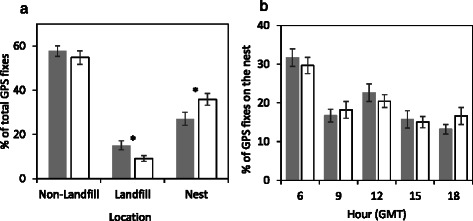
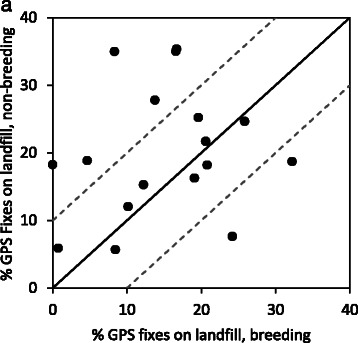
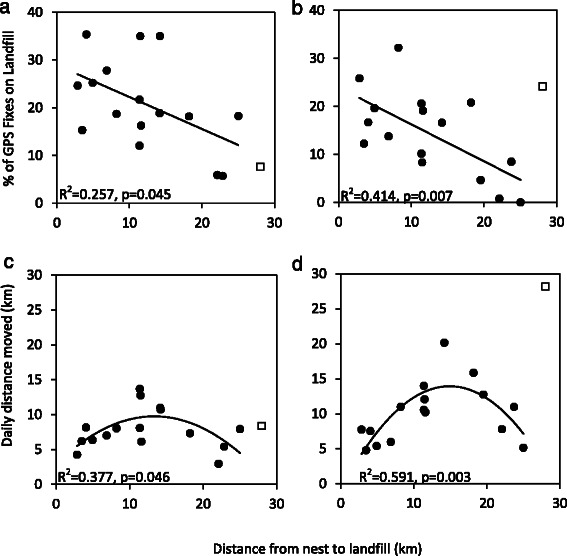
BACKGROUND: The migratory patterns of animals are changing in response to global environmental change with many species forming resident populations in areas where they were once migratory. The white stork (Ciconia ciconia) was wholly migratory in Europe but recently guaranteed, year-round food from landfill sites has facilitated the establishment of resident populations in Iberia. In this study 17 resident white storks were fitted with GPS/GSM data loggers (including accelerometer) and tracked for 9.1 ± 3.7 months to quantify the extent and consistency of landfill attendance by individuals during the non-breeding and breeding seasons and to assess the influence of landfill use on daily distances travelled, percentage of GPS fixes spent foraging and non-landfill foraging ranges. RESULTS: Resident white storks used landfill more during non-breeding (20.1 % ± 2.3 of foraging GPS fixes) than during breeding (14.9 % ± 2.2). Landfill attendance declined with increasing distance between nest and landfill in both seasons. During non-breeding a large percentage of GPS fixes occurred on the nest throughout the day (27 % ± 3.0 of fixes) in the majority of tagged storks. This study provides first confirmation of year-round nest use by resident white storks. The percentage of GPS fixes on the nest was not influenced by the distance between nest and the landfill site. Storks travelled up to 48.2 km to visit landfills during non-breeding and a maximum of 28.1 km during breeding, notably further than previous estimates. Storks nesting close to landfill sites used landfill more and had smaller foraging ranges in non-landfill habitat indicating higher reliance on landfill. The majority of non-landfill foraging occurred around the nest and long distance trips were made specifically to visit landfill. CONCLUSIONS: The continuous availability of food resources on landfill has facilitated year-round nest use in white storks and is influencing their home ranges and movement behaviour. White storks rely on landfill sites for foraging especially during the non-breeding season when other food resources are scarcer and this artificial food supplementation probably facilitated the establishment of resident populations. The closure of landfills, as required by EU Landfill Directives, will likely cause dramatic impacts on white stork populations.
Overview
The claims and statistics of this paper haven’t been checked yet.
Run the check — free, no account needed. It reads the open-access text and checks the sources it cites.
Integrity signals
Registry
Cites
Statistics
Figures
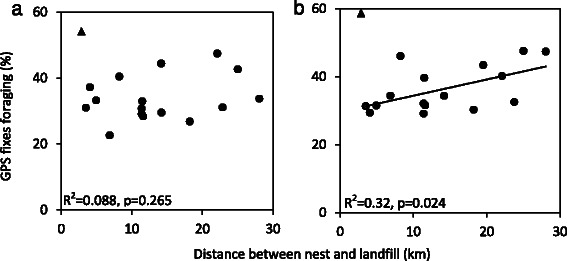
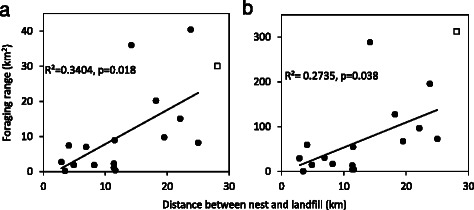
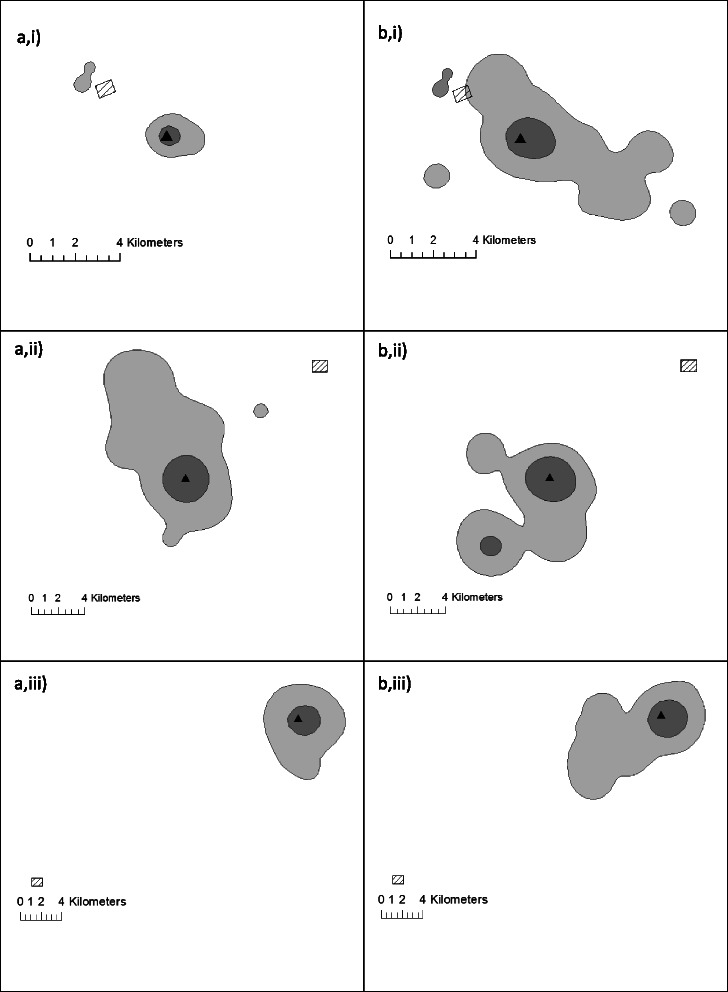
Verification
Claims the paper makes
The claims and statistics of this paper haven’t been checked yet.
Run the check — free, no account needed. It reads the open-access text and checks the sources it cites.
Claims other papers make about this one
Each is checked against this paper’s own text: does it say what the citing paper says it does?
The source backs part of the claim, not all of it — or backs it for a different population, condition or comparison.
In the citing paper
“For other species, predictable food resources have encouraged residency (e.g., [16,53,54]).”
From Seasonal activity levels of a farm-island population of striated caracaras (Phalcoboenus australis) in the Falkland Islands (2020) · cites this paper as [16]
Experimental — accuracy not yet measured
Self-check
Percentages, sums and reported differences re-computed from the paper’s own numbers.
The self-check needs the paper’s full text.
Citations
Cites
Ecological responses to recent climate change.
Walther, G.-R., Post, E., Convey, P., Menzel, A., Parmesan, C., Beebee, T. J. C., Fromentin, J.-M., Hoegh-Guldberg, O., & Bairlein, F. (2002) · Nature · doi:10.1038/416389a · Cited by 9,975
A Simple Generalisation of the Area Under the ROC Curve for Multiple Class Classification Problems
Hand, D. J., & Till, R. J. (2001) · Machine Learning · doi:10.1023/a:1010920819831 · Cited by 2,276
Population Limitation in Birds
(1998) · Elsevier eBooks · doi:10.1016/b978-0-12-517365-0.x5000-5 · Cited by 1,883
Ecological and evolutionary implications of food subsidies from humans
Oró, D., Genovart, M., Tavecchia, G., Fowler, M. S., & Martínez‐Abraín, A. (2013) · Ecology Letters · doi:10.1111/ele.12187 · Cited by 892
The ecology and evolution of partial migration
Chapman, B. B., Brönmark, C., Nilsson, J., & Hansson, L. (2011) · Oikos · doi:10.1111/j.1600-0706.2011.20131.x · Cited by 802
Both, C., van Turnhout, C. A. M., Bijlsma, R. G., Siepel, H., Strien, A. J. V., & Foppen, R. (2009) · Proceedings of the Royal Society B Biological Sciences · doi:10.1098/rspb.2009.1525 · Cited by 635
The timing of birds' breeding seasons: a review of experiments that manipulated timing of breeding
Verhulst, S., & Nilsson, J. (2008) · Philosophical Transactions of the Royal Society B: Biological Sciences · doi:10.1098/rstb.2007.2146 · Cited by 616
Avian productivity in urban landscapes: a review and meta‐analysis
Chamberlain, D., CANNON, A. R., Toms, M. P., Leech, D. I., Hatchwell, B. J., & Gaston, K. J. (2008) · Ibis · doi:10.1111/j.1474-919x.2008.00899.x · Cited by 583
Avian migration phenology and global climate change
Cotton, P. A. (2003) · Proceedings of the National Academy of Sciences · doi:10.1073/pnas.1930548100 · Cited by 553
Arrival timing and seasonal reproductive performance in a long-distance migratory landbird
Smith, R. J., & Moore, F. R. (2004) · Behavioral Ecology and Sociobiology · doi:10.1007/s00265-004-0855-9 · Cited by 428
Research works printed but not linked: 5
- Peris SJ. Feeding in urban refuse dumps: Ingestion of plastic objects by the white stork (Ciconia ciconia). Ardeola. 2003;50:81–4.
- Onrubia A, Martín B, De la Cruz A, Ferrer M. La migración de las aves planeadoras por el Estrecho de Gibraltar: magnitud, tendencias e implicaciones de conservación. Madrid: Actas XXII Congreso Español de Ornitología; 2014.
- Kosiki J, Sparks T, Tryjanowski P. Does arrival date influence autumn departure of the white stork Ciconia ciconia? Ornis Fenn. 2004;81:91–5.
- Moritzi M, Maumary L, Schmid D, Steiner I, Vallotton L, Spaar R, et al. Time budget, habitat use and breeding success of white storks Ciconia ciconia under variable foraging conditions during the breeding season in Switzerland. Ardea. 2001;89:457–70.
- (PERSU II) Ministério do Ambiente do Ordenamento do Territorio e do Desenvolvimento Regional. 1st edition 2007 Deposito legal no. 255 244/07.
Cited by
Sorted by citations
Environmental Predictability as a Cause and Consequence of Animal Movement
Riotte‐Lambert, L., & Matthiopoulos, J. (2019) · Trends in Ecology & Evolution · doi:10.1016/j.tree.2019.09.009 · Cited by 257
How are garbage dumps impacting vertebrate demography, health, and conservation?
Plaza, P. I., & Lambertucci, S. A. (2017) · Global Ecology and Conservation · doi:10.1016/j.gecco.2017.08.002 · Cited by 263
A 2017 Horizon Scan of Emerging Issues for Global Conservation and Biological Diversity
Sutherland, W. J., Barnard, P., Broad, S., Clout, M. N., Connor, B., Côté, I. M., Dicks, L. V., Doran, H., Entwistle, A. C., Fleishman, E., et al. (2016) · Trends in Ecology & Evolution · doi:10.1016/j.tree.2016.11.005 · Cited by 140
Energy efficiency drives the global seasonal distribution of birds
Somveille, M., Rodrigues, A. S. L., & Manica, A. (2018) · Nature Ecology & Evolution · doi:10.1038/s41559-018-0556-9 · Cited by 109
Berger‐Tal, O., & Saltz, D. (2019) · Philosophical Transactions of the Royal Society B Biological Sciences · doi:10.1098/rstb.2018.0049 · Cited by 100
Multidimensional nutritional ecology and urban birds
Coogan, S. C. P., Raubenheimer, D., Zantis, S. P., & Machovsky‐Capuska, G. E. (2018) · Ecosphere · doi:10.1002/ecs2.2177 · Cited by 79
Plastic ingestion in aquatic birds in Portugal.
Basto, M., Nicastro, K., Tavares, A. I., McQuaid, C., Casero, M., Azevedo, F., & Zardi, G. (2019) · Marine Pollution Bulletin · doi:10.1016/j.marpolbul.2018.11.024 · Cited by 62
“Closer‐to‐home” strategy benefits juvenile survival in a long‐distance migratory bird
Cheng, Y., Fiedler, W., Wikelski, M. C., & Flack, A. (2019) · Ecology and Evolution · doi:10.1002/ece3.5395 · Cited by 77
Becker, D. J., Streicker, D. G., & Altizer, S. (2017) · Journal of Animal Ecology · doi:10.1111/1365-2656.12765 · Cited by 77
Somveille, M., Manica, A., & Rodrigues, A. S. L. (2018) · Ecography · doi:10.1111/ecog.03531 · Cited by 72
Murray, M. H., Kidd, A. D., Curry, S. E., Hepinstall‐Cymerman, J., Yabsley, M. J., Adams, H., Ellison, T. J., Welch, C. N., & Hernandez, S. M. (2018) · Philosophical Transactions of the Royal Society B Biological Sciences · doi:10.1098/rstb.2017.0100 · Cited by 69
Jagiello, Z. A., Dylewski, Ł., Winiarska, D., Żołnierowicz, K., & Tobółka, M. (2018) · Environmental science and pollution research international · doi:10.1007/s11356-018-1626-x · Cited by 64
Effects of urbanization on bird migration
Bonnet‐Lebrun, A., Manica, A., & Rodrigues, A. S. L. (2020) · Biological Conservation · doi:10.1016/j.biocon.2020.108423 · Cited by 67
Large birds travel farther in homogeneous environments
Tucker, M. A., Αλεξάνδρου, Ό., Bierregaard, R. O., Bildstein, K. L., Böhning‐Gaese, K., Bracis, C., Brzorad, J. N., Buechley, E. R., Cabot, D., Calabrese, J. M., et al. (2019) · Global Ecology and Biogeography · doi:10.1111/geb.12875 · Cited by 66
Self-citationTongue, A. D. W., Reynolds, S. J., Fernie, K. J., & Harrad, S. (2019) · Environmental Pollution · doi:10.1016/j.envpol.2019.01.103 · Cited by 64
Individual environmental niches in mobile organisms
Carlson, B., Rotics, S., Nathan, R., Wikelski, M. C., & Jetz, W. (2021) · Nature Communications · doi:10.1038/s41467-021-24826-x · Cited by 61
Feathered Detectives: Real-Time GPS Tracking of Scavenging Gulls Pinpoints Illegal Waste Dumping
Navarro, J., Grémillet, D., Afán, I., Ramı́rez, F., Bouten, W., & Forero, M. G. (2016) · PLoS ONE · doi:10.1371/journal.pone.0159974 · Cited by 60
Urban food subsidies reduce natural food limitations and reproductive costs for a wetland bird
Evans, B. A., & Gawlik, D. E. (2020) · Scientific Reports · doi:10.1038/s41598-020-70934-x · Cited by 57
Drivers of power line use by white storks: A case study of birds nesting on anthropogenic structures
Moreira, F., Martins, R. C., Catry, I., & D’Amico, M. (2018) · Journal of Applied Ecology · doi:10.1111/1365-2664.13149 · Cited by 55
Self-citationHow will climate change affect endangered Mediterranean waterbirds?
Ramı́rez, F., Rodríguez, C., Seoane, J., Figuerola, J., & Bustamante, J. (2018) · PLoS ONE · doi:10.1371/journal.pone.0192702 · Cited by 57
Urban birds: An important source of antimicrobial resistant Salmonella strains in Central Spain
Martín‐Maldonado, B., Vega, S., Mencía-Gutiérrez, A., Lorenzo-Rebenaque, L., de Frutos, C., González, F., Revuelta, L., & Marín, C. (2020) · Comparative Immunology Microbiology and Infectious Diseases · doi:10.1016/j.cimid.2020.101519 · Cited by 53
Responses of migratory species and their pathogens to supplemental feeding
Satterfield, D. A., Marra, P. P., Sillett, T. S., & Altizer, S. (2018) · Philosophical Transactions of the Royal Society B Biological Sciences · doi:10.1098/rstb.2017.0094 · Cited by 54
Lopes, C., Paiva, V., Vaz, P. T., de Faria, J. P., Calado, J. G., Pereira, J., & Ramos, J. (2021) · Environmental science and pollution research international · doi:10.1007/s11356-020-12161-5 · Cited by 45
The conservation of Afro‐Palaearctic migrants: What we are learning and what we need to know?
Vickery, J. A., Mallord, J. W., Adams, W. M., Beresford, A. E., Both, C., Cresswell, W. R., Diop, N., Ewing, S. R., Gregory, R. D., Morrison, C. A., et al. (2023) · Ibis · doi:10.1111/ibi.13171 · Cited by 55
Real, E., Oró, D., Martínez‐Abraín, A., Igual, J. M., Bertolero, A., Bosch, M., & Tavecchia, G. (2017) · Journal of Avian Biology · doi:10.1111/jav.01454 · Cited by 47
Soriano‐Redondo, A., Franco, A. M. A., Acácio, M., Martins, B., Moreira, F., & Catry, I. (2021) · The Science of The Total Environment · doi:10.1016/j.scitotenv.2021.146843 · Cited by 47
Self-citationThabethe, V., & Downs, C. T. (2018) · Urban Ecosystems · doi:10.1007/s11252-018-0774-6 · Cited by 46
Plastic ingestion in aquatic-associated bird species in southern Portugal
Nicastro, K. R., Savio, R. L., McQuaid, C. D., Madeira, P. M., Valbusa, U., Azevedo, F., Casero, M., Lourenço, C. R., & Zardi, G. I. (2017) · Marine Pollution Bulletin · doi:10.1016/j.marpolbul.2017.11.050 · Cited by 43
Testing alternative methods for estimation of bird migration phenology from GPS tracking data
Soriano‐Redondo, A., Acácio, M., Franco, A. M. A., Martins, B., Moreira, F., Rogerson, K. F., & Catry, I. (2019) · Ibis · doi:10.1111/ibi.12809 · Cited by 41
Self-citationHöfle, Ú., González‐López, J. J., Camacho, M. C., Solà-Ginés, M., MORENO, A. J., Hernández, J. M., de la Puente, J., Pineda‐Pampliega, J., Aguirre, J. I., Torres‐Medina, F., et al. (2020) · Frontiers in Microbiology · doi:10.3389/fmicb.2020.01397 · Cited by 43
Pineda‐Pampliega, J., Ramiro, Y., Herrera-Dueñas, A., Martínez-Haro, M., Hernández, J. M., Aguirre, J. I., & Höfle, Ú. (2021) · The Science of The Total Environment · doi:10.1016/j.scitotenv.2021.145197 · Cited by 43
Białas, J. T., Dylewski, Ł., & Tobółka, M. (2019) · Environmental Science and Pollution Research · doi:10.1007/s11356-019-06639-0 · Cited by 41
White stork movements reveal the ecological connectivity between landfills and different habitats
López‐Calderón, C., Martín‐Vélez, V., Blas, J., Höfle, Ú., Sánchez, M. I., Flack, A., Fiedler, W., Wikelski, M. C., & Green, A. J. (2023) · Movement Ecology · doi:10.1186/s40462-023-00380-7 · Cited by 39
Arizaga, J., Resano‐Mayor, J., Villanúa, D., Alonso, D., Barbarin, J. M., Herrero, A., Lekuona, J. M., & Rodríguez, R. A. (2017) · Ibis · doi:10.1111/ibi.12566 · Cited by 39
Understanding and predicting animal movements and distributions in the Anthropocene
Gomez, S., English, H. M., Alegre, V. B., Blackwell, P. G., Bracken, A. M., Bray, E., Evans, L. C., Gan, J. L., Grecian, W. J., Roberts, C. G., et al. (2025) · Journal of Animal Ecology · doi:10.1111/1365-2656.70040 · Cited by 49
Freedman, M. G., Dingle, H., Strauss, S. Y., & Ramírez, S. R. (2020) · Proceedings of the National Academy of Sciences · doi:10.1073/pnas.2001283117 · Cited by 37
PAH and POP Presence in Plastic Waste and Recyclates: State of the Art
Conesa, J. A., Núñez, S. S., Ortuño, N., & Moltó, J. (2021) · Energies · doi:10.3390/en14123451 · Cited by 37
Clermont, J., Grenier‐Potvin, A., Duchesne, É., Couchoux, C., Broin, F. D., Beardsell, A., Bêty, J., & Berteaux, D. (2021) · Ecosphere · doi:10.1002/ecs2.3858 · Cited by 35
Martín‐Maldonado, B., Rodríguez-Alcázar, P., Fernández-Novo, A., González, F., Pastor, N., López, I., Suárez, L., Moraleda, V., & Aranaz, A. (2022) · Animals · doi:10.3390/ani12192714 · Cited by 35
R package for animal behavior classification from accelerometer data—rabc
Yu, H., & Klaassen, M. (2021) · Ecology and Evolution · doi:10.1002/ece3.7937 · Cited by 34
Acácio, M., Atkinson, P. W., Silva, J. P., & Franco, A. M. A. (2022) · PLoS ONE · doi:10.1371/journal.pone.0265541 · Cited by 34
Self-citationLópez‐García, A., Sanz‐Aguilar, A., & Aguirre, J. I. (2021) · The Science of The Total Environment · doi:10.1016/j.scitotenv.2021.146217 · Cited by 31
Białas, J. T., Dylewski, Ł., Dylik, A., Janiszewski, T., Kaługa, I., Królak, T., Kruszyk, R., Pawlukojć, K., Pestka, Z., Polakowski, M., et al. (2021) · Scientific Reports · doi:10.1038/s41598-021-86529-z · Cited by 31
Urban specialization reduces habitat connectivity by a highly mobile wading bird
Teitelbaum, C. S., Hepinstall‐Cymerman, J., Kidd, A. D., Hernandez, S. M., Altizer, S., & Hall, R. J. (2020) · Movement Ecology · doi:10.1186/s40462-020-00233-7 · Cited by 32
Noreen, Z. (2020) · Pure and Applied Biology · doi:10.19045/bspab.2021.100062 · Cited by 30
The significance of partial migration for food web and ecosystem dynamics
Peller, T., Guichard, F., & Altermatt, F. (2022) · Ecology Letters · doi:10.1111/ele.14143 · Cited by 30
Becker, D. J., Snedden, C. E., Altizer, S., & Hall, R. J. (2018) · The American Naturalist · doi:10.1086/699477 · Cited by 29
Not just trash birds: Quantifying avian diversity at landfills using community science data
Arnold, Z. J., Wenger, S. J., & Hall, R. J. (2021) · PLoS ONE · doi:10.1371/journal.pone.0255391 · Cited by 28
Guil, F., Soria, M. Á., Margalida, A., & Pérez‐García, J. M. (2017) · The Science of The Total Environment · doi:10.1016/j.scitotenv.2017.12.242 · Cited by 31
Auteri, G. G. (2022) · Biology Letters · doi:10.1098/rsbl.2022.0050 · Cited by 27
Macronutrient selection of free-ranging urban Australian white ibis (Threskiornis moluccus)
Coogan, S. C. P., Machovsky‐Capuska, G. E., Senior, A. M., Martin, J. M., Major, R. E., & Raubenheimer, D. (2017) · Behavioral Ecology · doi:10.1093/beheco/arx060 · Cited by 26
Humans shape the year‐round distribution and habitat use of an opportunistic scavenger
Ramı́rez, F., Afán, I., Bouten, W., Carrasco, J. L., Forero, M. G., & Navarro, J. (2020) · Ecology and Evolution · doi:10.1002/ece3.6226 · Cited by 25
A comparative analysis of the behavioral response to fishing boats in two albatross species
Collet, J., Patrick, S. C., & Weimerskirch, H. (2017) · Behavioral Ecology · doi:10.1093/beheco/arx097 · Cited by 26
Demographic impact of landfill closure on a resident opportunistic gull
Delgado, S., Herrero, A., Galarza, A., Aldalur, A., Zorrozua, N., & Arizaga, J. (2021) · Population Ecology · doi:10.1002/1438-390x.12083 · Cited by 24
Biovectoring of plastic by white storks from a landfill to a complex of salt ponds and marshes
Cano-Povedano, J., López‐Calderón, C., Sánchez, M. I., Hortas, F., Cañuelo-Jurado, B., Martín‐Vélez, V., Ros, M., Cózar, A., & Green, A. J. (2023) · Marine Pollution Bulletin · doi:10.1016/j.marpolbul.2023.115773 · Cited by 24
Sangkachai, N., Gummow, B., Hayakijkosol, O., Suwanpakdee, S., & Wiratsudakul, A. (2024) · One Health · doi:10.1016/j.onehlt.2024.100915 · Cited by 29
Orłowski, G., Karg, J., Jerzak, L., Bocheński, M., Profus, P., Książkiewicz‐Parulska, Z., Zub, K., Ekner‐Grzyb, A., & Czarnecka, J. (2018) · The Science of The Total Environment · doi:10.1016/j.scitotenv.2018.07.297 · Cited by 23
Zorrozua, N., Egunez, A., Aldalur, A., Galarza, A., Diaz, B., Hidalgo, J., Jover, L., Sanpera, C., Castège, I., & Arizaga, J. (2020) · Journal of Zoology · doi:10.1111/jzo.12759 · Cited by 23
Yu, H., Deng, J., Leen, T., Li, G., & Klaassen, M. (2022) · Methods in Ecology and Evolution · doi:10.1111/2041-210x.13878 · Cited by 23
Acácio, M., Catry, I., Soriano‐Redondo, A., Silva, J. P., Atkinson, P. W., & Franco, A. M. A. (2022) · Movement Ecology · doi:10.1186/s40462-022-00328-3 · Cited by 22
Self-citationNutrient availability in urban food waste: carbohydrate bias in the Philadelphia–Camden urban matrix
Carpenter, M., & Savage, A. M. (2021) · Journal of Urban Ecology · doi:10.1093/jue/juab012 · Cited by 22
López‐García, A., & Aguirre, J. I. (2023) · Ornithological Applications · doi:10.1093/ornithapp/duad009 · Cited by 21
Seasonal niche tracking of climate emerges at the population level in a migratory bird
Fandós, G., Rotics, S., Sapir, N., Fiedler, W., Kaatz, M., Wikelski, M. C., Nathan, R., & Zurell, D. (2020) · Proceedings of the Royal Society B Biological Sciences · doi:10.1098/rspb.2020.1799 · Cited by 21
Sacristán‐Soriano, O., Jarma, D., Sánchez, M. I., Romero, N., Alonso, E., Green, A. J., Sànchez-Melsió, A., Hortas, F., Balcázar, J. L., Peralta‐Sánchez, J. M., et al. (2024) · The Science of The Total Environment · doi:10.1016/j.scitotenv.2024.169946 · Cited by 24
Bárbara, A., Torrontegi, O., Camacho, M., Barral, M., Hernández, J.-M., & Höfle, Ú. (2017) · Frontiers in Veterinary Science · doi:10.3389/fvets.2017.00178 · Cited by 19
Dini, B., Bennett, G. L., Franco, A. M. A., Whitworth, M. R. Z., Cook, K., Senn, A., & Reynolds, J. M. (2021) · Earth Surface Dynamics · doi:10.5194/esurf-9-295-2021 · Cited by 19
Self-citationWinter movement patterns of a globally endangered avian scavenger in south-western Europe
Morant, J., Abad‐Gómez, J. M., Álvarez, T., Sánchez, Á., Zuberogoitia, Í., & López‐López, P. (2020) · Scientific Reports · doi:10.1038/s41598-020-74333-0 · Cited by 19
Soriano‐Redondo, A., Franco, A. M. A., Acácio, M., Payo‐Payo, A., Martins, B., Moreira, F., & Catry, I. (2023) · Ecology · doi:10.1002/ecy.4151 · Cited by 18
Self-citationPartial migration in a subtropical wading bird in the southeastern United States
Picardi, S., Frederick, P. C., Borkhataria, R. R., & Basille, M. (2020) · Ecosphere · doi:10.1002/ecs2.3054 · Cited by 18
Vansteelant, W. M. G., Wehrmann, J., Engelen, D., Jansen, J., Verhelst, B. L., Benjumea, R., Cavaillès, S., Kaasiku, T., Hoekstra, B., & de Boer, F. K. (2019) · Ibis · doi:10.1111/ibi.12773 · Cited by 18
Kidd, A. D., Hepinstall‐Cymerman, J., Welch, C. N., Murray, M. H., Adams, H., Ellison, T. J., Yabsley, M. J., & Hernandez, S. M. (2020) · PLoS ONE · doi:10.1371/journal.pone.0230158 · Cited by 18
The influence of provisioning on animal‐mediated seed dispersal
Sengupta, A., McConkey, K. R., & Kwit, C. (2021) · Oikos · doi:10.1111/oik.08276 · Cited by 18
Santos, C. S. A., Brandão, R., Monteiro, M. S., Bastos, A. C., Soares, A. M. V. M., & Loureiro, S. (2016) · Ecotoxicology and Environmental Safety · doi:10.1016/j.ecoenv.2016.10.039 · Cited by 18
Public perceptions of an avian reintroduction aiming to connect people with nature
White, R. L., Jones, L. P., Groves, L., Hudson, M. A., Kennerley, R. J., & Crowley, S. L. (2023) · People and Nature · doi:10.1002/pan3.10538 · Cited by 16
Hmamouchi, M.-J., Agharroud, K., Dahmani, J., & Hanane, S. (2020) · Estuarine Coastal and Shelf Science · doi:10.1016/j.ecss.2020.106835 · Cited by 17
Martín, B., Onrubia, A., & Ferrer, M. (2021) · Birds · doi:10.3390/birds2040027 · Cited by 18
Sanitary Landfill Operation and Management
Kamaruddin, M. A., Norashiddin, F. A., Yusoff, M. S., Hanif, M. H. M., Wang, L. K., & Wang, M.-H. S. (2021) · Handbook of environmental engineering · doi:10.1007/978-3-030-84180-5_8 · Cited by 15
Blanco, G., Gómez‐Ramírez, P., Espín, S., Sánchez‐Virosta, P., Frías, Ó., & García-Fernández, A. J. (2023) · Antibiotics · doi:10.3390/antibiotics12030520 · Cited by 15
Gauld, J., Atkinson, P. W., Silva, J. P., Senn, A., & Franco, A. M. A. (2023) · Animal Biotelemetry · doi:10.1186/s40317-023-00329-y · Cited by 15
Self-citationResource predictability modulates spatial-use networks in an endangered scavenger species
Cerecedo-Iglesias, C., Bartumeus, F., Cortés‐Avizanda, A., Pretus, J. L., Hernández‐Matías, A., & Real, J. L. P. (2023) · Movement Ecology · doi:10.1186/s40462-023-00383-4 · Cited by 15
Movement rules determine nomadic species' responses to resource supplementation and degradation
Teitelbaum, C. S., Altizer, S., & Hall, R. J. (2020) · Journal of Animal Ecology · doi:10.1111/1365-2656.13318 · Cited by 14
Jain, V., Bugnyar, T., Cunningham, S. J., Gallego‐Abenza, M., Loretto, M., & Sumasgutner, P. (2022) · Movement Ecology · doi:10.1186/s40462-022-00335-4 · Cited by 14
Moreira, F., Martins, R. C., Aguilar, F. F., Canhoto, A., Martins, J., Moreira, J., & Bernardino, J. (2022) · Journal of Environmental Management · doi:10.1016/j.jenvman.2022.116897 · Cited by 14
Distance doesn't matter: migration strategy in a seabird has no effect on survival or reproduction
Kentie, R., Brown, J. M., Camphuysen, C. J., & Shamoun-Baranes, J. Z. (2023) · Proceedings of the Royal Society B Biological Sciences · doi:10.1098/rspb.2022.2408 · Cited by 14
Mammeria, A. B., Triplet, P., & Bitam, I. (2018) · Estuarine Coastal and Shelf Science · doi:10.1016/j.ecss.2018.01.001 · Cited by 14
Behavioural responses to human disturbance in an alpine bird
Vallino, C., Caprio, E., Fabrizio, G., Chamberlain, D., Palestrini, C., Roggero, A., Bocca, M., & Rolando, A. (2019) · Journal für Ornithologie · doi:10.1007/s10336-019-01660-z · Cited by 14
Harrington, K. J., Pole-Evans, S., Reeves, M., Bechard, M., Bobowski, M., Barber, D. R., Rexer-Huber, K., Lecomte, N., & Bildstein, K. L. (2018) · Movement Ecology · doi:10.1186/s40462-018-0122-8 · Cited by 13
Anthropogenic food subsidies reshape the migratory behaviour of a long-distance migrant
Marcelino, J., Franco, A. M. A., Acácio, M., Soriano‐Redondo, A., Moreira, F., & Catry, I. (2022) · The Science of The Total Environment · doi:10.1016/j.scitotenv.2022.159992 · Cited by 13
Self-citationAge mediates access to landfill food resources and foraging proficiency in a long-lived bird species
Martins, B., Soriano‐Redondo, A., Franco, A. M. A., & Catry, I. (2023) · Animal Behaviour · doi:10.1016/j.anbehav.2023.10.011 · Cited by 13
Self-citationKota, T. A. W. A., & Sagawa, S. (2020) · Journal für Ornithologie · doi:10.1007/s10336-020-01806-4 · Cited by 13
Stable prevalence of Coxiella burnetii in wildlife after a decade of surveillance in northern Spain
Zendoia, I. I., Cevidanes, A., Hurtado, A., Vázquez, P., Barral, M., Barandika, J. F., & García-Pérez, A. L. (2022) · Veterinary Microbiology · doi:10.1016/j.vetmic.2022.109422 · Cited by 13
A death trap in the nest: anthropogenic nest materials cause high mortality in a terrestrial bird
Heinze, U. M., Acácio, M., Franco, A. M. A., & Catry, I. (2025) · Ecological Indicators · doi:10.1016/j.ecolind.2025.113796 · Cited by 12
Self-citationMartínez-Álvarez, S. A., Höfle, Ú., Châtre, P., Alonso, C. A., Asencio-Egea, M. Á., François, P., Cardona-Cabrera, T., Zarazaga, M., Madec, J.-Y., Haenni, M., et al. (2024) · Journal of Antimicrobial Chemotherapy · doi:10.1093/jac/dkae371 · Cited by 12
Lamb, J. S., Fiorello, C. V., Satgé, Y. G., Mills, K. L., Ziccardi, M. H., & Jodice, P. G. R. (2018) · Marine Pollution Bulletin · doi:10.1016/j.marpolbul.2018.03.043 · Cited by 12
Exploring intraspecific variation in migratory destinations to investigate the drivers of migration
Bonnet‐Lebrun, A., Somveille, M., Rodrigues, A. S. L., & Manica, A. (2020) · Oikos · doi:10.1111/oik.07689 · Cited by 12
Mayall, E., Groves, L., Kennerley, R. J., Hudson, M., & Franco, A. M. A. (2023) · Bird Conservation International · doi:10.1017/s0959270922000466 · Cited by 12
Self-citationBurdett, E. M., Muriel, R., Morandini, V., Kolnegari, M., & Ferrer, M. (2022) · Diversity · doi:10.3390/d14110984 · Cited by 12
Bastard, J., Gregory, N., Fernández, M. D. P., Mincone, M., Card, O., VanAcker, M. C., Kross, S. M., & Diuk‐Wasser, M. A. (2024) · Ecosphere · doi:10.1002/ecs2.4957 · Cited by 11
Athamnia, M., Belabed, B.-E., Samraoui, K. R., Boucheker, A., Touati, L., Samraoui, F., El‐Serehy, H. A., & Samraoui, B. (2022) · Frontiers in Ecology and Evolution · doi:10.3389/fevo.2022.841744 · Cited by 11
Seabirds as samplers of the marine environment – a case study of northern gannets
Garthe, S., Peschko, V., Kubetzki, U., & Corman, A. (2017) · Ocean science · doi:10.5194/os-13-337-2017 · Cited by 11
Metadata
- Authors
- Gilbert, N. I., Correia, R. A., Silva, J. P., Pacheco, C., Catry, I., Atkinson, P. W., Gill, J. A., & Franco, A. M. A.
- Affiliations
- University of East Anglia (GB)
- University of Lisbon (PT)
- British Trust for Ornithology (GB)
- Corresponding author
- Gilbert, Nathalie I.
- ORCID
- Venue
- Movement Ecology
- Published
- 2016-03-15
- Volume
- 4
- Issue
- 1
- Pages
- 7-7
- ISSN
- 2051-3933 (ISSN-L)
- PMC
- PMC4791752
- OpenAlex
- W2302520141
- Cited by
- 217
- References
- 36
- Citations by year
- 2026: 17 · 2025: 22 · 2024: 21 · 2023: 25 · 2022: 26 · 2021: 27 · 2020: 25 · 2019: 14 · 2018: 24 · 2017: 13 · 2016: 3
- FWCI
- 15.74
- Type
- journal article
- Language
- en
- Open access
- gold
- doi.org
- Licence
- cc-by
- Locations
- Movement Ecology (publishedVersion, cc-by)
- PubMed Central (publishedVersion, cc-by)
- PubMed (publishedVersion)
- UEA Digital Repository (University of East Anglia) (acceptedVersion)
- Funders
- Natural Environment Research Council (T12314.ENV.R.AS.)
- Topics
- Physical Sciences › Environmental Science › Ecology › Avian ecology and behavior
- Physical Sciences › Environmental Science › Ecology › Wildlife Ecology and Conservation
- Physical Sciences › Environmental Science › Ecology › Animal Ecology and Behavior Studies
- Keywords
- white stork, resident population, foraging behavior, home range, movement behavior, non-breeding season, landfill closure, Iberia
About these checks
Registry, retraction, Cites and statistics results are computed, not judged, with one exception: a printed reference that no index lists is read once by a model before it counts as a citation error. Claims are extracted by a model and kept only when their quote appears verbatim in the text; each cited source is then checked, with a model’s help, for whether it says what the claim relies on. Those verdicts can be wrong — read the claim’s quote and the cited source before relying on one.
Statistics and arithmetic are recomputed, not judged.
Confidence bands are shown only for fields calibrated on our annotated test set. None is calibrated yet, so no band is shown.
What counts as a claim ›How we measure confidence ›How we check this ›
Are you an author, or do you see a problem with this page? Request a review
