

The DOI matches its Crossref record; 35 of the 36 references it cites were found in a registry or an index.
Are white storks addicted to junk food? Impacts of landfill use on the movement and behaviour of resident white storks (Ciconia ciconia) from a partially migratory population
Open accessAbstract
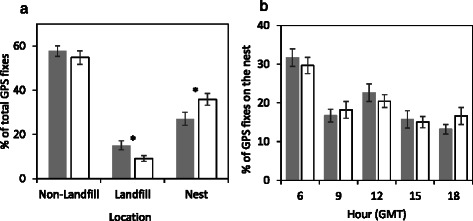
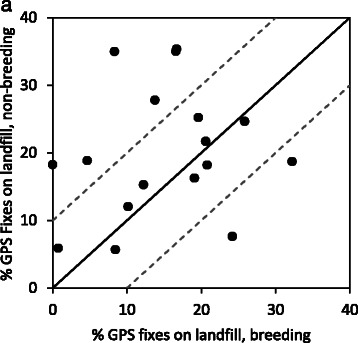
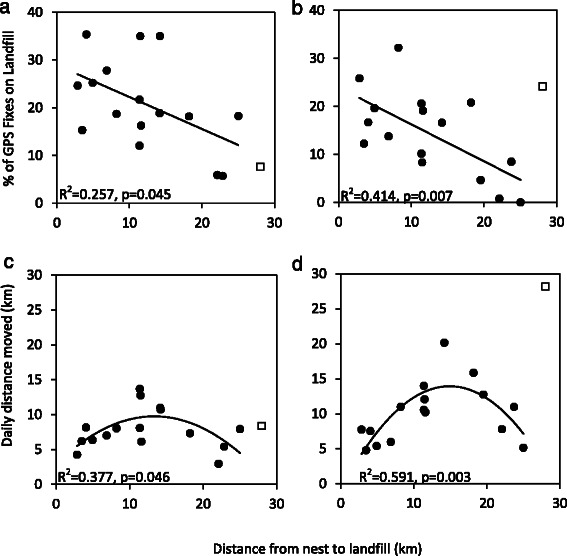
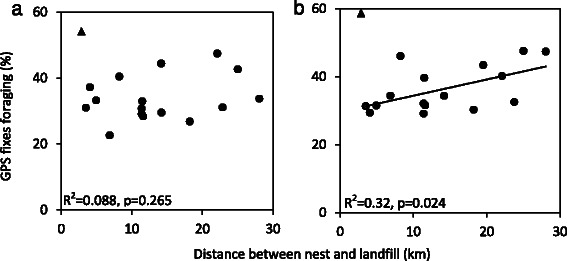
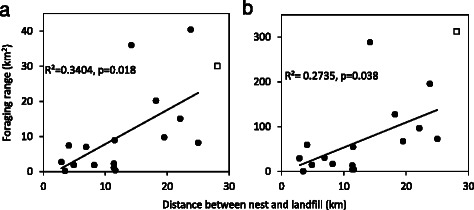
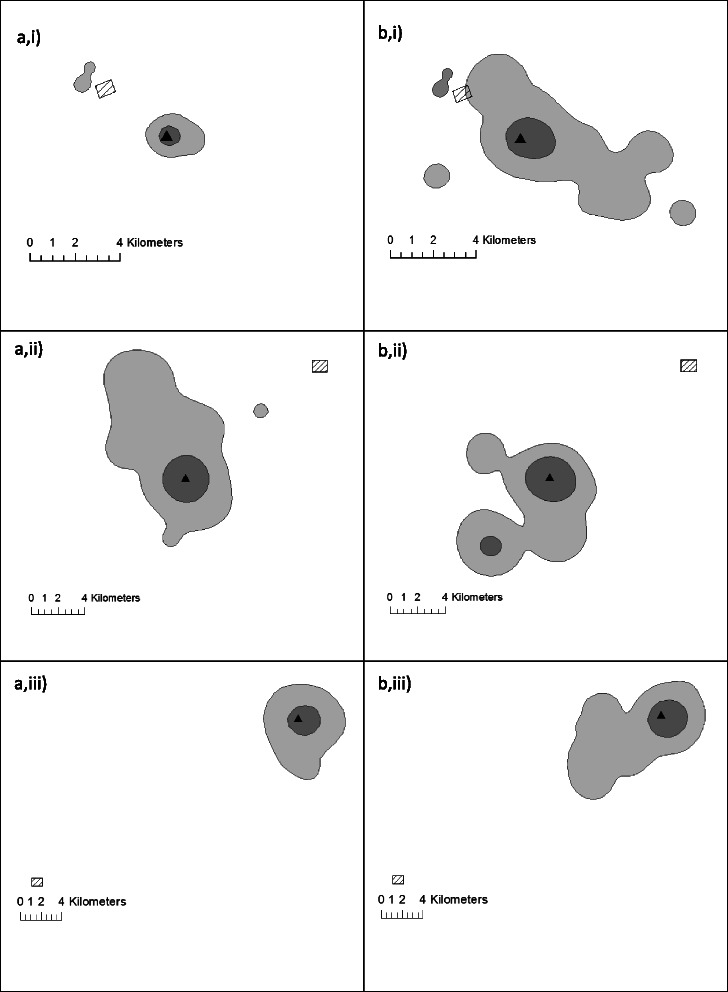
BACKGROUND: The migratory patterns of animals are changing in response to global environmental change with many species forming resident populations in areas where they were once migratory. The white stork (Ciconia ciconia) was wholly migratory in Europe but recently guaranteed, year-round food from landfill sites has facilitated the establishment of resident populations in Iberia. In this study 17 resident white storks were fitted with GPS/GSM data loggers (including accelerometer) and tracked for 9.1 ± 3.7 months to quantify the extent and consistency of landfill attendance by individuals during the non-breeding and breeding seasons and to assess the influence of landfill use on daily distances travelled, percentage of GPS fixes spent foraging and non-landfill foraging ranges. RESULTS: Resident white storks used landfill more during non-breeding (20.1 % ± 2.3 of foraging GPS fixes) than during breeding (14.9 % ± 2.2). Landfill attendance declined with increasing distance between nest and landfill in both seasons. During non-breeding a large percentage of GPS fixes occurred on the nest throughout the day (27 % ± 3.0 of fixes) in the majority of tagged storks. This study provides first confirmation of year-round nest use by resident white storks. The percentage of GPS fixes on the nest was not influenced by the distance between nest and the landfill site. Storks travelled up to 48.2 km to visit landfills during non-breeding and a maximum of 28.1 km during breeding, notably further than previous estimates. Storks nesting close to landfill sites used landfill more and had smaller foraging ranges in non-landfill habitat indicating higher reliance on landfill. The majority of non-landfill foraging occurred around the nest and long distance trips were made specifically to visit landfill. CONCLUSIONS: The continuous availability of food resources on landfill has facilitated year-round nest use in white storks and is influencing their home ranges and movement behaviour. White storks rely on landfill sites for foraging especially during the non-breeding season when other food resources are scarcer and this artificial food supplementation probably facilitated the establishment of resident populations. The closure of landfills, as required by EU Landfill Directives, will likely cause dramatic impacts on white stork populations.
Overview
The claims and statistics of this paper haven’t been checked yet.
Run the check — free, no account needed. It reads the open-access text and checks the sources it cites.
Integrity signals
Registry
Cites
Statistics
Figures
Verification
Claims the paper makes
The claims and statistics of this paper haven’t been checked yet.
Run the check — free, no account needed. It reads the open-access text and checks the sources it cites.
Claims other papers make about this one
Each is checked against this paper’s own text: does it say what the citing paper says it does?
The source backs part of the claim, not all of it — or backs it for a different population, condition or comparison.
In the citing paper
“For other species, predictable food resources have encouraged residency (e.g., [16,53,54]).”
From Seasonal activity levels of a farm-island population of striated caracaras (Phalcoboenus australis) in the Falkland Islands (2020) · cites this paper as [16]
Experimental — accuracy not yet measured
Self-check
Percentages, sums and reported differences re-computed from the paper’s own numbers.
The self-check needs the paper’s full text.
Citations
Cites
Ecological responses to recent climate change.
Walther, G.-R., Post, E., Convey, P., Menzel, A., Parmesan, C., Beebee, T. J. C., Fromentin, J.-M., Hoegh-Guldberg, O., & Bairlein, F. (2002) · Nature · doi:10.1038/416389a · Cited by 9,975
A Simple Generalisation of the Area Under the ROC Curve for Multiple Class Classification Problems
Hand, D. J., & Till, R. J. (2001) · Machine Learning · doi:10.1023/a:1010920819831 · Cited by 2,276
Population Limitation in Birds
(1998) · Elsevier eBooks · doi:10.1016/b978-0-12-517365-0.x5000-5 · Cited by 1,883
Ecological and evolutionary implications of food subsidies from humans
Oró, D., Genovart, M., Tavecchia, G., Fowler, M. S., & Martínez‐Abraín, A. (2013) · Ecology Letters · doi:10.1111/ele.12187 · Cited by 892
The ecology and evolution of partial migration
Chapman, B. B., Brönmark, C., Nilsson, J., & Hansson, L. (2011) · Oikos · doi:10.1111/j.1600-0706.2011.20131.x · Cited by 802
Both, C., van Turnhout, C. A. M., Bijlsma, R. G., Siepel, H., Strien, A. J. V., & Foppen, R. (2009) · Proceedings of the Royal Society B Biological Sciences · doi:10.1098/rspb.2009.1525 · Cited by 635
The timing of birds' breeding seasons: a review of experiments that manipulated timing of breeding
Verhulst, S., & Nilsson, J. (2008) · Philosophical Transactions of the Royal Society B: Biological Sciences · doi:10.1098/rstb.2007.2146 · Cited by 616
Avian productivity in urban landscapes: a review and meta‐analysis
Chamberlain, D., CANNON, A. R., Toms, M. P., Leech, D. I., Hatchwell, B. J., & Gaston, K. J. (2008) · Ibis · doi:10.1111/j.1474-919x.2008.00899.x · Cited by 583
Avian migration phenology and global climate change
Cotton, P. A. (2003) · Proceedings of the National Academy of Sciences · doi:10.1073/pnas.1930548100 · Cited by 553
Arrival timing and seasonal reproductive performance in a long-distance migratory landbird
Smith, R. J., & Moore, F. R. (2004) · Behavioral Ecology and Sociobiology · doi:10.1007/s00265-004-0855-9 · Cited by 428
Monsarrat, S., Benhamou, S., Sarrazin, F., Bessa‐Gomes, C., Bouten, W., & Duriez, O. (2013) · PLoS ONE · doi:10.1371/journal.pone.0053077 · Cited by 206
Effect of Rubbish Dumps on Breeding Success in the White Stork in Southern Spain
Tortosa, F. S., Caballero, J. M., & Reyes-López, J. L. (2002) · Waterbirds · doi:10.1675/1524-4695(2002)025[0039:eordob]2.0.co;2 · Cited by 147
Climate change and bird phenology: a long‐term study in the Iberian Peninsula
Gordo, Ò., & Sanz, J. J. (2006) · Global Change Biology · doi:10.1111/j.1365-2486.2006.01178.x · Cited by 133
The paradox of spoonbill migration: most birds travel to where survival rates are lowest
Lok, T., Overdijk, O., Tinbergen, J. M., & Piersma, T. (2011) · Animal Behaviour · doi:10.1016/j.anbehav.2011.07.019 · Cited by 96
The effect of migration strategy and food availability on White StorkCiconia ciconiabreeding success
Massemin, S., Gendner, J., SAMTMANN, S., Pichegru, L., WULGUÉ, A., & Maho, Y. L. (2006) · Ibis · doi:10.1111/j.1474-919x.2006.00550.x · Cited by 84
Habitat selection by foraging White Storks, Ciconia ciconia, during the breeding season
Alonso, J. C., Alonso, J. A., & Carrascal, L. M. (1991) · Canadian Journal of Zoology · doi:10.1139/z91-270 · Cited by 83
Do White StorksCiconia ciconiaalways profit from an early return to their breeding grounds?
Tryjanowski, P., Sparks, T. H., Ptaszyk, J., & Kosicki, J. Z. (2004) · Bird Study · doi:10.1080/00063650409461357 · Cited by 76
Effect of food abundance on laying date and clutch size in the White StorkCiconia ciconia
Tortosa, F. S., Pérez‐Rodríguez, L., & Hillström, L. (2003) · Bird Study · doi:10.1080/00063650309461302 · Cited by 68
Berthold, P. R., BOSSCHE, W. V. D., Jakubiec, Z., Kaatz, C., Kaatz, M., & Querner, U. (2002) · Journal für Ornithologie · doi:10.1007/bf02465604 · Cited by 67
Nonlinear impact of climate on survival in a migratory white stork population
Nevoux, M., Barbraud, J., & Barbraud, C. (2008) · Journal of Animal Ecology · doi:10.1111/j.1365-2656.2008.01435.x · Cited by 62
Population Dynamics and Communal Roosting of White Storks Foraging at a Spanish Refuse Dump
Blanco, G. (1996) · Colonial Waterbirds · doi:10.2307/1521871 · Cited by 62
White Storks, Ciconia ciconia, forage on rubbish dumps in Poland—a novel behaviour in population
Kruszyk, R., & Ciach, M. (2009) · European Journal of Wildlife Research · doi:10.1007/s10344-009-0313-0 · Cited by 53
Vergara, P., Gordo, Ò., & Aguirre, J. I. (2010) · Annales Zoologici Fennici · doi:10.5735/086.047.0303 · Cited by 52
How Is the Diet of Yellow-legged Gull Chicks Influenced by Parents’ Accessibility to Landfills?
Duhem, C., Vidal, É., Roche, P. K., & Legrand, J. (2005) · Waterbirds · doi:10.1675/1524-4695(2005)028[0046:hitdoy]2.0.co;2 · Cited by 47
Pons, J. (1994) · Ethology Ecology & Evolution · doi:10.1080/08927014.1994.9523003 · Cited by 35
Spatial patterns of white stork (Ciconia ciconia) migratory phenology in the Iberian Peninsula
Gordo, Ò., Sanz, J. J., & Lobo, J. M. (2007) · Journal für Ornithologie · doi:10.1007/s10336-007-0132-6 · Cited by 33
Impact of Supplementary Feeding on Reproductive Success of White Storks
Hilgartner, R., Stahl, D. R., & Zinner, D. P. (2014) · PLoS ONE · doi:10.1371/journal.pone.0104276 · Cited by 30
Wild bird feeding delays start of dawn singing in the great tit
Saggese, K., Korner‐Nievergelt, F., Slagsvold, T., & Amrhein, V. (2010) · Animal Behaviour · doi:10.1016/j.anbehav.2010.11.008 · Cited by 30
Tryjanowski, P., & Sparks, T. H. (2008) · Acta Oecologica · doi:10.1016/j.actao.2007.10.010 · Cited by 27
Kosicki, J. Z. (2010) · Ardeola · Cited by 26
Sexing of white storks Ciconia ciconia based on biometric measurements
Ćwiertnia, P., Kwieciński, Z., Kwiecinska, H., Wysocki, A., Tryjanowski, P., & Olsson, O. (2006) · Lund University Publications (Lund University) · Cited by 8
Recent changes in bird migrations
Newton, I. (2007) · Elsevier eBooks · doi:10.1016/b978-012517367-4.50021-8 · Cited by 8
High turnover and moderate fidelity of White StorksCiconia ciconiaat a European wintering site
Archaux, F., Henry, P., & Balança, G. (2008) · Ibis · doi:10.1111/j.1474-919x.2007.00798.x · Cited by 6
Population limitation – breeding and wintering areas
Newton, I. (2007) · Elsevier eBooks · doi:10.1016/b978-012517367-4.50026-7 · Cited by 2
Evaluation of the exploitation potential of red swamp crayfish (Procambarus clarkii) in Portugal
de Almeida, P. R. C. M. (2013) · Cited by 1
Research works printed but not linked: 5
- Peris SJ. Feeding in urban refuse dumps: Ingestion of plastic objects by the white stork (Ciconia ciconia). Ardeola. 2003;50:81–4.
- Onrubia A, Martín B, De la Cruz A, Ferrer M. La migración de las aves planeadoras por el Estrecho de Gibraltar: magnitud, tendencias e implicaciones de conservación. Madrid: Actas XXII Congreso Español de Ornitología; 2014.
- Kosiki J, Sparks T, Tryjanowski P. Does arrival date influence autumn departure of the white stork Ciconia ciconia? Ornis Fenn. 2004;81:91–5.
- Moritzi M, Maumary L, Schmid D, Steiner I, Vallotton L, Spaar R, et al. Time budget, habitat use and breeding success of white storks Ciconia ciconia under variable foraging conditions during the breeding season in Switzerland. Ardea. 2001;89:457–70.
- (PERSU II) Ministério do Ambiente do Ordenamento do Territorio e do Desenvolvimento Regional. 1st edition 2007 Deposito legal no. 255 244/07.
Cited by
Sorted by citations
Environmental Predictability as a Cause and Consequence of Animal Movement
Riotte‐Lambert, L., & Matthiopoulos, J. (2019) · Trends in Ecology & Evolution · doi:10.1016/j.tree.2019.09.009 · Cited by 257
How are garbage dumps impacting vertebrate demography, health, and conservation?
Plaza, P. I., & Lambertucci, S. A. (2017) · Global Ecology and Conservation · doi:10.1016/j.gecco.2017.08.002 · Cited by 263
A 2017 Horizon Scan of Emerging Issues for Global Conservation and Biological Diversity
Sutherland, W. J., Barnard, P., Broad, S., Clout, M. N., Connor, B., Côté, I. M., Dicks, L. V., Doran, H., Entwistle, A. C., Fleishman, E., et al. (2016) · Trends in Ecology & Evolution · doi:10.1016/j.tree.2016.11.005 · Cited by 140
Energy efficiency drives the global seasonal distribution of birds
Somveille, M., Rodrigues, A. S. L., & Manica, A. (2018) · Nature Ecology & Evolution · doi:10.1038/s41559-018-0556-9 · Cited by 109
Berger‐Tal, O., & Saltz, D. (2019) · Philosophical Transactions of the Royal Society B Biological Sciences · doi:10.1098/rstb.2018.0049 · Cited by 100
Metadata
- Authors
- Gilbert, N. I., Correia, R. A., Silva, J. P., Pacheco, C., Catry, I., Atkinson, P. W., Gill, J. A., & Franco, A. M. A.
- Affiliations
- University of East Anglia (GB)
- University of Lisbon (PT)
- British Trust for Ornithology (GB)
- Corresponding author
- Gilbert, Nathalie I.
- ORCID
- Venue
- Movement Ecology
- Published
- 2016-03-15
- Volume
- 4
- Issue
- 1
- Pages
- 7-7
- ISSN
- 2051-3933 (ISSN-L)
- PMC
- PMC4791752
- OpenAlex
- W2302520141
- Cited by
- 217
- References
- 36
- Citations by year
- 2026: 17 · 2025: 22 · 2024: 21 · 2023: 25 · 2022: 26 · 2021: 27 · 2020: 25 · 2019: 14 · 2018: 24 · 2017: 13 · 2016: 3
- FWCI
- 15.74
- Type
- journal article
- Language
- en
- Open access
- gold
- doi.org
- Licence
- cc-by
- Locations
- Movement Ecology (publishedVersion, cc-by)
- PubMed Central (publishedVersion, cc-by)
- PubMed (publishedVersion)
- UEA Digital Repository (University of East Anglia) (acceptedVersion)
- Funders
- Natural Environment Research Council (T12314.ENV.R.AS.)
- Topics
- Physical Sciences › Environmental Science › Ecology › Avian ecology and behavior
- Physical Sciences › Environmental Science › Ecology › Wildlife Ecology and Conservation
- Physical Sciences › Environmental Science › Ecology › Animal Ecology and Behavior Studies
- Keywords
- white stork, resident population, foraging behavior, home range, movement behavior, non-breeding season, landfill closure, Iberia
About these checks
Registry, retraction, Cites and statistics results are computed, not judged, with one exception: a printed reference that no index lists is read once by a model before it counts as a citation error. Claims are extracted by a model and kept only when their quote appears verbatim in the text; each cited source is then checked, with a model’s help, for whether it says what the claim relies on. Those verdicts can be wrong — read the claim’s quote and the cited source before relying on one.
Statistics and arithmetic are recomputed, not judged.
Confidence bands are shown only for fields calibrated on our annotated test set. None is calibrated yet, so no band is shown.
What counts as a claim ›How we measure confidence ›How we check this ›
Are you an author, or do you see a problem with this page? Request a review
