

Suite of simple metrics reveals common movement syndromes across vertebrate taxa
Open accessThe DOI matches its Crossref record; 75 of the 75 references it cites were found in a registry or an index.
Abstract
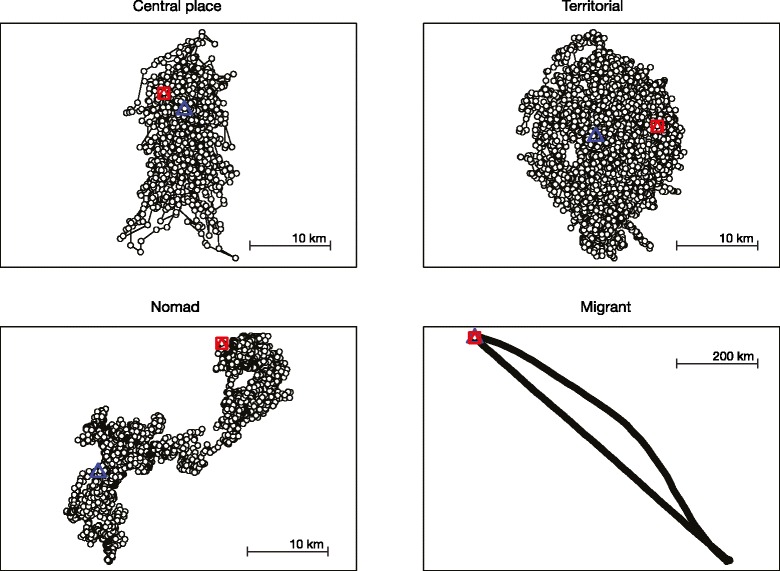
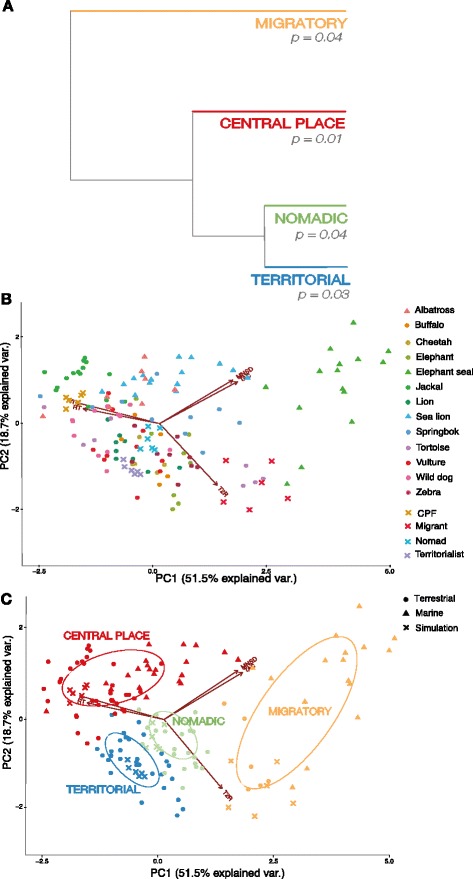
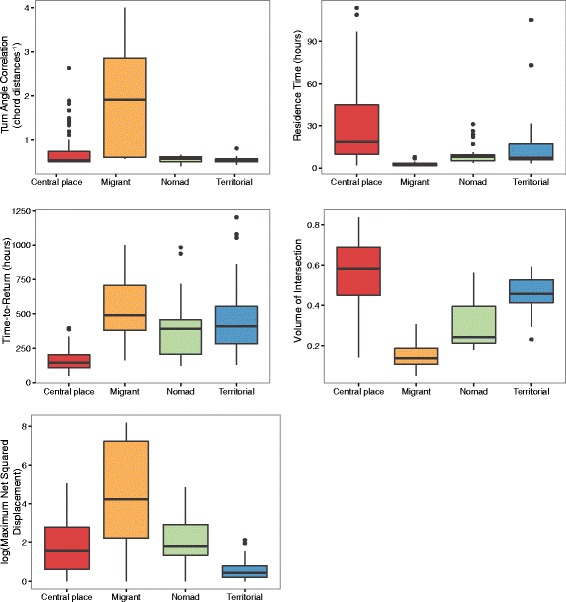
Because empirical studies of animal movement are most-often site- and species-specific, we lack understanding of the level of consistency in movement patterns across diverse taxa, as well as a framework for quantitatively classifying movement patterns. We aim to address this gap by determining the extent to which statistical signatures of animal movement patterns recur across ecological systems. We assessed a suite of movement metrics derived from GPS trajectories of thirteen marine and terrestrial vertebrate species spanning three taxonomic classes, orders of magnitude in body size, and modes of movement (swimming, flying, walking). Using these metrics, we performed a principal components analysis and cluster analysis to determine if individuals organized into statistically distinct clusters. Finally, to identify and interpret commonalities within clusters, we compared them to computer-simulated idealized movement syndromes representing suites of correlated movement traits observed across taxa (migration, nomadism, territoriality, and central place foraging). Two principal components explained 70% of the variance among the movement metrics we evaluated across the thirteen species, and were used for the cluster analysis. The resulting analysis revealed four statistically distinct clusters. All simulated individuals of each idealized movement syndrome organized into separate clusters, suggesting that the four clusters are explained by common movement syndrome. Our results offer early indication of widespread recurrent patterns in movement ecology that have consistent statistical signatures, regardless of taxon, body size, mode of movement, or environment. We further show that a simple set of metrics can be used to classify broad-scale movement patterns in disparate vertebrate taxa. Our comparative approach provides a general framework for quantifying and classifying animal movements, and facilitates new inquiries into relationships between movement syndromes and other ecological processes.
Overview
The claims and statistics of this paper haven’t been checked yet.
Free: it reads the open-access text and checks the first 5 claims that cite a source we can check. Create a free account to check every claim.
Integrity signals
Registry
Cites
Statistics
Figures
Verification
Claims the paper makes
The claims and statistics of this paper haven’t been checked yet.
Free: it reads the open-access text and checks the first 5 claims that cite a source we can check. Create a free account to check every claim.
Claims other papers make about this one
Each is checked against this paper’s own text: does it say what the citing paper says it does?
The cited source says what the claim attributes to it.
In the citing paper
“This approach allows us to detect emergent and interpretable mobility types in a robust and reproducible manner (Abrahms et al. 2017).”
From Visitation patterns across mobility groups: wandering, commuting, and exploring (2026) · cites this paper as Abrahms et al. 2017
Self-check
Percentages, sums and reported differences re-computed from the paper’s own numbers.
The self-check needs the paper’s full text.
Citations
Cites
Hierarchical Grouping to Optimize an Objective Function
Ward, J. H. (1963) · Journal of the American Statistical Association · doi:10.1080/01621459.1963.10500845 · Cited by 20,598
Species diversity in space and time
(1996) · Choice Reviews Online · doi:10.5860/choice.33-2720 · Cited by 4,573
Calenge, C. (2006) · Ecological Modelling · doi:10.1016/j.ecolmodel.2006.03.017 · Cited by 4,074
Species Diversity in Space and Time
Rosenzweig, M. L. (1995) · doi:10.1017/cbo9780511623387 · Cited by 3,690
Landscape Ecology: The Effect Of Pattern On Process
Turner, M. G. (1989) · Annual Review of Ecology and Systematics · doi:10.1146/annurev.ecolsys.20.1.171 · Cited by 3,273
A movement ecology paradigm for unifying organismal movement research
Nathan, R., Getz, W. M., Revilla, E., Holyoak, M., Kadmon, R., Saltz, D., & Smouse, P. E. (2008) · Proceedings of the National Academy of Sciences · doi:10.1073/pnas.0800375105 · Cited by 2,968
Self-citationBehavioral syndromes: an ecological and evolutionary overview
Sih, A., Bell, A., & Johnson, J. C. (2004) · Trends in Ecology & Evolution · doi:10.1016/j.tree.2004.04.009 · Cited by 2,861
Hanski, I. (1998) · Nature · doi:10.1038/23876 · Cited by 2,779
Pvclust: an R package for assessing the uncertainty in hierarchical clustering
Suzuki, R., & Shimodaira, H. (2006) · Bioinformatics · doi:10.1093/bioinformatics/btl117 · Cited by 2,451
Codling, E. A., Plank, M. J., & Benhamou, S. (2008) · Journal of The Royal Society Interface · doi:10.1098/rsif.2008.0014 · Cited by 1,482 · cited 1×
“2b), suggesting this axis indicates a spectrum of random walk movement from diffusive (low directional persistence) to advective (high directional persistence) movement [30].”
Background
Research works printed but not linked: 5
- Clobert J Danchin E Dhondt AA Nichols JD Dispersal 2001 Oxford Oxford University Press
- Bastille-Rousseau G Potts JR Yackulic CB Frair JL Ellington EH Blake S Flexible characterization of animal movement pattern using net squared displacement and a latent state model Mov Ecol 2nd ed 2016 4 19052 19035 PMC4888472 27252856
- Orians GH, Pearson NE. On the theory of central place foraging. In: Horn DH, Mitchell R, Stairs GR, editors. Analysis of Ecological Systems. Columbus; 1979. p. 155–77.
- Clobert J, Fraipont M de, Danchin E. Evolution of Dispersal. In: Danchin E, Giraldeau LA, Cézilly F, editors. Behavioural Ecology. Oxford, UK; 2008. pp. 323–59.
- Calenge C Analysis of animal movements in R: the adehabitatLT package 2015
Cited by
Marine top predators as climate and ecosystem sentinels
Hazen, E. L., Abrahms, B., Brodie, S., Carroll, G., Jacox, M. G., Savoca, M. S., Scales, K. L., Sydeman, W. J., & Bograd, S. J. (2019) · Frontiers in Ecology and the Environment · doi:10.1002/fee.2125 · Cited by 437
Self-citationContinental-scale animal tracking reveals functional movement classes across marine taxa
Brodie, S., Lédée, E. J. I., Heupel, M. R., Babcock, R. C., Campbell, H. A., Gledhill, D. C., Hoenner, X., Huveneers, C., Jaine, F. R. A., Simpfendorfer, C. A., et al. (2018) · Scientific Reports · doi:10.1038/s41598-018-21988-5 · Cited by 346
A guide for studying among-individual behavioral variation from movement data in the wild
Hertel, A. G., Niemelä, P. T., Dingemanse, N. J., & Mueller, T. (2020) · Movement Ecology · doi:10.1186/s40462-020-00216-8 · Cited by 282
Causes and consequences of individual variation in animal movement
Shaw, A. K. (2020) · Movement Ecology · doi:10.1186/s40462-020-0197-x · Cited by 267
Animal-Borne Telemetry: An Integral Component of the Ocean Observing Toolkit
Harcourt, R., Sequeira, A. M. M., Zhang, X., Roquet, F., Komatsu, K., Heupel, M., McMahon, C., Whoriskey, F., Meekan, M., Carroll, G., et al. (2019) · Frontiers in Marine Science · doi:10.3389/fmars.2019.00326 · Cited by 246
Self-citationThe Movebank system for studying global animal movement and demography
Kays, R., Davidson, S. C., Berger, M., Bohrer, G., Fiedler, W., Flack, A., Hirt, J., Hahn, C., Gauggel, D., Russell, B., et al. (2022) · Methods in Ecology and Evolution · doi:10.1111/2041-210x.13767 · Cited by 230
“Movement ecologists are conducting large- scale comparative analyses, leading to discoveries about animal movement syndromes (Abrahms et al., 2017) and influences of climate (Davidson et al., 2020) and anthropogenic disturbance (Tucker et al., 2018) on animal behaviour.”
BackgroundBeyond Migration: Causes and Consequences of Nomadic Animal Movements
Teitelbaum, C. S., & Mueller, T. (2019) · Trends in Ecology & Evolution · doi:10.1016/j.tree.2019.02.005 · Cited by 226
Prevalence and Mechanisms of Partial Migration in Ungulates
Berg, J., Hebblewhite, M., Clair, C. C. S., & Merrill, E. H. (2019) · Frontiers in Ecology and Evolution · doi:10.3389/fevo.2019.00325 · Cited by 124
Ecological metrics and methods for GPS movement data
Seidel, D. P., Dougherty, E. R., Carlson, C. J., & Getz, W. M. (2018) · International Journal of Geographical Information Systems · doi:10.1080/13658816.2018.1498097 · Cited by 113
Self-citationHazen, E. L., Abrahms, B. L., Brodie, S. J., Carroll, G., Welch, H., & Bograd, S. J. (2021) · Movement Ecology · doi:10.1186/s40462-021-00240-2 · Cited by 103
Self-citationTsalyuk, M., Kilian, W., Reineking, B., & Getz, W. M. (2019) · Ecological Monographs · doi:10.1002/ecm.1348 · Cited by 98
Self-citationEffects of body size on estimation of mammalian area requirements
Noonan, M. J., Fleming, C. H., Tucker, M. A., Kays, R., Harrison, A., Crofoot, M. C., Abrahms, B. L., Alberts, S. C., Ali, A. H., Altmann, J., et al. (2020) · Conservation Biology · doi:10.1111/cobi.13495 · Cited by 98
Self-citationSpatial and Temporal Variability in Migration of a Soaring Raptor Across Three Continents
Phipps, W. L., López‐López, P., Buechley, E. R., Oppel, S., Álvarez, E., Arkumarev, V. S., Bekmansurov, R. H., Berger‐Tal, O., Bermejo, A., Bounas, A., et al. (2019) · Frontiers in Ecology and Evolution · doi:10.3389/fevo.2019.00323 · Cited by 87
Principles and Patterns of Bat Movements: From Aerodynamics to Ecology
Voigt, C. C., Frick, W. F., Holderied, M. W., Holland, R. A., Kerth, G., Mello, M. A. R., Plowright, R. K., Swartz, S. M., & Yovel, Y. (2017) · The Quarterly Review of Biology · doi:10.1086/693847 · Cited by 87
Using time-series similarity measures to compare animal movement trajectories in ecology
Cleasby, I. R., Wakefield, E. D., Morrissey, B. J., Bodey, T. W., Votier, S. C., Bearhop, S., & Hamer, K. C. (2019) · Behavioral Ecology and Sociobiology · doi:10.1007/s00265-019-2761-1 · Cited by 86
Manlove, K. R., Wilber, M., White, L. A., Bastille‐Rousseau, G., Yang, A., Gilbertson, M. L. J., Craft, M. E., Cross, P. C., Wittemyer, G., & Pepin, K. M. (2022) · Ecology Letters · doi:10.1111/ele.14032 · Cited by 73
Kühnapfel, C., Fingerhut, J., Brinkmann, H., Ganster, V., Tanaka, T. S., Specker, E., Mikuni, J., Güldenpfennig, F., Gartus, A., Rosenberg, R., et al. (2023) · Empirical Studies of the Arts · doi:10.1177/02762374231160000 · Cited by 62
Not a cakewalk: Insights into movement of large carnivores in human‐dominated landscapes in India
Habib, B., Ghaskadbi, P., Khan, S., Hussain, Z., & Nigam, P. (2021) · Ecology and Evolution · doi:10.1002/ece3.7156 · Cited by 61
Movescapes and eco‐evolutionary movement strategies in marine fish: Assessing a connectivity hotspot
Lowerre‐Barbieri, S. K., Friess, C., Griffin, L. P., Morley, D., Skomal, G. B., Bickford, J. W., Hammerschlag, N., Rider, M. J., Smukall, M. J., Bergmann, M. P. M. V. Z., et al. (2021) · Fish and Fisheries · doi:10.1111/faf.12589 · Cited by 59
Applying network theory to animal movements to identify properties of landscape space use
Bastille‐Rousseau, G., Douglas‐Hamilton, I., Blake, S., Northrup, J. M., & Wittemyer, G. (2018) · Ecological Applications · doi:10.1002/eap.1697 · Cited by 51
Self-citationSite fidelity and behavioral plasticity regulate an ungulate’s response to extreme disturbance
Kreling, S. E. S., Gaynor, K. M., McInturff, A., Calhoun, K. L., & Brashares, J. S. (2021) · Ecology and Evolution · doi:10.1002/ece3.8221 · Cited by 50
Self-citationMaximizing biological insights from instruments attached to animals
Beltran, R. S., Kilpatrick, A. M., Picardi, S., Abrahms, B. L., Barrile, G. M., Oestreich, W. K., Smith, J. A., Czapanskiy, M. F., Favilla, A. B., Reisinger, R. R., et al. (2024) · Trends in Ecology & Evolution · doi:10.1016/j.tree.2024.09.009 · Cited by 46
Self-citationFriess, C., Lowerre‐Barbieri, S. K., Poulakis, G. R., Hammerschlag, N., Gardiner, J. M., Kroetz, A. M., Bassos-Hull, K., Bickford, J. W., Bohaboy, E., Ellis, R. D., et al. (2021) · Marine Ecology Progress Series · doi:10.3354/meps13637 · Cited by 46
Cain, S., Solomon, T., Leshem, Y., Toledo, S., Arnon, E., Roulin, A., & Spiegel, O. (2023) · Movement Ecology · doi:10.1186/s40462-022-00366-x · Cited by 46
Michelangeli, M., Payne, E., Spiegel, O., Sinn, D. L., Leu, S. T., Gardner, M., & Sih, A. (2021) · Journal of Animal Ecology · doi:10.1111/1365-2656.13616 · Cited by 44
Feedback loops between 3D vegetation structure and ecological functions of animals
Russo, N. J., Davies, A. B., Blakey, R. V., Ordway, E. M., & Smith, T. B. (2023) · Ecology Letters · doi:10.1111/ele.14272 · Cited by 45
Multi-scale movement syndromes for comparative analyses of animal movement patterns
Kays, R., Hirsch, B. T., Caillaud, D., Marés, R., Alavi, S. E., Havmøller, R. W., & Crofoot, M. C. (2023) · Movement Ecology · doi:10.1186/s40462-022-00365-y · Cited by 42
On the Search for Grazing Personalities: From Individual to Collective Behaviors
García, C. A. M., Maxwell, T. M. R., Hickford, J. G. H., & Gregorini, P. (2020) · Frontiers in Veterinary Science · doi:10.3389/fvets.2020.00074 · Cited by 39
A hierarchical path-segmentation movement ecology framework
Getz, W. M. (2022) · Ecological Processes · doi:10.1186/s13717-022-00399-5 · Cited by 37
Self-citationDejid, N., Bracis, C., Leimgruber, P., Kaczensky, P., Buuveibaatar, B., Lkhagvasuren, B., Chimeddorj, B., Shiilegdamba, E., Horning, N., Ito, Y., et al. (2019) · Ecosphere · doi:10.1002/ecs2.2924 · Cited by 37
Lowerre‐Barbieri, S. K., Tringali, M. D., Shea, C. P., Burnsed, S. W., Bickford, J. W., Murphy, M. D., & Porch, C. E. (2018) · ICES Journal of Marine Science · doi:10.1093/icesjms/fsy173 · Cited by 36
Wang, Y., Mi, C., & Guo, Y. (2020) · PeerJ · doi:10.7717/peerj.9715 · Cited by 34
Tropical cyclones alter short-term activity patterns of a coastal seabird
Wilkinson, B. P., Satgé, Y. G., Lamb, J. S., & Jodice, P. G. R. (2019) · Movement Ecology · doi:10.1186/s40462-019-0178-0 · Cited by 33
Olson, L. E., Squires, J. R., Roberts, E. K., Ivan, J. S., & Hebblewhite, M. (2018) · Ecology and Evolution · doi:10.1002/ece3.4382 · Cited by 29
Individual and seasonal variation in the movement behavior of two tropical nectarivorous birds
Smetzer, J., Paxton, K. L., & Paxton, E. H. (2021) · Movement Ecology · doi:10.1186/s40462-021-00275-5 · Cited by 29
Integrating sensory ecology and predator‐prey theory to understand animal responses to fire
Michel, A., Johnson, J. R., Szeligowski, R. V., Ritchie, E. G., & Sih, A. (2023) · Ecology Letters · doi:10.1111/ele.14231 · Cited by 28
Behavioral patterns of bats at a wind turbine confirm seasonality of fatality risk
Goldenberg, S. Z., Cryan, P. M., Gorresen, P. M., & Fingersh, L. J. (2021) · Ecology and Evolution · doi:10.1002/ece3.7388 · Cited by 26
Vissat, L. L., Cain, S., Nathan, R., Toledo, S., Spiegel, O., & Getz, W. M. (2023) · Movement Ecology · doi:10.1186/s40462-023-00367-4 · Cited by 23
Self-citationDefining null expectations for animal site fidelity
Picardi, S., Abrahms, B. L., Gelzer, E. R., Morrison, T. A., Verzuh, T. L., & Merkle, J. A. (2022) · Ecology Letters · doi:10.1111/ele.14148 · Cited by 22
Self-citationDo beluga whales truly migrate? Testing a key trait of the classical migration syndrome
Storrie, L., Loseto, L. L., Sutherland, E. L., MacPhee, S. A., O'Corry-Crowe, G. M., & Hussey, N. E. (2023) · Movement Ecology · doi:10.1186/s40462-023-00416-y · Cited by 24
The welfare problems of wide-ranging Carnivora reflect naturally itinerant lifestyles
Bandeli, M., Mellor, E., Kroshko, J., Maherali, H., & Mason, G. J. (2023) · Royal Society Open Science · doi:10.1098/rsos.230437 · Cited by 21
Movement rules determine nomadic species' responses to resource supplementation and degradation
Teitelbaum, C. S., Altizer, S., & Hall, R. J. (2020) · Journal of Animal Ecology · doi:10.1111/1365-2656.13318 · Cited by 20
Where nothing stands still: quantifying nomadism in Australian arid-zone birds
Gibson, M. R., Runge, C. A., Stephens, P. A., Fuller, R. A., & Willis, S. G. (2021) · Landscape Ecology · doi:10.1007/s10980-021-01343-2 · Cited by 17
Flexible Modelling of Diel and Other Periodic Variation in Hidden Markov Models
Feldmann, C. C., Mews, S., Coculla, A., Stanewsky, R., & Langrock, R. (2023) · Journal of Statistical Theory and Practice · doi:10.1007/s42519-023-00342-7 · Cited by 16
The statistical building blocks of animal movement simulations
Getz, W. M., Salter, R. M., Sethi, V., Cain, S., Spiegel, O., & Toledo, S. (2024) · Movement Ecology · doi:10.1186/s40462-024-00507-4 · Cited by 15
Self-citationIntegrating animal tracking and trait data to facilitate global ecological discoveries
Beltran, R. S., Kilpatrick, A. M., Adamczak, S. K., Beumer, L. T., Czapanskiy, M. F., Davidson, S. C., McLean, B. S., Mueller, T., Payne, A. R., Soria, C. D., et al. (2025) · Journal of Experimental Biology · doi:10.1242/jeb.247981 · Cited by 15
A relative‐motion method for parsing spatiotemporal behaviour of dyads using GPS relocation data
Vissat, L. L., Blackburn, J. K., & Getz, W. M. (2021) · Methods in Ecology and Evolution · doi:10.1111/2041-210x.13700 · Cited by 15
Self-citationMcGinness, H. M., Lloyd‐Jones, L. R., Robinson, F., Langston, A., O’Neill, L. G., Rapley, S., Jackson, M. V., Hodgson, J., Piper, M., Davies, M., et al. (2024) · Movement Ecology · doi:10.1186/s40462-024-00515-4 · Cited by 14
MoveTraits —A Database for Integrating Animal Behaviour Into Trait‐Based Ecology
Beumer, L. T., Hertel, A. G., Royauté, R., Tucker, M. A., Albrecht, J., Beltran, R. S., Cagnacci, F., Davidson, S. C., Dejid, N., Kays, R., et al. (2025) · Ecology Letters · doi:10.1111/ele.70297 · Cited by 13
Net displacement and temporal scaling: Model fitting, interpretation and implementation
Street, G. M., Avgar, T., & Börger, L. (2018) · Methods in Ecology and Evolution · doi:10.1111/2041-210x.12978 · Cited by 13
Characterization of Animal Movement Patterns using Information Theory: a PrimerPreprint
Owoeye, K., Musolesi, M., & Hailes, S. M. V. (2018) · bioRxiv (Cold Spring Harbor Laboratory) · doi:10.1101/311241 · Cited by 13
Russi, G. D., Lanzoni, M., Bisazza, A., Domenici, P., Castaldelli, G., Bertolucci, C., & Lucon‐Xiccato, T. (2024) · Proceedings of the National Academy of Sciences · doi:10.1073/pnas.2407804121 · Cited by 12
A method to predict connectivity for nomadic waterbird species from tracking data
Nicol, S., Lloyd‐Jones, L. R., & McGinness, H. M. (2024) · Landscape Ecology · doi:10.1007/s10980-024-01808-0 · Cited by 11
Circadian periodicity in space use by ungulates of temperate regions: How much, when and why?
Péron, G., Duparc, A., Garel, M., Marchand, P., Morellet, N., Saïd, S., & Loison, A. (2018) · Journal of Animal Ecology · doi:10.1111/1365-2656.12857 · Cited by 11
The Mechanisms Through Which Fire Drives Population Change in Terrestrial Biota
Plumanns-Pouton, E. S., Santos, J. L., Aponte, C., Brotons, L., Kelly, L. T., Mason, S. C., Parris, K. M., Ponisio, L. C., & Keith, D. A. (2025) · Global Change Biology · doi:10.1111/gcb.70479 · Cited by 10
McAlpine‐Bellis, E., Utsumi, K. L., Diamond, K. M., Klein, J., Gilbert‐Smith, S., Garrison, G. E., Eifler, M. A., & Eifler, D. A. (2023) · Ecology and Evolution · doi:10.1002/ece3.10422 · Cited by 10
Evidence for seasonal migration by a cryptic top predator of the deep sea
Oestreich, W. K., Benoit‐Bird, K. J., Abrahms, B. L., Margolina, T., Joseph, J. E., Zhang, Y., Rueda, C., & Ryan, J. P. (2024) · Movement Ecology · doi:10.1186/s40462-024-00500-x · Cited by 9
Self-citationBasso, E., Ruiz, J., Linscott, J. A., Senner, N. R., Weegman, M. D., Ballard, B. M., & Navedo, J. G. (2024) · Behavioral Ecology and Sociobiology · doi:10.1007/s00265-024-03484-1 · Cited by 9
Dynamics of animal joint space use: a novel application of a time series approach
French, J. T., Wang, H., Grant, W. E., & Tomeček, J. M. (2019) · Movement Ecology · doi:10.1186/s40462-019-0183-3 · Cited by 9
Landscape configuration alters movement behavior and space‐use of a Hawaiian forest bird community
Paxton, K. L., Smetzer, J., Hart, P. J., Anderson, M. J., & Paxton, E. H. (2023) · Journal of Avian Biology · doi:10.1111/jav.03117 · Cited by 9
Movement across scales: red fox spatial ecology
Walton, Z. (2020) · NVA (Nasjonalt vitenarkiv) · Cited by 9
Caron‐Carrier, J., Lai, S., Vézina, F., Tam, A., & Berteaux, D. (2022) · Scientific Reports · doi:10.1038/s41598-022-08347-1 · Cited by 8
A marine subsidy reshapes the ecology of a large terrestrial carnivore
Serota, M. W., Connor, T., Xu, W., Alarcón, P. A. E., Donadío, E., & Middleton, A. D. (2025) · Proceedings of the Royal Society B Biological Sciences · doi:10.1098/rspb.2025.2172 · Cited by 7
Consistent inter-individual variability in movement traits shapes the wild boar movement syndrome
Masilkova, M., Ciuti, S., Podgórski, T., Ježek, M., Мorelle, К., & Morera‐Pujol, V. (2025) · Behavioral Ecology · doi:10.1093/beheco/araf036 · Cited by 7
An animal movement track segmentation framework for forecasting range adaptation under global change
Getz, W. M. (2023) · Frontiers in Ecology and Evolution · doi:10.3389/fevo.2023.1171169 · Cited by 7
Self-citationKhazar, I., Morellet, N., Hewison, A. J. M., Gervais, L., Verheyden, H., Loc’h, G. L., Bonnet, A., Cèbe, N., Chaval, Y., Geffré, A., et al. (2025) · Animal Behaviour · doi:10.1016/j.anbehav.2025.123374 · Cited by 6
Overton, C. T., Casazza, M. L., Bretz, J., Mcduie, F. P., Matchett, E. L., Mackell, D. A., Lorenz, A. A., Mott, A. L., Herzog, M. P., & Ackerman, J. T. (2022) · Movement Ecology · doi:10.1186/s40462-022-00324-7 · Cited by 6
A hierarchical framework for segmenting movement pathsPreprint
Getz, W. M. (2019) · bioRxiv (Cold Spring Harbor Laboratory) · doi:10.1101/819763 · Cited by 6
Self-citationCheng, Z., Ma, D., Lu, M., Du, X., Kong, L., & Bao, X. (2025) · Avian Research · doi:10.1016/j.avrs.2025.100265 · Cited by 5
Efficacy of an inflatable deterrent for reducing New World vulture human-wildlife conflict
Kluever, B. M., Evans, B. A., Osterhoudt, N. M., & Tillman, E. A. (2024) · Scientific Reports · doi:10.1038/s41598-024-56941-2 · Cited by 5
Exploratory movement analysis and report building with R package stmovePreprint
Seidel, D. P., Dougherty, E. R., & Getz, W. M. (2019) · bioRxiv (Cold Spring Harbor Laboratory) · doi:10.1101/758987 · Cited by 5
Self-citationCowan, M. A., Forrest, S. W., Setterfield, S. A., Dunlop, J., Gibson, L. A., & Nimmo, D. G. (2025) · Ecological Applications · doi:10.1002/eap.70134 · Cited by 4
Spatial behavior of red deer (Cervus elaphus) in Northern Apennines: are we managing them correctly?
Fontana, R., Calabrese, L., Lanzi, A., Armaroli, E., & Pelliccioni, E. R. (2022) · Animal Biotelemetry · doi:10.1186/s40317-022-00300-3 · Cited by 4
Bar‐Ziv, M., Ziv, H., Breuer, M., Arnon, E., Uzan, A., & Spiegel, O. (2025) · Proceedings of the Royal Society B Biological Sciences · doi:10.1098/rspb.2024.2471 · Cited by 4
Walking on water: terrestrial mammal migrations in the warming Arctic
Berteaux, D., & Lai, S. (2021) · Animal Migration · doi:10.1515/ami-2020-0111 · Cited by 5
An Information Theory Treatment of Animal Movement Tracks
Getz, W. M. (2025) · Springer eBooks · doi:10.1007/978-3-032-00873-2_8 · Cited by 4
Self-citationGrady, S. C., Welbergen, J. A., Boer, M. M., Martin, J. M., & Meade, J. (2025) · Global Change Biology · doi:10.1111/gcb.70592 · Cited by 3
Rueda‐Uribe, C., Martínez, P. A. C., Espitia, J., Lozano‐Rocha, M., Ríos, J. P., Echeverry-Gálvis, M. Á., Lancaster, L. T., Capellini, I., Travis, J. M. J., & Rico‐Guevara, A. (2025) · Biotropica · doi:10.1111/btp.70132 · Cited by 3
Monitoring animal movement diversity as a component of biodiversity
Russo, N. J., Gahm, K., Zuercher, M. E., Hernandez, K., Blakey, R. V., Niesner, C., & Abelson, E. S. (2026) · Frontiers in Ecology and the Environment · doi:10.1002/fee.70038 · Cited by 3
Perry, G. L. W., Wilmshurst, J. M., & Wood, J. R. (2021) · Functional Ecology · doi:10.1111/1365-2435.13904 · Cited by 3
Falk, J. J., Sargent, A. J., Medina-Madrid, J. L., & Rico‐Guevara, A. (2025) · bioRxiv (Cold Spring Harbor Laboratory) · doi:10.1101/2025.02.25.640146 · Cited by 3
Utsumi, K. L., Pham, A., Erdenetsetseg, B., Eifler, M. A., & Eifler, D. A. (2025) · Diversity · doi:10.3390/d17090659 · Cited by 2
de Guinea, M., Landesman, R., Madden, J. R., Bugnyar, T., Bartan, Y., & Nathan, R. (2026) · Ecology Letters · doi:10.1111/ele.70366 · Cited by 2
de Margerie, E., & Monmasson, K. (2025) · Peer Community Journal · doi:10.24072/pcjournal.566 · Cited by 2
Sengupta, R., Chapman, C. C., Sarkar, D., & Bortolamiol, S. (2017) · Advances in geographic information science · doi:10.1007/978-3-319-65993-0_5 · Cited by 2
Ecological genomics and conservation of caribou in Western North America
Cavedon, M. (2020) · doi:10.11575/prism/38181 · Cited by 2
Making movement ecology into a predictive sciencePreprint
Hacker, F., Christensen, C., Davis, G. H., Tucker, M., & Farine, D. R. (2026) · EcoEvoRxiv · doi:10.32942/x2tw82 · Cited by 2
On the importance and use of multiple social information sources for movement determinism
Brevet, M. (2022) · theses.fr (ABES) · doi:10.70675/439b4719z0fbez479bz9f38za7ef0fd54318 · Cited by 2
Seascape heterogeneity and predictability drive movement strategy selection in estuarine predators
Eggenberger, C. W., Viadero, N. M., Santos, R. O., Papastamatiou, Y. P., Price, R. M., Strazisar, T., Madden, C. J., & Rehage, J. S. (2025) · Journal of Animal Ecology · doi:10.1111/1365-2656.70164 · Cited by 1
Tekam, A., Russo, N. J., Sonké, B., Deblauwe, V., Nshom, D., Barbier, N., Ferraz, A., Saatchi, S. S., Wikelski, M. C., Ordway, E. M., et al. (2025) · Biotropica · doi:10.1111/btp.70153 · Cited by 1
Individual movements drive community-level space and resource use across Yellowstone ungulates
Caldwell, M. R., Geremia, C., Stahler, D. R., MacNulty, D. R., Smith, D. W., & Merkle, J. A. (2026) · Current Biology · doi:10.1016/j.cub.2026.05.041 · Cited by 1
How far might plant-eating dinosaurs have moved seeds?
Perry, G. L. W. (2021) · Biology Letters · doi:10.1098/rsbl.2020.0689 · Cited by 1
Specifying Caribou Migratory Behaviours to Identify and Preserve Intraspecies Diversity
Theoret, J. (2020) · doi:10.11575/prism/38421 · Cited by 1
An Analysis of Elephants' Movement Data in Sub-Saharan Africa Using ClusteringPreprint
Glatzer, G., Mitra, P., & Kinyua, J. D. M. (2021) · arXiv (Cornell University) · doi:10.48550/arxiv.2111.03533 · Cited by 1
Gupte, P. R. (2022) · University of Groningen research database (University of Groningen / Centre for Information Technology) · doi:10.33612/diss.242140787 · Cited by 1
Beukeboom, R. (2023) · Opin vísindi (Opin vísindi) · Cited by 1
Mechanisms constraining distribution of juvenile Spoonbills Platalea leucorodia
Rodrigues, M. D. S. (2018) · Portuguese National Funding Agency for Science, Research and Technology (RCAAP Project by FCT) · Cited by 1
Stewart, D. G., Lozano-Sifuentes, I. A., Masterton, E. A., Blum, M. E., Lozano-Cavazos, E. A., & Webb, S. L. (2026) · Research Square · doi:10.21203/rs.3.rs-10796936/v1 · Cited by 1
Visitation patterns across mobility groups: wandering, commuting, and exploring
Hołubowska, O., Smolak, K., Brum-Bastos, V., & Sila-Nowicka, K. (2026) · Journal of Geographical Systems · doi:10.1007/s10109-026-00501-x
Seidel, D. P. (2019) · eScholarship (California Digital Library)
Self-citation
Metadata
- Authors
- Abrahms, B., Seidel, D. P., Dougherty, E., Hazen, E. L., Bograd, S. J., Wilson, A. M., Weldon McNutt, J., Costa, D. P., Blake, S., Brashares, J. S., & Getz, W. M.
- Affiliations
- National Oceanic and Atmospheric Administration (US)
- University of California, Berkeley (US)
- University of London (GB)
- University of California, Santa Cruz (US)
- Max Planck Society (DE)
- University of KwaZulu-Natal (ZA)
- Corresponding author
- Abrahms, Briana
- ORCID
- Venue
- Movement Ecology
- Published
- 2017-06-01
- Volume
- 5
- Issue
- 1
- Pages
- 12-12
- ISSN
- 2051-3933 (ISSN-L)
- PMC
- PMC5452391
- OpenAlex
- W2611531649
- Cited by
- 109
- References
- 74
- Citations by year
- 2026: 10 · 2025: 15 · 2024: 13 · 2023: 16 · 2022: 10 · 2021: 17 · 2020: 6 · 2019: 12 · 2018: 8 · 2017: 2
- FWCI
- 5.78
- Type
- journal article
- Language
- en
- Open access
- gold
- doi.org
- Licence
- cc-by
- Locations
- Movement Ecology (publishedVersion, cc-by)
- Europe PMC (PubMed Central) (publishedVersion, other-oa)
- PubMed Central (publishedVersion, cc-by)
- PubMed (publishedVersion)
- RVC Research Online (Royal Veterinary College) (submittedVersion, cc-by)
- DOAJ (DOAJ: Directory of Open Access Journals) (submittedVersion, cc-by-sa)
- eScholarship (California Digital Library) (submittedVersion)
- Max Planck Digital Library (submittedVersion)
- NOAA Institutional Repository (submittedVersion, cc-by)
- MPG.PuRe (Max Planck Society) (submittedVersion)
- Greater South Information System
- Funders
- National Science Foundation (DGE 1106400)
- National Institutes of Health (GM83863)
- European Research Council (323041)
- Biotechnology and Biological Sciences Research Council (BB/J018007/1)
- Engineering and Physical Sciences Research Council (EP/H013016/1)
- Topics
- Physical Sciences › Environmental Science › Ecology › Wildlife Ecology and Conservation
- Physical Sciences › Environmental Science › Ecology › Animal Ecology and Behavior Studies
- Social Sciences › Transportation › Human Mobility and Location-Based Analysis
- Keywords
- movement metrics, GPS tracks, movement pattern classification, marine vertebrates, terrestrial vertebrates, migration, nomadism, territoriality, central place foraging, movement simulation, body size
About these checks
Registry, retraction, Cites and statistics results are computed, not judged, with one exception: a printed reference that no index lists is read once by a model before it counts as a citation error. Claims are extracted by a model and kept only when their quote appears verbatim in the text; each cited source is then checked, with a model’s help, for whether it says what the claim relies on. Those verdicts can be wrong — read the claim’s quote and the cited source before relying on one.
Statistics and arithmetic are recomputed, not judged.
Confidence bands are shown only for fields calibrated on our annotated test set. None is calibrated yet, so no band is shown.
What counts as a claim ›How we measure confidence ›How we check this ›
Are you an author, or do you see a problem with this page? Request a review
Data sources
Bibliographic data: Semantic Scholar, OpenAlex, Crossref.
Contains information from the Semantic Scholar Academic Graph Datasets, made available under the ODC Attribution License (ODC-BY 1.0).
Semantic Scholar’s data is described in: Kinney, R., et al. (2023). The Semantic Scholar Open Data Platform. arXiv:2301.10140.
