

Suite of simple metrics reveals common movement syndromes across vertebrate taxa
Open accessThe DOI matches its Crossref record; 75 of the 75 references it cites were found in a registry or an index.
Abstract
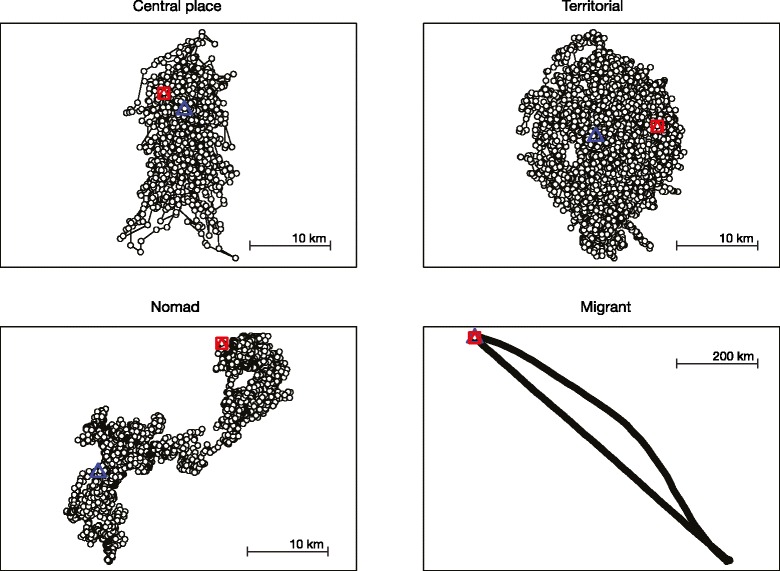
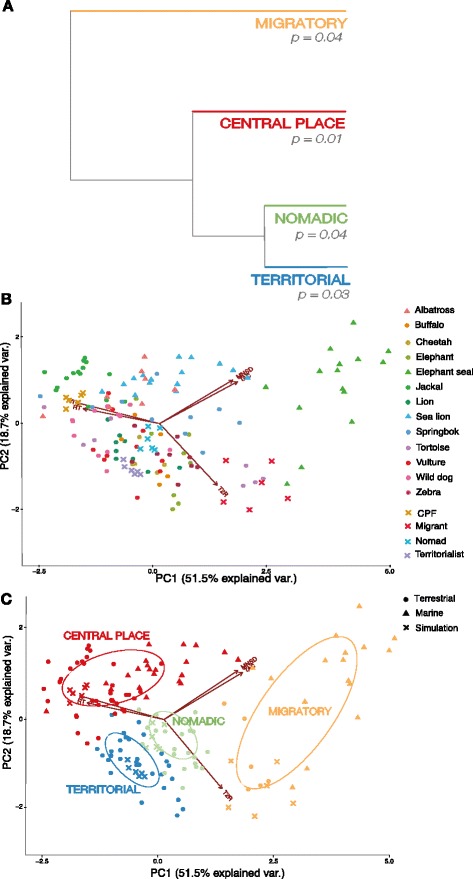
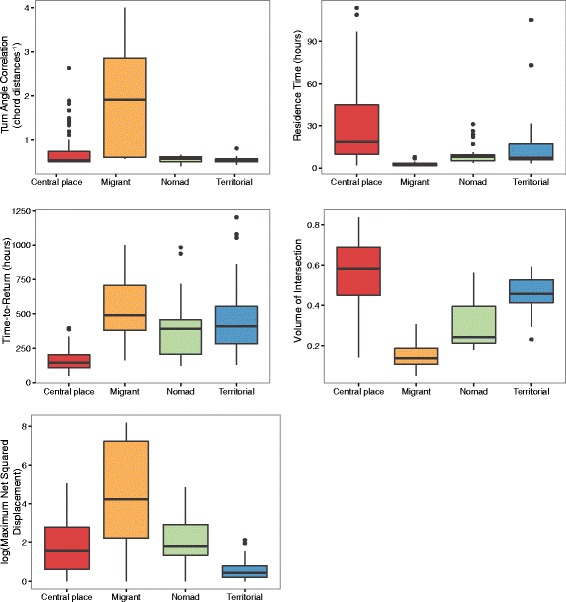
Because empirical studies of animal movement are most-often site- and species-specific, we lack understanding of the level of consistency in movement patterns across diverse taxa, as well as a framework for quantitatively classifying movement patterns. We aim to address this gap by determining the extent to which statistical signatures of animal movement patterns recur across ecological systems. We assessed a suite of movement metrics derived from GPS trajectories of thirteen marine and terrestrial vertebrate species spanning three taxonomic classes, orders of magnitude in body size, and modes of movement (swimming, flying, walking). Using these metrics, we performed a principal components analysis and cluster analysis to determine if individuals organized into statistically distinct clusters. Finally, to identify and interpret commonalities within clusters, we compared them to computer-simulated idealized movement syndromes representing suites of correlated movement traits observed across taxa (migration, nomadism, territoriality, and central place foraging). Two principal components explained 70% of the variance among the movement metrics we evaluated across the thirteen species, and were used for the cluster analysis. The resulting analysis revealed four statistically distinct clusters. All simulated individuals of each idealized movement syndrome organized into separate clusters, suggesting that the four clusters are explained by common movement syndrome. Our results offer early indication of widespread recurrent patterns in movement ecology that have consistent statistical signatures, regardless of taxon, body size, mode of movement, or environment. We further show that a simple set of metrics can be used to classify broad-scale movement patterns in disparate vertebrate taxa. Our comparative approach provides a general framework for quantifying and classifying animal movements, and facilitates new inquiries into relationships between movement syndromes and other ecological processes.
Overview
The claims and statistics of this paper haven’t been checked yet.
Free: it reads the open-access text and checks the first 5 claims that cite a source we can check. Create a free account to check every claim.
Integrity signals
Registry
Cites
Statistics
Figures
Verification
Claims the paper makes
The claims and statistics of this paper haven’t been checked yet.
Free: it reads the open-access text and checks the first 5 claims that cite a source we can check. Create a free account to check every claim.
Claims other papers make about this one
Each is checked against this paper’s own text: does it say what the citing paper says it does?
The cited source says what the claim attributes to it.
In the citing paper
“This approach allows us to detect emergent and interpretable mobility types in a robust and reproducible manner (Abrahms et al. 2017).”
From Visitation patterns across mobility groups: wandering, commuting, and exploring (2026) · cites this paper as Abrahms et al. 2017
Self-check
Percentages, sums and reported differences re-computed from the paper’s own numbers.
The self-check needs the paper’s full text.
Citations
Cites
Hierarchical Grouping to Optimize an Objective Function
Ward, J. H. (1963) · Journal of the American Statistical Association · doi:10.1080/01621459.1963.10500845 · Cited by 20,598
Species diversity in space and time
(1996) · Choice Reviews Online · doi:10.5860/choice.33-2720 · Cited by 4,573
Calenge, C. (2006) · Ecological Modelling · doi:10.1016/j.ecolmodel.2006.03.017 · Cited by 4,074
Species Diversity in Space and Time
Rosenzweig, M. L. (1995) · doi:10.1017/cbo9780511623387 · Cited by 3,690
Landscape Ecology: The Effect Of Pattern On Process
Turner, M. G. (1989) · Annual Review of Ecology and Systematics · doi:10.1146/annurev.ecolsys.20.1.171 · Cited by 3,273
A movement ecology paradigm for unifying organismal movement research
Nathan, R., Getz, W. M., Revilla, E., Holyoak, M., Kadmon, R., Saltz, D., & Smouse, P. E. (2008) · Proceedings of the National Academy of Sciences · doi:10.1073/pnas.0800375105 · Cited by 2,968
Self-citationBehavioral syndromes: an ecological and evolutionary overview
Sih, A., Bell, A., & Johnson, J. C. (2004) · Trends in Ecology & Evolution · doi:10.1016/j.tree.2004.04.009 · Cited by 2,861
Hanski, I. (1998) · Nature · doi:10.1038/23876 · Cited by 2,779
Pvclust: an R package for assessing the uncertainty in hierarchical clustering
Suzuki, R., & Shimodaira, H. (2006) · Bioinformatics · doi:10.1093/bioinformatics/btl117 · Cited by 2,451
Codling, E. A., Plank, M. J., & Benhamou, S. (2008) · Journal of The Royal Society Interface · doi:10.1098/rsif.2008.0014 · Cited by 1,482 · cited 1×
“2b), suggesting this axis indicates a spectrum of random walk movement from diffusive (low directional persistence) to advective (high directional persistence) movement [30].”
BackgroundOptimizing the success of random searches.
Viswanathan, G. M., Buldyrev, S. V., Havlin, S., da Luz, M. G. E., Raposo, E. P., & Stanley, H. E. (1999) · Nature · doi:10.1038/44831 · Cited by 1,359
Jolliffe, I. (2014) · Wiley StatsRef: Statistics Reference Online · doi:10.1002/9781118445112.stat06472 · Cited by 1,221
The behavior and ecology of Pacific salmon and trout
(2005) · Choice Reviews Online · doi:10.5860/choice.43-0943 · Cited by 1,154 · cited 1×
“), which undertakes a one-time migration as juveniles [71].”
BackgroundPredicting the Geography of Species’ Invasions via Ecological Niche Modeling
Peterson, A. T. (2003) · The Quarterly Review of Biology · doi:10.1086/378926 · Cited by 1,141
Dingle, H., & Drake, V. A. (2007) · BioScience · doi:10.1641/b570206 · Cited by 1,139
Population Responses to Patchy Environments
Wiens, J. A. (1976) · Annual Review of Ecology and Systematics · doi:10.1146/annurev.es.07.110176.000501 · Cited by 1,067
QUANTIFYING HOME-RANGE OVERLAP: THE IMPORTANCE OF THE UTILIZATION DISTRIBUTION
FIEBERG, J., & KOCHANNY, C. O. (2005) · Journal of Wildlife Management · doi:10.2193/0022-541x(2005)69[1346:qhotio]2.0.co;2 · Cited by 895
EXTRACTING MORE OUT OF RELOCATION DATA: BUILDING MOVEMENT MODELS AS MIXTURES OF RANDOM WALKS
Morales, J. M., Haydon, D. T., Frair, J., Holsinger, K. E., & Fryxell, J. M. (2004) · Ecology · doi:10.1890/03-0269 · Cited by 799
ANIMAL SEARCH STRATEGIES: A QUANTITATIVE RANDOM-WALK ANALYSIS
Bartumeus, F., da Luz, M. G. E., Viswanathan, G. M., & Catalan, J. (2005) · Ecology · doi:10.1890/04-1806 · Cited by 703
Analyzing insect movement as a correlated random walk
Kareiva, P. M., & Shigesada, N. (1983) · Oecologia · doi:10.1007/bf00379695 · Cited by 681
Birds track their Grinnellian niche through a century of climate change
Tingley, M. W., Monahan, W. B., Beissinger, S. R., & Moritz, C. (2009) · Proceedings of the National Academy of Sciences · doi:10.1073/pnas.0901562106 · Cited by 640
Börger, L., Dalziel, B. D., & Fryxell, J. M. (2008) · Ecology Letters · doi:10.1111/j.1461-0248.2008.01182.x · Cited by 616
Dispersal will limit ability of mammals to track climate change in the Western Hemisphere
Schloss, C. A., Nuñez, T. A., & Lawler, J. J. (2012) · Proceedings of the National Academy of Sciences · doi:10.1073/pnas.1116791109 · Cited by 603
Do species’ traits predict recent shifts at expanding range edges?: Traits and range shifts
Angert, A. L., Crozier, L. G., Rissler, L. J., Gilman, S. E., Tewksbury, J. J., & Chunco, A. J. (2011) · Ecology Letters · doi:10.1111/j.1461-0248.2011.01620.x · Cited by 591
Migratory shearwaters integrate oceanic resources across the Pacific Ocean in an endless summer
Shaffer, S. A., Tremblay, Y., Weimerskirch, H., Scott, D., Thompson, D. R., Sagar, P. M., Moller, H., Taylor, G. A., Foley, D. G., Block, B. A., et al. (2006) · Proceedings of the National Academy of Sciences · doi:10.1073/pnas.0603715103 · Cited by 563
Self-citationPredicted habitat shifts of Pacific top predators in a changing climate
Hazen, E. L., Jorgensen, S., Rykaczewski, R. R., Bograd, S. J., Foley, D. G., Jonsen, I. D., Shaffer, S. A., Dunne, J. P., Costa, D. P., Crowder, L. B., et al. (2013) · Nature Climate Change · doi:10.1038/nclimate1686 · Cited by 499
Self-citationSwingland, I. R., & Greenwood, P. J. (1983) · Cited by 492
The push and pull of climate change causes heterogeneous shifts in avian elevational ranges
Tingley, M. W., Koo, M. S., Moritz, C., Rush, A. C., & Beissinger, S. R. (2012) · Global Change Biology · doi:10.1111/j.1365-2486.2012.02784.x · Cited by 459
Linking Movement Ecology with Wildlife Management and Conservation
Allen, A. M., & Singh, N. J. (2016) · Frontiers in Ecology and Evolution · doi:10.3389/fevo.2015.00155 · Cited by 441
Bunnefeld, N., Börger, L., van Moorter, B., Rolandsen, C. M., Dettki, H., Solberg, E. J., & Ericsson, G. (2011) · Journal of Animal Ecology · doi:10.1111/j.1365-2656.2010.01776.x · Cited by 436
What's your move? Movement as a link between personality and spatial dynamics in animal populations
Spiegel, O., Leu, S. T., Bull, C. M., & Sih, A. (2017) · Ecology Letters · doi:10.1111/ele.12708 · Cited by 427
Understanding movement data and movement processes: current and emerging directions
Schick, R. S., Loarie, S. R., Colchero, F., Best, B. D., Boustany, A., Conde, D. A., Halpin, P. N., Joppa, L. N., McClellan, C. M., & Clark, J. S. (2008) · Ecology Letters · doi:10.1111/j.1461-0248.2008.01249.x · Cited by 417
What are functional types and how should we seek them
Gitay, H., & Noble, I. R. (1997) · Cited by 412
Peres-Neto, P. R., Jackson, D. A., & Somers, K. M. (2003) · Ecology · doi:10.1890/00-0634 · Cited by 407
Turchin, P. (1991) · Ecology · doi:10.2307/1941099 · Cited by 402
Mueller, T., & Fagan, W. F. (2008) · Oikos · doi:10.1111/j.0030-1299.2008.16291.x · Cited by 399
A Review of Hierarchical Classification
Gordon, A. D. (1987) · Journal of the Royal Statistical Society. Series A (General) · doi:10.2307/2981629 · Cited by 380
Trends and missing parts in the study of movement ecology
Holyoak, M., Casagrandi, R., Nathan, R., Revilla, E., & Spiegel, O. (2008) · Proceedings of the National Academy of Sciences · doi:10.1073/pnas.0800483105 · Cited by 378
Howard, H. E. (1920) · E.P. Dutton eBooks · doi:10.5962/bhl.title.14533 · Cited by 351
Barraquand, F., & Benhamou, S. (2008) · Ecology · doi:10.1890/08-0162.1 · Cited by 341
The Ecology of Animal Movement
Dingle, H., Swingland, I. R., & Greenwood, P. J. (1985) · The Journal of Animal Ecology · doi:10.2307/4647 · Cited by 326
The Lévy flight paradigm: random search patterns and mechanisms
Reynolds, A. M., & Rhodes, C. J. (2009) · Ecology · doi:10.1890/08-0153.1 · Cited by 308
Approximately unbiased tests of regions using Multistep-Multiscale Bootstrap Resampling
Shimodaira, H. (2004) · Cited by 291
Approximately unbiased tests of regions using multistep-multiscale bootstrap resampling
Shimodaira, H. (2004) · The Annals of Statistics · doi:10.1214/009053604000000823 · Cited by 273
Robinson, P. W., Costa, D. P., Crocker, D. E., Gallo-Reynoso, J. P., Champagne, C. D., Fowler, M. A., Goetsch, C., Goetz, K. T., Hassrick, J. L., Hückstädt, L. A., et al. (2012) · PLoS ONE · doi:10.1371/journal.pone.0036728 · Cited by 256
Self-citationHome range plus: a space-time characterization of movement over real landscapes
Lyons, A. J., Turner, W. C., & Getz, W. M. (2013) · Movement Ecology · doi:10.1186/2051-3933-1-2 · Cited by 227
Self-citationAnimal migration: is there a common migratory syndrome?
Dingle, H. (2006) · Journal of Ornithology · doi:10.1007/s10336-005-0052-2 · Cited by 223
Moorcroft, P. R., Lewis, M. A., & Crabtree, R. L. (2006) · Proceedings of the Royal Society B: Biological Sciences · doi:10.1098/rspb.2005.3439 · Cited by 218
PREDICTIVE MODELS OF MOVEMENT BY SERENGETI GRAZERS
Fryxell, J. M., Wilmshurst, J. F., & Sinclair, A. R. E. (2004) · Ecology · doi:10.1890/04-0147 · Cited by 217
Mueller, T., Olson, K. A., Dressler, G., Leimgruber, P., Fuller, T. K., Nicolson, C., Novaro, A. J., Bolgeri, M. J., Wattles, D., DeStefano, S., et al. (2011) · Global Ecology and Biogeography · doi:10.1111/j.1466-8238.2010.00638.x · Cited by 208
Variable selection in large environmental data sets using principal components analysis
King, J. R., & Jackson, D. A. (1999) · Environmetrics · doi:10.1002/(sici)1099-095x(199901/02)10:1<67::aid-env336>3.0.co;2-0 · Cited by 197
Movement is the glue connecting home ranges and habitat selection
Van Moorter, B., Rolandsen, C. M., Basille, M., & Gaillard, J. (2016) · Journal of Animal Ecology · doi:10.1111/1365-2656.12394 · Cited by 197
Linking Species and Ecosystems: Organisms as Ecosystem Engineers
Lawton, J. H., & Jones, C. G. (1995) · Linking Species & Ecosystems · doi:10.1007/978-1-4615-1773-3_14 · Cited by 189
Home Range in a Patchy Environment: Optimal Foraging Predictions
FORD, R. G. (1983) · American Zoologist · doi:10.1093/icb/23.2.315 · Cited by 177
Of scales and stationarity in animal movements
Benhamou, S. (2014) · Ecology Letters · doi:10.1111/ele.12225 · Cited by 177
Large-scale climatic anomalies affect marine predator foraging behaviour and demography
Bost, C. A., Cotté, C., Terray, P., Barbraud, C., Bon, C., Delord, K., Gimenez, O., Handrich, Y., Naito, Y., Guinet, C., et al. (2015) · Nature Communications · doi:10.1038/ncomms9220 · Cited by 168
Animal Interactions and the Emergence of Territoriality
Giuggioli, L., Potts, J. R., & Harris, S. (2011) · PLoS Computational Biology · doi:10.1371/journal.pcbi.1002008 · Cited by 161
Scales, K. L., Hazen, E. L., Jacox, M. G., Edwards, C. A., Boustany, A. M., Oliver, M. J., & Bograd, S. J. (2016) · Ecography · doi:10.1111/ecog.02272 · Cited by 161
Self-citationComparability of three analytical techniques to assess joint space use
Millspaugh, J. J., Gitzen, R. A., Kernohan, B. J., Larson, M. A., & Clay, C. L. (2004) · Wildlife Society Bulletin · doi:10.2193/0091-7648(2004)32[148:cotatt]2.0.co;2 · Cited by 139
‘MigrateR’: extending model‐driven methods for classifying and quantifying animal movement behavior
Spitz, D. B., Hebblewhite, M., & Stephenson, T. R. (2017) · Ecography · doi:10.1111/ecog.02587 · Cited by 123
Cagnacci, F., Focardi, S., Ghisla, A., van Moorter, B., Merrill, E. H., Gurarie, E., Heurich, M., Mysterud, A., Linnell, J., Panzacchi, M., et al. (2016) · Journal of Animal Ecology · doi:10.1111/1365-2656.12449 · Cited by 119
Biogeography of diseases: a framework for analysis
Peterson, A. T. (2008) · Naturwissenschaften · doi:10.1007/s00114-008-0352-5 · Cited by 118
Haydon, D. T., Morales, J. M., Yott, A., Jenkins, D. A., Rosatte, R. C., & Fryxell, J. M. (2008) · Proceedings of the Royal Society B Biological Sciences · doi:10.1098/rspb.2007.1688 · Cited by 110
Williams, C. B. (1957) · Annual Review of Entomology · doi:10.1146/annurev.en.02.010157.001115 · Cited by 108
Sampling rate and misidentification of Lévy and non‐Lévy movement paths
Plank, M. J., & Codling, E. A. (2009) · Ecology · doi:10.1890/09-0079.1 · Cited by 101
Bastille‐Rousseau, G., Potts, J. R., Yackulic, C. B., Frair, J. L., Ellington, E. H., & Blake, S. (2016) · Movement Ecology · doi:10.1186/s40462-016-0080-y · Cited by 101
Self-citationBlake, S., Yackulic, C. B., Cabrera, F., Tapia, W., Gibbs, J. P., Kümmeth, F., & Wikelski, M. C. (2012) · Journal of Animal Ecology · doi:10.1111/1365-2656.12020 · Cited by 93
Self-citationThe exploratory analysis of autocorrelation in animal‐movement studies
Dray, S., Royer‐Carenzi, M., & Calenge, C. (2010) · Ecological Research · doi:10.1007/s11284-010-0701-7 · Cited by 70
On the dispersal of leatherback turtle hatchlings from Mesoamerican nesting beaches
Shillinger, G. L., Lorenzo, E. D., Luo, H., Bograd, S. J., Hazen, E. L., Bailey, H., & Spotila, J. R. (2012) · Proceedings of the Royal Society B Biological Sciences · doi:10.1098/rspb.2011.2348 · Cited by 59
Self-citationPredicting persistence in a changing climate: flow direction and limitations to redistribution
Sorte, C. J. B. (2012) · Oikos · doi:10.1111/j.1600-0706.2012.00066.x · Cited by 58
Effects of Temporal Resolution on an Inferential Model of Animal Movement
Postlethwaite, C., & Dennis, T. E. (2013) · PLoS ONE · doi:10.1371/journal.pone.0057640 · Cited by 55
Interannual variation in the at‐sea behavior of California sea lions (Zalophus californianus)
Kuhn, C. E., & da Costa, D. P. (2014) · Marine Mammal Science · doi:10.1111/mms.12110 · Cited by 52
Self-citationKappes, M. A., Shaffer, S. A., Tremblay, Y., Foley, D. G., Palacios, D. M., Bograd, S. J., & da Costa, D. P. (2015) · Movement Ecology · doi:10.1186/s40462-015-0063-4 · Cited by 34
Self-citation(2012) · Nature Climate Change · doi:10.1038/nclimate1612 · Cited by 25
Mbizah, M. M., Joubert, C. J., Joubert, L., & Groom, R. J. (2014) · Biodiversity and Conservation · doi:10.1007/s10531-014-0675-9 · Cited by 20
Research works printed but not linked: 5
- Clobert J Danchin E Dhondt AA Nichols JD Dispersal 2001 Oxford Oxford University Press
- Bastille-Rousseau G Potts JR Yackulic CB Frair JL Ellington EH Blake S Flexible characterization of animal movement pattern using net squared displacement and a latent state model Mov Ecol 2nd ed 2016 4 19052 19035 PMC4888472 27252856
- Orians GH, Pearson NE. On the theory of central place foraging. In: Horn DH, Mitchell R, Stairs GR, editors. Analysis of Ecological Systems. Columbus; 1979. p. 155–77.
- Clobert J, Fraipont M de, Danchin E. Evolution of Dispersal. In: Danchin E, Giraldeau LA, Cézilly F, editors. Behavioural Ecology. Oxford, UK; 2008. pp. 323–59.
- Calenge C Analysis of animal movements in R: the adehabitatLT package 2015
Cited by
Marine top predators as climate and ecosystem sentinels
Hazen, E. L., Abrahms, B., Brodie, S., Carroll, G., Jacox, M. G., Savoca, M. S., Scales, K. L., Sydeman, W. J., & Bograd, S. J. (2019) · Frontiers in Ecology and the Environment · doi:10.1002/fee.2125 · Cited by 437
Self-citationContinental-scale animal tracking reveals functional movement classes across marine taxa
Brodie, S., Lédée, E. J. I., Heupel, M. R., Babcock, R. C., Campbell, H. A., Gledhill, D. C., Hoenner, X., Huveneers, C., Jaine, F. R. A., Simpfendorfer, C. A., et al. (2018) · Scientific Reports · doi:10.1038/s41598-018-21988-5 · Cited by 346
A guide for studying among-individual behavioral variation from movement data in the wild
Hertel, A. G., Niemelä, P. T., Dingemanse, N. J., & Mueller, T. (2020) · Movement Ecology · doi:10.1186/s40462-020-00216-8 · Cited by 282
Causes and consequences of individual variation in animal movement
Shaw, A. K. (2020) · Movement Ecology · doi:10.1186/s40462-020-0197-x · Cited by 267
Animal-Borne Telemetry: An Integral Component of the Ocean Observing Toolkit
Harcourt, R., Sequeira, A. M. M., Zhang, X., Roquet, F., Komatsu, K., Heupel, M., McMahon, C., Whoriskey, F., Meekan, M., Carroll, G., et al. (2019) · Frontiers in Marine Science · doi:10.3389/fmars.2019.00326 · Cited by 246
Self-citation
Metadata
- Authors
- Abrahms, B., Seidel, D. P., Dougherty, E., Hazen, E. L., Bograd, S. J., Wilson, A. M., Weldon McNutt, J., Costa, D. P., Blake, S., Brashares, J. S., & Getz, W. M.
- Affiliations
- National Oceanic and Atmospheric Administration (US)
- University of California, Berkeley (US)
- University of London (GB)
- University of California, Santa Cruz (US)
- Max Planck Society (DE)
- University of KwaZulu-Natal (ZA)
- Corresponding author
- Abrahms, Briana
- ORCID
- Venue
- Movement Ecology
- Published
- 2017-06-01
- Volume
- 5
- Issue
- 1
- Pages
- 12-12
- ISSN
- 2051-3933 (ISSN-L)
- PMC
- PMC5452391
- OpenAlex
- W2611531649
- Cited by
- 109
- References
- 74
- Citations by year
- 2026: 10 · 2025: 15 · 2024: 13 · 2023: 16 · 2022: 10 · 2021: 17 · 2020: 6 · 2019: 12 · 2018: 8 · 2017: 2
- FWCI
- 5.78
- Type
- journal article
- Language
- en
- Open access
- gold
- doi.org
- Licence
- cc-by
- Locations
- Movement Ecology (publishedVersion, cc-by)
- Europe PMC (PubMed Central) (publishedVersion, other-oa)
- PubMed Central (publishedVersion, cc-by)
- PubMed (publishedVersion)
- RVC Research Online (Royal Veterinary College) (submittedVersion, cc-by)
- DOAJ (DOAJ: Directory of Open Access Journals) (submittedVersion, cc-by-sa)
- eScholarship (California Digital Library) (submittedVersion)
- Max Planck Digital Library (submittedVersion)
- NOAA Institutional Repository (submittedVersion, cc-by)
- MPG.PuRe (Max Planck Society) (submittedVersion)
- Greater South Information System
- Funders
- National Science Foundation (DGE 1106400)
- National Institutes of Health (GM83863)
- European Research Council (323041)
- Biotechnology and Biological Sciences Research Council (BB/J018007/1)
- Engineering and Physical Sciences Research Council (EP/H013016/1)
- Topics
- Physical Sciences › Environmental Science › Ecology › Wildlife Ecology and Conservation
- Physical Sciences › Environmental Science › Ecology › Animal Ecology and Behavior Studies
- Social Sciences › Transportation › Human Mobility and Location-Based Analysis
- Keywords
- movement metrics, GPS tracks, movement pattern classification, marine vertebrates, terrestrial vertebrates, migration, nomadism, territoriality, central place foraging, movement simulation, body size
About these checks
Registry, retraction, Cites and statistics results are computed, not judged, with one exception: a printed reference that no index lists is read once by a model before it counts as a citation error. Claims are extracted by a model and kept only when their quote appears verbatim in the text; each cited source is then checked, with a model’s help, for whether it says what the claim relies on. Those verdicts can be wrong — read the claim’s quote and the cited source before relying on one.
Statistics and arithmetic are recomputed, not judged.
Confidence bands are shown only for fields calibrated on our annotated test set. None is calibrated yet, so no band is shown.
What counts as a claim ›How we measure confidence ›How we check this ›
Are you an author, or do you see a problem with this page? Request a review
Data sources
Bibliographic data: Semantic Scholar, OpenAlex, Crossref.
Contains information from the Semantic Scholar Academic Graph Datasets, made available under the ODC Attribution License (ODC-BY 1.0).
Semantic Scholar’s data is described in: Kinney, R., et al. (2023). The Semantic Scholar Open Data Platform. arXiv:2301.10140.
