

The DOI matches its Crossref record; 30 of the 30 references it cites were found in a registry or an index.
Amyloid accelerates tau propagation and toxicity in a model of early Alzheimer’s disease
Open accessAbstract
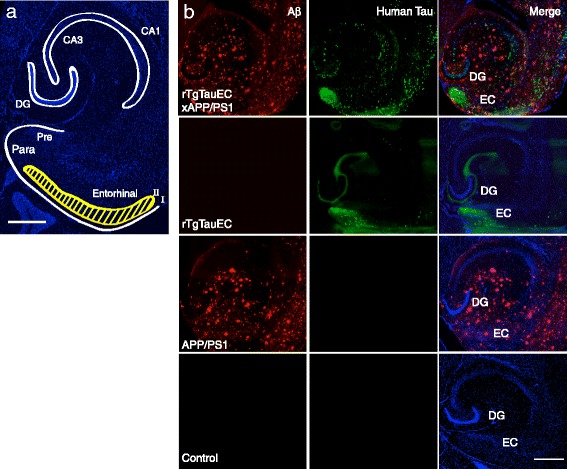
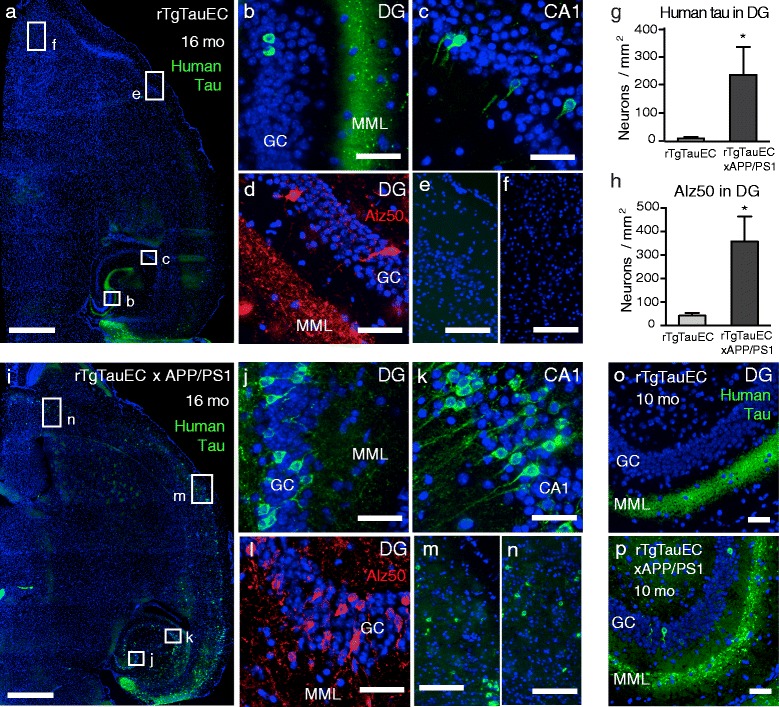
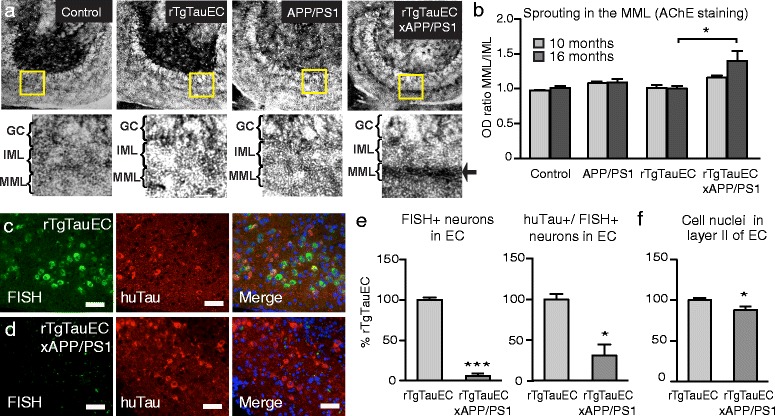
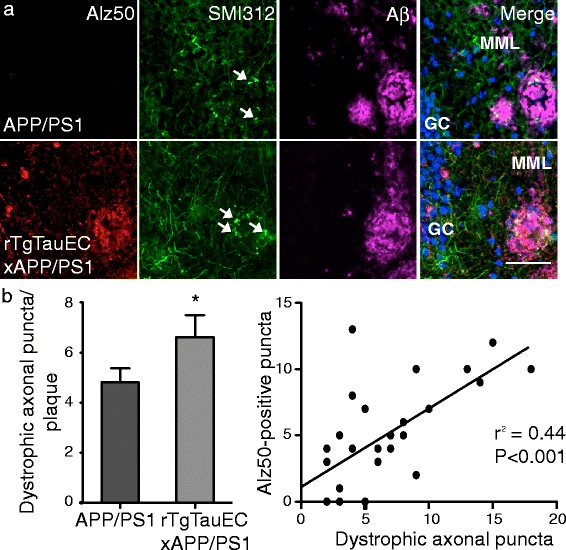
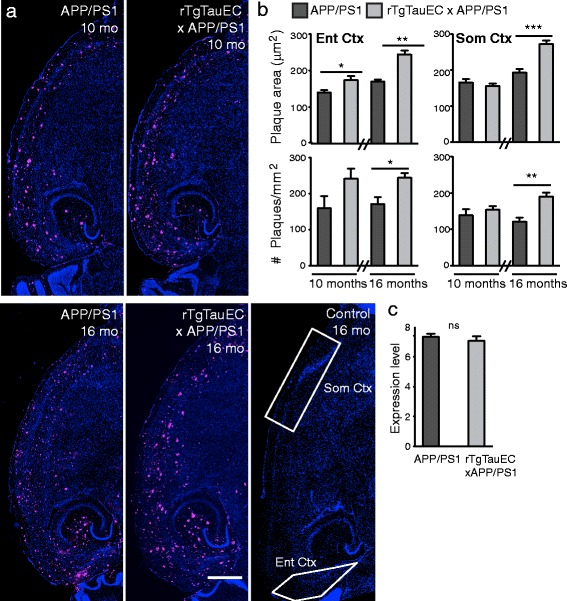
INTRODUCTION: In early stages of Alzheimer's disease (AD), neurofibrillary tangles (NFT) are largely restricted to the entorhinal cortex and medial temporal lobe. At later stages, when clinical symptoms generally occur, NFT involve widespread limbic and association cortices. At this point in the disease, amyloid plaques are also abundantly distributed in the cortex. This observation from human neuropathological studies led us to pose two alternative hypotheses: that amyloid in the cortex is permissive for the spread of tangles from the medial temporal lobe, or that these are co-occurring but not causally related events simply reflecting progression of AD pathology. RESULTS: We now directly test the hypothesis that cortical amyloid acts as an accelerant for spreading of tangles beyond the medial temporal lobe. We crossed rTgTauEC transgenic mice that demonstrate spread of tau from entorhinal cortex to other brain structures at advanced age with APP/PS1 mice, and examined mice with either NFTs, amyloid pathology, or both. We show that concurrent amyloid deposition in the cortex 1) leads to a dramatic increase in the speed of tau propagation and an extraordinary increase in the spread of tau to distal brain regions, and 2) significantly increases tau-induced neuronal loss. CONCLUSIONS: These data strongly support the hypothesis that cortical amyloid accelerates the spread of tangles throughout the cortex and amplifies tangle-associated neural system failure in AD.
Overview
The claims and statistics of this paper haven’t been checked yet.
Run the check — free, no account needed. It reads the open-access text and checks the sources it cites.
Integrity signals
Registry
Cites
Statistics
Figures
Verification
Claims the paper makes
The claims and statistics of this paper haven’t been checked yet.
Run the check — free, no account needed. It reads the open-access text and checks the sources it cites.
Claims other papers make about this one
Each is checked against this paper’s own text: does it say what the citing paper says it does?
The cited source says what the claim attributes to it.
In the citing paper
“Another study has shown that presence of cortical Aβ plaques accelerates the development of tauopathy along the perforant pathway and synergizes with tau-related neurodegeneration (6).”
From Combinatorial model of amyloid β and tau reveals synergy between amyloid deposits and tangle formation (2022) · cites this paper as [6]
The cited source says what the claim attributes to it.
In the citing paper
“Previous studies have shown that either co-expressing APP and MAPT genes (3, 6, 23) or using prion-like seeding paradigms (4, 24, 25) led to exacerbated Aβ and tau pathologies.”
From Combinatorial model of amyloid β and tau reveals synergy between amyloid deposits and tangle formation (2022) · cites this paper as [6]
The cited source says what the claim attributes to it.
In the citing paper
“Furthermore, Aβ plays a permissive role for the spread of tau pathology in vivo (Pooler et al., 2015).”
From Wild-Type, but Not Mutant N296H, Human Tau Restores Aβ-Mediated Inhibition of LTP in Tau−/− mice (2017) · cites this paper as Pooler et al., 2015
Self-check
Percentages, sums and reported differences re-computed from the paper’s own numbers.
The self-check needs the paper’s full text.
Citations
Cites
Alzheimer's disease: the amyloid cascade hypothesis
Hardy, J. A., & Higgins, G. A. (1992) · Science · doi:10.1126/science.1566067 · Cited by 7,484
Jack, C. R., Knopman, D. S., Jagust, W. J., Petersen, R. C., Weiner, M. W., Aisen, P. S., Shaw, L. M., Vemuri, P., Wiste, H. J., Weigand, S. D., et al. (2013) · The Lancet Neurology · doi:10.1016/s1474-4422(12)70291-0 · Cited by 4,396
Phases of Aβ-deposition in the human brain and its relevance for the development of AD
Thal, D. R., Rüb, U., Orantes, M., & Braak, H. (2002) · Neurology · doi:10.1212/wnl.58.12.1791 · Cited by 3,490
Neurofibrillary tangles but not senile plaques parallel duration and severity of Alzheimer's disease
Arriagada, P. V., Growdon, J. H., Hedley-Whyte, E. T., & Hyman, B. T. (1992) · Neurology · doi:10.1212/wnl.42.3.631 · Cited by 2,668
Self-citationAlzheimer's disease: cell-specific pathology isolates the hippocampal formation.
Hyman, B. T., Van Hoesen, G. W., Damasio, A. R., & Barnes, C. L. (1984) · Science · doi:10.1126/science.6474172 · Cited by 2,268
Self-citationStages of the Pathologic Process in Alzheimer Disease: Age Categories From 1 to 100 Years
Braak, H., Thal, D. R., Ghebremedhin, E., & Del Tredici, K. (2011) · Journal of Neuropathology & Experimental Neurology · doi:10.1097/nen.0b013e318232a379 · Cited by 2,194
Tau Suppression in a Neurodegenerative Mouse Model Improves Memory Function
SantaCruz, K., Lewis, J., Spires, T., Paulson, J., Kotilinek, L., Ingelsson, M., Guimaraes, A., DeTure, M., Ramsden, M., McGowan, E., et al. (2005) · Science · doi:10.1126/science.1113694 · Cited by 2,014
Self-citationFormation of Neurofibrillary Tangles in P301L Tau Transgenic Mice Induced by Aβ42 Fibrils
Götz, J., Chen, F., van Dorpe, J., & Nitsch, R. M. (2001) · Science · doi:10.1126/science.1062097 · Cited by 1,526
Propagation of Tau Pathology in a Model of Early Alzheimer's Disease
de Calignon, A., Polydoro, M., Suárez-Calvet, M., William, C., Adamowicz, D. H., Kopeikina, K. J., Pitstick, R., Sahara, N., Ashe, K. H., Carlson, G. A., et al. (2012) · Neuron · doi:10.1016/j.neuron.2011.11.033 · Cited by 1,427
Self-citationTrans-Synaptic Spread of Tau Pathology In Vivo
Liu, L., Drouet, V., Wu, J., Witter, M. P., Small, S. A., Clelland, C. L. T., & Duff, K. (2012) · PLoS ONE · doi:10.1371/journal.pone.0031302 · Cited by 994
Cited by
Sorted by citations
Items 201–236 of 236
Generation of sophisticated Alzheimer’s disease mouse models and research advances utilizing them
Hashimoto, S., & Saido, T. C. (2023) · Translational and Regulatory Sciences · doi:10.33611/trs.2023-003 · Cited by 1
Modelling C9orf72-linked frontotemporal dementia and amyotrophic lateral sclerosis
Ryan, S. (2015) · Research Explorer (The University of Manchester)
Croft, C. L. (2016) · Research Portal (King's College London)
Review Article Tau: From research to clinical development
Holtzman, D. M., Carrillo, M. C., Hendrix, J. A., Bain, L. J., Catafau, A. M., Gault, L. M., Goedert, M., Mandelkow�, E., Mandelkow, E., Miller, D. S., et al. (2016)
Self-citationThe Analysis of Exosomal Tau Release and its Regulation
Bradshaw, A. (2018) · UCL Discovery (University College London)
TREM2 Limits Progression of Deficits and Spreading of Tau Pathology in MicePreprint
Feiten, A., Au, C. G., van Hummel, A., van der Hoven, J., Deng, Y., Przybyla, M., Bright, F., Butler, T. A., Delerue, F., Toutonji, A., et al. (2021) · Research Square · doi:10.21203/rs.3.rs-741896/v1
Self-citationJadhav, V. (2021) · IUScholarWorks (Indiana University) · doi:10.7912/c2/2086
Lipid rafts act as a common platform for Aß oligomer-induced Alzheimer’s pathologyPreprint
Kawarabayashi, T., Nakamura, T., Sato, K., Seino, Y., Ichii, S., Nakahata, N., Takatama, M., Westaway, D. A., George‐Hyslop, P. S., & Shoji, M. (2021) · Research Square · doi:10.21203/rs.3.rs-1063238/v1
Ashford, J. W. (2018) · Faculty Opinions – Post-Publication Peer Review of the Biomedical Literature · doi:10.3410/f.734280398.793553881
TREM2 limits progression of deficits and spreading of tau pathology in micePreprint
Feiten, A., Au, C. G., Sabale, M., van Hummel, A., van der Hoven, J., Deng, Y., Przybyla, M., Bright, F., Butler, T., Delerue, F., et al. (2022) · Research Square · doi:10.21203/rs.3.rs-741896/v2
Self-citationNew Therapeutic Approaches for Sensory Symptoms in Alzheimer’s Disease
Reddy, C., & Madureira, M. (2022) · Journal of Student Research · doi:10.47611/jsrhs.v11i3.3793
Negative Regulation of Cathepsins by β-Amyloid
Lundin, B., Comby, A.-C., Berezovska, O., & Maesako, M. (2024) · eNeuro · doi:10.1523/eneuro.0258-23.2023 · Cited by 2
Do Tau Deposition and Glucose Metabolism Dissociate in Alzheimer’s Disease Trajectory?
Nowell, J., Raza, S., Livingston, N. R., Sivanathan, S., Gentleman, S., & Edison, P. (2024) · Journal of Alzheimer s Disease · doi:10.3233/jad-240434
Yadav, R., Mani, R. J., Kumar, A. H. S., Ahmad, S., & Katare, D. P. (2024) · Biomedical & Pharmacology Journal · doi:10.13005/bpj/2990 · Cited by 1
Chan, D., Spires‐Jones, T. L., Provenzano, F. A., Glennon, E. B. C., & Duff, K. (2025) · Oxford University Press eBooks · doi:10.1093/med/9780190065324.003.0020
Self-citationProtein Misfolding and Aggregation in the Pathogenesis of Alzheimer’s Disease
Kim, J., & Kim, H. (2025) · Gyemyeong uidae haksulji · doi:10.46308/kmj.2025.00164
Additional file 1 of Tau reduction in aged mice does not impact Microangiopathy
Bennett, R. E., Hu, M., Fernandes, A. R., Perez-Rando, M., Robbins, A., Kamath, T. V., Dujardin, S., & Hyman, B. T. (2020) · Figshare · doi:10.6084/m9.figshare.12825330
Self-citationTsering, W., Hery, G. P., Phillips, J. L., Lolo, K., Bathe, T., Villareal, J. A. B., Ruan, I. Y., & Prokop, S. (2024) · Figshare · doi:10.6084/m9.figshare.26648013
Engels, N., Koops, E. A., Hsieh, S., Wiklund, E. E., Schultz, A. P., Riphagen, J. M., Prokopiou, P. C., Hanseeuw, B. J., Rentz, D. M., Sperling, R. A., et al. (2024) · Figshare · doi:10.6084/m9.figshare.26054646
Clayton, K. A., Delpech, J.-C., Herron, S., Iwahara, N., Ericsson, M., Saito, T., Saido, T. C., Ikezu, S., & Ikezu, T. (2021) · Figshare · doi:10.6084/m9.figshare.14267041
Chaggar, P., Vogel, J. W., Thompson, T., Aldea, R., Strandberg, O. T., Stomrud, E., Palmqvist, S., Ossenkoppele, R., Jbabdi, S., Magon, S., et al. (2026) · bioRxiv (Cold Spring Harbor Laboratory) · doi:10.64898/2026.01.27.701320
Subramanian, J. (2026) · The Neuroscientist · doi:10.1177/10738584251414384 · Cited by 1
Rôle des modifications post-traductionnelles dans le processus d’agrégation de la protéine Tau
Despres, C. (2017) · theses.fr (ABES) · doi:10.70675/de10f843z8572z4295zb672z763dbf30e2b5
Lam, S. (2021) · theses.fr (ABES) · doi:10.70675/60b353ffz56fcz41a2z9e53zf0d9ac078167 · Cited by 1
Yin, T., Metkar, S. K., Yeşiltepe, M., & D'adamio, L. (2026) · bioRxiv (Cold Spring Harbor Laboratory) · doi:10.64898/2026.04.28.721316
Oh, J. M., Jeong, W. K., Son, H., Kwon, Y.-J., Kim, S. Y., Oh, T. W., Ji, M., Baek, M., Shin, W., Kim, H. J., et al. (2026) · Journal of Ethnopharmacology · doi:10.1016/j.jep.2026.121958
Mostowfi, N., Foreman, R. P., Wang, J., Khoury, R., Albanese, A., Ma, Q. L., Cohn, W., Petzinger, G. M., Jakowec, M. W., Ahmed, S., et al. (2026) · bioRxiv (Cold Spring Harbor Laboratory) · doi:10.64898/2026.06.09.731185
Yang, S., Liu, H.-C., Chiu, M., Chang, J.-F., Ho, C.-S., & Lee, K.-H. (2026) · ACS Omega · doi:10.1021/acsomega.6c00355
de Bruin, H., Przygodda, X., Wisse, L. E. M., Ravikumar, S., Düzel, E., Pijnenburg, Y. A. L., Yushkevich, P. A., Groot, C., Berron, D., Franzmeier, N., et al. (2026) · Research Square · doi:10.21203/rs.3.rs-10581799/v1
Tau-PET subtype modifies the association between plasma p-tau217 and memory in Alzheimer’s diseasePreprint
Zheng, L., Ghanbarian, E., Morillo, C. A., Younes, K., Glover, C. M., Rabin, L. A., Grill, J. D., Ewers, M., Sajjadi, S. A., Ezzati, A., et al. (2026) · medRxiv · doi:10.64898/2026.09.25.26363629
Salvadó, G., Groot, C., Wisse, L. E. M., Vogel, J. W., Beach, T. G., Serrano, G. E., Reiman, E. M., Schneider, J. A., Bennett, D. A., Ossenkoppele, R., et al. (2026) · Acta Neuropathologica · doi:10.1007/s00401-026-03095-2
Metadata
- Authors
- Pooler, A. M., Polydoro, M., Maury, E. A., Nicholls, S. B., Reddy, S. M., Wegmann, S., William, C., Saqran, L., Cagsal-Getkin, O., Pitstick, R., Beier, D. R., Carlson, G. A., Spires-Jones, T. L., & Hyman, B. T.
- Affiliations
- Harvard University (US)
- McLaughlin Research Institute (US)
- Seattle Children's Research Institute (US)
- Corresponding author
- Hyman, Bradley T
- ORCID
- Venue
- Acta Neuropathologica Communications
- Published
- 2015-03-24
- Volume
- 3
- Issue
- 1
- Pages
- 14-14
- ISSN
- 2051-5960 (ISSN-L)
- PMC
- PMC4371800
- OpenAlex
- W2107141858
- Cited by
- 236
- References
- 30
- Citations by year
- 2026: 9 · 2025: 20 · 2024: 20 · 2023: 26 · 2022: 20 · 2021: 24 · 2020: 30 · 2019: 17 · 2018: 25 · 2017: 23 · 2016: 16 · 2015: 5
- FWCI
- 16.94
- Type
- journal article
- Language
- en
- Open access
- gold
- doi.org
- Locations
- Acta Neuropathologica Communications (publishedVersion, cc-by)
- Europe PMC (PubMed Central) (publishedVersion, cc-by)
- PubMed Central (publishedVersion, cc-by)
- PubMed (publishedVersion)
- Digital Access to Scholarship at Harvard (DASH) (Harvard University) (submittedVersion, cc-by)
- Edinburgh Research Explorer (University of Edinburgh) (submittedVersion, cc-by)
- Funders
- Alzheimer's Association (ZEN-09-132524)
- American Health Assistance Foundation
- Glenn Foundation for Medical Research
- Alzheimer's Society
- National Institutes of Health
- National Institute on Aging (R01AG026249, 5T32AG00022222, R00AG033670, P50AG005134, R21AG03885, T32AG000222, P30AG062421)
- Topics
- Life Sciences › Neuroscience › Cellular and Molecular Neuroscience › Alzheimer's disease research and treatments
- Health Sciences › Medicine › Psychiatry and Mental health › Dementia and Cognitive Impairment Research
- Life Sciences › Neuroscience › Neurology › Neuroinflammation and Neurodegeneration Mechanisms
- Keywords
- Alzheimer's disease, amyloid plaques, tau propagation, neurofibrillary tangles, tauopathy, cortical amyloid, entorhinal cortex, APP/PS1 mice, transgenic mouse model, neuronal loss, tau toxicity, disease progression
- MeSH terms
- Aging, Alzheimer Disease, Amyloid, Animals, Brain, Cerebral Cortex, Disease Models, Animal, Hippocampus, Humans, Mice, Transgenic, Neurons, Temporal Lobe, Neurofibrillary Tangles, tau Proteins, Disease Progression, Mice
About these checks
Registry, retraction, Cites and statistics results are computed, not judged, with one exception: a printed reference that no index lists is read once by a model before it counts as a citation error. Claims are extracted by a model and kept only when their quote appears verbatim in the text; each cited source is then checked, with a model’s help, for whether it says what the claim relies on. Those verdicts can be wrong — read the claim’s quote and the cited source before relying on one.
Statistics and arithmetic are recomputed, not judged.
Confidence bands are shown only for fields calibrated on our annotated test set. None is calibrated yet, so no band is shown.
What counts as a claim ›How we measure confidence ›How we check this ›
Are you an author, or do you see a problem with this page? Request a review
