

A systematic review on the relationship between antisocial, borderline and narcissistic personality disorder diagnostic traits and risk of violence to others in a clinical and forensic sample
Open accessThe DOI matches its Crossref record; 50 of the 51 references it cites were found in a registry or an index.
Abstract
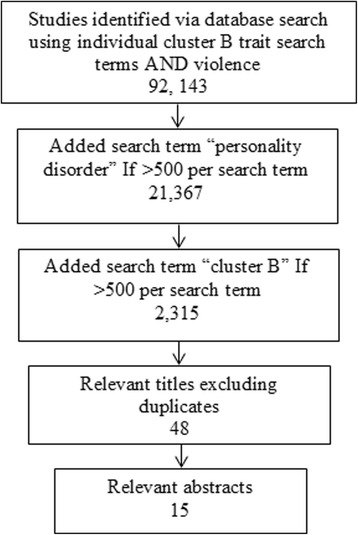
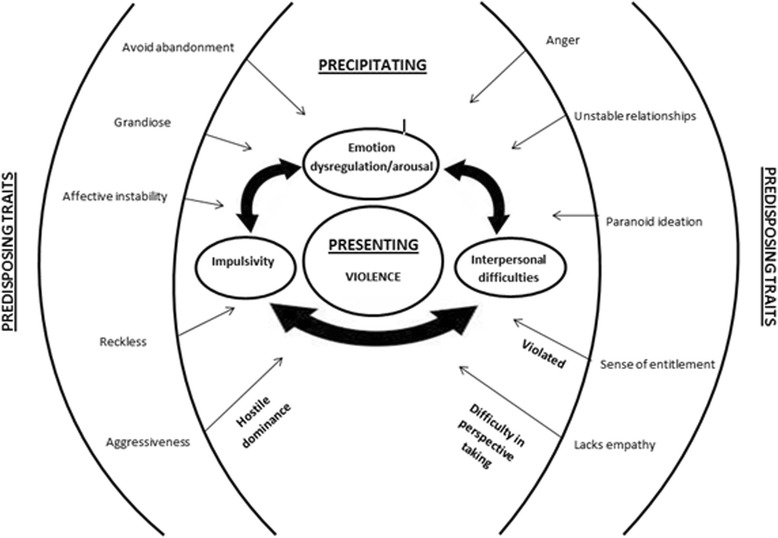
Risk assessments identify the presence of a Personality Disorder diagnosis as relevant to future violence. At present, risk assessments focus on the presence of the disorder rather than identifying key traits related to risk. Systematic searches of three databases were conducted from January 2000 until August 2014. Of 92,143, 15 studies met the inclusion criteria. A lack of empirical research was found focusing on individual traits; instead most considered PD diagnosis as a sole entity. A preliminary model has been developed detailing the link between potential interactions of diagnostic traits and risk of violence. Recommendations for future research are made.
Overview
The claims and statistics of this paper haven’t been checked yet.
Free: it reads the open-access text and checks the first 5 claims that cite a source we can check. Create a free account to check every claim.
Integrity signals
Registry
Cites
Statistics
Figures
Verification
Claims the paper makes
The claims and statistics of this paper haven’t been checked yet.
Free: it reads the open-access text and checks the first 5 claims that cite a source we can check. Create a free account to check every claim.
Claims other papers make about this one
Each is checked against this paper’s own text: does it say what the citing paper says it does?
The source backs part of the claim, not all of it — or backs it for a different population, condition or comparison.
In the citing paper
“Investigating the links between narcissism and abuse perpetration, Lowenstein et al. (2016) report on the roles of emotion dysregulation and narcissistic grandiosity which can ‘present a direct pathway to serious violence’ (p. 8).”
From Pathological narcissism: An analysis of interpersonal dysfunction within intimate relationships (2022) · cites this paper as Lowenstein et al. (2016)
Experimental — accuracy not yet measuredThe cited source says what the claim attributes to it.
In the citing paper
“The authors describe that personality comorbidities involving narcissism significantly increases the risk of serious physical violence, consistent with the severe forms of violence described in our participant sample.”
From Pathological narcissism: An analysis of interpersonal dysfunction within intimate relationships (2022) · cites this paper as Lowenstein et al. (2016)
Self-check
Percentages, sums and reported differences re-computed from the paper’s own numbers.
The self-check needs the paper’s full text.
Citations
Cites
Diagnostic and Statistical Manual of Mental Disorders
Williams, J. B. W., & First, M. (2013) · Encyclopedia of Social Work · doi:10.1093/acrefore/9780199975839.013.104 · Cited by 109,519
Hierarchical Grouping to Optimize an Objective Function
Ward, J. H. (1963) · Journal of the American Statistical Association · doi:10.1080/01621459.1963.10500845 · Cited by 20,598
The world report on violence and health
Krug, E. G., Mercy, J. A., Dahlberg, L. L., & Zwi, A. B. (2002) · The Lancet · doi:10.1016/s0140-6736(02)11133-0 · Cited by 9,110
Crick, N. R., & Dodge, K. A. (1994) · Psychological Bulletin · doi:10.1037/0033-2909.115.1.74 · Cited by 5,510
El informe mundial sobre la violencia y la salud.
Krug, E. G., Mercy, J. A., Dahlberg, L. L., & Zwi, A. B. (2002) · Biomédica · doi:10.7705/biomedica.v22isupp2.1182 · Cited by 1,057
Prevalence and correlates of personality disorder in Great Britain
Coid, J., Yang, M., Tyrer, P., Roberts, A., & Ullrich, S. (2006) · British Journal of Psychiatry · doi:10.1192/bjp.188.5.423 · Cited by 901 · cited 2×
“[4, 5]) identified that only 11 % of those with a PD diagnosis reported violent behaviour over the past 5 years in comparison to 7 % of the population without a diagnosis of PD.”
BackgroundBaumeister, R. F., Bushman, B. J., & Campbell, W. K. (2000) · Current Directions in Psychological Science · doi:10.1111/1467-8721.00053 · Cited by 567
Connecting neurosis and psychosis: the direct influence of emotion on delusions and hallucinations
Freeman, D., & Garety, P. A. (2003) · Behaviour Research and Therapy · doi:10.1016/s0005-7967(02)00104-3 · Cited by 484 · cited 1×
“Despite this, the study remains pertinent as it argues that emotion can contribute to the formation and maintenance of delusions [20], which may account for the fine line between grandiose thoughts and grandiose delusions.”
BackgroundSerious criminal offending and mental disorder: Case linkage study
Wallace, C., Mullen, P. E., Burgess, P., Palmer, S., Ruschena, D., & Browne, C. (1998) · British Journal of Psychiatry · doi:10.1192/bjp.172.6.477 · Cited by 441
Mental disorder and violence: is there a relationship beyond substance use?
Van Dorn, R., Volavka, J., & Johnson, N. (2012) · Social Psychiatry and Psychiatric Epidemiology · doi:10.1007/s00127-011-0356-x · Cited by 387 · cited 1×
“Research also shows that the aetiology of violent behaviour attributed to PD is low in comparison to other well-known risk factors such as substance abuse and lifetime severe mental illness [45] Table 2.”
Background
Research works printed but not linked: 2
- Alwin N Blackburn R Davidson K Hilton M Logan C Shine J Understanding personality disorder: A report by the British Psychological Society 2006 Leicester The British Psychological Society
- Douglas KS Hart SD Webster CD Belfrage H HCR-20 V3: Assessing risk of violence–User guide 2013 Burnaby, Canada Mental Health, Law, and Policy Institute, Simon Fraser University
Cited by
Scarth, M., Havnes, I. A., Jørstad, M. L., McVeigh, J., Hout, M. C. V., Westlye, L. T., Torgersen, S. O., & Bjørnebekk, A. (2022) · Drug and Alcohol Dependence · doi:10.1016/j.drugalcdep.2022.109275 · Cited by 50
Pathological narcissism: An analysis of interpersonal dysfunction within intimate relationships
Day, N. J. S., Townsend, M. L., & Grenyer, B. F. S. (2022) · Personality and Mental Health · doi:10.1002/pmh.1532 · Cited by 47
“Investigating the links between narcissism and abuse perpetration, Lowenstein et al. (2016) report on the roles of emotion dysregulation and narcissistic grandiosity which can ‘present a direct pathway to serious violence’ (p. 8).”
BackgroundChow, R. T. S., Yu, R., Geddes, J. R., & Fazel, S. (2024) · The British Journal of Psychiatry · doi:10.1192/bjp.2024.226 · Cited by 48
Violent offending in borderline personality disorder and attention deficit/hyperactivity disorder
Sebastian, A., Retz, W., Tüscher, O., & Turner, D. (2019) · Neuropharmacology · doi:10.1016/j.neuropharm.2019.03.008 · Cited by 37
Noland, E., & Strandh, M. (2021) · International Journal of Law and Psychiatry · doi:10.1016/j.ijlp.2021.101749 · Cited by 30
Rogier, G., Marzo, A., & Velotti, P. (2019) · Criminal Justice and Behavior · doi:10.1177/0093854819862013 · Cited by 30
Childhood risk factors for personality disorder symptoms related to violence
Reising, K., Farrington, D. P., Ttofi, M. M., Piquero, A. R., & Coid, J. (2019) · Aggression and Violent Behavior · doi:10.1016/j.avb.2019.07.010 · Cited by 35
Chukwuorji, J. C., Uzuegbu, C. N., Agbo, F., Ifeagwazi, C. M., & Ebulum, G. C. (2020) · Current Psychology · doi:10.1007/s12144-018-9881-z · Cited by 27
“…of NPD, being highly narcissistic is associated with adverse psychosocial consequences such as psychopathy, aggression/violence (Anwar et al. 2016; Lowenstein et al. 2016), poor relationship quality (Hepper et al. 2014a), high intolerance of others (Wallace et al. 2016), counterproductive work…”
BackgroundDellazizzo, L., Dugre, J. R., Berwald, M., Stafford, M.-C., Côté, G., Potvin, S., & Dumais, A. (2017) · Psychiatry Research · doi:10.1016/j.psychres.2017.12.006 · Cited by 26
Blakey, S. M., Love, H., Lindquist, L. K., Beckham, J. C., & Elbogen, E. B. (2018) · Journal of Consulting and Clinical Psychology · doi:10.1037/ccp0000253 · Cited by 19
Juarros-Basterretxea, J., Herrero, J., Escoda-Menéndez, P., & Rodríguez-Díaz, F. (2020) · Journal of Interpersonal Violence · doi:10.1177/0886260520922351 · Cited by 18
Berardis, D. D., Ventriglio, A., Fornaro, M., Vellante, F., Martinotti, G., Fraticelli, S., & Giannantonio, M. D. (2020) · Journal of Clinical Medicine · doi:10.3390/jcm9113774 · Cited by 18
“Moreover, substance and alcohol abuse is frequent in subjects with personality disorder (PDs, especially antisocial and borderline personality disorders), which may further enhance the aggressive behaviors often seen in these subjects [25,26].”
BackgroundSuárez, I. R., Guerrero‐Jiménez, M., Cervilla, J. A., & Gutiérrez, B. (2025) · Journal of Affective Disorders · doi:10.1016/j.jad.2025.120482 · Cited by 20
Hean, S. C. P. D., Willumsen, E., & Ødegård, A. (2018) · International Journal of Prisoner Health · doi:10.1108/ijph-01-2017-0006 · Cited by 20
Velotti, P., Rogier, G., & Sarlo, A. (2019) · Personality and Individual Differences · doi:10.1016/j.paid.2019.109757 · Cited by 17
Wojciechowski, T. W. (2021) · Journal of Forensic Sciences · doi:10.1111/1556-4029.14807 · Cited by 10
“[10] recently provided a systematic review of past research on personality disorders and risk of violence.”
BackgroundResultMental Disorder and Women’s Recidivism: A Meta-Analysis
Pettersen, C., Wanamaker, K. A., Garvey, M. L., Brown, S. L., & Goodwin, J. (2023) · Feminist Criminology · doi:10.1177/15570851231213100 · Cited by 9
“For example, theorists have proposed that the empirical association between borderline personality disorder (BPD) and violence (Moore et al., 2017) results from both dysregulated anger (Jackson et al., 2015), and elevated trait aggressiveness (Lowenstein et al., 2016; Moore et al., 2017).”
BackgroundLittlebear, S., Lofties, E. E., & Mikolon, T. M. (2023) · Contemporary Family Therapy · doi:10.1007/s10591-023-09667-8 · Cited by 9
“Previous research investigating NPD traits indicate that delusions of a grandiose nature, when associated with elation or anger, may lead to serious violence (Lowenstein et al., 2016).”
Morena, D., Fazio, N. D., Russa, R. L., Delogu, G., Frati, P., Fineschi, V., & Ferracuti, S. (2022) · International Journal of Environmental Research and Public Health · doi:10.3390/ijerph192214826 · Cited by 8
“The association between narcissistic personality traits and violent behavior has emerged as being significant in some studies [28], in particular when they configure as delusions of a grandiose nature, elation, and anger [29,30].”
BackgroundForensic prevention outpatient clinic: a treatment evaluation study
Nitschke, J., Sünkel, Z., & Mokros, A. (2020) · Journal of Forensic Psychiatry and Psychology · doi:10.1080/14789949.2020.1785527 · Cited by 8
Wang, Y., Guo, J.-N., Yin, X., Zhang, Q., Dong, L.-Y., Wang, K., & Wang, Y. (2021) · Journal of Forensic Psychiatry and Psychology · doi:10.1080/14789949.2021.1886314 · Cited by 8
Abi‐Habib, R., Wehbe, N., Badr, K., & Tohme, P. (2020) · International Journal of Forensic Mental Health · doi:10.1080/14999013.2019.1684403 · Cited by 7
“It can be argued that the preoccupation with one’s own anxiety could partly interfere with the capacity to think of the other, thus rendering one more vulnerable to committing violent behaviors if a threat is perceived (Fisher & Hall, 2011; Lowenstein et al., 2016).”
BackgroundInfluentialTrønnes, H. C. S., Urheim, R., Senneseth, M., Harde, M. H., & Gjestad, R. (2020) · Journal of Forensic Psychiatry and Psychology · doi:10.1080/14789949.2020.1784982 · Cited by 5
“In a review of the relationship between PDs and violence, Lowenstein et al. (2016) draw attention to the fact that several studies treat diagnoses as a sole entity and miss the potential importance of traits, rather than diagnoses.”
BackgroundOliveira, R. V., Reid, J. C., Brown, S. J., & Mims, B. (2026) · Journal of Developmental and Life-Course Criminology · doi:10.1007/s40865-026-00291-2 · Cited by 4
“However, only personality disorders predicted a reconviction for a technical violation, which is expected given that prior research indicates that personality disorders are more strongly related to criminal offending than mental illness on its own (Lowenstein et al., 2016 ; Nestor, 2002 ).”
Narcissistic Rage and the Murder of Allison Baden-Clay
Scott, R. J., & Freckelton, I. R. (2017) · Psychiatry Psychology and Law · doi:10.1080/13218719.2017.1379113 · Cited by 4
Merwin, R. M., Cuper, P. F., Lynch, T., & McMahon, K. (2020) · Elsevier eBooks · doi:10.1016/b978-0-12-805469-7.00019-x · Cited by 4
Mohajerin, B., Howard, R., & Pincus, A. L. (2026) · Clinical Psychology & Psychotherapy · doi:10.1002/cpp.70247 · Cited by 3
Executive Functions and Emotional Lability in Adults with ADHD
Amador, J. A., & Krieger, V. (2023) · Autism and child psychopathology series · doi:10.1007/978-3-031-41709-2_5 · Cited by 3
Predicting juvenile delinquency and criminal behavior in adulthood using machine learning
Schroeders, U., Mariss, A., Sauter, J., & Jankowsky, K. (2025) · International Journal of Behavioral Development · doi:10.1177/01650254251339392 · Cited by 3
“While forensic psychiatry focuses on the relationship between mental disorders and criminal behavior (Biedermann et al., 2023; Fazel et al., 2009; Lowenstein et al., 2016), criminal psychology emphasizes the relationship between personality traits or characteristics and criminal behavior (Jones et…”
Coping and violence perpetration in a residential substance use disorder treatment sample
Bonar, E. E., Matusiewicz, A. K., Bohnert, A. M., Ilgen, M. A., Sanborn, M. L., & Chermack, S. T. (2018) · Journal of Addictive Diseases · doi:10.1080/10550887.2018.1479611 · Cited by 4
“Interventions could also be enhanced by targeting co-occurring problems that are linked to aggression, such as personality disorders (82) where associated features such as emotion dysregulation are associated with violence (93).”
BackgroundTRANSTORNO DA PERSONALIDADE NARCISISTA: UMA REVISÃO NARRATIVA
Calzada, J. V. D., Roriz, M. D. D. F., Ramos, D. D. F. F., Severo, V. M., & Alves, J. M. D. F. (2024) · Revista Ibero-Americana de Humanidades, Ciências e Educação · doi:10.51891/rease.v10i7.15037 · Cited by 3
Davidson, S., Flood, S., McAvoy, C. T., & Watt, N. (2025) · Cogent Psychology · doi:10.1080/23311908.2025.2545076 · Cited by 3
“…an acknowledgement that the risk of violence in PD is likely overestimated due to the complexities of other confounding personal and environmental factors related to violence (lowenstein et al., 2016). there is consensus that individuals with PD are entitled to good general psychiatric care.”
Epidemiology of aggression and violence in mental disorders and the approach of TRR 379
Habel, U., Herpertz, S., Reif, A., Habel, U., Herpertz, S., Reif, A., Wagels, L., Reindl, V., Konrad, K., Holz, N., et al. (2026) · Der Nervenarzt · doi:10.1007/s00115-026-02005-x · Cited by 2
Exploring the Role of Psycho-Social Factors on the Recidivism of Homicide Offenders
Reid, J. C., Oliveira, R., & Collier, N. L. (2023) · Homicide Studies · doi:10.1177/10887679221148407 · Cited by 2
“To avoid relying on research reflecting high comorbidity issues of PD with other mental health issues and substance abuse, scholars have argued for the need to focus on underlying personality characteristics that are associated with criminal involvement (Lowenstein et al., 2016; Nestor, 2002).”
BackgroundMethodExploring key risk factors of intimate partner violence among chinese college students
Ip, M. W. S., Manning, M., Wong, G. T. W., & Wong, D. S. W. (2020) · Children and Youth Services Review · doi:10.1016/j.childyouth.2020.105278 · Cited by 2
Behandlung von Persönlichkeitsstörungen und Psychopathie
Krüppel, J., Hollerbach, P., Yoon, D., & Mokros, A. (2023) · Edition Forschung und Entwicklung in der Strafrechtspflege · doi:10.1007/978-3-658-36046-7_19 · Cited by 2
Cyber dating abuse: nuova espressione di IPV o nuova forma di violenza?
Celsi, L. (2019) · Aisberg (University of Bergamo) · doi:10.6092/tdunibg_128675 · Cited by 1
Pettersen, C. (2021) · Carleton University's Institutional Repository (MacOdrum Library, Carleton University) · doi:10.22215/etd/2021-14469 · Cited by 2
Predicting Juvenile Delinquency and Criminal Behavior in Adulthood Using Machine LearningPreprint
Schroeders, U., Mariss, A., Sauter, J., & Jankowsky, K. (2023) · PsyArXiv (OSF Preprints) · doi:10.31234/osf.io/ubs9e · Cited by 1
Predicting Juvenile Delinquency and Criminal Behavior in Adulthood Using Machine LearningPreprint
Schroeders, U., Mariss, A., Sauter, J., & Jankowsky, K. (2023) · PsyArXiv (OSF Preprints) · doi:10.31234/osf.io/ubs9e_v1 · Cited by 1
Predicting Juvenile Delinquency and Criminal Behavior in Adulthood Using Machine LearningPreprint
Schroeders, U., Mariss, A., Sauter, J., & Jankowsky, K. (2025) · PsyArXiv (OSF Preprints) · doi:10.31234/osf.io/ubs9e_v2 · Cited by 1
A biopsychosocial approach to violence risk assessment in acute psychiatry
Eriksen, B. M. S. (2019) · NVA (Nasjonalt vitenarkiv) · Cited by 1
The Relationship of Pathological Narcissism to Empathic Functioning
McMaster, A. (2021) · CUNY Academic Works (City University of New York) · Cited by 1
Reising, K. (2020) · Apollo (University of Cambridge) · doi:10.17863/cam.72834 · Cited by 2
Mental Disorders, Violence, and Crime
Sahni, S. P., & Karishma (2021) · Springer eBooks · doi:10.1007/978-981-16-4570-9_5
Developing a psychologically informed typology of partner violent women
Dempsey, F. (2017) · Open Access Victoria University of Wellington | Te Herenga Waka (Figshare) · doi:10.26686/wgtn.17061824
Az antiszocialitás megjelenése az egyes személyiségzavarokban és annak kriminológiai jelentősége
Bellavics, M. Z. (2022) · Magyar Rendészet · doi:10.32577/mr.2022.2.4
Psychische Störungen, Gewalt und Kriminalität
Sahni, S. P., & Karishma (2023) · Springer eBooks · doi:10.1007/978-981-99-4316-6_5
Forenzička obilježja počinitelja ubojstva intimne partnerice
Klinika za psihijatriju, K. B. D., Marinić, L. M., Marinić, I., & Klinika za psihijatriju, K. B. D. (2024) · Socijalna psihijatrija · doi:10.24869/spsih.2024.334
Emir, Z., Güngör, S., Isin, B. K., & Oskay, D. (2025) · SSRN Electronic Journal · doi:10.2139/ssrn.5320810
Resting State Functional Connectivity and Decision Making in Borderline Personality Disorder
Taha, A. Y. (2024) · UCL Discovery (University College London)
Pompili, P. M. (2020) · IRIS Research product catalog (Sapienza University of Rome)
Fuzzy-based machine learning for predicting narcissistic traits among Twitter users.
Mursi, J. K. (2022) · ResearchSpace (University of KwaZulu-Natal) · Cited by 1
Povezava med osebnostnimi motnjami in prestopništvom
Škofljanec, A. (2023) · University of Maribor digital library (University of Maribor)
A relação do abuso de substâncias e a psicopatologia em população reclusa.
Silva, T. R. V. D. (2020) · Portuguese National Funding Agency for Science, Research and Technology (RCAAP Project by FCT) · Cited by 1
Jarrett, M., Forrester, A., Campbell, C. D., Khondoker, M. R., & Vamvakas, G. (2026) · International Journal of Offender Therapy and Comparative Criminology · doi:10.1177/0306624x261449811
Kassar, M., & Stamminger, C. (2026) · Nervenheilkunde · doi:10.1055/a-2843-0007
Leung, K.-W. (2025) · Nottingham ePrints (University of Nottingham)
Timmins, K. L. E. (2021) · Nottingham ePrints (University of Nottingham)
The relationship between substance abuse and psychopathology in a prison population.
Silva, T. M. D. J. N. C. (2020) · Portuguese National Funding Agency for Science, Research and Technology (RCAAP Project by FCT)
Metadata
- Authors
- Lowenstein, J., Purvis, C., & Rose, K.
- Affiliations
- St Ann's Hospital (GB)
- Corresponding author
- Lowenstein, Joe
- Venue
- Borderline Personality Disorder and Emotion Dysregulation
- Published
- 2016-10-13
- Volume
- 3
- Issue
- 1
- Pages
- 14-14
- ISSN
- 2051-6673 (ISSN-L)
- PMC
- PMC5062934
- OpenAlex
- W2531422958
- Cited by
- 45
- References
- 51
- Citations by year
- 2026: 4 · 2025: 4 · 2024: 2 · 2023: 7 · 2022: 3 · 2021: 6 · 2020: 7 · 2019: 5 · 2018: 3 · 2017: 4
- FWCI
- 0.59
- Type
- journal article
- Language
- en
- Open access
- gold
- doi.org
- Licence
- cc-by
- Locations
- Borderline Personality Disorder and Emotion Dysregulation (publishedVersion, cc-by)
- Europe PMC (PubMed Central) (publishedVersion, cc-by)
- PubMed Central (publishedVersion, cc-by)
- PubMed (publishedVersion)
- Topics
- Social Sciences › Psychology › Clinical Psychology › Personality Disorders and Psychopathology
- Social Sciences › Psychology › Clinical Psychology › Psychopathy, Forensic Psychiatry, Sexual Offending
- Social Sciences › Psychology › Clinical Psychology › Personality Traits and Psychology
- Keywords
- antisocial personality disorder, borderline personality disorder, narcissistic personality disorder, personality disorder traits, violence risk, violence risk assessment, forensic psychiatry, clinical samples, trait relationships
About these checks
Registry, retraction, Cites and statistics results are computed, not judged, with one exception: a printed reference that no index lists is read once by a model before it counts as a citation error. Claims are extracted by a model and kept only when their quote appears verbatim in the text; each cited source is then checked, with a model’s help, for whether it says what the claim relies on. Those verdicts can be wrong — read the claim’s quote and the cited source before relying on one.
Statistics and arithmetic are recomputed, not judged.
Confidence bands are shown only for fields calibrated on our annotated test set. None is calibrated yet, so no band is shown.
What counts as a claim ›How we measure confidence ›How we check this ›
Are you an author, or do you see a problem with this page? Request a review
Data sources
Bibliographic data: Semantic Scholar, OpenAlex, Crossref.
Contains information from the Semantic Scholar Academic Graph Datasets, made available under the ODC Attribution License (ODC-BY 1.0).
Semantic Scholar’s data is described in: Kinney, R., et al. (2023). The Semantic Scholar Open Data Platform. arXiv:2301.10140.
