

A systematic review on the relationship between antisocial, borderline and narcissistic personality disorder diagnostic traits and risk of violence to others in a clinical and forensic sample
Open accessThe DOI matches its Crossref record; 50 of the 51 references it cites were found in a registry or an index.
Abstract
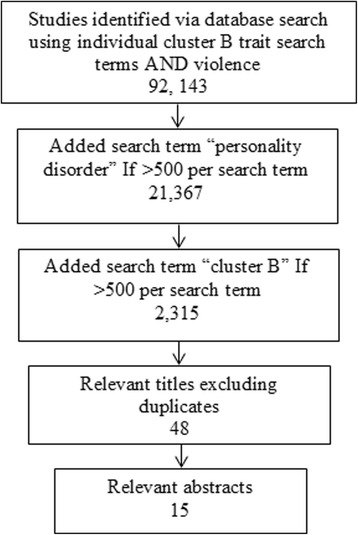
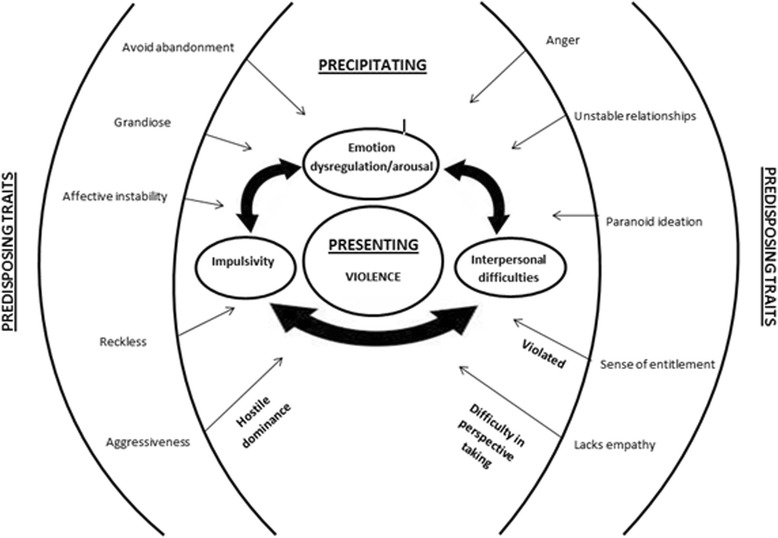
Risk assessments identify the presence of a Personality Disorder diagnosis as relevant to future violence. At present, risk assessments focus on the presence of the disorder rather than identifying key traits related to risk. Systematic searches of three databases were conducted from January 2000 until August 2014. Of 92,143, 15 studies met the inclusion criteria. A lack of empirical research was found focusing on individual traits; instead most considered PD diagnosis as a sole entity. A preliminary model has been developed detailing the link between potential interactions of diagnostic traits and risk of violence. Recommendations for future research are made.
Overview
The claims and statistics of this paper haven’t been checked yet.
Free: it reads the open-access text and checks the first 5 claims that cite a source we can check. Create a free account to check every claim.
Integrity signals
Registry
Cites
Statistics
Figures
Verification
Claims the paper makes
The claims and statistics of this paper haven’t been checked yet.
Free: it reads the open-access text and checks the first 5 claims that cite a source we can check. Create a free account to check every claim.
Claims other papers make about this one
Each is checked against this paper’s own text: does it say what the citing paper says it does?
The source backs part of the claim, not all of it — or backs it for a different population, condition or comparison.
In the citing paper
“Investigating the links between narcissism and abuse perpetration, Lowenstein et al. (2016) report on the roles of emotion dysregulation and narcissistic grandiosity which can ‘present a direct pathway to serious violence’ (p. 8).”
From Pathological narcissism: An analysis of interpersonal dysfunction within intimate relationships (2022) · cites this paper as Lowenstein et al. (2016)
Experimental — accuracy not yet measuredThe cited source says what the claim attributes to it.
In the citing paper
“The authors describe that personality comorbidities involving narcissism significantly increases the risk of serious physical violence, consistent with the severe forms of violence described in our participant sample.”
From Pathological narcissism: An analysis of interpersonal dysfunction within intimate relationships (2022) · cites this paper as Lowenstein et al. (2016)
Self-check
Percentages, sums and reported differences re-computed from the paper’s own numbers.
The self-check needs the paper’s full text.
Citations
Cites
Diagnostic and Statistical Manual of Mental Disorders
Williams, J. B. W., & First, M. (2013) · Encyclopedia of Social Work · doi:10.1093/acrefore/9780199975839.013.104 · Cited by 109,519
Hierarchical Grouping to Optimize an Objective Function
Ward, J. H. (1963) · Journal of the American Statistical Association · doi:10.1080/01621459.1963.10500845 · Cited by 20,598
The world report on violence and health
Krug, E. G., Mercy, J. A., Dahlberg, L. L., & Zwi, A. B. (2002) · The Lancet · doi:10.1016/s0140-6736(02)11133-0 · Cited by 9,110
Crick, N. R., & Dodge, K. A. (1994) · Psychological Bulletin · doi:10.1037/0033-2909.115.1.74 · Cited by 5,510
El informe mundial sobre la violencia y la salud.
Krug, E. G., Mercy, J. A., Dahlberg, L. L., & Zwi, A. B. (2002) · Biomédica · doi:10.7705/biomedica.v22isupp2.1182 · Cited by 1,057
Prevalence and correlates of personality disorder in Great Britain
Coid, J., Yang, M., Tyrer, P., Roberts, A., & Ullrich, S. (2006) · British Journal of Psychiatry · doi:10.1192/bjp.188.5.423 · Cited by 901 · cited 2×
“[4, 5]) identified that only 11 % of those with a PD diagnosis reported violent behaviour over the past 5 years in comparison to 7 % of the population without a diagnosis of PD.”
BackgroundBaumeister, R. F., Bushman, B. J., & Campbell, W. K. (2000) · Current Directions in Psychological Science · doi:10.1111/1467-8721.00053 · Cited by 567
Connecting neurosis and psychosis: the direct influence of emotion on delusions and hallucinations
Freeman, D., & Garety, P. A. (2003) · Behaviour Research and Therapy · doi:10.1016/s0005-7967(02)00104-3 · Cited by 484 · cited 1×
“Despite this, the study remains pertinent as it argues that emotion can contribute to the formation and maintenance of delusions [20], which may account for the fine line between grandiose thoughts and grandiose delusions.”
BackgroundSerious criminal offending and mental disorder: Case linkage study
Wallace, C., Mullen, P. E., Burgess, P., Palmer, S., Ruschena, D., & Browne, C. (1998) · British Journal of Psychiatry · doi:10.1192/bjp.172.6.477 · Cited by 441
Mental disorder and violence: is there a relationship beyond substance use?
Van Dorn, R., Volavka, J., & Johnson, N. (2012) · Social Psychiatry and Psychiatric Epidemiology · doi:10.1007/s00127-011-0356-x · Cited by 387 · cited 1×
“Research also shows that the aetiology of violent behaviour attributed to PD is low in comparison to other well-known risk factors such as substance abuse and lifetime severe mental illness [45] Table 2.”
BackgroundNewton-Howes, G. (2014) · Oxford University Press eBooks · doi:10.1093/med/9780199688388.001.0001 · Cited by 350
Personality, personality disorder and violence: An evidence based approach
McMurran, M., & Howard, R. (2009) · Cited by 243
Mental Disorder and Violence: Personality Dimensions and Clinical Features
Nestor, P. G. (2002) · American Journal of Psychiatry · doi:10.1176/appi.ajp.159.12.1973 · Cited by 229 · cited 1×
“Nestor [36] reviewed the relationship between violence among persons with certain psychological disorders and identified four fundamental personality dimensions that may increase the risk of violence: 1) impulse control, 2) affect regulation, 3) threatened egotism or narcissism, and 4) paranoid cognitive personality s…”
BackgroundDoumas, D. M., Pearson, C. L., Elgin, J. E., & McKinley, L. L. (2008) · Journal of Interpersonal Violence · doi:10.1177/0886260507313526 · Cited by 184
Behavior and Adaptation in Long-Term Prison Inmates: Descriptive Longitudinal Results
ZAMBLE, E. (1992) · Criminal Justice and Behavior · doi:10.1177/0093854892019004005 · Cited by 179 · cited 1×
“This may have biased the results, as offenders who had served the longest time indicated that their sense of entitlement had significantly reduced since sentencing; Zamble [51] coined this phenomenon the “maturity factor”.”
ResultViolence and personality disorders: clinical and forensic implications.
Esbec, E., & Echeburúa, E. (2010) · Actas Españolas de Psiquiatría · Cited by 177
Ullrich, S., Keers, R., & Coid, J. W. (2014) · Schizophrenia Bulletin · doi:10.1093/schbul/sbt126 · Cited by 176 · cited 3×
“Key findings from the literature in relation to NPD traits indicate that delusions of a grandiose nature, when associated with elation or anger can present a direct pathway to serious violence [44].”
BackgroundMethodInfluentialCritical developments in the assessment of personality disorder
Tyrer, P., Coombs, N., Ibrahimi, F., Mathilakath, A., Bajaj, P., Ranger, M., Rao, B., & Din, R. (2007) · British Journal of Psychiatry · doi:10.1192/bjp.190.5.s51 · Cited by 170 · cited 3×
“[43] refers to the “morass of comorbidity” as holding the key to the causal relationship between PD and violence.”
BackgroundInfluentialViolence: a glossary: Figure 1
Rutherford, A., Zwi, A. B., Grove, N. J., & Butchart, A. (2007) · Journal of Epidemiology and Community Health · doi:10.1136/jech.2005.043711 · Cited by 161 · cited 1×
“Violence has been explicitly identified as a significant public health problem and currently, a number of widely used definitions and concepts of violence are used within the public health field [39].”
BackgroundScott, L. N., Stepp, S. D., & Pilkonis, P. A. (2014) · Personality Disorders: Theory, Research, and Treatment · doi:10.1037/per0000070 · Cited by 138 · cited 5×
“which supports the theory that BPD and aggression may be mediated by difficulties with emotion regulation [40].”
BackgroundInfluentialCoid, J., Yang, M., Roberts, A., Ullrich, S., Moran, P., Bebbington, P., Brugha, T., Jenkins, R., Farrell, M., Lewis, G., et al. (2006) · American Journal of Epidemiology · doi:10.1093/aje/kwj339 · Cited by 133 · cited 2×
“[4, 5]) identified that only 11 % of those with a PD diagnosis reported violent behaviour over the past 5 years in comparison to 7 % of the population without a diagnosis of PD.”
BackgroundShorey, R. C., Brasfield, H., Febres, J., & Stuart, G. L. (2011) · Journal of Interpersonal Violence · doi:10.1177/0886260510388289 · Cited by 128 · cited 2×
“[42] examined the association between impulsivity, trait anger and intimate partner aggression, psychological and physical, in a sample of 80 females mandated to attend a domestic violence intervention program.”
BackgroundResultMauricio, A. M., Tein, J.-Y., & Lopez, F. G. (2007) · Violence and Victims · doi:10.1891/088667007780477339 · Cited by 127
Goldenson, J., Geffner, R., Foster, S. L., & Clipson, C. R. (2007) · Violence and Victims · doi:10.1891/088667007782312186 · Cited by 125 · cited 4×
“[22], identified that personal histories of trauma, commonly associated with dimensions of PDs [23], relate to less secure attachment styles, indicative of trait “avoid abandonment”.”
BackgroundInfluentialImpulsivity, aggressiveness, and DSM-IV personality disorders
Fossati, A., Barratt, E. S., Borroni, S., Villa, D., Grazioli, F., & Maffei, C. (2006) · Psychiatry Research · doi:10.1016/j.psychres.2006.03.011 · Cited by 125
Anger and Aggression in Psychiatric Outpatients
Posternak, M. A., & Zimmerman, M. (2002) · The Journal of Clinical Psychiatry · doi:10.4088/jcp.v63n0803 · Cited by 122 · cited 2×
“Studies have demonstrated a link between Cluster B pathology and increased anger, aggression and violence; Posternak and Zimmerman [38]) identified that patients with Cluster B personality pathology were 4.”
BackgroundInfluentialPersonality disorders and violence among female prison inmates.
Warren, J. I., Burnette, M. L., South, S. C., Chauhan, P., Bale, R., & Friend, R. (2002) · PubMed · Cited by 115
Komarovskaya, I., Loper, A. B., & Warren, J. I. (2007) · Criminal Justice and Behavior · doi:10.1177/0093854807306354 · Cited by 113 · cited 1×
“The trait of impulsivity has theoretical linkage to personality structure as well as aggressive or violent behaviour [29].”
BackgroundGilbert, F., & Daffern, M. (2011) · Psychology of Violence · doi:10.1037/a0024089 · Cited by 110
Exploring the Link Between Personality Disorder and Criminality in a Community Sample
Howard, R. C., Huband, N., Duggan, C., & Mannion, A. (2008) · Journal of Personality Disorders · doi:10.1521/pedi.2008.22.6.589 · Cited by 99 · cited 1×
“Despite this, it is important to remain mindful of the tendency for over diagnosis within forensic and prison populations [26].”
BackgroundPersonality, personality disorder and violence: An evidence based approach
McMurran, M., & Howard, R. (2009) · Wiley-Blackwell eBooks · Cited by 96
Personality Disorder Symptoms in Adolescence: A Five-Factor Model Perspective
Clercq, B. J. D., & Fruyt, F. D. (2003) · Journal of Personality Disorders · doi:10.1521/pedi.17.4.269.23972 · Cited by 92
Vos, M. K., Bernstein, D. P., Vanstipelen, S., de Vogel, V., Lucker, T. P. C., Slaats, M., Hartkoorn, M., & Arntz, A. R. (2014) · Legal and Criminological Psychology · doi:10.1111/lcrp.12047 · Cited by 86
Elonheimo, H., Niemelä, S., Parkkola, K. I., Multimäki, P., Helenius, H. Y. M., Nuutila, A.-M., & Sourander, A. (2007) · Social Psychiatry and Psychiatric Epidemiology · doi:10.1007/s00127-007-0192-1 · Cited by 82
Association between personality disorder and violent behavior pattern
de Barros, D. M., & Serafim, A. D. P. (2008) · Forensic Science International · doi:10.1016/j.forsciint.2008.04.013 · Cited by 77
Empathic competencies in violent offenders
Seidel, E.-M., Pfabigan, D. M., Keckeis, K., Wucherer, A. M., Jahn, T., Lamm, C., & Derntl, B. (2013) · Psychiatry Research · doi:10.1016/j.psychres.2013.08.027 · Cited by 76 · cited 5×
“Reckless Related to more violent assaults [41].”
BackgroundInfluentialCunha, O., & Gonçalves, R. A. (2013) · The European Journal of Psychology Applied to Legal Context · doi:10.5093/ejpalc2013a2 · Cited by 74 · cited 10×
“This may account for domestic violence that was deemed to be of the “impulsive type” or “borderline” type described by Cunha and Gonçalves [7].”
BackgroundResultInfluentialHiscoke, U. L., Långström, N., Ottosson, H., & Grann, M. (2003) · Journal of Personality Disorders · doi:10.1521/pedi.17.4.293.23966 · Cited by 70 · cited 1×
“[24] found that individuals with a diagnosis of ASPD had 3.”
BackgroundThe Role of Empathy in Anger Arousal in Violent Offenders and University Students
Day, A., Mohr, P. B., Howells, K., Gerace, A., & Lim, L. (2011) · International Journal of Offender Therapy and Comparative Criminology · doi:10.1177/0306624x11431061 · Cited by 61 · cited 3×
“Poor perspective taking exacerbated anger arousal [9].”
BackgroundInfluentialPersonality Disorder and Violence: Making the Link Through Risk Formulation
Logan, C., & Johnstone, L. (2010) · Journal of Personality Disorders · doi:10.1521/pedi.2010.24.5.610 · Cited by 60 · cited 1×
“This is never truer than in the domain of Personality Disorder (PD), with current approaches to risk assessment “failing to provide a systematic framework for assessors to use to make sense of the heterogeneous presentations typically found in individuals with Personality Disorder and violence” ([33], pp.”
BackgroundGender- and violence-related prevalence of mental disorders in prisoners
Watzke, S., Ullrich, S., & Marneros, A. (2006) · European Archives of Psychiatry and Clinical Neuroscience · doi:10.1007/s00406-006-0656-4 · Cited by 57 · cited 1×
“It is known that violent individuals have a more complex psychopathology than non-violent individuals [50], and it is essential to consider the interplay between environmental and organic factors [14].”
BackgroundWarren, J. I., & South, S. C. (2008) · International Journal of Law and Psychiatry · doi:10.1016/j.ijlp.2008.11.005 · Cited by 43 · cited 7×
“Despite this, NPD comorbid with other PDs, significantly enhances the risk of serious physical violence, particularly murder [49], which supports the inference that trait impulsivity, associated with ASPD and BPD, may present a significant elevating risk factor towards the perpetration of physical violence or aggressi…”
BackgroundInfluentialHengartner, M. P., Müller, M., Rodgers, S., Rössler, W., & Ajdacic‐Gross, V. (2013) · Journal of Psychiatric Research · doi:10.1016/j.jpsychires.2013.05.005 · Cited by 39
Personality disorder and criminal behaviour
Davison, S. E., & Janča, A. (2011) · Current Opinion in Psychiatry · doi:10.1097/yco.0b013e32834d18f0 · Cited by 39 · cited 1×
“Davison and Janca [8] emphasise the need to employ an integrated risk framework that considers the diagnostic traits of PDs and their co-morbidity with other known risk factors.”
BackgroundImpulsivity and Schemas for a Hostile World
James, M. G., & Seager, J. A. (2006) · International journal of offender therapy and comparative criminology · doi:10.1177/0306624x05279804 · Cited by 38 · cited 17×
“Analyses indicated that the trait of aggressiveness was related to both ASPDs and NPDs, but only the physical aspect of aggression was linked to ASPD.”
BackgroundInfluentialLawson, D. M., & Brossart, D. F. (2013) · Violence and Victims · doi:10.1891/0886-6708.vv-d-12-00031 · Cited by 29 · cited 4×
“Avoid abandonment Avoidant attachment predicted severity of physical partner violence mediated by interpersonal difficulties [31].”
BackgroundInfluentialAchieving transparency in forensic risk assessment: a multimodal approach
Horstead, A., & Cree, A. (2013) · Advances in Psychiatric Treatment · doi:10.1192/apt.bp.112.010645 · Cited by 23 · cited 1×
“Transparent, collaborative assessment and formulation of idiosyncratic risk factors can raise service user insight and awareness, enhance trust and working alliance [25], support their ongoing self-management and consequentially minimise risk of violence towards others.”
BackgroundPluck, G. C., Brooker, C., Blizard, R., & Moran, P. (2014) · Criminal Behaviour and Mental Health · doi:10.1002/cbm.1938 · Cited by 14 · cited 1×
“This lends consideration to precipitating factors that can influence elation or anger, such as substance misuse for example, which is known to be associated with PD, violence, and aggression [37].”
Background“If You Show a Bit of Violence They Learn Real Quick”: Measuring Entitlement in Violent Offenders
Fisher, S., & Hall, G. J. (2011) · Psychiatry Psychology and Law · doi:10.1080/13218719.2010.543398 · Cited by 10 · cited 5×
“It is only when this is triggered by a sense of feeling violated that violence may occur as concluded by Fisher and Hall [18].”
BackgroundResultInfluentialAgronin, M. (2007) · Humana Press eBooks · doi:10.1007/978-1-59259-960-8_10 · Cited by 6
Research works printed but not linked: 2
- Alwin N Blackburn R Davidson K Hilton M Logan C Shine J Understanding personality disorder: A report by the British Psychological Society 2006 Leicester The British Psychological Society
- Douglas KS Hart SD Webster CD Belfrage H HCR-20 V3: Assessing risk of violence–User guide 2013 Burnaby, Canada Mental Health, Law, and Policy Institute, Simon Fraser University
Cited by
Scarth, M., Havnes, I. A., Jørstad, M. L., McVeigh, J., Hout, M. C. V., Westlye, L. T., Torgersen, S. O., & Bjørnebekk, A. (2022) · Drug and Alcohol Dependence · doi:10.1016/j.drugalcdep.2022.109275 · Cited by 50
Pathological narcissism: An analysis of interpersonal dysfunction within intimate relationships
Day, N. J. S., Townsend, M. L., & Grenyer, B. F. S. (2022) · Personality and Mental Health · doi:10.1002/pmh.1532 · Cited by 47
“Investigating the links between narcissism and abuse perpetration, Lowenstein et al. (2016) report on the roles of emotion dysregulation and narcissistic grandiosity which can ‘present a direct pathway to serious violence’ (p. 8).”
BackgroundChow, R. T. S., Yu, R., Geddes, J. R., & Fazel, S. (2024) · The British Journal of Psychiatry · doi:10.1192/bjp.2024.226 · Cited by 48
Violent offending in borderline personality disorder and attention deficit/hyperactivity disorder
Sebastian, A., Retz, W., Tüscher, O., & Turner, D. (2019) · Neuropharmacology · doi:10.1016/j.neuropharm.2019.03.008 · Cited by 37
Noland, E., & Strandh, M. (2021) · International Journal of Law and Psychiatry · doi:10.1016/j.ijlp.2021.101749 · Cited by 30
Metadata
- Authors
- Lowenstein, J., Purvis, C., & Rose, K.
- Affiliations
- St Ann's Hospital (GB)
- Corresponding author
- Lowenstein, Joe
- Venue
- Borderline Personality Disorder and Emotion Dysregulation
- Published
- 2016-10-13
- Volume
- 3
- Issue
- 1
- Pages
- 14-14
- ISSN
- 2051-6673 (ISSN-L)
- PMC
- PMC5062934
- OpenAlex
- W2531422958
- Cited by
- 45
- References
- 51
- Citations by year
- 2026: 4 · 2025: 4 · 2024: 2 · 2023: 7 · 2022: 3 · 2021: 6 · 2020: 7 · 2019: 5 · 2018: 3 · 2017: 4
- FWCI
- 0.59
- Type
- journal article
- Language
- en
- Open access
- gold
- doi.org
- Licence
- cc-by
- Locations
- Borderline Personality Disorder and Emotion Dysregulation (publishedVersion, cc-by)
- Europe PMC (PubMed Central) (publishedVersion, cc-by)
- PubMed Central (publishedVersion, cc-by)
- PubMed (publishedVersion)
- Topics
- Social Sciences › Psychology › Clinical Psychology › Personality Disorders and Psychopathology
- Social Sciences › Psychology › Clinical Psychology › Psychopathy, Forensic Psychiatry, Sexual Offending
- Social Sciences › Psychology › Clinical Psychology › Personality Traits and Psychology
- Keywords
- antisocial personality disorder, borderline personality disorder, narcissistic personality disorder, personality disorder traits, violence risk, violence risk assessment, forensic psychiatry, clinical samples, trait relationships
About these checks
Registry, retraction, Cites and statistics results are computed, not judged, with one exception: a printed reference that no index lists is read once by a model before it counts as a citation error. Claims are extracted by a model and kept only when their quote appears verbatim in the text; each cited source is then checked, with a model’s help, for whether it says what the claim relies on. Those verdicts can be wrong — read the claim’s quote and the cited source before relying on one.
Statistics and arithmetic are recomputed, not judged.
Confidence bands are shown only for fields calibrated on our annotated test set. None is calibrated yet, so no band is shown.
What counts as a claim ›How we measure confidence ›How we check this ›
Are you an author, or do you see a problem with this page? Request a review
Data sources
Bibliographic data: Semantic Scholar, OpenAlex, Crossref.
Contains information from the Semantic Scholar Academic Graph Datasets, made available under the ODC Attribution License (ODC-BY 1.0).
Semantic Scholar’s data is described in: Kinney, R., et al. (2023). The Semantic Scholar Open Data Platform. arXiv:2301.10140.
