

Does treatment method matter? A meta-analysis of the past 20 years of research on therapeutic interventions for self-harm and suicidal ideation in adolescents
Open accessThe DOI matches its Crossref record; 76 of the 82 references it cites were found in a registry or an index; 9 of the 13 sources its claims cite were checked for support.
Abstract
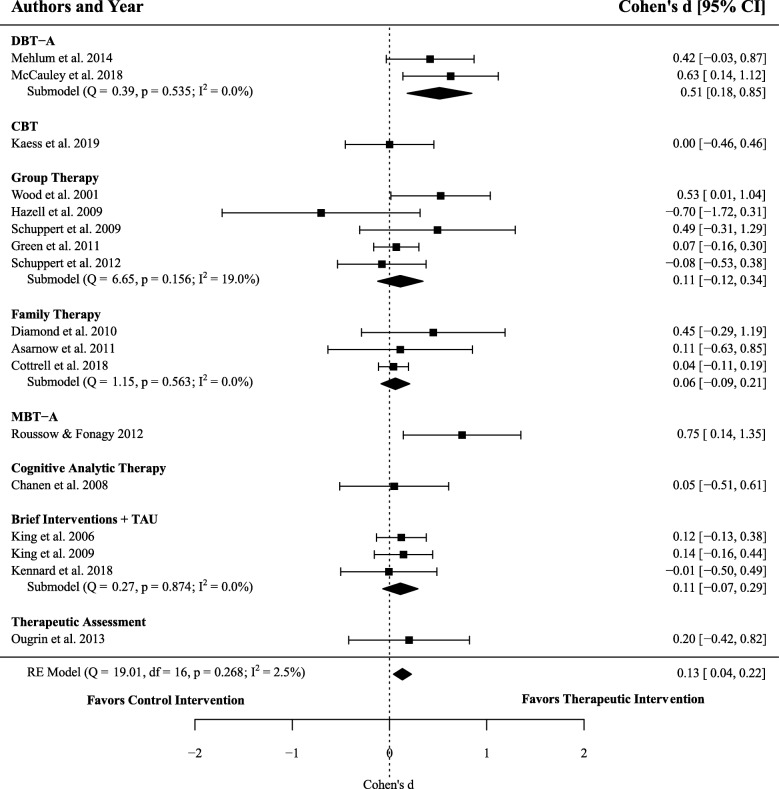
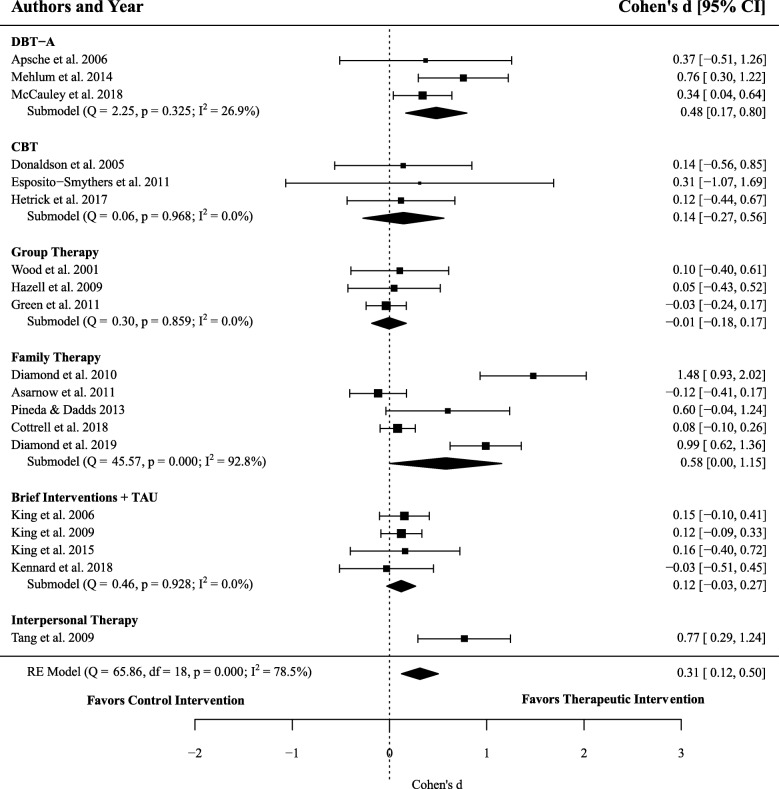
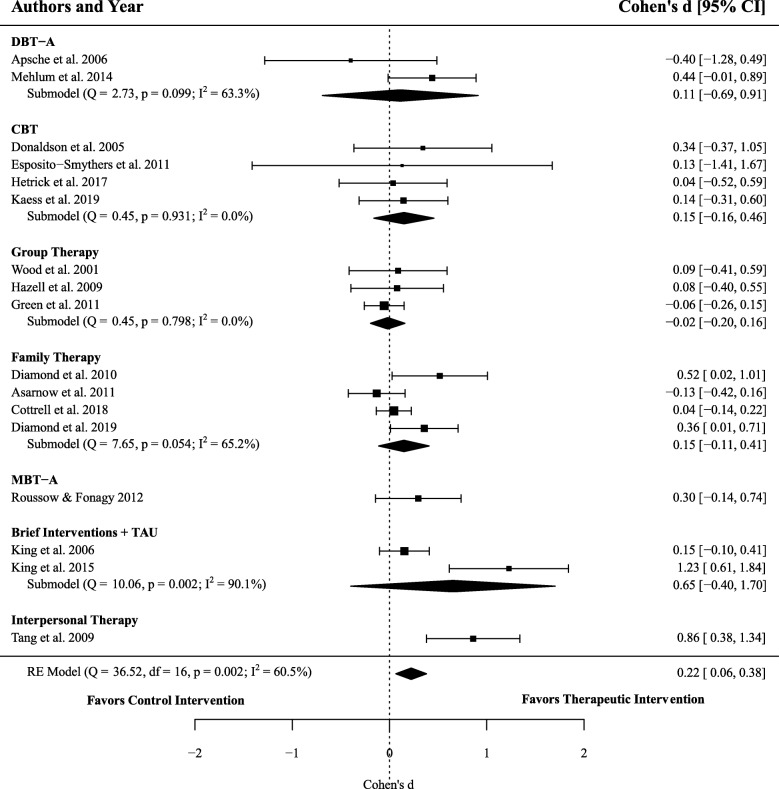
Background: Self-harm is a clinically relevant and prevalent behaviour which peaks in adolescence. Given the high prevalence of self-harm, the high levels of psychiatric comorbidity, and its role as a risk factor for suicide, delivering evidence-based care is critical. Methods: We conducted a systematic review and meta-analysis of the literature on treating self-harm in adolescents (12–19 years) published in the last 20 years, identifying 25 randomised controlled trials. We calculated the effect of treatment interventions relative to active control conditions in reducing self-harm, suicidal ideation and depressive symptoms. Results: Overall, treatment interventions fared slightly better than active controls in decreasing self-harm (d = 0.13, 95% CI 0.04–0.22,p = .004), suicidal ideation (d = 0.31, 95% CI 0.12–0.50,p = .001) and depressive symptoms (d = 0.22, 95% CI 0.07–0.38,p = .006). Subgroup analysis of specific therapies revealed moderate effects of DBT-A in reducing self-harm (d = 0.51, 95% CI 0.18–0.85,p = .002) and suicidal ideation (d = 0.48, 95% CI 0.17–0.80,p = .003), as well as moderate effects of family-centred therapy in the treating suicidal ideation (d = 0.58, 95% CI 0.01–1.15,p = .049). Conclusions: The findings of our meta-analysis indicate that, overall, currently available treatments are effective in treating self-harm, suicidal ideation, and depressive symptoms in adolescence. Although the treatment intervention conditions showed only small to moderate effects in comparison to active controls, these differences were statistically significant and are clinically important. Further research is needed to understand the reduction in self-harm within active controls, which may arise due to the natural course of self-harm, or the potential efficacy of treatment as usual and enhanced usual care. Given the significant reduction of self-harm in active control conditions, delivering effective care to a large number of adolescents with self-harm may require developing stepped-care models in clinical practice. Expensive and poorly available treatments should be targeted at young people who most need them.
Overview
CoChat Summary
## TL;DR
This meta-analysis of 25 randomized controlled trials in adolescents aged 12–19 found that therapeutic interventions were only slightly better than active controls for self-harm, suicidal ideation, and depressive symptoms. DBT-A and family-centred therapy stood out as the most promising specific approaches, while treatment as usual/enhanced usual care also showed sizable improvements.
## Key findings
- Across 25 RCTs with 2962 participants, therapeutic interventions outperformed active controls by a small margin for:
- self-harm: d = 0.13, 95% CI 0.04–0.22, p = .004
- suicidal ideation: d = 0.31, 95% CI 0.12–0.50, p = .001
- depressive symptoms: d = 0.22, 95% CI 0.07–0.38, p = .006
- In subgroup analyses, DBT-A showed moderate effects versus active controls for:
- self-harm: d = 0.51, 95% CI 0.18–0.85, p = .002
- suicidal ideation: d = 0.48, 95% CI 0.17–0.80, p = .003
- Family-centred therapy showed a moderate effect for suicidal ideation: d = 0.58, 95% CI 0.01–1.15, p = .049.
- Active control conditions (mostly TAU/EUC) also showed substantial pre-post improvements across 22 studies:
- self-harm: d = 0.60, 95% CI 0.28–0.92, p < .001
- suicidal ideation: d = 0.87, 95% CI 0.35–1.39, p = .001
- depressive symptoms: d = 0.51, 95% CI 0.07–0.94, p = .002
## Methods
- Systematic review and meta-analysis of studies published from December 1999 to December 2019; included randomized controlled trials of therapeutic interventions for adolescents aged 12–19 with self-harm and/or suicidal ideation.
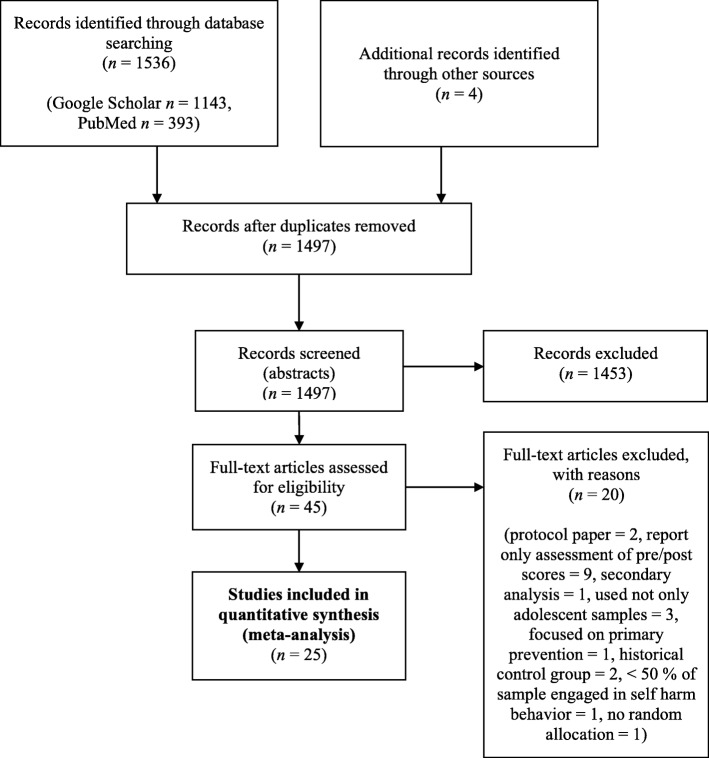
- Searches were conducted in Google Scholar and PubMed; 1536 results were screened, and 25 peer-reviewed journal articles met inclusion criteria.
- Main analysis computed Cohen’s d using random-effects models; outcomes were post-intervention self-harm (primary), suicidal ideation, and depressive symptoms (secondary), with heterogeneity assessed by I2 and publication bias checked with funnel plots, Egger’s regression, and trim-and-fill.
## Limitations
- The paper states that subgroup analyses were limited by the small number of studies in some categories, with some subgroups containing only one study; it says these effects should be interpreted with caution.
- The paper states that heterogeneity was high for suicidal ideation and depressive symptoms, which limits certainty about those pooled estimates.
- Evident from the text: the included samples were mostly young women, and none of the 25 trials reported transgender or gender-diverse participants, limiting generalizability to those groups.
- Evident from the text: only a minority of studies reported follow-up data, so the durability of effects over time remains unclear.
Model-written summary. Check it against the paper before relying on it.
Integrity signals
Registry
Cites
Statistics
Figures
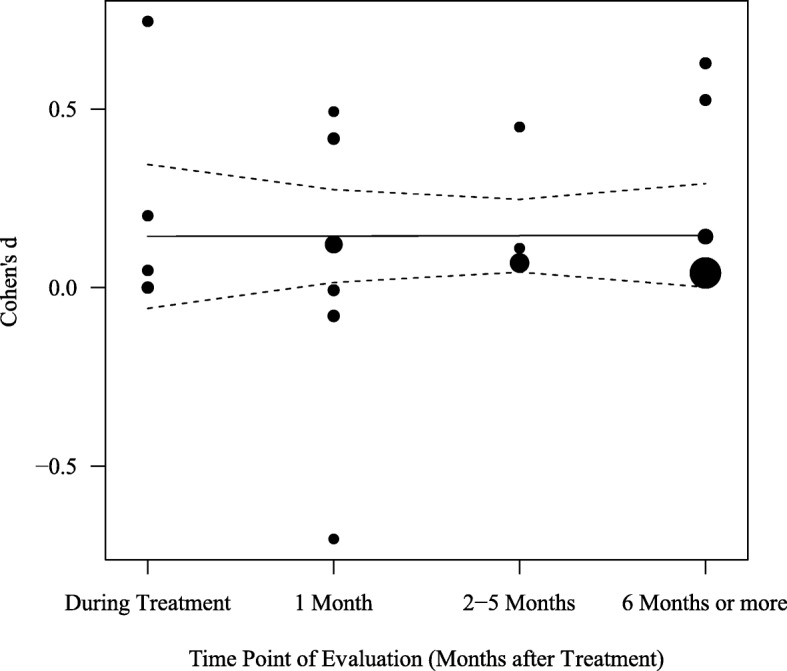
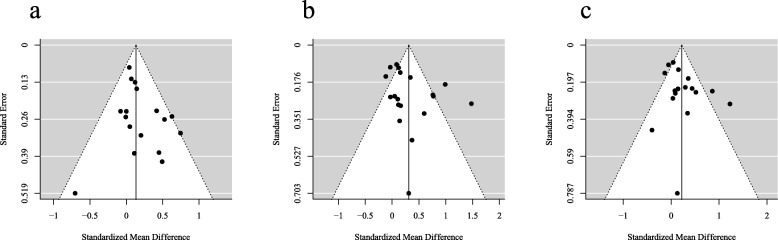
Verification
Claims the paper makes
7 Valid · 1 Not valid · 7 Not checked · 26 Own results and interpretations
Every source the paper cites for this claim was checked and supports it.
In the paper
“with recent evidence that engaging in NSSI is one of the strongest predictors of transition from suicidal thoughts to suicide attempts among adolescents [45].”
§ Does treatment method matter? A meta-analysis of the past 20 years of research on therapeutic interventions for self-harm and suicidal ideation in adolescents > Abstract > Conclusions
What the sources say
- Supportedcites [45] Mars B Heron J Klonsky ED Moran P O’Connor RC Tilling K Predictors of future suicide attempt among adolescents with suicidal thoughts or non-suicidal self-harm: a population-based birth cohort study Lancet Psychiatry 2019 6 4 327 337 10.1016/S2215-0366(19)30030-6 30879972 PMC6494973 source
The Introduction (page not available in our copy) explicitly lists non-suicidal self-harm among the strongest predictors of transition from suicidal thoughts to suicide attempts in adolescents. The Discussion likewise says it is associated with the transition from suicidal thinking to action. (LLM, conf=0.95)
boostedstates an association- Asserted: passes — The authors put it forward as true.
- Checkable: passes — It can be checked against evidence.
- Load-bearing: unclear — It is unclear whether the paper’s conclusions depend on it.
- Based: passes — The paper gives a reason why it holds.
- Supported
A result the paper reports from its own data — it cites no other source for it, so there is none to check. The quote shows it is in the paper.
In the paper
“Subgroup analysis of specific therapies revealed moderate effects of DBT-A in reducing self-harm (d = 0.51, 95% CI 0.18–0.85, p = .002) and suicidal ideation (d = 0.48, 95% CI 0.17–0.80, p = .003)”
- Also stated in: § Applicability of the results · plain
“In terms of therapeutic types most effective for decreasing suicidal ideation, DBT-A also showed a small effect size against control interventions (d = 0.48) with moderate heterogeneity in results, and is larger compared to results of the meta-analysis of adult samples (d = 0.23, [12]).”
§ Does treatment method matter? A meta-analysis of the past 20 years of research on therapeutic interventions for self-harm and suicidal ideation in adolescents > Abstract > Results
plainstates a cause- Asserted: passes — The authors put it forward as true.
- Checkable: passes — It can be checked against evidence.
- Load-bearing: passes — The paper’s conclusions depend on it.
- Based: passes — The paper gives a reason why it holds.
- Also stated in: § Applicability of the results · plain
A result the paper reports from its own data — it cites no other source for it, so there is none to check. The quote shows it is in the paper.
In the paper
“as well as moderate effects of family-centred therapy in the treating suicidal ideation (d = 0.58, 95% CI 0.01–1.15, p = .049).”
- Also stated in: § Applicability of the results · plain
“In contrast to the pattern of results for self-harm behaviours, family-centred therapies also showed a moderate effect against controls in reducing suicidal ideation (d = 0.58).”
§ Does treatment method matter? A meta-analysis of the past 20 years of research on therapeutic interventions for self-harm and suicidal ideation in adolescents > Abstract > Results
plainstates a cause- Asserted: passes — The authors put it forward as true.
- Checkable: passes — It can be checked against evidence.
- Load-bearing: passes — The paper’s conclusions depend on it.
- Based: passes — The paper gives a reason why it holds.
- Also stated in: § Applicability of the results · plain
A result the paper reports from its own data — it cites no other source for it, so there is none to check. The quote shows it is in the paper.
In the paper
“Subgroup analysis of specific therapies revealed moderate effects of DBT-A in reducing self-harm (d = 0.51, 95% CI 0.18–0.85, p = .002) and suicidal ideation (d = 0.48, 95% CI 0.17–0.80, p = .003)”
- Also stated in: § Applicability of the results · plain
“Subgroup analysis of specific types of therapeutic intervention revealed that, when compared to active control interventions, only DBT-A showed significantly better treatment outcomes with a moderate effect (d = 0.51).”
§ Does treatment method matter? A meta-analysis of the past 20 years of research on therapeutic interventions for self-harm and suicidal ideation in adolescents > Abstract > Results
plainstates a cause- Asserted: passes — The authors put it forward as true.
- Checkable: passes — It can be checked against evidence.
- Load-bearing: passes — The paper’s conclusions depend on it.
- Based: passes — The paper gives a reason why it holds.
- Also stated in: § Applicability of the results · plain
A result the paper reports from its own data — it cites no other source for it, so there is none to check. The quote shows it is in the paper.
In the paper
“Overall, treatment interventions fared slightly better than active controls in decreasing self-harm (d = 0.13, 95% CI 0.04–0.22, p = .004), suicidal ideation (d = 0.31, 95% CI 0.12–0.50, p = .001) and depressive symptoms (d = 0.22, 95% CI 0.07–0.38, p = .006).”
- Also stated in: § Efficacy of therapeutic interventions on depressive symptoms · plain
“Meta-analysis resulted in a significant difference between groups (d = 0.22, 95% CI 0.07–0.38, p = .006), with moderate heterogeneity between studies (I2 = 56.70%). That is, therapeutic interventions were moderately more effective at reducing symptoms of depression compared to control treatments.”
- Also stated in: § Discussion · hedged
“Our results indicate that compared to active control conditions, participants assigned to therapeutic interventions showed significantly greater decreases in self-harm behaviour (d = 0.13), suicidal ideation (d = 0.31), and depressive symptoms (d = 0.22) with small effect sizes.”
§ Does treatment method matter? A meta-analysis of the past 20 years of research on therapeutic interventions for self-harm and suicidal ideation in adolescents > Abstract > Results
plainstates a causen = 2,071 ·- Asserted: passes — The authors put it forward as true.
- Checkable: passes — It can be checked against evidence.
- Load-bearing: passes — The paper’s conclusions depend on it.
- Based: passes — The paper gives a reason why it holds.
- Also stated in: § Efficacy of therapeutic interventions on depressive symptoms · plain
19 more claims
Create a free account to see all 41 claims and every source verdict.
- Probably not a substantial claim. 2
- It may state two separate claims as one. 16
Claims other papers make about this one
Each is checked against this paper’s own text: does it say what the citing paper says it does?
The cited source doesn’t support the claim as written.
In the citing paper
“However, previous meta-analysis focused exclusively on a small number (k = 3) of randomized controlled trials (RCTs; Kothgassner et al., 2020), and the systematic review of controlled clinical trials (CCTs, trials including a control group, but which lack randomization) and pre-post evaluations only included studies published prior to July 2013 (k = 5, no RCTs; Glenn et al., 2015).”
From Efficacy of dialectical behavior therapy for adolescent self-harm and suicidal ideation: a systematic review and meta-analysis (2021) · cites this paper as Kothgassner et al., 2020
Checked by a reasoning model — may be wrong.
Experimental — accuracy not yet measuredThe source backs part of the claim, not all of it — or backs it for a different population, condition or comparison.
In the citing paper
“A growing body of research demonstrates that therapeutic interventions for self-harm and suicidal ideation in general show limited efficacy (Fox et al., 2020; Kothgassner et al., 2020), highlighting the importance of isolating specific therapies which show promise for further development.”
From Efficacy of dialectical behavior therapy for adolescent self-harm and suicidal ideation: a systematic review and meta-analysis (2021) · cites this paper as Kothgassner et al., 2020
Experimental — accuracy not yet measuredThe source backs part of the claim, not all of it — or backs it for a different population, condition or comparison.
In the citing paper
“According to international standards, Dialectical Behavior Therapy for Adolescents (DBT®-A) is an evidence-based treatment for these patients, especially concerning the reduction of self-harm (8–11).”
From Radical Acceptance of Reality: Putting DBT®-A Skill Groups Online During the COVID-19 Pandemic: A Qualitative Study (2022) · cites this paper as [9]
Experimental — accuracy not yet measuredThe source backs part of the claim, not all of it — or backs it for a different population, condition or comparison.
In the citing paper
“The absence of an intervention effect for secondary mental health and well-being outcomes was unexpected yet appears to corroborate findings from prior meta-analytic studies that even face-to-face DBT does not significantly reduce depressive symptoms among adolescents (p = 0.099; [32]) nor adults (p = 0.08; [33]).”
From The effect of a therapeutic smartphone application on suicidal ideation in young adults: Findings from a randomized controlled trial in Australia. (2022) · cites this paper as [32]
Experimental — accuracy not yet measuredThe source backs part of the claim, not all of it — or backs it for a different population, condition or comparison.
In the citing paper
“It is also noteworthy that the immediate effect of Lifebuoy on suicidal ideation in our postintervention period (d = 0.45) is comparable to the pooled effects reported for the intensive face-to-face DBT treatment of suicidal ideation (e.g., d = 0.48) [32].”
From The effect of a therapeutic smartphone application on suicidal ideation in young adults: Findings from a randomized controlled trial in Australia. (2022) · cites this paper as [32]
Experimental — accuracy not yet measured
1 more claim about this paper
Create a free account to see every claim other papers make about this one.
Statistics recomputed
Every reported test result, recomputed from its test statistic and degrees of freedom. A result shows as not adding up only once an independent check has confirmed it.
- Consistentz = 1.59reported p = .112 · recomputed p = .112
“(z = 1.59, p = .112”
- Consistentz = 1.1reported p = .273 · recomputed p = .271
“(z = 1.10, p = .273”
- Consistentz = 1.4reported p = .162 · recomputed p = .162
“(z = 1.40, p = .162”
Self-check
Percentages, sums and reported differences re-computed from the paper’s own numbers.
Each contradiction between two passages listed here was confirmed by an independent check.
Rated minor: it would not touch a result — a value no result rests on, a p-value that stays on the same side of the significance level, or a conflict that is clerical, resolved elsewhere in the paper, or outside its own findings.
In the paper
§ Does treatment method matter? A meta-analysis of the past 20 years of research on therapeutic interventions for self-harm and suicidal ideation in adolescents > Discussion
“we conducted a systematic review and meta-analysis of 25 studies (including 9 studies new to this meta-analysis)”
§ Does treatment method matter? A meta-analysis of the past 20 years of research on therapeutic interventions for self-harm and suicidal ideation in adolescents > Abstract > Conclusions
“we decided to conduct a meta-analysis of all controlled studies and RCTs published in the last 20 years, including the 12 studies not included in the most recent meta-analysis [57].”
Citations
Cites
Diagnostic and Statistical Manual of Mental Disorders
American Psychiatric Association (2013) · doi:10.1176/appi.books.9780890425596 · Cited by 116,369
Statistical Power Analysis for the Behavioral Sciences
Muller, K. (1989) · Technometrics · doi:10.1080/00401706.1989.10488618 · Cited by 99,167
Statistical power analysis for the behavioral sciences
(1990) · Computers, Environment and Urban Systems · doi:10.1016/0198-9715(90)90050-4 · Cited by 65,269
Measuring inconsistency in meta-analyses
Higgins, J. P. T., Thompson, S. G., Deeks, J. J., & Altman, D. G. (2003) · BMJ · doi:10.1136/bmj.327.7414.557 · Cited by 63,139 · cited 1×
“Heterogeneity across study outcomes was reported with I(2) values, where 25% indicates low, 50% moderate, and 75% high heterogeneity [32].”
BackgroundConducting Meta-Analyses in R with the metafor Package
Viechtbauer, W. (2010) · Journal of Statistical Software · doi:10.18637/jss.v036.i03 · Cited by 20,464 · cited 1×
“Effect size calculations and subsequent meta-analysis were then conducted with the metafor package for R [71], which automatically corrects Cohen’s d for the potential positive bias in small samples [30].”
Method(2000) · Cited by 9,198
Distribution Theory for Glass's Estimator of Effect Size and Related Estimators
Hedges, L. V. (1981) · Journal of Educational Statistics · doi:10.2307/1164588 · Cited by 5,695 · cited 1×
“Effect size calculations and subsequent meta-analysis were then conducted with the metafor package for R [71], which automatically corrects Cohen’s d for the potential positive bias in small samples [30].”
MethodA Nonparametric “Trim and Fill” Method of Accounting for Publication Bias in Meta-Analysis
Duval, S., & Tweedie, R. (2000) · Journal of the American Statistical Association · doi:10.1080/01621459.2000.10473905 · Cited by 2,955
Self-harm and suicide in adolescents
Hawton, K., Saunders, K. E., & O'Connor, R. C. (2012) · The Lancet · doi:10.1016/s0140-6736(12)60322-5 · Cited by 2,306 · cited 1×
“Self-harm, defined as intentional self-poisoning or injury of oneself irrespective of suicidal motivation or intent [26], is a behaviour widespread among adolescents.”
BackgroundMeta-analysis of experiments with matched groups or repeated measures designs
Dunlap, W. P., Cortina, J. M., Vaslow, J. B., & Burke, M. J. (1996) · Psychological Methods · doi:10.1037/1082-989x.1.2.170 · Cited by 1,693 · cited 1×
“To analyse the effect of control interventions from pre- to post-measurement, we computed the standardized mean difference (Cohen’s d) based on the means and standard deviations [16] of self-harm, depressive symptoms, and suicidal ideation before and after the control interventions.”
Method
Research works printed but not linked: 1
- Cochrane Collaboration Review manager (RevMan) [computer program]. Version 5.3 2014 Copenhagen The Nordic Cochrane Centre
Cited by
Kothgassner, O. D., Goreis, A., Robinson, K., Huscsava, M. M., Schmahl, C., & Plener, P. L. (2021) · Psychological Medicine · doi:10.1017/s0033291721001355 · Cited by 288
“A growing body of research demonstrates that therapeutic interventions for self-harm and suicidal ideation in general show limited efficacy (Fox et al., 2020; Kothgassner et al., 2020), highlighting the importance of isolating specific therapies which show promise for further development.”
Self-citationSelf-harm in the context of borderline personality disorder
Reichl, C., & Kaess, M. (2021) · Current Opinion in Psychology · doi:10.1016/j.copsyc.2020.12.007 · Cited by 175
Zieliński, G., Pająk, A., & Wójcicki, M. (2024) · Journal of Clinical Medicine · doi:10.3390/jcm13144259 · Cited by 235
“This was a 20-year timeframe, chosen based on earlier works [52–54].”
MethodInterventions for self-harm in children and adolescents
Witt, K. G., Hetrick, S. E., Rajaram, G., Hazell, P., Taylor Salisbury, T. L., Townsend, E., & Hawton, K. (2021) · Cochrane Database of Systematic Reviews · doi:10.1002/14651858.cd013667.pub2 · Cited by 149
Kaess, M., Hooley, J. M., Klimes‐Dougan, B., Koenig, J., Plener, P. L., Reichl, C., Robinson, K., Schmahl, C. G., Sicorello, M., Schreiner, M. W., et al. (2021) · Neuroscience & Biobehavioral Reviews · doi:10.1016/j.neubiorev.2021.08.022 · Cited by 163
“Although the social and psychological contributions to risk for developing NSSI are relatively well understood and have guided the development of effective psychosocial treatments for self-injury (Kothgassner et al., 2020), the biological mechanisms underlying NSSI have just begun to come to light.”
BackgroundSelf-citationSuicide in young people: screening, risk assessment, and intervention
Hughes, J. L., Horowitz, L. M., Ackerman, J. P., Adrian, M. C., Campo, J. V., & Bridge, J. A. (2023) · BMJ · doi:10.1136/bmj-2022-070630 · Cited by 135
Ougrin, D., Wong, B. H.-C., Vaezinejad, M., Plener, P. L., Mehdi, T., Romaniuk, L., Barrett, E., Hussain, H., Lloyd, A., Tolmac, J., et al. (2022) · European Child & Adolescent Psychiatry · doi:10.1007/s00787-021-01741-6 · Cited by 127
Self-citationRobinson, K., Garisch, J. A., & Wilson, M. (2021) · Journal of Affective Disorders · doi:10.1016/j.jad.2020.12.201 · Cited by 91
Self-citationTorok, M., Han, J., McGillivray, L., Wong, Q., Werner-Seidler, A., O’Dea, B., Calear, A., & Christensen, H. (2022) · PLoS Medicine · doi:10.1371/journal.pmed.1003978 · Cited by 71
Impact of the COVID-19 pandemic on child and adolescent mental health services
Huang, H. C.-H., & Ougrin, D. (2021) · BJPsych Open · doi:10.1192/bjo.2021.976 · Cited by 70
Self-citationJones, G. M., & Nock, M. K. (2022) · Journal of Psychopharmacology · doi:10.1177/02698811211058923 · Cited by 68
“Moreover, meta-analyses of existing treatments suggest that they have small effects at best (Inagaki et al., 2015; Kothgassner et al., 2020; Tarrier et al., 2008).”
BackgroundBahji, A., Pierce, M., Wong, J., Roberge, J. N., Ortega, I., & Patten, S. (2021) · JAMA Network Open · doi:10.1001/jamanetworkopen.2021.6614 · Cited by 60
Wong, B. H.-C., Cross, S., Zavaleta-Ramírez, P., Bauda, I., Hoffman, P. E., Ibeziako, P. I., Nussbaum, L. A., Berger, G. E., Hassanian‐Moghaddam, H., Kapornai, K., et al. (2023) · Journal of the American Academy of Child & Adolescent Psychiatry · doi:10.1016/j.jaac.2022.11.016 · Cited by 73
Self-citationLutz, N. M., Neufeld, S., Hook, R. W., Jones, P. B., Bullmore, E. T., Goodyer, I. M., Ford, T. J., Chamberlain, S. R., & Wilkinson, P. O. (2022) · Archives of Suicide Research · doi:10.1080/13811118.2022.2084004 · Cited by 93
Bjureberg, J., Kuja‐Halkola, R., Ohlis, A., Lichtenstein, P., D'Onofrio, B. M., Hellner, C., & Cederlöf, M. (2021) · Journal of Child Psychology and Psychiatry · doi:10.1111/jcpp.13544 · Cited by 58
Help-seeking duration in adolescents with suicidal behavior and non-suicidal self-injury
Lustig, S., Koenig, J., Resch, F., & Kaess, M. (2021) · Journal of Psychiatric Research · doi:10.1016/j.jpsychires.2021.05.037 · Cited by 59
He, H., Hong, L., Jin, W., Xu, Y. Q., Kang, W., Liu, J., Song, J., Zheng, T., Chen, H., & Zhao, K. (2023) · BMC Psychiatry · doi:10.1186/s12888-023-04808-7 · Cited by 50
Itzhaky, L., Davaasambuu, S., Ellis, S. P., Cisneros-Trujillo, S., Hannett, K., Scolaro, K., Stanley, B. H., Mann, J. J., Wainberg, M. L., Oquendo, M. A., et al. (2022) · Journal of Affective Disorders · doi:10.1016/j.jad.2021.12.094 · Cited by 33
Efficacy of mentalization‐based therapy in treating self‐harm: A systematic review and meta‐analysis
Hajek Gross, C., Oehlke, S., Prillinger, K., Goreis, A., Plener, P. L., & Kothgassner, O. D. (2024) · Suicide and Life-Threatening Behavior · doi:10.1111/sltb.13044 · Cited by 31
Self-citationLakeman, R., & Crighton, J. (2020) · Issues in Mental Health Nursing · doi:10.1080/01612840.2020.1817208 · Cited by 31
“It is one of few established and effective treatments for self-harm and suicidal behaviour (DeCou et al., 2019; Kothgassner et al., 2020; Ougrin et al., 2015) and has been found useful in the treatment of substance misuse (Haktanır & Callender, 2020), depression, eating disorders, those with suicidal ideation and non-…”
BackgroundTrajectories of Treatment Response and Nonresponse in Youth at High Risk for Suicide
Berk, M. S., Gallop, R., Asarnow, J. R., Adrian, M. C., Avina, C., Hughes, J. L., Korslund, K. E., & McCauley, E. (2022) · Journal of the American Academy of Child & Adolescent Psychiatry · doi:10.1016/j.jaac.2022.01.010 · Cited by 25
Buerger, A., Emser, T. S., Seidel, A., Scheiner, C., von Schoenfeld, C., Ruecker, V., Heuschmann, P. U., & Romanos, M. (2022) · Trials · doi:10.1186/s13063-021-05973-4 · Cited by 33
“As it has been proven that skills-based approaches in targeted prevention might change the tragic development of suicidality [14], increased efforts should be undertaken to develop universal prevention programs based on a skills-based approach in order to reduce NSSI in a school setting.”
BackgroundInfluentialWitt, K., Stewart, A. L., & Hawton, K. E. (2024) · Journal of Child Psychology and Psychiatry · doi:10.1111/jcpp.14052 · Cited by 35
“…reviews, including our own, have also concluded that a number of interventions for self-harm in young people appear to be equally effective (or ineffective) compared to the control or comparator condition (Kothgassner et al., 2020; Morken, Dahlgren, Lunde, & Toven, 2022; Witt et al., 2021a).”
Hamza, C. A., Robinson, K., Hasking, P. A., Heath, N. L., Lewis, S. P., Lloyd‐Richardson, E. E., Whitlock, J. L., & Wilson, M. (2021) · Journal of American College Health · doi:10.1080/07448481.2021.1961782 · Cited by 23
“24,25 Should this training be unavailable, hosting professional development workshops or related opportunities for campus mental health professionals may be needed.”
BackgroundMethodInfluentialSelf-citationPsychotherapie nach einem Suizidversuch – Evidenzlage und Bewertung
Teismann, T., & Gysin-Maillart, A. (2021) · Bundesgesundheitsblatt - Gesundheitsforschung - Gesundheitsschutz · doi:10.1007/s00103-021-03466-y · Cited by 27
“1 Es sei allerdings angemerkt, dass TAU alleine nicht selteneinendeutlichpositivenEffekt zeigt [24].”
BackgroundTownsend, E., Ness, J., Waters, K., Rehman, M., Kapur, N., Clements, C., Geulayov, G., Bale, E., Casey, D., & Hawton, K. E. (2022) · Child and Adolescent Mental Health · doi:10.1111/camh.12544 · Cited by 40
Jones, G. M., Arias, D., & Nock, M. K. (2022) · Scientific Reports · doi:10.1038/s41598-022-25658-5 · Cited by 24
Hammond, N. G., Semchishen, S. N., Geoffroy, M., Sikora, L., Wafy, G., Hsueh, L., Khan, H., Edwards, J., Gravel, C. A., Ferro, M. A., et al. (2025) · The Lancet Psychiatry · doi:10.1016/s2215-0366(25)00217-2 · Cited by 34
Luccarelli, J., McCoy, T. H., Henry, M., Smith, F. A., Beach, S. R., & Fernandez-Robles, C. G. (2023) · General Hospital Psychiatry · doi:10.1016/j.genhosppsych.2023.03.012 · Cited by 18
Physiological stress reactivity and self-harm: A meta-analysis
Goreis, A., Prillinger, K., Bedus, C., Lipp, R., Mayer, A. C., Nater, U. M., Koenig, J., Plener, P. L., & Kothgassner, O. D. (2023) · Psychoneuroendocrinology · doi:10.1016/j.psyneuen.2023.106406 · Cited by 24
“…in people with self-harm — may be valuable additions to already established psycho-therapy, where DBT-A can be regarded as the first recommended path of action due to its primary goal of reducing emotional distress and increasing stress coping skills in general (Kothgassner et al., 2021, 2020).”
Self-citationCommunicating distress: suicide threats/gestures among clinical and community youth
Robinson, K., Scharinger, C., Brown, R. C., & Plener, P. L. (2022) · European Child & Adolescent Psychiatry · doi:10.1007/s00787-022-01960-5 · Cited by 21
“Although the nomenclature of SITBs is the subject of continuing debate [15], SITBs have been distinguished by intent to die into the two superordinate clusters: Suicidal phenomena and non-suicidal phenomena [17].”
BackgroundSelf-citationOpen Science in Suicide Research Is Open for Business
Kirtley, O. J., Janssens, J. J., & Kaurin, A. (2022) · Crisis · doi:10.1027/0227-5910/a000859 · Cited by 19
“…are choosing to share their data in the interests of transparency, reproducibility, and potential reuse (Holman & Williams, 2019; Knipe et al., 2021;Millner, 2016; Robinson&Wilson, 2020), including from meta-analyses (Kothgassner et al., 2020) andnarrative reviews (Kirtley, Rodhamet al., 2019).”
BackgroundMental health interventions in adolescence
Campisi, S. C., Ataullahjan, A., Baxter, J. B., Szatmári, P., & Bhutta, Z. A. (2022) · Current Opinion in Psychology · doi:10.1016/j.copsyc.2022.101492 · Cited by 24
Wang, Z., Li, D., Chen, Y., Tao, Z., Jiang, L., He, X., & Zhang, W. (2024) · Psychiatry Research · doi:10.1016/j.psychres.2024.115816 · Cited by 24
Kanani, J. (2025) · Neuroscience and Neurological Surgery · doi:10.31579/2578-8868/359 · Cited by 18
Adrian, M. C., Blossom, J. B., Chu, P. V., Jobes, D. A., & McCauley, E. (2022) · Practice Innovations · doi:10.1037/pri0000156 · Cited by 23
Diurnal variation of cardiac autonomic activity in adolescent non-suicidal self-injury
Sigrist, C., Jakob, H., Beeretz, C. J., Schmidt, S. J., Kaess, M., & Koenig, J. (2023) · European Archives of Psychiatry and Clinical Neuroscience · doi:10.1007/s00406-023-01574-1 · Cited by 20
“The social and psychological aspects that contribute to the risk for NSSI are relatively well understood (see e.g. [16, 120], and have guided the development of important and effective psychosocial treatments (see e.g. [66]).”
BackgroundAttentional Biases and Nonsuicidal Self-Injury Urges in Adolescents
Goreis, A., Pfeffer, B., Gross, C. H., Klinger, D., Oehlke, S., Zesch, H. E., Claes, L., Plener, P. L., & Kothgassner, O. D. (2024) · JAMA Network Open · doi:10.1001/jamanetworkopen.2024.22892 · Cited by 18
Self-citationA Rhesus Monkey Model of Non-suicidal Self-Injury
Novak, M. A., & Meyer, J. S. (2021) · Frontiers in Behavioral Neuroscience · doi:10.3389/fnbeh.2021.674127 · Cited by 19
“The most noteworthy approach was dialectical behavior therapy targeted for adolescents (DBT-A) which had moderate effects in reducing NSSI (Kothgassner et al., 2020).”
BackgroundSolution-focused approaches for treating self-injurious thoughts and behaviours: a scoping review
Jerome, L., Masood, S. S., Henden, J., Bird, V., & Ougrin, D. (2024) · BMC Psychiatry · doi:10.1186/s12888-024-06101-7 · Cited by 16
Self-citationSchulte-Frankenfeld, P. M., Breedvelt, J., Brouwer, M. E., van der Spek, N., Bosmans, G., & Bockting, C. (2024) · Clinical Psychology in Europe · doi:10.32872/cpe.13717 · Cited by 18
“However, efficacy of these interventions for adolescent populations was found to be low overall and has stagnated for decades (Busby et al., 2020; Fox et al., 2020; Franklin et al., 2017; Kothgassner et al., 2020; Robinson et al., 2018; Tarrier et al., 2008).”
Bock, M. M., Graf, T., Woeber, V., Kothgassner, O. D., Buerger, A., & Plener, P. L. (2022) · Frontiers in Psychiatry · doi:10.3389/fpsyt.2022.617941 · Cited by 13
Self-citationCloutier, P., Gray, C., Sheridan, N., Silverman, A. J., Cappelli, M., Zemek, R. L., Jabbour, M., Reid, S. M., & Kennedy, A. (2021) · Child and Adolescent Mental Health · doi:10.1111/camh.12506 · Cited by 17
Universal prevention for non-suicidal self-injury in adolescents is scarce - A systematic review
Bürger, A., von Schoenfeld, C., Scheiner, C., Seidel, A., Wasserscheid, A., Gad, D., Kittel‐Schneider, S., Romanos, M., & Reiter, A. M. F. (2023) · Frontiers in Psychiatry · doi:10.3389/fpsyt.2023.1130610 · Cited by 15
Jahn, C., Wieacker, E., Bender, S., & Krischer, M. (2021) · Praxis der Kinderpsychologie und Kinderpsychiatrie · doi:10.13109/prkk.2021.70.8.728 · Cited by 14
Self‐Injurious behavior in rhesus macaques: Issues and challenges
Novak, M. A. (2020) · American Journal of Primatology · doi:10.1002/ajp.23222 · Cited by 16
“Additionally, a meta‐analysis of different behavioral therapies revealed small but positive effect sizes for several of these therapies suggesting that the behavior was not completely eliminated (Kothgassner et al., 2020).”
BackgroundDevelopment and Psychometric Properties of the Test of Passive Aggression
Schanz, C. G., Equit, M., Schäfer, S. K., Käfer, M., Mattheus, H. K., & Michael, T. (2021) · Frontiers in Psychology · doi:10.3389/fpsyg.2021.579183 · Cited by 19
“However, patients of Study 1 received a multidisciplinary intervention, including psychotherapeutic and psychopharmacological treatment, and therefore interventions sufficient to change levels of aggressive behavior (Jones R. M. et al., 2011; Karakurt et al., 2016; Kothgassner et al., 2020).”
BackgroundMorthorst, B. R., Olsen, M. H., Jakobsen, J. C., Lindschou, J., Gluud, C. N., Heinrichsen, M., Møhl, B., Rubæk, L., Ojala, O., Hellner, C., et al. (2022) · JCPP Advances · doi:10.1002/jcv2.12115 · Cited by 16
“A) in adolescents with persistent self‐harming behavior and personality disorder traits both in individual trials (McCauley et al., 2018; Mehlum et al., 2014) and meta‐analysis (Kothgassner et al., 2020).”
BackgroundWright-Hughes, A. M., Farrin, A. J., Fonagy, P., Ougrin, D., Stahl, D. R., Wright, J. M., Irving, D., Mughal, F., Truscott, A., Diggins, E., et al. (2025) · Journal of the American Academy of Child & Adolescent Psychiatry · doi:10.1016/j.jaac.2025.01.017 · Cited by 15
Self-citationJohansson, B. A., Ramsay, K. W., Pettersson, A., & Bjureberg, J. (2025) · European Child & Adolescent Psychiatry · doi:10.1007/s00787-025-02859-7 · Cited by 15
“Similarly, group therapy showed effectiveness for self-harm in one review [19], but not in two others [14, 18].”
InfluentialPsychological interventions for suicidal behavior in adolescents: a comprehensive systematic review
García-Fernández, A., Bobes-Bascarán, T., Martínez-Cao, C., González-Blanco, L., Fernández, J. F., Madera, P. Z., Zazo, E. S., Jiménez-Treviño, L., García‐Portilla, M. P., Bobes, J., et al. (2024) · Translational Psychiatry · doi:10.1038/s41398-024-03132-2 · Cited by 17
“Over the past two decades, psychotherapies speci fi cally designed to reduce suicidal thoughts and behaviors in adolescents have multiplied signi fi cantly [6, 7].”
BackgroundEmerging ecophenotype: reward anticipation is linked to high-risk behaviours after sexual abuse
Pechtel, P., Harris, J. R., Karl, A., Clunies-Ross, C., Bower, S., Moberly, N. J., Pizzagalli, D. A., & Watkins, E. R. (2022) · Social Cognitive and Affective Neuroscience · doi:10.1093/scan/nsac030 · Cited by 15
“Only a few interventions show small effects for specific HRB (e.g. self-harm; Kothgassner et al., 2020).”
BackgroundExperiences of dialectical behaviour therapy for adolescents: A qualitative analysis
Ohlis, A., Bjureberg, J., Ojala, O., Kerj, E., Hallek, C., Fruzzetti, A. E., & Hellner, C. (2023) · Psychology and Psychotherapy Theory Research and Practice · doi:10.1111/papt.12447 · Cited by 19
Luccarelli, J., McCoy, T. H., Seiner, S. J., & Henry, M. (2022) · Brain stimulation · doi:10.1016/j.brs.2022.08.011 · Cited by 11
“At present, there is little evidence for pharmacologic treatments for the treatment of self-harm behaviors [3] or suicidal ideation [9] in adolescents, with only psychotherapeutic techniques showing evidence of efficacy.”
BackgroundFenton, C., Attwell, L., Standley, E., & Holmes, J. (2023) · International Journal of Mental Health Nursing · doi:10.1111/inm.13164 · Cited by 12
Dibaj, I. S., Tørmoen, A. J., Klungsøyr, O., Morken, K. T. E., Haga, E., Dymbe, K. J., & Mehlum, L. I. (2024) · European Child & Adolescent Psychiatry · doi:10.1007/s00787-024-02602-8 · Cited by 17
“Dialectical Behaviour Therapy for adolescents [DBT-A], currently the treatment with the strongest evidence of effectiveness in the treatment of adolescents presenting with DSH and ED [16], helps patients replace DSH and dysfunctional coping strategies with more functional behaviour [17].”
Al‐Halabí, S., & Fonseca‐Pedrero, E. (2023) · Revista de Psicoterapia · doi:10.5944/rdp.v34i124.37050 · Cited by 14
Patterns of six behaviors and psychosomatic symptoms in adolescents: A six-province study in China
Li, D., Yang, R., Hu, J., Xue, Y., Huang, X., Wan, Y., Fang, J. Q., & Zhang, S. (2021) · Journal of Affective Disorders · doi:10.1016/j.jad.2021.10.118 · Cited by 12
Wilson, E., & Ougrin, D. (2021) · Child and Adolescent Mental Health · doi:10.1111/camh.12502 · Cited by 13
Self-citationRobinson, K., Garisch, J. A., & Wilson, M. (2020) · doi:10.31234/osf.io/z58mc · Cited by 9
Self-citationColville, L., Anderson, J., & Burn, A. (2024) · Emotional and Behavioural Difficulties · doi:10.1080/13632752.2024.2405806 · Cited by 9
“Self-harm in young people is associated with an average lifetime prevalence rate of 17% (Kothgassner et al. 2020).”
Liao, X., Xine, L., & Ni, J. (2025) · BMJ Open · doi:10.1136/bmjopen-2024-087346 · Cited by 9
Peripheral and neural correlates of self-harm in children and adolescents: a scoping review
Sparrow-Downes, V. M., Trincao-Batra, S., Cloutier, P., Helleman, A., Salamatmanesh, M., Gardner, W. P., Baksh, A., Kapur, R., Sheridan, N., Suntharalingam, S., et al. (2022) · BMC Psychiatry · doi:10.1186/s12888-022-03724-6 · Cited by 9
Pediatric suicide: Review of a preventable tragedy
Greydanus, D. E., Nazeer, A., Qayyum, Z., Patel, D. R., Rausch, R., Hoang, L.-N., Miller, C., Chahin, S. S., Apple, R. W., Saha, G. K., et al. (2024) · Disease-a-Month · doi:10.1016/j.disamonth.2024.101725 · Cited by 13
Hammond, N. G., Gravel, C. A., Ferro, M. A., Landry, H., Geoffroy, M., Racine, N. M., & Colman, I. (2025) · The Canadian Journal of Psychiatry · doi:10.1177/07067437251315526 · Cited by 14
In‐Albon, T., Schlau, S., & Friedrich, S. (2025) · Die Psychotherapie · doi:10.1007/s00278-025-00771-8 · Cited by 7
“Bei den Interventionen für suizi-daleKinderundJugendlichegibtesderzeit positive Evidenz für die Dialektisch-Beha-viorale Therapie für Jugendliche (DBT-A; Fleischhaker et al. 2011) und für die kogni-tive Verhaltenstherapie (KVT; Itzhaky et al. 2022; Kothgassner et al. 2020; Witt et al. 2021).”
Qin, Y., Wu, D., Liu, J., Peng, J., & Li, C. (2023) · Frontiers in Psychiatry · doi:10.3389/fpsyt.2023.1237436 · Cited by 7
Lutz, N. M., Chamberlain, S. R., Grant, J. E., Löchner, C., Wilkinson, P. O., Ford, T. J., & Neufeld, S. (2024) · Journal of Affective Disorders · doi:10.1016/j.jad.2024.08.224 · Cited by 13
“Though clinical research has primarily studied NSSI treatment in majority female samples (Kothgassner et al., 2020), recent studies with men and TGNC patients find positive effects of DBT (Anestis et al., 2020; Birt et al., 2022; Camp et al., 2024).”
ResultZainal, N. H. (2023) · Psychological Medicine · doi:10.1017/s0033291723003306 · Cited by 11
You’re not alone: imagery rescripting for adolescents who self-harm
Schmied, E., Hack, L., Connemann, B. J., Sosic-Vasic, Z., & Kroener, J. (2024) · Frontiers in Psychology · doi:10.3389/fpsyg.2024.1395603 · Cited by 10
Pollock, C., Grenyer, B. F. S., & Townsend, M. L. (2024) · Children and Youth Services Review · doi:10.1016/j.childyouth.2024.107927 · Cited by 8
Farbstein, D., Lukito, S., Yorke, I., Wilson, E., Crudgington, H., El-Aalem, O., Cliffe, C., Bergou, N., Itani, L. A., Owusu, A., et al. (2022) · BMJ Open · doi:10.1136/bmjopen-2021-058297 · Cited by 11
Self-citationA unique model of care for youth in crisis: A pilot open trial.
Adrian, M. C., Twohy, E., Babeva, K. N., Jenness, J. L., Gurtovenko, K., Blossom, J. B., King, S., McCartney, L., & McCauley, E. (2024) · Psychological Services · doi:10.1037/ser0000778 · Cited by 12
Reichl, C., Schär, S., Lerch, S., Hedinger, N., Brunner, R. M., Koenig, J., & Kaess, M. (2024) · Psychoneuroendocrinology · doi:10.1016/j.psyneuen.2024.107093 · Cited by 13
“…adolescents, particularly highlighting the role of specialized treatment programs: Comparing different interventions, meta-analyses reported the strongest effects in the reduction of self-harm for Dialectic-Behavioral Therapy for Adolescents (DBT-A; Kothgassner et al., 2020; Witt et al., 2021).”
BackgroundMughal, F., Young, P. J., Stahl, D. R., Asarnow, J. R., & Ougrin, D. (2025) · JCPP Advances · doi:10.1002/jcv2.12302 · Cited by 8
Self-citationSchool-based recommendations for addressing nonsuicidal self-injury: Application to rural settings.
Lewis, S. P., Heath, N. L., Bloom, E. L., Baetens, I., Brausch, A. M., Hamza, C. A., Muehlenkamp, J. J., & Robinson, K. (2022) · Rural Mental Health · doi:10.1037/rmh0000211 · Cited by 9
Self-citationLu, J., Gao, W., Wang, Z., Yang, N., Pang, W. I. P., Lok, K.-I., & Rao, W. (2023) · Frontiers in Public Health · doi:10.3389/fpubh.2023.1281696 · Cited by 9
Robinson, K., Grey, I., Broodryk, T., Hove, L. V., & Wilson, M. (2025) · Australian & New Zealand Journal of Psychiatry · doi:10.1177/00048674241312797 · Cited by 6
“…et al., 2016; Nock, 2009), our results provide initial support that the therapeutic interventions scaffolding emotion regulation that successfully reduce NSSI among adolescents and emerging adults (Kothgassner et al., 2020, 2021) may show promise for middle-aged and older adults who self-injure.”
Self-citationHu, R., Li, J., Luo, H., Guo, Y., Tan, J., Li, S., & Luo, Q. (2025) · Journal of Affective Disorders · doi:10.1016/j.jad.2025.120092 · Cited by 6
Danzo, S., Adrian, M. C., Twohy, E., Babeva, K. N., & McCauley, E. (2024) · JAACAP Open · doi:10.1016/j.jaacop.2024.09.006 · Cited by 10
“Crisis interventions that actively include both adolescents and their caregivers demonstrate promise in reducing adolescent STB. 5,12,17,18 In particular, outpatient crisis interventions for youth with STB typically involve coaching caregivers to provide safety monitoring for youth, to restrict…”
Gender differences in adolescents with suicidal behaviour: Personality and psychopathology
Villar-Cabeza, F., Lombardini, F., Fernández, B. S., Vila, M., Esnaola-Letemendia, E., Verge-Muñoz, M., Navarro-Marfisis, M. C., & Castellano‐Tejedor, C. (2022) · Revista de Psicología Clínica con Niños y Adolescentes · doi:10.21134/rpcna.2022.09.2.2 · Cited by 9
“…based on the acquisition of emotional management resources and social skills, as for example the Dialectical Behavioral Therapy for adolescents (DBT-A); (Glenn et al., 2019; Kothgassner et al., 2020; Linehan et al., 2015; Mehlum et al., 2016) or a problem-solving approach (Rudd et al., 1996).”
BackgroundAdrian, M. C., McCauley, E., Gallop, R., Stevens, J. H., Jobes, D. A., Crumlish, J. A., Stanley, B., Brown, G. K., Green, K. L., Hughes, J. L., et al. (2023) · BMJ Open · doi:10.1136/bmjopen-2023-074116 · Cited by 5
How do adolescents consider life and death? A cognition-to-action framework for suicide prevention
Benzekri, A., & Morris‐Perez, P. (2024) · Development and Psychopathology · doi:10.1017/s0954579424001160 · Cited by 6
Berk, M. S., Starace, N., & Glasser, C. (2021) · Evidence-Based Practice in Child and Adolescent Mental Health · doi:10.1080/23794925.2021.1941429 · Cited by 5
Fadum, E. A., Carlsen, E. Ø., Ramberg, M., Strand, L. Å., Håberg, S. E., Borud, E. K., & Martinussen, M. (2021) · BMJ Open · doi:10.1136/bmjopen-2021-054707 · Cited by 12
Kweon, K. (2026) · Journal of korean Academy of Child and Adolescent Psychiatry · doi:10.5765/jkacap.250050 · Cited by 8
“While evidence-based practice prioritizes the most validated treatments (i.e., DBT), theoretical models suggest that the optimal treat-ment should align with the underlying mechanisms driving behavior [54].”
Suicidal and self-harm behavior in adolescents, an unsolved problem. A comprehensive review.
Bello, I., Rodríguez-Quiroga, A., & Quintero, J. (2023) · PubMed Central · Cited by 15
E-Learning in Suicide Prevention: A Systematic Review and Meta-Analysis
Schmeckenbecher, J., Lentner, S., Emilian, C. A., Plener, P. L., Baran, A., & Kapusta, N. D. (2022) · Death Studies · doi:10.1080/07481187.2023.2297058 · Cited by 7
Self-citationSchmeckenbecher, J., Rattner, K., Cramer, R. J., Plener, P. L., Baran, A., & Kapusta, N. D. (2022) · BJPsych Open · doi:10.1192/bjo.2022.526 · Cited by 6
Self-citationWright-Hughes, A. M., Walwyn, R. E. A., Wright, J. M., Farrin, A. J., Fonagy, P., Ougrin, D., Stahl, D. R., & Cottrell, D. J. (2021) · BMJ Open · doi:10.1136/bmjopen-2021-049255 · Cited by 5
Self-citationLu, F., Xie, X., Tao, Z., Xu, S., Yang, C., Wang, Z., Bao, X., Jiang, L., & Zhang, W. (2023) · doi:10.22541/au.168313503.35198245/v1 · Cited by 4
Smith, L. M., Barrett, B. M., Barnes, S., Oltean, B., Ige, L., Day, C., & Tranah, T. (2025) · British Journal of Clinical Psychology · doi:10.1111/bjc.12528 · Cited by 4
“Intensive and standardized DBT is not needed by all, but rather for those with the most severe difficulties (Kothgassner et al., 2020).”
Yu, X., Li, L., Liu, C., Ren, L., Chen, X., & Li, K. (2025) · BMC Psychiatry · doi:10.1186/s12888-025-07207-2 · Cited by 5
Annual Research Review: Self‐harm in young people
Ougrin, D., & Kaess, M. (2026) · Journal of Child Psychology and Psychiatry · doi:10.1111/jcpp.70112 · Cited by 5
Self-citationWalle, M. F., Langvik, M. H., Jessen, R. S., & Stänicke, L. I. (2025) · Psychotherapy Research · doi:10.1080/10503307.2025.2481604 · Cited by 6
“The importance of discussing patient cases and emotional reactions with the supervisor or the team is emphasised in effective treatment models for self-harm (Kothgassner et al., 2020; Witt et al., 2021).”
Zhang, C., Qu, D., Chong, D., Lei, C., Shen, Y., Cui, X., He, Y., Li, Y., Ou, J., & Chen, R. (2025) · Journal of Child Psychology and Psychiatry · doi:10.1111/jcpp.70054 · Cited by 5
Saunders, N. R., Strauss, R., Swayze, S., Kopp, A., Kurdyak, P. A., Furqan, Z., Malick, A., Husain, M. I., Sinyor, M., & Zaheer, J. (2023) · The Canadian Journal of Psychiatry · doi:10.1177/07067437231166840 · Cited by 3
Cognitive-Behavioral and Dialectical Behavior Therapy for Nonsuicidal Self-Injury
Chapman, A. L., Hood, P., & Turner, C. J. (2023) · Oxford University Press eBooks · doi:10.1093/oxfordhb/9780197611272.013.55 · Cited by 4
Preventing suicide by young people requires integrative strategies
Dudley, M. J., & Lin, P. (2021) · The Medical Journal of Australia · doi:10.5694/mja2.50939 · Cited by 3
Suizidalität im Kindes- und Jugendalter
Plener, P. L., & Kaess, M. (2023) · Springer Reference Medizin · doi:10.1007/978-3-662-49289-5_128-1 · Cited by 2
Self-citation
Metadata
- Authors
- Kothgassner, O. D., Robinson, K., Goreis, A., Ougrin, D., & Plener, P. L.
- Affiliations
- Medical University of Vienna (AT)
- Victoria University of Wellington (NZ)
- University of Vienna (AT)
- King's College London (GB)
- Universität Ulm (DE)
- Corresponding author
- Plener, Paul L.
- Venue
- Borderline Personality Disorder and Emotion Dysregulation
- Published
- 2020-05-11
- Volume
- 7
- Issue
- 1
- Pages
- 9-9
- ISSN
- 2051-6673 (ISSN-L)
- PMC
- PMC7216729
- OpenAlex
- W3027846434
- Cited by
- 163
- References
- 82
- Citations by year
- 2026: 22 · 2025: 29 · 2024: 25 · 2023: 31 · 2022: 26 · 2021: 27 · 2020: 3
- FWCI
- 1.70
- Type
- journal article
- Language
- en
- Open access
- gold
- doi.org
- Licence
- cc-by
- creativecommons.org/licenses/by/4.0 (tdm)
- creativecommons.org/licenses/by/4.0 (vor)
- Locations
- Borderline Personality Disorder and Emotion Dysregulation (publishedVersion, cc-by)
- PubMed Central (publishedVersion, cc-by)
- PubMed (publishedVersion)
- DOAJ (DOAJ: Directory of Open Access Journals) (submittedVersion, cc-by-sa)
- Research Portal (King's College London) (submittedVersion, other-oa)
- Funders
- Federalno Ministarstvo Obrazovanja i Nauke
- Topics
- Social Sciences › Psychology › Clinical Psychology › Suicide and Self-Harm Studies
- Social Sciences › Psychology › Clinical Psychology › Personality Disorders and Psychopathology
- Social Sciences › Psychology › Clinical Psychology › Psychotherapy Techniques and Applications
- Keywords
- self-harm, suicidal ideation, adolescents, therapeutic interventions, dialectical behavior therapy, depressive symptoms, stepped care, treatment effectiveness, active control, suicide risk factors, psychiatric comorbidity, usual care, enhanced usual care
About these checks
Registry, retraction, Cites and statistics results are computed, not judged, with one exception: a printed reference that no index lists is read once by a model before it counts as a citation error. Claims are extracted by a model and kept only when their quote appears verbatim in the text; each cited source is then checked, with a model’s help, for whether it says what the claim relies on. Those verdicts can be wrong — read the claim’s quote and the cited source before relying on one.
The claim verdicts this report counts are experimental: their accuracy is not yet measured.
A language model drew the claims from the paper on 2026-10-09, under version 3 of the claim definition (model deepseek-v4.1-flash, prompt extract-v3).
A second model labelled each claim on 2026-10-09 (model jev-1.13-20260917, definition revision gold-guideline-v0.2).
Cited sources are checked with a language model’s help (gpt-6-sol).
Statistics and arithmetic are recomputed, not judged.
Confidence bands are shown only for fields calibrated on our annotated test set. None is calibrated yet, so no band is shown.
What counts as a claim ›How we measure confidence ›How we check this ›
Are you an author, or do you see a problem with this page? Request a review
Data sources
Bibliographic data: Semantic Scholar, OpenAlex, Crossref.
Contains information from the Semantic Scholar Academic Graph Datasets, made available under the ODC Attribution License (ODC-BY 1.0).
Semantic Scholar’s data is described in: Kinney, R., et al. (2023). The Semantic Scholar Open Data Platform. arXiv:2301.10140.
