

Does treatment method matter? A meta-analysis of the past 20 years of research on therapeutic interventions for self-harm and suicidal ideation in adolescents
Open accessThe DOI matches its Crossref record; 76 of the 82 references it cites were found in a registry or an index; 9 of the 13 sources its claims cite were checked for support.
Abstract
Background: Self-harm is a clinically relevant and prevalent behaviour which peaks in adolescence. Given the high prevalence of self-harm, the high levels of psychiatric comorbidity, and its role as a risk factor for suicide, delivering evidence-based care is critical. Methods: We conducted a systematic review and meta-analysis of the literature on treating self-harm in adolescents (12–19 years) published in the last 20 years, identifying 25 randomised controlled trials. We calculated the effect of treatment interventions relative to active control conditions in reducing self-harm, suicidal ideation and depressive symptoms. Results: Overall, treatment interventions fared slightly better than active controls in decreasing self-harm (d = 0.13, 95% CI 0.04–0.22,p = .004), suicidal ideation (d = 0.31, 95% CI 0.12–0.50,p = .001) and depressive symptoms (d = 0.22, 95% CI 0.07–0.38,p = .006). Subgroup analysis of specific therapies revealed moderate effects of DBT-A in reducing self-harm (d = 0.51, 95% CI 0.18–0.85,p = .002) and suicidal ideation (d = 0.48, 95% CI 0.17–0.80,p = .003), as well as moderate effects of family-centred therapy in the treating suicidal ideation (d = 0.58, 95% CI 0.01–1.15,p = .049). Conclusions: The findings of our meta-analysis indicate that, overall, currently available treatments are effective in treating self-harm, suicidal ideation, and depressive symptoms in adolescence. Although the treatment intervention conditions showed only small to moderate effects in comparison to active controls, these differences were statistically significant and are clinically important. Further research is needed to understand the reduction in self-harm within active controls, which may arise due to the natural course of self-harm, or the potential efficacy of treatment as usual and enhanced usual care. Given the significant reduction of self-harm in active control conditions, delivering effective care to a large number of adolescents with self-harm may require developing stepped-care models in clinical practice. Expensive and poorly available treatments should be targeted at young people who most need them.
Overview
CoChat Summary
## TL;DR
This meta-analysis of 25 randomized controlled trials in adolescents aged 12–19 found that therapeutic interventions were only slightly better than active controls for self-harm, suicidal ideation, and depressive symptoms. DBT-A and family-centred therapy stood out as the most promising specific approaches, while treatment as usual/enhanced usual care also showed sizable improvements.
## Key findings
- Across 25 RCTs with 2962 participants, therapeutic interventions outperformed active controls by a small margin for:
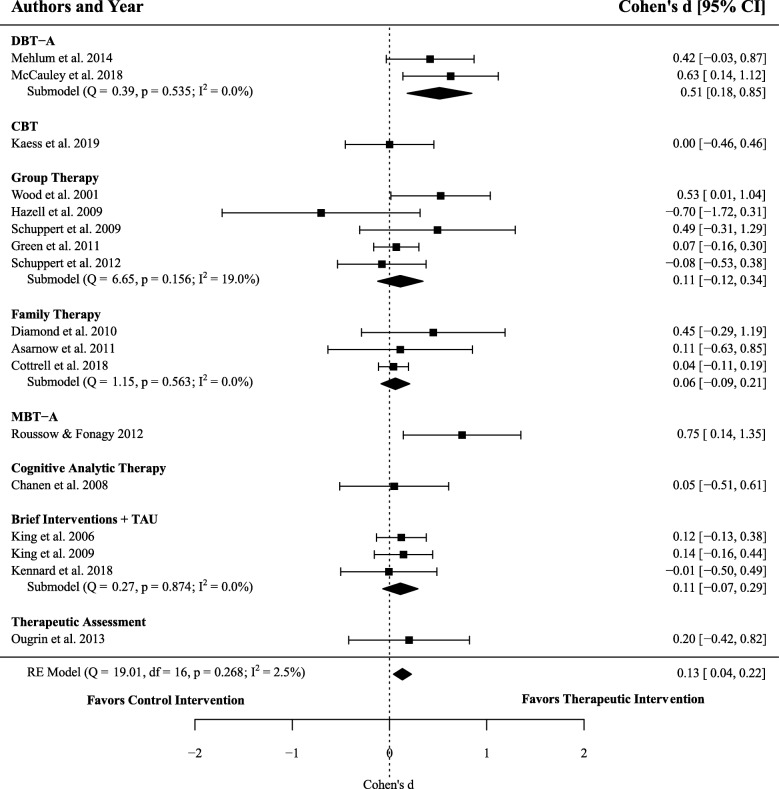
- self-harm: d = 0.13, 95% CI 0.04–0.22, p = .004
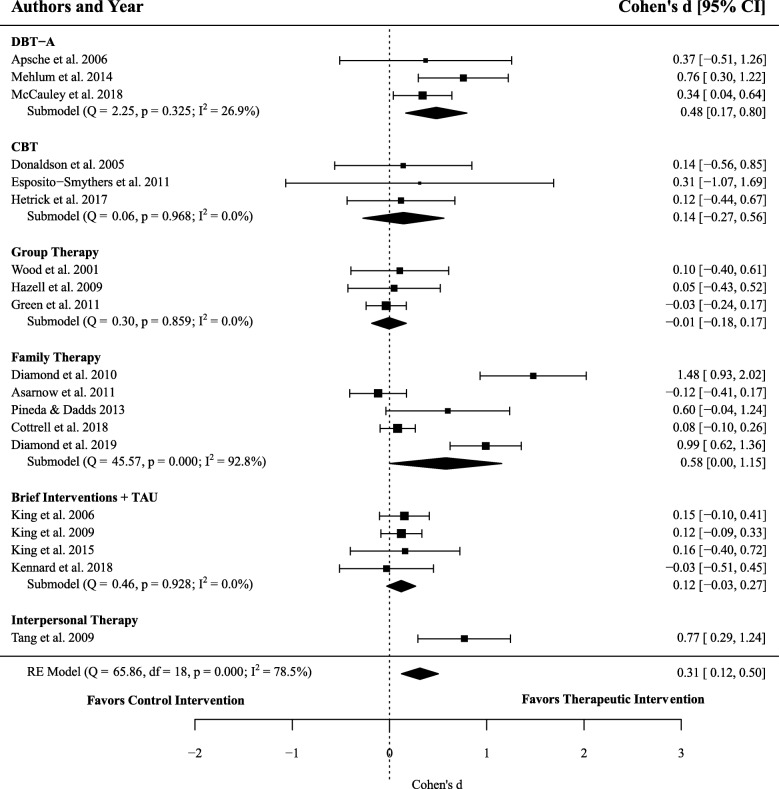
- suicidal ideation: d = 0.31, 95% CI 0.12–0.50, p = .001
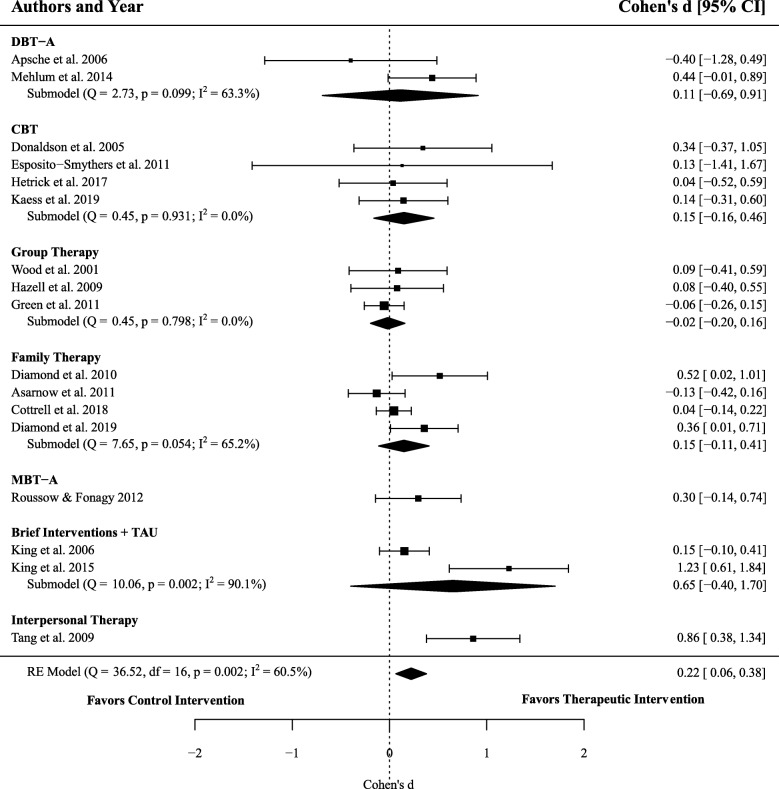
- depressive symptoms: d = 0.22, 95% CI 0.07–0.38, p = .006
- In subgroup analyses, DBT-A showed moderate effects versus active controls for:
- self-harm: d = 0.51, 95% CI 0.18–0.85, p = .002
- suicidal ideation: d = 0.48, 95% CI 0.17–0.80, p = .003
- Family-centred therapy showed a moderate effect for suicidal ideation: d = 0.58, 95% CI 0.01–1.15, p = .049.
- Active control conditions (mostly TAU/EUC) also showed substantial pre-post improvements across 22 studies:
- self-harm: d = 0.60, 95% CI 0.28–0.92, p < .001
- suicidal ideation: d = 0.87, 95% CI 0.35–1.39, p = .001
- depressive symptoms: d = 0.51, 95% CI 0.07–0.94, p = .002
## Methods
- Systematic review and meta-analysis of studies published from December 1999 to December 2019; included randomized controlled trials of therapeutic interventions for adolescents aged 12–19 with self-harm and/or suicidal ideation.
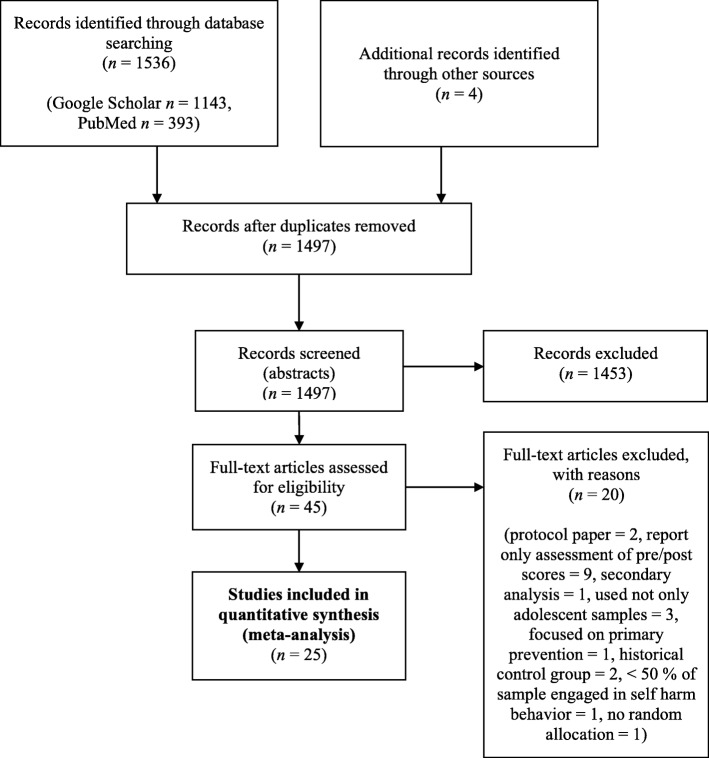
- Searches were conducted in Google Scholar and PubMed; 1536 results were screened, and 25 peer-reviewed journal articles met inclusion criteria.
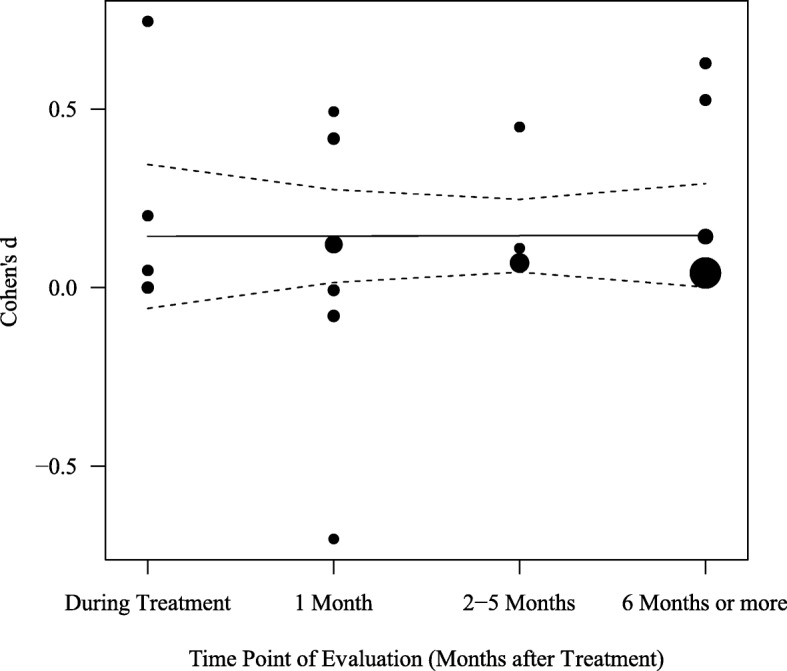
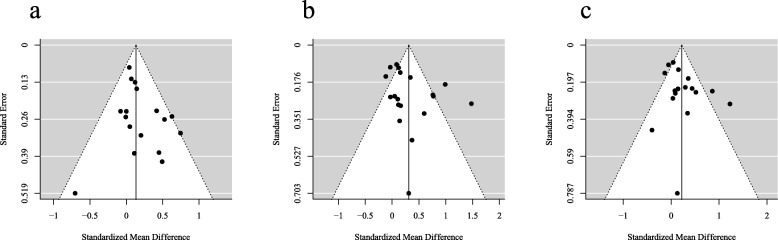
- Main analysis computed Cohen’s d using random-effects models; outcomes were post-intervention self-harm (primary), suicidal ideation, and depressive symptoms (secondary), with heterogeneity assessed by I2 and publication bias checked with funnel plots, Egger’s regression, and trim-and-fill.
## Limitations
- The paper states that subgroup analyses were limited by the small number of studies in some categories, with some subgroups containing only one study; it says these effects should be interpreted with caution.
- The paper states that heterogeneity was high for suicidal ideation and depressive symptoms, which limits certainty about those pooled estimates.
- Evident from the text: the included samples were mostly young women, and none of the 25 trials reported transgender or gender-diverse participants, limiting generalizability to those groups.
- Evident from the text: only a minority of studies reported follow-up data, so the durability of effects over time remains unclear.
Model-written summary. Check it against the paper before relying on it.
Integrity signals
Registry
Cites
Statistics
Figures
Verification
Claims the paper makes
7 Valid · 1 Not valid · 7 Not checked · 26 Own results and interpretations
Every source the paper cites for this claim was checked and supports it.
In the paper
“with recent evidence that engaging in NSSI is one of the strongest predictors of transition from suicidal thoughts to suicide attempts among adolescents [45].”
§ Does treatment method matter? A meta-analysis of the past 20 years of research on therapeutic interventions for self-harm and suicidal ideation in adolescents > Abstract > Conclusions
What the sources say
- Supportedcites [45] Mars B Heron J Klonsky ED Moran P O’Connor RC Tilling K Predictors of future suicide attempt among adolescents with suicidal thoughts or non-suicidal self-harm: a population-based birth cohort study Lancet Psychiatry 2019 6 4 327 337 10.1016/S2215-0366(19)30030-6 30879972 PMC6494973 source
The Introduction (page not available in our copy) explicitly lists non-suicidal self-harm among the strongest predictors of transition from suicidal thoughts to suicide attempts in adolescents. The Discussion likewise says it is associated with the transition from suicidal thinking to action. (LLM, conf=0.95)
boostedstates an association- Asserted: passes — The authors put it forward as true.
- Checkable: passes — It can be checked against evidence.
- Load-bearing: unclear — It is unclear whether the paper’s conclusions depend on it.
- Based: passes — The paper gives a reason why it holds.
- Supported
A result the paper reports from its own data — it cites no other source for it, so there is none to check. The quote shows it is in the paper.
In the paper
“Subgroup analysis of specific therapies revealed moderate effects of DBT-A in reducing self-harm (d = 0.51, 95% CI 0.18–0.85, p = .002) and suicidal ideation (d = 0.48, 95% CI 0.17–0.80, p = .003)”
- Also stated in: § Applicability of the results · plain
“In terms of therapeutic types most effective for decreasing suicidal ideation, DBT-A also showed a small effect size against control interventions (d = 0.48) with moderate heterogeneity in results, and is larger compared to results of the meta-analysis of adult samples (d = 0.23, [12]).”
§ Does treatment method matter? A meta-analysis of the past 20 years of research on therapeutic interventions for self-harm and suicidal ideation in adolescents > Abstract > Results
plainstates a cause- Asserted: passes — The authors put it forward as true.
- Checkable: passes — It can be checked against evidence.
- Load-bearing: passes — The paper’s conclusions depend on it.
- Based: passes — The paper gives a reason why it holds.
- Also stated in: § Applicability of the results · plain
A result the paper reports from its own data — it cites no other source for it, so there is none to check. The quote shows it is in the paper.
In the paper
“as well as moderate effects of family-centred therapy in the treating suicidal ideation (d = 0.58, 95% CI 0.01–1.15, p = .049).”
- Also stated in: § Applicability of the results · plain
“In contrast to the pattern of results for self-harm behaviours, family-centred therapies also showed a moderate effect against controls in reducing suicidal ideation (d = 0.58).”
§ Does treatment method matter? A meta-analysis of the past 20 years of research on therapeutic interventions for self-harm and suicidal ideation in adolescents > Abstract > Results
plainstates a cause- Asserted: passes — The authors put it forward as true.
- Checkable: passes — It can be checked against evidence.
- Load-bearing: passes — The paper’s conclusions depend on it.
- Based: passes — The paper gives a reason why it holds.
- Also stated in: § Applicability of the results · plain
A result the paper reports from its own data — it cites no other source for it, so there is none to check. The quote shows it is in the paper.
In the paper
“Subgroup analysis of specific therapies revealed moderate effects of DBT-A in reducing self-harm (d = 0.51, 95% CI 0.18–0.85, p = .002) and suicidal ideation (d = 0.48, 95% CI 0.17–0.80, p = .003)”
- Also stated in: § Applicability of the results · plain
“Subgroup analysis of specific types of therapeutic intervention revealed that, when compared to active control interventions, only DBT-A showed significantly better treatment outcomes with a moderate effect (d = 0.51).”
§ Does treatment method matter? A meta-analysis of the past 20 years of research on therapeutic interventions for self-harm and suicidal ideation in adolescents > Abstract > Results
plainstates a cause- Asserted: passes — The authors put it forward as true.
- Checkable: passes — It can be checked against evidence.
- Load-bearing: passes — The paper’s conclusions depend on it.
- Based: passes — The paper gives a reason why it holds.
- Also stated in: § Applicability of the results · plain
A result the paper reports from its own data — it cites no other source for it, so there is none to check. The quote shows it is in the paper.
In the paper
“Overall, treatment interventions fared slightly better than active controls in decreasing self-harm (d = 0.13, 95% CI 0.04–0.22, p = .004), suicidal ideation (d = 0.31, 95% CI 0.12–0.50, p = .001) and depressive symptoms (d = 0.22, 95% CI 0.07–0.38, p = .006).”
- Also stated in: § Efficacy of therapeutic interventions on depressive symptoms · plain
“Meta-analysis resulted in a significant difference between groups (d = 0.22, 95% CI 0.07–0.38, p = .006), with moderate heterogeneity between studies (I2 = 56.70%). That is, therapeutic interventions were moderately more effective at reducing symptoms of depression compared to control treatments.”
- Also stated in: § Discussion · hedged
“Our results indicate that compared to active control conditions, participants assigned to therapeutic interventions showed significantly greater decreases in self-harm behaviour (d = 0.13), suicidal ideation (d = 0.31), and depressive symptoms (d = 0.22) with small effect sizes.”
§ Does treatment method matter? A meta-analysis of the past 20 years of research on therapeutic interventions for self-harm and suicidal ideation in adolescents > Abstract > Results
plainstates a causen = 2,071 ·- Asserted: passes — The authors put it forward as true.
- Checkable: passes — It can be checked against evidence.
- Load-bearing: passes — The paper’s conclusions depend on it.
- Based: passes — The paper gives a reason why it holds.
- Also stated in: § Efficacy of therapeutic interventions on depressive symptoms · plain
19 more claims
Create a free account to see all 41 claims and every source verdict.
- Probably not a substantial claim. 2
- It may state two separate claims as one. 16
Claims other papers make about this one
Each is checked against this paper’s own text: does it say what the citing paper says it does?
The cited source doesn’t support the claim as written.
In the citing paper
“However, previous meta-analysis focused exclusively on a small number (k = 3) of randomized controlled trials (RCTs; Kothgassner et al., 2020), and the systematic review of controlled clinical trials (CCTs, trials including a control group, but which lack randomization) and pre-post evaluations only included studies published prior to July 2013 (k = 5, no RCTs; Glenn et al., 2015).”
From Efficacy of dialectical behavior therapy for adolescent self-harm and suicidal ideation: a systematic review and meta-analysis (2021) · cites this paper as Kothgassner et al., 2020
Checked by a reasoning model — may be wrong.
Experimental — accuracy not yet measuredThe source backs part of the claim, not all of it — or backs it for a different population, condition or comparison.
In the citing paper
“A growing body of research demonstrates that therapeutic interventions for self-harm and suicidal ideation in general show limited efficacy (Fox et al., 2020; Kothgassner et al., 2020), highlighting the importance of isolating specific therapies which show promise for further development.”
From Efficacy of dialectical behavior therapy for adolescent self-harm and suicidal ideation: a systematic review and meta-analysis (2021) · cites this paper as Kothgassner et al., 2020
Experimental — accuracy not yet measuredThe source backs part of the claim, not all of it — or backs it for a different population, condition or comparison.
In the citing paper
“According to international standards, Dialectical Behavior Therapy for Adolescents (DBT®-A) is an evidence-based treatment for these patients, especially concerning the reduction of self-harm (8–11).”
From Radical Acceptance of Reality: Putting DBT®-A Skill Groups Online During the COVID-19 Pandemic: A Qualitative Study (2022) · cites this paper as [9]
Experimental — accuracy not yet measuredThe source backs part of the claim, not all of it — or backs it for a different population, condition or comparison.
In the citing paper
“The absence of an intervention effect for secondary mental health and well-being outcomes was unexpected yet appears to corroborate findings from prior meta-analytic studies that even face-to-face DBT does not significantly reduce depressive symptoms among adolescents (p = 0.099; [32]) nor adults (p = 0.08; [33]).”
From The effect of a therapeutic smartphone application on suicidal ideation in young adults: Findings from a randomized controlled trial in Australia. (2022) · cites this paper as [32]
Experimental — accuracy not yet measuredThe source backs part of the claim, not all of it — or backs it for a different population, condition or comparison.
In the citing paper
“It is also noteworthy that the immediate effect of Lifebuoy on suicidal ideation in our postintervention period (d = 0.45) is comparable to the pooled effects reported for the intensive face-to-face DBT treatment of suicidal ideation (e.g., d = 0.48) [32].”
From The effect of a therapeutic smartphone application on suicidal ideation in young adults: Findings from a randomized controlled trial in Australia. (2022) · cites this paper as [32]
Experimental — accuracy not yet measured
1 more claim about this paper
Create a free account to see every claim other papers make about this one.
Statistics recomputed
Every reported test result, recomputed from its test statistic and degrees of freedom. A result shows as not adding up only once an independent check has confirmed it.
- Consistentz = 1.59reported p = .112 · recomputed p = .112
“(z = 1.59, p = .112”
- Consistentz = 1.1reported p = .273 · recomputed p = .271
“(z = 1.10, p = .273”
- Consistentz = 1.4reported p = .162 · recomputed p = .162
“(z = 1.40, p = .162”
Self-check
Percentages, sums and reported differences re-computed from the paper’s own numbers.
Each contradiction between two passages listed here was confirmed by an independent check.
Rated minor: it would not touch a result — a value no result rests on, a p-value that stays on the same side of the significance level, or a conflict that is clerical, resolved elsewhere in the paper, or outside its own findings.
In the paper
§ Does treatment method matter? A meta-analysis of the past 20 years of research on therapeutic interventions for self-harm and suicidal ideation in adolescents > Discussion
“we conducted a systematic review and meta-analysis of 25 studies (including 9 studies new to this meta-analysis)”
§ Does treatment method matter? A meta-analysis of the past 20 years of research on therapeutic interventions for self-harm and suicidal ideation in adolescents > Abstract > Conclusions
“we decided to conduct a meta-analysis of all controlled studies and RCTs published in the last 20 years, including the 12 studies not included in the most recent meta-analysis [57].”
Citations
Cites
Diagnostic and Statistical Manual of Mental Disorders
American Psychiatric Association (2013) · doi:10.1176/appi.books.9780890425596 · Cited by 116,369
Statistical Power Analysis for the Behavioral Sciences
Muller, K. (1989) · Technometrics · doi:10.1080/00401706.1989.10488618 · Cited by 99,167
Statistical power analysis for the behavioral sciences
(1990) · Computers, Environment and Urban Systems · doi:10.1016/0198-9715(90)90050-4 · Cited by 65,269
Measuring inconsistency in meta-analyses
Higgins, J. P. T., Thompson, S. G., Deeks, J. J., & Altman, D. G. (2003) · BMJ · doi:10.1136/bmj.327.7414.557 · Cited by 63,139 · cited 1×
“Heterogeneity across study outcomes was reported with I(2) values, where 25% indicates low, 50% moderate, and 75% high heterogeneity [32].”
BackgroundConducting Meta-Analyses in R with the metafor Package
Viechtbauer, W. (2010) · Journal of Statistical Software · doi:10.18637/jss.v036.i03 · Cited by 20,464 · cited 1×
“Effect size calculations and subsequent meta-analysis were then conducted with the metafor package for R [71], which automatically corrects Cohen’s d for the potential positive bias in small samples [30].”
Method(2000) · Cited by 9,198
Distribution Theory for Glass's Estimator of Effect Size and Related Estimators
Hedges, L. V. (1981) · Journal of Educational Statistics · doi:10.2307/1164588 · Cited by 5,695 · cited 1×
“Effect size calculations and subsequent meta-analysis were then conducted with the metafor package for R [71], which automatically corrects Cohen’s d for the potential positive bias in small samples [30].”
MethodA Nonparametric “Trim and Fill” Method of Accounting for Publication Bias in Meta-Analysis
Duval, S., & Tweedie, R. (2000) · Journal of the American Statistical Association · doi:10.1080/01621459.2000.10473905 · Cited by 2,955
Self-harm and suicide in adolescents
Hawton, K., Saunders, K. E., & O'Connor, R. C. (2012) · The Lancet · doi:10.1016/s0140-6736(12)60322-5 · Cited by 2,306 · cited 1×
“Self-harm, defined as intentional self-poisoning or injury of oneself irrespective of suicidal motivation or intent [26], is a behaviour widespread among adolescents.”
BackgroundMeta-analysis of experiments with matched groups or repeated measures designs
Dunlap, W. P., Cortina, J. M., Vaslow, J. B., & Burke, M. J. (1996) · Psychological Methods · doi:10.1037/1082-989x.1.2.170 · Cited by 1,693 · cited 1×
“To analyse the effect of control interventions from pre- to post-measurement, we computed the standardized mean difference (Cohen’s d) based on the means and standard deviations [16] of self-harm, depressive symptoms, and suicidal ideation before and after the control interventions.”
Method
Research works printed but not linked: 1
- Cochrane Collaboration Review manager (RevMan) [computer program]. Version 5.3 2014 Copenhagen The Nordic Cochrane Centre
Cited by
Items 101–163 of 163
Lockwood, J., Goodwin, T., Freeman, K., & Harroe, C. (2025) · BMJ Mental Health · doi:10.1136/bmjment-2025-301601 · Cited by 6
“11 12 Standard forms of these psychological interventions are also typically lengthy and resource intensive and associated with low availability, long waitlists and poor adherence.”
Carrasco, M. Á. (2023) · Revista de Psicología Clínica con Niños y Adolescentes · doi:10.21134/rpcna.2023.10.1.7 · Cited by 10
Negative Affect and Nonsuicidal Self-Injury
Swerdlow, B. A., Pearlstein, J. G., Sandel, D. B., & Johnson, S. L. (2023) · Oxford University Press eBooks · doi:10.1093/oxfordhb/9780197611272.013.13 · Cited by 7
Christensen, H. B., Michalsen, A., Brattmyr, M., Havnen, A., & Solem, S. (2024) · Nordic Psychology · doi:10.1080/19012276.2024.2313526 · Cited by 2
“Of the previous studies, the study by Kothgassner et al. (2020) in which the control group received TAU is most like this study.”
InfluentialNon-Suicidal Self-Injury and Eating Disorders
Plener, P. L. (2024) · Springer eBooks · doi:10.1007/978-3-662-67662-2_26 · Cited by 2
Self-citationA Quality Improvement Initiative to Decrease Behavioral Health Unit Readmission Rates
Winner, K., Sandberg, K., Saia, B., Calabro, M., & Blankenship, K. M. (2025) · PEDIATRICS · doi:10.1542/peds.2023-064917 · Cited by 3
Adolescent Dialectical Behavior Therapy Intensive Outpatient Programs
Clarke, S. B., Atasuntseva, A. A., Thordarson, M. A., & Berk, M. S. (2022) · Issues in clinical child psychology · doi:10.1007/978-3-031-14567-4_16 · Cited by 2
Haro, M. V. N. (2023) · Revista de Psicología Clínica con Niños y Adolescentes · doi:10.21134/rpcna.2023.10.1.8 · Cited by 6
Robinson, K. (2021) · Open Access Victoria University of Wellington | Te Herenga Waka (Figshare) · doi:10.26686/wgtn.16960195.v1 · Cited by 2
Self-citationDewa, L. H., Servi, A., Gardner-Bougaard, E., et al. (2025) · medRxiv · doi:10.1101/2025.09.11.25335501 · Cited by 2
Application of the cognitive-behavioral approach in psychotherapy for self-harming behavior
Granitsa, A. S. (2021) · Neurology Bulletin · doi:10.17816/nb71159 · Cited by 1
Self-harming behavior in adolescents: Current diagnostic and therapeutic approaches
Yazıcı, M., & Hocaoğlu, Ç. (2023) · IntechOpen eBooks · doi:10.5772/intechopen.1002918 · Cited by 3
Medical and Pharmaceutical Interventions in NSSI
Plener, P. L. (2023) · Oxford University Press eBooks · doi:10.1093/oxfordhb/9780197611272.013.52 · Cited by 1
Self-citationDjajadisastra, F. W. (2024) · Journal of Preventive Medicine and Public Health · doi:10.3961/jpmph.24.448 · Cited by 2
“This focus stems from the recognition that the effectiveness of evidence-based treatments for self-injury and suicide risk depends on individ - uals actively seeking professional help within the healthcare system [1].”
von Perponcher, E., Jarvers, I., Ecker, A., Heidingsfelder, E., Kandsperger, S., Brunner, R. M., & Schleicher, D. (2025) · BJPsych Open · doi:10.1192/bjo.2025.10893 · Cited by 1
McKay, S., Ng, C., Nicholas, J., Browne, V., Chinnery, G. L., Choi, I., Nation-Ingle, B., Allison, K., Perlow, E., Lamblin, M., et al. (2025) · Contemporary Clinical Trials Communications · doi:10.1016/j.conctc.2025.101578 · Cited by 2
“The tools draw on cognitive behavioural (CBT), dialectical behavioural (DBT), and acceptance and commitment (ACT) therapies to reduce psychological distress, strengthen emotion regulation, and support values-based coping strategies associated with reduced suicidal ideation [16,26].”
Ni, J., Liao, X., Liu, J., & Jiang, Q. (2025) · BMC Public Health · doi:10.1186/s12889-025-25799-y · Cited by 3
“The global prevalence of NSSI varies considerably, with studies reporting rates from 5.5% to 17.2% globally and 6.4% to 47.5% in China [11–13].”
InfluentialBaldini, V., Gnazzo, M., Varallo, G., Bargiacchi, G., Stefano, R. D., Ronchi, D. D., & Carotenuto, M. (2026) · Journal of Clinical Medicine · doi:10.3390/jcm15093236 · Cited by 1
“Meta-analytic findings suggest that a significant proportion of suicide attempts occur in the absence of prior ideation, challenging linear models of suicide development [14].”
Haro, M. V. N. (2023) · Revista de Psicología Clínica con Niños y Adolescentes · doi:10.21134/rpcna.2023.10.8 · Cited by 1
Cottrell, D. J., Wright-Hughes, A. M., Farrin, A. J., Walwyn, R. E. A., Mughal, F., Truscott, A., Diggins, E., Irving, D., Fonagy, P., Ougrin, D., et al. (2024) · Health Technology Assessment · doi:10.3310/gtnt6331 · Cited by 1
“9 There are suggestions that dialectical behavioural therapies are associated with reductions in self-harm at the end of therapy 7 and mentalisation-based therapies (MBT) at the end of follow-up, 10 but methodological weaknesses prevent firm conclusions from being drawn.”
Self-citationEmergency Department Boarding, Diversion Programs, and Other Novel Interventions
Twohy, E., & Sommerhalder, M. S. (2024) · Issues in clinical child psychology · doi:10.1007/978-3-031-62749-1_22 · Cited by 3
Epigenetics and suicidal behavior in adolescents: a critical review
Funahashi, Y., & Dwivedi, Y. (2025) · Epigenomics · doi:10.1080/17501911.2025.2453415 · Cited by 2
Aunon, F. M., Ingram, P. F., Wolkowicz, N. R., Martino, S., Kacos, H. N., Spana, E., Honsberger, M., Rielage, J. K., Doran, N., Carretta, R. F., et al. (2025) · Counselling and Psychotherapy Research · doi:10.1002/capr.70000 · Cited by 2
Nicht-suizidales Selbstverletzendes Verhalten und Essstörungen
Plener, P. L. (2022) · Springer eBooks · doi:10.1007/978-3-662-63544-5_26 · Cited by 1
Self-citationSpohrs, J., Kühnle, V., Ferger, M. D., & Abler, B. (2023) · Nervenheilkunde · doi:10.1055/a-1984-9925 · Cited by 2
“Es existieren weder eine pharmakologische Therapie noch eine wirksame Neurostimulation [10, 11].”
BackgroundNICE guidelines for self-harm: a new school of thought
(2022) · doi:10.13056/acamh.19618 · Cited by 3
“9 Kothgassner OD et al. (2020) Does treatment method matter? A meta-analysis of the past 20 years of research on therapeutic interventions for self-harm and suicidal ideation in adolescents.”
BackgroundPeripheral and Neural Correlates of Self-Harm in Children and Adolescents: A Scoping ReviewPreprint
Sparrow-Downes, V. M., Trincao-Batra, S., Cloutier, P., Helleman, A., Salamatmanesh, M., Gardner, W., Baksh, A., Kapur, R., Sheridan, N., Suntharalingam, S., et al. (2021) · Research Square · doi:10.21203/rs.3.rs-955587/v1
#instantmessaging and the Unbearable Distress of Being Online
Kothgassner, O. D., & Felnhofer, A. (2022) · Digital Psychology · doi:10.24989/dp.v3i1.2164
Self-citationChen, D., Wang, Y., & Jian-zhong, L. (2022) · Psychology · doi:10.4236/psych.2022.138076
Bürger, A., & Föcker, M. (2022) · Springer eBooks · doi:10.1007/978-3-662-64627-4_10
New Studies on Suicide and Self-Harm
Hocaoğlu, Ç. (2023) · IntechOpen eBooks · doi:10.5772/intechopen.1000386 · Cited by 3
Corcoran, J., & Wolk, C. B. (2023) · Oxford University Press eBooks · doi:10.1093/oso/9780197653562.003.0011
Brown, K., & Jenkinson, L. (2024) · Mental Health Review Journal · doi:10.1108/mhrj-04-2023-0017
Suizidalität im Kindes- und Jugendalter
Plener, P. L., & Kaess, M. (2024) · Springer Reference Medizin · doi:10.1007/978-3-662-66744-6_128
Self-citationBody Image and Self-Harming Behaviors in Adolescents: The Mediating Effect of Somatization
Campos, R. C., Marmelo, M., & Holden, R. R. (2024) · Perceptual and Motor Skills · doi:10.1177/00315125241306480 · Cited by 2
“Treatment should also include evidence-based therapy for self-harming, including techniques from dialectical behavior therapy as recommended in a recent review (Kothgassner et al., 2020).”
Skillsketten zur Behandlung von nicht-suizidalem selbstverletzenden Verhalten – Schritt für Schritt
Cornelisse, S., Biermann, M., Bartels, J., & Bürger, A. (2025) · KJP up2date · doi:10.1055/a-2314-2171
Dibaj, I. S., Neupane, S. P., & Mehlum, L. I. (2025) · Borderline Personality Disorder and Emotion Dysregulation · doi:10.1186/s40479-025-00285-4
Imitation, Rivalry, and Escalation: Rethinking Adolescent Self-Harm Through Mimetic Theory
Sweetmore, A. (2025) · Culture Medicine and Psychiatry · doi:10.1007/s11013-025-09926-3
“These models often rely on predisposing factors, symptoms, and post hoc rationalisations to explain the behaviour (Iyengar et al., 2018; Kothgassner et al., 2020).”
Schmied, E., Sosic-Vasic, Z., Connemann, B. J., & Kroener, J. (2025) · Research Square · doi:10.21203/rs.3.rs-7246251/v1
Suicidal ideation as a risk factor for suicide: Insights from hypertension screening
Weissman, C. R., Stapper, N., Valmadrid, L. C., Appelbaum, L. G., & Daskalakis, Z. J. (2025) · Journal of Affective Disorders · doi:10.1016/j.jad.2025.120501 · Cited by 3
Self-Harm and Suicide in Young People
Reeves, M., Frisira, E., & Kingsley, D. (2025) · Cambridge University Press eBooks · doi:10.1017/9781009110266.012
Young Australian Women’s Views on Peer Support for Self-Harm: A Qualitative Study
Wang, A., Rheinberger, D., Tang, S., Christensen, H. M., Calear, A. L., Boydell, K., Whitton, A. E., Slade, A., & Hronis, A. (2025) · International Journal of Environmental Research and Public Health · doi:10.3390/ijerph22121874 · Cited by 2
“Furthermore, although recommended interventions such as Dialectical Behavioural Therapy and Cognitive Behavioural Therapy have demonstrated effectiveness in reducing self-harm behaviours [16], reviews indicate that the treatment effects remain small [17,18].”
Therapeutic Nursing Interventions to Reduce Self-Injurious Behavior: A Scoping Review
Putri, T. H., Suryani, S., Abdullah, K. L., Andriyani, S., Fujiana, F., & Syisnawati, S. (2025) · Journal of Multidisciplinary Healthcare · doi:10.2147/jmdh.s553691
Szabo, M. P., Neves, S., Huerta, P. L., & Smoski, M. J. (2026) · Evidence-Based Practice in Child and Adolescent Mental Health · doi:10.1080/23794925.2026.2617586
“Furthermore, research supports the use of DBT-A with adolescents as evidenced by greater reductions in SI, SA and hospitalizations following participation in DBT-A treatment compared to enhanced usual care (Kothgassner et al., 2020; McCauley et al., 2018; Mehlum et al., 2014; Rathus & Miller, 2002).”
Reducing self-harm in adolescents: the RISA-IPD comprehensive synopsis
Cottrell, D. J., Walwyn, R. E. A., Farrin, A. J., Irving, D., Fonagy, P., Ougrin, D., Stahl, D. R., Wright, J., & Wright-Hughes, A. M. (2026) · Health Technology Assessment · doi:10.3310/kkbb1164
Self-citationDolgopolova, M., & Ney, L. (2026) · Psychodynamic Practice · doi:10.1080/14753634.2026.2619877
“…Dopp et al., 2017; Spas et al., 2012), in adults (Ferguson & Wormith, 2012; Kernberg, 1985; Meloy, 1988; Welldon, 1991) and for suicidal ideation (Kothgassner et al., 2020; Zalsman et al., 2016), integrated treatments for adult individuals showing CPTSD symptoms as well as antisocial behaviours…”
Strengthening brief CAT in self-harm interventions: A commentary on the RELATE study
Mufidah, E. F., Toding, N., Nurmaya, A., Setiawan, A., & Badiah, L. I. (2026) · Psychiatry Research · doi:10.1016/j.psychres.2026.116991
Temporal dynamics of shame and guilt in adolescent NSSI: an ambulatory assessment study
Goreis, A., van Eickels, R. L., Chang, D., Klinger, D., Zesch, H. E., Prillinger, K., Pfeffer, B., Oehlke, S., Ebner‐Priemer, U., Claes, L., et al. (2026) · Frontiers in Psychiatry · doi:10.3389/fpsyt.2026.1758601
Self-citationSystematic Review of Best Practice Guidance for Schools to Respond to Self-Harm
Bowden, L., Fortune, S. A., Hetrick, S. E., Meinhardt, I., & Donkin, L. (2026) · School Mental Health · doi:10.1007/s12310-026-09871-5 · Cited by 1
“The prevalence of self-harm increases across the adolescent period (Brager-Larsen et al., 2022; Geulayov et al., 2018; Gillies et al., 2018), therefore adolescence represents an important period for prevention and intervention (Denny et al., 2018; Hawton et al., 2015 ; Kothgassner et al., 2020).”
Quality and Contents of Self-Guided Adolescent Suicide Safety Plans
Pinder, J. B., Labouliere, C. D., Wang, S. B., Hunt, R. A., Leone, G., & Fox, K. R. (2026) · Journal of Clinical Child & Adolescent Psychology · doi:10.1080/15374416.2026.2660293
Baek, J., Lee, J., Park, W., & Kim, D. (2026) · Cognitive Therapy and Research · doi:10.1007/s10608-026-10726-1 · Cited by 4
Goreis, A., Pfeffer, B., Klinger, D., Oehlke, S., Macura, S., Kafka, J. X., Müller, N., Prillinger, K., Zesch, H. E., Kapusiz, I., et al. (2026) · Psychoneuroendocrinology · doi:10.1016/j.psyneuen.2026.107920
Self-citationGimenez, M. C., Jaén, I., Vega, D., Julià, A., López‐Solà, M., Solé‐Casals, J., Miralles, I., & García‐Palacios, A. (2026) · Frontiers in Digital Health · doi:10.3389/fdgth.2026.1794576 · Cited by 1
Weedage, D., d’Huart, D., Bürgin, D., Seker, S., In‐Albon, T., Vermeiren, R. R. J. M., Boonmann, C., & Schmid, M. (2026) · Psychiatry Research · doi:10.1016/j.psychres.2026.117261
Lee, S., 송지혜, Suh, S. A., & 신윤미 (2026) · BMC Psychiatry · doi:10.1186/s12888-026-08168-w
“The six included systematic reviews were based on a total of 178 unique primary studies, although the reviews used aggregated data from 236 study reports, as Viswa-nathan et al. [29] [11] included 25 RCTs focusing on adolescents aged 12–19 years with a history of self-harm.”
InfluentialGiannakopoulos, G., & Prassou, A. (2026) · Children · doi:10.3390/children13070972
“Reviews of self-harm interventions in youth continue to identify DBT-A as the best-supported approach for repeated self-harm and suicidal ideation, while other interventions remain preliminary [21–24].”
Autonomic dysregulation and nonsuicidal self-injury: findings from a cross-sectional online survey
Goreis, A., Alsch, J., Oehlke, S., Plener, P. L., & Kothgassner, O. D. (2026) · Frontiers in Psychiatry · doi:10.3389/fpsyt.2026.1874303
“Although social and psychological factors associated with NSSI are well studied, and several psychological interventions show promise for reducing adolescent self-harm and related outcomes (17, 18), the evidence base for interventions speci fi cally targeting NSSI remains comparatively limited.”
Self-citationMaxwell, C. A., Holland, K. E., Young, L., Chen, E. Y., Olino, T. M., & Kendall, P. C. (2026) · Journal of Clinical Psychology · doi:10.1002/jclp.70195
“Yet, Kothgassner et al. (2020, 2021) found that DBT‐”
Schmied, E., Sosic-Vasic, Z., Connemann, B. J., & Kroener, J. (2026) · Frontiers in Child and Adolescent Psychiatry · doi:10.3389/frcha.2026.1878269
“Despite growing clinical recognition, treatment options for NSSI remain limited in accessibility and effectiveness (10, 11).”
Reducing suicidal ideation through protective media content in India: randomised controlled trial
Armstrong, G., Mohanraj, R., Kumar, S., Haregu, T., Spittal, M. J., Niederkrotenthaler, T., Pirkis, J., Nisha, B., Selvan, D., & Vijayakumar, L. (2026) · The British Journal of Psychiatry · doi:10.1192/bjp.2026.10799 · Cited by 1
Dewa, L. H., Servi, A., Gardner-Bougaard, E., Mohamed, S. J., McDermott, A., Nusaybah, C., Aveyard, B., Rodrigues, R., Hampshire, A., Zalk, N. V., et al. (2026) · Child and Adolescent Mental Health · doi:10.1111/camh.70135 · Cited by 2
Metadata
- Authors
- Kothgassner, O. D., Robinson, K., Goreis, A., Ougrin, D., & Plener, P. L.
- Affiliations
- Medical University of Vienna (AT)
- Victoria University of Wellington (NZ)
- University of Vienna (AT)
- King's College London (GB)
- Universität Ulm (DE)
- Corresponding author
- Plener, Paul L.
- Venue
- Borderline Personality Disorder and Emotion Dysregulation
- Published
- 2020-05-11
- Volume
- 7
- Issue
- 1
- Pages
- 9-9
- ISSN
- 2051-6673 (ISSN-L)
- PMC
- PMC7216729
- OpenAlex
- W3027846434
- Cited by
- 163
- References
- 82
- Citations by year
- 2026: 22 · 2025: 29 · 2024: 25 · 2023: 31 · 2022: 26 · 2021: 27 · 2020: 3
- FWCI
- 1.70
- Type
- journal article
- Language
- en
- Open access
- gold
- doi.org
- Licence
- cc-by
- creativecommons.org/licenses/by/4.0 (tdm)
- creativecommons.org/licenses/by/4.0 (vor)
- Locations
- Borderline Personality Disorder and Emotion Dysregulation (publishedVersion, cc-by)
- PubMed Central (publishedVersion, cc-by)
- PubMed (publishedVersion)
- DOAJ (DOAJ: Directory of Open Access Journals) (submittedVersion, cc-by-sa)
- Research Portal (King's College London) (submittedVersion, other-oa)
- Funders
- Federalno Ministarstvo Obrazovanja i Nauke
- Topics
- Social Sciences › Psychology › Clinical Psychology › Suicide and Self-Harm Studies
- Social Sciences › Psychology › Clinical Psychology › Personality Disorders and Psychopathology
- Social Sciences › Psychology › Clinical Psychology › Psychotherapy Techniques and Applications
- Keywords
- self-harm, suicidal ideation, adolescents, therapeutic interventions, dialectical behavior therapy, depressive symptoms, stepped care, treatment effectiveness, active control, suicide risk factors, psychiatric comorbidity, usual care, enhanced usual care
About these checks
Registry, retraction, Cites and statistics results are computed, not judged, with one exception: a printed reference that no index lists is read once by a model before it counts as a citation error. Claims are extracted by a model and kept only when their quote appears verbatim in the text; each cited source is then checked, with a model’s help, for whether it says what the claim relies on. Those verdicts can be wrong — read the claim’s quote and the cited source before relying on one.
The claim verdicts this report counts are experimental: their accuracy is not yet measured.
A language model drew the claims from the paper on 2026-10-09, under version 3 of the claim definition (model deepseek-v4.1-flash, prompt extract-v3).
A second model labelled each claim on 2026-10-09 (model jev-1.13-20260917, definition revision gold-guideline-v0.2).
Cited sources are checked with a language model’s help (gpt-6-sol).
Statistics and arithmetic are recomputed, not judged.
Confidence bands are shown only for fields calibrated on our annotated test set. None is calibrated yet, so no band is shown.
What counts as a claim ›How we measure confidence ›How we check this ›
Are you an author, or do you see a problem with this page? Request a review
Data sources
Bibliographic data: Semantic Scholar, OpenAlex, Crossref.
Contains information from the Semantic Scholar Academic Graph Datasets, made available under the ODC Attribution License (ODC-BY 1.0).
Semantic Scholar’s data is described in: Kinney, R., et al. (2023). The Semantic Scholar Open Data Platform. arXiv:2301.10140.
