

Suicidal ideation, self-injury, aggressive behavior and substance use during intensive trauma-focused treatment with exposure-based components in adolescent and young adult PTSD patients
Open accessThe DOI matches its Crossref record; 80 of the 80 references it cites were found in a registry or an index.
Abstract
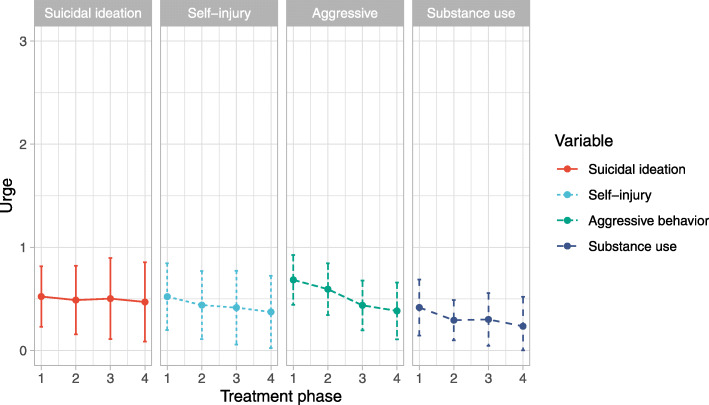
Background: Multiple traumata such as child sexual and/or physical abuse often result in complex psychopathologies and a range of associated dysfunctional behaviors. Although evidence-based interventions exist, some therapists are concerned that trauma-focused psychotherapy with exposure-based elements may lead to the deterioration of associated dysfunctional behaviors in adolescents and young adults. Therefore, we examined the course of suicidal ideation, self-injury, aggressive behavior and substance use in a group of abuse-related posttraumatic stress disorder (PTSD) patients during phase-based, trauma-focused PTSD treatment. Methods: Daily assessments from a randomized controlled trial (RCT) of Developmentally adapted Cognitive Processing Therapy (D-CPT) were analyzed to test for differences in the stated dysfunctional behaviors between the four treatment phases. We conducted multilevel modeling and repeated measure ANOVAs. Results: We did not find any significant differences between the treatment phases concerning the stated dysfunctional behaviors, either at the level of urge or at the level of actual actions. On the contrary, in some primary outcomes (self-injury, aggressive behavior), as well as secondary outcomes (distress caused by trauma, joy), we observed significant improvements. Discussion: Overall, during D-CPT, adolescents and young adults showed no deterioration in dysfunctional behaviors, while even showing improvements in some, suggesting that trauma-focused treatment preceded by skills building was not deleterious to this population. Hence, the dissemination of effective interventions such as D-CPT should be fostered, whilst the concerns of the therapists regarding exposure-based components need to be addressed during appropriate training. Nevertheless, further studies with momentary assessment, extended measurement methods, a control group and larger sample sizes are needed to confirm our preliminary findings. Trial registration: The trial was registered at the German Clinical Trial Registry (GCTR), DRKS00004787, 18 March 2013, https://www.drks.de/DRKS00004787.
Overview
The claims and statistics of this paper haven’t been checked yet.
Free: it reads the open-access text and checks the first 5 claims that cite a source we can check. Create a free account to check every claim.
Integrity signals
Registry
Cites
Statistics
Figures
Verification
Claims the paper makes
The claims and statistics of this paper haven’t been checked yet.
Free: it reads the open-access text and checks the first 5 claims that cite a source we can check. Create a free account to check every claim.
Claims other papers make about this one
Each is checked against this paper’s own text: does it say what the citing paper says it does?
The source backs part of the claim, not all of it — or backs it for a different population, condition or comparison.
In the citing paper
“Although exposure therapy was only the focus of two interventions (i.e., RRFT and D-CPT), these trials had robust sustained PTSD outcomes and did not report any adverse effects of exposure therapy, despite detailed monitoring, when exposure components were preceded by an extensive safety and skill-building phase [29, 55].”
From Interventions for prevention and treatment of substance use in youth with traumatic childhood experiences: a systematic review and synthesis of the literature (2024) · cites this paper as [55]
Experimental — accuracy not yet measuredThe cited source says what the claim attributes to it.
In the citing paper
“phase-based D-CPT (i.e., preparation and emotional regulation skill-building over ~11 sessions, followed by trauma processing over ~15 sessions) was not associated with any increase in urges or actual use of substances or other dysfunctional behaviors [55].”
Self-check
Percentages, sums and reported differences re-computed from the paper’s own numbers.
The self-check needs the paper’s full text.
Citations
Cites
Bundesgesundheitsblatt - Gesundheitsforschung - Gesundheitsschutz
(2013) · Bundesgesundheitsblatt - Gesundheitsforschung - Gesundheitsschutz · doi:10.1007/103.1437-1588 · Cited by 11,796
Diagnostic and Statistical Manual of Mental Disorders, Fourth Edition, Text Revision (DSM-IV-TR)
American Psychiatric Association (2000) · doi:10.1176/appi.books.9780890423349 · Cited by 11,069
Intensive Longitudinal Methods: An Introduction to Diary and Experience Sampling Research
Bolger, N. P., & Laurenceau, J. (2013) · Cited by 3,090
Multilevel Analysis: Techniques and Applications
Hox, J. J., Moerbeek, M., & van de Schoot, R. (2017) · Routledge eBooks · doi:10.4324/9781315650982 · Cited by 1,671
The University of California at Los Angeles post-traumatic stress disorder reaction index
Steinberg, A. M., Brymer, M. J., Decker, K. B., & Pynoos, R. S. (2004) · Current Psychiatry Reports · doi:10.1007/s11920-004-0048-2 · Cited by 1,212 · cited 2×
“: Number of observations in terms of diary card entries; MLM: Multilevel modeling; PE: Prolonged exposure; PTSD: Posttraumatic stress disorder; RCT: Randomized controlled trial; SD: Standard deviation; UCLA-PTSD-RI: University of California at Los Angeles PTSD Reaction Index for DSM-IV (Revision 1); WL/TA: Wait-list c…”
MethodSignificance Test for Sphericity of a Normal $n$-Variate Distribution
Mauchly, J. W. (1940) · The Annals of Mathematical Statistics · doi:10.1214/aoms/1177731915 · Cited by 1,136 · cited 1×
“Mauchly’s test was used to check for sphericity [73].”
MethodSexual abuse and lifetime diagnosis of psychiatric disorders: Systematic review and meta-analysis
Chen, L. P., Murad, M. H., Paras, M. L., Colbenson, K. M., Sattler, A. L., Goranson, E. N., Elamin, M. B., Seime, R. J., Shinozaki, G., Prokop, L. J., et al. (2010) · Mayo Clinic Proceedings · doi:10.4065/mcp.2009.0583 · Cited by 1,056 · cited 1×
“If traumatized youths receive no treatment or only unspecific, non-evidence-based interventions, this often leads to chronic impairments and poor results in adulthood [1, 18].”
BackgroundTrauma Exposure and Posttraumatic Stress Disorder in a National Sample of Adolescents
McLaughlin, K. A., Koenen, K. C., Hill, E. D., Petukhova, M., Sampson, N. A., Zaslavsky, A. M., & Kessler, R. C. (2013) · Journal of the American Academy of Child & Adolescent Psychiatry · doi:10.1016/j.jaac.2013.05.011 · Cited by 809 · cited 1×
“In youth, the risk for a posttraumatic stress disorder (PTSD) is especially high after such an interpersonal traumatization [4].”
BackgroundTrull, T. J., & Ebner-Priemer, U. (2013) · Annual Review of Clinical Psychology · doi:10.1146/annurev-clinpsy-050212-185510 · Cited by 761
A survey of psychologists’ attitudes towards and utilization of exposure therapy for PTSD
Becker, C. B., Zayfert, C., & Anderson, E. (2004) · Behaviour Research and Therapy · doi:10.1016/s0005-7967(03)00138-4 · Cited by 759 · cited 7×
“, level of trauma expertise) [19, 22], the outlined underuse of exposure [21, 22, 24, 28–30] and its suboptimal delivery [20, 24, 26, 30].”
BackgroundResultInfluentialEvidence for proposed ICD-11 PTSD and complex PTSD: a latent profile analysis
Cloitre, M., Garvert, D. W., Brewin, C. R., Bryant, R. A., & Maercker, A. (2013) · European Journal of Psychotraumatology · doi:10.3402/ejpt.v4i0.20706 · Cited by 751 · cited 1×
“In comparison to PTSD after a single trauma, PTSD after long CA is more frequently characterized by these comorbid problems and a more severe psychopathology [8, 9].”
BackgroundThe Effect of Small Sample Size on Two-Level Model Estimates: A Review and Illustration
McNeish, D. M., & Stapleton, L. M. (2016) · Educational Psychology Review · doi:10.1007/s10648-014-9287-x · Cited by 715 · cited 1×
“However, there is a clear consensus that small sample sizes increase several problems for the estimated effects [76].”
BackgroundPosttraumatic stress disorder and intimate relationship problems: A meta-analysis.
Taft, C. T., Watkins, L. E., Stafford, J., Street, A. E., & Monson, C. M. (2011) · Journal of Consulting and Clinical Psychology · doi:10.1037/a0022196 · Cited by 579
Nonsuicidal self-injury: Definition and classification.
Nock, M. K., & Favazza, A. R. (2009) · Understanding nonsuicidal self-injury: Origins, assessment, and treatment. · doi:10.1037/11875-001 · Cited by 503 · cited 1×
“Deliberate injuries without suicidal intentions are also referred to as non-suicidal self-injury [42].”
BackgroundNo Time Like the Present: Discovering the Hidden Dynamics in Intensive Longitudinal Data
Hamaker, E. L., & Wichers, M. (2017) · Current Directions in Psychological Science · doi:10.1177/0963721416666518 · Cited by 500
Long-term physical health consequences of childhood sexual abuse: a meta-analytic review
Irish, L., Kobayashi, I., & Delahanty, D. L. (2010) · Journal of Pediatric Psychology · doi:10.1093/jpepsy/jsp118 · Cited by 495 · cited 1×
“If traumatized youths receive no treatment or only unspecific, non-evidence-based interventions, this often leads to chronic impairments and poor results in adulthood [1, 18].”
BackgroundPsychopathology in a large cohort of sexually abused children followed up to 43 years
Cutajar, M. C., Mullen, P. E., Ogloff, J. R. P., Thomas, S. D., Wells, D. L., & Spataro, J. (2010) · Child Abuse & Neglect · doi:10.1016/j.chiabu.2010.04.004 · Cited by 472 · cited 1×
“In addition to suicidal ideation, CA also elevates the risk for engaging in self-injurious behavior [2, 41].”
BackgroundHarned, M. S., Korslund, K. E., & Linehan, M. M. (2014) · Behaviour Research and Therapy · doi:10.1016/j.brat.2014.01.008 · Cited by 388
Trull, T. J., & Ebner-Priemer, U. W. (2020) · Journal of Abnormal Psychology · doi:10.1037/abn0000473 · Cited by 344
Trauma histories, substance use coping, PTSD, and problem substance use among sexual assault victims
Ullman, S. E., Relyea, M., Peter-Hagene, L., & Vasquez, A. L. (2013) · Addictive Behaviors · doi:10.1016/j.addbeh.2013.01.027 · Cited by 323
Harned, M. S., Korslund, K. E., Foa, E. B., & Linehan, M. M. (2012) · Behaviour Research and Therapy · doi:10.1016/j.brat.2012.02.011 · Cited by 288 · cited 1×
“found in comparison to that at the time of study intake [45, 47].”
Resultvan Minnen, A., Hendriks, L., & Olff, M. (2010) · Behaviour Research and Therapy · doi:10.1016/j.brat.2009.12.003 · Cited by 282 · cited 8×
“, level of trauma expertise) [19, 22], the outlined underuse of exposure [21, 22, 24, 28–30] and its suboptimal delivery [20, 24, 26, 30].”
BackgroundResultInfluentialRakovshik, S. G., & McManus, F. (2010) · Clinical Psychology Review · doi:10.1016/j.cpr.2010.03.004 · Cited by 281 · cited 1×
“Another promising approach in the therapists’ continuing education is regular supervision [82].”
BackgroundThe Cruelest Cure? Ethical Issues in the Implementation of Exposure-Based Treatments
Olatunji, B. O., Deacon, B. J., & Abramowitz, J. S. (2009) · Cognitive and Behavioral Practice · doi:10.1016/j.cbpra.2008.07.003 · Cited by 273
Morina, N., Koerssen, R., & Pollet, T. V. (2016) · Clinical Psychology Review · doi:10.1016/j.cpr.2016.05.006 · Cited by 256 · cited 2×
“Over the past few years, a variety of trauma-focused treatments for adolescents and young adults with PTSD have been developed for which meta-analyses reported overall medium to large effect sizes [11, 12].”
BackgroundDeacon, B. J., Farrell, N. R., Kemp, J. J., Dixon, L. J., Sy, J. T., Zhang, A. R., & McGrath, P. B. (2013) · Journal of Anxiety Disorders · doi:10.1016/j.janxdis.2013.04.006 · Cited by 248 · cited 1×
“, level of trauma expertise) [19, 22], the outlined underuse of exposure [21, 22, 24, 28–30] and its suboptimal delivery [20, 24, 26, 30].”
BackgroundWeierich, M. R., & Nock, M. K. (2008) · Journal of Consulting and Clinical Psychology · doi:10.1037/0022-006x.76.1.39 · Cited by 243 · cited 2×
“, 41, 43] and that self-injury serves as a dysfunctional coping strategy to deal with burdening re-experiences [43, 44]; this may explain why the urge for self-injury decreases during treatment.”
BackgroundThe Relationship between Childhood Maltreatment and Non-Suicidal Self-Injury: A Systematic Review
Serafini, G., Canepa, G., Adavastro, G., Nebbia, J., Belvederi Murri, M., Erbuto, D., Pocai, B., Fiorillo, A., Pompili, M., Flouri, E., et al. (2017) · Frontiers in Psychiatry · doi:10.3389/fpsyt.2017.00149 · Cited by 233 · cited 2×
“In addition to suicidal ideation, CA also elevates the risk for engaging in self-injurious behavior [2, 41].”
BackgroundHyland, P., Murphy, J., Shevlin, M., Vallières, F., McElroy, E., Elklit, A., Christoffersen, M., & Cloitre, M. (2017) · Social Psychiatry and Psychiatric Epidemiology · doi:10.1007/s00127-017-1350-8 · Cited by 221 · cited 1×
“In comparison to PTSD after a single trauma, PTSD after long CA is more frequently characterized by these comorbid problems and a more severe psychopathology [8, 9].”
BackgroundPosttraumatic Stress Disorder in Children and Adolescents: A Review and Analysis
Davis, L., & Siegel, L. J. (2000) · Clinical Child and Family Psychology Review · doi:10.1023/a:1009564724720 · Cited by 215 · cited 1×
“Furthermore, adolescent PTSD patients often show emotion regulation difficulties [5] and consequently are likely to engage in high-risk problem behavior such as self-injury, substance use or suicidal ideation [3, 6, 7].”
BackgroundFord, J. D., & Gómez, J. M. (2015) · Journal of Trauma & Dissociation · doi:10.1080/15299732.2015.989563 · Cited by 198 · cited 2×
“, 41, 43] and that self-injury serves as a dysfunctional coping strategy to deal with burdening re-experiences [43, 44]; this may explain why the urge for self-injury decreases during treatment.”
BackgroundGutermann, J., Schreiber, F., Matulis, S., Schwartzkopff, L., Deppe, J., & Steil, R. (2016) · Clinical Child and Family Psychology Review · doi:10.1007/s10567-016-0202-5 · Cited by 198 · cited 2×
“Over the past few years, a variety of trauma-focused treatments for adolescents and young adults with PTSD have been developed for which meta-analyses reported overall medium to large effect sizes [11, 12].”
BackgroundSelf-citationFactors associated with practitioners’ use of exposure therapy for childhood anxiety disorders
Whiteside, S. P. H., Deacon, B. J., Benito, K., & Stewart, E. (2016) · Journal of Anxiety Disorders · doi:10.1016/j.janxdis.2016.04.001 · Cited by 195 · cited 3×
“On the other hand, more specific therapist characteristics such as the extent of negative beliefs towards trauma exposure seem to be connected with the suboptimal delivery of exposure elements [20, 24].”
BackgroundWhy do clinicians exclude anxious clients from exposure therapy?
Meyer, J. M., Farrell, N. R., Kemp, J. J., Blakey, S. M., & Deacon, B. J. (2014) · Behaviour Research and Therapy · doi:10.1016/j.brat.2014.01.004 · Cited by 185
Goldbeck, L., Muche, R., Sachser, C., Tutus, D., & Rosner, R. (2016) · Psychotherapy and Psychosomatics · doi:10.1159/000442824 · Cited by 173
Self-citationHipol, L. J., & Deacon, B. J. (2013) · Behavior Modification · doi:10.1177/0145445512458794 · Cited by 161 · cited 1×
“Despite substantial evidence for the effectiveness of trauma-focused psychotherapy for treating PTSD [11, 12], there is an insufficient dissemination in routine care [16, 17].”
BackgroundPittig, A., Kotter, R., & Hoyer, J. (2019) · Behavior Therapy · doi:10.1016/j.beth.2018.07.003 · Cited by 160 · cited 1×
“In particular, the idea that exposure might lead to a deterioration in psychopathological symptoms is widely common [19, 22, 27, 29].”
BackgroundCourvoisier, D. S., Eid, M., & Lischetzke, T. (2012) · Psychological Assessment · doi:10.1037/a0026733 · Cited by 153
Dissemination of exposure therapy in the treatment of posttraumatic stress disorder
Cahill, S. P., Foa, E. B., Hembree, E. A., Marshall, R. D., & Nacash, N. (2006) · Journal of Traumatic Stress · doi:10.1002/jts.20173 · Cited by 141
Reed, P. L., Anthony, J. C., & Breslau, N. (2007) · Archives of General Psychiatry · doi:10.1001/archpsyc.64.12.1435 · Cited by 136 · cited 1×
“Furthermore, adolescent PTSD patients often show emotion regulation difficulties [5] and consequently are likely to engage in high-risk problem behavior such as self-injury, substance use or suicidal ideation [3, 6, 7].”
BackgroundLarsen, S. E., Stirman, S. W., Smith, B. N., & Resick, P. A. (2015) · Behaviour Research and Therapy · doi:10.1016/j.brat.2015.12.009 · Cited by 136 · cited 3×
“[31] focused on symptom deterioration during treatment, analyzing data from RCTs with victims of interpersonal violence, comparing CPT, prolonged exposure (PE) and CPT without exposure elements.”
BackgroundMethodResultFarrell, N. R., Deacon, B. J., Kemp, J. J., Dixon, L. J., & Sy, J. T. (2013) · Journal of Anxiety Disorders · doi:10.1016/j.janxdis.2013.03.007 · Cited by 133 · cited 2×
“On the other hand, more specific therapist characteristics such as the extent of negative beliefs towards trauma exposure seem to be connected with the suboptimal delivery of exposure elements [20, 24].”
BackgroundPanagioti, M., Gooding, P. A., Triantafyllou, K., & Tarrier, N. (2014) · Social Psychiatry and Psychiatric Epidemiology · doi:10.1007/s00127-014-0978-x · Cited by 132 · cited 1×
“[36] found a significant association between suicidality and PTSD for several adolescent trauma samples.”
BackgroundGradus, J. L., Suvak, M. K., Wisco, B. E., Marx, B. P., & Resick, P. A. (2013) · Depression and Anxiety · doi:10.1002/da.22117 · Cited by 129 · cited 1×
“In fact, it has been shown that trauma-focused treatment can reduce suicide ideation in adults [39, 40].”
BackgroundChanges in Comorbid Conditions After Prolonged Exposure for PTSD: a Literature Review
van Minnen, A., Zoellner, L. A., Harned, M. S., & Mills, K. (2015) · Current Psychiatry Reports · doi:10.1007/s11920-015-0549-1 · Cited by 127 · cited 2×
“[33] examined secondary outcomes of 18 RCTs on PE.”
BackgroundEmotion regulation difficulties in traumatized youth: a meta-analysis and conceptual review
Villalta, L., Smith, P., Hickin, N., & Stringaris, A. (2018) · European Child & Adolescent Psychiatry · doi:10.1007/s00787-018-1105-4 · Cited by 119 · cited 1×
“Furthermore, adolescent PTSD patients often show emotion regulation difficulties [5] and consequently are likely to engage in high-risk problem behavior such as self-injury, substance use or suicidal ideation [3, 6, 7].”
BackgroundAnger, aggression, and self‐harm in PTSD and complex PTSD
Dyer, K. F. W., Dorahy, M. J., Hamilton, G., Corry, M., Shannon, M., MacSherry, A., McRobert, G., Elder, R., & McElhill, B. (2009) · Journal of Clinical Psychology · doi:10.1002/jclp.20619 · Cited by 116 · cited 4×
“Abbreviations ANOVA: Analysis of variance; CA: Child sexual and/or physical abuse; CAPSCA: Clinician-Administered PTSD Scale for Children and Adolescents; CPT: Cognitive Processing Therapy; CPTSD: Complex posttraumatic stress disorder; D-CPT: Developmentally adapted Cognitive Processing Therapy; DF: Degrees of freedom…”
BackgroundInfluentialWalker, E. A., Redfern, A., & Oleson, J. (2019) · Journal of Speech Language and Hearing Research · doi:10.1044/2018_jslhr-l-astm-18-0250 · Cited by 110 · cited 1×
“repeated-measures analysis of variance (ANOVA), MLM is more flexible in dealing with missing data and every observation can be included in the estimation [71].”
MethodOprel, D. A. C., Hoeboer, C. M., Schoorl, M., Kleine, R. A. D., Cloitre, M., Wigard, I. G., van Minnen, A., & van der Does, W. (2021) · European Journal of Psychotraumatology · doi:10.1080/20008198.2020.1851511 · Cited by 106
Rosner, R., Rimane, E., Frick, U., Gutermann, J., Hagl, M., Renneberg, B., Schreiber, F., Vogel, A., & Steil, R. (2019) · JAMA Psychiatry · doi:10.1001/jamapsychiatry.2018.4349 · Cited by 102
Self-citationTaft, C. T., Creech, S. K., & Murphy, C. M. (2017) · Current Opinion in Psychology · doi:10.1016/j.copsyc.2016.11.008 · Cited by 101 · cited 1×
“Specific interventions concerning the reduction of aggressive behavior in trauma patients are also poorly understood [74].”
BackgroundMiles, S. R., Menefee, D. S., Wanner, J., Teten Tharp, A., & Kent, T. A. (2016) · Journal of Interpersonal Violence · doi:10.1177/0886260515570746 · Cited by 98 · cited 1×
“Research with veterans indicated that the ability to regulate emotions is determining in whether PTSD patients exhibit impulsive aggressive behaviors [56].”
BackgroundIntensive Cognitive Therapy for PTSD: A Feasibility Study
Ehlers, A., Clark, D. M., Hackmann, A., Grey, N., Liness, S., Wild, J., Manley, J., Waddington, L., & McManus, F. (2010) · Behavioural and Cognitive Psychotherapy · doi:10.1017/s1352465810000214 · Cited by 98 · cited 2×
“Research findings on adults with PTSD indicate that the therapists’ fears of symptom deterioration are not in line with empirical findings [23, 31, 32].”
BackgroundResultMatulis, S., Resick, P. A., Rosner, R., & Steil, R. (2013) · Clinical Child and Family Psychology Review · doi:10.1007/s10567-013-0156-9 · Cited by 96 · cited 10×
“Patients received D-CPT tailored to treat adolescents and young adults who have experienced CA [15].”
BackgroundMethodResultInfluentialSelf-citationTrauma exposure and PTSD symptoms associate with violence in inner city civilians
Gillikin, C. L., Habib, L., Evces, M. R., Bradley, B., Ressler, K. J., & Sanders, J. (2016) · Journal of Psychiatric Research · doi:10.1016/j.jpsychires.2016.07.027 · Cited by 83
Panagioti, M., Gooding, P. A., & Tarrier, N. (2012) · Journal of Nervous & Mental Disease · doi:10.1097/nmd.0b013e3182613f91 · Cited by 81 · cited 1×
“Other researchers have suggested that affective or cognitive processes, such as the perception of hopelessness [38], serve as mediators.”
BackgroundFarrell, N. R., Kemp, J. J., Blakey, S. M., Meyer, J. M., & Deacon, B. J. (2016) · Behaviour Research and Therapy · doi:10.1016/j.brat.2016.08.011 · Cited by 71
Jayawickreme, N., Cahill, S. P., Riggs, D. S., Rauch, S. A. M., Resick, P. A., ROTHBAUM, B. O., & Foa, E. B. (2013) · Depression and Anxiety · doi:10.1002/da.22225 · Cited by 68 · cited 1×
“Research findings on adults with PTSD indicate that the therapists’ fears of symptom deterioration are not in line with empirical findings [23, 31, 32].”
ResultWhich symptoms of post-traumatic stress disorder are associated with suicide attempts?
Selaman, Z., Chartrand, H., Bolton, J. M., & Sareen, J. (2014) · Journal of Anxiety Disorders · doi:10.1016/j.janxdis.2013.12.005 · Cited by 62 · cited 1×
“There are several explanatory models discussed; for example, it is postulated that certain PTSD clusters such as re-experiencing or avoidance elevate the risk for suicide attempts [37].”
BackgroundTraumatic Events and Substance Use Disorders in Adolescents
Basedow, L. A., Kuitunen‐Paul, S., Roessner, V., & Golub, Y. (2020) · Frontiers in Psychiatry · doi:10.3389/fpsyt.2020.00559 · Cited by 62
Common Barriers to the Dissemination of Exposure Therapy for Youth with Anxiety Disorders
Reid, A. M., Bolshakova, M. I., Guzick, A. G., Fernandez, A. G., Striley, C. W., Geffken, G. R., & McNamara, J. P. (2017) · Community Mental Health Journal · doi:10.1007/s10597-017-0108-9 · Cited by 60 · cited 1×
“, level of trauma expertise) [19, 22], the outlined underuse of exposure [21, 22, 24, 28–30] and its suboptimal delivery [20, 24, 26, 30].”
BackgroundGutermann, J., Schwartzkopff, L., & Steil, R. (2017) · Clinical Child and Family Psychology Review · doi:10.1007/s10567-017-0242-5 · Cited by 58 · cited 1×
“Treatment success has been shown to be stable in the long-term [13].”
BackgroundSelf-citationReducing suicidal ideation through evidence-based treatment for posttraumatic stress disorder
Cox, K. S., Mouilso, E. R., Venners, M. R., Defever, M. E., Duvivier, L., Rauch, S. A. M., Strom, T. Q., Joiner, T. E., & Tuerk, P. W. (2016) · Journal of Psychiatric Research · doi:10.1016/j.jpsychires.2016.05.011 · Cited by 57 · cited 1×
“In fact, it has been shown that trauma-focused treatment can reduce suicide ideation in adults [39, 40].”
BackgroundKisiel, C., Fehrenbach, T., Liang, L.-J., Stolbach, B., McClelland, G., Griffin, G., Maj, N., Briggs, E. C., Vivrette, R. L., Layne, C. M., et al. (2014) · Psychological Trauma: Theory, Research, Practice, and Policy · doi:10.1037/a0037812 · Cited by 50 · cited 1×
“Furthermore, adolescent PTSD patients often show emotion regulation difficulties [5] and consequently are likely to engage in high-risk problem behavior such as self-injury, substance use or suicidal ideation [3, 6, 7].”
BackgroundPosttraumatic Stress and Youth Violence Perpetration: a Population-Based Cross-Sectional Study
Aebi, M., Mohler-Kuo, M., Barra, S., Schnyder, U., Maier, T., & Landolt, M. A. (2017) · European Psychiatry · doi:10.1016/j.eurpsy.2016.08.007 · Cited by 45 · cited 6×
“Again, PTSD symptoms have been suggested to mediate the relationship between trauma and aggressive behaviors [52, 55].”
BackgroundInfluentialRosner, R., König, H.-H., Neuner, F., Schmidt, U., & Steil, R. (2014) · Trials · doi:10.1186/1745-6215-15-195 · Cited by 44 · cited 1×
“The requirement for participation in this study was a primary CA-related PTSD diagnosis according to DSM-IV [63] with a lowered threshold for avoidance symptoms [64].”
MethodSelf-citationFrueh, B. C., Grubaugh, A. L., Cusack, K. J., & Elhai, J. D. (2009) · Behavior Modification · doi:10.1177/0145445508322619 · Cited by 42 · cited 3×
“In particular, the idea that exposure might lead to a deterioration in psychopathological symptoms is widely common [19, 22, 27, 29].”
BackgroundResultHaller, M. M., & Chassin, L. (2012) · Psychological Trauma Theory Research Practice and Policy · doi:10.1037/a0029335 · Cited by 40 · cited 1×
“The association between PTSD and an increased substance use is well documented in literature for adults [57, 58], but there is also growing evidence for this association in adolescent populations [59, 60].”
BackgroundMoe, B. K., King, A. R., & Bailly, M. D. (2004) · Aggressive Behavior · doi:10.1002/ab.20019 · Cited by 32 · cited 1×
“Although most findings refer to adults, CA and PTSD are also strongly associated with violent behaviors [52] and aggression [53, 54] in adolescents; PTSD symptoms, again, have been discussed to mediate this relationship [52, 55].”
BackgroundWolf, E. J., Harrington, K. M., Reardon, A. F., Castillo, D. T., Taft, C. T., & Miller, M. W. (2013) · Journal of Traumatic Stress · doi:10.1002/jts.21805 · Cited by 31 · cited 2×
“Again, PTSD symptoms have been suggested to mediate the relationship between trauma and aggressive behaviors [52, 55].”
BackgroundWeiss, N. H., Schick, M. R., Contractor, A. A., & Dixon–Gordon, K. L. (2019) · Addictive Behaviors · doi:10.1016/j.addbeh.2019.04.029 · Cited by 30 · cited 1×
“The association between PTSD and an increased substance use is well documented in literature for adults [57, 58], but there is also growing evidence for this association in adolescent populations [59, 60].”
BackgroundSchoenleber, M. L., Sippel, L. M., Jakupcak, M., & Tull, M. T. (2014) · Psychological Trauma Theory Research Practice and Policy · doi:10.1037/a0037434 · Cited by 29
Krüger, A., Kleindienst, N., Priebe, K., Dyer, A., Steil, R., Schmahl, C. G., & Bohus, M. (2014) · Behaviour Research and Therapy · doi:10.1016/j.brat.2014.08.003 · Cited by 27 · cited 1×
“found in comparison to that at the time of study intake [45, 47].”
ResultSelf-citationKinder und Jugendliche mit Misshandlungserfahrungen: bekommen sie die Versorgung, die sie brauchen?
Ganser, H. G., Münzer, A., Plener, P. L., Witt, A., & Goldbeck, L. (2016) · Bundesgesundheitsblatt - Gesundheitsforschung - Gesundheitsschutz · doi:10.1007/s00103-016-2351-6 · Cited by 27
Vogel, A., & Rosner, R. (2020) · Clinical Child and Family Psychology Review · doi:10.1007/s10567-019-00305-0 · Cited by 25 · cited 2×
“Nevertheless, there is still a need for studies focusing explicitly on adolescents and young adults with abuse-related PTSD and severe psychopathologies [15, 62].”
BackgroundSelf-citationRosner, R., Barke, A., Albrecht, B., Christiansen, H., Ebert, D. D., Lechner‐Meichsner, F., Muche, R., Zarski, A., & Steil, R. (2020) · European Journal of Psychotraumatology · doi:10.1080/20008198.2020.1837531 · Cited by 24
Self-citationPfeiffer, E., Ormhaug, S. M., Tutus, D., Holt, T., Rosner, R., Wentzel Larsen, T., & Jensen, T. K. (2020) · European Journal of Psychotraumatology · doi:10.1080/20008198.2020.1776048 · Cited by 23 · cited 1×
“, age, clinical expertise, theoretical background) do not have an effect on treatment outcome in children and adolescents [79].”
BackgroundSelf-citationThe effects of PTSD symptomatology on laboratory‐based aggression
Kivisto, A. J., Moore, T. M., Elkins, S. R., & Rhatigan, D. L. (2009) · Journal of Traumatic Stress · doi:10.1002/jts.20425 · Cited by 21 · cited 1×
“Although most findings refer to adults, CA and PTSD are also strongly associated with violent behaviors [52] and aggression [53, 54] in adolescents; PTSD symptoms, again, have been discussed to mediate this relationship [52, 55].”
BackgroundFeasibility and Acceptability of a Toolkit to Facilitate Clinician Use of Exposure Therapy for Youth
Becker-Haimes, E. M., Franklin, M., Bodie, J., & Beidas, R. S. (2017) · Evidence-Based Practice in Child and Adolescent Mental Health · doi:10.1080/23794925.2017.1383867 · Cited by 12
Post-traumatic stress disorder symptom clusters predicting substance abuse in adolescents
Donbæk, D. F., Elklit, A., & Pedersen, M. U. (2014) · Mental Health and Substance Use · doi:10.1080/17523281.2013.873071 · Cited by 11 · cited 1×
“The association between PTSD and an increased substance use is well documented in literature for adults [57, 58], but there is also growing evidence for this association in adolescent populations [59, 60].”
Background
Research works printed but not linked: 2
- Steil R Füchsel G Interviews zu Belastungsstörungen bei Kindern und Jugendlichen (IBS-KJ): Diagnostik der Akuten und der Posttraumatischen Belastungsstörung 2006 Göttingen Hogrefe
- Ruf M Schauer M Elbert T Barkmann C Schulte-Markwort M Brähler E UPID-UCLA PTSD index for DSM IV Fragebögen zur Diagnostik psychischer Störungen des Kindes und Jugendalters 2010 Göttingen Hogrefe 468 472
Cited by
Weiner, L., Costache, M. E., Bemmouna, D., Rabot, J., Weibel, S., Dubreucq, M., Dubreucq, J., & Coutelle, R. (2023) · Women s Health · doi:10.1177/17455057231174763 · Cited by 37
MDMA-assisted psychotherapy for PTSD in adolescents: rationale, potential, risks, and considerations
Kangaslampi, S., & Zijlmans, J. (2023) · European Child & Adolescent Psychiatry · doi:10.1007/s00787-023-02310-9 · Cited by 28
Becker, T. D., Castañeda Ramirez, S., Bruges Boude, A., Leong, A., Ivanov, I., & Rice, T. R. (2024) · European Child & Adolescent Psychiatry · doi:10.1007/s00787-023-02265-x · Cited by 18
Zhou, L., Yu, Y., Liu, B., Zhou, L., Sheng, J., Zhang, X.-F., Deng, X., & Ran, M. (2024) · Frontiers in Psychiatry · doi:10.3389/fpsyt.2024.1446727 · Cited by 9
Martin, B., Rasmussen, S. A., Russell, K., Crawford, M., Whittaker, S., Thomson, S., & Greenwood, A. (2026) · International Journal of Environmental Research and Public Health · doi:10.3390/ijerph23010084 · Cited by 5
“Studies have used EMA reporting of self-harm thoughts to identify the impact of emotion-focused and cognitive processing interventions [37,66].”
Metadata
- Authors
- Fischer, A., Rosner, R., Renneberg, B., & Steil, R.
- Affiliations
- Goethe University Frankfurt (DE)
- Catholic University of Eichstätt-Ingolstadt (DE)
- Freie Universität Berlin (DE)
- Corresponding author
- Fischer, Anne
- Venue
- Borderline Personality Disorder and Emotion Dysregulation
- Published
- 2022-01-03
- Volume
- 9
- Issue
- 1
- Pages
- 1-1
- ISSN
- 2051-6673 (ISSN-L)
- PMC
- PMC8722304
- OpenAlex
- W4206547597
- Cited by
- 18
- References
- 80
- Citations by year
- 2026: 4 · 2025: 4 · 2024: 5 · 2023: 3 · 2022: 2
- FWCI
- 3.19
- Type
- journal article
- Language
- en
- Open access
- gold
- doi.org
- Licence
- cc-by
- creativecommons.org/licenses/by/4.0 (tdm)
- creativecommons.org/licenses/by/4.0 (vor)
- Locations
- Borderline Personality Disorder and Emotion Dysregulation (publishedVersion, cc-by)
- PubMed Central (publishedVersion, cc-by)
- PubMed (publishedVersion)
- Publication Server of the Catholic University Eichstätt-Ingolstadt (Catholic University of Eichstätt-Ingolstadt) (submittedVersion)
- DOAJ (DOAJ: Directory of Open Access Journals) (submittedVersion, cc-by-sa)
- Publication Server of Goethe University Frankfurt am Main (Goethe University Frankfurt) (submittedVersion, cc-by)
- Refubium (Universitätsbibliothek der Freien Universität Berlin) (submittedVersion, cc-by)
- Universitätsbibliothek der FU Berlin Hochschulschriftenstelle u. Dokumentenserver (cc-by)
- Funders
- Bundesministerium für Bildung und Forschung (01KR1204A, 01KR1204B, 01KR1204C)
- Johann Wolfgang Goethe-Universität, Frankfurt am Main
- Topics
- Social Sciences › Psychology › Clinical Psychology › Posttraumatic Stress Disorder Research
- Social Sciences › Psychology › Clinical Psychology › Child Abuse and Trauma
- Social Sciences › Psychology › Clinical Psychology › Suicide and Self-Harm Studies
- Keywords
- post-traumatic stress disorder, suicidal ideation, self-harm, aggression, substance use, trauma-focused psychotherapy, exposure therapy, adolescents, young adults, child sexual abuse, child physical abuse, treatment safety, dysfunctional behavior
About these checks
Registry, retraction, Cites and statistics results are computed, not judged, with one exception: a printed reference that no index lists is read once by a model before it counts as a citation error. Claims are extracted by a model and kept only when their quote appears verbatim in the text; each cited source is then checked, with a model’s help, for whether it says what the claim relies on. Those verdicts can be wrong — read the claim’s quote and the cited source before relying on one.
Statistics and arithmetic are recomputed, not judged.
Confidence bands are shown only for fields calibrated on our annotated test set. None is calibrated yet, so no band is shown.
What counts as a claim ›How we measure confidence ›How we check this ›
Are you an author, or do you see a problem with this page? Request a review
Data sources
Bibliographic data: Semantic Scholar, OpenAlex, Crossref.
Contains information from the Semantic Scholar Academic Graph Datasets, made available under the ODC Attribution License (ODC-BY 1.0).
Semantic Scholar’s data is described in: Kinney, R., et al. (2023). The Semantic Scholar Open Data Platform. arXiv:2301.10140.
