

The DOI matches its Crossref record; 6 of the 6 references it cites were found in a registry or an index.
Social entrepreneurship: the need, relevance, facets and constraints
Open accessAbstract
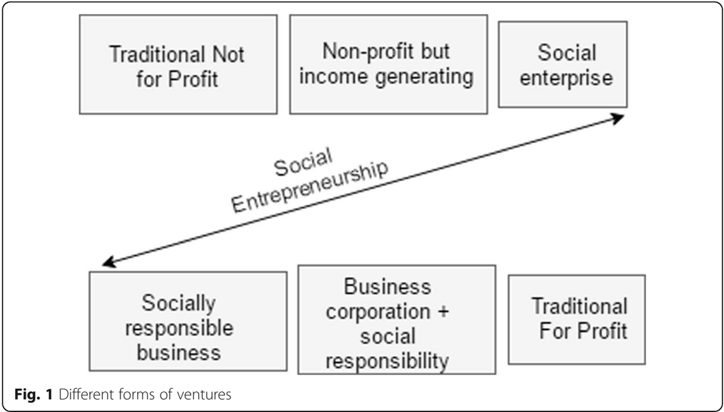
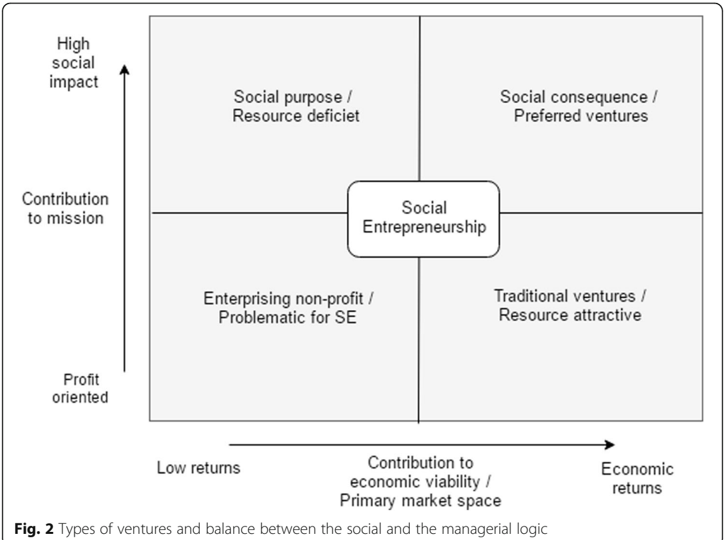
Social entrepreneurship is gradually becoming a crucial element in the worldwide discussion on volunteerism and civic commitment. It interleaves the passion of a common cause with industrial ethics and is notable and different from the present other types of entrepreneurship models due to its quest for mission associated influence. The previous few years have noticed a striking and surprising progress in the field of social entrepreneurship and has amplified attention ranging throughout all the diverse sectors. The critical difference between social and traditional entrepreneurship can be seen in the founding mission of the venture and the market impressions. Social entrepreneurs emphasize on ways to relieve or eradicate societal pressures and produce progressive externalities or public properties. This study focuses mainly on the meaning of social entrepreneurship to different genres and where does it stand in respect to other forms of entrepreneurship in today’s times.
Overview
The claims and statistics of this paper haven’t been checked yet.
Run the check — free, no account needed. It reads the open-access text and checks the sources it cites.
Integrity signals
Registry
Cites
Statistics
Figures

Verification
Claims the paper makes
The claims and statistics of this paper haven’t been checked yet.
Run the check — free, no account needed. It reads the open-access text and checks the sources it cites.
Claims other papers make about this one
Each is checked against this paper’s own text: does it say what the citing paper says it does?
In the citing paper
“prevailing SMFs lack the nuance required to achieve the sustainability performance of diverse organisational models”
From Business sustainability measurement frameworks: a systematic literature review using a TCCM approach (2025) · cites this paper as Gandhi and Raina, 2018
Self-check
Percentages, sums and reported differences re-computed from the paper’s own numbers.
The self-check needs the paper’s full text.
Citations
Cites
Economic Action and Social Structure: The Problem of Embeddedness
Granovetter, M. (1985) · American Journal of Sociology · doi:10.1086/228311 · Cited by 28,745
Social entrepreneurship research: A source of explanation, prediction, and delight
Mair, J., & Martí, I. (2006) · Journal of World Business · doi:10.1016/j.jwb.2005.09.002 · Cited by 4,015
Social entrepreneurship: A critical review of the concept
Peredo, A. M., & McLean, M. (2006) · Journal of World Business · doi:10.1016/j.jwb.2005.10.007 · Cited by 1,993
Social Enterprises as Hybrid Organizations: A Review and Research Agenda
Doherty, B., Haugh, H., & Lyon, F. (2014) · International Journal of Management Reviews · doi:10.1111/ijmr.12028 · Cited by 1,896
A Comparative Analysis of the Global Emergence of Social Enterprise
Kerlin, J. A. (2010) · VOLUNTAS International Journal of Voluntary and Nonprofit Organizations · doi:10.1007/s11266-010-9126-8 · Cited by 412
Theoretical deduction on influence factors of opportunity recognition in social entrepreneurship
Cai, N., & Sun, W. W. (2012) · International Symposium on Management of Technology · doi:10.1109/ismot.2012.6679439 · Cited by 3
Research works printed but not linked: 1
- Wolfgang, G. (2012). Business models of social enterprise: A design approach to hybridity. ACRN Journal of entrepreneurship Perspectives, 1(1), 37–60.
Cited by
Sorted by citations
Emerging needs of social innovators and social innovation ecosystems
Audretsch, D. B., Eichler, G. M., & Schwarz, E. J. (2021) · International Entrepreneurship and Management Journal · doi:10.1007/s11365-021-00789-9 · Cited by 145
Agu, A. G., Kalu, O. O., Esi-Ubani, C. O., & AGU, P. C. (2021) · International Journal of Sustainability in Higher Education · doi:10.1108/ijshe-07-2020-0277 · Cited by 123
Hassan, H. M. K. (2020) · On the Horizon The International Journal of Learning Futures · doi:10.1108/oth-04-2020-0012 · Cited by 111
Bodolica, V., D, M. S. A. B., & Badi, H. (2021) · The International Journal of Management Education · doi:10.1016/j.ijme.2021.100489 · Cited by 80
Social Entrepreneurship Competency in Higher Education: An Analysis Using Mixed Methods
García-González, A., & Soledad, M. (2020) · Journal of Social Entrepreneurship · doi:10.1080/19420676.2020.1823872 · Cited by 74
Metadata
- Authors
- Gandhi, T., & Raina, R.
- Affiliations
- Jaypee Institute of Information Technology (IN)
- Corresponding author
- Gandhi, Tanvi
- ORCID
- Gandhi, Tanvi
- Venue
- Journal of Global Entrepreneurship Research
- Published
- 2018-04-13
- Volume
- 8
- Issue
- 1
- ISSN
- 2228-7566 (ISSN-L)
- 2251-7316
- OpenAlex
- W2800401319
- Cited by
- 115
- References
- 6
- Citations by year
- 2026: 5 · 2025: 10 · 2024: 7 · 2023: 21 · 2022: 17 · 2021: 28 · 2020: 18 · 2019: 9
- FWCI
- 18.44
- Type
- journal article
- Language
- en
- Open access
- hybrid
- doi.org
- Licence
- Locations
- Journal of global entrepreneurship research (publishedVersion, cc-by)
- RePEc: Research Papers in Economics (submittedVersion)
- DOAJ (DOAJ: Directory of Open Access Journals) (submittedVersion)
- Econstor (Econstor) (submittedVersion, cc-by)
- Topics
- Social Sciences › Business, Management and Accounting › Management of Technology and Innovation › Entrepreneurship Studies and Influences
- Social Sciences › Economics, Econometrics and Finance › Finance › Community Development and Social Impact
- Social Sciences › Sociology and Political Science › Innovation, Technology, and Society
- Keywords
- social entrepreneurship, volunteering, civic commitment, industrial ethics, social impact, externalities, public goods, traditional entrepreneurship
About these checks
Registry, retraction, Cites and statistics results are computed, not judged, with one exception: a printed reference that no index lists is read once by a model before it counts as a citation error. Claims are extracted by a model and kept only when their quote appears verbatim in the text; each cited source is then checked, with a model’s help, for whether it says what the claim relies on. Those verdicts can be wrong — read the claim’s quote and the cited source before relying on one.
Statistics and arithmetic are recomputed, not judged.
Confidence bands are shown only for fields calibrated on our annotated test set. None is calibrated yet, so no band is shown.
What counts as a claim ›How we measure confidence ›How we check this ›
Are you an author, or do you see a problem with this page? Request a review
