

The DOI matches its Crossref record; 17 of the 19 references it cites were found in a registry or an index.
Acceptance of homegrown enterprise resource planning (ERP) systems in Ethiopia
Open accessAbstract
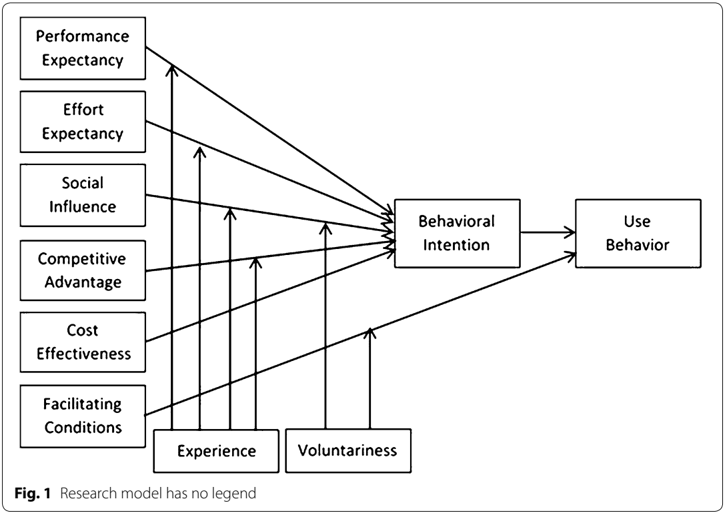
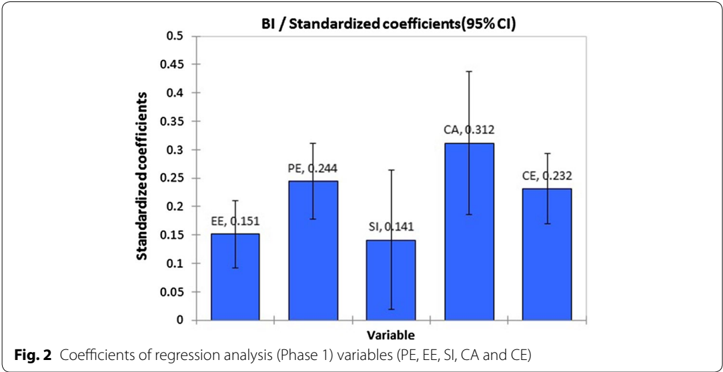
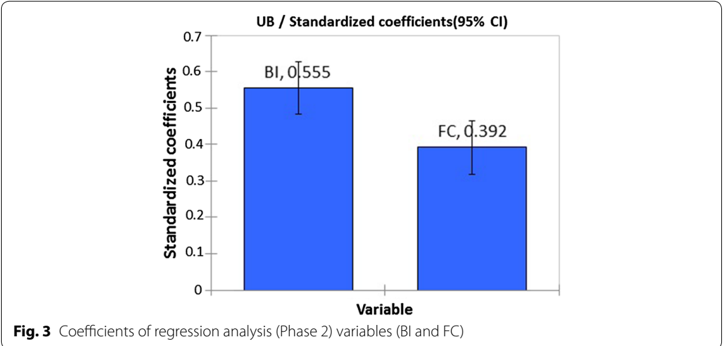
In the current competitive global market, organizations are implementing information and communication technology (ICT) that could add value to their products, processes, and satisfaction of their users. The adoption, implementation and use of homegrown enterprise resource planning (ERP) systems is one of these mechanisms being globally used for recording, processing, storing, and exchanging organizational information anytime anywhere. Although organizations have been utilizing ERP systems, the acceptance of homegrown ERP systems is given less attention as compared to commercial off-the shelf (COTS) software. Hence, this research studied factors that determine acceptance of homegrown ERP through the extension of unified theory of acceptance and use of technology (UTAUT) model. The finding revealed that performance expectancy, effort expectancy, social influence, competitive advantage, cost effectiveness, and facilitations functions are determinants of homegrown ERP system acceptance in Ethiopia. Moreover, experience and voluntariness are found to be significant moderators of the study.
Overview
The claims and statistics of this paper haven’t been checked yet.
Run the check — free, no account needed. It reads the open-access text and checks the sources it cites.
Integrity signals
Registry
Cites
Statistics
Figures
Verification
Claims the paper makes
The claims and statistics of this paper haven’t been checked yet.
Run the check — free, no account needed. It reads the open-access text and checks the sources it cites.
Claims other papers make about this one
Each is checked against this paper’s own text: does it say what the citing paper says it does?
In the citing paper
“Studies by Venkatesh et al. (2003), Chauhan and Jaiswal (2016), Wagaw (2017), Handoko and Prianto (2020), and Andwika and Witjaksono (2020) have shown a significant positive relationship between these two variables.”
From ERP Post-Implementation Phase: Deployment of the Unified Theory of Acceptance and Use of Technology (UTAUT) Model on User Acceptance (2023) · cites this paper as Wagaw (2017)
Self-check
Percentages, sums and reported differences re-computed from the paper’s own numbers.
The self-check needs the paper’s full text.
Citations
Cites
Evaluating structural equation models with unobservable variables and measurement error
Fornell, C., & Larcker, D. F. (1981) · Journal of Marketing Research · doi:10.1177/002224378101800104 · Cited by 109,190
User Acceptance of Information Technology: Toward A Unified View1
Venkatesh, V., Morris, M. G., Davis, G. B., & Davis, F. D. (2003) · MIS Quarterly · doi:10.2307/30036540 · Cited by 45,035
Psychometric theory (2nd ed.).
Sitgreaves, R. (1979) · Contemporary Psychology · doi:10.1037/018882 · Cited by 14,384
Research Methodology: Methods and Techniques
Kothari, C. R. (2004) · The Open University of Tanzania Repository (The Open University of Tanzania) · Cited by 10,197
Enterprise resource planning: Implementation procedures and critical success factors
Umble, E. J., Haft, R. R., & Umble, M. M. (2003) · European Journal of Operational Research · doi:10.1016/s0377-2217(02)00547-7 · Cited by 1,607
(2000) · Cited by 1,267
Critical Issues Affecting an ERP Implementation
Bingi, P., Sharma, M. K., & Godla, J. (1999) · Information Systems Management · doi:10.1201/1078/43197.16.3.19990601/31310.2 · Cited by 1,144
Enterprise resource planning: cultural fits and misfits: is ERP a universal solution?
Soh, C., Kien, S. S., & Tay-Yap, J. (2000) · Communications of the ACM · doi:10.1145/332051.332070 · Cited by 686
The Use of the UTAUT Model in the Adoption of E-Government Services in Kuwait
AlAwadhi, S. A., & Morris, A. (2008) · Hawaii International Conference on System Sciences (HICSS) · doi:10.1109/hicss.2008.452 · Cited by 488
Identifying critical issues in enterprise resource planning (ERP) implementation
Ehie, I. C., & Madsen, M. (2005) · Computers in Industry · doi:10.1016/j.compind.2005.02.006 · Cited by 477
Research works printed but not linked: 3
- Moghavvemi S, Hakimian F, Feissal T, Faziharudean TM (2012) Competitive advantages through IT innovation adoption by SMEs. Soc Technol 2(1):24–39
- Nunnaly JC (1978) Psychometric theory, 2nd edn. New York, MCGraw-Hill
- Ramesh HN (2011) Competitive advantage and Employee’s attitude towards IT intervention. Int J Contemp Bus Stud 2(6):42–52
Cited by
Sorted by citations
Integration of ICT and tourism for improved promotion of tourist attractions in Ethiopia
Wagaw, M., & Mulugeta, F. (2018) · Applied Informatics · doi:10.1186/s40535-018-0053-x · Cited by 20
Self-citationMohamad Zain, M. R., Tajul Urus, S., Trinh, T., Amirul, S. M., & Tuan Mat, T. Z. (2023) · Asia-Pacific Management Accounting Journal · doi:10.24191/apmaj.v18i1-05 · Cited by 6
Rahmadan, F., Mursityo, Y. T., & Wardani, N. H. (2021) · INTENSIF Jurnal Ilmiah Penelitian dan Penerapan Teknologi Sistem Informasi · doi:10.29407/intensif.v5i1.14590 · Cited by 6
Workhorse or White Elephant? End User Acceptance of ERP System in a Shared Service Center
Subbarao, A., Khan, N., Ramli, M. A., & Siddika, A. (2023) · HighTech and Innovation Journal · doi:10.28991/hij-2023-04-04-013 · Cited by 3
Implementation of B2B E-Commerce in the Enterprise Market
Arisandy, E., Qoriah, R., Nova, S. H., Nugroho, H. P. B. A., Sediyono, E., & Widodo, A. P. (2022) · SISTEMASI · doi:10.32520/stmsi.v11i1.1490 · Cited by 1
Bezuneh, D. W., Kamau, J. N., & Macharia, J. K. N. (2021) · Strategic Journal of Business & Change Management · doi:10.61426/sjbcm.v8i4.2154
Sesi, P., & Bezuneh, D. W. (2025) · Springer eBooks · doi:10.1007/978-3-031-32257-0_93-1
Sesi, P., & Bezuneh, D. W. (2026) · Springer eBooks · doi:10.1007/978-3-031-76750-0_93
Metadata
- Authors
- Wagaw, M.
- Affiliations
- Bahir Dar University (ET)
- Corresponding author
- Wagaw, Mekonnen
- ORCID
- Wagaw, Mekonnen
- Venue
- Applied Informatics
- Published
- 2017-03-14
- Volume
- 4
- Issue
- 1
- ISSN
- 2196-0089 (ISSN-L)
- OpenAlex
- W2601042574
- Cited by
- 8
- References
- 19
- Citations by year
- 2026: 1 · 2025: 1 · 2023: 2 · 2022: 1 · 2021: 2 · 2018: 1
- FWCI
- 0.47
- Type
- journal article
- Language
- en
- Open access
- hybrid
- doi.org
- Locations
- Applied Informatics (publishedVersion, cc-by)
- Funders
- Bahir Dar University
- Topics
- Social Sciences › Business, Management and Accounting › Management Information Systems › ERP Systems Implementation and Impact
- Social Sciences › Decision Sciences › Information Systems and Management › Technology Adoption and User Behaviour
- Social Sciences › Business, Management and Accounting › Management Information Systems › Decision Support System Applications
- Keywords
- enterprise resource planning, technology acceptance, UTAUT, performance expectancy, effort expectancy, social influence, competitive advantage, cost-effectiveness, commercial off-the-shelf software, Ethiopia
About these checks
Registry, retraction, Cites and statistics results are computed, not judged, with one exception: a printed reference that no index lists is read once by a model before it counts as a citation error. Claims are extracted by a model and kept only when their quote appears verbatim in the text; each cited source is then checked, with a model’s help, for whether it says what the claim relies on. Those verdicts can be wrong — read the claim’s quote and the cited source before relying on one.
Statistics and arithmetic are recomputed, not judged.
Confidence bands are shown only for fields calibrated on our annotated test set. None is calibrated yet, so no band is shown.
What counts as a claim ›How we measure confidence ›How we check this ›
Are you an author, or do you see a problem with this page? Request a review
