

Cybersecurity data science: an overview from machine learning perspective
Open accessPublished version of a preprint
The DOI matches its Crossref record; 165 of the 172 references it cites were found in a registry or an index.
Abstract
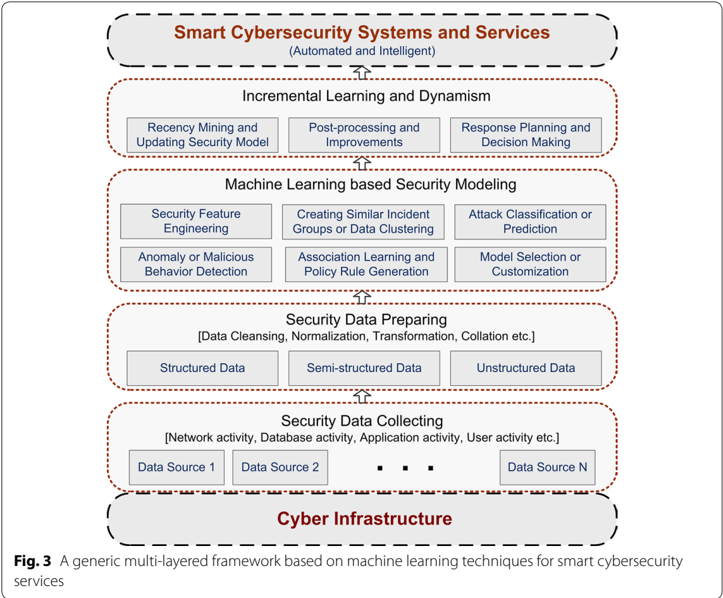
In a computing context, cybersecurity is undergoing massive shifts in technology and its operations in recent days, and data science is driving the change. Extracting security incident patterns or insights from cybersecurity data and building corresponding data-driven model , is the key to make a security system automated and intelligent. To understand and analyze the actual phenomena with data, various scientific methods, machine learning techniques, processes, and systems are used, which is commonly known as data science. In this paper, we focus and briefly discuss on cybersecurity data science , where the data is being gathered from relevant cybersecurity sources, and the analytics complement the latest data-driven patterns for providing more effective security solutions. The concept of cybersecurity data science allows making the computing process more actionable and intelligent as compared to traditional ones in the domain of cybersecurity. We then discuss and summarize a number of associated research issues and future directions . Furthermore, we provide a machine learning based multi-layered framework for the purpose of cybersecurity modeling. Overall, our goal is not only to discuss cybersecurity data science and relevant methods but also to focus the applicability towards data-driven intelligent decision making for protecting the systems from cyber-attacks.
Overview
The claims and statistics of this paper haven’t been checked yet.
Free: it reads the open-access text and checks the first 5 claims that cite a source we can check. Create a free account to check every claim.
Integrity signals
Registry
Cites
Statistics
Figures
Verification
Claims the paper makes
The claims and statistics of this paper haven’t been checked yet.
Free: it reads the open-access text and checks the first 5 claims that cite a source we can check. Create a free account to check every claim.
Claims other papers make about this one
Each is checked against this paper’s own text: does it say what the citing paper says it does?
The source backs part of the claim, not all of it — or backs it for a different population, condition or comparison.
In the citing paper
“The key benefit of deep learning over conventional machine learning methods is that it performs better in a variety of situations, particularly when learning from large datasets [114, 140].”
From Data Science and Analytics: An Overview from Data-Driven Smart Computing, Decision-Making and Applications Perspective (2021) · cites this paper as [114]
Experimental — accuracy not yet measuredThe cited source says what the claim attributes to it.
In the citing paper
“As we know that data science is largely driven by the availability of data [114].”
From Data Science and Analytics: An Overview from Data-Driven Smart Computing, Decision-Making and Applications Perspective (2021) · cites this paper as [114]
The cited source says what the claim attributes to it.
In the citing paper
“For instance, in our earlier paper Sarker et al. [114], we have discussed how data science and machine learning modeling can play a significant role in the domain of cybersecurity for making smart decisions and to provide data-driven intelligent security services.”
From Data Science and Analytics: An Overview from Data-Driven Smart Computing, Decision-Making and Applications Perspective (2021) · cites this paper as [114]
The cited source says what the claim attributes to it.
In the citing paper
“The main advantage of deep learning over traditional machine learning methods is its better performance in several cases, particularly learning from large datasets [105, 129].”
From Machine learning: Algorithms, real-world applications and research directions (2021) · cites this paper as [105]
In the citing paper
“Semi-supervised learning can be defined as a hybridization of the above-mentioned supervised and unsupervised methods, as it operates on both labeled and unlabeled data [41, 105].”
From Machine learning: Algorithms, real-world applications and research directions (2021) · cites this paper as [105]
1 more claim about this paper
Create a free account to see every claim other papers make about this one.
Self-check
Percentages, sums and reported differences re-computed from the paper’s own numbers.
The self-check needs the paper’s full text.
Citations
Cites
Breiman, L. (2001) · Machine Learning · doi:10.1023/a:1010933404324 · Cited by 133,538
Data mining: concepts and techniques
(2012) · Choice Reviews Online · doi:10.5860/choice.49-3305 · Cited by 28,531
Data Mining: Practical Machine Learning Tools and Techniques
(2011) · Elsevier eBooks · doi:10.1016/c2009-0-19715-5 · Cited by 25,437
(1992) · Cited by 23,431
Mining association rules between sets of items in large databases
Agrawal, R., Imieliński, T., & Swami, A. (1993) · Proceedings of the 1993 ACM SIGMOD international conference on Management of data · doi:10.1145/170035.170072 · Cited by 14,907 · cited 3×
“Moreover, AIS [147], Apriori [149], Apriori-TID and Apriori-Hybrid [149], FP-Tree [152], and RARM [154], and Eclat [155] are the well-known association rule learning algorithms that are capable to solve such problems by generating a set of policy rules in the domain of cybersecurity.”
BackgroundMethodFast algorithms for mining association rules
Agrawal, R., & Srikant, R. (1998) · Cited by 11,307
Reinforcement Learning: A Survey
Kaelbling, L. P., Littman, M. L., & Moore, A. W. (1996) · Journal of Artificial Intelligence Research · doi:10.1613/jair.301 · Cited by 8,972
Mining frequent patterns without candidate generation
Han, J., Pei, J., & Yin, Y. (2000) · ACM SIGMOD Record · doi:10.1145/335191.335372 · Cited by 6,402
A detailed analysis of the KDD CUP 99 data set
Tavallaee, M., Bagheri, E., Lu, W., & Ghorbani, A. A. (2009) · 2009 IEEE Symposium on Computational Intelligence for Security and Defense Applications · doi:10.1109/cisda.2009.5356528 · Cited by 5,396
Mining association rules between sets of items in large databases
Agrawal, R., Imieliński, T., & Swami, A. (1993) · ACM SIGMOD Record · doi:10.1145/170036.170072 · Cited by 4,551
Research works printed but not linked: 8
- 21. Rainie L, Anderson J, Connolly J. Cyber attacks likely to increase. Digital Life in. 2014, vol. 2025.
- 23. Craigen D, Diakun-Thibault N, Purse R. Defining cybersecurity. Technology Innovation. Manag Rev. 2014;4(10):13-21.
- 45. Ragsdale DJ, Carver C, Humphries JW, Pooch UW. Adaptation techniques for intrusion detection and intrusion response systems. In: Smc 2000 conference proceedings. 2000 IEEE international conference on systems, man and cybernetics. 'cybernetics evolving to systems, humans, organizations, and their complex interactions'(cat. No. 0). IEEE; 2000. vol. 4, p. 2344-2349.
- 74. Microsoft malware classification (big 2015). arXiv :org/abs/1802.10135 /. Accessed 20 Oct 2019.
- 92. Dada E. A hybridized svm-knn-pdapso approach to intrusion detection system. In: Proc. Fac. Seminar Ser., 2017, p. 14-21.
- 93. Sharifi AM, Amirgholipour SK, Pourebrahimi A. Intrusion detection based on joint of k-means and knn. J Converg Inform Technol. 2015;10(5):42.
- Rai K, Devi MS, Guleria A. Decision tree based algorithm for intrusion detection. Int J Adv Netw Appl. 2016;7(4):2828.
- MacQueen J. Some methods for classification and analysis of multivariate observations. In: Fifth Berkeley symposium on mathematical statistics and probability, vol. 1, 1967.
Cited by
Machine learning: Algorithms, real-world applications and research directions
Sarker, I. H. (2021) · SN Computer Science · doi:10.1007/s42979-021-00592-x · Cited by 5,583
“Usually, the availability of data is considered as the key to construct a machine learning model or data-driven realworld systems [103, 105].”
InfluentialSelf-citationSarker, I. H. (2021) · SN Computer Science · doi:10.1007/s42979-021-00815-1 · Cited by 2,678
Self-citationSarker, I. H. (2022) · SN Computer Science · doi:10.1007/s42979-022-01043-x · Cited by 1,208
“highlight numerous sorts of cyber anomalies and attacks that can be detected using machine learning approaches in the domain of cybersecurity [78] [89].”
BackgroundSelf-citationSarker, I. H. (2021) · SN Computer Science · doi:10.1007/s42979-021-00765-8 · Cited by 570
Self-citationAI-Driven Cybersecurity: An Overview, Security Intelligence Modeling and Research Directions
Sarker, I. H. (2021) · doi:10.20944/preprints202101.0457.v1 · Cited by 550
Self-citationAI-Driven Cybersecurity: An Overview, Security Intelligence Modeling and Research Directions
Sarker, I. H., Furhad, M. H., & Nowrozy, R. (2021) · SN Computer Science · doi:10.1007/s42979-021-00557-0 · Cited by 543
Self-citationSarker, I. H., Khan, A. I., Abushark, Y. B., & Alsolami, F. (2023) · Mobile Networks and Applications · doi:10.1007/s11036-022-01937-3 · Cited by 398
Self-citationMachine learning-based approach: global trends, research directions, and regulatory standpoints
Pugliese, R., Regondi, S., & Marini, R. (2021) · Data Science and Management · doi:10.1016/j.dsm.2021.12.002 · Cited by 373
IntruDTree: A Machine Learning Based Cyber Security Intrusion Detection Model
Sarker, I. H., Abushark, Y. B., Alsolami, F., & Khan, A. I. (2020) · Symmetry · doi:10.3390/sym12050754 · Cited by 356
Self-citationCyber risk and cybersecurity: a systematic review of data availability
Cremer, F., Sheehan, B., Fortmann, M., Kia, A. N., Mullins, M., Murphy, F., & Materne, S. (2022) · The Geneva Papers on Risk and Insurance - Issues and Practice · doi:10.1057/s41288-022-00266-6 · Cited by 355
Explainable Artificial Intelligence in CyberSecurity: A Survey
Capuano, N., Fenza, G., Loia, V., & Stanzione, C. (2022) · IEEE Access · doi:10.1109/access.2022.3204171 · Cited by 330
“435 Information Security, Network security, operational secu-436 rity, application security, Internet of Things (IoT) Security, 437 Cloud security, and infrastructure Security are all covered by 438 CyberSecurity [48].”
BackgroundTalukder, M. A., Islam, M. M., Uddin, M. A., Hasan, K. F., Sharmin, S., Alyami, S. A., & Moni, M. A. (2024) · Journal of Big Data · doi:10.1186/s40537-024-00886-w · Cited by 300
Deep Cybersecurity: A Comprehensive Overview from Neural Network and Deep Learning Perspective
Sarker, I. H. (2021) · doi:10.20944/preprints202102.0340.v1 · Cited by 295
Self-citationDeep Cybersecurity: A Comprehensive Overview from Neural Network and Deep Learning Perspective
Sarker, I. H. (2021) · SN Computer Science · doi:10.1007/s42979-021-00535-6 · Cited by 289
Self-citationMachine learning approaches to IoT security: A systematic literature review
Ahmad, R., & Alsmadi, I. (2021) · Internet of Things · doi:10.1016/j.iot.2021.100365 · Cited by 285
Advancing cybersecurity: a comprehensive review of AI-driven detection techniques
Salem, A. H., Azzam, S. M., Emam, O. E., & Abohany, A. A. (2024) · Journal of Big Data · doi:10.1186/s40537-024-00957-y · Cited by 282
“In cybersecurity, DL-enhanced defense mechanisms are increasingly deployed to auto-mate the identification of cyber threats, with these systems continuously evolving and enhancing their effectiveness over time [28].”
BackgroundThe Emerging Threat of Ai-driven Cyber Attacks: A Review
Guembe, B., Azeta, A., Misra, S., Osamor, V. C., Fernandez-Sanz, L., & Pospelova, V. (2022) · Applied Artificial Intelligence · doi:10.1080/08839514.2022.2037254 · Cited by 267
Sarker, I. H. (2023) · Annals of Data Science · doi:10.1007/s40745-022-00444-2 · Cited by 256
Self-citationComprehensive Overview of Flood Modeling Approaches: A Review of Recent Advances
Kumar, V., Sharma, K., Caloiero, T., Mehta, D., & Singh, K. (2023) · Hydrology · doi:10.3390/hydrology10070141 · Cited by 251
“ML technology enables systems to improve themselves through experience without the need for explicit programming [157,158].”
BackgroundA dependable hybrid machine learning model for network intrusion detection
Talukder, M. A., Hasan, K. F., Islam, M. M., Uddin, M. A., Akhter, A., Yousuf, M. A., Alharbi, F., & Moni, M. A. (2023) · Journal of Information Security and Applications · doi:10.1016/j.jisa.2022.103405 · Cited by 239
“NIDS detects infiltration by monitoring network traffic and hosts connecting to the network.”
BackgroundInfluentialMobile Data Science and Intelligent Apps: Concepts, AI-Based Modeling and Research Directions
Sarker, I. H., Hoque, M. M., Uddin, M. K., & Alsanoosy, T. (2021) · Mobile Networks and Applications · doi:10.1007/s11036-020-01650-z · Cited by 207
“Moreover, intelligent data-driven solutions could also be effective in AI-based mobile security and privacy, where AI works with huge volumes of security event data to extract the useful insights using machine learning techniques [10].”
BackgroundMethodSelf-citationA systematic review of AI-enhanced techniques in credit card fraud detection
Hafez, I. Y., Hafez, A. Y., Saleh, A., El-Mageed, A. A. A., & Abohany, A. A. (2025) · Journal Of Big Data · doi:10.1186/s40537-024-01048-8 · Cited by 207
Pinto, A., Herrera, L.-C., Donoso, Y., & Gutierrez, J. A. (2023) · Sensors · doi:10.3390/s23052415 · Cited by 200
“UL helps to uncover hidden characteristics, patterns, and structures from datasets to establish indicators of cyber-attacks [31,60] and, through clustering, has enhanced its capacity to identify novel attacks.”
InfluentialAnalysis of IoT Security Challenges and Its Solutions Using Artificial Intelligence
Mazhar, T., Talpur, D. B., Shloul, T. A., Ghadi, Y. Y., Haq, I., Ullah, I., Ouahada, K., & Hamam, H. (2023) · Brain Sciences · doi:10.3390/brainsci13040683 · Cited by 198
“To sift through security data in search of novel insights and trends, machine learning and deep learning models commonly use a preset set of rules, strategies, or complex transfer functions [3].”
Zero-day attack detection: a systematic literature review
Ahmad, R., Alsmadi, I., Alhamdani, W., & Tawalbeh, L. (2023) · Artificial Intelligence Review · doi:10.1007/s10462-023-10437-z · Cited by 182
Machine Learning in Network Intrusion Detection: A Cross-Dataset Generalization Study
Cantone, M., Marrocco, C., & Bria, A. (2024) · IEEE Access · doi:10.1109/access.2024.3472907 · Cited by 190
Smart City Data Science: Towards data-driven smart cities with open research issues
Sarker, I. H. (2022) · Internet of Things · doi:10.1016/j.iot.2022.100528 · Cited by 177
Self-citationCyber Intrusion Detection Using Machine Learning Classification Techniques
Alqahtani, H., Sarker, I. H., Kalim, A., Minhaz Hossain, S. M., Ikhlaq, S., & Hossain, S. (2020) · Communications in Computer and Information Science · doi:10.1007/978-981-15-6648-6_10 · Cited by 173
“It is known as a data-driven intelligent intrusion detection system [25].”
BackgroundInfluentialSelf-citationLee, S.-W., Sidqi, H. M., Mohammadi, M., Rashidi, S., Rahmani, A. M., Masdari, M., & Hosseinzadeh, M. (2021) · Journal of Network and Computer Applications · doi:10.1016/j.jnca.2021.103111 · Cited by 174
Jimmy, F. (2021) · International Journal of Scientific Research and Management (IJSRM) · doi:10.18535/ijsrm/v9i2.ec01 · Cited by 172
A Review on Machine Learning Strategies for Real-World Engineering Applications
Jhaveri, R. H., Revathi, A. R., Ramana, K., Raut, R., & Dhanaraj, R. K. (2022) · Mobile Information Systems · doi:10.1155/2022/1833507 · Cited by 173
Al-Momani, A. M., Ramayah, T., & Al-Sharafi, M. A. (2024) · Technology in Society · doi:10.1016/j.techsoc.2024.102592 · Cited by 169
Application of Large Language Models in Cybersecurity: A Systematic Literature Review
Hasanov, I., Virtanen, S., Hakkala, A., & Isoaho, J. (2024) · IEEE Access · doi:10.1109/access.2024.3505983 · Cited by 89
Batteries temperature prediction and thermal management using machine learning: An overview
Al Miaari, A., & Ali, H. M. (2023) · Energy Reports · doi:10.1016/j.egyr.2023.08.043 · Cited by 132
Abisoye, A., & Akerele, J. I. (2021) · International Journal of Multidisciplinary Research and Growth Evaluation · doi:10.54660/.ijmrge.2021.2.1.623-637 · Cited by 151
The future of Artificial Intelligence in Cybersecurity: A Comprehensive Survey
Tao, F., Akhtar, M. S., & Jiayuan, Z. (2021) · EAI Endorsed Transactions on Creative Technologies · doi:10.4108/eai.7-7-2021.170285 · Cited by 146
A Review of Quantum Cybersecurity: Threats, Risks and Opportunities
Faruk, M. J. H., Tahora, S., Tasnim, M., Shahriar, H., & Sakib, N. (2022) · IEEE International Conference on AI in Cybersecurity (ICAIC) · doi:10.1109/icaic53980.2022.9896970 · Cited by 146
Ullah, I., Adhikari, D., Su, X., Palmieri, F., Wu, C., & Choi, C. (2024) · Digital Communications and Networks · doi:10.1016/j.dcan.2024.02.007 · Cited by 149
Sarker, I. H. (2023) · Security and Privacy · doi:10.1002/spy2.295 · Cited by 146
Self-citationA Survey of Adversarial Attack and Defense Methods for Malware Classification in Cyber Security
Yan, S., Ren, J., Wang, W., Sun, L., Zhang, W., & Yu, Q. (2022) · IEEE Communications Surveys & Tutorials · doi:10.1109/comst.2022.3225137 · Cited by 134
Gupta, C., Johri, I., Srinivasan, K., Hu, Y., Qaisar, S. M., & Huang, K.-Y. (2022) · Sensors · doi:10.3390/s22052017 · Cited by 132
Jaw, E., & Wang, X. (2021) · Symmetry · doi:10.3390/sym13101764 · Cited by 133
Sarker, I. H. (2021) · Internet of Things · doi:10.1016/j.iot.2021.100393 · Cited by 129
Self-citationMahmoud, D., Magolon, M., Boer, J., Elbestawi, M. A., & Mohammadi, M. G. (2021) · Applied Sciences · doi:10.3390/app112411910 · Cited by 124
Koç, K., Ekmekcioğlu, Ö., & Gürgün, A. P. (2021) · Automation in Construction · doi:10.1016/j.autcon.2021.103896 · Cited by 122
A Survey on Threat Hunting in Enterprise Networks
Nour, B., Pourzandi, M., & Debbabi, M. (2023) · IEEE Communications Surveys & Tutorials · doi:10.1109/comst.2023.3299519 · Cited by 123
Machine learning and blockchain technologies for cybersecurity in connected vehicles
Ahmad, J., Zia, M. U., Naqvi, I. H., Chattha, J. N., Butt, F. A., Huang, T., & Xiang, W. (2023) · Wiley Interdisciplinary Reviews Data Mining and Knowledge Discovery · doi:10.1002/widm.1515 · Cited by 121
Network intrusion detection using feature fusion with deep learning
Ayantayo, A., Kaur, A., Kour, A., Schmoor, X., Shah, F., Vickers, I., Kearney, P., & Abdelsamea, M. M. (2023) · Journal Of Big Data · doi:10.1186/s40537-023-00834-0 · Cited by 120
Machine Learning - Algorithms, Models and Applications
Sen, J. (2021) · Artificial intelligence · doi:10.5772/intechopen.94615 · Cited by 117
A review on security analysis of cyber physical systems using Machine learning
Ahmed Jamal, A., Mustafa Majid, A.-A., Konev, A., Kosachenko, T., & Shelupanov, A. (2023) · Materials Today: Proceedings · doi:10.1016/j.matpr.2021.06.320 · Cited by 76
Detecting Zero-Day Intrusion Attacks Using Semi-Supervised Machine Learning Approaches
Mbona, I., & Eloff, J. H. P. (2022) · IEEE Access · doi:10.1109/access.2022.3187116 · Cited by 113
The Artificial Intelligence-Powered New Era in Pharmaceutical Research and Development: A Review
Suriyaamporn, P., Pamornpathomkul, B., Patrojanasophon, P., Ngawhirunpat, T., Rojanarata, T., & Opanasopit, P. (2024) · AAPS PharmSciTech · doi:10.1208/s12249-024-02901-y · Cited by 115
A Novel Multi-Stage Approach for Hierarchical Intrusion Detection
Verkerken, M., D’hooge, L., Sudyana, D., Lin, Y., Wauters, T., Volckaert, B., & Turck, F. D. (2023) · IEEE Transactions on Network and Service Management · doi:10.1109/tnsm.2023.3259474 · Cited by 113
Fahd, K., Venkatraman, S., Miah, S. J., & Ahmed, K. (2022) · Education and Information Technologies · doi:10.1007/s10639-021-10741-7 · Cited by 110
“It is considered as a task-driven approach i.e. a model that achieves a task (classify or predict) by identifying the target from a set of labeled input (Sarker et al., 2020).”
BackgroundA Data-Driven Heart Disease Prediction Model Through K-Means Clustering-Based Anomaly Detection
Ripan, R. C., Sarker, I. H., Hossain, S. M. M., Anwar, M. M., Nowrozy, R., Hoque, M. M., & Furhad, M. H. (2021) · SN Computer Science · doi:10.1007/s42979-021-00518-7 · Cited by 112
Self-citationQaddoura, R., Al-Zoubi, A. M., Almomani, I., & Faris, H. (2021) · Applied Sciences · doi:10.3390/app11073022 · Cited by 107
Sharing Machine Learning Models as Indicators of Compromise for Cyber Threat Intelligence
Preuveneers, D., & Joosen, W. (2021) · Journal of Cybersecurity and Privacy · doi:10.3390/jcp1010008 · Cited by 107
Florido‐Benítez, L. (2024) · Smart Cities · doi:10.3390/smartcities7010019 · Cited by 101
A comprehensive deep learning benchmark for IoT IDS
Ahmad, R., Alsmadi, I. M., Al-Hamdani, W. A., & Tawalbeh, L. (2021) · Computers & Security · doi:10.1016/j.cose.2021.102588 · Cited by 101
Ferro, M., Crocetto, F., Barone, B., Giudice, F. D., Maggi, M., Lucarelli, G. T., Busetto, G. M., Autorino, R., Marchioni, M., Cantiello, F., et al. (2023) · Therapeutic Advances in Urology · doi:10.1177/17562872231164803 · Cited by 100
Integrating machine learning for sustaining cybersecurity in digital banks
Asmar, M., & Tuqan, A. (2024) · Heliyon · doi:10.1016/j.heliyon.2024.e37571 · Cited by 103
Artificial Intelligence in Cybersecurity: A Comprehensive Review and Future Direction
Ofusori, L. O., Bokaba, T., & Mhlongo, S. (2024) · Applied Artificial Intelligence · doi:10.1080/08839514.2024.2439609 · Cited by 98
Cyber Attack Prediction: From Traditional Machine Learning to Generative Artificial Intelligence
Ankalaki, S., Atmakuri, A. R., Pallavi, M., Hukkeri, G. S., Jan, T., & Naik, G. R. (2025) · IEEE Access · doi:10.1109/access.2025.3547433 · Cited by 97
Russ, M. (2021) · Sustainability · doi:10.3390/su13063353 · Cited by 91
Shen, C., Zhang, M., Lu, M., Chang, E., Gao, Z., Ban, W., Liu, Q., Zuo, Z., & Jiang, C. (2025) · Acta Pharmaceutica Sinica B · doi:10.1016/j.apsb.2025.12.011 · Cited by 95
LLMs as Hackers: Autonomous Linux Privilege Escalation Attacks
Happe, A., Kaplan, A., & Cito, J. (2026) · Empirical Software Engineering · doi:10.1007/s10664-025-10758-3 · Cited by 22
Federated Learning for Privacy-Preserving Intrusion Detection in Software-Defined Networks
Raza, M. I., Saeed, M. J., Riaz, M. B., & Sattar, M. A. (2024) · IEEE Access · doi:10.1109/access.2024.3395997 · Cited by 90
Zola, F., Segurola-Gil, L., Bruse, J. L., Galar, M., & Orduna-Urrutia, R. (2022) · Computers & Security · doi:10.1016/j.cose.2022.102632 · Cited by 85
Intrusion detection based on ensemble learning for big data classification
Jemili, F., Meddeb, R., & Korbaa, O. (2023) · Cluster Computing · doi:10.1007/s10586-023-04168-7 · Cited by 83
Cybersecurity Threats in Digital Payment Systems (DPS): A Data Science Perspective
Hundekari, S. (2025) · Journal of Information Systems Engineering & Management · doi:10.52783/jisem.v10i13s.2104 · Cited by 82
A Review of Computer Vision Methods in Network Security
Zhao, J., Masood, R., & Seneviratne, S. (2021) · IEEE Communications Surveys & Tutorials · doi:10.1109/comst.2021.3086475 · Cited by 82
Analysis of the Influence of Investment in Education and Health on Economic Growth in Malaysia
Nadhirah, A. N., Kurniawati, T., & Nor, Z. B. M. (2023) · International Journal of Multidisciplinary Research of Higher Education · doi:10.24036/ijmurhica.v6i2.42 · Cited by 81
Anomaly Detection in Encrypted Internet Traffic Using Hybrid Deep Learning
Bakhshi, T., & Ghita, B. (2021) · Security and Communication Networks · doi:10.1155/2021/5363750 · Cited by 79
AI-Driven Threat Detection: A Brief Overview of AI Techniques in Cybersecurity
Khan, M. I., Arif, A., & Khan, A. R. A. (2024) · BIN : Bulletin Of Informatics · Cited by 79
IoT-Driven Transformation of Circular Economy Efficiency: An Overview
Turskis, Z., & Šniokienė, V. (2024) · Mathematical and Computational Applications · doi:10.3390/mca29040049 · Cited by 77
Sarker, I. H., & Kayes, A. S. M. (2020) · Journal of Network and Computer Applications · doi:10.1016/j.jnca.2020.102762 · Cited by 75
Self-citationStakeholder perspectives and requirements on cybersecurity in Europe
Fischer‐Hübner, S., Alcaraz, C., Ferreira, A., Fernández-Gago, C., López, J., Markatos, E. P., Islami, L., & Akil, M. (2021) · Journal of Information Security and Applications · doi:10.1016/j.jisa.2021.102916 · Cited by 74
KRYSTAL: Knowledge graph-based framework for tactical attack discovery in audit data
Kurniawan, K., Ekelhart, A., Kiesling, E., Quirchmayr, G., & Tjoa, A. M. (2022) · Computers & Security · doi:10.1016/j.cose.2022.102828 · Cited by 74
Employing Deep Reinforcement Learning to Cyber-Attack Simulation for Enhancing Cybersecurity
Oh, S. H., Kim, J., Nah, J. H., & Park, J. (2024) · Electronics · doi:10.3390/electronics13030555 · Cited by 74
Application of meta-learning in cyberspace security: a survey
Yang, A., Lu, C., Li, J., Huang, X., Ji, T., Li, X., & Sheng, Y. (2022) · Digital Communications and Networks · doi:10.1016/j.dcan.2022.03.007 · Cited by 74
Cybersecurity Deep: Approaches, Attacks Dataset, and Comparative Study
Barik, K., Misra, S., Konar, K., Sanz, L. F., & Koyuncu, M. (2022) · Applied Artificial Intelligence · doi:10.1080/08839514.2022.2055399 · Cited by 74
Ngueajio, M. K., Washington, G. J., Rawat, D. B., & Ngueabou, Y. (2022) · Lecture notes in networks and systems · doi:10.1007/978-3-031-16078-3_42 · Cited by 73
Browne, T. O., Abedin, M., & Chowdhury, M. J. M. (2024) · International Journal of Information Security · doi:10.1007/s10207-024-00868-2 · Cited by 71
A Comprehensive Review on Cybersecurity Issues and Their Mitigation Measures in FinTech
Ali, G., Mijwil, M. M., Buruga, B. A., & Abotaleb, M. S. A. (2024) · Iraqi Journal for Computer Science and Mathematics · doi:10.52866/ijcsm.2024.05.03.004 · Cited by 71
INTEGRATION OF MACHINE LEARNING AND ADVANCED COMPUTING FOR OPTIMIZING RETAIL CUSTOMER ANALYTICS
Shafa, H. (2022) · doi:10.63125/p87sv224 · Cited by 71
A Real-Time Sequential Deep Extreme Learning Machine Cybersecurity Intrusion Detection System
Haider, A., Khan, M. A., Rehman, A., Rahman, M., & Kim, H. S. (2020) · Computers, materials & continua/Computers, materials & continua (Print) · doi:10.32604/cmc.2020.013910 · Cited by 69
Applications and Challenges of Artificial Intelligence in Space Missions
Oche, P. A., Ewa, G. A., & Ibekwe, N. (2024) · IEEE Access · doi:10.1109/access.2021.3132500 · Cited by 68
“Semi-supervised [31, 34] Defined as the hybridization of the above methods, as it operates on both labeled and unlabeled data.”
BackgroundL-Boost: Identifying Offensive Texts From Social Media Post in Bengali
Mridha, M. F., Wadud, M. A. H., Hamid, M. A., Monowar, M. M., Abdullah-Al-Wadud, M., & Alamri, A. M. (2021) · IEEE Access · doi:10.1109/access.2021.3134154 · Cited by 70
Intrusion Detection System Based on Machine Learning Algorithms:( SVM and Genetic Algorithm)
Alsajri, A., & Steiti, A. (2024) · Babylonian Journal of Machine Learning · doi:10.58496/bjml/2024/002 · Cited by 70
Dedeloudi, A., Weaver, E., & Lamprou, D. A. (2023) · International Journal of Pharmaceutics · doi:10.1016/j.ijpharm.2023.122818 · Cited by 62
Detecting Suspicious Texts Using Machine Learning Techniques
Sharif, O., Hoque, M. M., Kayes, A. S. M., Nowrozy, R., & Sarker, I. H. (2020) · Applied Sciences · doi:10.3390/app10186527 · Cited by 63
Self-citationA New Solution for Cyber Security in Big Data Using Machine Learning Approach
Rawat, R., Oki, O. A., Sankaran, K. S., Olasupo, O., Ebong, G. N., & Ajagbe, S. A. (2023) · Lecture notes on data engineering and communications technologies · doi:10.1007/978-981-99-0835-6_35 · Cited by 61
A lightweight framework to secure IoT devices with limited resources in cloud environments
Pandey, V. K., Sahu, D. K., Prakash, S., Rathore, R. S., Dixit, P., & Hunko, I. (2025) · Scientific Reports · doi:10.1038/s41598-025-09885-0 · Cited by 61
Lean Six Sigma 4.0 – a framework and review for Lean Six Sigma practices in the digital era
Citybabu, G., & Yamini, S. (2023) · Benchmarking An International Journal · doi:10.1108/bij-09-2022-0586 · Cited by 64
An Intelligent Diagnosis System for Predicting Coronary Heart Disease
Saberi, Z. A., Sadr, H., & Yamaghani, M. R. (2024) · doi:10.1109/qicar61538.2024.10496601 · Cited by 60
Gholizadeh, S., Leman, Z., & Baharudin, B. H. T. (2023) · Ultrasonics · doi:10.1016/j.ultras.2023.106998 · Cited by 57
Communications Security in Industry X: A Survey
Ahmad, I., Rodriguez, F., Kumar, T., Suomalainen, J., Jagatheesaperumal, S. K., Walter, S., Asghar, M. Z., Li, G., Papakonstantinou, N., Ylianttila, M., et al. (2024) · IEEE Open Journal of the Communications Society · doi:10.1109/ojcoms.2024.3356076 · Cited by 57
Ji, R., Padha, D., Singh, Y. P., & Sharma, S. (2024) · Transactions on Emerging Telecommunications Technologies · doi:10.1002/ett.5029 · Cited by 56
AI in Context: Harnessing Domain Knowledge for Smarter Machine Learning
Miller, T. I., Durlik, I., Łobodzińska, A., Dorobczyński, L., & Jasionowski, R. (2024) · Applied Sciences · doi:10.3390/app142411612 · Cited by 56
A Shared Cyber Threat Intelligence Solution for SMEs
van Haastrecht, M., Golpur, G., Tzismadia, G., Kab, R., Priboi, C., David, D., Răcătăian, A., Baumgartner, L., Fricker, S., Ruiz, J., et al. (2021) · Electronics · doi:10.3390/electronics10232913 · Cited by 56
Metadata
- Authors
- Sarker, I. H., Kayes, A. S. M., Badsha, S., Alqahtani, H., Watters, P., & Ng, A.
- Affiliations
- Chittagong University of Engineering & Technology (BD)
- La Trobe University (AU)
- University of Nevada, Reno (US)
- Macquarie University (AU)
- Corresponding author
- Sarker, Iqbal H.
- Venue
- Journal of Big Data
- Published
- 2020-07-01
- Volume
- 7
- Issue
- 1
- ISSN
- 2196-1115 (ISSN-L)
- OpenAlex
- W3038955483
- Semantic Scholar
- ede0a8039a561905f40777ec2ae66c2010e3f2bc
- Cited by
- 766
- References
- 172
- Citations by year
- 2026: 100 · 2025: 174 · 2024: 152 · 2023: 133 · 2022: 120 · 2021: 73 · 2020: 14
- FWCI
- 39.94
- Type
- journal article
- Language
- en
- Open access
- gold
- doi.org
- Licence
- cc-by
- creativecommons.org/licenses/by/4.0 (tdm)
- creativecommons.org/licenses/by/4.0 (vor)
- Locations
- Journal Of Big Data (publishedVersion, cc-by)
- Preprints.org (acceptedVersion)
- DOAJ (DOAJ: Directory of Open Access Journals) (submittedVersion, cc-by-sa)
- Swinburne figshare (Swinburne University of Technology) (submittedVersion)
- Topics
- Physical Sciences › Computer Science › Computer Networks and Communications › Network Security and Intrusion Detection
- Physical Sciences › Computer Science › Information Systems › Information and Cyber Security
- Physical Sciences › Computer Science › Artificial Intelligence › Adversarial Robustness in Machine Learning
- Keywords
- machine learning for cybersecurity, intelligent decision-making, cyberattack detection, security analytics
About these checks
Registry, retraction, Cites and statistics results are computed, not judged, with one exception: a printed reference that no index lists is read once by a model before it counts as a citation error. Claims are extracted by a model and kept only when their quote appears verbatim in the text; each cited source is then checked, with a model’s help, for whether it says what the claim relies on. Those verdicts can be wrong — read the claim’s quote and the cited source before relying on one.
Statistics and arithmetic are recomputed, not judged.
Confidence bands are shown only for fields calibrated on our annotated test set. None is calibrated yet, so no band is shown.
What counts as a claim ›How we measure confidence ›How we check this ›
Are you an author, or do you see a problem with this page? Request a review
Data sources
Bibliographic data: Semantic Scholar, OpenAlex, Crossref.
Contains information from the Semantic Scholar Academic Graph Datasets, made available under the ODC Attribution License (ODC-BY 1.0).
Semantic Scholar’s data is described in: Kinney, R., et al. (2023). The Semantic Scholar Open Data Platform. arXiv:2301.10140.
