

Cybersecurity data science: an overview from machine learning perspective
Open accessPublished version of a preprint
The DOI matches its Crossref record; 165 of the 172 references it cites were found in a registry or an index.
Abstract
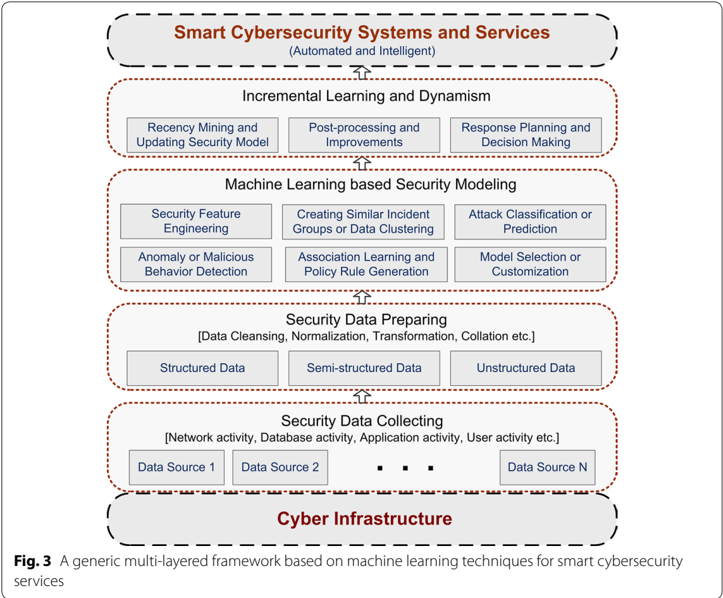
In a computing context, cybersecurity is undergoing massive shifts in technology and its operations in recent days, and data science is driving the change. Extracting security incident patterns or insights from cybersecurity data and building corresponding data-driven model , is the key to make a security system automated and intelligent. To understand and analyze the actual phenomena with data, various scientific methods, machine learning techniques, processes, and systems are used, which is commonly known as data science. In this paper, we focus and briefly discuss on cybersecurity data science , where the data is being gathered from relevant cybersecurity sources, and the analytics complement the latest data-driven patterns for providing more effective security solutions. The concept of cybersecurity data science allows making the computing process more actionable and intelligent as compared to traditional ones in the domain of cybersecurity. We then discuss and summarize a number of associated research issues and future directions . Furthermore, we provide a machine learning based multi-layered framework for the purpose of cybersecurity modeling. Overall, our goal is not only to discuss cybersecurity data science and relevant methods but also to focus the applicability towards data-driven intelligent decision making for protecting the systems from cyber-attacks.
Overview
The claims and statistics of this paper haven’t been checked yet.
Free: it reads the open-access text and checks the first 5 claims that cite a source we can check. Create a free account to check every claim.
Integrity signals
Registry
Cites
Statistics
Figures
Verification
Claims the paper makes
The claims and statistics of this paper haven’t been checked yet.
Free: it reads the open-access text and checks the first 5 claims that cite a source we can check. Create a free account to check every claim.
Claims other papers make about this one
Each is checked against this paper’s own text: does it say what the citing paper says it does?
The source backs part of the claim, not all of it — or backs it for a different population, condition or comparison.
In the citing paper
“The key benefit of deep learning over conventional machine learning methods is that it performs better in a variety of situations, particularly when learning from large datasets [114, 140].”
From Data Science and Analytics: An Overview from Data-Driven Smart Computing, Decision-Making and Applications Perspective (2021) · cites this paper as [114]
Experimental — accuracy not yet measuredThe cited source says what the claim attributes to it.
In the citing paper
“As we know that data science is largely driven by the availability of data [114].”
From Data Science and Analytics: An Overview from Data-Driven Smart Computing, Decision-Making and Applications Perspective (2021) · cites this paper as [114]
The cited source says what the claim attributes to it.
In the citing paper
“For instance, in our earlier paper Sarker et al. [114], we have discussed how data science and machine learning modeling can play a significant role in the domain of cybersecurity for making smart decisions and to provide data-driven intelligent security services.”
From Data Science and Analytics: An Overview from Data-Driven Smart Computing, Decision-Making and Applications Perspective (2021) · cites this paper as [114]
The cited source says what the claim attributes to it.
In the citing paper
“The main advantage of deep learning over traditional machine learning methods is its better performance in several cases, particularly learning from large datasets [105, 129].”
From Machine learning: Algorithms, real-world applications and research directions (2021) · cites this paper as [105]
In the citing paper
“Semi-supervised learning can be defined as a hybridization of the above-mentioned supervised and unsupervised methods, as it operates on both labeled and unlabeled data [41, 105].”
From Machine learning: Algorithms, real-world applications and research directions (2021) · cites this paper as [105]
1 more claim about this paper
Create a free account to see every claim other papers make about this one.
Self-check
Percentages, sums and reported differences re-computed from the paper’s own numbers.
The self-check needs the paper’s full text.
Citations
Cites
Breiman, L. (2001) · Machine Learning · doi:10.1023/a:1010933404324 · Cited by 133,538
Data mining: concepts and techniques
(2012) · Choice Reviews Online · doi:10.5860/choice.49-3305 · Cited by 28,531
Data Mining: Practical Machine Learning Tools and Techniques
(2011) · Elsevier eBooks · doi:10.1016/c2009-0-19715-5 · Cited by 25,437
(1992) · Cited by 23,431
Mining association rules between sets of items in large databases
Agrawal, R., Imieliński, T., & Swami, A. (1993) · Proceedings of the 1993 ACM SIGMOD international conference on Management of data · doi:10.1145/170035.170072 · Cited by 14,907 · cited 3×
“Moreover, AIS [147], Apriori [149], Apriori-TID and Apriori-Hybrid [149], FP-Tree [152], and RARM [154], and Eclat [155] are the well-known association rule learning algorithms that are capable to solve such problems by generating a set of policy rules in the domain of cybersecurity.”
BackgroundMethodFast algorithms for mining association rules
Agrawal, R., & Srikant, R. (1998) · Cited by 11,307
Reinforcement Learning: A Survey
Kaelbling, L. P., Littman, M. L., & Moore, A. W. (1996) · Journal of Artificial Intelligence Research · doi:10.1613/jair.301 · Cited by 8,972
Mining frequent patterns without candidate generation
Han, J., Pei, J., & Yin, Y. (2000) · ACM SIGMOD Record · doi:10.1145/335191.335372 · Cited by 6,402
A detailed analysis of the KDD CUP 99 data set
Tavallaee, M., Bagheri, E., Lu, W., & Ghorbani, A. A. (2009) · 2009 IEEE Symposium on Computational Intelligence for Security and Defense Applications · doi:10.1109/cisda.2009.5356528 · Cited by 5,396
Mining association rules between sets of items in large databases
Agrawal, R., Imieliński, T., & Swami, A. (1993) · ACM SIGMOD Record · doi:10.1145/170036.170072 · Cited by 4,551
Beyond the hype: Big data concepts, methods, and analytics
Gandomi, A., & Haider, M. (2015) · International Journal of Information Management · doi:10.1016/j.ijinfomgt.2014.10.007 · Cited by 4,226
Moustafa, N., & Slay, J. (2015) · 2015 Military Communications and Information Systems Conference (MilCIS) · doi:10.1109/milcis.2015.7348942 · Cited by 4,033
Bellman, R. (1957) · Indiana University Mathematics Journal · doi:10.1512/iumj.1957.6.56038 · Cited by 2,408 · cited 1×
“, environment-driven approach, where the environment is typically formulated as a Markov decision process and take decision based on a reward function [160].”
BackgroundThe internet of things: a survey
Li, S., Xu, L. D., & Zhao, S. (2015) · Information Systems Frontiers · doi:10.1007/s10796-014-9492-7 · Cited by 2,297
Instance-based learning algorithms
Aha, D. W., Kibler, D., & Albert, M. K. (1991) · Machine Learning · doi:10.1007/bf00153759 · Cited by 2,163
Dissecting Android Malware: Characterization and Evolution
Zhou, Y., & Jiang, X. (2012) · 2012 IEEE Symposium on Security and Privacy · doi:10.1109/sp.2012.16 · Cited by 2,133
A Deep Learning Approach for Intrusion Detection Using Recurrent Neural Networks
Yin, C., Zhu, Y., Fei, J., & He, X. (2017) · IEEE Access · doi:10.1109/access.2017.2762418 · Cited by 2,100
Survey of intrusion detection systems: Techniques, datasets and challenges
Khraisat, A., Gondal, I., Vamplew, P., & Kamruzzaman, J. (2019) · Cybersecurity · doi:10.1186/s42400-019-0038-7 · Cited by 2,024
Koroniotis, N., Moustafa, N., Sitnikova, E., & Turnbull, B. (2019) · Future Generation Computer Systems · doi:10.1016/j.future.2019.05.041 · Cited by 1,983
INTERNATIONAL JOURNAL OF COMPUTER APPLICATIONS
(2025) · doi:10.34218/ijca · Cited by 1,821
Very Simple Classification Rules Perform Well on Most Commonly Used Datasets
Holte, R. C. (1993) · Machine Learning · doi:10.1023/a:1022631118932 · Cited by 1,791
Scalable algorithms for association mining
Zaki, M. J. (2000) · IEEE Transactions on Knowledge and Data Engineering · doi:10.1109/69.846291 · Cited by 1,751
Ridge Estimators in Logistic Regression
Cessie, S. L., & Houwelingen, J. C. V. (1992) · Applied Statistics · doi:10.2307/2347628 · Cited by 1,680
IEEE Transactions on Knowledge and Data Engineering
(2023) · IEEE Transactions on Knowledge and Data Engineering · doi:10.1109/tkde.69 · Cited by 1,671
Intrusion detection system: A comprehensive review
Liao, H.-J., Richard Lin, C.-H., Lin, Y.-C., & Tung, K.-Y. (2013) · Journal of Network and Computer Applications · doi:10.1016/j.jnca.2012.09.004 · Cited by 1,630
The Fourth Paradigm – Data-Intensive Scientific Discovery
Hey, T. (2012) · Communications in Computer and Information Science · doi:10.1007/978-3-642-33299-9_1 · Cited by 1,585
Toward developing a systematic approach to generate benchmark datasets for intrusion detection
Shiravi, A., Shiravi, H., Tavallaee, M., & Ghorbani, A. A. (2012) · Computers & Security · doi:10.1016/j.cose.2011.12.012 · Cited by 1,345
Improvements to Platt's SMO Algorithm for SVM Classifier Design
Keerthi, S. S., Shevade, S. K., Bhattacharyya, C., & Murthy, K. R. K. (2001) · Neural Computation · doi:10.1162/089976601300014493 · Cited by 1,318
Machine Learning and Deep Learning Methods for Cybersecurity
Xin, Y., Kong, L., Liu, Z., Chen, Y., Li, Y., Zhu, H., Gao, M., Hou, H., & Wang, C. (2018) · IEEE Access · doi:10.1109/access.2018.2836950 · Cited by 1,228
Singular Value Decomposition and Principal Component Analysis
Wall, M. E., Rechtsteiner, A., & Rocha, L. M. (2005) · A Practical Approach to Microarray Data Analysis · doi:10.1007/0-306-47815-3_5 · Cited by 1,215
International Journal of Information Management
Hills, P. (2006) · International Journal of Information Management · doi:10.1016/j.ijinfomgt.2005.10.001 · Cited by 1,188
Journal of the Royal Statistical Society: Series C (Applied Statistics)
(2023) · Journal of the Royal Statistical Society Series C (Applied Statistics) · doi:10.1111/(issn)1467-9876 · Cited by 1,178
Malware traffic classification using convolutional neural network for representation learning
Wang, W., Zhu, M., Zeng, X., Ye, X., & Sheng, Y. (2017) · 2017 International Conference on Information Networking (ICOIN) · doi:10.1109/icoin.2017.7899588 · Cited by 1,177
Blockchain for AI: review and open research challenges
Salah, K., Rehman, M. H. U., Nizamuddin, N., & Al-Fuqaha, A. (2019) · IEEE Access · doi:10.1109/access.2018.2890507 · Cited by 1,001
The Application of Computers to Taxonomy
Sneath, P. H. A. (1957) · Microbiology · doi:10.1099/00221287-17-1-201 · Cited by 936
Evaluating intrusion detection systems: the 1998 DARPA off-line intrusion detection evaluation
Lippmann, R. P., Fried, D. J., Graf, I., Haines, J. W., Kendall, K. R., McClung, D., Weber, D., Webster, S. E., Wyschogrod, D., Cunningham, R. K., et al. (2002) · Proceedings DARPA Information Survivability Conference and Exposition. DISCEX'00 · doi:10.1109/discex.2000.821506 · Cited by 917
A survey of emerging threats in cybersecurity
Jang-Jaccard, J., & Nepal, S. (2014) · Journal of Computer and System Sciences · doi:10.1016/j.jcss.2014.02.005 · Cited by 892
Tsai, C.-W., Lai, C.-F., Chao, H.-C., & Vasilakos, A. V. (2015) · Journal of Big Data · doi:10.1186/s40537-015-0030-3 · Cited by 818
Machine Learning: The Art and Science of Algorithms that Make Sense of Data
Flach, P. (2012) · doi:10.1017/cbo9780511973000 · Cited by 753
Long Short Term Memory Recurrent Neural Network Classifier for Intrusion Detection
Kim, J., Kim, J., Thi Thu, H. L., & Kim, H. (2016) · 2016 International Conference on Platform Technology and Service (PlatCon) · doi:10.1109/platcon.2016.7456805 · Cited by 690
Cyber Security and the Internet of Things: Vulnerabilities, Threats, Intruders and Attacks
Abomhara, M., Department of Information and Communication Technology, U. O. A., K�ien, G. M., & Department of Information and Communication Technology, U. O. A. (2015) · Journal of Cyber Security and Mobility · doi:10.13052/jcsm2245-1439.414 · Cited by 662
Before we knew it: an empirical study of zero-day attacks in the real world
Bilge, L., & Dumitraş, T. (2012) · Proceedings of the 2012 ACM conference on Computer and communications security · doi:10.1145/2382196.2382284 · Cited by 627
Uncertainty in Big Data Analytics: Survey, Opportunities, and Challenges
Hariri, R. H., Fredericks, E. M., & Bowers, K. M. (2019) · Journal Of Big Data · doi:10.1186/s40537-019-0206-3 · Cited by 620
A novel hybrid intrusion detection method integrating anomaly detection with misuse detection
Kim, G., Lee, S., & Kim, S. (2014) · Expert Systems with Applications · doi:10.1016/j.eswa.2013.08.066 · Cited by 589
Random-Forests-Based Network Intrusion Detection Systems
Zhang, J., Zulkernine, M., & Haque, A. (2008) · IEEE Transactions on Systems, Man, and Cybernetics, Part C (Applications and Reviews) · doi:10.1109/tsmcc.2008.923876 · Cited by 574
A Survey of Deep Learning Methods for Cyber Security
Berman, D. S., Buczak, A. L., Chavis, J. S., & Corbett, C. L. (2019) · Information · doi:10.3390/info10040122 · Cited by 569
Security and Communication Networks
(2018) · Security and Communication Networks · doi:10.1002/(issn)1939-0122 · Cited by 564
Proceedings of the Eleventh Conference on Uncertainty in Artificial Intelligence (1995)
Besnard, P., & Hanks, S. (2013) · arXiv (Cornell University) · doi:10.48550/arxiv.1304.3848 · Cited by 549
Deep Learning for Classification of Malware System Call Sequences
Kolosnjaji, B., Zarras, A., Webster, G., & Eckert, C. (2016) · Lecture Notes in Computer Science · doi:10.1007/978-3-319-50127-7_11 · Cited by 515
CANN: An intrusion detection system based on combining cluster centers and nearest neighbors
Lin, W.-C., Ke, S.-W., & Tsai, C.-F. (2015) · Knowledge-Based Systems · doi:10.1016/j.knosys.2015.01.009 · Cited by 484
Deep recurrent neural network for IoT intrusion detection system
Almiani, M., AbuGhazleh, A., Al-Rahayfeh, A., Atiewi, S., & Razaque, A. (2020) · Simulation Modelling Practice and Theory · doi:10.1016/j.simpat.2019.102031 · Cited by 461
Privilege Escalation Attacks on Android
Davi, L., Dmitrienko, A., Sadeghi, A.-R., & Winandy, M. (2011) · Lecture Notes in Computer Science · doi:10.1007/978-3-642-18178-8_30 · Cited by 436
SQLrand: Preventing SQL Injection Attacks
Boyd, S. W., & Keromytis, A. D. (2004) · Lecture Notes in Computer Science · doi:10.1007/978-3-540-24852-1_21 · Cited by 429
Data Mining and Machine Learning in Cybersecurity
Dua, S., & Du, X. (2016) · Auerbach Publications eBooks · doi:10.1201/b10867 · Cited by 386
Li, Y., Xia, J., Zhang, S., Yan, J., Ai, X., & Dai, K. (2012) · Expert Systems with Applications · doi:10.1016/j.eswa.2011.07.032 · Cited by 386
Behavioral and policy issues in information systems security: the insider threat
Warkentin, M., & Willison, R. (2009) · European Journal of Information Systems · doi:10.1057/ejis.2009.12 · Cited by 384
IEEE Transactions on Systems, Man, and Cybernetics, Part C (Applications and Reviews)
(2023) · IEEE Transactions on Systems Man and Cybernetics Part C (Applications and Reviews) · doi:10.1109/tsmcc.5326 · Cited by 366
Application of deep reinforcement learning to intrusion detection for supervised problems
Lopez-Martin, M., Carro, B., & Sanchez-Esguevillas, A. (2020) · Expert Systems with Applications · doi:10.1016/j.eswa.2019.112963 · Cited by 360
IntruDTree: A Machine Learning Based Cyber Security Intrusion Detection Model
Sarker, I. H., Abushark, Y. B., Alsolami, F., & Khan, A. I. (2020) · Symmetry · doi:10.3390/sym12050754 · Cited by 356
Self-citationBridging the Gap: A Pragmatic Approach to Generating Insider Threat Data
Glasser, J., & Lindauer, B. (2013) · 2013 IEEE Security and Privacy Workshops · doi:10.1109/spw.2013.37 · Cited by 344
Data-Driven Cybersecurity Incident Prediction: A Survey
Sun, N., Zhang, J., Rimba, P., Gao, S., Zhang, L. Y., & Xiang, Y. (2019) · IEEE Communications Surveys & Tutorials · doi:10.1109/comst.2018.2885561 · Cited by 323
Some Thoughts on Bacterial Classification
Sneath, P. H. A. (1957) · Journal of General Microbiology · doi:10.1099/00221287-17-1-184 · Cited by 319
A network intrusion detection system based on a Hidden Naïve Bayes multiclass classifier
Koc, L., Mazzuchi, T. A., & Sarkani, S. (2012) · Expert Systems with Applications · doi:10.1016/j.eswa.2012.07.009 · Cited by 310
Manufacturing process data analysis pipelines: a requirements analysis and survey
Ismail, A., Truong, H.-L., & Kastner, W. (2019) · Journal of Big Data · doi:10.1186/s40537-018-0162-3 · Cited by 304
Cyber intrusion detection by combined feature selection algorithm
Mohammadi, S., Mirvaziri, H., Ghazizadeh-Ahsaee, M., & Karimipour, H. (2019) · Journal of Information Security and Applications · doi:10.1016/j.jisa.2018.11.007 · Cited by 295
Fighting against phishing attacks: state of the art and future challenges
Gupta, B. B., Tewari, A., Jain, A. K., & Agrawal, D. P. (2017) · Neural Computing and Applications · doi:10.1007/s00521-016-2275-y · Cited by 289
Toward an Online Anomaly Intrusion Detection System Based on Deep Learning
Alrawashdeh, K., & Purdy, C. (2016) · 2016 15th IEEE International Conference on Machine Learning and Applications (ICMLA) · doi:10.1109/icmla.2016.0040 · Cited by 287
Sarker, I. H., Kayes, A. S. M., & Watters, P. (2019) · Journal of Big Data · doi:10.1186/s40537-019-0219-y · Cited by 287
Self-citationToward Credible Evaluation of Anomaly-Based Intrusion-Detection Methods
Tavallaee, M., Stakhanova, N., & Ghorbani, A. A. (2010) · IEEE Transactions on Systems, Man, and Cybernetics, Part C (Applications and Reviews) · doi:10.1109/tsmcc.2010.2048428 · Cited by 280 · cited 2×
“CDS represents a partial paradigm shift from traditional well-known security solutions such as fire-walls, user authentication and access control, cryptography systems etc. that might not be effective according to today’s need in cyber industry [16] [17] [18] [19].”
BackgroundSet-oriented mining for association rules in relational databases
Houtsma, M., & Swami, A. (2002) · Proceedings of the Eleventh International Conference on Data Engineering · doi:10.1109/icde.1995.380413 · Cited by 263 · cited 1×
“…algorithms have been proposed in the area of machine learning and data mining literature, such as logic-based [148], frequent pattern based [149] [150], [151], tree-based [152], etc. Recently, Sarker et al. [153] have proposed an association rule learning approach considering non-redundant…”
BackgroundVerizon: 2019 Data Breach Investigations Report
(2019) · Computer Fraud & Security · doi:10.1016/s1361-3723(19)30060-0 · Cited by 263
Proceedings of the Fourth International Conference on Knowledge Discovery and Data Mining
Agrawal, R., & Stolorz, P. (1998) · Knowledge Discovery and Data Mining · Cited by 252
A survey of Clustering Algorithms
Rokach, L. (2009) · Data Mining and Knowledge Discovery Handbook · doi:10.1007/978-0-387-09823-4_14 · Cited by 245 · cited 1×
“K-means [141], K-medoids [142] are the popular partitioning clustering algorithms, and single linkage [143] or complete linkage [144] are the well-known hierarchical clustering algorithms used in various application domains.”
MethodIntrusion detection using fuzzy association rules
Tajbakhsh, A., Rahmati, M., & Mirzaei, A. (2009) · Applied Soft Computing · doi:10.1016/j.asoc.2008.06.001 · Cited by 242
Mitchell, R., & Chen, I.-R. (2015) · IEEE Transactions on Dependable and Secure Computing · doi:10.1109/tdsc.2014.2312327 · Cited by 236
A hybrid method consisting of GA and SVM for intrusion detection system
Aslahi-Shahri, B. M., Rahmani, R., Chizari, M., Maralani, A., Eslami, M., Golkar, M. J., & Ebrahimi, A. (2016) · Neural Computing and Applications · doi:10.1007/s00521-015-1964-2 · Cited by 235
Feature selection and intrusion classification in NSL-KDD cup 99 dataset employing SVMs
Pervez, M. S., & Farid, D. M. (2014) · The 8th International Conference on Software, Knowledge, Information Management and Applications (SKIMA 2014) · doi:10.1109/skima.2014.7083539 · Cited by 218
CNN and RNN based payload classification methods for attack detection
Liu, H., Lang, B., Liu, M., & Yan, H. (2019) · Knowledge-Based Systems · doi:10.1016/j.knosys.2018.08.036 · Cited by 209
Technology Innovation Management Review
McPhee, C., & Bailetti, T. (2012) · Cited by 208
DDoS detection and analysis in SDN-based environment using support vector machine classifier
Kokila, R. T., Thamarai Selvi, S., & Govindarajan, K. (2014) · 2014 Sixth International Conference on Advanced Computing (ICoAC) · doi:10.1109/icoac.2014.7229711 · Cited by 207
Zero-day malware detection based on supervised learning algorithms of API call signatures
Alazab, M., Venkatraman, S., Watters, P., & Alazab, M. (2011) · FedUni ResearchOnline (Federation University Australia) · Cited by 194
Self-citationAnwar, S., Mohamad Zain, J., Zolkipli, M. F., Inayat, Z., Khan, S., Anthony, B., & Chang, V. (2017) · Algorithms · doi:10.3390/a10020039 · Cited by 190
Towards Understanding Malware Behaviour by the Extraction of API Calls
Alazab, M., Venkataraman, S., & Watters, P. (2010) · Cybercrime and Trustworthy Computing Workshop (CTC) · doi:10.1109/ctc.2010.8 · Cited by 183
Self-citationThe Big Four - What We Did Wrong in Advanced Persistent Threat Detection?
Virvilis, N., & Gritzalis, D. (2013) · 2013 International Conference on Availability, Reliability and Security · doi:10.1109/ares.2013.32 · Cited by 175
International Journal of Advanced Networking and Application
(2019) · doi:10.35444/ijana · Cited by 168
Moon, D., Im, H., Kim, I., & Park, J. H. (2015) · The Journal of Supercomputing · doi:10.1007/s11227-015-1604-8 · Cited by 159
Data science: challenges and directions
Cao, L. (2017) · Communications of the ACM · doi:10.1145/3015456 · Cited by 154
Decision Tree Based Intrusion Detection System for NSL-KDD Dataset
Ingre, B., Yadav, A., & Soni, A. K. (2018) · Smart Innovation, Systems and Technologies · doi:10.1007/978-3-319-63645-0_23 · Cited by 150
A GPU deep learning metaheuristic based model for time series forecasting
Coelho, I. M., Coelho, V. N., Luz, E. J. D. S., Ochi, L. S., Guimarães, F. G., & Rios, E. (2017) · Applied Energy · doi:10.1016/j.apenergy.2017.01.003 · Cited by 147
Journal of Convergence for Information Technology
주은실 (2018) · Journal of Convergence Information Technology · doi:10.22156/cs4smb.2018.8.2.067 · Cited by 147
BehavDT: A Behavioral Decision Tree Learning to Build User-Centric Context-Aware Predictive Model
Sarker, I. H., Colman, A., Han, J., Khan, A. I., Abushark, Y. B., & Salah, K. (2020) · Mobile Networks and Applications · doi:10.1007/s11036-019-01443-z · Cited by 142
Self-citationAn efficient reinforcement learning-based Botnet detection approach
Alauthman, M., Aslam, N., Al-kasassbeh, M., Khan, S., Al-Qerem, A., & Raymond Choo, K.-K. (2020) · Journal of Network and Computer Applications · doi:10.1016/j.jnca.2019.102479 · Cited by 134
Confirmation-Guided Discovery of First-Order Rules with Tertius
Flach, P. A., & Lachiche, N. (2001) · Machine Learning · doi:10.1023/a:1007656703224 · Cited by 131
HMMPayl: An intrusion detection system based on Hidden Markov Models
Ariu, D., Tronci, R., & Giacinto, G. (2011) · Computers & Security · doi:10.1016/j.cose.2010.12.004 · Cited by 130
A Survey on the Development of Self-Organizing Maps for Unsupervised Intrusion Detection
Qu, X., Yang, L., Guo, K., Ma, L., Sun, M., Ke, M., & Li, M. (2019) · Mobile Networks and Applications · doi:10.1007/s11036-019-01353-0 · Cited by 128
Towards an Energy-Efficient Anomaly-Based Intrusion Detection Engine for Embedded Systems
Viegas, E. K., Santin, A. O., de Franca, A. J., Jasinski, R. P., Pedroni, V. A., & Oliveira, L. S. (2016) · IEEE Transactions on Computers · doi:10.1109/tc.2016.2560839 · Cited by 120
Using feature selection for intrusion detection system
Alazab, A., Hobbs, M., Abawajy, J., & Alazab, M. (2012) · 2012 International Symposium on Communications and Information Technologies (ISCIT) · doi:10.1109/iscit.2012.6380910 · Cited by 118
Architectural Tactics for Big Data Cybersecurity Analytics Systems: A Review
Ullah, F., & Babar, M. A. (2019) · Journal of Systems and Software · doi:10.1016/j.jss.2019.01.051 · Cited by 115
A machine learning based robust prediction model for real-life mobile phone data
Sarker, I. H. (2019) · Internet of Things · doi:10.1016/j.iot.2019.01.007 · Cited by 113
Self-citationContext-aware rule learning from smartphone data: survey, challenges and future directions
Sarker, I. H. (2019) · Journal of Big Data · doi:10.1186/s40537-019-0258-4 · Cited by 105 · cited 1×
“In an expert system, the rules are usually manually defined by a knowledge engineer working in collaboration with a domain expert [37, 140, 146].”
BackgroundSelf-citationMalik, A. J., & Khan, F. A. (2017) · Cluster Computing · doi:10.1007/s10586-017-0971-8 · Cited by 104
Proceedings of the Eleventh International Conference on Data Engineering
(1995) · IEEE International Conference on Data Engineering (ICDE) · doi:10.1109/icde.1995.380416 · Cited by 104
The Aerobic Breakdown of Uric Acid by Certain Pseudomonads
Bachrach, U. (1957) · Journal of General Microbiology · doi:10.1099/00221287-17-1-1 · Cited by 99
Cloud Security Auditing: Challenges and Emerging Approaches
Ryoo, J., Rizvi, S. S., Aiken, W., & Kissell, J. (2013) · IEEE Security & Privacy · doi:10.1109/msp.2013.132 · Cited by 97
Hansen, J. V., Lowry, P. B., Meservy, R. D., & McDonald, D. M. (2006) · Decision Support Systems · doi:10.1016/j.dss.2006.04.004 · Cited by 95
Raman, M. R. G., Somu, N., Jagarapu, S., Manghnani, T., Selvam, T. M., Krithivasan, K., & Sriram, V. S. S. (2019) · Artificial Intelligence Review · doi:10.1007/s10462-019-09762-z · Cited by 94
Meng, W., Li, W., & Kwok, L. (2015) · Security and Communication Networks · doi:10.1002/sec.1307 · Cited by 90
Network traffic fusion and analysis against DDoS flooding attacks with a novel reversible sketch
Jing, X., Yan, Z., Jiang, X., & Pedrycz, W. (2018) · Information Fusion · doi:10.1016/j.inffus.2018.10.013 · Cited by 87
Årnes, A., Valeur, F., Vigna, G., & Kemmerer, R. A. (2006) · Lecture notes in computer science · doi:10.1007/11856214_8 · Cited by 86
Das, A., Ng, W.-K., & Woon, Y.-K. (2001) · Proceedings of the tenth international conference on Information and knowledge management · doi:10.1145/502585.502665 · Cited by 84
Xie, M., Hu, J., & Slay, J. (2014) · International Conference on Fuzzy Systems and Knowledge Discovery (FSKD) · doi:10.1109/fskd.2014.6980972 · Cited by 83
2019 International Conference on Information Networking (ICOIN)
(2019) · doi:10.1109/icoin45329.2019 · Cited by 83
Individualized Time-Series Segmentation for Mining Mobile Phone User Behavior
Sarker, I. H., Colman, A., Kabir, M. A., & Han, J. (2018) · The Computer Journal · doi:10.1093/comjnl/bxx082 · Cited by 80
Self-citationData Science: Challenges and Directions
Cao, L. (2020) · arXiv (Cornell University) · doi:10.48550/arxiv.2006.16966 · Cited by 79
The Inadequacy of Entropy-Based Ransomware Detection
McIntosh, T. R., Jang‐Jaccard, J., Watters, P., & Sušnjak, T. (2019) · Communications in computer and information science · doi:10.1007/978-3-030-36802-9_20 · Cited by 79
Self-citationIntrusion Detection using a Novel Hybrid Method Incorporating an Improved KNN
Shapoorifard, H., & Shamsinejad, P. (2017) · International Journal of Computer Applications · doi:10.5120/ijca2017914340 · Cited by 73
Cybersecurity: The cold war online
Aftergood, S. (2017) · Nature · doi:10.1038/547030a · Cited by 72
Creating a National Framework for Cybersecurity: An analysis of Issues and Options
Fischer, E. A. (2010) · University of North Texas Digital Library (University of North Texas) · Cited by 69
Xie, M., Hu, J., Yu, X., & Chang, E. J. (2014) · Lecture notes in computer science · doi:10.1007/978-3-319-11698-3_44 · Cited by 67
Intrusion Detection in KDD99 Dataset using SVM-PSO and Feature Reduction with Information Gain
Saxena, H., & Richariya, V. (2014) · International Journal of Computer Applications · doi:10.5120/17188-7369 · Cited by 66
Access control technologies for Big Data management systems: literature review and future trends
Colombo, P., & Ferrari, E. (2019) · Cybersecurity · doi:10.1186/s42400-018-0020-9 · Cited by 66
Data science: developing theoretical contributions in information systems via text analytics
Rizk, A., & Elragal, A. A. (2020) · Journal Of Big Data · doi:10.1186/s40537-019-0280-6 · Cited by 66
RecencyMiner: mining recency-based personalized behavior from contextual smartphone data
Sarker, I. H., Colman, A., & Han, J. (2019) · Journal of Big Data · doi:10.1186/s40537-019-0211-6 · Cited by 65 · cited 2×
“Therefore, the concept of recency analysis [170] in cybersecurity solutions could be another issue in cybersecurity data science.”
BackgroundSelf-citation“Man in the Middle” Attacks on Bluetooth
Kügler, D. (2003) · Lecture notes in computer science · doi:10.1007/978-3-540-45126-6_11 · Cited by 64
Classification of Attacks Using Support Vector Machine (SVM) on KDDCUP'99 IDS Database
Kotpalliwar, M. V., & Wajgi, R. (2015) · 2015 Fifth International Conference on Communication Systems and Network Technologies · doi:10.1109/csnt.2015.185 · Cited by 63
Toward a safer and more secure cyberspace
Lin, H., Spector, A. Z., Neumann, P. G., & Goodman, S. E. (2007) · Communications of the ACM · doi:10.1145/1290958.1290991 · Cited by 60
Data Science Methodology for Cybersecurity Projects
Foroughi, F., & Luksch, P. (2018) · doi:10.5121/csit.2018.80401 · Cited by 60
Crypto-jacking: how cyber-criminals are exploiting the crypto-currency boom
Sigler, K. (2018) · Computer Fraud & Security · doi:10.1016/s1361-3723(18)30086-1 · Cited by 60
Implementation of network intrusion detection system using variant of decision tree algorithm
Relan, N. G., & Patil, D. R. (2015) · 2015 International Conference on Nascent Technologies in the Engineering Field (ICNTE) · doi:10.1109/icnte.2015.7029925 · Cited by 59
A multi-layer perceptron approach for flow-based anomaly detection
van Efferen, L., & Eldin, A. A. (2017) · International Symposium on Networks, Computers and Communications (ISNCC) · doi:10.1109/isncc.2017.8072036 · Cited by 50
Characterising and predicting cyber attacks using the Cyber Attacker Model Profile (CAMP)
Watters, P., McCombie, S. J., Layton, R., & Pieprzyk, J. (2012) · Journal of Money Laundering Control · doi:10.1108/13685201211266015 · Cited by 47
Self-citationMining User Behavioral Rules from Smartphone Data Through Association Analysis
Sarker, I. H., & Salim, F. D. (2018) · Lecture notes in computer science · doi:10.1007/978-3-319-93034-3_36 · Cited by 45
Self-citationKey-Recovery Attacks on KIDS, a Keyed Anomaly Detection System
Tapiador, J., Orfila, A., Ribagorda, A., & Ramos, B. (2013) · IEEE Transactions on Dependable and Secure Computing · doi:10.1109/tdsc.2013.39 · Cited by 44
ContextPCA: Predicting Context-Aware Smartphone Apps Usage Based On Machine Learning Techniques
Sarker, I. H., Abushark, Y. B., & Khan, A. I. (2020) · Symmetry · doi:10.3390/sym12040499 · Cited by 44
Self-citationContextual information fusion for intrusion detection: a survey and taxonomy
AlEroud, A. F., & Karabatis, G. (2017) · Knowledge and Information Systems · doi:10.1007/s10115-017-1027-3 · Cited by 43
Chandrasekhar, A. M., & Raghuveer, K. (2014) · International Conference on Communications and Signal Processing (ICCSP) · doi:10.1109/iccsp.2014.6949927 · Cited by 41
Three cyber-security strategies to mitigate the impact of a data breach
Densham, B. (2015) · Network Security · doi:10.1016/s1353-4858(15)70007-3 · Cited by 39
OntCAAC: An Ontology-Based Approach to Context-Aware Access Control for Software Services
Kayes, A. S. M., Han, J., & Colman, A. (2015) · The Computer Journal · doi:10.1093/comjnl/bxv034 · Cited by 39
Self-citationEffective and Explainable Detection of Android Malware Based on Machine Learning Algorithms
Kumar, R., Xiaosong, Z., Khan, R. U., Kumar, J., & Ahad, I. (2018) · International Conference on Computing and Artificial Intelligence (ICCAI) · doi:10.1145/3194452.3194465 · Cited by 38
Generating Test Data for Insider Threat Detectors.
Lindauer, B., Glasser, J., Rosen, M., & Wallnau, K. (2014) · Journal of Wireless Mobile Networks Ubiquitous Computing and Dependable Applications · Cited by 37
Real-Time Hybrid Intrusion Detection System Using Machine Learning Techniques
Dutt, I., Borah, S., Maitra, I. K., Bhowmik, K., Maity, A., & Das, S. (2018) · Lecture notes in electrical engineering · doi:10.1007/978-981-10-7901-6_95 · Cited by 32
Data Breach: From Notification to Prevention Using PCI DSS
Shaw, A. (2010) · Columbia journal of law and social problems · Cited by 31
Data Mining Based Network Intrusion Detection System: A Survey
Helali, R. G. M. (2009) · Springer eBooks · doi:10.1007/978-90-481-3662-9_86 · Cited by 31
Azad, C., & Jha, V. K. (2015) · International Journal of Computer Network and Information Security · doi:10.5815/ijcnis.2015.08.07 · Cited by 31
A Novel Semi-Supervised Adaboost Technique for Network Anomaly Detection
Yuan, Y., Kaklamanos, G., & Hogrefe, D. (2016) · ACM International Conference on Modeling, Analysis and Simulation of Wireless and Mobile Systems (MSWiM) · doi:10.1145/2988287.2989177 · Cited by 31
Papastergiou, S., Mouratidis, H., & Kalogeraki, E.-M. (2019) · Communications in computer and information science · doi:10.1007/978-3-030-20257-6_41 · Cited by 30
An Intrusion Detection System using KNN-ACO Algorithm
Vishwakarma, S., Sharma, V., & Tiwari, A. (2017) · International Journal of Computer Applications · doi:10.5120/ijca2017914079 · Cited by 29
Intrusion Detection Using Improved Decision Tree Algorithm with Binary and Quad Split
Puthran, S., & Shah, K. (2016) · Communications in computer and information science · doi:10.1007/978-981-10-2738-3_37 · Cited by 28
Cybersecurity Issues and Challenges
Fischer, E. A. (2014) · Cited by 28
UMUDGA: A dataset for profiling algorithmically generated domain names in botnet detection
Zago, M., Pérez, M. G., & Pérez, G. M. (2020) · Data in Brief · doi:10.1016/j.dib.2020.105400 · Cited by 27
Big Data – The information revolution
Golchha, N. (2015) · International journal of applied research · Cited by 25
Large Scale Behavioral Analysis of Ransomware Attacks
McIntosh, T. R., Jang‐Jaccard, J., & Watters, P. (2018) · Lecture notes in computer science · doi:10.1007/978-3-030-04224-0_19 · Cited by 25
Self-citationComputer Incident Response and Forensics Team Management: Conducting a Successful Incident Response
Johnson, L. A. (2013) · CERN Document Server (European Organization for Nuclear Research) · Cited by 22
Mining of Attack Models in IDS Alerts from Network Backbone by a Two-stage Clustering Method
Qiao, L., Zhang, B., Lai, Z., & Su, J. (2012) · IEEE International Symposium on Parallel & Distributed Processing, Workshops and Phd Forum · doi:10.1109/ipdpsw.2012.146 · Cited by 20
A New Method of Transductive SVM-Based Network Intrusion Detection
Man-fu, Y., & Liu, Z. (2011) · IFIP International Federation for Information Processing/IFIP · doi:10.1007/978-3-642-18333-1_12 · Cited by 19
Jo, S., Sung, H., & Ahn, B.-H. (2015) · Journal of the Korea Society of Digital Industry and Information Management · doi:10.17662/ksdim.2015.11.4.033 · Cited by 19
Common web application attack types and security using ASP.NET
Jovičić, B., & Simić, D. (2006) · Computer Science and Information Systems · doi:10.2298/csis0602083j · Cited by 17
Cyber-Security Challenges: Designing Efficient Intrusion Detection Systems and Anti-Virus Tools
Sung, A. H., Abraham, A., & Mukkamala, S. (2005) · Auerbach Publications eBooks · doi:10.1201/9781420031225.ch6 · Cited by 17
An Ontology-Based Approach to Dynamic Contextual Role for Pervasive Access Control
Kayes, A. S. M., Rahayu, W. J., & Dillon, T. S. (2018) · International Conference on Advanced Information Networking and Applications (AINA) · doi:10.1109/aina.2018.00093 · Cited by 16
Self-citationA Multi-agents Intrusion Detection System Using Ontology and Clustering Techniques
Brahmi, I., Brahmi, H., & Yahia, S. B. (2015) · IFIP advances in information and communication technology · doi:10.1007/978-3-319-19578-0_31 · Cited by 14
I-CaN-MaMa: Integrated campus network monitoring and management
Zhao, S., Leftwich, K., Owens, M., Magrone, F., Schonemann, J., Anderson, B., & Medhi, D. (2014) · IEEE/IFIP Network Operations and Management Symposium (NOMS) · doi:10.1109/noms.2014.6838304 · Cited by 12
Ha, H.-J., & Kim, E.-A. L. (2020) · Journal of Convergence Information Technology · doi:10.22156/cs4smb.2020.10.05.042 · Cited by 12
Applying Cost-Sensitive Classifiers with Reinforcement Learning to IDS
Blanco, R., Cilla, J. J., Briongos, S., Malagón, P., & Moya, J. M. (2018) · Lecture notes in computer science · doi:10.1007/978-3-030-03493-1_55 · Cited by 12
Johnson, L. R. (2013) · Elsevier eBooks · doi:10.1016/b978-1-59749-996-5.00006-6 · Cited by 9
(1996)
Research works printed but not linked: 8
- 21. Rainie L, Anderson J, Connolly J. Cyber attacks likely to increase. Digital Life in. 2014, vol. 2025.
- 23. Craigen D, Diakun-Thibault N, Purse R. Defining cybersecurity. Technology Innovation. Manag Rev. 2014;4(10):13-21.
- 45. Ragsdale DJ, Carver C, Humphries JW, Pooch UW. Adaptation techniques for intrusion detection and intrusion response systems. In: Smc 2000 conference proceedings. 2000 IEEE international conference on systems, man and cybernetics. 'cybernetics evolving to systems, humans, organizations, and their complex interactions'(cat. No. 0). IEEE; 2000. vol. 4, p. 2344-2349.
- 74. Microsoft malware classification (big 2015). arXiv :org/abs/1802.10135 /. Accessed 20 Oct 2019.
- 92. Dada E. A hybridized svm-knn-pdapso approach to intrusion detection system. In: Proc. Fac. Seminar Ser., 2017, p. 14-21.
- 93. Sharifi AM, Amirgholipour SK, Pourebrahimi A. Intrusion detection based on joint of k-means and knn. J Converg Inform Technol. 2015;10(5):42.
- Rai K, Devi MS, Guleria A. Decision tree based algorithm for intrusion detection. Int J Adv Netw Appl. 2016;7(4):2828.
- MacQueen J. Some methods for classification and analysis of multivariate observations. In: Fifth Berkeley symposium on mathematical statistics and probability, vol. 1, 1967.
Cited by
Machine learning: Algorithms, real-world applications and research directions
Sarker, I. H. (2021) · SN Computer Science · doi:10.1007/s42979-021-00592-x · Cited by 5,583
“Usually, the availability of data is considered as the key to construct a machine learning model or data-driven realworld systems [103, 105].”
InfluentialSelf-citationSarker, I. H. (2021) · SN Computer Science · doi:10.1007/s42979-021-00815-1 · Cited by 2,678
Self-citationSarker, I. H. (2022) · SN Computer Science · doi:10.1007/s42979-022-01043-x · Cited by 1,208
“highlight numerous sorts of cyber anomalies and attacks that can be detected using machine learning approaches in the domain of cybersecurity [78] [89].”
BackgroundSelf-citationSarker, I. H. (2021) · SN Computer Science · doi:10.1007/s42979-021-00765-8 · Cited by 570
Self-citationAI-Driven Cybersecurity: An Overview, Security Intelligence Modeling and Research Directions
Sarker, I. H. (2021) · doi:10.20944/preprints202101.0457.v1 · Cited by 550
Self-citation
Metadata
- Authors
- Sarker, I. H., Kayes, A. S. M., Badsha, S., Alqahtani, H., Watters, P., & Ng, A.
- Affiliations
- Chittagong University of Engineering & Technology (BD)
- La Trobe University (AU)
- University of Nevada, Reno (US)
- Macquarie University (AU)
- Corresponding author
- Sarker, Iqbal H.
- Venue
- Journal of Big Data
- Published
- 2020-07-01
- Volume
- 7
- Issue
- 1
- ISSN
- 2196-1115 (ISSN-L)
- OpenAlex
- W3038955483
- Cited by
- 766
- References
- 172
- Citations by year
- 2026: 100 · 2025: 174 · 2024: 152 · 2023: 133 · 2022: 120 · 2021: 73 · 2020: 14
- FWCI
- 39.94
- Type
- journal article
- Language
- en
- Open access
- gold
- doi.org
- Licence
- cc-by
- creativecommons.org/licenses/by/4.0 (tdm)
- creativecommons.org/licenses/by/4.0 (vor)
- Locations
- Journal Of Big Data (publishedVersion, cc-by)
- Preprints.org (acceptedVersion)
- DOAJ (DOAJ: Directory of Open Access Journals) (submittedVersion, cc-by-sa)
- Swinburne figshare (Swinburne University of Technology) (submittedVersion)
- Topics
- Physical Sciences › Computer Science › Computer Networks and Communications › Network Security and Intrusion Detection
- Physical Sciences › Computer Science › Information Systems › Information and Cyber Security
- Physical Sciences › Computer Science › Artificial Intelligence › Adversarial Robustness in Machine Learning
- Keywords
- machine learning for cybersecurity, intelligent decision-making, cyberattack detection, security analytics
About these checks
Registry, retraction, Cites and statistics results are computed, not judged, with one exception: a printed reference that no index lists is read once by a model before it counts as a citation error. Claims are extracted by a model and kept only when their quote appears verbatim in the text; each cited source is then checked, with a model’s help, for whether it says what the claim relies on. Those verdicts can be wrong — read the claim’s quote and the cited source before relying on one.
Statistics and arithmetic are recomputed, not judged.
Confidence bands are shown only for fields calibrated on our annotated test set. None is calibrated yet, so no band is shown.
What counts as a claim ›How we measure confidence ›How we check this ›
Are you an author, or do you see a problem with this page? Request a review
Data sources
Bibliographic data: Semantic Scholar, OpenAlex, Crossref.
Contains information from the Semantic Scholar Academic Graph Datasets, made available under the ODC Attribution License (ODC-BY 1.0).
Semantic Scholar’s data is described in: Kinney, R., et al. (2023). The Semantic Scholar Open Data Platform. arXiv:2301.10140.
