

Upper limb muscle atrophy associated with in-hospital mortality and physical function impairments in mechanically ventilated critically ill adults: a two-center prospective observational study
Open accessThe DOI matches its Crossref record; 39 of the 39 references it cites were found in a registry or an index.
Abstract
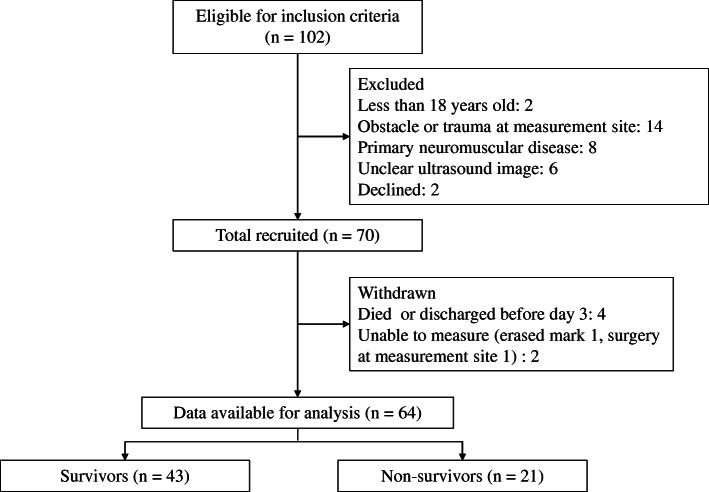
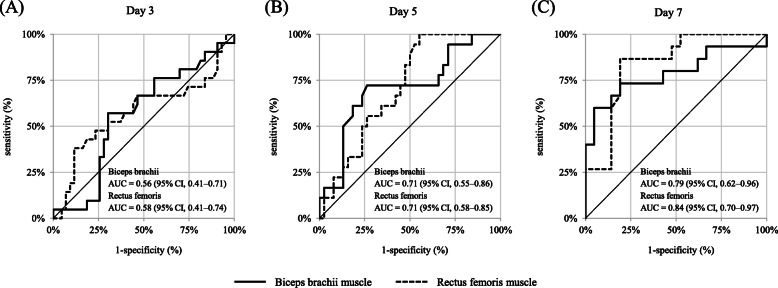
Background: Lower limb muscle atrophy is often observed in critically ill patients. Although upper limb muscles can undergo atrophy, it remains unclear how this atrophy is associated with clinical outcomes. We hypothesized that this atrophy is associated with mortality and impairments in physical function. Methods: In this two-center prospective observational study, we included adult patients who were expected to require mechanical ventilation for > 48 h and remain in the intensive care unit (ICU) for > 5 days. We used ultrasound to evaluate the cross-sectional area of the biceps brachii on days 1, 3, 5, and 7 and upon ICU discharge along with assessment of physical functions. The primary outcome was the relationship between muscle atrophy ratio and in-hospital mortality on each measurement day, which was assessed using multivariate analysis. The secondary outcomes were the relationships between upper limb muscle atrophy and Medical Research Council (MRC) score, handgrip strength, ICU Mobility Scale (IMS) score, and Functional Status Score for the ICU (FSS-ICU). Results: Sixty-four patients (43 males; aged 70 ± 13 years) were enrolled. The Acute Physiology and Chronic Health Evaluation (APACHE) II score was 27 (22–30), and in-hospital mortality occurred in 21 (33%) patients. The decreased cross-sectional area of the biceps brachii was not associated with in-hospital mortality on day 3 (p= 0.43) but was associated on days 5 (p= 0.01) and 7 (p< 0.01), which was confirmed after adjusting for sex, age, and APACHE II score. In 27 patients in whom physical functions were assessed, the decrease of the cross-sectional area of the biceps brachii was associated with MRC score (r= 0.47,p= 0.01), handgrip strength (r= 0.50,p= 0.01), and FSS-ICU (r= 0.56,p< 0.01), but not with IMS score (r= 0.35,p= 0.07) upon ICU discharge. Conclusions: Upper limb muscle atrophy was associated with in-hospital mortality and physical function impairments; thus, it is prudent to monitor it. (321 words) Trial registration: UMIN 000031316. Retrospectively registered on 15 February 2018.
Overview
The claims and statistics of this paper haven’t been checked yet.
Free: it reads the open-access text and checks the first 5 claims that cite a source we can check. Create a free account to check every claim.
Integrity signals
Registry
Cites
Statistics
Figures
Verification
Claims the paper makes
The claims and statistics of this paper haven’t been checked yet.
Free: it reads the open-access text and checks the first 5 claims that cite a source we can check. Create a free account to check every claim.
Self-check
Percentages, sums and reported differences re-computed from the paper’s own numbers.
The self-check needs the paper’s full text.
Citations
Cites
Acute skeletal muscle wasting in critical illness
Puthucheary, Z. A., Rawal, J., McPhail, M., Connolly, B., Ratnayake, G., Chan, P., Hopkinson, N. S., Padhke, R., Dew, T., Sidhu, P. S., et al. (2013) · JAMA · doi:10.1001/jama.2013.278481 · Cited by 2,103
Paresis Acquired in the Intensive Care Unit<SUBTITLE>A Prospective Multicenter Study</SUBTITLE>
De Jonghe, B. (2002) · JAMA · doi:10.1001/jama.288.22.2859 · Cited by 1,516
Early intensive care unit mobility therapy in the treatment of acute respiratory failure*
Morris, P. E., Goad, A., Thompson, C., Taylor, K., Harry, B., Passmore, L., Ross, A., Anderson, L., Baker, S., Sanchez, M., et al. (2008) · Critical Care Medicine · doi:10.1097/ccm.0b013e318180b90e · Cited by 1,349
Clinical review: intensive care unit acquired weakness
Hermans, G., & Van den Berghe, G. (2015) · Critical Care · doi:10.1186/s13054-015-0993-7 · Cited by 792
Acquired Weakness, Handgrip Strength, and Mortality in Critically Ill Patients
Ali, N. A., O'Brien, J. M., Hoffmann, S. P., Phillips, G., Garland, A., Finley, J. C. W., Almoosa, K., Hejal, R., Wolf, K. M., Lemeshow, S., et al. (2008) · American Journal of Respiratory and Critical Care Medicine · doi:10.1164/rccm.200712-1829oc · Cited by 779
A framework for diagnosing and classifying intensive care unit-acquired weakness
Stevens, R. D., Marshall, S. A., Cornblath, D. R., Hoke, A., Needham, D. M., de Jonghe, B., Ali, N. A., & Sharshar, T. (2009) · Critical Care Medicine · doi:10.1097/ccm.0b013e3181b6ef67 · Cited by 698 · cited 1×
“Limb muscle strength was evaluated using the Medical Research Council (MRC) score, which uses the sum of manual muscle strength at bilateral shoulder abductors, elbow flexors, wrist extensors, hip flexors, knee extensors, and ankle dorsiflexors [17].”
MethodPost‐intensive care syndrome: its pathophysiology, prevention, and future directions
Inoue, S., Hatakeyama, J., Kondo, Y., Hifumi, T., Sakuramoto, H., Kawasaki, T., Taito, S., Nakamura, K., Unoki, T., Kawai, Y., et al. (2019) · Acute Medicine & Surgery · doi:10.1002/ams2.415 · Cited by 598
Weijs, P. J., Looijaard, W. G., Dekker, I. M., Stapel, S. N., Girbes, A. R., Straaten, H. M. O.-V., & Beishuizen, A. (2014) · Critical Care · doi:10.1186/cc13189 · Cited by 459
Feasibility and inter-rater reliability of the ICU Mobility Scale
Hodgson, C., Needham, D., Haines, K., Bailey, M., Ward, A., Harrold, M., Young, P., Zanni, J., Buhr, H., Higgins, A., et al. (2014) · Heart & Lung · doi:10.1016/j.hrtlng.2013.11.003 · Cited by 445
Parry, S. M., El-Ansary, D., Cartwright, M. S., Sarwal, A., Berney, S., Koopman, R., Annoni, R., Puthucheary, Z., Gordon, I. R., Morris, P. E., et al. (2015) · Journal of Critical Care · doi:10.1016/j.jcrc.2015.05.024 · Cited by 436 · cited 1×
“Our finding on lower limb muscle atrophy is consistent with the findings of previous studies (Table 2) [2, 11, 13].”
Result
Cited by
Fazzini, B., Märkl, T., Costas, C., Blobner, M., Schaller, S. J., Prowle, J., Puthucheary, Z., & Wackerhage, H. (2023) · Critical Care · doi:10.1186/s13054-022-04253-0 · Cited by 384
“Early decline in biceps brachii mass was found a predictor for mortality [28].”
BackgroundPost-intensive care syndrome follow-up system after hospital discharge: a narrative review
Nakanishi, N., Liu, K., Hatakeyama, J., Kawauchi, A., Yoshida, M., Sumita, H., Miyamoto, K., & Nakamura, K. (2024) · Journal of Intensive Care · doi:10.1186/s40560-023-00716-w · Cited by 125
Self-citationPost‐intensive care syndrome: Recent advances and future directions
Inoue, S., Nakanishi, N., Amaya, F., Fujinami, Y., Hatakeyama, J., Hifumi, T., Iida, Y., Kawakami, D., Kawai, Y., Kondo, Y., et al. (2024) · Acute Medicine & Surgery · doi:10.1002/ams2.929 · Cited by 148
“16 This muscle atrophy is caused by inflammation-induced abnormal im-munoreactions to human organs as a systemic inflammatory response syndrome.”
BackgroundSelf-citationHuman skeletal muscle size with ultrasound imaging: a comprehensive review
Naruse, M., Trappe, S. W., & Trappe, T. A. (2022) · Journal of Applied Physiology · doi:10.1152/japplphysiol.00041.2022 · Cited by 67
Arai, Y., Nakanishi, N., Ono, Y., Inoue, S., Kotani, J., Harada, M., & Oto, J. (2021) · Clinical Nutrition ESPEN · doi:10.1016/j.clnesp.2021.08.032 · Cited by 38
Self-citationLima, J., Foletto, E., Cardoso, R. C. B., Garbelotto, C., Frenzel, A. P., Carneiro, J. U., Carpes, L. S., Barbosa-Silva, T. G., González, M. C., & Silva, F. M. (2023) · Clinical Nutrition · doi:10.1016/j.clnu.2023.11.003 · Cited by 38
Nakanishi, N., Tsutsumi, R., Hara, K., Matsuo, M., Sakaue, H., & Oto, J. (2021) · Journal of Clinical Medicine · doi:10.3390/jcm10040614 · Cited by 33
“These muscle atrophies are associated with impaired physical function and mortality [17, 18].”
BackgroundSelf-citationFerroptosis and Its Potential Role in the Physiopathology of Skeletal Muscle Atrophy
Sun, C., Xiao, J.-L., Sun, C., & Tang, C. (2024) · International Journal of Molecular Sciences · doi:10.3390/ijms252212463 · Cited by 34
“Skeletal muscle atrophy is one of the most common side effects of cisplatin chemotherapy, which is usually related to adverse reactions such as increased catabolism, weight loss, and skeletal muscle loss and is directly related to increased patient mortality [120,121].”
Sepsis causes neutrophil infiltration in muscle leading to muscle atrophy and weakness in mice
Nakanishi, N., Ono, Y., Miyazaki, Y., Moriyama, N., Fujioka, K., Yamashita, K., Inoue, S., & Kotani, J. (2022) · Frontiers in Immunology · doi:10.3389/fimmu.2022.950646 · Cited by 27
Self-citationRahiminezhad, E., Sadeghi, M., Ahmadinejad, M., Gohari, S. I. M., & Dehghan, M. (2022) · BMC Sports Science Medicine and Rehabilitation · doi:10.1186/s13102-022-00489-z · Cited by 38
“They also showed that upper extremity muscle atrophy was associated with in-hospital mortality and physical dysfunction [11].”
BackgroundNakanishi, N., Inoue, S., Tsutsumi, R., Akimoto, Y., Ono, Y., Kotani, J., Sakaue, H., & Oto, J. (2021) · Journal of Clinical Medicine · doi:10.3390/jcm10122721 · Cited by 20
“After the ICU admission, progressive muscle atrophy occurs, and the atrophy is associated with ICU acquired weakness and mortality [3].”
BackgroundSelf-citationAldrich, L., Ispoglou, T., Prokopidis, K., Alqallaf, J., Wilson, O. J., & Stavropoulos‐Kalinoglou, A. (2024) · Journal of Cachexia Sarcopenia and Muscle · doi:10.1002/jcsm.13662 · Cited by 24
Nakanishi, N. (2025) · Acute and Critical Care · doi:10.4266/acc.001450 · Cited by 21
“Muscle atrophy at ICU discharge is associated with decreases in hand grip strength (r=0.50–0.62, P≤0.01), Medical Research Council (MRC) score (r=0.46–0.47, P≤0.02), and Functional Status Score in the ICU (FSS-ICU) (r=0.56, P 0.01) [14].”
InfluentialSelf-citationEffects of early exercise training following severe burn injury: a randomized controlled trial
Schieffelers, D. R., Ru, T. F., Dai, H., Ye, Z., van Breda, E., Daele, U. V., Xie, W., & Wu, J. (2024) · Burns & Trauma · doi:10.1093/burnst/tkae005 · Cited by 24
“In the short term, muscle wasting is associated with impaired wound healing, increased risk of infection, intensive care unit-acquired weakness and difficulty weaning off mechanical ventilation, which might ultimately lead to a pro-tracted hospital length of stay and a delayed recovery [12–15].”
BackgroundNaoi, T., Morita, M., Koyama, K., Katayama, S., Tonai, K., Sekine, T., Hamada, K., & Nunomiya, S. (2022) · Progress in Rehabilitation Medicine · doi:10.2490/prm.20220034 · Cited by 12
Barbosa, F. D. S., Nascimento, B. S. S., Silva, M. C. D. F. S., Cerqueira, T. C. F., & Santana‐Filho, V. J. (2024) · International Journal of Environmental Research and Public Health · doi:10.3390/ijerph21070908 · Cited by 42
“A correlation has also been reported between decreased CSA of the biceps brachii and rectus femoris [43].”
BackgroundNakanishi, N., Inoue, S., Ono, Y., Sugiyama, J., Takayama, K., Arai, Y., Nakamura, K., Oto, J., & Kotani, J. (2023) · Clinical Nutrition ESPEN · doi:10.1016/j.clnesp.2023.07.089 · Cited by 11
Self-citationAbe, R., Shimazui, T., Sugo, M., Ogawa, A., Namekawa, M., Kitamura, N., & Kido, S. (2024) · BMC Nutrition · doi:10.1186/s40795-024-00846-w · Cited by 9
“A study of critically ill patients reported that the physical function associated with muscle strength (grip strength / manual muscle testing results) at ICU discharge was significantly associated with biceps muscle mass on day 7 of ICU admission [27].”
BackgroundArtese, A., Winthrop, H. M., Beyer, M., Haines, K., Molinger, J., Pastva, A. M., & Wischmeyer, P. E. (2024) · Critical Care Clinics · doi:10.1016/j.ccc.2024.09.007 · Cited by 12
Hodgson, H., Wilkinson, M., Bowen, S., Giannoudis, P. V., & Howard, A. (2021) · European Journal of Trauma and Emergency Surgery · doi:10.1007/s00068-021-01694-0 · Cited by 9
Skeletal muscle mass assessment in critically ill patients: method and application
Tanaka, K., Katayama, S., Okura, K., Okamura, M., Nawata, K., Nakanishi, N., & Shinohara, A. (2022) · Annals of Cancer Research and Therapy · doi:10.4993/acrt.30.93 · Cited by 8
Self-citationCostly immunometabolic remodelling in disused muscle buildup through physical exercise
Padilha, C. S., Figueiredo, C., Deminice, R., Krüger, K., Seelaender, M. C. L., Neto, J. C. R., & Lira, F. S. (2022) · Acta Physiologica · doi:10.1111/apha.13782 · Cited by 8
Kim, M., Kim, S., Ju, Y.-R., Ahn, S. Y., & Lee, S. (2024) · Healthcare · doi:10.3390/healthcare12212128 · Cited by 7
“Furthermore, skeletal muscle mass loss is associated with ICU mortality [32], 60 day mortality [17], and in-hospital mortality [33].”
BackgroundQuadros, T. C. C., Horn, T. L., Moraes, M., Selmo, L. D. C., Ribas, A., Blattner, C. N., & Boniatti, M. M. (2025) · Critical Care Science · doi:10.62675/2965-2774.20250050 · Cited by 5
Arm cycle ergometry in critically ill patients: A systematic review
Vanderlelie, L., Bosich, S., O’Grady, H. K., Azizi, K., Lally, J., Micks, S., Sandhu, S., Whyte, B., & Kho, M. E. (2024) · Australian Critical Care · doi:10.1016/j.aucc.2024.01.008 · Cited by 4
Wu, R.-Y., Yeh, H.-J., Tsai, M.-W., & Chen, C. (2025) · Australian Critical Care · doi:10.1016/j.aucc.2025.101315 · Cited by 4
Çatıkkaş, N. M., & Safer, V. B. (2023) · Journal of Clinical Ultrasound · doi:10.1002/jcu.23571 · Cited by 8
“54 In our study, similar to previous studies, the biceps brachii CSA was found to be significantly associated with mortality in the all group, but this significance disappeared when subgroup analysis of older patients was performed in which the PPS score was added to the regression analysis.”
BackgroundResultSkoczynski, R., Hansen, J., Adhikary, S. D., Lehman, E. B., & Bonavia, A. S. (2025) · Therapeutic Advances in Pulmonary and Critical Care Medicine · doi:10.1177/29768675251397475 · Cited by 4
“33 Additionally, our results align with those reported by Hadda et al, 34 who demonstrated that in patients with sepsis a decline in mid-arm muscle thickness of ≥ 6.6% between days 1 and 3 was a strong predictor of in-hospital mortality (AUC 0.81) and was associated with both ICU-acquired weakness…”
InfluentialUpper limb function of individuals hospitalized in intensive care: A 6-month cohort study
de Carvalho, D. A., Malaguti, C., Cabral, L. F., Oliveira, C. C., Annoni, R., & José, A. (2022) · Heart & Lung · doi:10.1016/j.hrtlng.2022.10.011 · Cited by 4
Doi, S., Nakanishi, N., Kawahara, Y., Nomura, K. T., Shima, M., Shiraishi, M., & Oto, J. (2024) · Critical Care Medicine · doi:10.1097/ccm.0000000000006210 · Cited by 3
“Rolling, sitting, sit to stand, and ambulation were not statistically different between the intervention and control; however, the supine-to-sit ability was significantly improved in the intervention group (median score: 6 [3–6] vs. 4 [2–6]; p < 0.01).”
BackgroundInfluentialSelf-citationUltrasound-derived muscle variables and physical function in older adults: A scoping review.
Phillip, J. G., Brockhattingen, K. K., Kaarsbo, T., Kristensen, M. T., Ryg, J., Suetta, C., Masud, T., & Minet, L. R. (2026) · Archives of Gerontology and Geriatrics · doi:10.1016/j.archger.2026.106151 · Cited by 2
Longitudinal Ultrasound Monitoring of Peripheral Muscle Loss in Neurocritical Patients
de Arruda, T. S., Lima, R. B. H., Seki, K. L. M., Pinto, V. P., Koch, R., Demarchi, A. C. D. S., & Christofoletti, G. (2025) · Journal of Imaging · doi:10.3390/jimaging11090297 · Cited by 2
“Recent prospective studies involving critically ill patients have reported a gradual reduction in the cross-sectional area of the biceps brachii [21–23].”
Padilha, C. S., Figueiredo, C., Deminice, R., Ribeiro, A. S., Newton, R. U., Hart, N. H., Neto, J. C. R., Seelaender, M. C. L., & Lira, F. S. (2026) · Journal of Cachexia Sarcopenia and Muscle · doi:10.1002/jcsm.70259 · Cited by 3
Nakanishi, N., Miyajima, I., Saijo, T., Kudo, T., Tanaka, K., Arai, Y., Ishihara, M., Nakamura, K., & Kotani, J. (2024) · Clinical Nutrition Open Science · doi:10.1016/j.nutos.2024.05.002 · Cited by 2
Self-citationMyostatin antisense administration prevents sepsis‐induced muscle atrophy and weakness in male mice
Nakanishi, N., Maeta, K., Ono, Y., Hirabayashi, T., Tatebayashi, D., Nakamura, K., Inoue, S., Matsuo, M., & Kotani, J. (2025) · Physiological Reports · doi:10.14814/phy2.70566 · Cited by 2
“Muscle atrophy in the acute phase is primarily due to systemic inflammation (Ji et al., 2022; Webster et al., 2020), and approximately 2% of muscle mass atrophy occurs daily after ICU admission (Fazzini et al., 2023; Nakanishi, Oto, et al., 2020).”
Self-citationArai, Y., Nakanishi, N., Ono, Y., Inoue, S., Kotani, J., Harada, M., & Oto, J. (2021) · Research Square · doi:10.21203/rs.3.rs-501371/v1 · Cited by 2
Self-citationDevelopment of pectoral muscle atrophy in critically ill patients
Nosiglia, O., Cambón, V., Filippi, P., Ríos, A., Romero, Y., Vacca, A., Gaiero, C., & Angulo, M. (2023) · Medicina Intensiva · doi:10.1016/j.medin.2022.10.003 · Cited by 1
Kubat, G. B., Türkel, İ., & Akat, F. (2025) · Turkish Journal of Sports Medicine · doi:10.47447/tjsm.0872 · Cited by 3
Muscle Loss Is Prevalent and Severe in the ICU: An Analysis of Clinically Acquired CT Images
Smith, A., Hisey, B., Lee, C. H., Grant, C. J., Walker, R. E. A., Solverson, K., Bott, K. N., Doig, C., & Manske, S. L. (2025) · JCSM Communications · doi:10.1002/rco2.70004 · Cited by 1
“This finding is consistent with reports of correlation between greater mortality and lower baseline muscle mass [33, 34], greater mortality and greater muscle loss measured with ultrasound [37, 38], and greater mortality and greater muscle weakness [39, 40].”
Uyaroğlu, M. B., Pehlivan, E., Koyutürk, G., Baydili, K. N., & Parlak, H. (2025) · Türk yoğun bakım derneği dergisi/Türk yoğun bakım dergisi · doi:10.63729/tjic.2025.665 · Cited by 1
“Studies have shown that after admission to the ICU, muscle atrophy is rapid and reaches 17.7% in the lower extremities and 13.2-16.9% in the upper extremities within the first 10 days (3,4).”
InfluentialLin, C., Lin, Y.-J., Chen, C.-T., Chou, H.-M., & Hsu, W.-C. (2026) · Critical Care · doi:10.1186/s13054-025-05825-6 · Cited by 4
“Some demonstrated significant associations between muscle mass measurements and MRC scores, handgrip strength, or mobility scales [27, 31–33], while muscle quality parameters (EI and PA) showed variable predictive value (Table 2) [1, 22, 33, 34].”
Ikechi, D., Nakano, H., Nakanishi, N., Fujita, T., Watanabe, N., Koyama, Y., Hashimoto, H., & Nakamura, K. (2024) · Journal of Medical Ultrasonics · doi:10.1007/s10396-024-01412-4 · Cited by 1
“A previous study also found that muscle mass on day 7 was more closely related to survival in critically ill patients than that on day 1 or 3 [27], and the muscle mass status a few days after ICU admission may be more important for predicting outcomes.”
Self-citationThe Evaluation and Treatment of ICU-acquired Weakness
Nakanishi, N. (2024) · リハビリテーション医学 : 日本リハビリテーション医学会誌 · doi:10.2490/jjrmc.61.452 · Cited by 1
Self-citationSkeletal muscle assessment in critically ill patients:Methods and application
Tanaka, K., Katayama, S., Okura, K., Okamura, M., Nawata, K., Nakanishi, N., & Shinohara, A. (2021) · The Japanese Journal of SURGICAL METABOLISM and NUTRITION · doi:10.11638/jssmn.55.6_273 · Cited by 1
Self-citationA society, muscle atrophy zero project aims for
Nakanishi, N. (2021) · Journal of the Japanese Society of Intensive Care Medicine · doi:10.3918/jsicm.28_169
Self-citationDevelopment of pectoral muscle atrophy in critically ill patients
Nosiglia, O., Cambón, V., Filippi, P., Ríos, A., Romero, Y., Vacca, A., Gaiero, C., & Angulo, M. (2022) · Medicina Intensiva (English Edition) · doi:10.1016/j.medine.2022.11.001
中西, 信. (2023) · The Japanese Journal of SURGICAL METABOLISM and NUTRITION · doi:10.11638/jssmn.57.2_48
Prolonged intensive care: muscular functional, and nutritional insights from the COVID-19 pandemic
Martínez-Camacho, M. Á., Baro, R. A. J., Gómez-González, A., Lugo-García, D. S., Gallardo-Astorga, P. C., Melo-Villalobos, A., González-Rodríguez, B. K., & Pérez-Calatayud, Á. A. (2024) · Acute and Critical Care · doi:10.4266/acc.2023.01284 · Cited by 1
“According According to Nakanishi et al. [30], loss of biceps brachii muscle mass at 5 and 7 days is a predictor of in-hospital mortality in mechanically ventilated patients.”
MethodSmith, A., Hisey, B., Lee, C. H., Grant, C. J., Walker, R. E. A., Solverson, K., Bott, K. N., Doig, C., & Manske, S. L. (2024) · Research Square · doi:10.21203/rs.3.rs-4510938/v1
直井, 為., 森田, 光., 小山, 寛., 方山, 真., 藤内研, Sekine, T., 濵田, 桂., & 布宮, 伸. (2024) · リハビリテーション医学 : 日本リハビリテーション医学会誌 · doi:10.2490/jjrmc.61.317
Rahiminezhad, E., Sadeghi, M., Ahmadinejad, M., Mirzadi Gohari, S. I., & Dehghan, M. (2022) · Figshare · doi:10.6084/m9.figshare.19906180
Abe, R., Shimazui, T., Sugo, M., Ogawa, A., Namekawa, M., Kitamura, N., & Kido, S. (2024) · Figshare · doi:10.6084/m9.figshare.25282946
Abe, R., Shimazui, T., Sugo, M., Ogawa, A., Namekawa, M., Kitamura, N., & Kido, S. (2024) · Figshare · doi:10.6084/m9.figshare.26685132
Fazzini, B., Märkl, T., Costas, C., Blobner, M., Schaller, S. J., Prowle, J. R., Puthucheary, Z., & Wackerhage, H. (2024) · Figshare · doi:10.6084/m9.figshare.26558924
Rahiminezhad, E., Sadeghi, M., Ahmadinejad, M., Mirzadi Gohari, S. I., & Dehghan, M. (2022) · Figshare · doi:10.6084/m9.figshare.19906186
Abe, R., Shimazui, T., Sugo, M., Ogawa, A., Namekawa, M., Kitamura, N., & Kido, S. (2024) · Figshare · doi:10.6084/m9.figshare.25282759
Abe, R., Shimazui, T., Sugo, M., Ogawa, A., Namekawa, M., Kitamura, N., & Kido, S. (2024) · Figshare · doi:10.6084/m9.figshare.26685129
Abe, R., Shimazui, T., Sugo, M., Ogawa, A., Namekawa, M., Kitamura, N., & Kido, S. (2024) · Figshare · doi:10.6084/m9.figshare.26685123
Abe, R., Shimazui, T., Sugo, M., Ogawa, A., Namekawa, M., Kitamura, N., & Kido, S. (2024) · Figshare · doi:10.6084/m9.figshare.26685126
Utilization of Ultrasound in Rehabilitation Medicine in the Intensive Care Unit
Niimi, M. (2025) · リハビリテーション医学 : 日本リハビリテーション医学会誌 · doi:10.2490/jjrmc.62.1062
Lung–Muscle Interaction in ARDS: Implications for Injury, Recovery, and Long‐Term Outcomes
Amarelle, L., Pécora, M., Hermida, V., & Angulo, M. (2026) · Comprehensive physiology · doi:10.1002/cph4.70201
“As previously discussed, the development of muscle atrophy during critical illness (ICUAW) has long been recognized as a major determinant of poor recovery and adverse outcomes in ICU patients (Carambula et al. 2021; Nakanishi et al. 2020).”
Loh, C. T. I., Lee, Z., Yunos, N. M., Stoppe, C., & Hasan, M. S. (2026) · Journal of Parenteral and Enteral Nutrition · doi:10.1002/jpen.70123
Changes in Muscle Mass and Quality Mediate the Effect of High‐Calorie Intake on Clinical Outcomes
Aarab, Y., Raynaud, F., Capdevila, M., Flatres, A., Hugon, G., Lauret, C., Molinari, N., Vidal, C., Klouche, K., Jaber, S., et al. (2026) · Journal of Cachexia Sarcopenia and Muscle · doi:10.1002/jcsm.70355 · Cited by 1
Metadata
- Authors
- Nakanishi, N., Oto, J., Tsutsumi, R., Akimoto, Y., Nakano, Y., & Nishimura, M.
- Affiliations
- Tokushima University Hospital (JP)
- Tokushima University (JP)
- Tokushima Prefectural Central Hospital (JP)
- Corresponding author
- Nakanishi, Nobuto
- Venue
- Journal of Intensive Care
- Published
- 2020-11-23
- Volume
- 8
- Issue
- 1
- Pages
- 87-87
- ISSN
- 2052-0492 (ISSN-L)
- PMC
- PMC7684934
- OpenAlex
- W3107985961
- Cited by
- 63
- References
- 39
- Citations by year
- 2026: 6 · 2025: 10 · 2024: 24 · 2023: 6 · 2022: 10 · 2021: 7
- FWCI
- 3.65
- Type
- journal article
- Language
- en
- Open access
- gold
- doi.org
- Licence
- cc-by
- creativecommons.org/licenses/by/4.0/ (tdm)
- creativecommons.org/licenses/by/4.0/ (vor)
- Locations
- Journal of Intensive Care (publishedVersion, cc-by)
- PubMed Central (publishedVersion, cc-by)
- PubMed (publishedVersion)
- Institutional Repositories DataBase (IRDB) (submittedVersion, cc-by-nc-nd)
- Funders
- Otsucle
- Topics
- Health Sciences › Medicine › Critical Care and Intensive Care Medicine › Intensive Care Unit Cognitive Disorders
- Health Sciences › Nursing › Nutrition and Dietetics › Clinical Nutrition and Gastroenterology
- Health Sciences › Medicine › Physiology (medical) › Nutrition and Health in Aging
- Keywords
- critical illness, mechanical ventilation, in-hospital mortality, physical function, grip strength, ICU mobility, functional status, intensive care unit patients, muscle atrophy, MRC score, APACHE II score, ICU Mobility Scale
About these checks
Registry, retraction, Cites and statistics results are computed, not judged, with one exception: a printed reference that no index lists is read once by a model before it counts as a citation error. Claims are extracted by a model and kept only when their quote appears verbatim in the text; each cited source is then checked, with a model’s help, for whether it says what the claim relies on. Those verdicts can be wrong — read the claim’s quote and the cited source before relying on one.
Statistics and arithmetic are recomputed, not judged.
Confidence bands are shown only for fields calibrated on our annotated test set. None is calibrated yet, so no band is shown.
What counts as a claim ›How we measure confidence ›How we check this ›
Are you an author, or do you see a problem with this page? Request a review
Data sources
Bibliographic data: Semantic Scholar, OpenAlex, Crossref.
Contains information from the Semantic Scholar Academic Graph Datasets, made available under the ODC Attribution License (ODC-BY 1.0).
Semantic Scholar’s data is described in: Kinney, R., et al. (2023). The Semantic Scholar Open Data Platform. arXiv:2301.10140.
