

Supercycle in great earthquake recurrence along the Japan Trench over the last 4000 years.
Open accessThe DOI matches its Crossref record; 53 of the 53 references it cites were found in a registry or an index.
Abstract
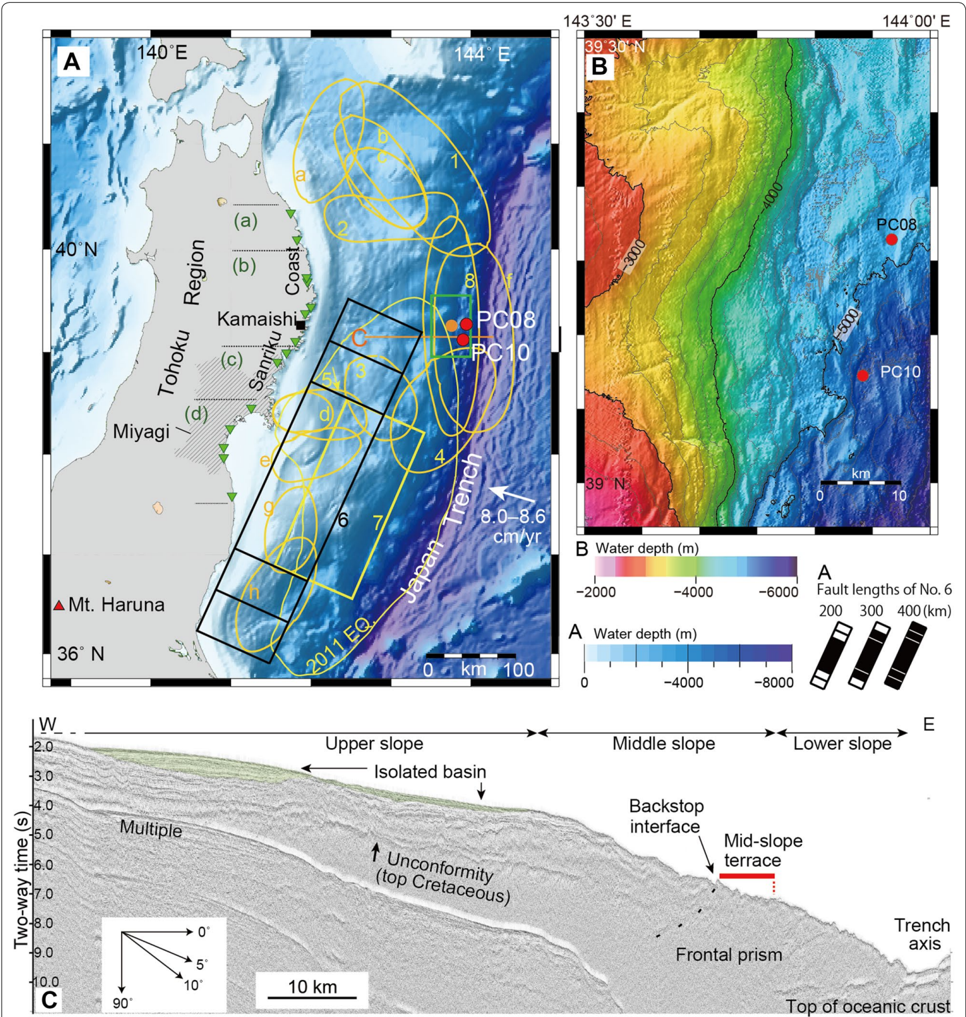
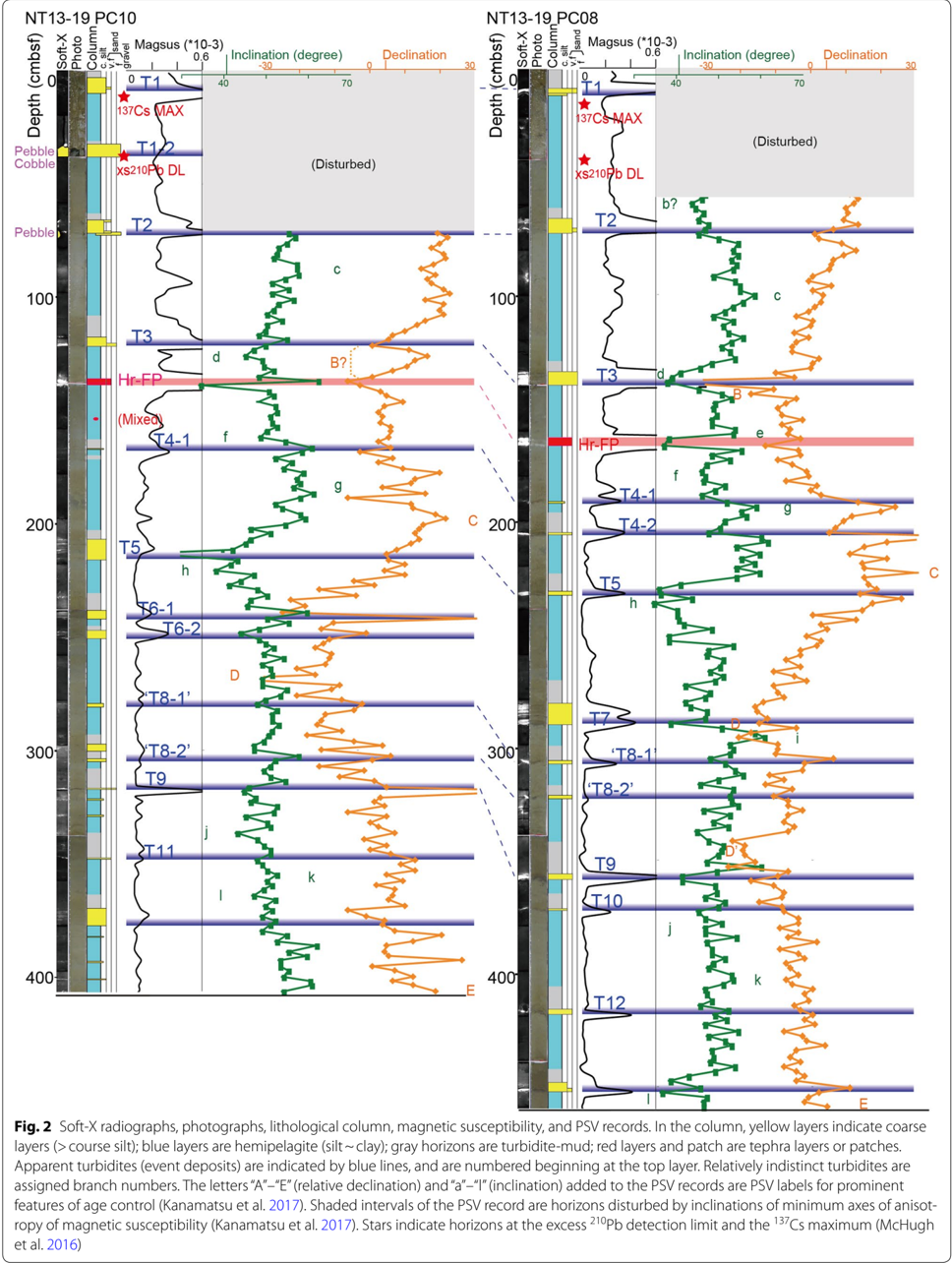
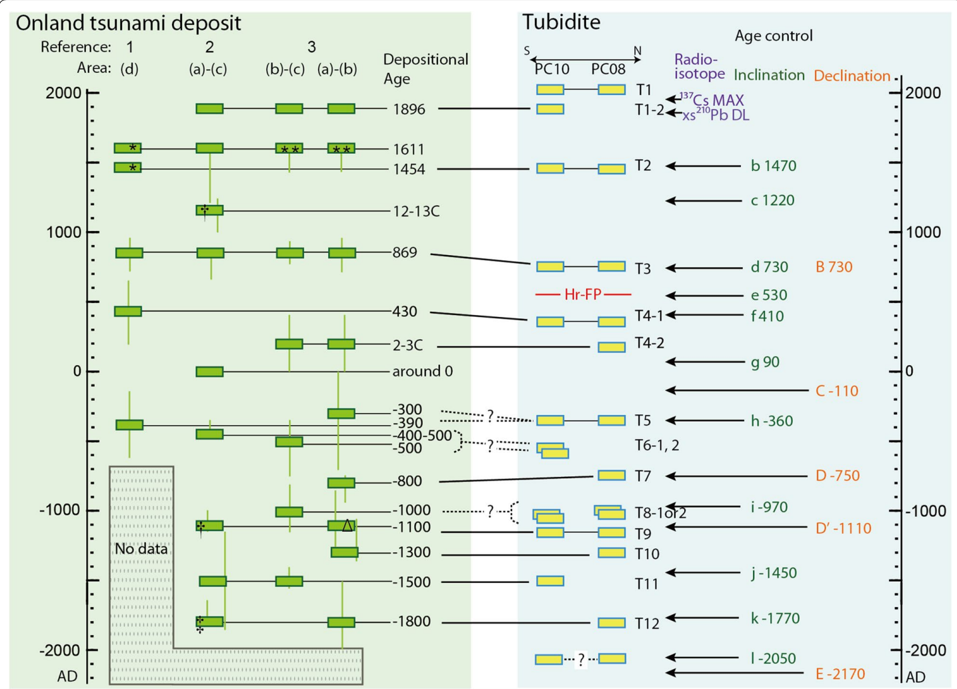
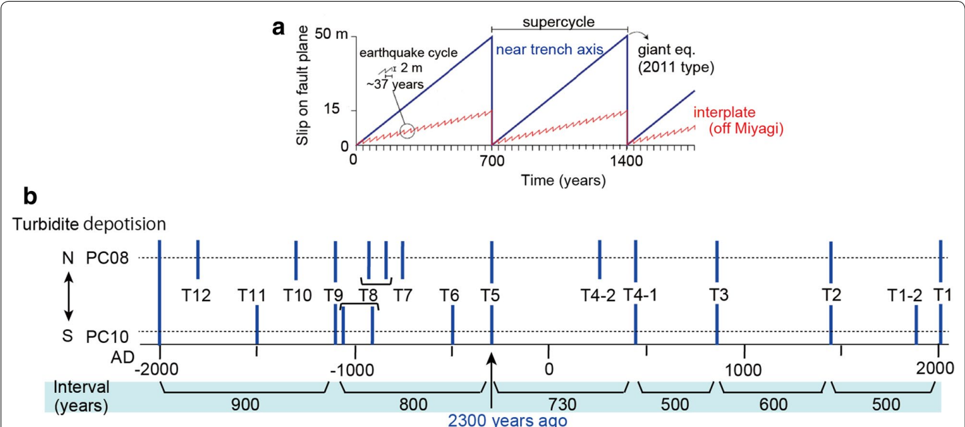
On the landward slope of the Japan Trench, the mid-slope terrace (MST) is located at a depth of 4000–6000 m. Two piston cores from the MST were analyzed to assess the applicability of the MST for turbidite paleoseismology and to find out reliable recurrence record of the great earthquakes along the Japan Trench. The cores have preserved records of ~ 12 seismo-turbidites (event deposits) during the last 4000 years. In the upper parts of the two cores, only the following earthquakes (magnitude M ~ 8 and larger) were clearly recorded: the 2011 Tohoku, the 1896 Sanriku, the 1454 Kyotoku, and the 869 Jogan earthquake. In the lower part of the cores, turbidites were deposited alternately in the northern and southern sites during the periods between concurrent depositional events occurring at intervals of 500–900 years. Considering the characteristics of the coring sites for their sensitivity to earthquake shaking, the concurrent depositional events likely correspond to a supercycle that follows giant ( M ~ 9) earthquakes along the Japan Trench. Preliminary estimations of peak ground acceleration for the historical earthquakes recorded as the turbidites imply that each rupture length of the 1454 and 869 earthquakes was over 200 km. The earthquakes related to the supercycle have occurred over at least the last 4000 years, and the cycle seems to have become slightly shorter in recent years. Earthquakes off the Sanriku coast forming the alternative deposition of turbidites in the two cores have released a part of accumulated slip, as indicated by the turbidites deposited in only one core. Decreases in the release of accumulated slip have possibly caused the recent shortening of the supercycle.
Overview
The claims and statistics of this paper haven’t been checked yet.
Free: it reads the open-access text and checks the first 5 claims that cite a source we can check. Create a free account to check every claim.
Integrity signals
Registry
Cites
Statistics
Figures
Verification
Claims the paper makes
The claims and statistics of this paper haven’t been checked yet.
Free: it reads the open-access text and checks the first 5 claims that cite a source we can check. Create a free account to check every claim.
Claims other papers make about this one
Each is checked against this paper’s own text: does it say what the citing paper says it does?
The source backs part of the claim, not all of it — or backs it for a different population, condition or comparison.
In the citing paper
“Moreover, several cores from the central part of the Japan Trench document evidence for event deposits related to surficial sediment remobilization triggered by older large earthquakes in the last few thousands of years, including the well-known AD 1454 Kyotoku and AD 869 Jogan earthquakes (Ikehara et al., 2016, 2018; Usami et al., 2018).”
From Event Stratigraphy in a Hadal Oceanic Trench: The Japan Trench as Sedimentary Archive Recording Recurrent Giant Subduction Zone Earthquakes and Their Role in Organic Carbon Export to the Deep Sea (2019) · cites this paper as Usami et al., 2018
Experimental — accuracy not yet measured
Self-check
Percentages, sums and reported differences re-computed from the paper’s own numbers.
The self-check needs the paper’s full text.
Citations
Cites
Simplified Procedure for Evaluating Soil Liquefaction Potential
Seed, H. B., & Idriss, I. M. (1971) · Journal of the Soil Mechanics and Foundations Division · doi:10.1061/jsfeaq.0001662 · Cited by 2,942
Geologically current plate motions
DeMets, C., Gordon, R. G., & Argus, D. F. (2010) · Geophysical Journal International · doi:10.1111/j.1365-246x.2009.04491.x · Cited by 2,741
ETOPO1 1 Arc-Minute Global Relief Model
NOAA National Geophysical Data Center (2009) · National Oceanic and Atmospheric Administration (NOAA) National Centers for Environmental Information (NCEI) · doi:10.7289/v5c8276m · Cited by 1,120
Mechanism of tsunami earthquakes
Kanamori, H. (1972) · Physics of the Earth and Planetary Interiors · doi:10.1016/0031-9201(72)90058-1 · Cited by 940 · cited 1×
“The 1896 Sanriku earthquake known as “tsunami earthquake” also caused serious damage to the Tohoku region (Kanamori 1972; Tanioka and Satake 1996; Satake *Correspondence: k-usami@aist.go.jp; k-usami@aori.u-tokyo.ac.jp 5 Atmosphere and Ocean Research Institute, The University of Tokyo, 5-1-5,…”
BackgroundCoseismic and postseismic slip of the 2011 magnitude-9 Tohoku-Oki earthquake
Ozawa, S., Nishimura, T., Suito, H., Kobayashi, T., Tobita, M., & Imakiire, T. (2011) · Nature · doi:10.1038/nature10227 · Cited by 792 · cited 2×
“Irregular ellipses with yellow solid line indicate the area of coseismic slips, which were 4 m or greater when the 2011 earthquake occurred (Ozawa et al. 2011).”
BackgroundDepth‐varying rupture properties of subduction zone megathrust faults
Lay, T., Kanamori, H., Ammon, C. J., Koper, K. D., Hutko, A. R., Ye, L., Yue, H., & Rushing, T. M. (2012) · Journal of Geophysical Research: Solid Earth · doi:10.1029/2011jb009133 · Cited by 640
Turbidite Systems in Deep-Water Basin Margins Classified by Grain Size and Feeder System
Harold G. Reading (2), M. R. (1994) · AAPG Bulletin · doi:10.1306/a25fe3bf-171b-11d7-8645000102c1865d · Cited by 619 · cited 1×
“The “linear sources” means that few lateral migrations on sediment transport (Reading and Richards 1994).”
BackgroundGoldfinger, C., Nelson, C. H., Morey, A. E., Johnson, J. E., Patton, J. R., Karabanov, E. B., Gutierrez-Pastor, J., Eriksson, A. T., Gracia, E., Dunhill, G., et al. (2012) · Professional Paper · doi:10.3133/pp1661f · Cited by 501
Tectonic erosion along the Japan and Peru convergent margins
VON HUENE, R., & LALLEMAND, S. (1990) · Geological Society of America Bulletin · doi:10.1130/0016-7606(1990)102<0704:teatja>2.3.co;2 · Cited by 434 · cited 1×
“This subduction is associated with tectonic erosion that results in forearc subsidence (von Huene and Lallemand 1990).”
BackgroundStow, D. A. V., & Shanmugam, G. (1980) · Sedimentary Geology · doi:10.1016/0037-0738(80)90052-4 · Cited by 423 · cited 1×
“Sedimentary structures of event deposits suggest that the deposits are considered as “fine-grained turbidite” (Stow and Shanmugam 1980), except for T1–2 in PC10, which consists of only two semi-indurated gravels.”
Background
Research works printed but not linked: 5
- 12. Hirakawa K (2012) Outsize tsunami sediments since last years along the Japan- and Kuril-Trench: a tentative idea on source and supercycle. Kagaku 82:172-181 (in Japanese)
- 21. Kon'no E, Iwai J, Takayanagi Y, Nakagawa H, Onuki Y, Shibata T, Mii H, Kitamura N, Kotaka T, Kataoka J (1961) Geological observations of the Sanriku coastal region damaged by the tsunami due to the Chile earthquake in 1960, vol 52. Contr Inst Geol Paleont, Tohoku Univ, Sendai, pp 1-45 (in Japanese)
- 41. Sato R (1989) Handbook for Japanese Earthquake faults parameters. Kajima Institute Publishing, Tokyo
- 45. Shipboard Scientific Party (1980) Site 440: Japan Trench midslope terrace, Leg57. Init Rept DSDP 56&57:225-231
- 50. Takada K, Shishikura M, Imai K, Ebina Y, Goto K, Koshiya S, Yamamoto H, Igarashi A, Ichihara T, Kinoshita H, Ikeda T, River division department of prefectural land development, Iwate prefecture government (2016) Distribution and ages of tsunami deposits along the Pacific coast of the Iwate Prefecture. Ann Rep Active Fault Paleoearthq Res 16:1-52 (in Japanese)
Cited by
A Decade of Lessons Learned from the 2011 Tohoku‐Oki Earthquake
Uchida, N., & Bürgmann, R. (2021) · Reviews of Geophysics · doi:10.1029/2020rg000713 · Cited by 117
Megathrust earthquake drives drastic organic carbon supply to the hadal trench.
Kioka, A., Schwestermann, T., Moernaut, J., Ikehara, K., Kanamatsu, T., McHugh, C. M., dos Santos Ferreira, C., Wiemer, G., Haghipour, N., Kopf, A. J., et al. (2019) · Scientific Reports · doi:10.1038/s41598-019-38834-x · Cited by 84
Self-citationGoto, K., Ishizawa, T., Ebina, Y., Imamura, F., Sato, S., & Udo, K. (2020) · Earth-Science Reviews · doi:10.1016/j.earscirev.2020.103417 · Cited by 82
Kioka, A., Schwestermann, T., Moernaut, J., Ikehara, K., Kanamatsu, T., Eglinton, T. I., & Strasser, M. (2019) · Frontiers in Earth Science · doi:10.3389/feart.2019.00319 · Cited by 73
“Moreover, several cores from the central part of the Japan Trench document evidence for event deposits related to surficial sediment remobilization triggered by older large earthquakes in the last few thousands of years, including the well-known AD 1454 Kyotoku and AD 869 Jogan earthquakes (Ikehara et al., 2016, 2018;…”
BackgroundSelf-citationFrictional and structural controls of seismic super-cycles at the Japan trench
Barbot, S. (2020) · Earth Planets and Space · doi:10.1186/s40623-020-01185-3 · Cited by 77
Metadata
- Authors
- Usami, K., Ikehara, K., Kanamatsu, T., & McHugh, C. M.
- Affiliations
- Geological Survey of Japan (JP)
- Japan Agency for Marine-Earth Science and Technology (JP)
- Queens College, CUNY (US)
- Corresponding author
- Usami, Kazuko
- Venue
- Geoscience Letters
- Published
- 2018-04-07
- Volume
- 5
- Issue
- 1
- ISSN
- 2196-4092 (ISSN-L)
- OpenAlex
- W2795675667
- Cited by
- 68
- References
- 53
- Citations by year
- 2026: 2 · 2025: 13 · 2024: 7 · 2023: 8 · 2022: 8 · 2021: 10 · 2020: 12 · 2019: 7
- FWCI
- 5.20
- Type
- journal article
- Language
- en
- Open access
- gold
- doi.org
- Licence
- cc-by
- creativecommons.org/licenses/by/4.0 (tdm)
- creativecommons.org/licenses/by/4.0 (vor)
- Locations
- Geoscience Letters (publishedVersion, cc-by)
- CUNY Academic Works (City University of New York) (submittedVersion, cc-by)
- DOAJ (DOAJ: Directory of Open Access Journals) (submittedVersion)
- Funders
- Ministry of Education, Culture, Sports, Science and Technology
- Japan Society for the Promotion of Science (260000002)
- National Institute of Advanced Industrial Science and Technology
- Topics
- Physical Sciences › Earth and Planetary Sciences › Geophysics › earthquake and tectonic studies
- Physical Sciences › Earth and Planetary Sciences › Earth-Surface Processes › Geological formations and processes
- Social Sciences › Geography, Planning and Development › Earthquake and Disaster Impact Studies
- Keywords
- Japan Trench, earthquake recurrence, supercycle, piston core, Great East Japan Earthquake, peak ground acceleration, rupture length, subduction zone megathrust
About these checks
Registry, retraction, Cites and statistics results are computed, not judged, with one exception: a printed reference that no index lists is read once by a model before it counts as a citation error. Claims are extracted by a model and kept only when their quote appears verbatim in the text; each cited source is then checked, with a model’s help, for whether it says what the claim relies on. Those verdicts can be wrong — read the claim’s quote and the cited source before relying on one.
Statistics and arithmetic are recomputed, not judged.
Confidence bands are shown only for fields calibrated on our annotated test set. None is calibrated yet, so no band is shown.
What counts as a claim ›How we measure confidence ›How we check this ›
Are you an author, or do you see a problem with this page? Request a review
Data sources
Bibliographic data: Semantic Scholar, OpenAlex, Crossref.
Contains information from the Semantic Scholar Academic Graph Datasets, made available under the ODC Attribution License (ODC-BY 1.0).
Semantic Scholar’s data is described in: Kinney, R., et al. (2023). The Semantic Scholar Open Data Platform. arXiv:2301.10140.
