

Supercycle in great earthquake recurrence along the Japan Trench over the last 4000 years.
Open accessThe DOI matches its Crossref record; 53 of the 53 references it cites were found in a registry or an index.
Abstract
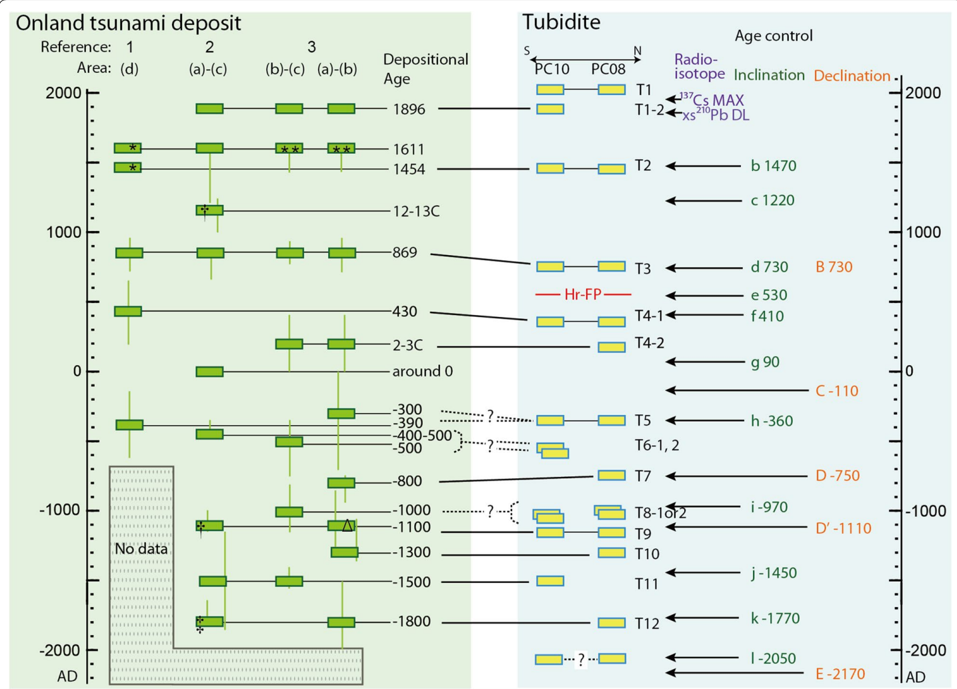
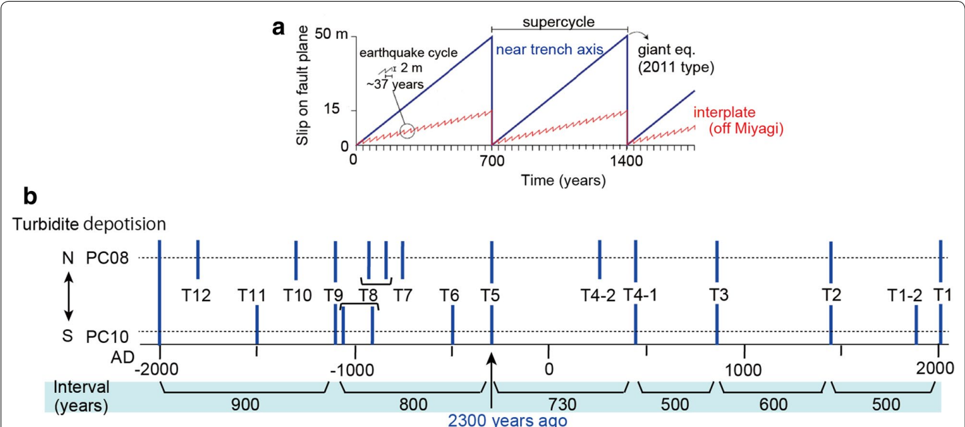
On the landward slope of the Japan Trench, the mid-slope terrace (MST) is located at a depth of 4000–6000 m. Two piston cores from the MST were analyzed to assess the applicability of the MST for turbidite paleoseismology and to find out reliable recurrence record of the great earthquakes along the Japan Trench. The cores have preserved records of ~ 12 seismo-turbidites (event deposits) during the last 4000 years. In the upper parts of the two cores, only the following earthquakes (magnitude M ~ 8 and larger) were clearly recorded: the 2011 Tohoku, the 1896 Sanriku, the 1454 Kyotoku, and the 869 Jogan earthquake. In the lower part of the cores, turbidites were deposited alternately in the northern and southern sites during the periods between concurrent depositional events occurring at intervals of 500–900 years. Considering the characteristics of the coring sites for their sensitivity to earthquake shaking, the concurrent depositional events likely correspond to a supercycle that follows giant ( M ~ 9) earthquakes along the Japan Trench. Preliminary estimations of peak ground acceleration for the historical earthquakes recorded as the turbidites imply that each rupture length of the 1454 and 869 earthquakes was over 200 km. The earthquakes related to the supercycle have occurred over at least the last 4000 years, and the cycle seems to have become slightly shorter in recent years. Earthquakes off the Sanriku coast forming the alternative deposition of turbidites in the two cores have released a part of accumulated slip, as indicated by the turbidites deposited in only one core. Decreases in the release of accumulated slip have possibly caused the recent shortening of the supercycle.
Overview
The claims and statistics of this paper haven’t been checked yet.
Free: it reads the open-access text and checks the first 5 claims that cite a source we can check. Create a free account to check every claim.
Integrity signals
Registry
Cites
Statistics
Figures
Verification
Claims the paper makes
The claims and statistics of this paper haven’t been checked yet.
Free: it reads the open-access text and checks the first 5 claims that cite a source we can check. Create a free account to check every claim.
Claims other papers make about this one
Each is checked against this paper’s own text: does it say what the citing paper says it does?
The source backs part of the claim, not all of it — or backs it for a different population, condition or comparison.
In the citing paper
“Moreover, several cores from the central part of the Japan Trench document evidence for event deposits related to surficial sediment remobilization triggered by older large earthquakes in the last few thousands of years, including the well-known AD 1454 Kyotoku and AD 869 Jogan earthquakes (Ikehara et al., 2016, 2018; Usami et al., 2018).”
From Event Stratigraphy in a Hadal Oceanic Trench: The Japan Trench as Sedimentary Archive Recording Recurrent Giant Subduction Zone Earthquakes and Their Role in Organic Carbon Export to the Deep Sea (2019) · cites this paper as Usami et al., 2018
Experimental — accuracy not yet measured
Self-check
Percentages, sums and reported differences re-computed from the paper’s own numbers.
The self-check needs the paper’s full text.
Citations
Cites
Simplified Procedure for Evaluating Soil Liquefaction Potential
Seed, H. B., & Idriss, I. M. (1971) · Journal of the Soil Mechanics and Foundations Division · doi:10.1061/jsfeaq.0001662 · Cited by 2,942
Geologically current plate motions
DeMets, C., Gordon, R. G., & Argus, D. F. (2010) · Geophysical Journal International · doi:10.1111/j.1365-246x.2009.04491.x · Cited by 2,741
ETOPO1 1 Arc-Minute Global Relief Model
NOAA National Geophysical Data Center (2009) · National Oceanic and Atmospheric Administration (NOAA) National Centers for Environmental Information (NCEI) · doi:10.7289/v5c8276m · Cited by 1,120
Mechanism of tsunami earthquakes
Kanamori, H. (1972) · Physics of the Earth and Planetary Interiors · doi:10.1016/0031-9201(72)90058-1 · Cited by 940 · cited 1×
“The 1896 Sanriku earthquake known as “tsunami earthquake” also caused serious damage to the Tohoku region (Kanamori 1972; Tanioka and Satake 1996; Satake *Correspondence: k-usami@aist.go.jp; k-usami@aori.u-tokyo.ac.jp 5 Atmosphere and Ocean Research Institute, The University of Tokyo, 5-1-5,…”
BackgroundCoseismic and postseismic slip of the 2011 magnitude-9 Tohoku-Oki earthquake
Ozawa, S., Nishimura, T., Suito, H., Kobayashi, T., Tobita, M., & Imakiire, T. (2011) · Nature · doi:10.1038/nature10227 · Cited by 792 · cited 2×
“Irregular ellipses with yellow solid line indicate the area of coseismic slips, which were 4 m or greater when the 2011 earthquake occurred (Ozawa et al. 2011).”
BackgroundDepth‐varying rupture properties of subduction zone megathrust faults
Lay, T., Kanamori, H., Ammon, C. J., Koper, K. D., Hutko, A. R., Ye, L., Yue, H., & Rushing, T. M. (2012) · Journal of Geophysical Research: Solid Earth · doi:10.1029/2011jb009133 · Cited by 640
Turbidite Systems in Deep-Water Basin Margins Classified by Grain Size and Feeder System
Harold G. Reading (2), M. R. (1994) · AAPG Bulletin · doi:10.1306/a25fe3bf-171b-11d7-8645000102c1865d · Cited by 619 · cited 1×
“The “linear sources” means that few lateral migrations on sediment transport (Reading and Richards 1994).”
BackgroundGoldfinger, C., Nelson, C. H., Morey, A. E., Johnson, J. E., Patton, J. R., Karabanov, E. B., Gutierrez-Pastor, J., Eriksson, A. T., Gracia, E., Dunhill, G., et al. (2012) · Professional Paper · doi:10.3133/pp1661f · Cited by 501
Tectonic erosion along the Japan and Peru convergent margins
VON HUENE, R., & LALLEMAND, S. (1990) · Geological Society of America Bulletin · doi:10.1130/0016-7606(1990)102<0704:teatja>2.3.co;2 · Cited by 434 · cited 1×
“This subduction is associated with tectonic erosion that results in forearc subsidence (von Huene and Lallemand 1990).”
BackgroundStow, D. A. V., & Shanmugam, G. (1980) · Sedimentary Geology · doi:10.1016/0037-0738(80)90052-4 · Cited by 423 · cited 1×
“Sedimentary structures of event deposits suggest that the deposits are considered as “fine-grained turbidite” (Stow and Shanmugam 1980), except for T1–2 in PC10, which consists of only two semi-indurated gravels.”
BackgroundAsperity map along the subduction zone in northeastern Japan inferred from regional seismic data
Yamanaka, Y., & Kikuchi, M. (2004) · Journal of Geophysical Research: Solid Earth · doi:10.1029/2003jb002683 · Cited by 407 · cited 1×
“However, the 1994 Sanriku-oki earthquake is not considered as the above-mentioned “near-trench” earthquake (Nakayama and Takeo 1997; Yamanaka and Kikuchi 2004).”
BackgroundThe Sissano, Papua New Guinea tsunami of July 1998 — offshore evidence on the source mechanism
Tappin, D. R., Watts, P., McMurtry, G. M., Lafoy, Y., & Matsumoto, T. (2001) · Marine Geology · doi:10.1016/s0025-3227(01)00131-1 · Cited by 364
Minoura, K., & Nakaya, S. (1991) · The Journal of Geology · doi:10.1086/629488 · Cited by 364 · cited 4×
“1961), the major cause of large tsunamis in this area is interplate earthquakes along the Japan Trench (Minoura and Nakaya 1991; Minoura et al. 2001; Namegaya and Satake 2014; Sawai et al. 2015).”
BackgroundInfluentialMinoura, K., Imamura, F., Sugawara, D., Kono, Y., & Iwashita, T. (2001) · Journal of Natural Disaster Science · Cited by 317
Challenges of anticipating the 2011 Tohoku earthquake and tsunami using coastal geology.
Sawai, Y., Namegaya, Y., Okamura, Y., Satake, K., & Shishikura, M. (2012) · Geophysical Research Letters · doi:10.1029/2012gl053692 · Cited by 261 · cited 4×
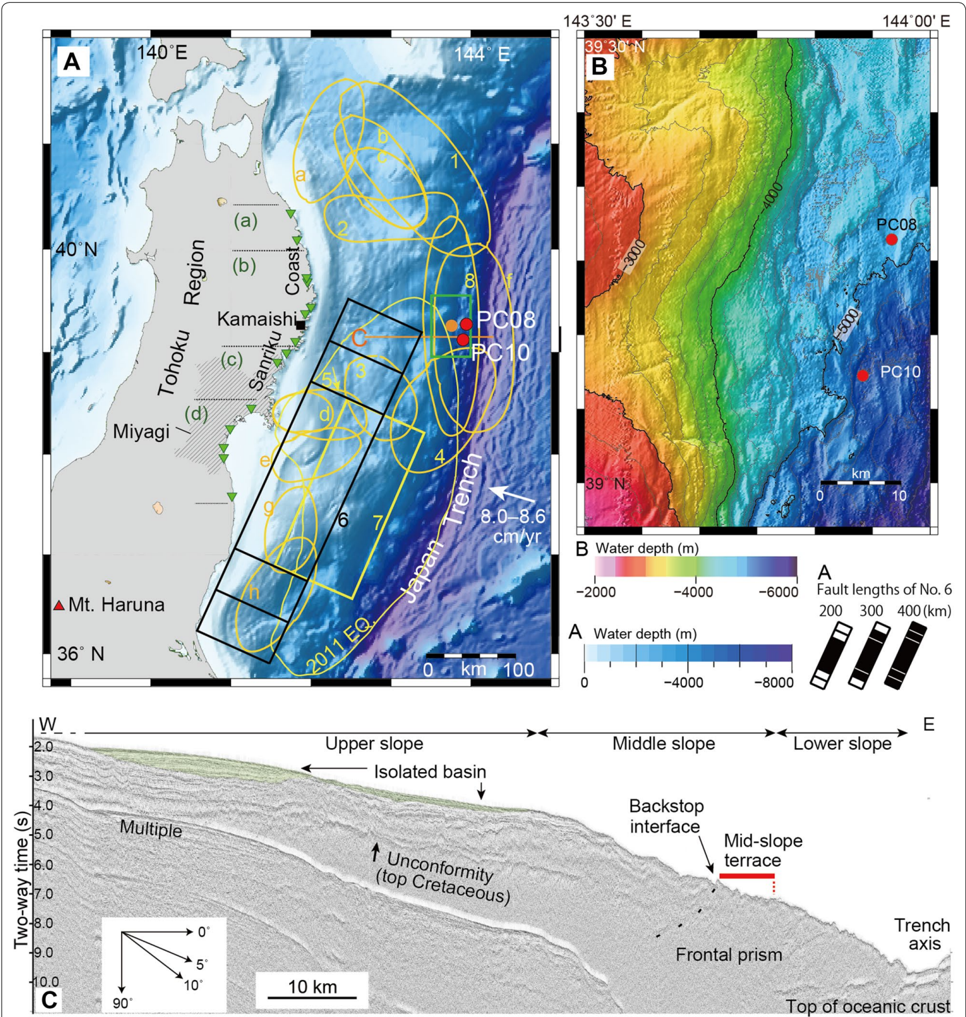
“Line C transects the inset in C. Green inverted triangles indicate the sites of onland tsunami deposits (Sawai et al. 2012; Hirakawa 2012; Takada et al. 2016; Ishimura 2017).”
BackgroundResultInfluentialFault parameters of the 1896 Sanriku Tsunami Earthquake estimated from Tsunami Numerical Modeling
Tanioka, Y., & Sataka, K. (1996) · Geophysical Research Letters · doi:10.1029/96gl01479 · Cited by 252 · cited 1×
“The 1896 Sanriku earthquake known as “tsunami earthquake” also caused serious damage to the Tohoku region (Kanamori 1972; Tanioka and Satake 1996; Satake *Correspondence: k-usami@aist.go.jp; k-usami@aori.u-tokyo.ac.jp 5 Atmosphere and Ocean Research Institute, The University of Tokyo, 5-1-5,…”
BackgroundDistribution of carbonate in surface sediments of the Pacific Ocean
Berger, W. H., Adelseck, C. G., & Mayer, L. A. (1976) · Journal of Geophysical Research · doi:10.1029/jc081i015p02617 · Cited by 224
Tsuru, T., Park, J., Miura, S., Kodaira, S., Kido, Y., & Hayashi, T. (2002) · Journal of Geophysical Research: Solid Earth · doi:10.1029/2001jb001664 · Cited by 214 · cited 5×
“Most large interplate thrust earthquakes occurred in high-velocity areas that may represent high-strength asperities (Huang and Zhao 2013); In contrast, a low-velocity area associated with abundant sediments supplied from the incoming plate lies off Kamaishi (Tsuru et al.”
BackgroundInfluentialKoper, K. D., Hutko, A. R., Lay, T., Ammon, C. J., & Kanamori, H. (2011) · Earth, Planets and Space · doi:10.5047/eps.2011.05.026 · Cited by 207 · cited 1×
“Yellow ellipses summarize the suggested rupture areas of historical earthquakes (M ~ 7.4 and larger) over the most recent 200 years (Koper et al. 2011; Toda 2016); 2: 1994 Sanriku-oki earthquake, 8: 1896 Sanriku earthquake.”
BackgroundInfluentialSuzuki, W., Aoi, S., Sekiguchi, H., & Kunugi, T. (2011) · Geophysical Research Letters · doi:10.1029/2011gl049136 · Cited by 190
Periodic slow slip triggers megathrust zone earthquakes in northeastern Japan
Uchida, N., Iinuma, T., Nadeau, R. M., Bürgmann, R., & Hino, R. (2016) · Science · doi:10.1126/science.aad3108 · Cited by 177
Furumura, T., & Kennett, B. L. N. (2005) · Journal of Geophysical Research: Solid Earth · doi:10.1029/2004jb003486 · Cited by 167
Yoshida, Y., Ueno, H., Muto, D., & Aoki, S. (2011) · Earth Planets and Space · doi:10.5047/eps.2011.05.011 · Cited by 143
Geological and historical evidence of irregular recurrent earthquakes in Japan
Satake, K. (2015) · Philosophical Transactions of the Royal Society A: Mathematical, Physical and Engineering Sciences · doi:10.1098/rsta.2014.0375 · Cited by 137 · cited 6×
“Such cumulative slips have been interpreted to have been released by infrequent earthquakes with recurring at an interval of ~ 700 years (Satake 2015).”
BackgroundInfluentialNamegaya, Y., & Satake, K. (2014) · Geophysical Research Letters · doi:10.1002/2013gl058678 · Cited by 136 · cited 5×
“…results infer that the PGA could be large (over ~ 200 cm/s2) at the hypothetical source zone, for fault models of the giant and great earthquakes recorded as the turbidites; the A.D. 869 Jogan (uniformslip model with a fault length of 200 km; Namegaya and Satake 2014), 1454 Kyotoku (Sawai et al.”
BackgroundInfluentialIkehara, K., Kanamatsu, T., Nagahashi, Y., Strasser, M., Fink, H., Usami, K., Irino, T., & Wefer, G. (2016) · Earth and Planetary Science Letters · doi:10.1016/j.epsl.2016.04.009 · Cited by 129
Self-citationTectonic erosion at the front of the Japan Trench convergent margin
von Huene, R. E., & Culotta, R. C. (1989) · Tectonophysics · doi:10.1016/0040-1951(89)90385-5 · Cited by 122 · cited 2×
“These features trap the gravity flow from the landward slope, and then deposit their transporting sediments (von Huene and Culotta 1989; Tsuru et al.”
BackgroundHoward, K. A., House, P. K., Dorsey, R. J., & Pearthree, P. A. (2015) · Geosphere · doi:10.1130/ges01059.1 · Cited by 101
Pouderoux, H., Proust, J.-N., & Lamarche, G. (2014) · Quaternary Science Reviews · doi:10.1016/j.quascirev.2013.11.015 · Cited by 100 · cited 1×
“Seismo-turbidites (turbidites deposited by earthquake-triggered turbidity currents) have been also used to estimate the recurrence history of earthquakes in other active tectonic margins (Goldfinger et al. 2012; Gutierrez-Pastor et al. 2013; Pouderoux et al. 2014; Patton et al. 2015).”
MethodSawai, Y., Namegaya, Y., Tamura, T., Nakashima, R., & Tanigawa, K. (2015) · Geophysical Research Letters · doi:10.1002/2015gl064167 · Cited by 96
McHugh, C. M., Kanamatsu, T., Seeber, L., Bopp, R., Cormier, M.-H., & Usami, K. (2016) · Geology · doi:10.1130/g37650.1 · Cited by 93 · cited 1×
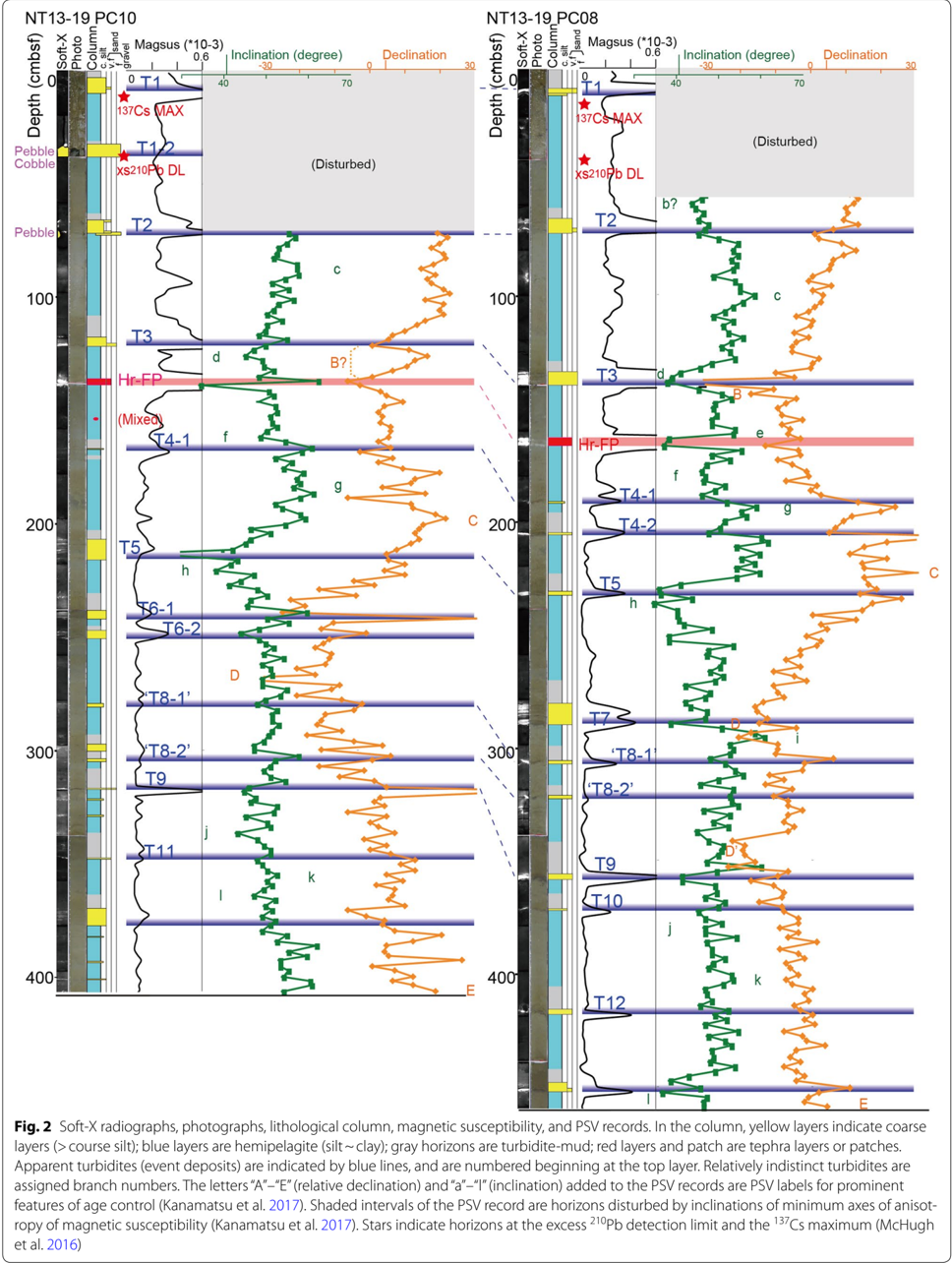
“Stars indicate horizons at the excess 210Pb detection limit and the 137Cs maximum (McHugh et al. 2016) indicates that few large earthquakes (with M ~ 7.5 and larger) have occurred in the forearc off Kamaishi, which is near the coring sites.”
BackgroundSelf-citationIshimura, D., & Miyauchi, T. (2015) · Progress in Earth and Planetary Science · doi:10.1186/s40645-015-0047-4 · Cited by 86 · cited 1×
“2012, 2015; Ishimura and Miyauchi 2015; Takada et al.”
BackgroundA 6600 year earthquake history in the region of the 2004 Sumatra-Andaman subduction zone earthquake
Patton, J. R., Goldfinger, C., Morey, A. E., Ikehara, K., Romsos, C., Stoner, J., Djadjadihardja, Y., Udrekh, Ardhyastuti, S., Gaffar, E. Z., et al. (2015) · Geosphere · doi:10.1130/ges01066.1 · Cited by 85
Self-citationEstimation of the Height of the Sanriku Jogan 11 Earthquake-Tsunami (A. D. 869) in the Sendai Plain
ABE, H., SUGENO, Y., & CHIGAMA, A. (1990) · Zisin (Journal of the Seismological Society of Japan. 2nd ser.) · doi:10.4294/zisin1948.43.4_513 · Cited by 84
Turbidite paleoseismology in the Calabrian Arc Subduction Complex (Ionian Sea)
Polonia, A., Panieri, G., Gasperini, L., Gasparotto, G., Bellucci, L. G., & Torelli, L. (2012) · Geochemistry Geophysics Geosystems · doi:10.1029/2012gc004402 · Cited by 78
Deep scientific dives in the Japan and Kuril Trenches.
Cadet, J. P., Kobayashi, K., Lallemand, S., Jolivet, L., Aubouin, J., Boulègue, J., Dubois, J., Hotta, H., Ishii, T., Konishi, K., et al. (1987) · Earth and Planetary Science Letters · doi:10.1016/0012-821x(87)90074-4 · Cited by 77
Slip history of the 1994 Sanriku-Haruka-Oki, Japan, earthquake deduced from strong-motion data
Nakayama, W., & Takeo, M. (1997) · Bulletin of the Seismological Society of America · doi:10.1785/bssa0870040918 · Cited by 74 · cited 5×
“However, the 1994 Sanriku-oki earthquake is not considered as the above-mentioned “near-trench” earthquake (Nakayama and Takeo 1997; Yamanaka and Kikuchi 2004).”
BackgroundInfluentialHolocene palaeomagnetic secular variation at Lake Biwa, central Japan
Ali, M., Oda, H., Hayashida, A., Takemura, K., & Torii, M. (1999) · Geophysical Journal International · doi:10.1046/j.1365-246x.1999.00718.x · Cited by 70 · cited 6×
“Correlations between PSV records of NT319 (PC08 and PC10) and those of Lake Biwa (Ali et al. 1999).”
BackgroundInfluentialGutiérrez-Pastor, J., Nelson, C., Goldfinger, C., & Escutia, C. (2012) · Marine Geology · doi:10.1016/j.margeo.2012.11.010 · Cited by 69
Mechanism of the 2011 Tohoku-oki earthquake (Mw 9.0) and tsunami: Insight from seismic tomography
Huang, Z., & Zhao, D. (2013) · Journal of Asian Earth Sciences · doi:10.1016/j.jseaes.2013.03.010 · Cited by 66 · cited 3×
“Most large interplate thrust earthquakes occurred in high-velocity areas that may represent high-strength asperities (Huang and Zhao 2013); In contrast, a low-velocity area associated with abundant sediments supplied from the incoming plate lies off Kamaishi (Tsuru et al.”
BackgroundNumerical simulation of the AD 869 Jogan tsunami in Ishinomaki and Sendai plains
Satake, K. (2008) · Medical Entomology and Zoology · Cited by 59
Summary, Japan Trench Transect
von Huene, R. E., Langseth, M. G., Nasu, N., & Okada, H. (1980) · U.S. Government Printing Office eBooks · doi:10.2973/dsdp.proc.5657.111.1980 · Cited by 52
Potential tsunamigenic submarine landslides in active margins
Kawamura, K., Laberg, J. S., & Kanamatsu, T. (2014) · Marine Geology · doi:10.1016/j.margeo.2014.03.007 · Cited by 51
Self-citationDifferent depths of near-trench slips of the 1896 Sanriku and 2011 Tohoku earthquakes
Satake, K., Fujii, Y., & Yamaki, S. (2017) · Geoscience Letters · doi:10.1186/s40562-017-0099-y · Cited by 41
Ishimura, D. (2017) · Geoscience Letters · doi:10.1186/s40562-017-0077-4 · Cited by 40 · cited 4×
“2016; Ishimura 2017).”
BackgroundResultInfluentialWorldwide Deposition of Long-lived Fission Products from Nuclear Explosions
Peirson, D. H. (1971) · Nature · doi:10.1038/234079a0 · Cited by 37 · cited 4×
“In the case of radioisotopes, horizons in the two cores that excess 210Pb detection limits (A.D. 1860) and the maximum for 137Cs (A.D. 1963; Peirson 1971) were referred to in previous studies (McHugh et al.”
BackgroundInfluentialKohsaku, A. R. A. I., Inoue, T., Ikehara, K., & Sasaki, T. (2014) · Earth and Planetary Science Letters · doi:10.1016/j.epsl.2014.09.048 · Cited by 35
Self-citationIkehara, K., Usami, K., Kanamatsu, T., Danhara, T., & Yamashita, T. (2017) · Quaternary International · doi:10.1016/j.quaint.2017.08.022 · Cited by 29
Self-citationNAMEGAYA, Y., & YATA, T. (2014) · Zisin (Journal of the Seismological Society of Japan. 2nd ser.) · doi:10.4294/zisin.66.73 · Cited by 28 · cited 2×
“2008; Namegaya and Yata 2014; Sawai et al.”
BackgroundReview: Source Models of the 2011 Tohoku Earthquake and Long-Term Forecast of Large Earthquakes
Satake, K., & Fujii, Y. (2014) · Journal of Disaster Research · doi:10.20965/jdr.2014.p0272 · Cited by 23 · cited 2×
“1A) has been proposed along the Japan Trench (Satake and Fujii 2014; Satake 2015; Fig.”
BackgroundKanamatsu, T., Usami, K., McHugh, C. M. G., & Ikehara, K. (2017) · Geochemistry, Geophysics, Geosystems · doi:10.1002/2017gc006878 · Cited by 23 · cited 3×
“Shaded intervals of the PSV record are horizons disturbed by inclinations of minimum axes of anisotropy of magnetic susceptibility (Kanamatsu et al. 2017).”
BackgroundSelf-citationThe 14C ages of the late Pleistocene - Holocene volcanic products erupted from the Haruna volcano
Geshi, N., & Oishi, M. (2011) · BULLETIN OF THE GEOLOGICAL SURVEY OF JAPAN · doi:10.9795/bullgsj.62.177 · Cited by 12 · cited 1×
“2017), products of a historical eruption of Mt. Haruna during the 6th century (Geshi and Oishi 2011; Fig.”
BackgroundToda, S. (2016) · Geological Society London eBooks · doi:10.1144/goj.14 · Cited by 9
Research works printed but not linked: 5
- 12. Hirakawa K (2012) Outsize tsunami sediments since last years along the Japan- and Kuril-Trench: a tentative idea on source and supercycle. Kagaku 82:172-181 (in Japanese)
- 21. Kon'no E, Iwai J, Takayanagi Y, Nakagawa H, Onuki Y, Shibata T, Mii H, Kitamura N, Kotaka T, Kataoka J (1961) Geological observations of the Sanriku coastal region damaged by the tsunami due to the Chile earthquake in 1960, vol 52. Contr Inst Geol Paleont, Tohoku Univ, Sendai, pp 1-45 (in Japanese)
- 41. Sato R (1989) Handbook for Japanese Earthquake faults parameters. Kajima Institute Publishing, Tokyo
- 45. Shipboard Scientific Party (1980) Site 440: Japan Trench midslope terrace, Leg57. Init Rept DSDP 56&57:225-231
- 50. Takada K, Shishikura M, Imai K, Ebina Y, Goto K, Koshiya S, Yamamoto H, Igarashi A, Ichihara T, Kinoshita H, Ikeda T, River division department of prefectural land development, Iwate prefecture government (2016) Distribution and ages of tsunami deposits along the Pacific coast of the Iwate Prefecture. Ann Rep Active Fault Paleoearthq Res 16:1-52 (in Japanese)
Cited by
A Decade of Lessons Learned from the 2011 Tohoku‐Oki Earthquake
Uchida, N., & Bürgmann, R. (2021) · Reviews of Geophysics · doi:10.1029/2020rg000713 · Cited by 117
Megathrust earthquake drives drastic organic carbon supply to the hadal trench.
Kioka, A., Schwestermann, T., Moernaut, J., Ikehara, K., Kanamatsu, T., McHugh, C. M., dos Santos Ferreira, C., Wiemer, G., Haghipour, N., Kopf, A. J., et al. (2019) · Scientific Reports · doi:10.1038/s41598-019-38834-x · Cited by 84
Self-citationGoto, K., Ishizawa, T., Ebina, Y., Imamura, F., Sato, S., & Udo, K. (2020) · Earth-Science Reviews · doi:10.1016/j.earscirev.2020.103417 · Cited by 82
Kioka, A., Schwestermann, T., Moernaut, J., Ikehara, K., Kanamatsu, T., Eglinton, T. I., & Strasser, M. (2019) · Frontiers in Earth Science · doi:10.3389/feart.2019.00319 · Cited by 73
“Moreover, several cores from the central part of the Japan Trench document evidence for event deposits related to surficial sediment remobilization triggered by older large earthquakes in the last few thousands of years, including the well-known AD 1454 Kyotoku and AD 869 Jogan earthquakes (Ikehara et al., 2016, 2018;…”
BackgroundSelf-citationFrictional and structural controls of seismic super-cycles at the Japan trench
Barbot, S. (2020) · Earth Planets and Space · doi:10.1186/s40623-020-01185-3 · Cited by 77
Metadata
- Authors
- Usami, K., Ikehara, K., Kanamatsu, T., & McHugh, C. M.
- Affiliations
- Geological Survey of Japan (JP)
- Japan Agency for Marine-Earth Science and Technology (JP)
- Queens College, CUNY (US)
- Corresponding author
- Usami, Kazuko
- Venue
- Geoscience Letters
- Published
- 2018-04-07
- Volume
- 5
- Issue
- 1
- ISSN
- 2196-4092 (ISSN-L)
- OpenAlex
- W2795675667
- Cited by
- 68
- References
- 53
- Citations by year
- 2026: 2 · 2025: 13 · 2024: 7 · 2023: 8 · 2022: 8 · 2021: 10 · 2020: 12 · 2019: 7
- FWCI
- 5.20
- Type
- journal article
- Language
- en
- Open access
- gold
- doi.org
- Licence
- cc-by
- creativecommons.org/licenses/by/4.0 (tdm)
- creativecommons.org/licenses/by/4.0 (vor)
- Locations
- Geoscience Letters (publishedVersion, cc-by)
- CUNY Academic Works (City University of New York) (submittedVersion, cc-by)
- DOAJ (DOAJ: Directory of Open Access Journals) (submittedVersion)
- Funders
- Ministry of Education, Culture, Sports, Science and Technology
- Japan Society for the Promotion of Science (260000002)
- National Institute of Advanced Industrial Science and Technology
- Topics
- Physical Sciences › Earth and Planetary Sciences › Geophysics › earthquake and tectonic studies
- Physical Sciences › Earth and Planetary Sciences › Earth-Surface Processes › Geological formations and processes
- Social Sciences › Geography, Planning and Development › Earthquake and Disaster Impact Studies
- Keywords
- Japan Trench, earthquake recurrence, supercycle, piston core, Great East Japan Earthquake, peak ground acceleration, rupture length, subduction zone megathrust
About these checks
Registry, retraction, Cites and statistics results are computed, not judged, with one exception: a printed reference that no index lists is read once by a model before it counts as a citation error. Claims are extracted by a model and kept only when their quote appears verbatim in the text; each cited source is then checked, with a model’s help, for whether it says what the claim relies on. Those verdicts can be wrong — read the claim’s quote and the cited source before relying on one.
Statistics and arithmetic are recomputed, not judged.
Confidence bands are shown only for fields calibrated on our annotated test set. None is calibrated yet, so no band is shown.
What counts as a claim ›How we measure confidence ›How we check this ›
Are you an author, or do you see a problem with this page? Request a review
Data sources
Bibliographic data: Semantic Scholar, OpenAlex, Crossref.
Contains information from the Semantic Scholar Academic Graph Datasets, made available under the ODC Attribution License (ODC-BY 1.0).
Semantic Scholar’s data is described in: Kinney, R., et al. (2023). The Semantic Scholar Open Data Platform. arXiv:2301.10140.
