

Firearm purchasing and firearm violence during the coronavirus pandemic in the United States: a cross-sectional study
Open accessPublished version of a preprint
The DOI matches its Crossref record; 54 of the 55 references it cites were found in a registry or an index.
Abstract
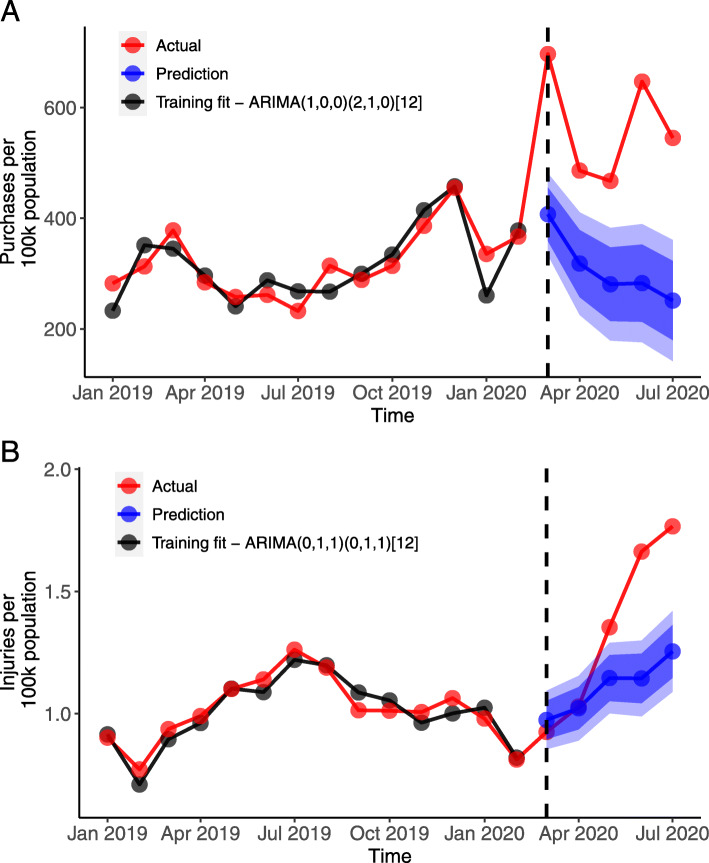
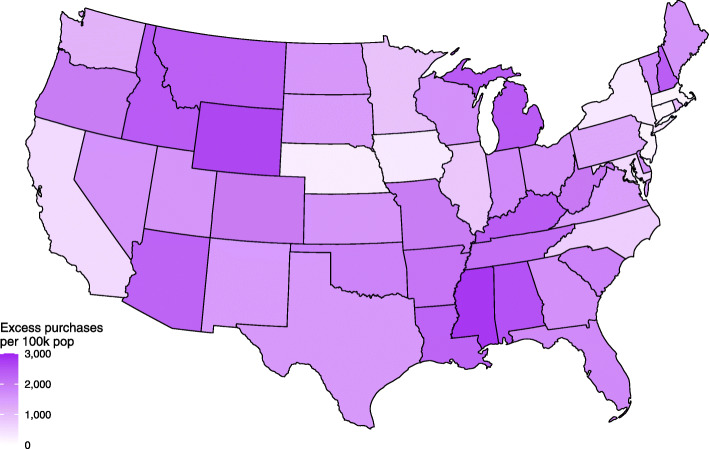
Background: Firearm violence is a significant public health problem in the United States. A surge in firearm purchasing following the onset of the coronavirus pandemic may have contributed to an increase in firearm violence. We sought to estimate the state-level association between firearm purchasing and interpersonal firearm violence during the pandemic. Methods: Cross-sectional study of the 48 contiguous states and the District of Columbia from January 2018 through July 2020. Data were obtained from the National Instant Criminal Background Check System (a proxy for firearm purchasing) and the Gun Violence Archive. Using negative binomial regression models, we estimated the association between cumulative excess firearm purchases in March through July 2020 (measured as the difference between observed rates and those expected from autoregressive integrated moving average models) and injuries (including nonfatal and fatal) from intentional, interpersonal firearm violence (non-domestic and domestic violence). Results: We estimated that there were 4.3 million excess firearm purchases nationally from March through July 2020 and a total of 4075 more firearm injuries than expected from April through July. We found no relationship between state-level excess purchasing and non-domestic firearm violence, e.g., each excess purchase per 100 population was associated with a rate ratio (RR) of firearm injury from non-domestic violence of 0.76 (95% CI: 0.50–1.02) in April; 0.99 (95% CI: 0.72–1.25) in May; 1.10 (95% CI: 0.93–1.32) in June; and 0.98 (95% CI: 0.85–1.12) in July. Excess firearm purchasing within states was associated with an increase in firearm injuries from domestic violence in April (RR: 2.60; 95% CI: 1.32–5.93) and May (RR: 1.79; 95% CI: 1.19–2.91), though estimates were sensitive to model specification. Conclusions: Nationwide, firearm purchasing and firearm violence increased substantially during the first months of the coronavirus pandemic. At the state level, the magnitude of the increase in purchasing was not associated with the magnitude of the increase in firearm violence. Increases in purchasing may have contributed to additional firearm injuries from domestic violence in April and May. Results suggest much of the rise in firearm violence during our study period was attributable to other factors, indicating a need for additional research.
Overview
The claims and statistics of this paper haven’t been checked yet.
Free: it reads the open-access text and checks the first 5 claims that cite a source we can check. Create a free account to check every claim.
Integrity signals
Registry
Cites
Statistics
Figures
Verification
Claims the paper makes
The claims and statistics of this paper haven’t been checked yet.
Free: it reads the open-access text and checks the first 5 claims that cite a source we can check. Create a free account to check every claim.
Claims other papers make about this one
Each is checked against this paper’s own text: does it say what the citing paper says it does?
The cited source says what the claim attributes to it.
In the citing paper
“Although the new data are consistent with other evidence that firearm violence has increased during the Covid-19 pandemic,5”
From Current Causes of Death in Children and Adolescents in the United States (2022) · cites this paper as [5]
Self-check
Percentages, sums and reported differences re-computed from the paper’s own numbers.
The self-check needs the paper’s full text.
Citations
Cites
Controlling the False Discovery Rate: A Practical and Powerful Approach to Multiple Testing
Benjamini, Y., & Hochberg, Y. (1995) · Journal of the Royal Statistical Society Series B: Statistical Methodology · doi:10.1111/j.2517-6161.1995.tb02031.x · Cited by 109,482 · cited 2×
“Benjamini Y, Hochberg Y. Controlling the false discovery rate: a practical and powerful approach to multiple testing.”
MethodTime Series Analysis: Forecasting and Control
Geurts, M., Box, G. E. P., & Jenkins, G. M. (1977) · Journal of Marketing Research · doi:10.2307/3150485 · Cited by 19,186
Biases in dynamic models with fixed effects
Nickell, S. (1981) · Econometrica · doi:10.2307/1911408 · Cited by 8,735 · cited 1×
“While the combination of lagged dependent variable and state fixed effects can generate bias, this bias is inversely proportional to the number of time periods and is likely small in our case (Nickell, 1981).”
BackgroundThe Environment and Disease: Association or Causation?
Hill, A. B. (1965) · Proceedings of the Royal Society of Medicine · doi:10.1177/003591576505800503 · Cited by 6,974
Time Series Analysis Forecasting and Control.
Bartholomew, D. J., Box, G. E. P., & Jenkins, G. M. (1971) · Operational Research Quarterly (1970-1977) · doi:10.2307/3008255 · Cited by 6,716
On a measure of lack of fit in time series models
LJUNG, G. M., & BOX, G. E. P. (1978) · Biometrika · doi:10.1093/biomet/65.2.297 · Cited by 6,668
Automatic Time Series Forecasting: The forecast Package for R
Hyndman, R. J., & Khandakar, Y. (2008) · Journal of Statistical Software · doi:10.18637/jss.v027.i03 · Cited by 3,511
The Dimensions of Residential Segregation
Massey, D. S., & Denton, N. A. (1988) · Social Forces · doi:10.1093/sf/67.2.281 · Cited by 3,483
The outbreak of COVID-19 coronavirus and its impact on global mental health
Torales, J., O’Higgins, M., Castaldelli-Maia, J. M., & Ventriglio, A. (2020) · International Journal of Social Psychiatry · doi:10.1177/0020764020915212 · Cited by 3,013
Designing Difference in Difference Studies: Best Practices for Public Health Policy Research
Wing, C., Simon, K., & Bello-Gomez, R. A. (2018) · Annual Review of Public Health · doi:10.1146/annurev-publhealth-040617-013507 · Cited by 1,470
Hernan, M. A. (2002) · American Journal of Epidemiology · doi:10.1093/aje/155.2.176 · Cited by 1,445 · cited 1×
“We developed a directed acyclic graph to identify potential confounders that should be adjusted for in analyses (Hernán et al., 2002) (Supplementary Fig.”
Method7. Fixed-Effects Negative Binomial Regression Models
Allison, P. D., & Waterman, R. P. (2002) · Sociological Methodology · doi:10.1111/1467-9531.00117 · Cited by 1,029
Suicide in the Home in Relation to Gun Ownership
Kellermann, A. L., Rivara, F. P., Somes, G., Reay, D. T., Francisco, J., Banton, J. G., Prodzinski, J., Fligner, C., & Hackman, B. B. (1992) · New England Journal of Medicine · doi:10.1056/nejm199208133270705 · Cited by 809
forecast: Forecasting Functions for Time Series and Linear Models
Hyndman, R., Athanasopoulos, G., Bergmeir, C., Caceres, G., Chhay, L., Kuroptev, K., Mücke, M., O'Hara-Wild, M., Petropoulos, F., Razbash, S., et al. (2009) · CRAN: Contributed Packages · doi:10.32614/cran.package.forecast · Cited by 791
Gun Ownership as a Risk Factor for Homicide in the Home
Kellermann, A. L., Rivara, F. P., Rushforth, N. B., Banton, J. G., Reay, D. T., Francisco, J. T., Locci, A. B., Prodzinski, J., Hackman, B. B., & Somes, G. (1993) · New England Journal of Medicine · doi:10.1056/nejm199310073291506 · Cited by 671
Anglemyer, A., Horvath, T., & Rutherford, G. (2014) · Annals of Internal Medicine · doi:10.7326/m13-1301 · Cited by 623
A Pandemic within a Pandemic — Intimate Partner Violence during Covid-19
Evans, M. L., Lindauer, M., & Farrell, M. E. (2020) · New England Journal of Medicine · doi:10.1056/nejmp2024046 · Cited by 479 · cited 1×
“…and intimate partner violence in healthcare settings (including telehealth), improving access to support services and basic resources like quality Internet, and increasing the adoption and use of domestic violence restraining order firearm prohibitions (Evans et al., 2020; Zeoli et al., 2016).”
BackgroundThe Epidemiology of Firearm Violence in the Twenty-First Century United States
Wintemute, G. J. (2015) · Annual Review of Public Health · doi:10.1146/annurev-publhealth-031914-122535 · Cited by 309
Self-citationKrieger, N. (2020) · American Journal of Public Health · doi:10.2105/ajph.2020.305886 · Cited by 257 · cited 2×
“…2020 was far from typical, with increases in anxiety, grief, substance use, economic strain, disruptions to daily routines, high-profile instances of police brutality, and a national mobilization against systemic racism, which was accompanied by civil unrest (Torales et al., 2020; Krieger, 2020).”
BackgroundFirearm Availability and Unintentional Firearm Deaths, Suicide, and Homicide among 5–14 Year Olds
Miller, M., Azrael, D., & Hemenway, D. (2002) · Journal of Trauma and Acute Care Surgery · doi:10.1097/00005373-200202000-00011 · Cited by 239
The Stock and Flow of U.S. Firearms: Results from the 2015 National Firearms Survey
Azrael, D., Hepburn, L., Hemenway, D., & Miller, M. (2017) · RSF: The Russell Sage Foundation Journal of the Social Sciences · doi:10.7758/rsf.2017.3.5.02 · Cited by 231 · cited 1×
“This is consistent with the fact that firearms are, in general, often owned for protection against people (Azrael et al., 2017).”
BackgroundHandgun Ownership and Suicide in California
Studdert, D. M., Zhang, Y., Swanson, S. A., Prince, L., Rodden, J. A., Holsinger, E. E., Spittal, M. J., Wintemute, G. J., & Miller, M. (2020) · New England Journal of Medicine · doi:10.1056/nejmsa1916744 · Cited by 224
Self-citationCOVID-19 and the US response: accelerating health inequities
Okonkwo, N. E., Aguwa, U. T., Jang, M., Barré, I. A., Page, K. R., Sullivan, P. S., Beyrer, C., & Baral, S. (2021) · BMJ Evidence-Based Medicine · doi:10.1136/bmjebm-2020-111426 · Cited by 223
Mortality among Recent Purchasers of Handguns
Wintemute, G. J., Parham, C. A., Beaumont, J. J., Wright, M., & Drake, C. (1999) · New England Journal of Medicine · doi:10.1056/nejm199911183412106 · Cited by 216
Self-citationCrandall, M., Sharp, D., Unger, E., Straus, D., Brasel, K., Hsia, R., & Esposito, T. (2013) · American Journal of Public Health · doi:10.2105/ajph.2013.301223 · Cited by 198
Simulation methods to estimate design power: an overview for applied research
Arnold, B. F., Hogan, D. R., Colford, J. M., & Hubbard, A. E. (2011) · BMC Medical Research Methodology · doi:10.1186/1471-2288-11-94 · Cited by 198 · cited 1×
“We estimated the power of our main analysis using a Monte Carlo simulation (Arnold et al., 2011).”
MethodShenassa, E. D., Rogers, M. L., Spalding, K. L., & Roberts, M. B. (2004) · Journal of Epidemiology and Community Health · doi:10.1136/jech.2003.017343 · Cited by 195
for the FACTS Consortium, Ranney, M., Karb, R., Ehrlich, P., Bromwich, K., Cunningham, R., & Beidas, R. S. (2019) · Journal of Behavioral Medicine · doi:10.1007/s10865-019-00035-2 · Cited by 168
Kim, D. (2019) · PLOS Medicine · doi:10.1371/journal.pmed.1002978 · Cited by 158 · cited 1×
“Despite these limitations, GVA is the most comprehensive real-time database of firearm violence, to our knowledge, and it has been used in prior research (Kim, 2019; Leibbrand et al., 2020).”
MethodRates of household firearm ownership and homicide across US regions and states, 1988–1997
Miller, M., Azrael, D., & Hemenway, D. (2002) · American Journal of Public Health · doi:10.2105/ajph.92.12.1988 · Cited by 137
Firearm Acquisition Without Background Checks: Results of a National Survey
Miller, M., Hepburn, L. H., & Azrael, D. R. (2017) · Annals of Internal Medicine · doi:10.7326/m16-1590 · Cited by 130 · cited 4×
“…association in the current study, a large and growing body of literature ties firearms to increased—rather than decreased—risk of firearm injury (Miller et al., 2002), underscoring the paradox of protection and making surges in firearm purchasing nonetheless potentially concerning for public…”
BackgroundInfluentialSutherland, M., McKenney, M. G., & Elkbuli, A. (2020) · The American Journal of Emergency Medicine · doi:10.1016/j.ajem.2020.05.006 · Cited by 128
Firearm Availability and Suicide, Homicide, and Unintentional Firearm Deaths Among Women
Miller, M., Azrael, D., & Hemenway, D. (2002) · Journal of Heredity · doi:10.1093/jurban/79.1.26 · Cited by 119 · cited 2×
“…association in the current study, a large and growing body of literature ties firearms to increased—rather than decreased—risk of firearm injury (Miller et al., 2002), underscoring the paradox of protection and making surges in firearm purchasing nonetheless potentially concerning for public…”
BackgroundCOVID-19 and Crime: Effects of Stay-at-Home Orders on Domestic Violence
Bullinger, L. R., Carr, J., & Packham, A. (2020) · National Bureau of Economic Research · doi:10.3386/w27667 · Cited by 119
Preventing Firearm-Related Death and Injury
Pallin, R., Spitzer, S. A., Ranney, M. L., Betz, M. E., & Wintemute, G. J. (2019) · Annals of Internal Medicine · doi:10.7326/aitc201906040 · Cited by 116
Self-citationPublic Concern About Violence, Firearms, and the COVID-19 Pandemic in California
Kravitz‐Wirtz, N., Aubel, A. J., Schleimer, J. P., Pallin, R., & Wintemute, G. J. (2021) · JAMA Network Open · doi:10.1001/jamanetworkopen.2020.33484 · Cited by 111 · cited 4×
“Prior research (Kravitz-Wirtz et al., 2021; Lyons et al., 2021) and media reports suggest that fears regarding personal safety and civil unrest contributed to the current surge in purchasing.”
BackgroundResultInfluentialSelf-citationCollinearity and Causal Diagrams: A Lesson on the Importance of Model Specification
Schisterman, E. F., Perkins, N. J., Mumford, S. L., Ahrens, K. A., & Mitchell, E. M. (2016) · Epidemiology · doi:10.1097/ede.0000000000000554 · Cited by 105
Firearm purchasing and storage during the COVID-19 pandemic
Lyons, V. H., Haviland, M. J., Azrael, D. R., Adhia, A., Bellenger, M. A., Ellyson, A. M., Rowhani‐Rahbar, A., & Rivara, F. P. (2020) · Injury Prevention · doi:10.1136/injuryprev-2020-043872 · Cited by 95
Firearms and accidental deaths: Evidence from the aftermath of the Sandy Hook school shooting
Levine, P. B., & McKnight, R. (2017) · Science · doi:10.1126/science.aan8179 · Cited by 91 · cited 3×
“Surges in firearm purchasing, which occur after mass shootings and significant political events, have been associated with subsequent population-level increases in firearm violence (Laqueur et al., 2019; Levine & McKnight, 2017).”
BackgroundLeibbrand, C., Hill, H., Rowhani-Rahbar, A., & Rivara, F. (2020) · SSM - Population Health · doi:10.1016/j.ssmph.2020.100689 · Cited by 87
Risks and Targeted Interventions: Firearms in Intimate Partner Violence
Zeoli, A. M., Malinski, R., & Turchan, B. (2016) · Epidemiologic Reviews · doi:10.1093/epirev/mxv007 · Cited by 86 · cited 1×
“…and intimate partner violence in healthcare settings (including telehealth), improving access to support services and basic resources like quality Internet, and increasing the adoption and use of domestic violence restraining order firearm prohibitions (Evans et al., 2020; Zeoli et al., 2016).”
BackgroundDescribing a “mass shooting”: the role of databases in understanding burden
Booty, M., O’Dwyer, J., Webster, D., McCourt, A., & Crifasi, C. (2019) · Injury Epidemiology · doi:10.1186/s40621-019-0226-7 · Cited by 76
Conner, A. S., Azrael, D. R., Lyons, V. H., Barber, C. W., & Miller, M. (2019) · American Journal of Public Health · doi:10.2105/ajph.2018.304904 · Cited by 70
Making the news: Victim characteristics associated with media reporting on firearm injury
Kaufman, E. J., Passman, J. E., Jacoby, S. F., Holena, D. N., Seamon, M. J., MacMillan, J., & Beard, J. H. (2020) · Preventive Medicine · doi:10.1016/j.ypmed.2020.106275 · Cited by 68 · cited 2×
“Models were parameterized using the Hyndman and Khandakar algorithm (Hyndman et al., 2020), and residual autocorrelation was examined using the Box-Ljung test (Ljung & Box, 1978) with the Benjamini and Hochberg (Benjamini & Hochberg, 1995) correction for multiple testing.”
MethodHandgun Acquisitions in California After Two Mass Shootings
Studdert, D. M., Zhang, Y., Rodden, J., Hyndman, R. J., & Wintemute, G. J. (2017) · Annals of Internal Medicine · doi:10.7326/m16-1574 · Cited by 60 · cited 1×
“Though the perceived threat itself may be different, researchers have similarly hypothesized that perceived threat responses underlie prior spikes in firearm purchasing related to mass shootings and political events (Studdert et al., 2017).”
BackgroundSelf-citationDisparities in Firearm Injury: Consequences of Structural Violence
Boeck, M. A., Strong, B. L., & Campbell, A. R. (2020) · Current Trauma Reports · doi:10.1007/s40719-020-00188-5 · Cited by 47 · cited 1×
“…to interpersonal violence—including financial stress, trauma, and strains on community resources— particularly among Black, Indigenous, and other communities of color (Sequist, 2020), which already experience a disproportionate burden of interpersonal firearm violence (Boeck et al., 2020).”
BackgroundSchleimer, J. P., McCort, C. D., Pear, V. A., et al. (2020) · medRxiv · doi:10.1101/2020.07.02.20145508 · Cited by 41 · cited 3×
“The present study extends our prior work, which found a positive association between firearm purchasing and firearm violence through May 2020 (Schleimer et al., 2020a).”
BackgroundResultInfluentialSelf-citationKagawa, R. M. C., STEWART, S. L., Wright, M. A., Shev, A. B., Pear, V. A., McCort, C. D., Pallin, R., Asif-Sattar, R., Sohl, S., Kass, P. H., et al. (2019) · JAMA Internal Medicine · doi:10.1001/jamainternmed.2019.4491 · Cited by 41
Self-citationThe impact of spikes in handgun acquisitions on firearm-related harms
Laqueur, H. S., Kagawa, R. M. C., McCort, C. D., Pallin, R., & Wintemute, G. J. (2019) · Injury Epidemiology · doi:10.1186/s40621-019-0212-0 · Cited by 31 · cited 3×
“Surges in firearm purchasing, which occur after mass shootings and significant political events, have been associated with subsequent population-level increases in firearm violence (Laqueur et al., 2019; Levine & McKnight, 2017).”
BackgroundSelf-citationKlassen, A. B., Marshall, M., Dai, M., Mann, N. C., & Sztajnkrycer, M. D. (2018) · Prehospital Emergency Care · doi:10.1080/10903127.2018.1484970 · Cited by 22
Firearm ownership and perceived risk of personal firearm injury
Schleimer, J. P., Wintemute, G. J., & Kravitz‐Wirtz, N. (2020) · Injury Prevention · doi:10.1136/injuryprev-2020-043869 · Cited by 18
Self-citationEffects of Statewide Coronavirus Public Health Measures and State Gun Laws on American Gun ViolencePreprint
McKay, T., Metzl, J. M., & Piemonte, J. L. (2020) · SSRN Electronic Journal · doi:10.2139/ssrn.3680050 · Cited by 17 · cited 1×
“Any impact on violence due to stayat-home orders might be limited to the time those orders are in effect (McKay et al., 2020).”
BackgroundThree Interventions to Address the Other Pandemic—Firearm Injury and Death
Rivara, F. P., Vars, F. E., & Rowhani‐Rahbar, A. (2021) · JAMA · doi:10.1001/jama.2020.24206 · Cited by 13
Fixed Effects Models for Count Data
(2009) · Sage eBooks · doi:10.4135/9781412993869.d20 · Cited by 8
Research works printed but not linked: 1
- Sequist TD. The disproportionate impact of Covid-19 on communities of color. NEJM Catal Innov Care Deliv. 2020; https://catalyst.nejm.org/doi/full/10.1056/ CAT.20.0370. · doi:10.1056/cat.20.0370
Cited by
Current Causes of Death in Children and Adolescents in the United States
Goldstick, J. E., Cunningham, R. M., & Carter, P. M. (2022) · New England Journal of Medicine · doi:10.1056/nejmc2201761 · Cited by 722
Trends and Disparities in Firearm Deaths Among Children
Roberts, B. K., Nofi, C. P., Cornell, E., Kapoor, S., Harrison, L., & Sathya, C. (2023) · PEDIATRICS · doi:10.1542/peds.2023-061296 · Cited by 135
Public Concern About Violence, Firearms, and the COVID-19 Pandemic in California
Kravitz‐Wirtz, N., Aubel, A. J., Schleimer, J. P., Pallin, R., & Wintemute, G. J. (2021) · JAMA Network Open · doi:10.1001/jamanetworkopen.2020.33484 · Cited by 111
Self-citationZatzick, D., Jurkovich, G. J., Heagerty, P. J., Russo, J. E., Darnell, D. A., Parker, L. E., Roberts, M. K., Moodliar, R., Engstrom, A., Wang, J., et al. (2021) · JAMA Surgery · doi:10.1001/jamasurg.2021.0131 · Cited by 111
For the Greater Good? The Devastating Ripple Effects of the Covid-19 Crisis
Schippers, M. C. (2020) · Frontiers in Psychology · doi:10.3389/fpsyg.2020.577740 · Cited by 117
Metadata
- Authors
- Schleimer, J. P., McCort, C. D., Shev, A. B., Pear, V. A., Tomsich, E., De Biasi, A., Buggs, S., Laqueur, H. S., & Wintemute, G. J.
- Affiliations
- University of California, Davis (US)
- Corresponding author
- Schleimer, Julia P.
- ORCID
- Venue
- Injury Epidemiology
- Published
- 2021-07-05
- Volume
- 8
- Issue
- 1
- Pages
- 43-43
- ISSN
- 2197-1714 (ISSN-L)
- PMC
- PMC8256207
- OpenAlex
- W3182189940
- Cited by
- 179
- References
- 55
- Citations by year
- 2026: 10 · 2025: 20 · 2024: 30 · 2023: 46 · 2022: 43 · 2021: 22
- FWCI
- 19.43
- Type
- journal article
- Language
- en
- Open access
- gold
- doi.org
- Licence
- cc-by
- creativecommons.org/licenses/by/4.0 (tdm)
- creativecommons.org/licenses/by/4.0 (vor)
- Locations
- Injury Epidemiology (publishedVersion, cc-by)
- medRxiv (acceptedVersion)
- PubMed Central (publishedVersion, cc-by)
- PubMed (publishedVersion)
- DOAJ (DOAJ: Directory of Open Access Journals) (submittedVersion, cc-by-sa)
- eScholarship (California Digital Library) (submittedVersion)
- Funders
- Joyce Foundation (42400)
- Heising-Simons Foundation (2019-1728)
- University of California Firearm Violence Research Center
- Topics
- Social Sciences › Health › Gun Ownership and Violence Research
- Social Sciences › Sociology and Political Science › Homicide, Infanticide, and Child Abuse
- Social Sciences › Sociology and Political Science › Crime Patterns and Interventions
- Keywords
- gun violence, COVID-19 pandemic, domestic violence, firearm injuries, state-level analysis
About these checks
Registry, retraction, Cites and statistics results are computed, not judged, with one exception: a printed reference that no index lists is read once by a model before it counts as a citation error. Claims are extracted by a model and kept only when their quote appears verbatim in the text; each cited source is then checked, with a model’s help, for whether it says what the claim relies on. Those verdicts can be wrong — read the claim’s quote and the cited source before relying on one.
Statistics and arithmetic are recomputed, not judged.
Confidence bands are shown only for fields calibrated on our annotated test set. None is calibrated yet, so no band is shown.
What counts as a claim ›How we measure confidence ›How we check this ›
Are you an author, or do you see a problem with this page? Request a review
Data sources
Bibliographic data: Semantic Scholar, OpenAlex, Crossref.
Contains information from the Semantic Scholar Academic Graph Datasets, made available under the ODC Attribution License (ODC-BY 1.0).
Semantic Scholar’s data is described in: Kinney, R., et al. (2023). The Semantic Scholar Open Data Platform. arXiv:2301.10140.
