

Progress and perspective on lignocellulosic hydrolysate inhibitor tolerance improvement in Zymomonas mobilis
Open accessThe DOI matches its Crossref record; 103 of the 105 references it cites were found in a registry or an index.
Abstract
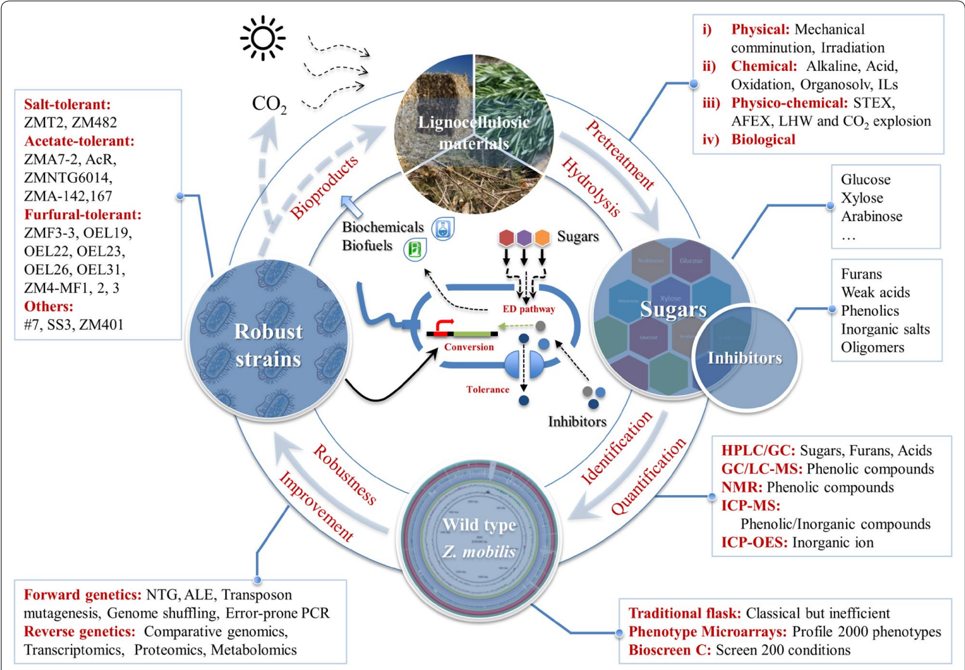
Pretreatment is the key step to overcome the recalcitrance of lignocellulosic biomass making sugars available for subsequent enzymatic hydrolysis and microbial fermentation. During the process of pretreatment and enzymatic hydrolysis as well as fermentation, various toxic compounds may be generated with strong inhibition on cell growth and the metabolic capacity of fermenting strains. Zymomonas mobilis is a natural ethanologenic bacterium with many desirable industrial characteristics, but it can also be severely affected by lignocellulosic hydrolysate inhibitors. In this review, analytical methods to identify and quantify potential inhibitory compounds generated during lignocellulose pretreatment and enzymatic hydrolysis were discussed. The effect of hydrolysate inhibitors on Z. mobilis was also summarized as well as corresponding approaches especially the high-throughput ones for the evaluation. Then the strategies to enhance inhibitor tolerance of Z. mobilis were presented, which include both forward and reverse genetics approaches such as classical and novel mutagenesis approaches, adaptive laboratory evolution, as well as genetic and metabolic engineering. Moreover, this review provided perspectives and guidelines for future developments of robust strains for efficient bioethanol or biochemical production from lignocellulosic materials.
Overview
The claims and statistics of this paper haven’t been checked yet.
Free: it reads the open-access text and checks the first 5 claims that cite a source we can check. Create a free account to check every claim.
Integrity signals
Registry
Cites
Statistics
Figures
Verification
Claims the paper makes
The claims and statistics of this paper haven’t been checked yet.
Free: it reads the open-access text and checks the first 5 claims that cite a source we can check. Create a free account to check every claim.
Claims other papers make about this one
Each is checked against this paper’s own text: does it say what the citing paper says it does?
The check wasn’t confident either way, so it gives no verdict — never disputed.
In the citing paper
“Of the 1,890 protein-coding genes in the Z. mobilis ZM4 genome (4, 16), we quantified the relative abundances of 1,107 proteins.”
From Physiological and metabolic responses of Zymomonas mobilis to lignocellulosic hydrolysate (2025) · cites this paper as [4]
Experimental — accuracy not yet measured
Self-check
Percentages, sums and reported differences re-computed from the paper’s own numbers.
The self-check needs the paper’s full text.
Citations
Cites
Hydrolysis of lignocellulosic materials for ethanol production: a review
Sun, Y., & Cheng, J. (2002) · Bioresource Technology · doi:10.1016/s0960-8524(01)00212-7 · Cited by 6,070 · cited 2×
“Identification and quantification of inhibitors in lignocellulosic hydrolysate Lignocellulose consists of three major polymerized components of cellulose, hemicellulose, and lignin, which are joined together with complex covalent bond, and difficult for microbial digestion (Sun and Cheng 2002).”
BackgroundKlinke, H. B., Thomsen, A. B., & Ahring, B. K. (2004) · Applied Microbiology and Biotechnology · doi:10.1007/s00253-004-1642-2 · Cited by 1,484
Bioconversion of lignocellulose: inhibitors and detoxification
Jönsson, L. J., Alriksson, B., & Nilvebrant, N.-O. (2013) · Biotechnology for Biofuels · doi:10.1186/1754-6834-6-16 · Cited by 1,382
Almeida, J. R., Modig, T., Petersson, A., Hähn‐Hägerdal, B., Lidén, G., & Gorwa‐Grauslund, M. F. (2007) · Journal of Chemical Technology & Biotechnology · doi:10.1002/jctb.1676 · Cited by 987
The role of pretreatment in improving the enzymatic hydrolysis of lignocellulosic materials
Sun, S., Sun, S., Cao, X., & Sun, R. (2016) · Bioresource Technology · doi:10.1016/j.biortech.2015.08.061 · Cited by 966
Adaptive laboratory evolution—Principles and applications for biotechnology
Dragosits, M., & Mattanovich, D. (2013) · Microbial Cell Factories · doi:10.1186/1475-2859-12-64 · Cited by 827 · cited 1×
“2011), as long as the desired trait can be coupled with growth or other easily detectable phenotypes (Dragosits and Mattanovich 2013).”
BackgroundFermentation of lignocellulosic hydrolysates for ethanol production
Olsson, L., & Hahn-Hägerdal, B. (1996) · Enzyme and Microbial Technology · doi:10.1016/0141-0229(95)00157-3 · Cited by 783 · cited 1×
“Several microorganisms have been applied for ethanol production from lignocellulose, including both bacteria and yeasts (Olsson and Hahn-Hägerdal 1996).”
MethodMetabolic Engineering of a Pentose Metabolism Pathway in Ethanologenic Zymomonas mobilis
Zhang, M., Eddy, C., Deanda, K., Finkelstein, M., & Picataggio, S. (1995) · Science · doi:10.1126/science.267.5195.240 · Cited by 716 · cited 1×
“2012; Zhang and Eddy 1995), all these strains were sensitive to inhibitor stress, especially for the xylose utilization (Kim et al.”
BackgroundLee, H., Popodi, E., Tang, H., & Foster, P. L. (2012) · Proceedings of the National Academy of Sciences · doi:10.1073/pnas.1210309109 · Cited by 681
Delgenes, J. P., Moletta, R., & Navarro, J. M. (1996) · Enzyme and Microbial Technology · doi:10.1016/0141-0229(95)00237-5 · Cited by 528
Cited by
Inhibitor formation and detoxification during lignocellulose biorefinery: A review
Guo, H., Zhao, Y., Chang, J.-S., & Lee, D.-J. (2022) · Bioresource Technology · doi:10.1016/j.biortech.2022.127666 · Cited by 174
Joshi, A., VERMA, K. K., Rajput, V. D., Minkina, T., & Arora, J. (2022) · Bioengineered · doi:10.1080/21655979.2022.2051856 · Cited by 139
“mobilis engineering have also enabled several strains to tolerate furfural and acetic acids, which are the predominant toxic inhibitors during lignocellulosic ethanol production [92,93].”
BackgroundYang, Y., Shen, W., Huang, J. W., Li, R., Xiao, Y., Wei, H., Chou, Y., Zhang, M., Himmel, M. E., Chen, S., et al. (2019) · Biotechnology for Biofuels · doi:10.1186/s13068-019-1399-6 · Cited by 115
Self-citationRecent progress in adaptive laboratory evolution of industrial microorganisms
Wang, G., Li, Q., Zhang, Z., Yin, X., Wang, B., & Yang, X. (2022) · Journal of Industrial Microbiology & Biotechnology · doi:10.1093/jimb/kuac023 · Cited by 128
Metabolic engineering of Zymomonas mobilis for anaerobic isobutanol production
Qiu, M., Shen, W., Yan, X., He, Q., Cai, D., Chen, S., Wei, H., Knoshaug, E. P., Zhang, M., Himmel, M. E., et al. (2020) · Biotechnology for Biofuels · doi:10.1186/s13068-020-1654-x · Cited by 90
Self-citationZabed, H. M., Akter, S., Yun, J., Zhang, G., Zhao, M., Mofijur, M., Awasthi, M. K., Kalam, M. A., Ragauskas, A. J., & Qi, X. (2023) · Journal of Cleaner Production · doi:10.1016/j.jclepro.2023.136699 · Cited by 90
Zhang, K., Lu, X., Li, Y., Jiang, X., Liu, L., & Wang, H. (2019) · Applied Microbiology and Biotechnology · doi:10.1007/s00253-019-09620-6 · Cited by 83
Dessie, W., Xin, F., Zhang, W., Zhou, J., Wu, H., Ma, J., & Jiang, M. (2019) · Biochemical Engineering Journal · doi:10.1016/j.bej.2019.107263 · Cited by 73
Valorization of Waste Biomass in Fermentative Production of Cellulases: A Review
Verma, N., Kumar, V., & Bansal, M. C. (2020) · Waste and Biomass Valorization · doi:10.1007/s12649-020-01048-8 · Cited by 61
Yan, X., Bao, W., Wu, Y.-L., Zhang, C.-Y., Mao, Z.-T., Yuan, Q.-Q., Hu, Z., He, P., Peng, Q., Hu, M., et al. (2024) · Nature Communications · doi:10.1038/s41467-024-54897-5 · Cited by 40
Self-citationPaes, B. G., Steindorff, A. S., Formighieri, E. F., Silva-Pereira, I., & de Almeida, J. R. M. (2021) · AMB Express · doi:10.1186/s13568-020-01170-9 · Cited by 48
Yang, S., Franden, M. A., Yang, Q., Chou, Y., Zhang, M., & Pienkos, P. T. (2018) · Frontiers in Bioengineering and Biotechnology · doi:10.3389/fbioe.2018.00023 · Cited by 37
“The detailed features as well as advantages and disadvantages of different pretreatment methods have been extensively reviewed previously and will not discussed in detail here (Baral et al., 2014; Silveira et al., 2015; Capolupo and Faraco, 2016; Jonsson and Martin, 2016; Sun et al., 2016; Yang et al., 2018).”
MethodSelf-citationLi, Y., Zhai, R., Jiang, X., Chen, X., Yuan, X., Liu, Z., & Jin, M. (2019) · Frontiers in Microbiology · doi:10.3389/fmicb.2019.02316 · Cited by 34
Li, R., Jin, M., Du, J., Li, M., Chen, S., & Yang, S. (2020) · Frontiers in Bioengineering and Biotechnology · doi:10.3389/fbioe.2020.00957 · Cited by 36
Self-citationYan, X., Wang, X., Yang, Y., Wang, Z., Zhang, H., Li, Y., He, Q., Li, M., & Yang, S. (2022) · Bioresource Technology · doi:10.1016/j.biortech.2022.126878 · Cited by 33
Self-citationNguyen, D. T. T., Praveen, P., & Loh, K. (2018) · Biochemical Engineering Journal · doi:10.1016/j.bej.2018.09.003 · Cited by 30
Zheng, Y., Kong, S., Luo, S., Chen, C., Cui, Z., Sun, X. H., Chen, T., & Wang, Z. (2022) · ACS Sustainable Chemistry & Engineering · doi:10.1021/acssuschemeng.1c05783 · Cited by 30
Yang, S., Franden, M. A., Wang, X., Chou, Y., Hu, Y. F., Brown, S. D., Pienkos, P. T., & Zhang, M. (2020) · Frontiers in Microbiology · doi:10.3389/fmicb.2020.00013 · Cited by 27
Self-citationLi, R., Shen, W., Yang, Y., Du, J. C., Li, M., & Yang, S. (2021) · Biotechnology for Biofuels · doi:10.1186/s13068-021-02000-1 · Cited by 31
Self-citationGenetic Diversity for Accelerating Microbial Adaptive Laboratory Evolution
Zheng, Y., Hong, K., Wang, B., Liu, D., Chen, T., & Wang, Z. (2021) · ACS Synthetic Biology · doi:10.1021/acssynbio.0c00589 · Cited by 28
Dias, B., Fernandes, H., Lopes, M., & Belo, I. (2023) · Applied Microbiology and Biotechnology · doi:10.1007/s00253-023-12565-6 · Cited by 27
Bao, W., Shen, W., Peng, Q., Du, J. C., & Yang, S. (2023) · Fermentation · doi:10.3390/fermentation9020113 · Cited by 22
Self-citationMicrobial tolerance engineering for boosting lactic acid production from lignocellulose
Shan, W., Yan, Y., Li, Y., Hu, W., & Chen, J. (2023) · Biotechnology for Biofuels and Bioproducts · doi:10.1186/s13068-023-02334-y · Cited by 24
“These inhibitors can adversely affect microbial cell viability, decrease feedstock conversion efficiency and increase production costs [14, 15].”
BackgroundMetabolic engineering of microorganisms in advancing biofuel production
Joshi, A., VERMA, K. K., Rajput, V. D., & Arora, J. (2023) · Elsevier eBooks · doi:10.1016/b978-0-323-91192-4.00016-x · Cited by 22
Microbial conversion of waste biomass into bioethanol: current challenges and future prospects
Verma, N., & Kumar, V. (2021) · Biomass Conversion and Biorefinery · doi:10.1007/s13399-021-01824-z · Cited by 27
Geng, B., Liu, S., Chen, Y., Wu, Y., Wang, Y., Zhou, X., Li, H., Li, M., & Yang, S. (2022) · Frontiers in Bioengineering and Biotechnology · doi:10.3389/fbioe.2022.1110513 · Cited by 19
Self-citationBehrendt, G., Frohwitter, J., Vlachonikolou, M., Klamt, S., & Bettenbrock, K. (2022) · ACS Synthetic Biology · doi:10.1021/acssynbio.2c00428 · Cited by 22
Asefi, S., Nouri, H., Pourmohammadi, G., & Moghimi, H. (2024) · Microbial Cell Factories · doi:10.1186/s12934-024-02459-1 · Cited by 22
“The accumulation of these compounds in the growth culture produces a stress state for the microorganisms that impedes their activity by reducing growth rate, decreasing bioethanol production, inhibiting metabolic enzymes, and altering cell components and transcription levels [36, 37].”
BackgroundMethodAlshehri, M. A., & Pugazhendhi, A. (2024) · Journal of Hazardous Materials Advances · doi:10.1016/j.hazadv.2024.100504 · Cited by 54
Sugarcane Industry By-Products: A Decade of Research Using Biotechnological Approaches
Pérez-Contreras, S., Hernández‐Rosas, F., Jiménez, M. A. L., Herrera‐Corredor, J. A., Baltazar-Bernal, O., la Cruz, D. A. A.-D., & Hernández-Martínez, R. (2025) · Recycling · doi:10.3390/recycling10040154 · Cited by 27
“…through adaptive laboratory evolution, membrane engineering, and the overexpression of detoxification genes to tolerate inhibitors such as furfural, HMF, acetic acid, and phenolic compounds—common by-products in lignocellulosic hydrolysates (Wang et al. (2018) [124], Yang et al. (2018) [125]).”
Tang, Y., Wang, Y., Yang, Q., Zhang, Y., Wu, Y., Yang, Y., Mei, M., He, M., Wang, X., & Yang, S. (2022) · Frontiers in Bioengineering and Biotechnology · doi:10.3389/fbioe.2022.1098021 · Cited by 17
Self-citationYang, Y., Rong, Z., Song, H., Yang, X., Li, M., & Yang, S. (2019) · Biotechnology and Applied Biochemistry · doi:10.1002/bab.1838 · Cited by 17
Self-citationNouri, H., Moghimi, H., Marashi, S., & Elahi, E. (2020) · PLoS ONE · doi:10.1371/journal.pone.0240330 · Cited by 19
Kaewchana, A., Techaparin, A., Boonchot, N., Thanonkeo, P., & Klanrit, P. (2021) · Applied Microbiology and Biotechnology · doi:10.1007/s00253-021-11686-0 · Cited by 16
Rivera Vazquez, J., Trujillo, E., Williams, J., She, F., Getahun, F., Callaghan, M. M., Coon, J. J., & Amador-Noguez, D. (2024) · Biotechnology for Biofuels and Bioproducts · doi:10.1186/s13068-023-02450-9 · Cited by 13
Singh, P., Gangwar, P., Kumar, N., & Ghosh, S. (2024) · Process Safety and Environmental Protection · doi:10.1016/j.psep.2024.11.047 · Cited by 12
Conversion of Rice straw to caprylic acid-rich microbial oils by oleaginous yeast isolates
Diwan, B., & Gupta, P. (2020) · Biomass Conversion and Biorefinery · doi:10.1007/s13399-020-01039-8 · Cited by 11
Pongcharoen, P., Tawong, W., & Kucharoenpsaibul, S. (2021) · ScienceAsia · doi:10.2306/scienceasia1513-1874.2021.009 · Cited by 11
Challenges in Bioethanol Production: Effect of Inhibitory Compounds
Kausar, F., Irfan, M. I., Shakir, H. A., Khan, M. N., Ali, S., & Franco, M. (2021) · Clean Energy Production Technologies · doi:10.1007/978-981-33-4611-6_5 · Cited by 11
Ciamponi, F. E., Procópio, D. P., Murad, N. F., Franco, T. T., Basso, T. O., & Brandão, M. M. (2022) · Scientific Reports · doi:10.1038/s41598-022-26843-2 · Cited by 12
Metabolic Remodeling during Nitrogen Fixation in Zymomonas mobilis
Martien, J. I., Trujillo, E. A., Jacobson, T. B., Tatli, M., Hebert, A. S., Stevenson, D. M., Coon, J. J., & Amador‐Noguez, D. (2021) · mSystems · doi:10.1128/msystems.00987-21 · Cited by 15
Molecular mechanism of engineered Zymomonas mobilis to furfural and acetic acid stress
Shabbir, S., Wang, W., Nawaz, M., Boruah, P., Kulyar, M. F., Chen, M., Wu, B., Liu, P., Dai, Y., Sun, L., et al. (2023) · Microbial Cell Factories · doi:10.1186/s12934-023-02095-1 · Cited by 9
Kumar, K., Siddiqa, A., Pragati, Chandane, P., Yadav, S., Kori, M., Shivram, A., Barbora, L., & Moholkar, V. S. (2022) · bioRxiv (Cold Spring Harbor Laboratory) · doi:10.1101/2022.11.19.517192 · Cited by 7
“6 Among various organic compounds produced during acid hydrolysis of LB, 10 compounds were identified as inhibitors of bacterial cell growth and enzymes in solventogenic pathway of metabolism (Baral and Shah, 2014; Kim, 2018; Yang et al., 2018).”
BackgroundCharoenpunthuwong, K., Klanrit, P., Chamnipa, N., Thanonkeo, P., Yamada, M. C., & Thanonkeo, P. (2023) · Energies · doi:10.3390/en16145284 · Cited by 8
Shrivastava, A., & Sharma, R. K. (2023) · BioEnergy Research · doi:10.1007/s12155-023-10609-3 · Cited by 4
Physiological and metabolic responses of Zymomonas mobilis to lignocellulosic hydrolysate
Rivera Vazquez, J., Trujillo, E., Wenger, Z., Botts, M., Coon, J. J., & Amador-Noguez, D. (2025) · Microbiology Spectrum · doi:10.1128/spectrum.00610-25 · Cited by 3
Padmapriya, G., Dhivya, V., Vishal, M., Roshni, Y. A. J., Akila, T., & Ramalingam, S. (2021) · Journal of Environmental Biology · doi:10.22438/jeb/42/5/mrn-1812 · Cited by 3
Kumar, V., Mishra, S., Joshi, P., Misra, J. P., Yegneswaran, P. P., Bhavanari, M., Yazdani, S. S., & Lal, P. B. (2026) · Bioresources and Bioprocessing · doi:10.1186/s40643-026-01081-w · Cited by 3
Verma, N., Kumar, V., & Bansal, M. C. (2019) · Waste Disposal & Sustainable Energy · doi:10.1007/s42768-019-00019-7 · Cited by 2
Li, R., Jin, M., Du, J. C., Chen, S., & Yang, S. (2020) · doi:10.21203/rs.2.21812/v1 · Cited by 2
Self-citationHuang, Y., Wang, X., Chen, M., Wu, Y., Todhanakasem, T., Peng, N., He, M., & Wu, B. (2025) · Bioresource Technology · doi:10.1016/j.biortech.2025.133198 · Cited by 3
Self-citationTechnological Advances in Synthetic Biology for Cellulosic Ethanol Production
Fantinel, A. L., Margis, R., Talamini, E., & Dewes, H. (2021) · IntechOpen eBooks · doi:10.5772/intechopen.100292 · Cited by 2
Ciamponi, F. E., Procópio, D. P., Murad, N. F., Franco, T. T., Basso, T. O., & Brandão, M. M. (2022) · Research Square · doi:10.21203/rs.3.rs-2113307/v1
Pragati (2024) · SSRN Electronic Journal · doi:10.2139/ssrn.4864585
Li, R., Shen, W., Yang, Y., Du, J., Li, M., & Yang, S. (2021) · Figshare · doi:10.6084/m9.figshare.14863499
Self-citationVazquez, J. C. R., Trujillo, E. A., Williams, J., She, F., Getahun, F., Callaghan, M. M., Coon, J. J., & Amador‐Noguez, D. (2024) · Figshare · doi:10.6084/m9.figshare.26673711
Vazquez, J. C. R., Trujillo, E. A., Williams, J., She, F., Getahun, F., Callaghan, M. M., Coon, J. J., & Amador‐Noguez, D. (2024) · Figshare · doi:10.6084/m9.figshare.26673741
Li, R., Shen, W., Yang, Y., Du, J., Li, M., & Yang, S. (2021) · Figshare · doi:10.6084/m9.figshare.14863493
Self-citationVazquez, J. C. R., Trujillo, E. A., Williams, J., She, F., Getahun, F., Callaghan, M. M., Coon, J. J., & Amador‐Noguez, D. (2024) · Figshare · doi:10.6084/m9.figshare.26673717
Shabbir, S., Wang, W., Nawaz, M., Boruah, P., Kulyar, M. F., Chen, M., Wu, B., Liu, P., Dai, Y., Sun, L., et al. (2023) · Figshare · doi:10.6084/m9.figshare.22729166
Li, R., Shen, W., Yang, Y., Du, J., Li, M., & Yang, S. (2021) · Figshare · doi:10.6084/m9.figshare.14863502
Self-citationVazquez, J. C. R., Trujillo, E. A., Williams, J., She, F., Getahun, F., Callaghan, M. M., Coon, J. J., & Amador‐Noguez, D. (2024) · Figshare · doi:10.6084/m9.figshare.26673732
Li, R., Shen, W., Yang, Y., Du, J., Li, M., & Yang, S. (2021) · Figshare · doi:10.6084/m9.figshare.14863505
Self-citationVazquez, J. C. R., Trujillo, E. A., Williams, J., She, F., Getahun, F., Callaghan, M. M., Coon, J. J., & Amador‐Noguez, D. (2024) · Figshare · doi:10.6084/m9.figshare.26673714
Vazquez, J. C. R., Trujillo, E. A., Williams, J., She, F., Getahun, F., Callaghan, M. M., Coon, J. J., & Amador‐Noguez, D. (2024) · Figshare · doi:10.6084/m9.figshare.26673723
Vazquez, J. C. R., Trujillo, E. A., Williams, J., She, F., Getahun, F., Callaghan, M. M., Coon, J. J., & Amador‐Noguez, D. (2024) · Figshare · doi:10.6084/m9.figshare.26673720
Li, R., Shen, W., Yang, Y., Du, J., Li, M., & Yang, S. (2021) · Figshare · doi:10.6084/m9.figshare.14863496
Self-citationDual reporter gene system with Pgap
杨永富 (2021) · China National GeneBank DataBase · doi:10.26036/cnp0001677
Metadata
- Authors
- Yang, Y., Hu, M., Tang, Y., Geng, B., Qiu, M., He, Q., Chen, S., Wang, X., & Yang, S.
- Affiliations
- Hubei University (CN)
- Corresponding author
- Wang, Xia
- Yang, Shihui
- Venue
- Bioresources and Bioprocessing
- Published
- 2018-02-09
- Volume
- 5
- Issue
- 1
- ISSN
- 2197-4365 (ISSN-L)
- OpenAlex
- W2794580877
- Cited by
- 60
- References
- 105
- Citations by year
- 2026: 1 · 2025: 3 · 2024: 6 · 2023: 9 · 2022: 11 · 2021: 15 · 2020: 7 · 2019: 6 · 2018: 2
- FWCI
- 3.10
- Type
- journal article
- Language
- en
- Open access
- gold
- doi.org
- Licence
- cc-by
- creativecommons.org/licenses/by/4.0 (tdm)
- Locations
- Bioresources and Bioprocessing (publishedVersion, cc-by)
- DOAJ (DOAJ: Directory of Open Access Journals) (submittedVersion, cc-by-sa)
- Topics
- Physical Sciences › Engineering › Biomedical Engineering › Biofuel production and bioconversion
- Life Sciences › Biochemistry, Genetics and Molecular Biology › Molecular Biology › Microbial Metabolic Engineering and Bioproduction
- Physical Sciences › Energy › Renewable Energy, Sustainability and the Environment › Anaerobic Digestion and Biogas Production
- Keywords
- Zymomonas mobilis, lignocellulosic hydrolysates, inhibitor tolerance, lignocellulosic biomass pretreatment, enzymatic hydrolysis, inhibitors, bioethanol production, adaptive laboratory evolution, mutagenesis, genetic engineering, metabolic engineering, high-throughput screening, bio-based chemicals
About these checks
Registry, retraction, Cites and statistics results are computed, not judged, with one exception: a printed reference that no index lists is read once by a model before it counts as a citation error. Claims are extracted by a model and kept only when their quote appears verbatim in the text; each cited source is then checked, with a model’s help, for whether it says what the claim relies on. Those verdicts can be wrong — read the claim’s quote and the cited source before relying on one.
Statistics and arithmetic are recomputed, not judged.
Confidence bands are shown only for fields calibrated on our annotated test set. None is calibrated yet, so no band is shown.
What counts as a claim ›How we measure confidence ›How we check this ›
Are you an author, or do you see a problem with this page? Request a review
Data sources
Bibliographic data: Semantic Scholar, OpenAlex, Crossref.
Contains information from the Semantic Scholar Academic Graph Datasets, made available under the ODC Attribution License (ODC-BY 1.0).
Semantic Scholar’s data is described in: Kinney, R., et al. (2023). The Semantic Scholar Open Data Platform. arXiv:2301.10140.
