

The DOI matches its Crossref record; 123 of the 123 references it cites were found in a registry or an index.
Graph convolutional networks: a comprehensive review
Open accessAbstract
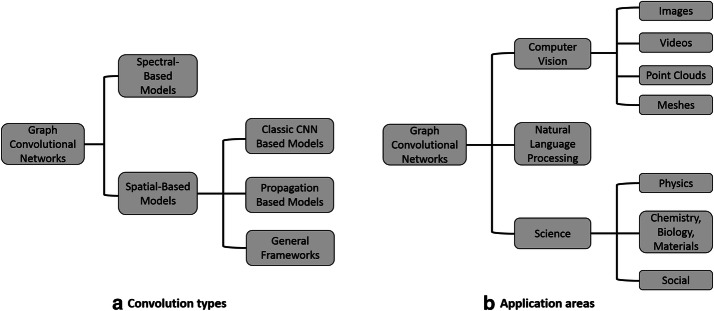
Graphs naturally appear in numerous application domains, ranging from social analysis, bioinformatics to computer vision. The unique capability of graphs enables capturing the structural relations among data, and thus allows to harvest more insights compared to analyzing data in isolation. However, it is often very challenging to solve the learning problems on graphs, because (1) many types of data are not originally structured as graphs, such as images and text data, and (2) for graph-structured data, the underlying connectivity patterns are often complex and diverse. On the other hand, the representation learning has achieved great successes in many areas. Thereby, a potential solution is to learn the representation of graphs in a low-dimensional Euclidean space, such that the graph properties can be preserved. Although tremendous efforts have been made to address the graph representation learning problem, many of them still suffer from their shallow learning mechanisms. Deep learning models on graphs (e.g., graph neural networks) have recently emerged in machine learning and other related areas, and demonstrated the superior performance in various problems. In this survey, despite numerous types of graph neural networks, we conduct a comprehensive review specifically on the emerging field of graph convolutional networks, which is one of the most prominent graph deep learning models. First, we group the existing graph convolutional network models into two categories based on the types of convolutions and highlight some graph convolutional network models in details. Then, we categorize different graph convolutional networks according to the areas of their applications. Finally, we present several open challenges in this area and discuss potential directions for future research.
Overview
The claims and statistics of this paper haven’t been checked yet.
Run the check — free, no account needed. It reads the open-access text and checks the sources it cites.
Integrity signals
Registry
Cites
Statistics
Figures
Verification
Claims the paper makes
The claims and statistics of this paper haven’t been checked yet.
Run the check — free, no account needed. It reads the open-access text and checks the sources it cites.
Claims other papers make about this one
Each is checked against this paper’s own text: does it say what the citing paper says it does?
The cited source says what the claim attributes to it.
In the citing paper
“The introduction of graph convolutional network (GCN) has enabled GNNs to learn the latent representations of target datasets with a convolution procedure [65].”
From Challenges in AI-driven Biomedical Multimodal Data Fusion and Analysis (2025) · cites this paper as [65]
Self-check
Percentages, sums and reported differences re-computed from the paper’s own numbers.
The self-check needs the paper’s full text.
Citations
Cites
Deep Residual Learning for Image Recognition
He, K., Zhang, X., Ren, S., & Sun, J. (2016) · 2016 IEEE Conference on Computer Vision and Pattern Recognition (CVPR) · doi:10.1109/cvpr.2016.90 · Cited by 235,474
Very Deep Convolutional Networks for Large-Scale Image Recognition
Simonyan, K., & Zisserman, A. (2014) · arXiv · doi:10.48550/arxiv.1409.1556 · Cited by 114,148
ImageNet classification with deep convolutional neural networks
Krizhevsky, A., Sutskever, I., & Hinton, G. E. (2017) · Communications of the ACM · doi:10.1145/3065386 · Cited by 112,155
Fully convolutional networks for semantic segmentation
Long, J., Shelhamer, E., & Darrell, T. (2015) · 2015 IEEE Conference on Computer Vision and Pattern Recognition (CVPR) · doi:10.1109/cvpr.2015.7298965 · Cited by 38,834
Rich Feature Hierarchies for Accurate Object Detection and Semantic Segmentation
Girshick, R., Donahue, J., Darrell, T., & Malik, J. (2014) · 2014 IEEE Conference on Computer Vision and Pattern Recognition · doi:10.1109/cvpr.2014.81 · Cited by 32,684
Girshick, R. (2015) · 2015 IEEE International Conference on Computer Vision (ICCV) · doi:10.1109/iccv.2015.169 · Cited by 28,105
Semi-supervised classification with graph convolutional networks
Kipf, T. N., & Welling, M. (2016) · arXiv · doi:10.48550/arxiv.1609.02907 · Cited by 24,853
Chen, L.-C., Papandreou, G., Kokkinos, I., Murphy, K., & Yuille, A. L. (2018) · IEEE Transactions on Pattern Analysis and Machine Intelligence · doi:10.1109/tpami.2017.2699184 · Cited by 22,392
Chen, L.-C., Papandreou, G., Kokkinos, I., Murphy, K., & Yuille, A. L. (2016) · arXiv · doi:10.48550/arxiv.1606.00915 · Cited by 22,392
Advances in neural information processing systems 7
Cios, K. J., & Shields, M. E. (1997) · Neurocomputing · doi:10.1016/s0925-2312(97)90018-7 · Cited by 22,093
Research works printed but not linked: 17
- You J, Ying R, Ren X, Hamilton WL, Leskovec J. Graphrnn: a deep generative model for graphs. 2018. arXiv preprint arXiv:1802.08773 · arXiv
- Lee JB, Rossi RA, Kim S, Ahmed NK, Koh E. Attention models in graphs: a survey. 2018. arXiv preprint arXiv:1807.07984 · arXiv
- Bruna J, Zaremba W, Szlam A, LeCun Y. Spectral networks and locally connected networks on graphs. 2013. arXiv preprint arXiv:1312.6203 · arXiv
- Defferrard M, Bresson X, Vandergheynst P. Convolutional neural networks on graphs with fast localized spectral filtering. In: NIPS. 2016. p. 3844–52.
- Huang W, Zhang T, Rong Y, Huang J. Adaptive sampling towards fast graph representation learning. In: Advances in neural information processing systems. 2018. p. 4563–72.
- Xu B, Shen H, Cao Q, Qiu Y, Cheng X. Graph wavelet neural network. In: International conference on learning representations. 2019. https://openreview.net/forum?id=H1ewdiR5tQ .
- Chang J, Gu J, Wang L, Meng G, Xiang S, Pan C. Structure-aware convolutional neural networks. In: Advances in neural information processing systems. 2018. p. 11–20.
- Xu K, Li C, Tian, Y, Sonobe, T, Kawarabayashi K.-i, Jegelka S. Representation learning on graphs with jumping knowledge networks. 2018. arXiv preprint arXiv:1806.03536 · arXiv
- Dai H, Kozareva Z, Dai B, Smola A, Song L. Learning steady-states of iterative algorithms over graphs. In: International conference on machine learning. 2018. p. 1114–22.
- Xu K, Hu W, Leskovec J, Jegelka S. How powerful are graph neural networks? 2018. arXiv preprint arXiv:1810.00826 · arXiv
- Gao X, Hu W, Tang J, Pan P, Liu J, Guo Z. Generalized graph convolutional networks for skeleton-based action recognition. 2018. arXiv preprint arXiv:1811.12013 . · arXiv
- Zhang T, Zheng W, Cui Z, Li Y. Tensor graph convolutional neural network. 2018; arXiv preprint arXiv:1803.10071 · arXiv
- Wang P-S, Liu Y, Guo Y-X, Sun C-Y, Tong X. O-cnn: octree-based convolutional neural networks for 3d shape analysis. ACM Trans Graph (TOG). 2017;36(4):72.
- Bastings J, Titov I, Aziz W, Marcheggiani D, Sima’an K. Graph convolutional encoders for syntax-aware neural machine translation. 2017. arXiv preprint arXiv:1704.04675 · DOI · Paper page
- Fout A, Byrd J, Shariat B, Ben-Hur A. Protein interface prediction using graph convolutional networks. In: Advances in neural information processing systems. 2017. p. 6530–9.
- Harada S, Akita H, Tsubaki M, Baba Y, Takigawa I, Yamanishi Y, Kashima H. Dual convolutional neural network for graph of graphs link prediction. 2018. arXiv preprint arXiv:1810.02080 · arXiv
- Chen J, Xu X, Wu Y, Zheng H. Gc-lstm: graph convolution embedded lstm for dynamic link prediction. 2018. arXiv preprint arXiv:1812.04206 · arXiv
Cited by
Sorted by citations
Items 1,001–1,001 of 1,001
Clustering of Temporal and Visual Data: Recent Advancements
Mudgal, P. (2026) · Data · doi:10.3390/data11010007 · Cited by 2
Metadata
- Authors
- Zhang, S., Tong, H., Xu, J., & Maciejewski, R.
- Affiliations
- University of Illinois Urbana-Champaign (US)
- HRL Laboratories (United States) (US)
- Arizona State University (US)
- Corresponding author
- Zhang, Si
- Venue
- Computational Social Networks
- Published
- 2019-11-10
- Volume
- 6
- Issue
- 1
- Pages
- 11-11
- ISSN
- 2197-4314 (ISSN-L)
- PMC
- PMC10615927
- OpenAlex
- W2985331920
- Cited by
- 1,888
- References
- 123
- Citations by year
- 2026: 271 · 2025: 544 · 2024: 434 · 2023: 308 · 2022: 182 · 2021: 96 · 2020: 52
- FWCI
- 37.64
- Type
- journal article
- Language
- en
- Open access
- hybrid
- doi.org
- Locations
- Computational Social Networks (publishedVersion, cc-by)
- PubMed Central (publishedVersion, cc-by)
- PubMed (publishedVersion)
- DOAJ (DOAJ: Directory of Open Access Journals) (submittedVersion)
- Funders
- National Science Foundation (IIS-1651203, IIS-1715385, IIS-1743040, CNS-1629888)
- Defense Threat Reduction Agency (HDTRA1-16-0017)
- United States Air Force and DARPA (FA8750-17-C-0153)
- Army Research Office (W911NF-16-1-0168)
- U.S. Department of Homeland Security (2017-ST-061-QA0001)
- Topics
- Physical Sciences › Computer Science › Artificial Intelligence › Advanced Graph Neural Networks
- Physical Sciences › Computer Science › Computational Theory and Mathematics › Graph Theory and Algorithms
- Physical Sciences › Physics and Astronomy › Statistical and Nonlinear Physics › Complex Network Analysis Techniques
- Keywords
- graph convolutional networks, graph neural networks, graph-based deep learning, graph representation learning, graph convolution, graph-structured data, open problems
About these checks
Registry, retraction, Cites and statistics results are computed, not judged, with one exception: a printed reference that no index lists is read once by a model before it counts as a citation error. Claims are extracted by a model and kept only when their quote appears verbatim in the text; each cited source is then checked, with a model’s help, for whether it says what the claim relies on. Those verdicts can be wrong — read the claim’s quote and the cited source before relying on one.
Statistics and arithmetic are recomputed, not judged.
Confidence bands are shown only for fields calibrated on our annotated test set. None is calibrated yet, so no band is shown.
What counts as a claim ›How we measure confidence ›How we check this ›
Are you an author, or do you see a problem with this page? Request a review
