

Challenges in AI-driven Biomedical Multimodal Data Fusion and Analysis
Open accessThe DOI matches its Crossref record; 196 of the 197 references it cites were found in a registry or an index; 136 of the 210 sources its claims cite were checked for support.
Abstract
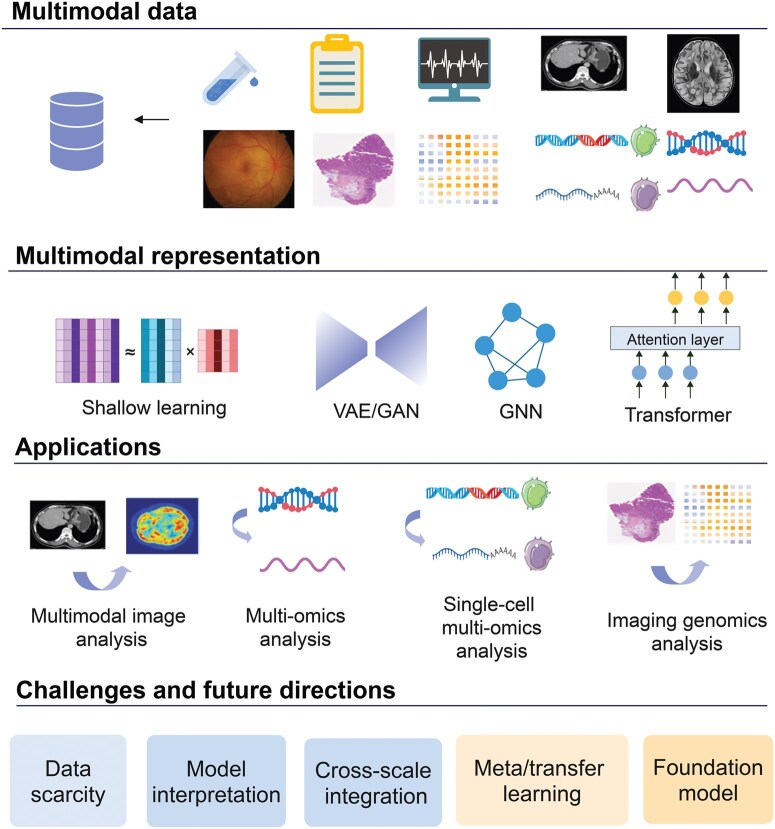
The rapid development of biological and medical examination methods has vastly expanded personal biomedical information, including molecular, cellular, image, and electronic health record datasets. Integrating this wealth of information enables precise disease diagnosis, biomarker identification, and treatment design in clinical settings. Artificial intelligence (AI) techniques, particularly deep learning models, have been extensively employed in biomedical applications, demonstrating increased precision, efficiency, and generalization. The success of the large language and vision models further significantly extends their biomedical applications. However, challenges remain in learning these multimodal biomedical datasets, such as data privacy, fusion, and model interpretation. In this review, we provide a comprehensive overview of various biomedical data modalities, multimodal representation learning methods, and the applications of AI in biomedical data integrative analysis. Additionally, we discuss the challenges in applying these deep learning methods and how to better integrate them into biomedical scenarios. We then propose future directions for adapting deep learning methods with model pretraining and knowledge integration to advance biomedical research and benefit their clinical applications.
Overview
CoChat Summary
TL;DR
This review surveys AI-driven multimodal biomedical data fusion, covering data modalities, representation learning methods, applications, challenges, and future directions. It argues that privacy, incomplete data, interpretation, and cross-scale integration remain key barriers, and highlights meta/transfer learning and foundation models as promising directions.
Key findings
- The review categorizes biomedical multimodal data into numeric, image, text, and signal data, spanning sequencing, clinical, and experimental sources, and lists representative resources such as TCGA, ICGC, ADNI, UK Biobank, and MedMNIST.
- It summarizes shallow methods (jNMF, PLS, CCA, MKL) and deep representation learning methods (VAE, GAN, GNN, Transformer) for aligning and integrating heterogeneous modalities.
- Applications reviewed include clinical multimodal integration (e.g., WSI + genomics, CT/MRI + genomics), multi-omics analysis, single-cell/spatial analysis, and genotype–phenotype association; the text notes high-throughput single-cell techniques have generated millions of individual cell data points and a NeurIPS competition identified three key tasks.
- Challenges include data privacy/sharing limits, incomplete modalities, model interpretation, and cross-scale integration; future directions include meta/transfer learning, foundation models, and LLM-based knowledge integration.
Methods
- Design: narrative review.
- Data/sample: existing literature and public multimodal biomedical databases/resources; no primary data collection.
- Analysis: thematic synthesis of data modalities, representation learning methods, applications, challenges, and future directions; no systematic search protocol or quantitative meta-analysis stated.
Limitations
- The paper does not explicitly state limitations of this review. It states field-level limitations: data privacy restrictions, incomplete multimodal datasets, limited cohort sizes, difficulty interpreting models, and reliance on predefined pathway annotations.
- Evident from the text: as a narrative review, it lacks a described systematic search strategy, inclusion/exclusion criteria, and quantitative synthesis; examples are illustrative rather than exhaustive.
Model-written summary. Check it against the paper before relying on it.
Integrity signals
Registry
Cites
Statistics
Figures


Verification
Claims the paper makes
110 Valid · 2 Not valid · 52 Not checked · 35 Own results and interpretations
The sources with a verdict support this claim; the rest weren’t checked yet, have no full text we could read, or their verdicts aren’t rated yet.
In the paper
“Self-supervised learning is an important approach for addressing the challenge by fully leveraging the unlabeled data.”
§ Challenges in AI-driven Biomedical Multimodal Data Fusion and Analysis > Challenges in AI-based biomedical multimodal data analysis > Data challenges
What the sources say
- Not checked — no full text of the sourcecites [146] Krishnan, 2022, Self-supervised learning in medicine and healthcare, Nat Biomed Eng source
- Supportedcites [147] Ciga, 2022, Self supervised contrastive learning for digital histopathology, Mach Learn Appl source
The Introduction says labeled data are scarce and expensive, and that self-supervised methods use unlabeled data to mitigate the annotation bottleneck. Section 5.4 also reports better downstream performance when more unlabeled images are used for pretraining. (LLM, conf=0.92)
plainstates a cause- Asserted: passes — The authors put it forward as true.
- Checkable: passes — It can be checked against evidence.
- Load-bearing: unclear — It is unclear whether the paper’s conclusions depend on it.
- Based: passes — The paper gives a reason why it holds.
Every source the paper cites for this claim was checked and supports it.
In the paper
“In digital pathology applications, whole slide images have been used for predicting genomic features [19]”
§ Challenges in AI-driven Biomedical Multimodal Data Fusion and Analysis > Introduction
What the sources say
- Supportedcites [19] Qiao, 2022, Multi-modality artificial intelligence in digital pathology, Brief Bioinform source
The Introduction describes digitized pathology slides as whole slide images (WSIs). The section ‘H&E images integration nucleic acid detection’ reports prediction of gene expression and specific gene mutations from pathology images; its references also include a study of genetic mutation prediction from whole slide images. Page numbers are unavailable in our copy. (LLM, conf=0.91)
plainstates an association- Asserted: passes — The authors put it forward as true.
- Checkable: passes — It can be checked against evidence.
- Load-bearing: unclear — It is unclear whether the paper’s conclusions depend on it.
- Based: passes — The paper gives a reason why it holds.
- Supported
Every source the paper cites for this claim was checked and supports it.
In the paper
“Despite the advancement of multimodal learning in the biomedical field, various challenges can hinder model training and its further applications [1].”
§ Challenges in AI-driven Biomedical Multimodal Data Fusion and Analysis > Introduction
What the sources say
- Supportedcites [1] Acosta, 2022, Multimodal biomedical AI, Nat Med source
The Technical challenges section identifies computational demands and infrastructure as obstacles to building multimodal models. It also says dataset blind spots can hurt real-life prediction and that further innovation is needed for effective multimodal AI, supporting challenges to both model training and application. (LLM, conf=0.93)
plainstates a possible cause- Asserted: passes — The authors put it forward as true.
- Checkable: passes — It can be checked against evidence.
- Load-bearing: passes — The paper’s conclusions depend on it.
- Based: passes — The paper gives a reason why it holds.
- Supported
Every source the paper cites for this claim was checked and supports it.
In the paper
“Additionally, the development of incomplete modal learning enables more flexible and efficient representation learning in multimodal datasets [54,55].”
§ Challenges in AI-driven Biomedical Multimodal Data Fusion and Analysis > Multimodal representation learning methods > Variational autoencoder and generative adversarial network
What the sources say
- Supportedcites [54] Ma, 2021, Smil: multimodal learning with severely missing modality, Proceedings of the 35th AAAI Conference on Artificial Intelligence source
The Proposed Method (p. 2) explicitly sets flexibility and efficiency as goals for learning from incomplete multimodal data. The Introduction (p. 1) describes learning latent embeddings under missing modalities, and the Conclusion (p. 7) reports that SMIL handles varied missing patterns effectively. The paper supports the claim through its specific method. (LLM, conf=0.86)
- Supportedcites [55] Wang, 2024, TMO-Net: an explainable pretrained multi-omics model for multi-task learning in oncology, Genome Biol source
The Results (Model framework; page unavailable) say TMO-Net accommodates incomplete omics data and efficiently aligns latent spaces across modalities. The Discussion (page unavailable) says it efficiently learns joint embeddings from multi-omics inputs despite missing modalities and describes the framework as versatile and adaptable. This supports the claim for multimodal cancer datasets. (LLM, conf=0.88)
plainstates a cause- Asserted: passes — The authors put it forward as true.
- Checkable: passes — It can be checked against evidence.
- Load-bearing: unclear — It is unclear whether the paper’s conclusions depend on it.
- Based: passes — The paper gives a reason why it holds.
- Supported
The cited sources support only part of this claim — read each source’s verdict below.
In the paper
“For functional adaption of VAE into multimodal usage, the mixture of experts (MoE) [51], the product of experts (PoE) [52], and the fusion of MoE and PoE (MoPoE) [53] models were integrated to better infer the joint variational posteriors of the VAE model.”
§ Challenges in AI-driven Biomedical Multimodal Data Fusion and Analysis > Multimodal representation learning methods > Variational autoencoder and generative adversarial network
What the sources say
- Not matchedcites [51] Shi, 2019
Couldn’t be matched to a paper in Crossref, so it can’t be checked.
- Not matchedcites [52] Wu, 2018
Couldn’t be matched to a paper in Crossref, so it can’t be checked.
- Supportedcites [53] Sutter, 2021 source
The Introduction (p. 1) says the proposed MoPoE-VAE models the joint posterior approximation as a mixture of products of experts, encompassing the PoE-based MVAE and MoE-based MMVAE. Section 3.5 (p. 5) explains that it combines PoE and MoE to retain their strengths, supporting the part of the sentence attributed to this paper. (LLM, conf=0.92)
plainstates a cause- Asserted: passes — The authors put it forward as true.
- Checkable: passes — It can be checked against evidence.
- Load-bearing: unclear — It is unclear whether the paper’s conclusions depend on it.
- Based: passes — The paper gives a reason why it holds.
- Not matched
43 more claims · 19 with their cited sources checked
Create a free account to see all 199 claims and to verify the 17 references still open.
- It may state two separate claims as one. 71
- Probably not a substantial claim. 114
Self-check
Percentages, sums and reported differences re-computed from the paper’s own numbers.
Each contradiction between two passages listed here was confirmed by an independent check.
Rated minor: it would not touch a result — a value no result rests on, a p-value that stays on the same side of the significance level, or a conflict that is clerical, resolved elsewhere in the paper, or outside its own findings.
In the paper
§ Challenges in AI-driven Biomedical Multimodal Data Fusion and Analysis > Challenges in AI-based biomedical multimodal data analysis > Data challenges
“Caroline et al. developed a cross-modal analysis method that enables the imputation of hard-to-acquire cardiac MRIs from easy-to-acquire ECG [154].”
§ Challenges in AI-driven Biomedical Multimodal Data Fusion and Analysis > References
“154. Radhakrishnan A, Friedman SF, Khurshid S, Ng K, Batra P, Lubitz SA, et al. Cross-modal autoencoder framework learns holistic representations of cardiovascular state.”
Rated minor: it would not touch a result — a value no result rests on, a p-value that stays on the same side of the significance level, or a conflict that is clerical, resolved elsewhere in the paper, or outside its own findings.
In the paper
§ Challenges in AI-driven Biomedical Multimodal Data Fusion and Analysis > Applications of AI in multimodal biomedical data analysis > Multi-omics data analysis
“Additionally, Froguel et al. introduced a multi-omics variational autoencoders (MOVE) framework for identifying the associations between drug usage and multi-omics data features, helping characterize the drug effects on type 2 diabetes [18].”
§ Challenges in AI-driven Biomedical Multimodal Data Fusion and Analysis > References
“18. Allesøe RL, Lundgaard AT, Hernández Medina R, Aguayo-Orozco A, Johansen J, Nissen JN, et al Discovery of drug-omics associations in type 2 diabetes with generative deep-learning models.”
Citations
Cites
BERT: Pre-training of Deep Bidirectional Transformers for Language Understanding
Devlin, J., Chang, M.-W., Lee, K., & Toutanova, K. (2019) · Proceedings of the 2019 Conference of the North American Chapter of the Association for Computational Linguistics: Human Language Technologies, Volume 1 (Long and Short Papers) · doi:10.18653/v1/n19-1423 · Cited by 54,325
Unpaired image-to-image translation using cycle-consistent adversarial networks
Zhu, J.-Y., Park, T., Isola, P., & Efros, A. A. (2017) · 2017 IEEE International Conference on Computer Vision (ICCV) · doi:10.1109/iccv.2017.244 · Cited by 23,602
Integrative Analysis of Complex Cancer Genomics and Clinical Profiles Using the cBioPortal
Gao, J., Aksoy, B. A., Dogrusoz, U., Dresdner, G., Gross, B., Sumer, S. O., Sun, Y., Jacobsen, A., Sinha, R., Larsson, E., et al. (2013) · Science Signaling · doi:10.1126/scisignal.2004088 · Cited by 15,160
Sudlow, C., Gallacher, J., Allen, N., Beral, V., Burton, P., Danesh, J., Downey, P., Elliott, P., Green, J., Landray, M., et al. (2015) · PLOS Medicine · doi:10.1371/journal.pmed.1001779 · Cited by 12,728 · cited 1×
“…consortium for type 2 diabetes, the Alzheimer’s Disease Neuroimaging Initiative (ADNI) [144] dataset for AD, and other portals like UK Biobank [145] for general digital health records, but the data size of specific cancer types or diseases remains limited, which may impede neural network…”
The graph neural network model
Scarselli, F., Gori, M., Tsoi, A. C., Hagenbuchner, M., & Monfardini, G. (2009) · IEEE Transactions on Neural Networks · doi:10.1109/tnn.2008.2005605 · Cited by 9,582
The genomic and transcriptomic architecture of 2,000 breast tumours reveals novel subgroups
METABRIC Group, Curtis, C., Shah, S. P., Chin, S.-F., Turashvili, G., Rueda, O. M., Dunning, M. J., Speed, D., Lynch, A. G., Samarajiwa, S., et al. (2012) · Nature · doi:10.1038/nature10983 · Cited by 6,097
Deep learning in medical image analysis
Shen, D., Wu, G., & Suk, H.-I. (2017) · Annual Review of Biomedical Engineering · doi:10.1146/annurev-bioeng-071516-044442 · Cited by 4,968
Generative Adversarial Networks: An Overview
Creswell, A., White, T., Dumoulin, V., Arulkumaran, K., Sengupta, B., & Bharath, A. A. (2018) · IEEE Signal Processing Magazine · doi:10.1109/msp.2017.2765202 · Cited by 4,540 · cited 1×
“…the data fusion module was used to learn the cross-modality information, while modality-specific decoders were applied The generative adversarial network (GAN) is another deep generative model for learning the latent representation and producing artificial datasets of the original datasets [58].”
Large language models encode clinical knowledge
Singhal, K., Azizi, S., Tu, T., Mahdavi, S. S., Wei, J., Chung, H. W., Scales, N., Tanwani, A., Cole-Lewis, H., Pfohl, S., et al. (2023) · Nature · doi:10.1038/s41586-023-06291-2 · Cited by 4,083 · cited 1×
“To address these problems, one approach is to combine prompt tuning to enhance LLMs for learning medical knowledge and adaptation for biomedical applications [200]; another approach is to infuse knowledge graphs into the LLMs [201].”
Liu, J., Lichtenberg, T., Hoadley, K. A., Poisson, L. M., Lazar, A. J., Cherniack, A. D., Kovatich, A. J., Benz, C. C., Levine, D. A., Lee, A. V., et al. (2018) · Cell · doi:10.1016/j.cell.2018.02.052 · Cited by 3,725
Self-citation
Cited by
Zubair, M., Hussain, M., Albashrawi, M. A., Bendechache, M., & Owais, M. (2025) · Computer Methods and Programs in Biomedicine · doi:10.1016/j.cmpb.2025.109014 · Cited by 169
Artificial Intelligence in Organoid-Based Disease Modeling: A New Frontier in Precision Medicine
Balkhair, O., & Albalushi, H. (2025) · Biomimetics · doi:10.3390/biomimetics10120845 · Cited by 36
“This is achieved by integrating multimodal datasets including transcriptomic, epigenetic, and spatial data [19].”
Chen, X., Xu, H., Yu, S., Hu, W., Zhang, Z., Wang, X., Yuan, Y., Wang, M., Chen, L., Lin, X., et al. (2025) · Biology · doi:10.3390/biology14060651 · Cited by 23
“In biomedical research, multimodal fusion necessitates balancing cross-modal complementarity with biological specificity [135].”
Cell-free DNA in sepsis: from molecular insights to clinical management
Li, L., Huang, H., He, Y., Pang, J., Xiao, S.-C., Xia, Z., & Zheng, Y. (2025) · Military Medical Research · doi:10.1186/s40779-025-00668-2 · Cited by 22
“However, obstacles including data privacy concerns, limited dataset size, and insufficient model interpretability continue to hinder clinical application [301].”
Li, H., Mo, H., Song, Y., Chen, G. C., Wu, C., & Zhu, F. (2025) · Trends in Food Science & Technology · doi:10.1016/j.tifs.2025.105029 · Cited by 18
Metadata
- Authors
- Liu, J., Cen, X., Yi, C., Wang, F.-A., Ding, J., Cheng, J., Wu, Q., Gai, B., Zhou, Y., He, R., Gao, F., & Li, Y.
- Affiliations
- Guangzhou Laboratory (CN)
- Chinese Academy of Sciences (CN)
- Sun Yat-sen University (CN)
- University of Chinese Academy of Sciences (CN)
- Chinese University of Hong Kong (HK)
- Shanghai Jiao Tong University (CN)
- Corresponding author
- Gao, Feng
- Li, Yixue
- ORCID
- Venue
- Genomics, Proteomics & Bioinformatics
- Publisher
- Oxford University Press (OUP)
- Published
- 2025-02
- Volume
- 23
- Issue
- 1
- ISSN
- 1672-0229 (ISSN-L)
- 2210-3244
- PMC
- PMC12231560
- OpenAlex
- W4408141508
- Semantic Scholar
- c340d3f8f76277c2c7d5275efa3201b12034acaf
- Cited by
- 75
- References
- 165
- Citations by year
- 2026: 56 · 2025: 19
- FWCI
- 7.80
- Type
- journal article
- Language
- en
- Open access
- gold
- doi.org
- Licence
- Locations
- Genomics Proteomics & Bioinformatics (publishedVersion, cc-by)
- PubMed Central (publishedVersion, cc-by)
- PubMed (publishedVersion)
- Topics
- Physical Sciences › Computer Science › Computer Vision and Pattern Recognition › Multimodal Machine Learning Applications
- Health Sciences › Medicine › Health Informatics › Artificial Intelligence in Healthcare and Education
- Physical Sciences › Computer Science › Artificial Intelligence › Machine Learning in Healthcare
- Keywords
- multimodal fusion, multimodal representation learning, large language models, vision models, data privacy, model interpretability, biomedical data integration, knowledge integration, biomarker discovery, disease diagnosis
- MeSH terms
- Deep Learning, Artificial Intelligence, Humans, Biomedical Research
About these checks
Registry, retraction, Cites and statistics results are computed, not judged, with one exception: a printed reference that no index lists is read once by a model before it counts as a citation error. Claims are extracted by a model and kept only when their quote appears verbatim in the text; each cited source is then checked, with a model’s help, for whether it says what the claim relies on. Those verdicts can be wrong — read the claim’s quote and the cited source before relying on one.
The claim verdicts this report counts are experimental: their accuracy is not yet measured.
A language model drew the claims from the paper on 2026-10-10, under version 3 of the claim definition (model deepseek-v4.1-flash, prompt extract-v3).
A second model labelled each claim on 2026-10-10 (model jev-1.13-20260917, definition revision gold-guideline-v0.2).
Cited sources are checked with a language model’s help (gpt-6-sol).
Statistics and arithmetic are recomputed, not judged.
Confidence bands are shown only for fields calibrated on our annotated test set. None is calibrated yet, so no band is shown.
What counts as a claim ›How we measure confidence ›How we check this ›
Are you an author, or do you see a problem with this page? Request a review
How to cite
Cite CoChat for the checks on this page, and the paper for its own findings.
- This page
- CoChat. (2026). Citation check: Challenges in AI-driven Biomedical Multimodal Data Fusion and Analysis. https://app.cochat.ai/papers/10.1093/gpbjnl/qzaf011
- The paper
- Liu, J., Cen, X., Yi, C., Wang, F.-A., Ding, J., Cheng, J., Wu, Q., Gai, B., Zhou, Y., He, R., Gao, F., & Li, Y. (2025). Challenges in AI-driven Biomedical Multimodal Data Fusion and Analysis. Genomics, Proteomics & Bioinformatics. https://doi.org/10.1093/gpbjnl/qzaf011
Data sources
Bibliographic data: Semantic Scholar, OpenAlex, Crossref.
Contains information from the Semantic Scholar Academic Graph Datasets, made available under the ODC Attribution License (ODC-BY 1.0).
Semantic Scholar’s data is described in: Kinney, R., et al. (2023). The Semantic Scholar Open Data Platform. arXiv:2301.10140.
