

The origin and role of innate lymphoid cells in the lung
Open accessThe DOI matches its Crossref record; 127 of the 127 references it cites were found in a registry or an index.
Abstract
Innate lymphoid cells (ILCs), a newly identified member of the lymphoid population, play a critical role in the transition from innate to adaptive immunity in host defense. ILCs are important in mucosal barrier immunity, tissue homeostasis, and immune regulation throughout the body. Significant alterations in ILC responses in lung diseases have been observed and reported. Emerging evidence has shown that ILCs are importantly involved in the pathogenesis and development of a variety of lung diseases, i.e., helminth infections, allergic airway inflammation, and airway hyper-responsiveness. However, as a tissue-resident cell population, the role of ILCs in the lung remains poorly characterized. In this review, we discuss the role of ILCs in lung diseases, the mechanisms underlying the ILC-mediated regulation of immunity, and the therapeutic potential of modulating ILC responses.
Overview
The claims and statistics of this paper haven’t been checked yet.
Free: it reads the open-access text and checks the first 5 claims that cite a source we can check. Create a free account to check every claim.
Integrity signals
Registry
Cites
Statistics
Figures
Verification
Claims the paper makes
The claims and statistics of this paper haven’t been checked yet.
Free: it reads the open-access text and checks the first 5 claims that cite a source we can check. Create a free account to check every claim.
Claims other papers make about this one
Each is checked against this paper’s own text: does it say what the citing paper says it does?
In the citing paper
“ILCs in the lung interact with epithelial cells, natural killer T cells, and myeloid cells to form an immune system network (122).”
From The Role of Immune and Inflammatory Cells in Idiopathic Pulmonary Fibrosis (2018) · cites this paper as [122]
Self-check
Percentages, sums and reported differences re-computed from the paper’s own numbers.
The self-check needs the paper’s full text.
Citations
Cites
Changes of Intestinal Functions in Liver Cirrhosis
Fukui, H., & Wiest, R. (2016) · Inflammatory Intestinal Diseases · doi:10.1159/000444436 · Cited by 6,808
The Nature of Small-Airway Obstruction in Chronic Obstructive Pulmonary Disease
Hogg, J. C., Chu, F., Utokaparch, S., Woods, R., Elliott, W. M., Buzatu, L., Cherniack, R. M., Rogers, R. M., Sciurba, F. C., Coxson, H. O., et al. (2004) · New England Journal of Medicine · doi:10.1056/nejmoa032158 · Cited by 3,782 · cited 10×
“Importantly, IL-5 and IL-13 were produced by ILC2s and are responsible for COPD exacerbation [111].”
BackgroundInfluentialInnate lymphoid cells — a proposal for uniform nomenclature
Spits, H., Artis, D., Colonna, M., Diefenbach, A., Di Santo, J. P., Eberl, G., Koyasu, S., Locksley, R. M., McKenzie, A. N. J., Mebius, R. E., et al. (2013) · Nature Reviews Immunology · doi:10.1038/nri3365 · Cited by 2,389 · cited 3×
“Compared to adaptive lymphocytes, ILCs are relatively rare in lymphoid tissue, but they populate barrier surfaces, such as the skin, intestine, and lung, as well as in adipose and some mucosal-associated lymphoid tissues [1–3].”
BackgroundInnate production of TH2 cytokines by adipose tissue-associated c-Kit+Sca-1+ lymphoid cells
Moro, K., Yamada, T., Tanabe, M., Takeuchi, T., Ikawa, T., Kawamoto, H., Furusawa, J.-I., Ohtani, M., Fujii, H., & Koyasu, S. (2010) · Nature · doi:10.1038/nature08636 · Cited by 1,992
Nuocytes represent a new innate effector leukocyte that mediates type-2 immunity
Neill, D. R., Wong, S. H., Bellosi, A., Flynn, R. J., Daly, M., Langford, T. K. A., Bucks, C., Kane, C. M., Fallon, P. G., Pannell, R., et al. (2010) · Nature · doi:10.1038/nature08900 · Cited by 1,938 · cited 3×
“ILC2s regulate antigen-specific T cell responses and enhance T cell cytokine production in an IL-13-independent manner [83].”
BackgroundInfluentialZhu, Z., Homer, R. J., Wang, Z., Chen, Q., Geba, G. P., Wang, J., Zhang, Y., & Elias, J. A. (1999) · Journal of Clinical Investigation · doi:10.1172/jci5909 · Cited by 1,719 · cited 1×
“IL-13 also causes inflammatory responses in monocytes and eosinophils, mucus cell metaplasia, airway fibrosis, and airway obstruction [102].”
BackgroundThe biology of innate lymphoid cells
Artis, D., & Spits, H. (2015) · Nature · doi:10.1038/nature14189 · Cited by 1,634 · cited 1×
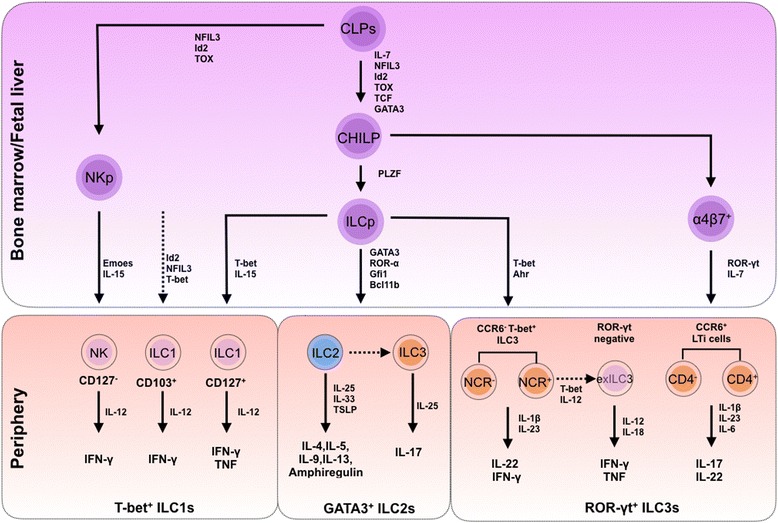
“The development of ILCs from CLPs is independent of the RAG-dependent rearrangement of antigen receptors, but is regulated by several transcription factors [3, 17, 18].”
BackgroundHueber, W., Sands, B. E., Lewitzky, S., Vandemeulebroecke, M., Reinisch, W., Higgins, P. D. R., Wehkamp, J., Feagan, B. G., Yao, M. D., Karczewski, M., et al. (2012) · Gut · doi:10.1136/gutjnl-2011-301668 · Cited by 1,547 · cited 1×
“In some cases, anti-IL-17 therapy resulted in increased susceptibility to fungal infections and enhanced disease [120–123].”
BackgroundLebrikizumab Treatment in Adults with Asthma
Corren, J., Lemanske, R. F., Hanania, N. A., Korenblat, P. E., Parsey, M. V., Arron, J. R., Harris, J. M., Scheerens, H., Wu, L. C., Su, Z., et al. (2011) · New England Journal of Medicine · doi:10.1056/nejmoa1106469 · Cited by 1,514 · cited 1×
“Furthermore, antiinterleukin-13 therapy improves the lung function of patients with severe asthma who had a pretreatment profile consistent with interleukin-13 activity [103].”
BackgroundInnate lymphoid cells promote lung-tissue homeostasis after infection with influenza virus
Monticelli, L. A., Sonnenberg, G. F., Abt, M. C., Alenghat, T., Ziegler, C. G. K., Doering, T. A., Angelosanto, J. M., Laidlaw, B. J., Yang, C. Y., Sathaliyawala, T., et al. (2011) · Nature Immunology · doi:10.1038/ni.2131 · Cited by 1,321 · cited 9×
“4-1 % of the total live cells in the lung [8].”
BackgroundInfluential
Cited by
The Role of Immune and Inflammatory Cells in Idiopathic Pulmonary Fibrosis
Desai, O., Winkler, J., Minasyan, M., & Herzog, E. L. (2018) · Frontiers in Medicine · doi:10.3389/fmed.2018.00043 · Cited by 314
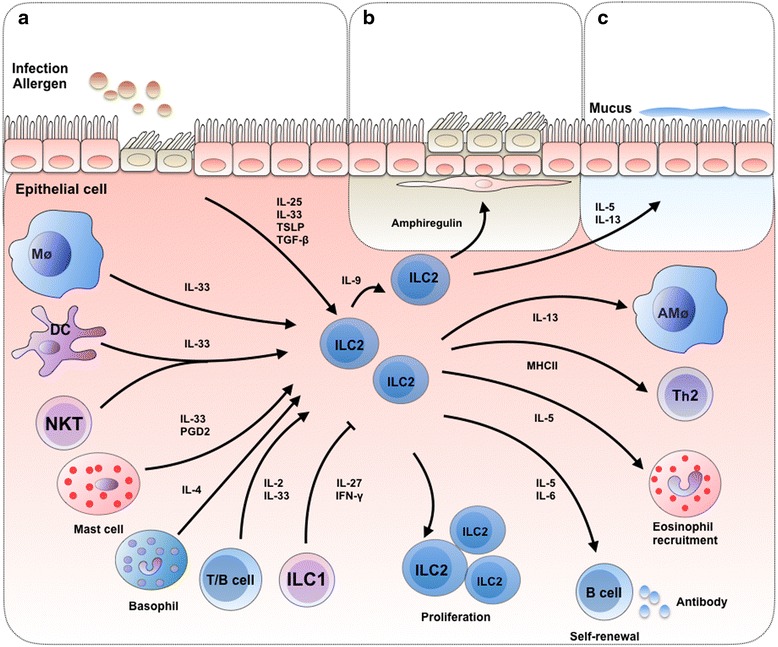
“ILCs in the lung interact with epithelial cells, natural killer T cells, and myeloid cells to form an immune system network (122).”
BackgroundMechanisms and Targeted Therapies for Pseudomonas aeruginosa Lung Infection
Curran, C. S., Bolig, T., & Torabi-Parizi, P. (2018) · American Journal of Respiratory and Critical Care Medicine · doi:10.1164/rccm.201705-1043so · Cited by 182
Sex Hormones Regulate Innate Immune Cells and Promote Sex Differences in Respiratory Virus Infection
Kadel, S., & Kovats, S. (2018) · Frontiers in Immunology · doi:10.3389/fimmu.2018.01653 · Cited by 181
“In homeostasis, ILC2s are the predominant ILC subset in the murine lung (102), and both ILC2s and ILC3s are predominant in human lung (103).”
BackgroundThe Role of Lymphocytes in Radiotherapy-Induced Adverse Late Effects in the Lung
Wirsdörfer, F., & Jendrossek, V. (2016) · Frontiers in Immunology · doi:10.3389/fimmu.2016.00591 · Cited by 125
“The present knowledge on ILC has nicely been summarized in two recent reviews with a focus on their roles in the lung tissue (94, 95).”
BackgroundAirway Basal Cells, Protectors of Epithelial Walls in Health and Respiratory Diseases
Ruysseveldt, E., Martens, K., & Steelant, B. (2021) · Frontiers in Allergy · doi:10.3389/falgy.2021.787128 · Cited by 113
Metadata
- Authors
- Lai, D.-M., Shu, Q., & Fan, J.
- Affiliations
- Children's Hospital of Zhejiang University (CN)
- University of Pittsburgh (US)
- Corresponding author
- Fan, Jie
- ORCID
- Venue
- Military Medical Research
- Publisher
- Elsevier BV
- Published
- 2016-08-19
- Volume
- 3
- Issue
- 1
- Pages
- 25-25
- ISSN
- 2054-9369 (ISSN-L)
- PMC
- PMC4992280
- OpenAlex
- W2514325364
- Cited by
- 45
- References
- 127
- Citations by year
- 2025: 2 · 2024: 4 · 2023: 5 · 2022: 2 · 2021: 6 · 2020: 8 · 2019: 2 · 2018: 10 · 2017: 5 · 2016: 1
- FWCI
- 0.58
- Type
- journal article
- Language
- en
- Open access
- diamond
- doi.org
- Licence
- cc-by
- Locations
- Military Medical Research (publishedVersion, cc-by)
- PubMed Central (publishedVersion, cc-by)
- PubMed (publishedVersion)
- Funders
- USA National Institutes of Health Grant (R01-HL076179, R56-HL-123882)
- USA VA Merit Award (1I01BX002729)
- Zhejiang Provincial Program for the Cultivation of High-level Innovative Health talents
- Topics
- Life Sciences › Immunology and Microbiology › Immunology › IL-33, ST2, and ILC Pathways
- Health Sciences › Medicine › Pulmonary and Respiratory Medicine › Asthma and respiratory diseases
- Life Sciences › Immunology and Microbiology › Immunology › Mast cells and histamine
- Keywords
- innate lymphoid cells, lung, lung disease, helminthiasis, allergic airway inflammation, airway hyperresponsiveness, mucosal immunity, tissue homeostasis, immune regulation
About these checks
Registry, retraction, Cites and statistics results are computed, not judged, with one exception: a printed reference that no index lists is read once by a model before it counts as a citation error. Claims are extracted by a model and kept only when their quote appears verbatim in the text; each cited source is then checked, with a model’s help, for whether it says what the claim relies on. Those verdicts can be wrong — read the claim’s quote and the cited source before relying on one.
Statistics and arithmetic are recomputed, not judged.
Confidence bands are shown only for fields calibrated on our annotated test set. None is calibrated yet, so no band is shown.
What counts as a claim ›How we measure confidence ›How we check this ›
Are you an author, or do you see a problem with this page? Request a review
Data sources
Bibliographic data: Semantic Scholar, OpenAlex, Crossref.
Contains information from the Semantic Scholar Academic Graph Datasets, made available under the ODC Attribution License (ODC-BY 1.0).
Semantic Scholar’s data is described in: Kinney, R., et al. (2023). The Semantic Scholar Open Data Platform. arXiv:2301.10140.
