

The DOI matches its Crossref record; 43 of the 43 references it cites were found in a registry or an index.
Posttraumatic stress disorder: from diagnosis to prevention
Open accessAbstract
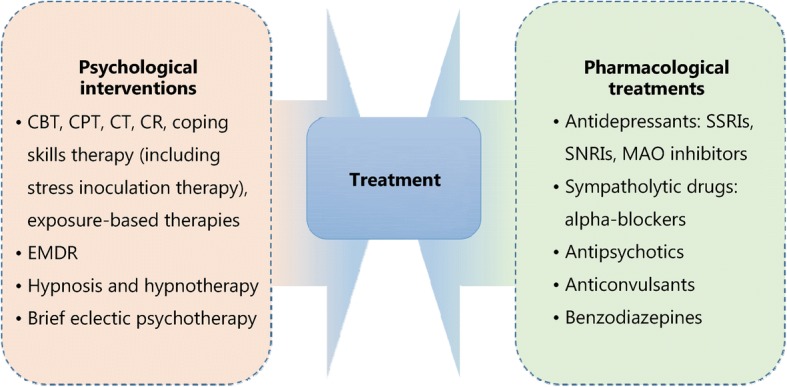
Posttraumatic stress disorder (PTSD) is a chronic impairment disorder that occurs after exposure to traumatic events. This disorder can result in a disturbance to individual and family functioning, causing significant medical, financial, and social problems. This study is a selective review of literature aiming to provide a general outlook of the current understanding of PTSD. There are several diagnostic guidelines for PTSD, with the most recent editions of the DSM-5 and ICD-11 being best accepted. Generally, PTSD is diagnosed according to several clusters of symptoms occurring after exposure to extreme stressors. Its pathogenesis is multifactorial, including the activation of the hypothalamic-pituitary-adrenal (HPA) axis, immune response, or even genetic discrepancy. The morphological alternation of subcortical brain structures may also correlate with PTSD symptoms. Prevention and treatment methods for PTSD vary from psychological interventions to pharmacological medications. Overall, the findings of pertinent studies are difficult to generalize because of heterogeneous patient groups, different traumatic events, diagnostic criteria, and study designs. Future investigations are needed to determine which guideline or inspection method is the best for early diagnosis and which strategies might prevent the development of PTSD.
Overview
The claims and statistics of this paper haven’t been checked yet.
Run the check — free, no account needed. It reads the open-access text and checks the sources it cites.
Integrity signals
Registry
Cites
Statistics
Figures
Verification
Claims the paper makes
The claims and statistics of this paper haven’t been checked yet.
Run the check — free, no account needed. It reads the open-access text and checks the sources it cites.
Claims other papers make about this one
Each is checked against this paper’s own text: does it say what the citing paper says it does?
The source backs part of the claim, not all of it — or backs it for a different population, condition or comparison.
In the citing paper
“A review 5 of the literature revealed that over 80% of PTSD cases involved 1 or more comorbid disorders such as depression, anxiety, or mild traumatic brain injury (TBI).6”
From Linguistic markers for identifying post-traumatic stress disorder and associated symptoms: a systematic literature review (2025) · cites this paper as [6]
Experimental — accuracy not yet measured
Self-check
Percentages, sums and reported differences re-computed from the paper’s own numbers.
The self-check needs the paper’s full text.
Citations
Cites
Foa, E. B., Cashman, L., Jaycox, L., & Perry, K. (1997) · Psychological Assessment · doi:10.1037/1040-3590.9.4.445 · Cited by 2,709
Bulger, R. E. (1992) · Kennedy Institute of Ethics journal · doi:10.1353/ken.0.0102 · Cited by 993
Passos, I. C., Vasconcelos-Moreno, M. P., Costa, L. G., Kunz, M., Brietzke, E., Quevedo, J., Salum, G., Magalhães, P. V., Kapczinski, F., & Kauer-Sant'Anna, M. (2015) · The Lancet Psychiatry · doi:10.1016/s2215-0366(15)00309-0 · Cited by 743
A review of current evidence regarding the ICD-11 proposals for diagnosing PTSD and complex PTSD
Brewin, C. R., Cloitre, M., Hyland, P., Shevlin, M., Maercker, A., Bryant, R. A., Humayun, A., Jones, L. M., Kagee, A., Rousseau, C., et al. (2017) · Clinical Psychology Review · doi:10.1016/j.cpr.2017.09.001 · Cited by 678 · cited 1×
“According to their study, diagnostic standards for symptoms of re-experiencing are higher in the ICD-11 than the DSM, whereas the standards for avoidance are less strict in the ICD-11 than in the DSM-IV [5].”
BackgroundCautionary Statement for Forensic Use of DSM-5
(2014) · Diagnostic and Statistical Manual of Mental Disorders, 5th Edition · doi:10.1176/appi.books.9780890425596.744053 · Cited by 624
Maercker, A., Brewin, C. R., Bryant, R. A., Cloitre, M., Reed, G. M., van Ommeren, M., Humayun, A., Jones, L. M., Kagee, A., Llosa, A. E., et al. (2013) · The Lancet · doi:10.1016/s0140-6736(12)62191-6 · Cited by 533
Logue, M. W., van Rooij, S. J. H., Dennis, E. L., Davis, S. L., Hayes, J. P., Stevens, J. S., Densmore, M., Haswell, C. C., Ipser, J., Koch, S. B. J., et al. (2018) · Biological Psychiatry · doi:10.1016/j.biopsych.2017.09.006 · Cited by 487
Assessment of Plasma C-Reactive Protein as a Biomarker of Posttraumatic Stress Disorder Risk
Eraly, S. A., Nievergelt, C. M., Maihofer, A. X., Barkauskas, D. A., Biswas, N., Agorastos, A., O’Connor, D. T., & Baker, D. G. (2014) · JAMA Psychiatry · doi:10.1001/jamapsychiatry.2013.4374 · Cited by 386
(2009) · PubMed · Cited by 285
Moral Injury: A Mechanism for War-Related Psychological Trauma in Military Family Members
Nash, W. P., & Litz, B. T. (2013) · Clinical Child and Family Psychology Review · doi:10.1007/s10567-013-0146-y · Cited by 259
Research works printed but not linked: 2
- Logue MW, Rooij SJHV, Dennis EL, Davis SL, Hayes JP, Stevens JS, et al. Smaller hippocampal volume in posttraumatic stress disorder: a multi-site ENIGMA-PGC study. Biol. Psychiatry . 2018;83(3):244–53.
- Sijaric-Voloder S, Capin D. Application of cognitive behavior therapeutic techniques for prevention of psychological disorders in police officers. Health Med. 2008;2(4):288–92.
Cited by
Sorted by citations
Losing DNA methylation at repetitive elements and breaking bad
Pappalardo, X. G., & Barra, V. (2021) · Epigenetics & Chromatin · doi:10.1186/s13072-021-00400-z · Cited by 165
Incidence of Post-Traumatic Stress Disorder after Coronavirus Disease
Chang, M. C., & Park, D. (2020) · Healthcare · doi:10.3390/healthcare8040373 · Cited by 93
Nazarov, A., Fikretoglu, D., Liu, A., Thompson, M. M., & Zamorski, M. A. (2018) · Acta Psychiatrica Scandinavica · doi:10.1111/acps.12866 · Cited by 92
A Public Health Perspective of Post-Traumatic Stress Disorder
Jowf, G. I. A., Ahmed, Z. T., An, N., Reijnders, R. A., Ambrosino, E., Rutten, B. P. F., de Nijs, L., & Eijssen, L. (2022) · International Journal of Environmental Research and Public Health · doi:10.3390/ijerph19116474 · Cited by 93
Telomere Shortening and Psychiatric Disorders: A Systematic Review
Pousa, P. A., de Souza, R. M., Melo, P. H. M., Correa, B. H. M., Mendonça, T. S. C., Silva, A. C. S. E., & de Miranda, D. M. (2021) · Cells · doi:10.3390/cells10061423 · Cited by 63
Metadata
- Authors
- Miao, X.-R., Chen, Q.-B., Wei, K., Tao, K.-M., & Lu, Z.-J.
- Affiliations
- Second Military Medical University (CN)
- Venue
- Military Medical Research
- Publisher
- Elsevier BV
- Published
- 2018-09-28
- Volume
- 5
- Issue
- 1
- Pages
- 32-32
- ISSN
- 2054-9369 (ISSN-L)
- PMC
- PMC6161419
- OpenAlex
- W2890877603
- Cited by
- 161
- References
- 43
- Citations by year
- 2026: 12 · 2025: 41 · 2024: 27 · 2023: 30 · 2022: 23 · 2021: 14 · 2020: 10 · 2019: 3 · 2018: 1
- FWCI
- 1.18
- Type
- journal article
- Language
- en
- Open access
- diamond
- doi.org
- Licence
- Locations
- Military Medical Research (publishedVersion, cc-by)
- Europe PMC (PubMed Central) (publishedVersion, other-oa)
- PubMed Central (publishedVersion, cc-by)
- PubMed (publishedVersion)
- DOAJ (DOAJ: Directory of Open Access Journals) (submittedVersion)
- Funders
- National Natural Science Foundation of China (81100276, 31371084, 31171013)
- Topics
- Social Sciences › Psychology › Clinical Psychology › Posttraumatic Stress Disorder Research
- Health Sciences › Medicine › Clinical Neurology › Traumatic Brain Injury Research
- Social Sciences › Psychology › Clinical Psychology › Child Abuse and Trauma
- Keywords
- post-traumatic stress disorder, PTSD diagnosis, PTSD prevention, PTSD treatment, DSM-5, ICD-11, traumatic events, hypothalamic-pituitary-adrenal axis, immune response, genetic susceptibility, subcortical structures, psychological intervention, pharmacotherapy
- MeSH terms
- Genetic Testing, Humans, Hypothalamo-Hypophyseal System, Life Change Events, Pituitary-Adrenal System, Risk Factors, Stress Disorders, Post-Traumatic, International Classification of Diseases, Diagnostic and Statistical Manual of Mental Disorders
About these checks
Registry, retraction, Cites and statistics results are computed, not judged, with one exception: a printed reference that no index lists is read once by a model before it counts as a citation error. Claims are extracted by a model and kept only when their quote appears verbatim in the text; each cited source is then checked, with a model’s help, for whether it says what the claim relies on. Those verdicts can be wrong — read the claim’s quote and the cited source before relying on one.
Statistics and arithmetic are recomputed, not judged.
Confidence bands are shown only for fields calibrated on our annotated test set. None is calibrated yet, so no band is shown.
What counts as a claim ›How we measure confidence ›How we check this ›
Are you an author, or do you see a problem with this page? Request a review
