

The Role of Technology in Adherence to Physical Activity Programs in Patients with Chronic Diseases Experiencing Fatigue: a Systematic Review
Open accessThe DOI matches its Crossref record; 73 of the 74 references it cites were found in a registry or an index.
Abstract
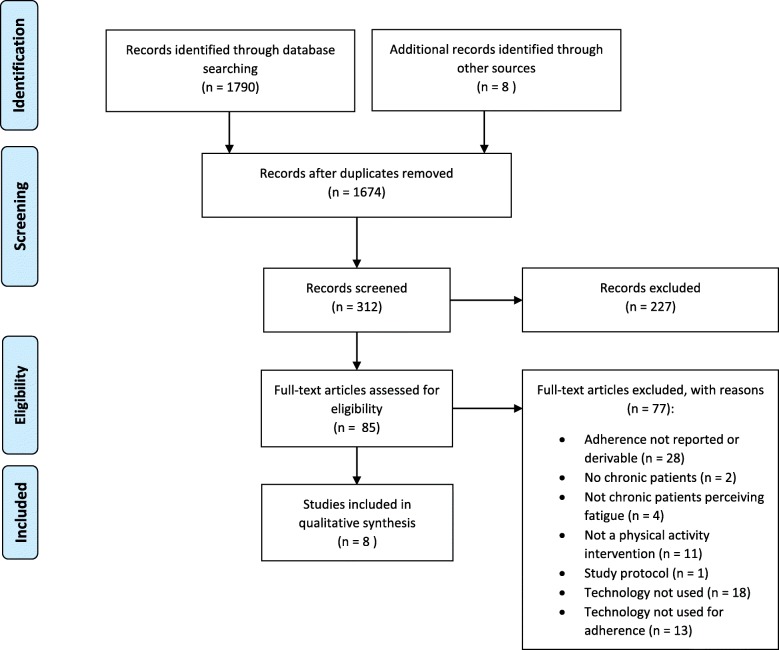
Background: The beneficial role of physical activity (PA) to manage the health condition of patients with chronic diseases is well known. However, adherence to PA guidelines in this group is still low. Monitoring and user-interface technology could represent a significant tool to increase exercise adherence to those particular groups who experience difficulties in adhering to regular and substantial physical activity, and could be supportive in increasing the success of PA programs and interventions. This systematic review aimed at evaluating the effect of physical activity monitoring technology in improving adherence to a PA program in patients with chronic diseases experiencing fatigue. Methods: This systematic review was conducted according to PRISMA guidelines. The literature search was performed in Embase, Medline, Biosis, Scopus, and SPORTDiscus. We filtered the literature according to the question: “Does monitoring technology affect adherence to physical activity and exercise programs in patients with chronic diseases perceiving fatigue?”. Results: The search resulted in 1790 hits; finally, eight studies were included, with a total number of 205 patients. Study quality was moderate except for one study of high quality. Only three disease types emerged, COPD, HF, and cancer. PA programs were rather short (from 8 to 13 weeks) except for one 3-year-long study. Five studies employed pedometers and two an activity monitor. Three studies based their adherence on steps, the remaining studies focused on active minutes. Adherence was explicitly reported in two studies, and otherwise derived. Four studies showed high adherence levels (85% week-10, 89% week-8, 81% week-13, 105% week-13, 83% average week-1–12) and three low levels (56% week-12, 41% year-2, 14 year-3). Conclusion: The small number of studies identified did not allow to establish whether the use of monitoring technology could improve adherence to PA programs in patients with chronic diseases experiencing fatigue, but the current evidence seems to suggest that this is a field warranting further study, particularly into how monitoring technology can help to engage patients to adhere to PA programs.
Overview
The claims and statistics of this paper haven’t been checked yet.
Free: it reads the open-access text and checks the first 5 claims that cite a source we can check. Create a free account to check every claim.
Integrity signals
Registry
Cites
Statistics
Figures
Verification
Claims the paper makes
The claims and statistics of this paper haven’t been checked yet.
Free: it reads the open-access text and checks the first 5 claims that cite a source we can check. Create a free account to check every claim.
Claims other papers make about this one
Each is checked against this paper’s own text: does it say what the citing paper says it does?
The source backs part of the claim, not all of it — or backs it for a different population, condition or comparison.
In the citing paper
“Although promising results have been achieved in technology-based exercise programs like those obtained by Xu, Li, Zhou, Li, Hong, and Tong [38], who observed that the completion was 1.38 times higher compared to traditional programs, the evidence is still debated [27].”
From Key Factors Associated with Adherence to Physical Exercise in Patients with Chronic Diseases and Older Adults: An Umbrella Review (2021) · cites this paper as [27]
Experimental — accuracy not yet measuredThe cited source says what the claim attributes to it.
In the citing paper
“Following this last definition of adherence that includes the assessment of the intensity and volume achieved, new advances in technology have made easier the assessment of adherence given that the exercise intensity and volume can be more easily monitored or even self-monitored by the participant [27].”
From Key Factors Associated with Adherence to Physical Exercise in Patients with Chronic Diseases and Older Adults: An Umbrella Review (2021) · cites this paper as [27]
Self-check
Percentages, sums and reported differences re-computed from the paper’s own numbers.
The self-check needs the paper’s full text.
Citations
Cites
Liberati, A., Altman, D. G., Tetzlaff, J., Mulrow, C., Gøtzsche, P. C., Ioannidis, J. P. A., Clarke, M., Devereaux, P. J., Kleijnen, J., & Moher, D. (2009) · PLoS Medicine · doi:10.1371/journal.pmed.1000100 · Cited by 28,164 · cited 2×
“This systematic review includes eight studies, comprising 195 patients, 89 COPD [41, 45, 46, 48, 51], 39 cancer Albergoni et al.”
BackgroundMethodDermyshi, E., Wang, Y., Yan, C., Hong, W., Qiu, G., Gong, X., & Zhang, T. (2017) · Neonatology · doi:10.1159/000454668 · Cited by 24,451
Vestbo, J., Hurd, S. S., Agustí, A. G., Jones, P. W., Vogelmeier, C., Anzueto, A., Barnes, P. J., Fabbri, L. M., Martinez, F. J., Nishimura, M., et al. (2013) · American Journal of Respiratory and Critical Care Medicine · doi:10.1164/rccm.201204-0596pp · Cited by 15,983
Liberati, A., Altman, D. G., Tetzlaff, J., Mulrow, C., Gøtzsche, P. C., Ioannidis, J. P. A., Clarke, M., Devereaux, P. J., Kleijnen, J., & Moher, D. (2009) · Journal of Clinical Epidemiology · doi:10.1016/j.jclinepi.2009.06.006 · Cited by 10,578
‘Small Changes' to Diet and Physical Activity Behaviors for Weight Management
Hills, A. P., Byrne, N. M., Lindstrom, R., & Hill, J. O. (2013) · Obesity Facts · doi:10.1159/000345030 · Cited by 9,493
Downs, S. H., & Black, N. (1998) · Journal of Epidemiology and Community Health · doi:10.1136/jech.52.6.377 · Cited by 8,252
Physical Activity in the United States Measured by Accelerometer
TROIANO, R. P., BERRIGAN, D., DODD, K. W., MÂSSE, L. C., TILERT, T., & MCDOWELL, M. (2008) · Medicine & Science in Sports & Exercise · doi:10.1249/mss.0b013e31815a51b3 · Cited by 7,638
Exercise as medicine - evidence for prescribing exercise as therapy in 26 different chronic diseases
Pedersen, B. K., & Saltin, B. (2015) · Scandinavian Journal of Medicine & Science in Sports · doi:10.1111/sms.12581 · Cited by 3,514
Using Pedometers to Increase Physical Activity and Improve Health: A Systematic Review
Bravata, D. M., Smith-Spangler, C., Sundaram, V., Gienger, A. L., Lin, N., Lewis, R., Stave, C. D., Olkin, I., & Sirard, J. R. (2007) · JAMA · doi:10.1001/jama.298.19.2296 · Cited by 2,064
Cancer-related fatigue—mechanisms, risk factors, and treatments
Bower, J. E. (2014) · Nature Reviews Clinical Oncology · doi:10.1038/nrclinonc.2014.127 · Cited by 1,666
Cited by
Collado-Mateo, D., Lavín-Pérez, A. M., Peñacoba, C., Del Coso, J., Leyton-Román, M., Luque-Casado, A., Gasque, P., Fernández-del-Olmo, M. Á., & Amado-Alonso, D. (2021) · International Journal of Environmental Research and Public Health · doi:10.3390/ijerph18042023 · Cited by 791
Make Fitness Fun: Could Novelty Be the Key Determinant for Physical Activity Adherence?
Lakičević, N., Gentile, A., Mehrabi, S., Cassar, S., Parker, K. E., Roklicer, R., Bianco, A., & Drid, P. (2020) · Frontiers in Psychology · doi:10.3389/fpsyg.2020.577522 · Cited by 89
“Exergaming through novel mediums such as virtual reality (VR), and digital behavior change apps provide a multisensory and immersive environment that is customizable to the user’s functional abilities and personal preferences, and thus may increase motivation for regular PA participation or enhanced adherence (Albergo…”
BackgroundZou, Y., Liu, S., Guo, S., Zhao, Q., & Cai, Y. (2023) · Children · doi:10.3390/children10020401 · Cited by 96
“As for improving exercise adherence at all ages, scholars have put forward many promotion methods, including peer support [19].”
BackgroundChakraborty, D., Singu, H. B., & Patre, S. (2022) · Journal of Retailing and Consumer Services · doi:10.1016/j.jretconser.2022.103033 · Cited by 78
Hutchesson, M. J., Gough, C., Müller, A. M., Short, C. E., Whatnall, M. C., Ahmed, M., Pearson, N., Yin, Z., Ashton, L. M., Maher, C., et al. (2021) · Obesity Reviews · doi:10.1111/obr.13295 · Cited by 60
Natalucci, V., Marmondi, F., Biraghi, M., & Bonato, M. (2023) · Nutrients · doi:10.3390/nu15040913 · Cited by 64
“Consequently, these barriers may negatively impact study participants’ adherence to wearing trackers [95].”
BackgroundSelf-citationEvidence and User Considerations of Home Health Monitoring for Older Adults: Scoping Review
Chan, A., Cohen, R., Robinson, K.-M., Bhardwaj, D., Gregson, G., Jutai, J. W., Millar, J., Rincon, A. M. R., & Fekr, A. R. (2022) · JMIR Aging · doi:10.2196/40079 · Cited by 43
Brown, M., O’Connor, D., Murphy, C., McClean, M., McMeekin, A., & Prue, G. (2021) · Supportive Care in Cancer · doi:10.1007/s00520-021-06165-1 · Cited by 32
White, D. A., Layton, A. M., Curran, T., Gauthier, N. S., Orr, W. B., Ward, K. M., Vernon, M., Martinez, M. N., Rice, M. C., Hansen, K., et al. (2023) · Frontiers in Cardiovascular Medicine · doi:10.3389/fcvm.2023.1155861 · Cited by 15
A Digital Platform for Home-Based Exercise Prescription for Older People with Sarcopenia
Bonato, M., Marmondi, F., Mastropaolo, C., Inzaghi, C., Cerizza, C., Galli, L., Banfi, G., & Cinque, P. M. (2024) · Sensors · doi:10.3390/s24154788 · Cited by 13
Self-citationGoevaerts, W. F., Limpt, N. T. V., Kop, W. J., Birk, M. V., Liu, Y., Brouwers, R. W. M., Lü, Y., & Kemps, H. (2023) · BMC Cardiovascular Disorders · doi:10.1186/s12872-023-03222-x · Cited by 16
“Whereas previous research showed high levels of adherence associated with monitoring technology [11, 12], these studies focused on relatively short programs (mostly 1 to 12 weeks).”
BackgroundAlbergoni, A., Hettinga, F. J., Stut, W. J. J., & Sartor, F. (2020) · International Journal of Environmental Research and Public Health · doi:10.3390/ijerph17176142 · Cited by 14
“In our recent systematic review, we observed that technology is mainly used to monitor PA but is not yet consistently used to improve adherence to PA and exercise programs in patients with chronic diseases experiencing fatigue [15], and the same may be said for the older population.”
BackgroundInfluentialSelf-citationPractical guidelines for exercise prescription in different clinical populations
Komici, K., Bianco, A., Cuomo, A., Bianco, R., Illario, M., Guerra, G., Paoli, A., Schena, F., & Iaccarino, G. (2026) · Frontiers in Sports and Active Living · doi:10.3389/fspor.2026.1649549 · Cited by 12
“…secondary to hypertension (92–106), clinical features of decompensated heart failure (121–136), diabetes mellitus ( 137– 199 ) and exercise intolerance in patients with Indeed, the use of ICTs in this context might help in engaging more the patients involved in physical activity programs (200).”
Warlo, L. S., Bardai, S. E., de Vries, A., van Veelen, M. C., Moors, S., Rings, E. H. H. M., Legerstee, J. S., & Dierckx, B. (2024) · JMIR Serious Games · doi:10.2196/55034 · Cited by 15
Movement Reminders to Encourage Arm Use During Daily Life in Stroke Patients
Mayrhuber, L., Lestoille, M., Andres, S. D., Held, J. P. O., Luft, A. R., Ryser, F., Gassert, R., Easthope, C. A., & Lambercy, O. (2023) · International Conference on Rehabilitation Robotics · doi:10.1109/icorr58425.2023.10304727 · Cited by 6
Chai, J., Liang, Y., Zhang, X., & Lu, Y. (2025) · Aslib Journal of Information Management · doi:10.1108/ajim-11-2024-0928 · Cited by 7
Remote maintenance cardiac rehabilitation (MAINTAIN): A protocol for a randomised feasibility study
Denton, F., Waddell, A., Kite, C., Hesketh, K. L., Atkinson, L., Cocks, M. S., Jones, H., Randeva, H. S., Davenport, N., Powell, R., et al. (2023) · Digital Health · doi:10.1177/20552076231152176 · Cited by 10
“28 Thus, understanding the effectiveness of long-term home-based CR maintenance programmes using mHealth is ever more essential to overcome both traditional and recently emerging barriers to centre-based CR.”
Diño, M. J. S., Dion, K. W., Abadir, P. M., Budhathoki, C. B., Balbin, P. T., Malacas, M. K. G., Hernandez, R. P., Nicolas, J. J. G., Barcial-Espinosa, J., Himmelfarb, C. D., et al. (2025) · Nursing Reports · doi:10.3390/nursrep15020049 · Cited by 7
Persuasive AI Voice-Assisted Technologies to Motivate and Encourage Physical Activity
Schooley, B. L., Akgun, D., Duhoon, P., & Hikmet, N. (2021) · Transactions on computational science and computational intelligence · doi:10.1007/978-3-030-71051-4_29 · Cited by 5
Aguilar, P. M., Carpio, C., Tenes, A., Zamarrón, E., Bueno, E. V., Santos, M. M., & Walther, R. Á.-S. (2022) · Work · doi:10.3233/wor-210907 · Cited by 8
“Regarding to that, it has been recommended some alternatives like technology support, such as commercial activity monitor or motion capture devices, because they could improve the patients’ adherence to the PRPs [17, 18].”
Barakou, I., Hackett, K. L., Hettinga, F. J., & Finch, T. L. (2025) · Disability and Rehabilitation · doi:10.1080/09638288.2025.2500066 · Cited by 3
“A systematic review on the role of technology in adherence to physical activity programs for patients with chronic diseases experiencing fatigue concluded that the small number of studies in the field prevents a definitive determination of whether monitoring technology improves adherence [68].”
Self-citationOtaka, E., Oguchi, K., Kondo, I., & Otaka, Y. (2021) · Frontiers in Rehabilitation Sciences · doi:10.3389/fresc.2021.752727 · Cited by 3
Pérez, A. M. L., Collado‐Mateo, D., Hinojo, C., Ferré, A. D. J., Villar, C. R., Mayo, X., & Jiménez, A. (2023) · Frontiers in Oncology · doi:10.3389/fonc.2023.1231683 · Cited by 3
Mohamed, S., Muhammad, S. A., Mohamed, A. A., Eldeen, A. A.-M. E., Alhaj, A. M., & Bulama, A. A. (2025) · Annals of Medicine and Surgery · doi:10.1097/ms9.0000000000002808 · Cited by 4
“Recent evidence suggested beneficial outcomes when they are offered to both patients post bariatric surgery, and those with chronic disease [ 65 , 66 ] .”
Sports medicine market – growth factors and forecasts
Lakshmi, B., & Narisetti, S. (2020) · World Journal of Advanced Research and Reviews · doi:10.30574/wjarr.2020.7.1.0208 · Cited by 2
Editorial: Exercise Prescription and Psychological Determinants for Healthy Living
Bonato, M., Vitale, J. A., Sánchez, G. F. L., & Codella, R. (2022) · Frontiers in Psychology · doi:10.3389/fpsyg.2022.851852 · Cited by 2
“However, they are all best marginally effective for increasing long-term exercise maintenance (Albergoni et al., 2019).”
BackgroundSelf-citationPeniche, P. D. C., Lennon, O. C., Magalhães, J. D. P., Santos, J. M. D., Polese, J. C., & Faria, C. D. C. D. M. (2025) · PLoS ONE · doi:10.1371/journal.pone.0320026 · Cited by 1
Moreno-Ligero, M., Dueñas, M., Failde, I., Pino, R. D., Coronilla, M. C., & Moral-Muñoz, J. A. (2025) · American Journal of Physical Medicine & Rehabilitation · doi:10.1097/phm.0000000000002829 · Cited by 1
Chopra, S., Holyk, T., Huot, S., & Camp, P. G. (2026) · Canadian Journal of Respiratory Critical Care and Sleep Medicine · doi:10.1080/24745332.2025.2608027 · Cited by 1
“45 Another frequently cited barrier was fatigue, a common intrinsic barrier among people with chronic disease or health conditions (including asthma and chronic obstructive pulmonary disease) in First Nations communities.”
Scoping review of digital biomarker-based studies (Preprint)Preprint
Motahari-Nezhad, H., Fgaier, M., Abid, M. M., Péntek, M., Gulàcsi, L., & Zrubka, Z. (2021) · doi:10.2196/preprints.35722
Kubis, H., Bonato, M., & Sartor, F. (2022) · Frontiers in Sports and Active Living · doi:10.3389/fspor.2022.1035259
Self-citationMucha, J., Hamdy, R., Marini, M., Aasem, R., Duong, C., Su, T.-T., Carusone, S. C., & O’Brien, K. K. (2026) · JMIR Rehabilitation and Assistive Technologies · doi:10.2196/86785 · Cited by 1
“Similar to prior studies, gamification features of WPAMs and real-time feedback supported users’ sense of progress and enhanced intrinsic motivation among adults aging with HIV [30,32,40].”
Goevaerts, W. F., Limpt, N. T. V., Goossen, S. A., Birk, M. V., Liu, Y., Regis, M., Brouwers, R. W. M., Lü, Y., Kop, W. J., & Kemps, H. (2026) · European Heart Journal - Digital Health · doi:10.1093/ehjdh/ztag016 · Cited by 3
“However, long-term self-reporting of lifestyle habits often faces issues related to adherence, 11 indicating the need to explore adherence patterns and identify strategies that support sustained engagement and improve outcomes over time.”
User-Centered Physiotherapy Prototype App Development for Post-surgery Patients
Baker, A., Krzycka, E., Głowacka, M., Costa, N., Sampaio, D., & Carreira, R. (2026) · Communications in computer and information science · doi:10.1007/978-3-032-16851-1_3
Janczarski, S., Banaś, A., Sarna, D., Widera, P., Michalik, M., Kwolek, K., Pilarek, M., Laskowska, W., Basta, F., & Dacyl, H. (2026) · International Journal of Innovative Technologies in Social Science · doi:10.31435/ijitss.1(49).2026.5512
Morouço, P., & Ramadas, E. (2026) · International Journal of Environmental Research and Public Health · doi:10.3390/ijerph23060703 · Cited by 1
“Meanwhile, digital technologies offer a practical opportunity to respond to part of this challenge [12].”
InfluentialSubach, R., Zanchi, G., Carfora, V., & Catellani, P. (2026) · Frontiers in Psychology · doi:10.3389/fpsyg.2026.1869579
“In summary, although some reviews have discussed various aspects of digital health (Abe et al., 2026; Albergoni et al., 2019; Kim et al., 2021; Kirk et al., 2019; Kwan et al., 2020; Valenzuela et al., 2018), none has specifically examined psychosocial barriers within digital walking interventions…”
Alkhamees, N. H., Gilyana, M., Al-Mhanna, S. B., & Batrakoulis, A. (2026) · Healthcare · doi:10.3390/healthcare14182911
Masoumy, M., Ahrari, S., Javanbakhtian, R., & Vagharseyyedin, S. A. (2026) · Complementary Therapies in Medicine · doi:10.1016/j.ctim.2026.103462
Metadata
- Authors
- Albergoni, A., Hettinga, F. J., La Torre, A., Bonato, M., & Sartor, F.
- Affiliations
- University of Milan (IT)
- University of Essex (GB)
- IRCCS Ospedale Galeazzi - Sant'Ambrogio (IT)
- Corresponding author
- Sartor, Francesco
- Venue
- Sports Medicine - Open
- Published
- 2019-09-12
- Volume
- 5
- Issue
- 1
- Pages
- 41-41
- ISSN
- 2198-9761 (ISSN-L)
- 2199-1170
- PMC
- PMC6739434
- OpenAlex
- W2973058407
- Semantic Scholar
- 6bc7084ad51f7d8f5c195eddb8e8e19cff0cc604
- Cited by
- 39
- References
- 74
- Citations by year
- 2026: 10 · 2025: 5 · 2024: 3 · 2023: 7 · 2022: 5 · 2021: 6 · 2020: 3
- FWCI
- 0.41
- Type
- journal article
- Language
- en
- Open access
- gold
- doi.org
- Licence
- cc-by
- creativecommons.org/licenses/by/4.0 (tdm)
- creativecommons.org/licenses/by/4.0 (vor)
- Locations
- Sports Medicine - Open (publishedVersion, cc-by)
- PubMed Central (publishedVersion, cc-by)
- PubMed (publishedVersion)
- Northumbria Research Link (Northumbria University) (acceptedVersion)
- Archivio Istituzionale della Ricerca (Universita Degli Studi Di Milano) (submittedVersion, other-oa)
- Topics
- Health Sciences › Medicine › Public Health, Environmental and Occupational Health › Physical Activity and Health
- Health Sciences › Health Professions › General Health Professions › Mobile Health and mHealth Applications
- Physical Sciences › Computer Science › Computer Vision and Pattern Recognition › Context-Aware Activity Recognition Systems
- Keywords
- physical activity adherence, chronic fatigue, chronic disease, pedometers, wearable activity trackers, exercise program, chronic obstructive pulmonary disease, heart failure, cancer patients, user interface technology
About these checks
Registry, retraction, Cites and statistics results are computed, not judged, with one exception: a printed reference that no index lists is read once by a model before it counts as a citation error. Claims are extracted by a model and kept only when their quote appears verbatim in the text; each cited source is then checked, with a model’s help, for whether it says what the claim relies on. Those verdicts can be wrong — read the claim’s quote and the cited source before relying on one.
Statistics and arithmetic are recomputed, not judged.
Confidence bands are shown only for fields calibrated on our annotated test set. None is calibrated yet, so no band is shown.
What counts as a claim ›How we measure confidence ›How we check this ›
Are you an author, or do you see a problem with this page? Request a review
Data sources
Bibliographic data: Semantic Scholar, OpenAlex, Crossref.
Contains information from the Semantic Scholar Academic Graph Datasets, made available under the ODC Attribution License (ODC-BY 1.0).
Semantic Scholar’s data is described in: Kinney, R., et al. (2023). The Semantic Scholar Open Data Platform. arXiv:2301.10140.
