

The Role of Technology in Adherence to Physical Activity Programs in Patients with Chronic Diseases Experiencing Fatigue: a Systematic Review
Open accessThe DOI matches its Crossref record; 73 of the 74 references it cites were found in a registry or an index.
Abstract
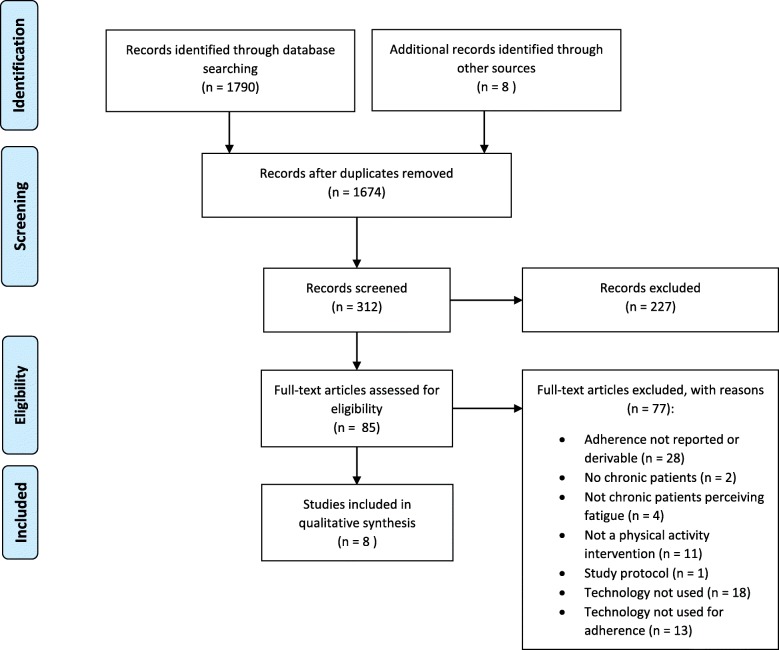
Background: The beneficial role of physical activity (PA) to manage the health condition of patients with chronic diseases is well known. However, adherence to PA guidelines in this group is still low. Monitoring and user-interface technology could represent a significant tool to increase exercise adherence to those particular groups who experience difficulties in adhering to regular and substantial physical activity, and could be supportive in increasing the success of PA programs and interventions. This systematic review aimed at evaluating the effect of physical activity monitoring technology in improving adherence to a PA program in patients with chronic diseases experiencing fatigue. Methods: This systematic review was conducted according to PRISMA guidelines. The literature search was performed in Embase, Medline, Biosis, Scopus, and SPORTDiscus. We filtered the literature according to the question: “Does monitoring technology affect adherence to physical activity and exercise programs in patients with chronic diseases perceiving fatigue?”. Results: The search resulted in 1790 hits; finally, eight studies were included, with a total number of 205 patients. Study quality was moderate except for one study of high quality. Only three disease types emerged, COPD, HF, and cancer. PA programs were rather short (from 8 to 13 weeks) except for one 3-year-long study. Five studies employed pedometers and two an activity monitor. Three studies based their adherence on steps, the remaining studies focused on active minutes. Adherence was explicitly reported in two studies, and otherwise derived. Four studies showed high adherence levels (85% week-10, 89% week-8, 81% week-13, 105% week-13, 83% average week-1–12) and three low levels (56% week-12, 41% year-2, 14 year-3). Conclusion: The small number of studies identified did not allow to establish whether the use of monitoring technology could improve adherence to PA programs in patients with chronic diseases experiencing fatigue, but the current evidence seems to suggest that this is a field warranting further study, particularly into how monitoring technology can help to engage patients to adhere to PA programs.
Overview
The claims and statistics of this paper haven’t been checked yet.
Free: it reads the open-access text and checks the first 5 claims that cite a source we can check. Create a free account to check every claim.
Integrity signals
Registry
Cites
Statistics
Figures
Verification
Claims the paper makes
The claims and statistics of this paper haven’t been checked yet.
Free: it reads the open-access text and checks the first 5 claims that cite a source we can check. Create a free account to check every claim.
Claims other papers make about this one
Each is checked against this paper’s own text: does it say what the citing paper says it does?
The source backs part of the claim, not all of it — or backs it for a different population, condition or comparison.
In the citing paper
“Although promising results have been achieved in technology-based exercise programs like those obtained by Xu, Li, Zhou, Li, Hong, and Tong [38], who observed that the completion was 1.38 times higher compared to traditional programs, the evidence is still debated [27].”
From Key Factors Associated with Adherence to Physical Exercise in Patients with Chronic Diseases and Older Adults: An Umbrella Review (2021) · cites this paper as [27]
Experimental — accuracy not yet measuredThe cited source says what the claim attributes to it.
In the citing paper
“Following this last definition of adherence that includes the assessment of the intensity and volume achieved, new advances in technology have made easier the assessment of adherence given that the exercise intensity and volume can be more easily monitored or even self-monitored by the participant [27].”
From Key Factors Associated with Adherence to Physical Exercise in Patients with Chronic Diseases and Older Adults: An Umbrella Review (2021) · cites this paper as [27]
Self-check
Percentages, sums and reported differences re-computed from the paper’s own numbers.
The self-check needs the paper’s full text.
Citations
Cites
Liberati, A., Altman, D. G., Tetzlaff, J., Mulrow, C., Gøtzsche, P. C., Ioannidis, J. P. A., Clarke, M., Devereaux, P. J., Kleijnen, J., & Moher, D. (2009) · PLoS Medicine · doi:10.1371/journal.pmed.1000100 · Cited by 28,164 · cited 2×
“This systematic review includes eight studies, comprising 195 patients, 89 COPD [41, 45, 46, 48, 51], 39 cancer Albergoni et al.”
BackgroundMethodDermyshi, E., Wang, Y., Yan, C., Hong, W., Qiu, G., Gong, X., & Zhang, T. (2017) · Neonatology · doi:10.1159/000454668 · Cited by 24,451
Vestbo, J., Hurd, S. S., Agustí, A. G., Jones, P. W., Vogelmeier, C., Anzueto, A., Barnes, P. J., Fabbri, L. M., Martinez, F. J., Nishimura, M., et al. (2013) · American Journal of Respiratory and Critical Care Medicine · doi:10.1164/rccm.201204-0596pp · Cited by 15,983
Liberati, A., Altman, D. G., Tetzlaff, J., Mulrow, C., Gøtzsche, P. C., Ioannidis, J. P. A., Clarke, M., Devereaux, P. J., Kleijnen, J., & Moher, D. (2009) · Journal of Clinical Epidemiology · doi:10.1016/j.jclinepi.2009.06.006 · Cited by 10,578
‘Small Changes' to Diet and Physical Activity Behaviors for Weight Management
Hills, A. P., Byrne, N. M., Lindstrom, R., & Hill, J. O. (2013) · Obesity Facts · doi:10.1159/000345030 · Cited by 9,493
Downs, S. H., & Black, N. (1998) · Journal of Epidemiology and Community Health · doi:10.1136/jech.52.6.377 · Cited by 8,252
Physical Activity in the United States Measured by Accelerometer
TROIANO, R. P., BERRIGAN, D., DODD, K. W., MÂSSE, L. C., TILERT, T., & MCDOWELL, M. (2008) · Medicine & Science in Sports & Exercise · doi:10.1249/mss.0b013e31815a51b3 · Cited by 7,638
Exercise as medicine - evidence for prescribing exercise as therapy in 26 different chronic diseases
Pedersen, B. K., & Saltin, B. (2015) · Scandinavian Journal of Medicine & Science in Sports · doi:10.1111/sms.12581 · Cited by 3,514
Using Pedometers to Increase Physical Activity and Improve Health: A Systematic Review
Bravata, D. M., Smith-Spangler, C., Sundaram, V., Gienger, A. L., Lin, N., Lewis, R., Stave, C. D., Olkin, I., & Sirard, J. R. (2007) · JAMA · doi:10.1001/jama.298.19.2296 · Cited by 2,064
Cancer-related fatigue—mechanisms, risk factors, and treatments
Bower, J. E. (2014) · Nature Reviews Clinical Oncology · doi:10.1038/nrclinonc.2014.127 · Cited by 1,666
Physical Activity in U.S. Adults
Tucker, J. M., Welk, G. J., & Beyler, N. K. (2011) · American Journal of Preventive Medicine · doi:10.1016/j.amepre.2010.12.016 · Cited by 977
Barriers to treatment adherence in physiotherapy outpatient clinics: A systematic review
Jack, K., McLean, S. M., Moffett, J. K., & Gardiner, E. (2010) · Manual Therapy · doi:10.1016/j.math.2009.12.004 · Cited by 924
Aune, D., Norat, T., Leitzmann, M., Tonstad, S., & Vatten, L. J. (2015) · European Journal of Epidemiology · doi:10.1007/s10654-015-0056-z · Cited by 880
Flores Mateo, G., Granado-Font, E., Ferré-Grau, C., & Montaña-Carreras, X. (2015) · Journal of Medical Internet Research · doi:10.2196/jmir.4836 · Cited by 540
Integrating Physical Activity Into Mental Health Services for Persons With Serious Mental Illness
Richardson, C. R., Faulkner, G., McDevitt, J., Skrinar, G. S., Hutchinson, D. S., & Piette, J. D. (2005) · Psychiatric Services · doi:10.1176/appi.ps.56.3.324 · Cited by 493
A Meta-Analysis of Pedometer-Based Walking Interventions and Weight Loss
Richardson, C. R., Newton, T. L., Abraham, J. J., Sen, A., Jimbo, M., & Swartz, A. M. (2008) · The Annals of Family Medicine · doi:10.1370/afm.761 · Cited by 421
Validity of Consumer-Based Physical Activity Monitors
LEE, J.-M., KIM, Y., & WELK, G. J. (2014) · Medicine & Science in Sports & Exercise · doi:10.1249/mss.0000000000000287 · Cited by 401
Determinants and outcomes of physical activity in patients with COPD: a systematic review
Gimeno-Santos, E., Frei, A., Steurer-Stey, C., de Batlle, J., Rabinovich, R. A., Raste, Y., Hopkinson, N. S., Polkey, M. I., van Remoortel, H., Troosters, T., et al. (2014) · Thorax · doi:10.1136/thoraxjnl-2013-204763 · Cited by 398
Fatigue in palliative care patients — an EAPC approach
Radbruch, L., Strasser, F., Elsner, F., Gonçalves, J. F., Løge, J., Kaasa, S., Nauck, F., Stone, P., & the Research Steering Committee of the European Association for Palliative Care (EAPC) (2008) · Palliative Medicine · doi:10.1177/0269216307085183 · Cited by 317
Wang, J. B., Cadmus-Bertram, L. A., Natarajan, L., White, M. M., Madanat, H., Nichols, J. F., Ayala, G. X., & Pierce, J. P. (2015) · Telemedicine and e-Health · doi:10.1089/tmj.2014.0176 · Cited by 308
Beinart, N. A., Goodchild, C. E., Weinman, J. A., Ayis, S., & Godfrey, E. L. (2013) · The Spine Journal · doi:10.1016/j.spinee.2013.08.027 · Cited by 294
Teixeira-Lemos, E., Nunes, S., Teixeira, F., & Reis, F. (2011) · Cardiovascular Diabetology · doi:10.1186/1475-2840-10-12 · Cited by 284
Impact of Exercise Rehabilitation on Exercise Capacity and Quality-of-Life in Heart Failure
Taylor, R. S., Walker, S., Smart, N. A., Piepoli, M. F., Warren, F. C., Ciani, O., Whellan, D., O’Connor, C., Keteyian, S. J., Coats, A., et al. (2019) · Journal of the American College of Cardiology · doi:10.1016/j.jacc.2018.12.072 · Cited by 283 · cited 1×
“According to a recent meta-analysis, exercise rehabilitation improved exercise capacity as well as healthrelated quality of life of heart failure patients and it should be offered to all heart failure patients [14].”
BackgroundJefferis, B. J., Sartini, C., Lee, I.-M., Choi, M., Amuzu, A., Gutierrez, C., Casas, J. P., Ash, S., Lennnon, L. T., Wannamethee, S. G., et al. (2014) · BMC Public Health · doi:10.1186/1471-2458-14-382 · Cited by 271
Strategies for promoting physical activity in clinical practice.
Sallis, R., Franklin, B., Joy, L., Ross, R., Sabgir, D., & Stone, J. (2015) · Progress in Cardiovascular Diseases · doi:10.1016/j.pcad.2014.10.003 · Cited by 265
Fatigue in patients with diabetes: A review
Fritschi, C., & Quinn, L. (2010) · Journal of Psychosomatic Research · doi:10.1016/j.jpsychores.2010.01.021 · Cited by 264
Physical activity levels in adults with intellectual disabilities: A systematic review
Dairo, Y. M., Collett, J., Dawes, H., & Oskrochi, G. R. (2016) · Preventive Medicine Reports · doi:10.1016/j.pmedr.2016.06.008 · Cited by 264
Gal, R., May, A. M., van Overmeeren, E. J., Simons, M., & Monninkhof, E. M. (2018) · Sports Medicine - Open · doi:10.1186/s40798-018-0157-9 · Cited by 257
Pedometers to enhance physical activity in COPD: a randomised controlled trial
Mendoza, L., Horta, P., Espinoza, J., Aguilera, M., Balmaceda, N., Castro, A., Ruiz, M., Díaz, O., & Hopkinson, N. S. (2015) · European Respiratory Journal · doi:10.1183/09031936.00084514 · Cited by 223
Changizi, M., & Kaveh, M. H. (2017) · mHealth · doi:10.21037/mhealth.2017.08.06 · Cited by 213
Palmefors, H., DuttaRoy, S., Rundqvist, B., & Börjesson, M. (2014) · Atherosclerosis · doi:10.1016/j.atherosclerosis.2014.04.026 · Cited by 198
Chambers, D., Bagnall, A.-M., Hempel, S., & Forbes, C. (2006) · Journal of the Royal Society of Medicine · doi:10.1258/jrsm.99.10.506 · Cited by 191 · cited 1×
“Moderate-to-vigorous PA bouts were associated with lower severity of pain and fatigue in women with fibromyalgia [12], and graded exercise therapy has shown benefits for myalgic encephalomyelitis patients [13].”
BackgroundWORLDWIDE SURVEY OF FITNESS TRENDS FOR 2019
Thompson, W. R. (2018) · ACSM'S Health & Fitness Journal · doi:10.1249/fit.0000000000000438 · Cited by 184
Exercise Adherence among Older Adults
Chao, D., Foy, C. G., & Farmer, D. (2000) · Controlled Clinical Trials · doi:10.1016/s0197-2456(00)00081-7 · Cited by 181
Physical Activity in Patients With Advanced-Stage Cancer: A Systematic Review of the Literature
Albrecht, T. A., & Taylor, A. G. (2012) · Clinical Journal of Oncology Nursing · doi:10.1188/12.cjon.293-300 · Cited by 174
Home‐based exercise among cancer survivors: adherence and its predictors
Pinto, B. M., Rabin, C., & Dunsiger, S. (2009) · Psycho-Oncology · doi:10.1002/pon.1465 · Cited by 160
Effects of exercise on inflammation markers in type 2 diabetic subjects
Hopps, E., Canino, B., & Caimi, G. (2011) · Acta Diabetologica · doi:10.1007/s00592-011-0278-9 · Cited by 153
Hoaas, H., Andreassen, H. K., Lien, L. A., Hjalmarsen, A., & Zanaboni, P. (2016) · BMC Medical Informatics and Decision Making · doi:10.1186/s12911-016-0264-9 · Cited by 152 · cited 10×
“[44] used a portable finger pulse oximeter (Nonin GO2 LED) to measure SPO2 and heart rate during exercise.”
BackgroundMethodResultInfluentialPhysical Activity and Cancer Survivorship
Garcia, D. O., & Thomson, C. A. (2014) · Nutrition in Clinical Practice · doi:10.1177/0884533614551969 · Cited by 137
Jones, S. B., Thomas, G. A., Hesselsweet, S. D., Alvarez-Reeves, M., Yu, H., & Irwin, M. L. (2013) · Cancer Prevention Research · doi:10.1158/1940-6207.capr-12-0278 · Cited by 124
A pilot study of an Internet walking program and pedometer in COPD
Moy, M. L., Weston, N. A., Wilson, E. J., Hess, M. L., & Richardson, C. R. (2012) · Respiratory Medicine · doi:10.1016/j.rmed.2012.06.013 · Cited by 118
Biomarkers, Fatigue, Sleep, and Depressive Symptoms in Women With Breast Cancer: A Pilot Study
Payne, J. K., Piper, B. F., Rabinowitz, I., & Zimmerman, M. B. (2006) · Oncology Nursing Forum · doi:10.1188/06.onf.775-783 · Cited by 106
Step counter use in type 2 diabetes: a meta-analysis of randomized controlled trials
Qiu, S., Cai, X., Chen, X., Yang, B., & Sun, Z. (2014) · BMC Medicine · doi:10.1186/1741-7015-12-36 · Cited by 106
Kalra, S., & Sahay, R. K. (2018) · Diabetes Therapy · doi:10.1007/s13300-018-0453-x · Cited by 106
Correlates of Fatigue in Patients With Heart Failure
Evangelista, L. S., Moser, D. K., Westlake, C., Pike, N., Ter‐Galstanyan, A., & Dracup, K. (2008) · Progress in Cardiovascular Nursing · doi:10.1111/j.1751-7117.2008.07275.x · Cited by 102
Long-term exercise maintenance in COPD via telerehabilitation: a two-year pilot study
Zanaboni, P., Hoaas, H., Lien, L. A., Hjalmarsen, A., & Wootton, R. (2016) · Journal of Telemedicine and Telecare · doi:10.1177/1357633x15625545 · Cited by 95
Vardy, J. L., Dhillon, H. M., Pond, G. R., Renton, C., Dodd, A., Zhang, H. A., Clarke, S. J., & Tannock, I. F. (2016) · Annals of Oncology · doi:10.1093/annonc/mdw252 · Cited by 95
Poole, E. S. (2013) · Translational Behavioral Medicine · doi:10.1007/s13142-013-0214-3 · Cited by 92 · cited 1×
“For this reason, PA programs better be implemented with the use of human interface and monitoring technology such as web sites [30, 32, 36], mobile devices [37], apps [38], and wearable devices [39].”
BackgroundBarriers to exercise for patients with renal disease: an integrative review
Hannan, M. F., & Bronas, U. G. (2017) · Journal of Nephrology · doi:10.1007/s40620-017-0420-z · Cited by 88
Backman, M., Wengström, Y., Johansson, B., Sköldengen, I., Börjesson, S., Tärnbro, S., & Berglund, Å. (2014) · Acta Oncologica · doi:10.3109/0284186x.2013.873820 · Cited by 86
Thorup, C., Hansen, J., Grønkjær, M., Andreasen, J. J., Nielsen, G., Sørensen, E. E., & Dinesen, B. I. (2016) · Journal of Medical Internet Research · doi:10.2196/jmir.5191 · Cited by 86 · cited 1×
“Motivational messages were shown to help patients increase their PA levels [58].”
BackgroundStrategies to Increase Physical Activity
Tuso, P. (2015) · The Permanente Journal · doi:10.7812/tpp/14-242 · Cited by 84 · cited 2×
“It is now common for patients to discuss their PA habits with their health professionals [30].”
BackgroundAvery, L., Flynn, D., Dombrowski, S. U., van Wersch, A., Sniehotta, F. F., & Trenell, M. I. (2015) · Diabetic Medicine · doi:10.1111/dme.12738 · Cited by 77
Gary, R. A., Cress, M. E., Higgins, M. K., Smith, A. L., & Dunbar, S. B. (2011) · Archives of Physical Medicine and Rehabilitation · doi:10.1016/j.apmr.2011.02.022 · Cited by 76
Increasing physical activity through mobile device interventions: A systematic review
Muntaner, A., Vidal-Conti, J., & Palou, P. (2016) · Health Informatics Journal · doi:10.1177/1460458214567004 · Cited by 72
Physical activity and fatigue in chronic obstructive pulmonary disease – A population based study
Andersson, M., Stridsman, C., Rönmark, E., Lindberg, A., & Emtner, M. (2015) · Respiratory Medicine · doi:10.1016/j.rmed.2015.05.007 · Cited by 70
Chronic Heart Failure and Exercise Intolerance: The Hemodynamic Paradox
Nilsson, K. R., Duscha, B. D., Hranitzky, P. M., & Kraus, W. E. (2008) · Current Cardiology Reviews · doi:10.2174/157340308784245757 · Cited by 57
Consequences of physical inactivity in chronic obstructive pulmonary disease
Hartman, J. E., Boezen, H. M., de Greef, M. H., Bossenbroek, L., & ten Hacken, N. H. T. (2010) · Expert Review of Respiratory Medicine · doi:10.1586/ers.10.76 · Cited by 56
Abonie, U. S., SANDERCOCK, G. R. H., Heesterbeek, M., & Hettinga, F. J. (2018) · Disability and Rehabilitation · doi:10.1080/09638288.2018.1504994 · Cited by 56
Self-citationTough, D., Robinson, J., Gowling, S., Raby, P., Dixon, J., & Harrison, S. L. (2018) · BMC Cancer · doi:10.1186/s12885-018-5068-0 · Cited by 52
Development and Feasibility of a Home Pulmonary Rehabilitation Program With Health Coaching
Benzo, R. P., Kramer, K. M., Hoult, J. P., Anderson, P. M., Begue, I. M., & Seifert, S. J. (2017) · Respiratory Care · doi:10.4187/respcare.05690 · Cited by 50
Finch, D., Jones, P., Watz, H., Wouters, E. F. �., & Cazzola, M. (2016) · International Journal of COPD · doi:10.2147/copd.s85977 · Cited by 48
Park, W., Lee, V. J., Ku, B., & Tanaka, H. (2014) · Journal of Exercise Science & Fitness · doi:10.1016/j.jesf.2014.01.003 · Cited by 42
Alingh, R. A., Hoekstra, F., van der Schans, C. P., Hettinga, F. J., Dekker, R., & van der Woude, L. H. V. (2015) · BMJ Open · doi:10.1136/bmjopen-2015-007591 · Cited by 42
Self-citationCraike, M., Gaskin, C. J., Courneya, K. S., Fraser, S. F., Salmon, J., Owen, P. J., Broadbent, S., & Livingston, P. M. (2016) · Cancer Medicine · doi:10.1002/cam4.639 · Cited by 42
Infographic. Physical activity for disabled adults
Smith, B. M., Kirby, N. V., Skinner, B. D., Wightman, L., Lucas, R. A. I., & Foster, C. E. (2018) · British Journal of Sports Medicine · doi:10.1136/bjsports-2018-100158 · Cited by 40
The Accuracy of Pedometers in Measuring Walking Steps on a Treadmill in College Students
Husted, H. M., & Llewellyn, T. (2017) · International Journal of Exercise Science · doi:10.70252/ftda3470 · Cited by 31 · cited 1×
“However, it needs to be acknowledged that the accuracy of step counting at lower speeds has been found to be reduced [66, 67].”
BackgroundRospo, G., Valsecchi, V., Bonomi, A., Thomassen, I., van Dantzig, S., Torre, A. L., & Sartor, F. (2016) · JMIR mhealth and uhealth · doi:10.2196/mhealth.5518 · Cited by 28
Self-citationSegura‐Jiménez, V., Estévez‐López, F., Castro‐Piñero, J., Álvarez‐Gallardo, I. C., Soriano‐Maldonado, A., Borges‐Cosic, M., & Delgado‐Fernández, M. (2019) · Archives of Physical Medicine and Rehabilitation · doi:10.1016/j.apmr.2018.12.019 · Cited by 28 · cited 1×
“Moderate-to-vigorous PA bouts were associated with lower severity of pain and fatigue in women with fibromyalgia [12], and graded exercise therapy has shown benefits for myalgic encephalomyelitis patients [13].”
BackgroundAre Physical Activity and Benefits Maintained After Long-Term Telerehabilitation in COPD?
Hoaas, H., Morseth, B., Holland, A. E., & Zanaboni, P. (2016) · International Journal of Telerehabilitation · doi:10.5195/ijt.2016.6200 · Cited by 22
Exercise training in heart failure
Piepoli, M. F. (2006) · Current Heart Failure Reports · doi:10.1007/s11897-006-0029-3 · Cited by 22
Exercise training in heart failure
Piepoli, M. F. (2005) · Current Cardiology Reports · doi:10.1007/s11886-005-0080-9 · Cited by 9
Long-term exercise maintenance in COPD via telerehabilitation: Effects from a 2-year pilot study
Zanaboni, P., Lien, L. A., Hoaas, H., Hjalmarsen, A., & Wootton, R. (2015) · doi:10.1183/13993003.congress-2015.oa3279 · Cited by 1 · cited 6×
“had Bluetooth connectivity [52]; the DigiWalker, Omron HJ-112, the Tanita PD-724, and the Nonin GO2 LED did not seem to have any type of digital connectivity [49, 53, 55, 57].”
BackgroundMethodInfluential
Cited by
Collado-Mateo, D., Lavín-Pérez, A. M., Peñacoba, C., Del Coso, J., Leyton-Román, M., Luque-Casado, A., Gasque, P., Fernández-del-Olmo, M. Á., & Amado-Alonso, D. (2021) · International Journal of Environmental Research and Public Health · doi:10.3390/ijerph18042023 · Cited by 791
Make Fitness Fun: Could Novelty Be the Key Determinant for Physical Activity Adherence?
Lakičević, N., Gentile, A., Mehrabi, S., Cassar, S., Parker, K. E., Roklicer, R., Bianco, A., & Drid, P. (2020) · Frontiers in Psychology · doi:10.3389/fpsyg.2020.577522 · Cited by 89
“Exergaming through novel mediums such as virtual reality (VR), and digital behavior change apps provide a multisensory and immersive environment that is customizable to the user’s functional abilities and personal preferences, and thus may increase motivation for regular PA participation or enhanced adherence (Albergo…”
BackgroundZou, Y., Liu, S., Guo, S., Zhao, Q., & Cai, Y. (2023) · Children · doi:10.3390/children10020401 · Cited by 96
“As for improving exercise adherence at all ages, scholars have put forward many promotion methods, including peer support [19].”
BackgroundChakraborty, D., Singu, H. B., & Patre, S. (2022) · Journal of Retailing and Consumer Services · doi:10.1016/j.jretconser.2022.103033 · Cited by 78
Hutchesson, M. J., Gough, C., Müller, A. M., Short, C. E., Whatnall, M. C., Ahmed, M., Pearson, N., Yin, Z., Ashton, L. M., Maher, C., et al. (2021) · Obesity Reviews · doi:10.1111/obr.13295 · Cited by 60
Metadata
- Authors
- Albergoni, A., Hettinga, F. J., La Torre, A., Bonato, M., & Sartor, F.
- Affiliations
- University of Milan (IT)
- University of Essex (GB)
- IRCCS Ospedale Galeazzi - Sant'Ambrogio (IT)
- Corresponding author
- Sartor, Francesco
- Venue
- Sports Medicine - Open
- Published
- 2019-09-12
- Volume
- 5
- Issue
- 1
- Pages
- 41-41
- ISSN
- 2198-9761 (ISSN-L)
- 2199-1170
- PMC
- PMC6739434
- OpenAlex
- W2973058407
- Semantic Scholar
- 6bc7084ad51f7d8f5c195eddb8e8e19cff0cc604
- Cited by
- 39
- References
- 74
- Citations by year
- 2026: 10 · 2025: 5 · 2024: 3 · 2023: 7 · 2022: 5 · 2021: 6 · 2020: 3
- FWCI
- 0.41
- Type
- journal article
- Language
- en
- Open access
- gold
- doi.org
- Licence
- cc-by
- creativecommons.org/licenses/by/4.0 (tdm)
- creativecommons.org/licenses/by/4.0 (vor)
- Locations
- Sports Medicine - Open (publishedVersion, cc-by)
- PubMed Central (publishedVersion, cc-by)
- PubMed (publishedVersion)
- Northumbria Research Link (Northumbria University) (acceptedVersion)
- Archivio Istituzionale della Ricerca (Universita Degli Studi Di Milano) (submittedVersion, other-oa)
- Topics
- Health Sciences › Medicine › Public Health, Environmental and Occupational Health › Physical Activity and Health
- Health Sciences › Health Professions › General Health Professions › Mobile Health and mHealth Applications
- Physical Sciences › Computer Science › Computer Vision and Pattern Recognition › Context-Aware Activity Recognition Systems
- Keywords
- physical activity adherence, chronic fatigue, chronic disease, pedometers, wearable activity trackers, exercise program, chronic obstructive pulmonary disease, heart failure, cancer patients, user interface technology
About these checks
Registry, retraction, Cites and statistics results are computed, not judged, with one exception: a printed reference that no index lists is read once by a model before it counts as a citation error. Claims are extracted by a model and kept only when their quote appears verbatim in the text; each cited source is then checked, with a model’s help, for whether it says what the claim relies on. Those verdicts can be wrong — read the claim’s quote and the cited source before relying on one.
Statistics and arithmetic are recomputed, not judged.
Confidence bands are shown only for fields calibrated on our annotated test set. None is calibrated yet, so no band is shown.
What counts as a claim ›How we measure confidence ›How we check this ›
Are you an author, or do you see a problem with this page? Request a review
Data sources
Bibliographic data: Semantic Scholar, OpenAlex, Crossref.
Contains information from the Semantic Scholar Academic Graph Datasets, made available under the ODC Attribution License (ODC-BY 1.0).
Semantic Scholar’s data is described in: Kinney, R., et al. (2023). The Semantic Scholar Open Data Platform. arXiv:2301.10140.
