

Exploring biometric identification in FinTech applications based on the modified TAM
Open accessThe DOI matches its Crossref record; 96 of the 97 references it cites were found in a registry or an index.
Abstract
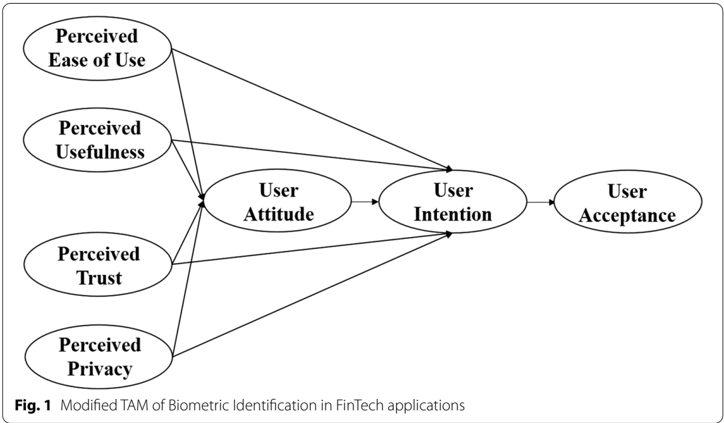
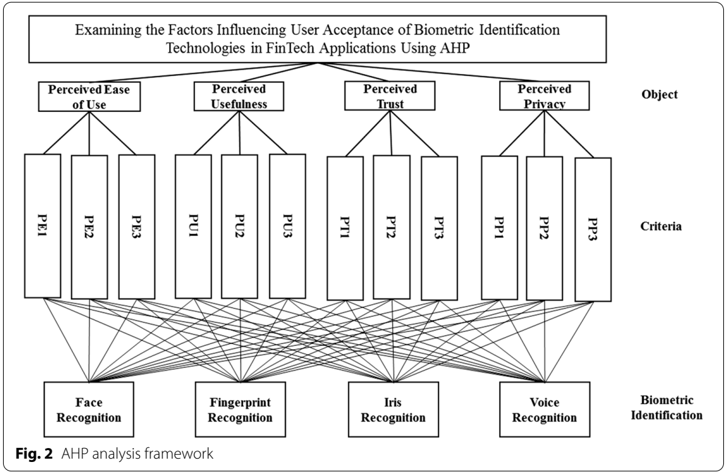
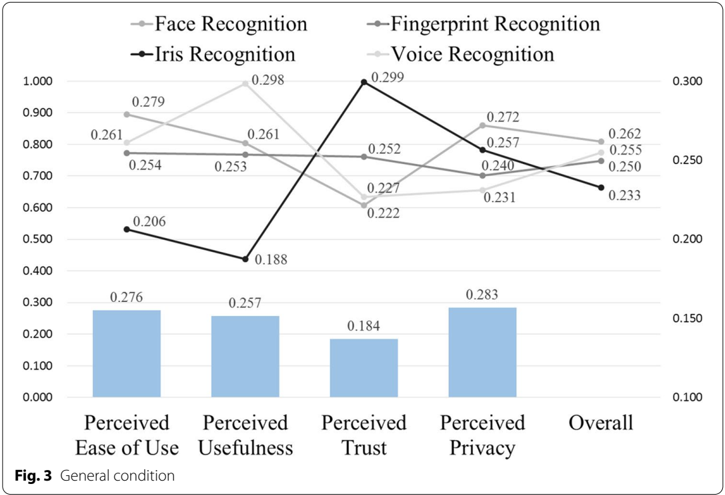
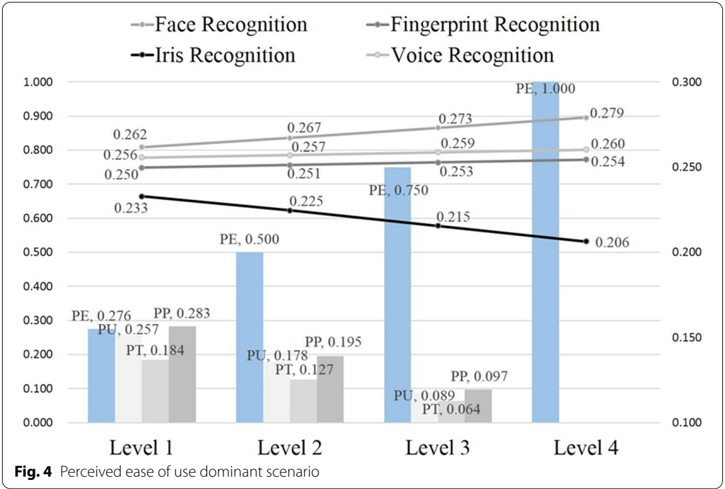
In recent years, biometric technologies have been widely embedded in mobile devices; these technologies were originally employed to enhance the security of mobile devices. With the rise of financial technology (FinTech), which uses mobile devices and applications as promotional platforms, biometrics has the important role of strengthening the identification of such applications for security. However, users still have privacy and trust concerns about biometrics. Previous studies have demonstrated that the technology acceptance model (TAM) can rigorously explain and predict user acceptance of new technologies. This study therefore modifies the TAM as a basic research architecture. Based on a literature review, we add two new variables, namely, “perceived privacy” and “perceived trust,” to extend the traditional TAM to examine user acceptance of biometric identification in FinTech applications. First, we apply the analytic hierarchy process (AHP) to evaluate the defined objects and relevant criteria of the research framework. Second, we use the AHP results in the scenario analysis to explore biometric identification methods that correspond to objects and criteria. The results indicate that face and voice recognition are the two most preferred identification methods in FinTech applications. In addition, there are significant changes in the results of the perceived trust and perceived privacy dominant scenarios.
Overview
The claims and statistics of this paper haven’t been checked yet.
Free: it reads the open-access text and checks the first 5 claims that cite a source we can check. Create a free account to check every claim.
Integrity signals
Registry
Cites
Statistics
Figures

Verification
Claims the paper makes
The claims and statistics of this paper haven’t been checked yet.
Free: it reads the open-access text and checks the first 5 claims that cite a source we can check. Create a free account to check every claim.
Self-check
Percentages, sums and reported differences re-computed from the paper’s own numbers.
The self-check needs the paper’s full text.
Citations
Cites
Perceived usefulness, perceived ease of use, and user acceptance of information technology
Davis, F. D. (1989) · MIS Quarterly · doi:10.2307/249008 · Cited by 68,483 · cited 1×
“The TAM developed by Davis (1989) is the most commonly employed analytical and representative model (Chau and Hu 2001).”
MethodA Theoretical Extension of the Technology Acceptance Model: Four Longitudinal Field Studies
Venkatesh, V., & Davis, F. D. (2000) · Management Science · doi:10.1287/mnsc.46.2.186.11926 · Cited by 23,066
The Analytic Hierarchy Process
SAATY, T. L., & KEARNS, K. P. (1985) · Analytical Planning · doi:10.1016/b978-0-08-032599-6.50008-8 · Cited by 15,357 · cited 4×
“As one of the most widely employed techniques, the analytic hierarchy process (AHP) can evaluate each alternative based on established criteria (Saaty 1980; Kou and Lin 2014; Lee et al. 2018; Galankashi et al. 2020).”
BackgroundMethodInfluential(2003) · International Journal of Electronic Commerce · doi:10.1080/10864415.2003.11044275 · Cited by 5,715 · cited 1×
“The TAM is an advantageous and reliable research method with excellent measurement, simplicity, and empirical stability (Pavlou 2003).”
MethodSaaty, T. L. (2013) · Encyclopedia of Operations Research and Management Science · doi:10.1007/978-1-4419-1153-7_31 · Cited by 5,577
The Legacy of the Technology Acceptance Model and a Proposal for a Paradigm Shift.
University of Michigan, & Bagozzi, R. (2007) · Journal of the Association for Information Systems · doi:10.17705/1jais.00122 · Cited by 2,035 · cited 1×
“Using the relevant variables of user attitudes and behaviors to assess the acceptance of new technologies (Bagozzi 2007; Schierz et al. 2010), the TAM addresses the most influential arguments in the theory of reasoned action (TRA) and theory of planned behavior (TPB).”
The Evolution of Fintech: A New Post-Crisis Paradigm?
Arner, D. W., Barberis, J. N., & Buckley, R. P. (2015) · SSRN Electronic Journal · doi:10.2139/ssrn.2676553 · Cited by 1,412 · cited 2×
“The 2008 financial crisis was a critical reason for FinTech to subvert tradition and develop new and alternative types of financial services (Arner et al. 2016; Kou 2019).”
BackgroundInformation technology acceptance by individual professionals: a model comparison approach
Chau, P. Y. K., & Hu, P. J. (2001) · Decision Sciences · doi:10.1111/j.1540-5915.2001.tb00978.x · Cited by 1,409
Understanding consumer acceptance of mobile payment services: An empirical analysis
Schierz, P. G., Schilke, O., & Wirtz, B. W. (2010) · Electronic Commerce Research and Applications · doi:10.1016/j.elerap.2009.07.005 · Cited by 1,266
Patil, P., Tamilmani, K., Rana, N. P., & Raghavan, V. (2020) · International Journal of Information Management · doi:10.1016/j.ijinfomgt.2020.102144 · Cited by 820
Research works printed but not linked: 5
- 4. Arner DW, Barberis J, Buckey RP (2017) Fintech, regtech, and the reconceptualization of financial regulation. Northwest J Int Law Bus 37(3):371-414
- 13. Callen-Naviglia J, James J (2018) FinTech, RegTech and the importance of cybersecurity. Issues Inf Syst 19(3):220-225
- 31. Ghani MA, Rahi S, Yasin NM, Alnaser FM (2017) Adoption of internet banking: extending the role of technology accept- ance model (TAM) with E-customer service and customer satisfaction. World Appl Sci J 35(9):1918-1929
- 46. Ko CH, Yu CC (2015) Exploring employees' perception of biometric technology adoption in hotels. Int J Organ Innov 8(2):187-199
- 71. Rashed A, Alajarmeh N (2015) Towards understanding user perceptions of biometrics authentication technologies. Int J Comput Sci Inf Secur 13(6):25-33
Cited by
Fintech Adoption Drivers for Innovation for SMEs in Indonesia
Nugraha, D. P., Setiawan, B., Nathan, R. J., & Fekete-Farkas, M. (2022) · Journal of Open Innovation: Technology, Market, and Complexity · doi:10.3390/joitmc8040208 · Cited by 188
Sampat, B. H., Mogaji, E., & Nguyen, N. P. (2023) · International Journal of Bank Marketing · doi:10.1108/ijbm-07-2022-0328 · Cited by 196
Do perceived risks and benefits impact trust and willingness to adopt CBDCs?
Gupta, S., Pandey, D. K., Ammari, A. E., & Sahu, G. P. (2023) · Research in International Business and Finance · doi:10.1016/j.ribaf.2023.101993 · Cited by 117
Analyzing the nexus of green economy, clean and financial technology
Metawa, N., Dogan, E., & Taşkın, D. (2022) · Economic Analysis and Policy · doi:10.1016/j.eap.2022.08.023 · Cited by 83
Biometric m-payment systems: A multi-analytical approach to determining use intention
Liébana-Cabanillas, F. J., Kalinić, Z., Muñoz‐Leiva, F., & Higueras‐Castillo, E. (2023) · Information & Management · doi:10.1016/j.im.2023.103907 · Cited by 104
Customers’ satisfaction with fintech services: evidence from Brazil
Mainardes, E. W., Costa, P. M. F., & Nossa, S. N. (2022) · Journal of Financial Services Marketing · doi:10.1057/s41264-022-00156-x · Cited by 73
“This model has been used in studies on the acceptance, adoption and use of fintech services (Chuang et al. 2016; Stewart and Jürjens 2018; Hu et al. 2019; Lee and Lee 2020; Wang 2021) but has not yet been used in studies on fintechs’ customer satisfaction.”
MethodA survey on biometric cryptosystems and their applications
Sharma, S., Saini, A. K., & Chaudhury, S. (2023) · Computers & Security · doi:10.1016/j.cose.2023.103458 · Cited by 52
Net valence analysis of iris recognition technology-based FinTech
Al‐Debei, M. M., Hujran, O., & Al‐Adwan, A. S. (2024) · Financial Innovation · doi:10.1186/s40854-023-00509-y · Cited by 54
“…on the acceptance of biometric technologies in the financial industry (James et al. 2006; Byun and Byun 2013; Breward et al. 2017; Moriuchi 2021; Wang 2021; Liébana-Cabanilla et al. 2022), the positive effect of the FinTech-enabled hygiene benefit on the perceived value of biometric…”
BackgroundMethodResultInfluentialBusiness trends & challenges in Islamic FinTech: A systematic literature review
Dawood, H., Zadjali, F. A., Rawahi, M. A., Karim, S., & Mohamed, H. (2022) · F1000Research · doi:10.12688/f1000research.109400.1 · Cited by 70
Cybersecurity Challenges and Solutions in the Fintech Mobile App Ecosystem
Mustapha, I., Vaicondam, Y., Jahanzeb, A., Burkhanov, A. U., & Yusof, S. H. (2023) · International Journal of Interactive Mobile Technologies (iJIM) · doi:10.3991/ijim.v17i22.45261 · Cited by 62
Alkadi, R. S., & Abed, S. S. (2023) · Journal of theoretical and applied electronic commerce research · doi:10.3390/jtaer18040093 · Cited by 70
Rukhiran, M., Wong-In, S., & Netinant, P. (2023) · Sustainability · doi:10.3390/su15043092 · Cited by 53
FinTech adoption for ESG integration through robo advisors, personalization, and perceived trust
Chen, A., Wang, S., Mehta, A. M., Asif, M., Xu, S., & Shahzad, M. F. (2025) · Scientific Reports · doi:10.1038/s41598-025-17046-6 · Cited by 51
“The TAM, introduced by Davis 28 , remains one of the most widely applied frameworks for understanding users’ acceptance of technology 12,29 .”
Trust and FinTech: A review and research agenda
Devlin, J. F., Roy, S. K., Sekhon, H. S., Moin, S. M. A., & Sahiner, M. (2025) · Electronic Markets · doi:10.1007/s12525-025-00803-w · Cited by 56
“Other authors have adopted a similar approach (c.f. Stewart and Jurjens, 2018; Ramli, et al., 2021; Wang, 2021), but these studies mainly replicate and confirm earlier investigations and findings and are generally limited to a narrow range of FinTech services, particularly mobile banking.”
Usage intention model of digital assessment systems
Chueh, H.-E., & Huang, D.-H. (2022) · Journal of Business Research · doi:10.1016/j.jbusres.2022.113469 · Cited by 27
Green sustainability balanced scorecard—Evidence from the Taiwan liquefied natural gas industry
Wang, J., Liu, C., & Chen, Y.-T. (2022) · Environmental Technology & Innovation · doi:10.1016/j.eti.2022.102862 · Cited by 28
Self-citationde Araluze, G. K. B., & Plaza, N. M. C. (2023) · SAGE Open · doi:10.1177/21582440231187607 · Cited by 37
Adoption of Fintech Services in Young Students: Empirical Approach from a Developing Country
Bermeo-Giraldo, M. C., Valencia-Arías, A., Palacios-Moya, L., & Valencia, J. (2023) · Economies · doi:10.3390/economies11090226 · Cited by 45
Abed, S. S., & Alkadi, R. S. (2024) · Journal of financial reporting & accounting · doi:10.1108/jfra-12-2023-0759 · Cited by 41
Kim, J. H., Song, W.-K., & Lee, H. C. (2023) · Sustainability · doi:10.3390/su151914129 · Cited by 29
Palos‐Sánchez, P. R., Chang-Tam, R. J., & Folgado-Fernández, J. A. (2025) · Sustainable Technology and Entrepreneurship · doi:10.1016/j.stae.2025.100109 · Cited by 32
Tuffour, P., Chen, G., Opoku‐Mensah, E., Darko, A. P., & Agyapong, R. A. (2023) · Sustainable Development · doi:10.1002/sd.2772 · Cited by 16
Emerging dimensions in Fintech: Insights from bibliometric analysis
Sethi, M., Bohra, N. S., Johri, A., & Asif, M. (2025) · Digital Business · doi:10.1016/j.digbus.2025.100113 · Cited by 21
Riasat, I., Shah, M. H., & Gonul, M. S. (2025) · Computers · doi:10.3390/computers14040129 · Cited by 36
Verification Techniques in FinTech Compared from User Perspectives
Wang, J. (2022) · Social Science Computer Review · doi:10.1177/08944393211058310 · Cited by 13
“At the same time, academics and professionals have extensively applied FAHP in the fi eld of technology comparison (Shieh et al., 2014; Wang, 2021).”
BackgroundInfluentialSelf-citationConfiguring the RegTech business model to explore implications of FinTech
Wang, J., & Chen, Y.-T. (2024) · Egyptian Informatics Journal · doi:10.1016/j.eij.2024.100483 · Cited by 12
Self-citationTechnology Acceptance Model: A Case Study of Palm Vein Authentication Technology
Nakisa, B., Ansarizadeh, F., Oommen, P., & Shrestha, S. (2022) · IEEE Access · doi:10.1109/access.2022.3221413 · Cited by 19
“The SEMmodel can analyze the regression paths simultaneously [4] and variables are confirmed to have relationships if they vary together.”
BackgroundMethodInfluentialThe FinTech adoption in rural areas of Pakistan: an application of SEM and ANN approach
Hidayat-ur-Rehman, I., Alam, M. N., Bhuiyan, A. B., & Zulkifli, N. (2025) · Asia-Pacific Journal of Business Administration · doi:10.1108/apjba-02-2024-0111 · Cited by 29
Determinants of consumer adoption of biometric technologies in mobile financial applications
Piotrowska, A. I. (2024) · Economics and Business Review/The Poznań University of Economics Review · doi:10.18559/ebr.2024.1.1019 · Cited by 13
Jóia, L. A., & Proença, R. (2022) · Financial Innovation · doi:10.1186/s40854-022-00409-7 · Cited by 16
Cybercrime dan Cybersecurity pada Fintech: Sebuah Tinjauan Pustaka Sistematis
Riskiyadi, M., Anggono, A., & Tarjo, T. (2021) · Jurnal Manajemen dan Organisasi · doi:10.29244/jmo.v12i3.33528 · Cited by 41
“Hadirnya fintech dapat diterima dengan baik oleh masyarakat, sebab fintech mampu berevolusi menjadi sarana yang ampuh dalam memberikan efektifitas dan efisiensi (Kou, 2019) sesuai dengan kebiasaan dan gaya hidup masyarakat (M. C. Shekar & Kumaran, 2019; Wang, 2021).”
BackgroundA Fuzzy Multicriteria Group Decision Making Approach for Evaluating and Selecting Fintech Projects
Wibowo, S., Grandhi, L. S., Grandhi, S., & Wells, M. (2022) · Mathematics · doi:10.3390/math10020225 · Cited by 14
Do, T.-L., Tran, M.-K., Nguyen, H. H., & Tran, M. (2022) · SN Computer Science · doi:10.1007/s42979-022-01364-x · Cited by 14
“eKYC provides for financial organizations with not only customers’ social information but also initial information about the customer’s biometrics [40].”
BackgroundAceptación de la tecnología y su relación con el desempeño laboral de los teletrabajadores
García-Salirrosas, E. E., & Millones-Liza, D. Y. (2023) · Revista Venezolana de Gerencia · doi:10.52080/rvgluz.28.e9.13 · Cited by 40
“…empleados es un indicador del desempeño laboral habilitado por la tecnología (Nuutinen et al, 2022). de alguna manera dependiente de la tecnología (Wang, 2021); en este contexto, la tecnología se ha convertido en una herramienta de optimización entre la interacción social y los recursos laborales…”
BackgroundFactors Influencing Consumer Interactions With FinTech Services
Aloumi, D., Malik, S., Alkhaldi, A. N., & de Pablos, P. O. (2024) · Advances in finance, accounting, and economics book series · doi:10.4018/979-8-3693-5673-9.ch010 · Cited by 11
Unlocking the future of paytech: exploring biometric payment card adoption patterns
Liébana-Cabanillas, F. J., Diéguez, A. I. I., Albort-Morant, G., & Zarco, C. (2026) · Financial Innovation · doi:10.1186/s40854-025-00883-9 · Cited by 15
“This result aligns with the findings of Liébana-Cabanillas et al. (2022), Moriuchi (2021), and Wang (2021), who consider these variables fundamental in defining use.”
Toward Smart Communication Components: Recent Advances in Human and AI Speaker Interaction
Kim, H., Hwang, S., Kim, J., & Lee, Z. (2022) · Electronics · doi:10.3390/electronics11101533 · Cited by 8
What Drives Individuals to Adopt Fintech: Extended TAM Model with Gender as Moderating Variable
Setiawan, B., Pandu, N. D., Ahmed, A. M., Emilda, E., & Nathan, R. J. (2023) · JURNAL MINDS Manajemen Ide dan Inspirasi · doi:10.24252/minds.v10i1.35081 · Cited by 23
Bhat, S. A., Islam, S. B., & Mir, M. F. (2024) · Journal of Financial Services Marketing · doi:10.1057/s41264-024-00285-5 · Cited by 11
“This suggests that the role of biometric authentication in the digital transformation of the finance industry is still debatable, as it has not garnered the expected level of support (Wang 2021; Piotrowska 2024).”
InfluentialChandani, A., Sanghvi, M., Wagholikar, S., Pathak, M., Bagade, S. J., Ubarhande, P., & Saini, U. (2025) · Journal of Behavioral and Experimental Finance · doi:10.1016/j.jbef.2025.101092 · Cited by 15
Do, T.-L., Tran, M.-K., Nguyen, H. H., & Tran, M. (2021) · Lecture notes in computer science · doi:10.1007/978-3-030-91387-8_19 · Cited by 10
Awal, M. R., Arzin, T. A., Islam, M. M., & Hasan, M. T. (2023) · Arab Gulf Journal of Scientific Research · doi:10.1108/agjsr-12-2022-0294 · Cited by 16
Shi, J., Hu, X., & Guo, X. (2023) · Risk Analysis · doi:10.1111/risa.14198 · Cited by 8
Azhari, S. C., Permatasari, A., & Angelus, M. (2025) · International Conference on Inventive Computation Technologies (ICICT) · doi:10.1109/icict64420.2025.11005053 · Cited by 6
Fintech market in Iran: an analysis of Fintech ecosystem and business models
Mirzaei, M. (2022) · Middle East Development Journal · doi:10.1080/17938120.2022.2143749 · Cited by 5
“Fintech is generally recognized as an exclusive financial solution based on the combination of financial services and information and communication technologies (Wang, 2021).”
BackgroundRehman, A., Ma, H., Ahmad, M. I., Batool, Z., Tillaguango, B., & Oláh, J. (2025) · Technological and Economic Development of Economy · doi:10.3846/tede.2025.23722 · Cited by 7
Abbas, N., Nazir, M. A., & Khan, M. R. (2025) · Journal of Science and Technology Policy Management · doi:10.1108/jstpm-04-2025-0163 · Cited by 10
Open banking boost and brake: an extended technology acceptance model
Burchi, A., Figà‐Talamanca, G., & Tanzi, P. M. (2025) · International Journal of Bank Marketing · doi:10.1108/ijbm-03-2024-0161 · Cited by 12
A survey on physical adversarial attacks against face recognition systems
Wang, M., Zhou, J., Li, T., Meng, G., & Chen, K. (2025) · Neurocomputing · doi:10.1016/j.neucom.2025.132485 · Cited by 18
Technology Acceptance Model and Fintech: An Evidence from Italian Banking Industry
Raza, A., & Türsoy, T. (2024) · Revista Mexicana de Economía y Finanzas · doi:10.21919/remef.v20i1.993 · Cited by 12
“FinTech adoption has risks due to these traits, and researchers have shown that trust is inversely linked to brand image and perceived risk (Wang, 2021).”
Domingo, M. A. K. A., Bernadas, A. G. P., Maiquez, J. D. P., Ong, A. K. S., & Magana, M. C. (2025) · Acta Psychologica · doi:10.1016/j.actpsy.2025.105426 · Cited by 11
Enhancing Fintech Security - A Comparative Analysis of Advanced Security Algorithms
Thakur, N., & Sharma, V. (2023) · International Conference on Edge Computing and Applications (ICECAA) · doi:10.1109/icecaa58104.2023.10212129 · Cited by 6
Liu, M., Wang, C., & Hu, J. (2025) · PLoS ONE · doi:10.1371/journal.pone.0325291 · Cited by 13
Kang, W., & Yang, M. (2023) · Journal of Electronic Business & Digital Economics · doi:10.1108/jebde-01-2023-0003 · Cited by 9
Determining perceptions of banking customers regarding fingerprint ATMs
Trawnih, A. A., Al‐Adwan, A. S., Yaseen, H., & Al-Rahmi, W. M. (2023) · Information Development · doi:10.1177/02666669231194360 · Cited by 6
“Moreover, fi ngerprint authentication is tentatively unique and more reliable than the prevalent PIN code technology (Wang, 2021; Lee and Pan, 2022).”
InfluentialMunasinghe, A. P., Grandhi, S., & Imam, T. (2024) · Studies in computational intelligence · doi:10.1007/978-3-031-56388-1_5 · Cited by 7
Xu, R. X., Feng, M. S., Yang, J., Xie, J., Tian, Y., Sang, X., Wang, J., Li, Y., Khan, A., & Song, F. (2024) · Chinese Journal of Physics · doi:10.1016/j.cjph.2024.08.025 · Cited by 3
Self-citationPPGAIHI: Efficient Authentication in Healthcare IoT via CNN- and Distance-Based Thresholding
Lee, S., Kim, G., & Jeong, I. C. (2025) · IEEE Internet of Things Journal · doi:10.1109/jiot.2025.3546604 · Cited by 3
A FinTech Clustering Framework: Technology, Model, and Stakeholder PerspectivesPreprint
Poon, P., Wibowo, S., & Tang, S.-F. (2025) · Qeios · doi:10.32388/kpfz4d · Cited by 5
Fernando, G., Reascos, I., Alvarez, F., & Lanchimba, A. (2023) · SN Computer Science · doi:10.1007/s42979-023-02418-4 · Cited by 2
“Therefore, this study adopts the TAM as the primary research framework and uses appropriate user attitudes and behavioral variables to measure the adoption of new face recognition technology [15].”
Wang, M., Yao, S., Yue, C., Zhang, L., & Meng, G. (2025) · International Conference on Multimedia Retrieval · doi:10.1145/3731715.3733425 · Cited by 3
Study of Machine Learning Methods for Voice Biometric Identification in Data Protection Systems
Semenov, S., Davydov, V., & Grynov, D. (2024) · International Conference on Dependable Systems, Services and Technologies (DESSERT) · doi:10.1109/dessert65323.2024.11122211 · Cited by 2
Hossain, M. I., Alam, M. K., Johari, Z., Tasnim, M., Ferdaous, K. I., & Pal, T. (2023) · Advances in business strategy and competitive advantage book series · doi:10.4018/978-1-6684-6782-4.ch008 · Cited by 14
Kim, S., & Kim, C. G. (2026) · Journal of Organizational and End User Computing · doi:10.4018/joeuc.399100 · Cited by 1
Drivers of Gen Y and Gen Z’s intention to invest in Sharia-compliant digital gold in Indonesia
Luthfi, A. A., Hati, S. R. H., Windasari, N. A., & Haron, H. I. C. (2026) · Journal of Islamic marketing · doi:10.1108/jima-05-2025-0278 · Cited by 2
Rohmah, L., Mumtahanah, N. L., & Pratiwi, E. R. (2022) · Airlangga International Journal of Islamic Economics and Finance · doi:10.20473/aijief.v5i02.31956 · Cited by 11
Enhancing Two-Factor Authentication with Deep Speaker Recognition on Librispeech Dataset
Natasya, C., Gunawan, A. A. S., & Komsiyah, S. (2024) · International Conference on Information Management and Technology (ICIMTech) · doi:10.1109/icimtech63123.2024.10780859 · Cited by 1
Open Banking Boost and Brake: Insights from the Financial Advisors Network in ItalyPreprint
Burchi, A., Figà‐Talamanca, G., & Tanzi, P. M. (2023) · SSRN Electronic Journal · doi:10.2139/ssrn.4586432 · Cited by 1
Synchronization of Chaotic Electroencephalography (EEG) Signals
Zaqueros-Martínez, J., Rodríguez‐Gómez, G., Tlelo‐Cuautle, E., & Orihuela‐Espina, F. (2022) · Studies in big data · doi:10.1007/978-3-030-92166-8_5
Manogaran, P., & Ping, T. A. (2023) · International Journal of Business and Technology Management · doi:10.55057/ijbtm.2023.5.3.26
Albuainain, A., & Ashby, S. (2024) · SSRN Electronic Journal · doi:10.2139/ssrn.4886846
Nugraha, Z. H., & Utomo, R. G. (2025) · International Conference on Data Science and Its Applications (ICoDSA) · doi:10.1109/icodsa67155.2025.11157161
From Satisfaction to Loyalty: User-perceived Security of Biometric-Based Authentication Methods
Liyanto, A. M., Nugroho, Z. N., Jauhari, J., & Halim, E. (2025) · International Conference on Business Analytics for Technology and Security (ICBATS) · doi:10.1109/icbats66542.2025.11258209
“(S1) [22], [23] I feel safe making digital payments despite using the internet network (S2) I believe I won't receive external threats such as hacking of personal information.”
Factors Influencing User Acceptance in Adopting Biometric Facial Recognition in Home Access
Sunanda, F. A., Nayoan, C. S., Megaryanti, N., & Cassandra, C. (2025) · International Conference on Software Engineering and Information Technology (ICoSEIT) · doi:10.1109/icoseit67010.2025.11290990 · Cited by 1
“Unlike other studies which consider only the perceived usefulness and ease of use regarding adoption, this study attempts to add trust, privacy concerns, and costs to reflect the intricate environment of biometric security implementation [11][12][13].”
Knowledge Distillation Model for Resource-Constrained Iris Segmentation in Biometric Systems
Soebroto, A. A., Mahmudy, W. F., Nugroho, A. S., Hidayat, N., Indriati, & Kharisma, A. P. (2025) · International Conference on Informatics and Computing (ICIC) · doi:10.1109/icic68054.2025.11309629
“One of the promising biometric approaches involves the use of iris-based image analysis [2].”
The omnipotent role of nanotechnology in digital banking sector
Singh, B. P., & Kumar, V. (2026) · AIP conference proceedings · doi:10.1063/5.0319450
John, D., Hussin, N., Zaini, M. K., Helda, L. I., Ametefe, D. S., Aliu, A. A., & Ali, Z. A. (2026) · Mobile Networks and Applications · doi:10.1007/s11036-026-02497-6
“Again, Wang [38 ]’s exploration of biometric identifica - tion in FinTech applications is another adaptation of the TAM, which is modified by adding “perceived privacy” and “perceived trust” as variables.”
Toward Financial Autonomy: Why Consumers are Embracing Digital Investment Platforms
Saldanha, L. C., Gonçalves, R., Pereira, L., & Costa, R. L. D. (2026) · Annals of Financial Economics · doi:10.1142/s2010495226500053
Acceptance of FinTech services by university women
Rodríguez-Correa, P. A., Bermeo-Giraldo, M. C., Betancur, J. E. H., Martínez, A. L., Valencia-Arias, A., Torres, E. R. T., & Sander, J. M. R. (2026) · F1000Research · doi:10.12688/f1000research.166040.1
Kopáčková, H., & Příhodová, K. (2026) · International Journal of Human-Computer Interaction · doi:10.1080/10447318.2026.2655927
Acceptance of FinTech services by university women
Rodríguez-Correa, P. A., Bermeo-Giraldo, M. C., Betancur, J. E. H., Martínez, A. L., Valencia-Arias, A., Torres, E. R. T., & Sander, J. M. R. (2026) · F1000Research · doi:10.12688/f1000research.166040.2 · Cited by 1
Savari, M., Malekabadi, M. K., & Jalali, M. (2026) · Results in Engineering · doi:10.1016/j.rineng.2026.111686
Britvak, N. (2026) · Вестник Российского университета дружбы народов. Серия: Юридические науки · doi:10.22363/2313-2337-2026-30-2-425-444
Biometric-Based Authentication for Mobile Devices Using Few-Shot Learning
Bhangare, S. B., Gilbile, A. S., Patil, R. V., Bansod, R. P., & Bapat, T. N. (2026) · Lecture notes in networks and systems · doi:10.1007/978-3-032-26905-8_20
Novianti, A. F., & Utomo, R. G. (2026) · International Conference on Electronics Representation and Algorithm (ICERA) · doi:10.1109/icera72709.2026.11666767
“AHP is used to determine relative priorities among criteria and alternatives [16].”
Influential
Metadata
- Authors
- Wang, J. S.
- Affiliations
- National Yang Ming Chiao Tung University (TW)
- Corresponding author
- Wang, Jen Sheng
- ORCID
- Wang, Jen Sheng
- Venue
- Financial Innovation
- Published
- 2021-06-08
- Volume
- 7
- Issue
- 1
- ISSN
- 2199-4730 (ISSN-L)
- OpenAlex
- W3171792482
- Cited by
- 86
- References
- 97
- Citations by year
- 2026: 13 · 2025: 21 · 2024: 13 · 2023: 22 · 2022: 15 · 2021: 2
- FWCI
- 11.10
- Type
- journal article
- Language
- en
- Open access
- diamond
- doi.org
- Licence
- cc-by
- creativecommons.org/licenses/by/4.0 (tdm)
- creativecommons.org/licenses/by/4.0 (vor)
- Locations
- Financial Innovation (publishedVersion, cc-by)
- RePEc: Research Papers in Economics (submittedVersion)
- DOAJ (DOAJ: Directory of Open Access Journals) (submittedVersion, cc-by-sa)
- Econstor (Econstor) (submittedVersion, cc-by)
- Topics
- Social Sciences › Decision Sciences › Information Systems and Management › Technology Adoption and User Behaviour
- Physical Sciences › Computer Science › Information Systems › User Authentication and Security Systems
- Physical Sciences › Computer Science › Signal Processing › Biometric Identification and Security
- Keywords
- biometric identification, fintech applications, technology acceptance model, user acceptance, perceived privacy, perceived trust, face recognition, voice recognition, mobile device security, scenario analysis
About these checks
Registry, retraction, Cites and statistics results are computed, not judged, with one exception: a printed reference that no index lists is read once by a model before it counts as a citation error. Claims are extracted by a model and kept only when their quote appears verbatim in the text; each cited source is then checked, with a model’s help, for whether it says what the claim relies on. Those verdicts can be wrong — read the claim’s quote and the cited source before relying on one.
Statistics and arithmetic are recomputed, not judged.
Confidence bands are shown only for fields calibrated on our annotated test set. None is calibrated yet, so no band is shown.
What counts as a claim ›How we measure confidence ›How we check this ›
Are you an author, or do you see a problem with this page? Request a review
Data sources
Bibliographic data: Semantic Scholar, OpenAlex, Crossref.
Contains information from the Semantic Scholar Academic Graph Datasets, made available under the ODC Attribution License (ODC-BY 1.0).
Semantic Scholar’s data is described in: Kinney, R., et al. (2023). The Semantic Scholar Open Data Platform. arXiv:2301.10140.
