

Exploring biometric identification in FinTech applications based on the modified TAM
Open accessThe DOI matches its Crossref record; 96 of the 97 references it cites were found in a registry or an index.
Abstract
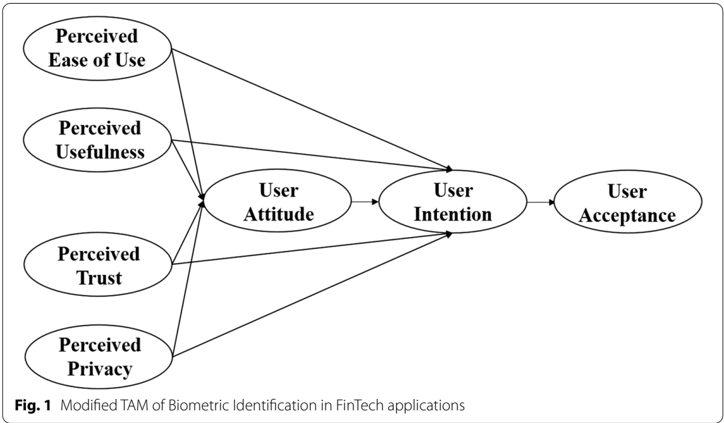
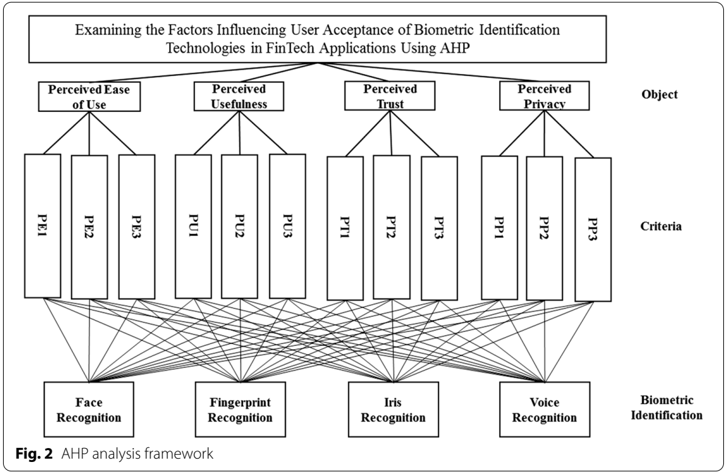
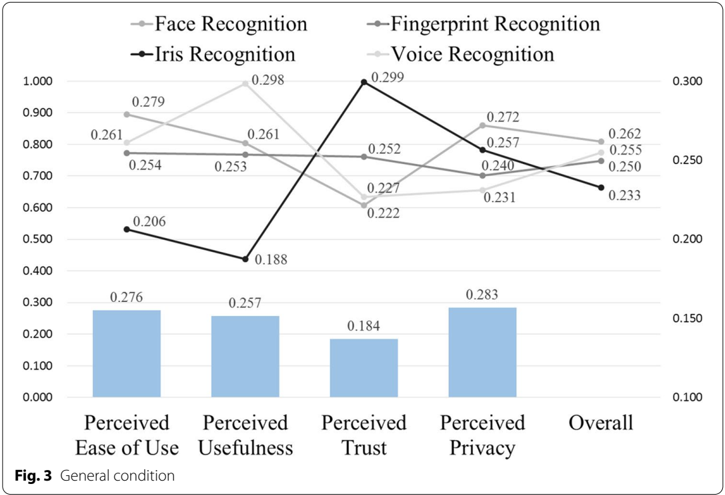
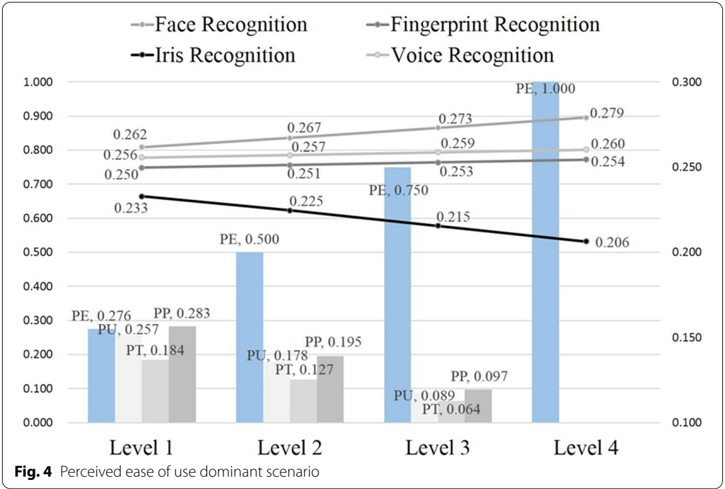
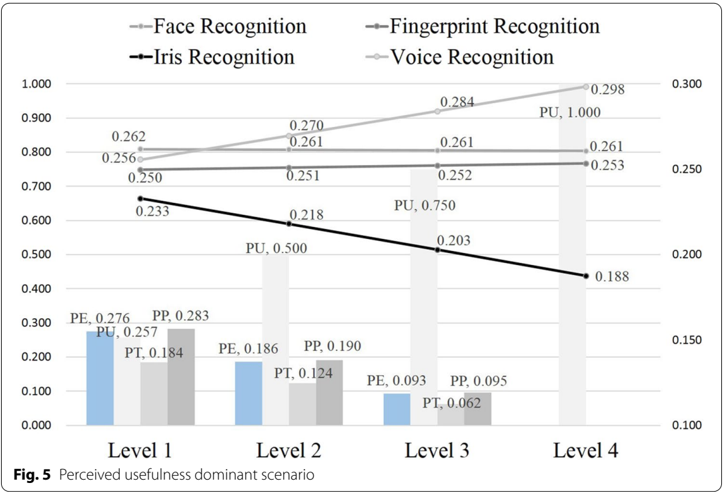
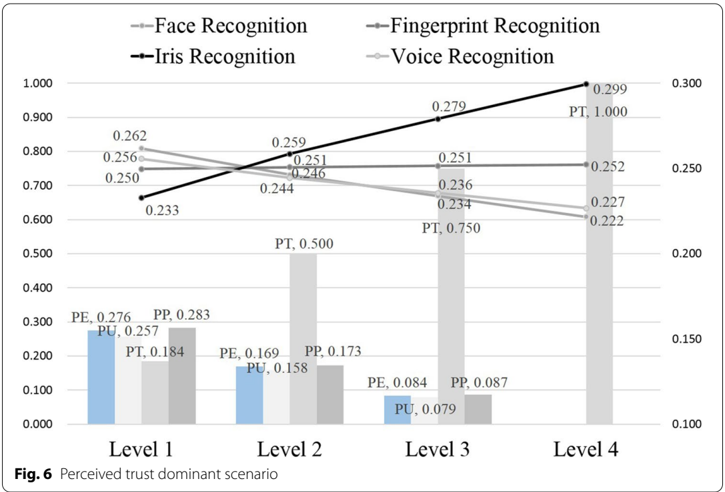
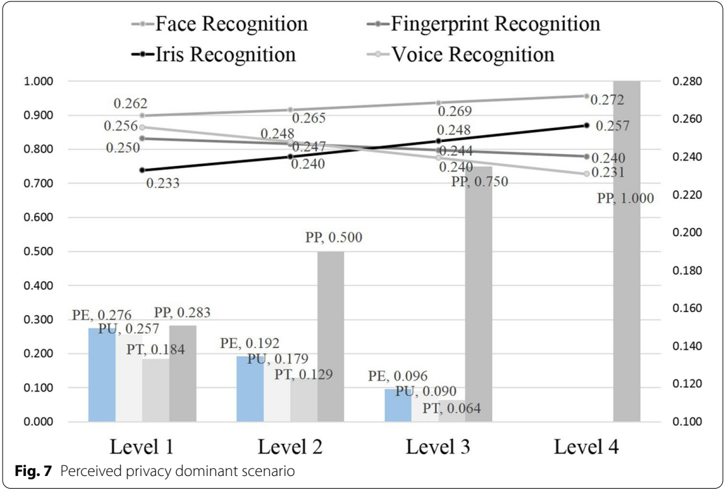
In recent years, biometric technologies have been widely embedded in mobile devices; these technologies were originally employed to enhance the security of mobile devices. With the rise of financial technology (FinTech), which uses mobile devices and applications as promotional platforms, biometrics has the important role of strengthening the identification of such applications for security. However, users still have privacy and trust concerns about biometrics. Previous studies have demonstrated that the technology acceptance model (TAM) can rigorously explain and predict user acceptance of new technologies. This study therefore modifies the TAM as a basic research architecture. Based on a literature review, we add two new variables, namely, “perceived privacy” and “perceived trust,” to extend the traditional TAM to examine user acceptance of biometric identification in FinTech applications. First, we apply the analytic hierarchy process (AHP) to evaluate the defined objects and relevant criteria of the research framework. Second, we use the AHP results in the scenario analysis to explore biometric identification methods that correspond to objects and criteria. The results indicate that face and voice recognition are the two most preferred identification methods in FinTech applications. In addition, there are significant changes in the results of the perceived trust and perceived privacy dominant scenarios.
Overview
The claims and statistics of this paper haven’t been checked yet.
Free: it reads the open-access text and checks the first 5 claims that cite a source we can check. Create a free account to check every claim.
Integrity signals
Registry
Cites
Statistics
Figures

Verification
Claims the paper makes
The claims and statistics of this paper haven’t been checked yet.
Free: it reads the open-access text and checks the first 5 claims that cite a source we can check. Create a free account to check every claim.
Self-check
Percentages, sums and reported differences re-computed from the paper’s own numbers.
The self-check needs the paper’s full text.
Citations
Cites
Perceived usefulness, perceived ease of use, and user acceptance of information technology
Davis, F. D. (1989) · MIS Quarterly · doi:10.2307/249008 · Cited by 68,483 · cited 1×
“The TAM developed by Davis (1989) is the most commonly employed analytical and representative model (Chau and Hu 2001).”
MethodA Theoretical Extension of the Technology Acceptance Model: Four Longitudinal Field Studies
Venkatesh, V., & Davis, F. D. (2000) · Management Science · doi:10.1287/mnsc.46.2.186.11926 · Cited by 23,066
The Analytic Hierarchy Process
SAATY, T. L., & KEARNS, K. P. (1985) · Analytical Planning · doi:10.1016/b978-0-08-032599-6.50008-8 · Cited by 15,357 · cited 4×
“As one of the most widely employed techniques, the analytic hierarchy process (AHP) can evaluate each alternative based on established criteria (Saaty 1980; Kou and Lin 2014; Lee et al. 2018; Galankashi et al. 2020).”
BackgroundMethodInfluential(2003) · International Journal of Electronic Commerce · doi:10.1080/10864415.2003.11044275 · Cited by 5,715 · cited 1×
“The TAM is an advantageous and reliable research method with excellent measurement, simplicity, and empirical stability (Pavlou 2003).”
MethodSaaty, T. L. (2013) · Encyclopedia of Operations Research and Management Science · doi:10.1007/978-1-4419-1153-7_31 · Cited by 5,577
The Legacy of the Technology Acceptance Model and a Proposal for a Paradigm Shift.
University of Michigan, & Bagozzi, R. (2007) · Journal of the Association for Information Systems · doi:10.17705/1jais.00122 · Cited by 2,035 · cited 1×
“Using the relevant variables of user attitudes and behaviors to assess the acceptance of new technologies (Bagozzi 2007; Schierz et al. 2010), the TAM addresses the most influential arguments in the theory of reasoned action (TRA) and theory of planned behavior (TPB).”
The Evolution of Fintech: A New Post-Crisis Paradigm?
Arner, D. W., Barberis, J. N., & Buckley, R. P. (2015) · SSRN Electronic Journal · doi:10.2139/ssrn.2676553 · Cited by 1,412 · cited 2×
“The 2008 financial crisis was a critical reason for FinTech to subvert tradition and develop new and alternative types of financial services (Arner et al. 2016; Kou 2019).”
BackgroundInformation technology acceptance by individual professionals: a model comparison approach
Chau, P. Y. K., & Hu, P. J. (2001) · Decision Sciences · doi:10.1111/j.1540-5915.2001.tb00978.x · Cited by 1,409
Understanding consumer acceptance of mobile payment services: An empirical analysis
Schierz, P. G., Schilke, O., & Wirtz, B. W. (2010) · Electronic Commerce Research and Applications · doi:10.1016/j.elerap.2009.07.005 · Cited by 1,266
Patil, P., Tamilmani, K., Rana, N. P., & Raghavan, V. (2020) · International Journal of Information Management · doi:10.1016/j.ijinfomgt.2020.102144 · Cited by 820
Dead Or Alive? The Development, Trajectory And Future Of Technology Adoption Research.
University of Arkansas, Venkatesh, V., Davis, F., University of Arkansas, Morris, M., & University of Virginia (2007) · Journal of the Association for Information Systems · doi:10.17705/1jais.00120 · Cited by 789 · cited 1×
“In this way, the continuity of the TAM has been maintained in the research field (Venkatesh et al. 2007; Cheng and Yeh 2011; Rashed and Alajarmeh 2015; Shachak et al. 2019).”
Background50 years of biometric research: Accomplishments, challenges, and opportunities
Jain, A. K., Nandakumar, K., & Ross, A. (2016) · Pattern Recognition Letters · doi:10.1016/j.patrec.2015.12.013 · Cited by 708
Singh, N., Sinha, N., & Liébana-Cabanillas, F. J. (2020) · International Journal of Information Management · doi:10.1016/j.ijinfomgt.2019.05.022 · Cited by 598
Hu, Z., Ding, S., Li, S., Chen, L., & Yang, S. (2019) · Symmetry · doi:10.3390/sym11030340 · Cited by 573
Fintechs: A literature review and research agenda
Milian, E. Z., Spinola, M. D. M., & Carvalho, M. M. D. (2019) · Electronic Commerce Research and Applications · doi:10.1016/j.elerap.2019.100833 · Cited by 503
Shao, Z., Zhang, L., Li, X., & Guo, Y. (2019) · Electronic Commerce Research and Applications · doi:10.1016/j.elerap.2018.100823 · Cited by 423
Understanding mobile payment users’ continuance intention: a trust transfer perspective
Cao, X., Yu, L., Liu, Z., Gong, M., & Adeel, L. (2018) · Internet Research · doi:10.1108/intr-11-2016-0359 · Cited by 375
Data security and consumer trust in FinTech innovation in Germany
Stewart, H., & Jürjens, J. (2018) · Information & Computer Security · doi:10.1108/ics-06-2017-0039 · Cited by 348
A cosine maximization method for the priority vector derivation in AHP
Kou, G., & Lin, C. (2014) · European Journal of Operational Research · doi:10.1016/j.ejor.2013.10.019 · Cited by 347 · cited 2×
“As one of the most widely employed techniques, the analytic hierarchy process (AHP) can evaluate each alternative based on established criteria (Saaty 1980; Kou and Lin 2014; Lee et al. 2018; Galankashi et al. 2020).”
BackgroundMethodBreckenridge, K. (2014) · doi:10.1017/cbo9781139939546 · Cited by 331
Kou, G., Ergu, D., & Shang, J. (2014) · European Journal of Operational Research · doi:10.1016/j.ejor.2013.11.035 · Cited by 275 · cited 3×
“Analysts can construct scenarios to describe situations that may affect the weight of the criterion or the attributes of each choice (Wang et al. 2013; Kou et al. 2014; Zhang et al. 2021).”
BackgroundMethodInfluentialBeyond TAM and UTAUT: Future directions for HIT implementation research
Shachak, A., Kuziemsky, C., & Petersen, C. (2019) · Journal of Biomedical Informatics · doi:10.1016/j.jbi.2019.103315 · Cited by 263
Schmidt, K., Aumann, I., Hollander, I., Damm, K., & von der Schulenburg, J.-M. G. (2015) · BMC Medical Informatics and Decision Making · doi:10.1186/s12911-015-0234-7 · Cited by 244
Analysis of Collaboration Evolution in AHP Research: 1982–2018
Yu, D., Kou, G., Xu, Z., & Shi, S. (2021) · International Journal of Information Technology & Decision Making · doi:10.1142/s0219622020500406 · Cited by 198
Hassan, H. E., & Wood, V. R. (2019) · Telematics and Informatics · doi:10.1016/j.tele.2019.101312 · Cited by 191
Ogbanufe, O., & Kim, D. J. (2017) · Decision Support Systems · doi:10.1016/j.dss.2017.11.003 · Cited by 188
Mobile payment in Fintech environment: trends, security challenges, and services
Kang, J. (2018) · Human-centric Computing and Information Sciences · doi:10.1186/s13673-018-0155-4 · Cited by 186 · cited 2×
“This issue should be regarded as the basis for relying on FinTech services and protecting users (Arner et al. 2017; Kang 2018; Kim et al. 2019).”
BackgroundMobile banking adoption in an emerging economy: An empirical analysis of young Indian consumers
Priya, R., Gandhi, A. V., & Shaikh, A. (2018) · Benchmarking An International Journal · doi:10.1108/bij-01-2016-0009 · Cited by 180
Kang, J.-W., & Namkung, Y. (2019) · International Journal of Contemporary Hospitality Management · doi:10.1108/ijchm-12-2017-0783 · Cited by 177
Personalization–privacy paradox and consumer conflict with the use of location-based mobile commerce
Lee, J.-M., & Rha, J.-Y. (2016) · Computers in Human Behavior · doi:10.1016/j.chb.2016.05.056 · Cited by 169
Towards Secure FinTech: A Survey, Taxonomy, and Open Research Challenges
Mehrban, S., Nadeem, M. W., Hussain, M., Ahmed, M. M., Hakeem, O., Saqib, S., Kiah, L. M., Abbas, F., Hassan, M., & Khan, M. A. (2020) · IEEE Access · doi:10.1109/access.2020.2970430 · Cited by 168
Rahi, S., Abd. Ghani, M., Alnaser, F. M., & Ngah, A. H. (2018) · Management Science Letters · doi:10.5267/j.msl.2018.1.001 · Cited by 163
What drives the adoption of crypto-payments by online retailers?
Jonker, N. (2019) · Electronic Commerce Research and Applications · doi:10.1016/j.elerap.2019.100848 · Cited by 152 · cited 1×
“…consumer (3C) devices and the introduction of mobile payments are forcing traditional retail banks and electronic commerce (e-commerce) retailers to increase the flexibility of their businesses to meet the challenges of new business pipelines and models in the FinTech era (Jonker 2019; Kou 2019).”
BackgroundKalinić, Z., Marinković, V., Djordjevic, A., & Liébana-Cabanillas, F. J. (2019) · Journal of Enterprise Information Management · doi:10.1108/jeim-05-2019-0136 · Cited by 150
Chopdar, P. K., & Sivakumar, V. J. (2019) · Behaviour & Information Technology · doi:10.1080/0144929x.2018.1513563 · Cited by 148
Merhi, M., Hone, K., Tarhini, A., & Ameen, N. (2021) · Journal of Enterprise Information Management · doi:10.1108/jeim-03-2020-0092 · Cited by 145
e-Banking Adoption: An Opportunity for Customer Value Co-creation
Carranza, R., Díaz, E., Sánchez‐Camacho, C., & Martín‐Consuegra, D. (2021) · Frontiers in Psychology · doi:10.3389/fpsyg.2020.621248 · Cited by 143
Wu, J., Liu, L., & Huang, L. (2017) · Industrial Management & Data Systems · doi:10.1108/imds-08-2016-0312 · Cited by 141
Authentication systems: A literature review and classification
Barkadehi, M. H., Nilashi, M., Ibrahim, O., Fardi, A. Z., & Samad, S. (2018) · Telematics and Informatics · doi:10.1016/j.tele.2018.03.018 · Cited by 140
Predictive and explanatory modeling regarding adoption of mobile payment systems
Liébana-Cabanillas, F. J., & Lara‐Rubio, J. (2017) · Technological Forecasting and Social Change · doi:10.1016/j.techfore.2017.04.002 · Cited by 136
The future of hydrogen fueling systems for transportation
Winebrake, J. J., & Creswick, B. P. (2003) · Technological Forecasting and Social Change · doi:10.1016/s0040-1625(01)00189-5 · Cited by 134
Portfolio selection: a fuzzy-ANP approach
Galankashi, M. R., Rafiei, F. M., & Ghezelbash, M. (2020) · Financial Innovation · doi:10.1186/s40854-020-00175-4 · Cited by 133
Iris Recognition: The Path Forward
Ross, A. (2010) · Computer · doi:10.1109/mc.2010.44 · Cited by 123 · cited 1×
“Compared with other biometric identification methods, the biometric characteristics of iris recognition are more special and difficult to imitate (Ross 2010); thus, it gains a higher degree of trust.”
MethodCashing in on innovation: a taxonomy of FinTech
Imerman, M. B., & Fabozzi, F. J. (2020) · Journal of Asset Management · doi:10.1057/s41260-020-00163-4 · Cited by 119
Aggregation of the nearest consistency matrices with the acceptable consensus in AHP-GDM
Lin, C.-S., Kou, G., Peng, Y., & Alsaadi, F. E. (2020) · Annals of Operations Research · doi:10.1007/s10479-020-03572-1 · Cited by 111
THE FINTECH BOOK: THE FINANCIAL TECHNOLOGY HANDBOOK FOR INVESTORS, ENTREPRENEURS AND VISIONARIES
Amalia, F. (2016) · Journal of Indonesian Economy and Business · doi:10.22146/jieb.23554 · Cited by 107 · cited 1×
“Furthermore, FinTech optimizes traditional financial services via technology flipping, and many financial services can be completed directly on the Internet across time and space (Arner et al. 2016; Eagar 2016; Sonea 2016).”
BackgroundEstimating priorities from relative deviations in pairwise comparison matrices
Zhang, J., Kou, G., Peng, Y., & Zhang, Y. (2020) · Information Sciences · doi:10.1016/j.ins.2020.12.008 · Cited by 103
Consumer preferences of attributes of mobile payment services in South Korea
Choi, H., Park, J., Kim, J., & Jung, Y. (2020) · Telematics and Informatics · doi:10.1016/j.tele.2020.101397 · Cited by 100
Jeong, N.-Y., Yoo, Y., & Heo, T. (2008) · Technological Forecasting and Social Change · doi:10.1016/j.techfore.2008.08.007 · Cited by 92
Alhassany, H., & Faisal, F. (2018) · Financial Innovation · doi:10.1186/s40854-018-0111-3 · Cited by 92
Arner, D. W., Zetzsche, D. A., Buckley, R. P., & Barberis, J. N. (2019) · European Business Organization Law Review · doi:10.1007/s40804-019-00135-1 · Cited by 92
The FINTECH Book: The Financial Technology Handbook for Investors, Entrepreneurs and Visionaries
Chishti, S., & Barberis, J. N. (2016) · Cited by 91
Fintech: AI powers financial services to improve people's lives
Qi, Y., & Xiao, J. (2018) · Communications of the ACM · doi:10.1145/3239550 · Cited by 74
Kim, M., Kim, S., & Kim, J. (2019) · Telematics and Informatics · doi:10.1016/j.tele.2019.02.003 · Cited by 69
Cancelable Biometric Recognition With ECGs: Subspace-Based Approaches
Wu, S., Chen, P.-T., Swindlehurst, A. L., & Hung, P.-L. (2018) · IEEE Transactions on Information Forensics and Security · doi:10.1109/tifs.2018.2876838 · Cited by 68
Moderating Effect of Smartphone Addiction on Mobile Wallet Payment Adoption
Shaw, B., & Kesharwani, A. (2019) · Journal of Internet Commerce · doi:10.1080/15332861.2019.1620045 · Cited by 67
An empirical examination of U.S. travelers’ intentions to use biometric e-gates in airports
Morosan, C. V. (2016) · Journal of Air Transport Management · doi:10.1016/j.jairtraman.2016.05.005 · Cited by 57 · cited 4×
“2016; Ko and Yu 2015; Rashed and Alajarmeh 2015; Morosan 2016; Lee and Rha 2016; Kanak and Sogukpinar 2017; Pai et al.”
BackgroundInfluentialBreckenridge, K. (2014) · Cited by 52
Mobile banking adoption in an emerging economy: An empirical analysis of young Indian consumers
Priya, R., Gandhi, A. V., & Shaikh, A. (2018) · Benchmarking An International Journal · Cited by 52
Vocal Features: From Voice Identification to Speech Recognition by Machine
Li, X., & Mills, M. (2019) · Technology and Culture · doi:10.1353/tech.2019.0066 · Cited by 52
Empirical study on Chinese tourists’ perceived trust and intention to use biometric technology
Pai, C.-K., Wang, T., Chen, S., & Cai, K.-Y. (2018) · Asia Pacific Journal of Tourism Research · doi:10.1080/10941665.2018.1499544 · Cited by 52
Factors Affecting Continuance Intention of FinTech Payment among Millennials in Jakarta
Diana, N., & Leon, F. M. (2020) · European Journal of Business Management and Research · doi:10.24018/ejbmr.2020.5.4.444 · Cited by 52
On Sensitivity Analysis in the Analytic Hierarchy Process
Erkut, E., & Tarimcilar, M. (1991) · IMA Journal of Management Mathematics · doi:10.1093/imaman/3.1.61 · Cited by 50 · cited 3×
“13 as This study employs this procedure to graphically display the z k scores; in this way, we can vary the value of d 1 from 0 to 1 (Erkut and Tarimcilar 1991; Srdjevic et al. 2012).”
BackgroundMethodCrossing the Next Frontier: The Role of ICT in Driving the Financialization of Credit
Drummer, D., Feuerriegel, S., & Neumann, D. (2017) · Journal of Information Technology · doi:10.1057/s41265-017-0035-9 · Cited by 44
Cancelable Permutation-Based Indexing for Secure and Efficient Biometric Identification
Murakami, T., Fujita, R., Ohki, T., Kaga, Y., Fujio, M., & Takahashi, K. (2019) · IEEE Access · doi:10.1109/access.2019.2908456 · Cited by 42
Selection of storage energy technologies in a power quality scenario — the AHP and the fuzzy logic
Barin, A., Canha, L. N., Abaide, A. D. R., & Magnago, K. F. (2009) · Annual Conference of the IEEE Industrial Electronics Society (IECON) · doi:10.1109/iecon.2009.5415150 · Cited by 38 · cited 1×
“Numerous studies on technology evaluations have employed sensitivity analysis to examine the effects caused by variations in weights (Barin et al. 2009; Wang et al. 2013; Başar 2018).”
BackgroundA Privacy-Preserving Edge Computation-Based Face Verification System for User Authentication
Wang, X., Xue, H., Liu, X., & Pei, Q. (2019) · IEEE Access · doi:10.1109/access.2019.2894535 · Cited by 36
Cheng, Y.-H., & Yeh, Y.-J. (2010) · Technological Forecasting and Social Change · doi:10.1016/j.techfore.2010.10.003 · Cited by 35
Lee, S., Kim, B. S., Kim, Y., Kim, W., & Ahn, W. (2017) · Technology Analysis and Strategic Management · doi:10.1080/09537325.2017.1297787 · Cited by 35
Mobile banking: consumer perception towards adoption
Priya, R., Gandhi, A. V., & Shaikh, A. (2018) · Benchmarking An International Journal · Cited by 34
The language of biometrics: Analysing public perceptions
Buckley, O. E., & Nurse, J. R. C. (2019) · Journal of Information Security and Applications · doi:10.1016/j.jisa.2019.05.001 · Cited by 34 · cited 1×
“Buckley and Nurse (2019) highlighted that users are seemingly more comfortable with biometric identification, which demonstrates privacy protection.”
BackgroundSrdjević, Z., Samardzic, M., & Srdjević, B. (2012) · Civil Engineering and Environmental Systems · doi:10.1080/10286608.2012.672412 · Cited by 33
Adoption of sensor based communication for mobile marketing in India
Abhishek, A., & Hemchand, S. (2016) · Journal of Indian Business Research · doi:10.1108/jibr-08-2015-0091 · Cited by 32
Decision making on financial investment in Turkey by using ARDL long-term coefficients and AHP
Atmaca, S., & KARADAŞ, H. A. (2020) · Financial Innovation · doi:10.1186/s40854-020-00196-z · Cited by 32
Controlling User Access to Cloud-Connected Mobile Applications by Means of Biometrics
Fenu, G., & Marras, M. (2018) · IEEE Cloud Computing · doi:10.1109/mcc.2018.043221014 · Cited by 25
Forecasting VoWLAN technology for the Taiwan mobile telecommunication industry
Ho, J. C., & Chen, J. (2009) · Technology Analysis and Strategic Management · doi:10.1080/09537320802625314 · Cited by 23
Why We’re so Excited About FinTech
Menat, R. (2016) · doi:10.1002/9781119218906.ch2 · Cited by 22 · cited 2×
“With the competition of various types of identification methods, biometric technologies that have been developed can gain user trust (Menat 2016).”
BackgroundMethodIntroduction to the special issue on FinTech
Kou, G. (2019) · Financial Innovation · doi:10.1186/s40854-019-0161-1 · Cited by 22 · cited 2×
“2016; Kou 2019).”
BackgroundBioTAM: a technology acceptance model for biometric authentication systems
Kanak, A., & Soğukpınar, İ. (2017) · IET Biometrics · doi:10.1049/iet-bmt.2016.0148 · Cited by 21
Cloud-assisted secure biometric identification with sub-linear search efficiency
Zhu, Y., Li, X., Wang, J., & Li, J. (2019) · Soft Computing · doi:10.1007/s00500-019-04401-9 · Cited by 14
Self-citationEvaluating and selecting the biometrics in network security
Liu, C., Wang, J., Peng, C., & Shyu, J. Z. (2014) · Security and Communication Networks · doi:10.1002/sec.1020 · Cited by 13
Self-citationDonohue, L. K. (2012) · Minnesota law review · doi:10.24926/265535.1243 · Cited by 11 · cited 4×
“It can replace more utilized monitoring systems (Donohue 2012; Faddis et al. 2013; Breckenridge 2014).”
BackgroundMethodInfluentialCHELURI, T. (2018) · i-manager’s Journal on Pattern Recognition · doi:10.26634/jpr.4.3.13885 · Cited by 9 · cited 2×
“This finding is consistent with those of other reports, which indicate that voice recognition has ranked second in multi-biometric systems (Trivikram et al. 2017).”
BackgroundResultFinTech + Digital Currency – Convergence or Collision?
Eagar, M. (2016) · doi:10.1002/9781119218906.ch56 · Cited by 6 · cited 1×
“Furthermore, FinTech optimizes traditional financial services via technology flipping, and many financial services can be completed directly on the Internet across time and space (Arner et al. 2016; Eagar 2016; Sonea 2016).”
BackgroundSecure Operation of Biometric Authentication Based on User’s Viewpoint
Tanimoto, S., Toriyama, S., Iwashita, M., Endo, T., & Chertchom, P. (2019) · IEEE/ACIS International Conference on Big Data, Cloud Computing, and Data Science (BCD) · doi:10.1109/bcd.2019.8885177 · Cited by 5 · cited 1×
“Regarding privacy and trust with respect to biometrics, most studies have discussed biometrics penetration from a technical view-point (Dubey 2019; Tanimoto et al. 2019; Iyer et al. 2020), but there is less research from the perspective of users.”
BackgroundControl of Electronic Devices Using Smartphone-Based Voice Identification
Sriwati, S., Eruinsyah, E., Karim, S., & Rahman, F. (2019) · IOP Conference Series Materials Science and Engineering · doi:10.1088/1757-899x/662/2/022004 · Cited by 5
Fintech - Digital way of ID Verification and Biometric Verification in 2020
Dubey, V. (2019) · International journal of innovation and applied studies · Cited by 5
AN ANALYSIS OF ARTIFICIAL INTELLIGENCE IN BIOMETRICS-THE NEXT LEVEL OF SECURITY
Iyer, A. P., Karthikeyan, J., Khan, M. R. H., & Binu, P. M. (2020) · Journal of Critical Reviews · Cited by 5
Improving tactical biometric systems through the application of systems engineering
Faddis, K. N., Matey, J. R., & Stracener, J. T. (2013) · IET Biometrics · doi:10.1049/iet-bmt.2012.0056 · Cited by 4
Biometrics technology evaluating and selecting model building
Wang, J., Liu, C., & Shyu, J. Z. (2013) · Technology Analysis and Strategic Management · doi:10.1080/09537325.2013.832747 · Cited by 3
Self-citationSo, You Think the Innovation Lab is the Answer?
Sonea, A. (2016) · doi:10.1002/9781119218906.ch46 · Cited by 3
ALIGNING BUSINESS AND IT STRATEGIES IN BANKING: A CASE STUDY
Başar, A. (2018) · Journal of Global Strategic Management · doi:10.20460/jgsm.2018.256 · Cited by 3 · cited 3×
“2012; Başar 2018; Lin et al.”
MethodInfluentialGuest Editorial Special Issue on Mobile Biometrics
Guo, G., Wechsle, H., Shan, S., & Poh, N. (2016) · IET Biometrics · doi:10.1049/iet-bmt.2016.0011 · Cited by 2
Mead, W. (2016) · doi:10.1002/9781119218906.ch1 · Cited by 2 · cited 2×
“Therefore, biometrics is considered an effective tool for logging into FinTech applications (Mead 2016).”
BackgroundMethodCostigan, N. (2017) · Journal of digital banking. · doi:10.69554/mqhx2352 · Cited by 2 · cited 3×
“In addition, banks are also driven by technology and are transforming and innovating at an extraordinary rate to meet regulatory requirements and customer expectations (Costigan 2017; Patil et al. 2020; Singh et al. 2020).”
BackgroundBehavioural Biometrics – A New Era of Security
Costigan, N. (2016) · doi:10.1002/9781119218906.ch28 · Cited by 1 · cited 2×
“High levels of online information exchange and interaction provide opportunities for hackers who are attempting to steal people’s identities and credentials for illegal purposes (Costigan 2016; Callen-Naviglia and James 2018).”
Background
Research works printed but not linked: 5
- 4. Arner DW, Barberis J, Buckey RP (2017) Fintech, regtech, and the reconceptualization of financial regulation. Northwest J Int Law Bus 37(3):371-414
- 13. Callen-Naviglia J, James J (2018) FinTech, RegTech and the importance of cybersecurity. Issues Inf Syst 19(3):220-225
- 31. Ghani MA, Rahi S, Yasin NM, Alnaser FM (2017) Adoption of internet banking: extending the role of technology accept- ance model (TAM) with E-customer service and customer satisfaction. World Appl Sci J 35(9):1918-1929
- 46. Ko CH, Yu CC (2015) Exploring employees' perception of biometric technology adoption in hotels. Int J Organ Innov 8(2):187-199
- 71. Rashed A, Alajarmeh N (2015) Towards understanding user perceptions of biometrics authentication technologies. Int J Comput Sci Inf Secur 13(6):25-33
Cited by
Fintech Adoption Drivers for Innovation for SMEs in Indonesia
Nugraha, D. P., Setiawan, B., Nathan, R. J., & Fekete-Farkas, M. (2022) · Journal of Open Innovation: Technology, Market, and Complexity · doi:10.3390/joitmc8040208 · Cited by 188
Sampat, B. H., Mogaji, E., & Nguyen, N. P. (2023) · International Journal of Bank Marketing · doi:10.1108/ijbm-07-2022-0328 · Cited by 196
Do perceived risks and benefits impact trust and willingness to adopt CBDCs?
Gupta, S., Pandey, D. K., Ammari, A. E., & Sahu, G. P. (2023) · Research in International Business and Finance · doi:10.1016/j.ribaf.2023.101993 · Cited by 117
Analyzing the nexus of green economy, clean and financial technology
Metawa, N., Dogan, E., & Taşkın, D. (2022) · Economic Analysis and Policy · doi:10.1016/j.eap.2022.08.023 · Cited by 83
Biometric m-payment systems: A multi-analytical approach to determining use intention
Liébana-Cabanillas, F. J., Kalinić, Z., Muñoz‐Leiva, F., & Higueras‐Castillo, E. (2023) · Information & Management · doi:10.1016/j.im.2023.103907 · Cited by 104
Metadata
- Authors
- Wang, J. S.
- Affiliations
- National Yang Ming Chiao Tung University (TW)
- Corresponding author
- Wang, Jen Sheng
- ORCID
- Wang, Jen Sheng
- Venue
- Financial Innovation
- Published
- 2021-06-08
- Volume
- 7
- Issue
- 1
- ISSN
- 2199-4730 (ISSN-L)
- OpenAlex
- W3171792482
- Cited by
- 86
- References
- 97
- Citations by year
- 2026: 13 · 2025: 21 · 2024: 13 · 2023: 22 · 2022: 15 · 2021: 2
- FWCI
- 11.10
- Type
- journal article
- Language
- en
- Open access
- diamond
- doi.org
- Licence
- cc-by
- creativecommons.org/licenses/by/4.0 (tdm)
- creativecommons.org/licenses/by/4.0 (vor)
- Locations
- Financial Innovation (publishedVersion, cc-by)
- RePEc: Research Papers in Economics (submittedVersion)
- DOAJ (DOAJ: Directory of Open Access Journals) (submittedVersion, cc-by-sa)
- Econstor (Econstor) (submittedVersion, cc-by)
- Topics
- Social Sciences › Decision Sciences › Information Systems and Management › Technology Adoption and User Behaviour
- Physical Sciences › Computer Science › Information Systems › User Authentication and Security Systems
- Physical Sciences › Computer Science › Signal Processing › Biometric Identification and Security
- Keywords
- biometric identification, fintech applications, technology acceptance model, user acceptance, perceived privacy, perceived trust, face recognition, voice recognition, mobile device security, scenario analysis
About these checks
Registry, retraction, Cites and statistics results are computed, not judged, with one exception: a printed reference that no index lists is read once by a model before it counts as a citation error. Claims are extracted by a model and kept only when their quote appears verbatim in the text; each cited source is then checked, with a model’s help, for whether it says what the claim relies on. Those verdicts can be wrong — read the claim’s quote and the cited source before relying on one.
Statistics and arithmetic are recomputed, not judged.
Confidence bands are shown only for fields calibrated on our annotated test set. None is calibrated yet, so no band is shown.
What counts as a claim ›How we measure confidence ›How we check this ›
Are you an author, or do you see a problem with this page? Request a review
Data sources
Bibliographic data: Semantic Scholar, OpenAlex, Crossref.
Contains information from the Semantic Scholar Academic Graph Datasets, made available under the ODC Attribution License (ODC-BY 1.0).
Semantic Scholar’s data is described in: Kinney, R., et al. (2023). The Semantic Scholar Open Data Platform. arXiv:2301.10140.
