

Participatory evaluation of the process of co-producing resources for the public on data science and artificial intelligence
Open accessThe DOI matches its Crossref record; 51 of the 51 references it cites were found in a registry or an index.
Abstract
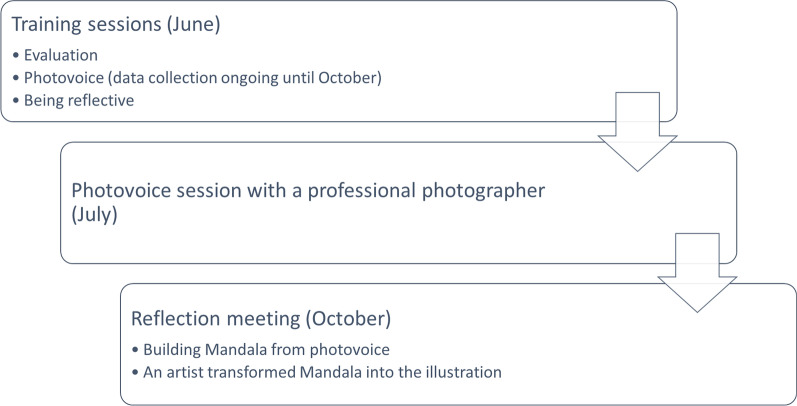
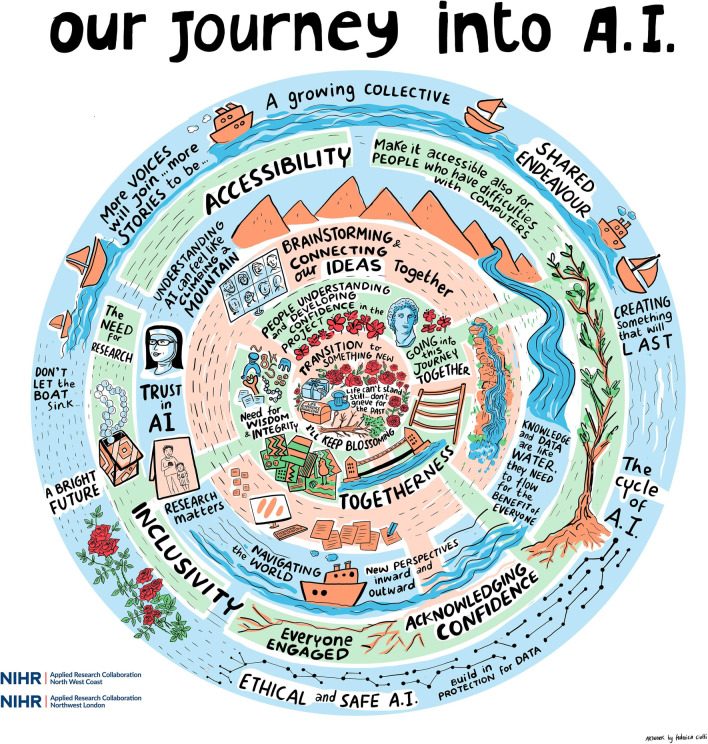
Background: The growth of data science and artificial intelligence offers novel healthcare applications and research possibilities. Patients should be able to make informed choices about using healthcare. Therefore, they must be provided with lay information about new technology. A team consisting of academic researchers, health professionals, and public contributors collaboratively co-designed and co-developed the new resource offering that information. In this paper, we evaluate this novel approach to co-production. Methods: We used participatory evaluation to understand the co-production process. This consisted of creative approaches and reflexivity over three stages. Firstly, everyone had an opportunity to participate in three online training sessions. The first one focused on the aims of evaluation, the second on photovoice (that included practical training on using photos as metaphors), and the third on being reflective (recognising one’s biases and perspectives during analysis). During the second stage, using photovoice, everyone took photos that symbolised their experiences of being involved in the project. This included a session with a professional photographer. At the last stage, we met in person and, using data collected from photovoice, built the mandala as a representation of a joint experience of the project. This stage was supported by professional artists who summarised the mandala in the illustration. Results: The mandala is the artistic presentation of the findings from the evaluation. It is a shared journey between everyone involved. We divided it into six related layers. Starting from inside layers present the following experiences (1) public contributors had space to build confidence in a new topic, (2) relationships between individuals and within the project, (3) working remotely during the COVID-19 pandemic, (4) motivation that influenced people to become involved in this particular piece of work, (5) requirements that co-production needs to be inclusive and accessible to everyone, (6) expectations towards data science and artificial intelligence that researchers should follow to establish public support. Conclusions: The participatory evaluation suggests that co-production around data science and artificial intelligence can be a meaningful process that is co-owned by everyone involved.
Overview
The claims and statistics of this paper haven’t been checked yet.
Free: it reads the open-access text and checks the first 5 claims that cite a source we can check. Create a free account to check every claim.
Integrity signals
Registry
Cites
Statistics
Figures
Verification
Claims the paper makes
The claims and statistics of this paper haven’t been checked yet.
Free: it reads the open-access text and checks the first 5 claims that cite a source we can check. Create a free account to check every claim.
Claims other papers make about this one
Each is checked against this paper’s own text: does it say what the citing paper says it does?
The source backs part of the claim, not all of it — or backs it for a different population, condition or comparison.
In the citing paper
“The participatory approach drew on academic, pedagogical, and lived experience to shape the teaching workshop and assessment materials, helping us spot practical challenges early and promote shared ownership of the development of the assessment (Fetterman et al., 2017; Teodorowski et al., 2023).”
From Participatory Co-Design and Evaluation of a Novel Approach to Generative AI-Integrated Coursework Assessment in Higher Education (2025) · cites this paper as Teodorowski et al., 2023
Experimental — accuracy not yet measured
Self-check
Percentages, sums and reported differences re-computed from the paper’s own numbers.
The self-check needs the paper’s full text.
Citations
Cites
Photovoice: Concept, Methodology, and Use for Participatory Needs Assessment
Wang, C., & Burris, M. A. (1997) · Health Education & Behavior · doi:10.1177/109019819702400309 · Cited by 5,551 · cited 1×
“Photos (taken and selected by people) accompanied by sto - ries behind their meaning allow their authors to reflect more critically and present their experiences [36, 37].”
BackgroundThematic Analysis: A Practical Guide
Braun, V., & Clarke, V. (2022) · QMiP Bulletin · doi:10.53841/bpsqmip.2022.1.33.46 · Cited by 5,438
Staniszewska, S., Brett, J., Simera, I., Seers, K., Mockford, C., Goodlad, S., Altman, D. G., Moher, D., Barber, R., Denegri, S., et al. (2017) · BMJ · doi:10.1136/bmj.j3453 · Cited by 1,983 · cited 1×
“We checked our reporting of public involvement in this evaluation using the GRIPP2 short form [22] (see Additional file 1).”
MethodPhotovoice: A Participatory Action Research Strategy Applied to Women's Health
WANG, C. C. (1999) · Journal of Women's Health · doi:10.1089/jwh.1999.8.185 · Cited by 1,766 · cited 1×
“Photos (taken and selected by people) accompanied by sto - ries behind their meaning allow their authors to reflect more critically and present their experiences [36, 37].”
BackgroundStaniszewska, S., Brett, J., Simera, I., Seers, K., Mockford, C., Goodlad, S., Altman, D. G., Moher, D., Barber, R., Denegri, S., et al. (2017) · Research Involvement and Engagement · doi:10.1186/s40900-017-0062-2 · Cited by 1,643
Empowerment through Photo Novella: Portraits of Participation
Wang, C., & Burris, M. A. (1994) · Health Education Quarterly · doi:10.1177/109019819402100204 · Cited by 1,328 · cited 2×
“Photovoice is embedded in literature around feminism, community-based approaches and education for critical consciousness [34, 35].”
BackgroundPhotovoice: A Review of the Literature in Health and Public Health
Catalani, C., & Minkler, M. (2010) · Health Education & Behavior · doi:10.1177/1090198109342084 · Cited by 1,234 · cited 3×
“Photovoice is a flexible method, and it can be successfully adapted to suit different contexts, groups and projects [41].”
BackgroundMethodInfluentialFrom tokenism to empowerment: progressing patient and public involvement in healthcare improvement
Ocloo, J., & Matthews, R. (2016) · BMJ Quality & Safety · doi:10.1136/bmjqs-2015-004839 · Cited by 998 · cited 1×
“Involvement requires ongoing support, practical and monetary investments to be conducted meaningfully[6].”
BackgroundPhotovoice Ethics: Perspectives from Flint Photovoice
Wang, C. C., & Redwood-Jones, Y. A. (2001) · Health Education & Behavior · doi:10.1177/109019810102800504 · Cited by 800 · cited 2×
“This allowed people to build confidence when positively appraised by a professional photographer [42].”
BackgroundModifying Photovoice for community-based participatory Indigenous research
Castleden, H., Garvin, T., & First Nation, H.-A.-A. (2008) · Social Science & Medicine · doi:10.1016/j.socscimed.2007.11.030 · Cited by 667 · cited 1×
“It fosters trust with researchers and creates a sense of ownership among participants [38].”
BackgroundWang, C. C., Cash, J. L., & Powers, L. S. (2000) · Health Promotion Practice · doi:10.1177/152483990000100113 · Cited by 455 · cited 3×
“Photovoice is an innovative and approachable way to reach external audiences such as other public contributors, researchers or policymakers [30, 35].”
BackgroundMethodYoung, A. T., Amara, D., Bhattacharya, A., & Wei, M. L. (2021) · The Lancet Digital Health · doi:10.1016/s2589-7500(21)00132-1 · Cited by 400 · cited 4×
“The water and boats are present throughout as these " express the sense of adventure, sailing into new experiences as a team " (Public contributor 4).”
BackgroundInfluentialAitken, M., de St. Jorre, J., Pagliari, C., Jepson, R., & Cunningham-Burley, S. (2016) · BMC Medical Ethics · doi:10.1186/s12910-016-0153-x · Cited by 346 · cited 2×
“The public is mostly supportive of reusing their data for health research but remains concerned about how this is being conducted [1–3].”
BackgroundKalkman, S., van Delden, J., Banerjee, A., Tyl, B., Mostert, M., & van Thiel, G. (2022) · Journal of Medical Ethics · doi:10.1136/medethics-2019-105651 · Cited by 292 · cited 1×
“The public is mostly supportive of reusing their data for health research but remains concerned about how this is being conducted [1–3].”
BackgroundCreative Research Methods: A Practical Guide
Kara, H. (2020) · Bristol University Press eBooks · doi:10.51952/9781447356769 · Cited by 274
Boylan, A., Locock, L., Thomson, R., & Staniszewska, S. (2019) · Health Expectations · doi:10.1111/hex.12883 · Cited by 153 · cited 1×
“Some researchers report that public contributors may not be interested in discussing data science [17] and can be more comfortable with involvement in qualitative rather than quantitative research (thanks to their lived experiences) [18].”
BackgroundPhotovoice Ethics: Critical Reflections From Men’s Mental Health Research
Creighton, G., Oliffe, J. L., Ferlatte, O., Bottorff, J. L., Broom, A. F., & Jenkins, E. (2017) · Qualitative Health Research · doi:10.1177/1049732317729137 · Cited by 125 · cited 1×
“However, we recognise the ethical considerations of using photovoice [42, 47].”
BackgroundAitken, M., Cunningham-Burley, S., & Pagliari, C. (2016) · Science and Public Policy · doi:10.1093/scipol/scv075 · Cited by 107
Consensus Statement on Public Involvement and Engagement with Data-Intensive Health Research
Aitken, M., Tully, M. P., Porteous, C., Denegri, S., Cunningham-Burley, S., Banner, N., Black, C., Burgess, M., Cross, L., Van Delden, J., et al. (2019) · International Journal of Population Data Science · doi:10.23889/ijpds.v4i1.586 · Cited by 95 · cited 1×
“This could be achieved by following established standards, for example, key principles for public involvement and engagement in data-intensive health research [52].”
BackgroundInvolving service users in health and social care research
Karlberg, I. H. (2006) · International Journal of Integrated Care · doi:10.5334/ijic.144 · Cited by 91
Facilitating non-tokenistic user involvement in research
Romsland, G. I., Milosavljevic, K. L., & Andreassen, T. A. (2019) · Research Involvement and Engagement · doi:10.1186/s40900-019-0153-3 · Cited by 74 · cited 1×
“Public involvement requires planning and time [48], and creative approaches (such as photovoice and the mandala) might require additional resources and time but offer a novel way of presenting public contributors’ experiences.”
BackgroundBallantyne, A., & Stewart, C. (2019) · Asian Bioethics Review · doi:10.1007/s41649-019-00100-7 · Cited by 65
Jewell, A., Pritchard, M., Barrett, K., Green, P. A., Markham, S., McKenzie, S., Oliver, R., Wan, M., Downs, J. M., & Stewart, R. J. (2019) · Research Involvement and Engagement · doi:10.1186/s40900-019-0152-4 · Cited by 50 · cited 1×
“To facilitate public involvement in complex topics additional training will be required for public contributors and researchers [19].”
BackgroundBroomfield, K., Craig, C., Smith, S. K., Jones, G. L., Judge, S., & Sage, K. (2021) · Research Involvement and Engagement · doi:10.1186/s40900-021-00260-7 · Cited by 48 · cited 1×
“Throughout the evaluation process, we used creative methods [23] to make involvement more easily understood and appreciated by public contributors [24– 26].”
MethodCollaborative, Participatory, and Empowerment Evaluation: Stakeholder Involvement Approaches
Rodríguez‐Campos, L., Zukoski, A. P., & Fetterman, D. M. (2017) · Cited by 48
Vat, L. E., Warren, M., Goold, S. D., Davidge, E., Porter, N., Schuitmaker‐Warnaar, T. J., Broerse, J. E. W., & Etchegary, H. (2020) · Research Involvement and Engagement · doi:10.1186/s40900-020-00206-5 · Cited by 45 · cited 1×
“Participatory evaluation has been successfully used to evaluate public involvement [21].”
MethodLampa, E., Sonnentheil, B., Tökés, A., & Warner, G. (2021) · Research Involvement and Engagement · doi:10.1186/s40900-021-00315-9 · Cited by 44 · cited 1×
“Meaningful remote public involvement is possible [28, 29].”
Adeyemi, I., Sanders, C., Ong, B. N., Howells, K., Quinlivan, L. M., Gorman, L. S., Giles, S. J., Amp, M., Monaghan, E., Naseem, S., et al. (2022) · Research Involvement and Engagement · doi:10.1186/s40900-022-00345-x · Cited by 39 · cited 1×
“Meaningful remote public involvement is possible [28, 29].”
Research Ethics in the Real World: Euro-Western and Indigenous perspectives
Kara, H. (2018) · doi:10.51952/9781447344780 · Cited by 38
A qualitative study of big data and the opioid epidemic: recommendations for data governance
Evans, E., Delorme, E., Cyr, K. D., & Goldstein, D. M. (2020) · BMC Medical Ethics · doi:10.1186/s12910-020-00544-9 · Cited by 33 · cited 1×
“Discussing data science and artificial intelligence with public contributors can be challenging because of the need to present appropriate information using lay language [10–13], as jargon and specialist terms can mar-ginalise anyone unfamiliar with that vocabulary [14].”
BackgroundRemote working in public involvement: findings from a mixed methods study
Jones, E., Frith, L., Gabbay, M., Tahir, N., Hossain, M. Z., Goodall, M., Bristow, K., & Hassan, S. M. (2022) · Research Involvement and Engagement · doi:10.1186/s40900-022-00396-0 · Cited by 32 · cited 2×
“This follows recent research showing that many public contributors prefer a mix of in-person and remote involvement [27].”
BackgroundMethodHidden Heroines: Lone Mothers Assessing Community Health Using Photovoice
Duffy, L. (2008) · Health Promotion Practice · doi:10.1177/1524839908324779 · Cited by 31 · cited 1×
“Photovoice is a popular method to empower seldom-heard groups [35, 39, 40] and has been previously used to involve communities around health issues [31].”
MethodDorey, C. M., Baumann, H., & Biller‐Andorno, N. (2018) · BMC Medical Ethics · doi:10.1186/s12910-018-0261-x · Cited by 31
Teng, J., Bentley, C., Burgess, M., O’Doherty, K. C., & McGrail, K. M. (2019) · International Journal for Population Data Science · doi:10.23889/ijpds.v4i1.1103 · Cited by 31 · cited 1×
“Providing introductory information for public contributors around data science is not new; e.g. Teng and colleagues [9] provided members of the public with a booklet written by researchers on what linked data sets are and contentious issues around their use to provide a base for the discussion.”
BackgroundInvolving consumers in the work of a data linkage research unit
Jones, K. H., McNerney, C., & Ford, D. V. (2013) · International Journal of Consumer Studies · doi:10.1111/ijcs.12062 · Cited by 30 · cited 1×
“Discussing data science and artificial intelligence with public contributors can be challenging because of the need to present appropriate information using lay language [10–13], as jargon and specialist terms can mar-ginalise anyone unfamiliar with that vocabulary [14].”
BackgroundPalmeirim, M. S., Ross, A. J., Obrist, B., Mohammed, U. A., Ame, S. M., Ali, S. M., & Keiser, J. (2020) · BMC Medical Ethics · doi:10.1186/s12910-019-0441-3 · Cited by 27
Broadening diversity through creative involvement to identify research priorities
Tierney, S., Dawson, S., Boylan, A. R., Richards, G., Park, S. E., Turk, A., & Babatunde, O. O. (2021) · Research Involvement and Engagement · doi:10.1186/s40900-020-00244-z · Cited by 27 · cited 3×
“Tweet Chat has been utilised successfully by other researchers [24].”
BackgroundMethodCo-design of Guidance for Patient and Public Involvement in Psychedelic Research
Close, J. B., Bornemann, J., Piggin, M., Jayacodi, S., Luan, L. X., Carhart-Harris, R. L., & Spriggs, M. J. (2021) · Frontiers in Psychiatry · doi:10.3389/fpsyt.2021.727496 · Cited by 27 · cited 1×
“As this study is classified as evaluation and public involvement, all involved in the project are considered as collaborators not sources of data, and therefore no ethical approval is required [46].”
BackgroundWatson, M., & Douglas, F. (2012) · International Journal of Health Promotion and Education · doi:10.1080/14635240.2012.723379 · Cited by 23 · cited 1×
“Photovoice is a popular method to empower seldom-heard groups [35, 39, 40] and has been previously used to involve communities around health issues [31].”
MethodFedorowicz, S. E., Riley, V., Cowap, L., Ellis, N., Chambers, R. M., Grogan, S., Crone, D., Cottrell, E., Clark-Carter, D. D., Roberts, L. M., et al. (2022) · Health Expectations · doi:10.1111/hex.13515 · Cited by 22 · cited 1×
“This was similar to Fedorowicz and colleagues [43] use of Facebook for public involvement to allow more exchanges among public contributors.”
Hopeful and Concerned: Public Input on Building a Trustworthy Medical Information Commons
Deverka, P. A., Gilmore, D., Richmond, J., Smith, Z. H., Mangrum, R., Koenig, B. A., Cook-Deegan, R. M., Villanueva, A. G., Majumder, M. A., & McGuire, A. L. (2019) · The Journal of Law Medicine & Ethics · doi:10.1177/1073110519840486 · Cited by 20
Necessary connections: ‘Feelings photographs’ in criminal justice research
Rogers, C. (2020) · Methodological Innovations · doi:10.1177/2059799120925255 · Cited by 19 · cited 1×
“Photos are known to enable people to make and share their experiences [49].”
BackgroundTeodorowski, P., Rodgers, S., Fleming, K. M., Tahir, N., Ahmed, S., & Frith, L. (2023) · Health Expectations · doi:10.1111/hex.13713 · Cited by 19 · cited 1×
“Teodorowski and colleagues [54], explored the experiences of researchers and public involvement facilitators in involving and engaging sel-dom-heard communities in big data research; they recognise that there is no one right approach to working with all communities.”
BackgroundSelf-citationMandalas as a visual research method for understanding primary care for depression
Palmer, V. J., Dowrick, C. F., & Gunn, J. M. (2013) · International Journal of Social Research Methodology · doi:10.1080/13645579.2013.796764 · Cited by 17 · cited 1×
“It offers an opportunity for people to reflect and produce new data [44].”
BackgroundEmpowering Maasai women behind the camera: Photovoice as a tool for trachoma control
Mtuy, T. B., Mepukori, J., Lankoi, J., & Lees, S. S. (2021) · Research Involvement and Engagement · doi:10.1186/s40900-021-00286-x · Cited by 17 · cited 2×
“Photovoice is a popular method to empower seldom-heard groups [35, 39, 40] and has been previously used to involve communities around health issues [31].”
MethodResultUse of Photovoice to engage stakeholders in planning for patient-centered outcomes research
Connors, J. D. N., Conley, M. J., & Lorenz, L. S. (2019) · Research Involvement and Engagement · doi:10.1186/s40900-019-0166-y · Cited by 16
Co-development of a Best Practice Checklist for Mental Health Data Science: A Delphi Study
Kirkham, E., Crompton, C. J., Iveson, M. H., Beange, I., McIntosh, A. M., & Fletcher‐Watson, S. (2021) · Frontiers in Psychiatry · doi:10.3389/fpsyt.2021.643914 · Cited by 15 · cited 1×
“Involving those with a better understanding of the topic could overcome this barrier but such groups could have different views than a wider population [16].”
BackgroundPublic Involvement & Engagement in the work of a data safe haven: a case study of the SAIL Databank
Jones, K. H., Heys, S., Thompson, R., Cross, L., & Ford, D. V. (2020) · International Journal for Population Data Science · doi:10.23889/ijpds.v5i3.1371 · Cited by 10 · cited 1×
“involvement groups that focus on what they perceive as technical topics [15].”
BackgroundCook, L., Rothstein, P. A. A. P., Emeh, L., Frumiento, P., Kennedy, D. A., McNicholas, D., Orjiekwe, I., Overton, M., Snead, M., Steward, R., et al. (2021) · British Journal of Learning Disabilities · doi:10.1111/bld.12408 · Cited by 9 · cited 1×
“This aligns with previous research with public contributors emphasising that motivation to make a difference is an important aspect of why public members join the research project as public contributors [51].”
BackgroundSelf-citationConsumer engagement in doctoral research – what difference does it make?
Rees, L., Sherwood, M., & Shields, N. (2022) · Spinal Cord · doi:10.1038/s41393-022-00871-1 · Cited by 9 · cited 1×
“Public contributors can have biases when expressing their views [53].”
BackgroundGilbertson, A., Ridd, M. J., Sutton, E. J., Liddiard, L., Clayton, J., Roberts, A., Chan, J., Bhanot, A., Wellesley, R., & Dawson, S. (2021) · Research Involvement and Engagement · doi:10.1186/s40900-021-00251-8 · Cited by 5
Research works printed but not linked: 1
- Broomfield K Volkmer A Broomfield K The unspoken voices project: creating accessible research through collaborative design Seldom heard voices in service user involvement 2022 Croydon J&R Press 111 128
Cited by
Co-creation experiences among adults in diverse contexts: A Health CASCADE scoping review
McCaffrey, L., McCann, B., Giné‐Garriga, M., An, Q., Cardon, G., CHASTIN, S. F. M., Chrifou, R., Lippke, S., Loisel, Q. E. A., Longworth, G. R., et al. (2024) · Public Health · doi:10.1016/j.puhe.2024.11.002 · Cited by 17
Martin, A. F., Tubaltseva, S., Harrison, A., & Rubin, G. J. (2025) · Behavioral Sciences · doi:10.3390/bs15060808 · Cited by 16
“The participatory approach drew on academic, pedagogical, and lived experience to shape the teaching workshop and assessment materials, helping us spot practical challenges early and promote shared ownership of the development of the assessment (Fetterman et al., 2017; Teodorowski et al., 2023).”
Reynolds, D. J., Mountain, S., Bartle, V., Remfry, E., Barnes, M. R., Reynolds, N. J., Thompson, A., MULTIPLY, A., Apea, V., Barnes, M., et al. (2025) · Research Involvement and Engagement · doi:10.1186/s40900-025-00753-9 · Cited by 5
Public Involvement in Cancer Research: Collaborative Evaluation Using Photovoice
Teodorowski, P., McInnes, M., Dale, G., Galbraith, L. D., Radin, E., Gold, K., & Gadsby, E. W. (2025) · JMIR Cancer · doi:10.2196/75741 · Cited by 3
“Creativity has been used successfully in previous public involvement [25] and to evaluate the involvement process [26].”
Self-citationBradbury, N. V., Roberts, J. L., Lock, S., Haddon, L., Begum, S., Goulão, B., Mackintosh, N. J., Newby, C., O’Reilly, M. J., & Gray, L. J. (2025) · PLoS ONE · doi:10.1371/journal.pone.0330232 · Cited by 3
“Therefore, we have used our knowledge of the field to incorporate the areas of statistical methodology that develop and evaluate statistical methods for healthcare (e.g., clinical trials methodology [12–15] and data science [16]).”
Metadata
- Authors
- Teodorowski, P., Gleason, K., Gregory, J. J., Martin, M., Punjabi, R., Steer, S., Savasir, S., Vema, P., Murray, K., Ward, H., & Chapko, D.
- Affiliations
- University of Liverpool (GB)
- Imperial College London (GB)
- National Institute for Health and Care Research (GB)
- Corresponding author
- Teodorowski, Piotr
- Venue
- Research Involvement and Engagement
- Published
- 2023-08-14
- Volume
- 9
- Issue
- 1
- Pages
- 67-67
- ISSN
- 2056-7529 (ISSN-L)
- PMC
- PMC10426152
- OpenAlex
- W4385800058
- Semantic Scholar
- 2556a6088e87734267c9ac8c8c6d1c8bb5092b5f
- Cited by
- 8
- References
- 51
- Citations by year
- 2026: 1 · 2025: 6 · 2024: 1
- FWCI
- 3.44
- Type
- journal article
- Language
- en
- Open access
- gold
- doi.org
- Licence
- cc-by
- creativecommons.org/licenses/by/4.0 (tdm)
- creativecommons.org/licenses/by/4.0 (vor)
- Locations
- Research Involvement and Engagement (publishedVersion, cc-by)
- PubMed Central (publishedVersion, cc-by)
- PubMed (publishedVersion)
- DOAJ (DOAJ: Directory of Open Access Journals) (submittedVersion, cc-by-sa)
- Spiral (Imperial College London) (submittedVersion, cc-by)
- Funders
- NIHR Applied Research Collaboration (ARC) North West Coast
- NIHR Short Placement Award for Research Collaboration
- NIHR Applied Research Collaboration (ARC) North West London
- National Institute for Health and Care Research (NIHR) Senior Investigator,
- NIHR Imperial Biomedical Research Centre
- Topics
- Social Sciences › Sociology and Political Science › Participatory Visual Research Methods
- Health Sciences › Health Professions › General Health Professions › Mental Health and Patient Involvement
- Health Sciences › Medicine › Public Health, Environmental and Occupational Health › Community Health and Development
- Keywords
- co-production, participatory evaluation, data science, artificial intelligence, citizen participation, photovoice, mandala, reflexivity, public understanding of technology, health technology, co-design, inclusive participation, COVID-19 remote work
About these checks
Registry, retraction, Cites and statistics results are computed, not judged, with one exception: a printed reference that no index lists is read once by a model before it counts as a citation error. Claims are extracted by a model and kept only when their quote appears verbatim in the text; each cited source is then checked, with a model’s help, for whether it says what the claim relies on. Those verdicts can be wrong — read the claim’s quote and the cited source before relying on one.
Statistics and arithmetic are recomputed, not judged.
Confidence bands are shown only for fields calibrated on our annotated test set. None is calibrated yet, so no band is shown.
What counts as a claim ›How we measure confidence ›How we check this ›
Are you an author, or do you see a problem with this page? Request a review
Data sources
Bibliographic data: Semantic Scholar, OpenAlex, Crossref.
Contains information from the Semantic Scholar Academic Graph Datasets, made available under the ODC Attribution License (ODC-BY 1.0).
Semantic Scholar’s data is described in: Kinney, R., et al. (2023). The Semantic Scholar Open Data Platform. arXiv:2301.10140.
