

The DOI matches its Crossref record; 30 of the 30 references it cites were found in a registry or an index.
Evaluation of facial appearance in patients with repaired cleft lip and palate: comparing the assessment of laypeople and healthcare professionals.
Open accessAbstract
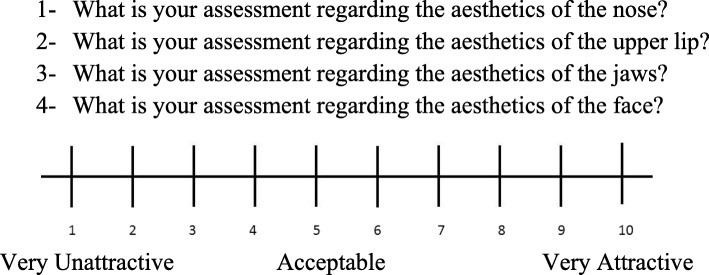
BACKGROUND: The present study aimed to determine whether laypeople and professionals rate the facial appearance of individuals with repaired complete unilateral or bilateral cleft lip and palate (UCLP, BCLP) similarly based on viewing full facial images. METHODS: The study followed a cross-sectional analytical design where five young patients aged 10 to 14 years, who had completed all stages of their unilateral or bilateral cleft lip and palate treatment (bilateral: three, unilateral: two), were evaluated by two groups. The assessment was done by laypeople and 97 qualified professionals (33 orthodontists, 32 plastic surgeons, and 32 oral and maxillofacial surgeons). Professionals were not involved in any stage of the patients' treatment. RESULTS: The facial appearance assessment of the professional groups on different facial aesthetics was significantly lower than that of laypeople, and they had higher perceived need for further treatment. On the other hand, laypeople had higher aesthetic ratings and lower perceived need for further treatment. Differences were also observed between the assessments of the professional groups. Participants who had lower aesthetic assessments of the repair tended to report a higher influence of cleft lip and palate on social activities and professional life. CONCLUSION: Differences in perception exist between healthcare professionals and laypeople. The discrepancies between the professional groups could be attributed to different treatment modalities and protocols.
Overview
The claims and statistics of this paper haven’t been checked yet.
Run the check — free, no account needed. It reads the open-access text and checks the sources it cites.
Integrity signals
Registry
Cites
Statistics
Figures
Verification
Claims the paper makes
The claims and statistics of this paper haven’t been checked yet.
Run the check — free, no account needed. It reads the open-access text and checks the sources it cites.
Claims other papers make about this one
Each is checked against this paper’s own text: does it say what the citing paper says it does?
The cited source says what the claim attributes to it.
In the citing paper
“The usefulness of this perspective is underscored by studies showing that clinicians are often more critical of craniofacial anomalies compared with the public.23–25”
From Long-term Outcomes of Infant Ear Molding: A 10-year Single-Surgeon Experience (2025) · cites this paper as [25]
Self-check
Percentages, sums and reported differences re-computed from the paper’s own numbers.
The self-check needs the paper’s full text.
Citations
Cites
Infant preferences for attractive faces: Rudiments of a stereotype?
Langlois, J. H., Roggman, L. A., Casey, R. J., & Ritter, J. M. (1987) · Developmental Psychology · doi:10.1037//0012-1649.23.3.363 · Cited by 479
Adjusting to disfigurement: processes involved in dealing with being visibly different
Thompson, A., & Kent, G. (2001) · Clinical Psychology Review · doi:10.1016/s0272-7358(00)00056-8 · Cited by 397
Sinko, K., Jagsch, R., Prechtl, V., Watzinger, F., Hollmann, K., & Baumann, A. (2005) · The Cleft Palate-Craniofacial Journal · doi:10.1597/03-142.1 · Cited by 220
Current Surgical Practices in Cleft Care: Cleft Palate Repair Techniques and Postoperative Care
Katzel, E. B., Basile, P. L., Koltz, P. F., Marcus, J. R., & Girotto, J. A. (2009) · Plastic & Reconstructive Surgery · doi:10.1097/prs.0b013e3181b03824 · Cited by 190
Panel Perception of Facial Attractiveness
Kerr, W. J. S., & O'Donnell, J. M. (1990) · British Journal of Orthodontics · doi:10.1179/bjo.17.4.299 · Cited by 178
Facial appearance in adults who had cleft lip and palate treated in childhood
Marcusson, A., Paulin, G., & Östrup, L. (2002) · Scandinavian Journal of Plastic and Reconstructive Surgery and Hand Surgery · doi:10.1080/028443102753478327 · Cited by 177
A qualitative study of teenagers’ decisions to undergo orthodontic treatment with fixed appliance
Trulsson, U., Strandmark, M., Mohlin, B. O., & Berggren, U. (2002) · Journal of Orthodontics · doi:10.1093/ortho/29.3.197 · Cited by 120
A comparison of the perception of facial profile by the general public and 3 groups of clinicians.
Cochrane, S. M., Cunningham, S. J., & Hunt, N. P. (1999) · PubMed · Cited by 117
Broder, H. L., Smith, F. B., & Strauss, R. P. (1994) · The Cleft Palate-Craniofacial Journal · doi:10.1597/1545-1569_1994_031_0429_eovaio_2.3.co_2 · Cited by 112
Social Anxiety in Chinese Adults With Oral-Facial Clefts
Berk, N. W., Cooper, M. E., Liu, Y.-E., & Marazita, M. L. (2001) · The Cleft Palate-Craniofacial Journal · doi:10.1597/1545-1569_2001_038_0126_saicaw_2.0.co_2 · Cited by 101
Development of Scales of Severity of Facial Cleft Impairment
Tobiasen, J. M., Hiebert, J. M., & Boraz, R. A. (1991) · The Cleft Palate-Craniofacial Journal · Cited by 86
Validity of Subjective Evaluations for the Assessment of Lip Scarring and Impairment
Ritter, K., Trotman, C., & Phillips, C. L. (2002) · The Cleft Palate-Craniofacial Journal · Cited by 62
Pitak‐Arnnop, P., Hemprich, A., Dhanuthai, K., Yildirim, V., & Pausch, N. C. (2010) · Journal of Cranio-Maxillofacial Surgery · doi:10.1016/j.jcms.2010.07.007 · Cited by 59
Treatment Outcome in Cleft Lip and Palate: Issues and Perspectives
Mølsted, K. (1999) · Critical Reviews in Oral Biology & Medicine · doi:10.1177/10454411990100020801 · Cited by 56
Lo, L., Wong, F.-H., Mardini, S., Chen, Y.-R., & Noordhoff, M. S. (2002) · Plastic & Reconstructive Surgery · doi:10.1097/00006534-200209010-00001 · Cited by 53
Appreciation of cleft lip and palate treatment outcome by professionals and laypeople
Papamanou, D. A., Gkantidis, N., Topouzelis, N., & Christou, P. (2011) · European Journal of Orthodontics · doi:10.1093/ejo/cjr073 · Cited by 51
Pattern of craniofacial anomalies seen in a tertiary care hospital in Saudi Arabia
Aziza, A., Kandasamy, R., & Shazia, S. (2011) · Annals of Saudi Medicine · doi:10.4103/0256-4947.84626 · Cited by 45
Mani, M. R., Semb, G., & Andlin‐Sobocki, A. (2010) · Journal of Plastic Surgery and Hand Surgery · doi:10.3109/02844311.2010.499671 · Cited by 45
Assessing Patient-Reported Outcomes Following Orthognathic Surgery and Osseous Genioplasty
Schwitzer, J. A., Albino, F. P., Mathis, R. K., Scott, A., Gamble, L., & Baker, S. B. (2015) · Journal of Craniofacial Surgery · doi:10.1097/scs.0000000000001983 · Cited by 37
Chung, E. H., Borzabadi‐Farahani, A., & Yen, S. L.-K. (2013) · International Journal of Pediatric Otorhinolaryngology · doi:10.1016/j.ijporl.2013.05.042 · Cited by 33
Foo, P., Sampson, W. J., Roberts, R., Jamieson, L., & David, D. (2011) · European Journal of Orthodontics · doi:10.1093/ejo/cjr129 · Cited by 31
Approaches to Cleft Lip and Palate Repair
de la Pedraja, J., Erbella, J., McDonald, S. W., & Thaller, S. R. (2000) · Journal of Craniofacial Surgery · doi:10.1097/00001665-200011060-00009 · Cited by 26
Attitude variables of dentofacial deformity patients: Demographic characteristics and associations
Mayo, K. H., Vig, K. W. L., Vig, P. S., & Kowalski, C. J. (1991) · Journal of Oral and Maxillofacial Surgery · doi:10.1016/0278-2391(91)90341-i · Cited by 26
The Dental Health and Caries-Related Microflora in Children With Craniosynostosis
Mustafa, D., Lucas, V. S., Junod, P., Evans, R. D., Mason, C., & ROBERTS, G. J. (2001) · The Cleft Palate-Craniofacial Journal · doi:10.1597/1545-1569(2001)038<0134:teonso>2.0.co;2 · Cited by 26
Paiva, T. B. S., André, M., Paiva, W. S., & Mattos, B. S. C. (2014) · BioMed Research International · doi:10.1155/2014/460106 · Cited by 24
Current knowledge in cleft lip and palate treatment from an orthodontist's point of view
Friede, H., & Katsaros, C. (1998) · Journal of Orofacial Orthopedics / Fortschritte der Kieferorthopädie · doi:10.1007/bf01299768 · Cited by 21
Jabbari, F., Hakelius, M. M., Thor, A. L. I., Reiser, E., Skoog, V. T., & Nowinski, D. J. (2016) · Plastic & Reconstructive Surgery · doi:10.1097/prs.0000000000002910 · Cited by 20
Ethical and scientific decision making in distraction osteogenesis.
Shaw, W. C., Mandall, N., & Mattick, C. (2002) · The Cleft Palate-Craniofacial Journal · doi:10.1597/1545-1569(2002)039<0392:fcapda>2.0.co;2 · Cited by 14
Motor Control of Velopharyngeal Structures during Vowel Production
Moon, J. B., & Jones, D. L. (1991) · The Cleft Palate-Craniofacial Journal · doi:10.1597/1545-1569(1991)028<0055:gotcbi>2.3.co;2 · Cited by 11
Furusawa, K., Yamaoka, M., & Ichikawa, N. (1994) · The Cleft Palate-Craniofacial Journal · doi:10.1597/1545-1569(1994)031<0008:doasor>2.3.co;2 · Cited by 3
Research works printed but not linked: 1
- Adams GR (1981) The effects of physical attractiveness on the socialization process. Psychological aspects of facial form Craniofacial growth series monograph 11:25–47
Cited by
Cho, S.-W., Byun, S., Yi, S.-M., Jang, W.-S., Kim, J., Park, I. Y., & Yang, B. (2021) · Journal of Personalized Medicine · doi:10.3390/jpm11030203 · Cited by 37
Social attractiveness perception of a cleft lip repair in an adolescent via eye-tracking
Hartmann, G. C., Guimarães, L. K., Maggioni, C. G., Gasparello, G. G., Júnior, S. L. M., Pithon, M. M., & Tanaka, O. M. (2022) · Journal of Stomatology Oral and Maxillofacial Surgery · doi:10.1016/j.jormas.2022.01.007 · Cited by 15
The use of hyaluronic acid in individuals with cleft lip and palate
Molena, K. F., Pinto, L. D. C., & Dalben, G. D. S. (2021) · Journal of Cleft Lip Palate and Craniofacial Anomalies · doi:10.4103/jclpca.jclpca_2_21 · Cited by 14
Guimarães, L. K., Gasparello, G. G., Pithon, M. M., Bark, M. J., Júnior, S. L. M., & Tanaka, O. M. (2022) · Journal of Dental Research Dental Clinics Dental Prospects · doi:10.34172/joddd.2022.008 · Cited by 9
Tan, R. A., Mulder, F. J., Schwirtz, R. M. F., Mosmuller, D. G. M., de Vet, H. C. W., & Griot, J. P. W. D. (2021) · The Cleft Palate-Craniofacial Journal · doi:10.1177/1055665620982801 · Cited by 8
Metadata
- Authors
- Alhayek, S., Alsalem, M., Alotaibi, Y., & Omair, A.
- Affiliations
- King Saud bin Abdulaziz University for Health Sciences (SA)
- Corresponding author
- Alsalem, Mohammed
- Venue
- Maxillofacial Plastic and Reconstructive Surgery
- Published
- 2019-02-06
- Volume
- 41
- Issue
- 1
- Pages
- 5-5
- ISSN
- 2288-8101 (ISSN-L)
- 2288-8586
- PMC
- PMC6363809
- OpenAlex
- W2922063795
- Cited by
- 25
- References
- 26
- Citations by year
- 2026: 1 · 2025: 5 · 2024: 4 · 2023: 2 · 2022: 5 · 2021: 4 · 2020: 3 · 2019: 1
- FWCI
- 1.96
- Type
- journal article
- Language
- en
- Open access
- gold
- doi.org
- Licence
- cc-by
- creativecommons.org/licenses/by/4.0 (tdm)
- Locations
- Maxillofacial Plastic and Reconstructive Surgery (publishedVersion, cc-by)
- Europe PMC (PubMed Central) (publishedVersion, other-oa)
- PubMed Central (publishedVersion, cc-by)
- PubMed (publishedVersion)
- DOAJ (DOAJ: Directory of Open Access Journals) (submittedVersion, cc-by-sa)
- Topics
- Health Sciences › Dentistry › Oral Surgery › Cleft Lip and Palate Research
- Health Sciences › Dentistry › Orthodontics › Orthodontics and Dentofacial Orthopedics
- Health Sciences › Medicine › Surgery › Reconstructive Facial Surgery Techniques
- Keywords
- cleft lip and palate, facial appearance, facial aesthetics, cleft repair, layperson perception, orthodontists, plastic surgeons, oral and maxillofacial surgeons, pediatric patients
About these checks
Registry, retraction, Cites and statistics results are computed, not judged, with one exception: a printed reference that no index lists is read once by a model before it counts as a citation error. Claims are extracted by a model and kept only when their quote appears verbatim in the text; each cited source is then checked, with a model’s help, for whether it says what the claim relies on. Those verdicts can be wrong — read the claim’s quote and the cited source before relying on one.
Statistics and arithmetic are recomputed, not judged.
Confidence bands are shown only for fields calibrated on our annotated test set. None is calibrated yet, so no band is shown.
What counts as a claim ›How we measure confidence ›How we check this ›
Are you an author, or do you see a problem with this page? Request a review
Data sources
Bibliographic data: Semantic Scholar, OpenAlex, Crossref.
Contains information from the Semantic Scholar Academic Graph Datasets, made available under the ODC Attribution License (ODC-BY 1.0).
Semantic Scholar’s data is described in: Kinney, R., et al. (2023). The Semantic Scholar Open Data Platform. arXiv:2301.10140.
