

The DOI matches its Crossref record; 45 of the 46 references it cites were found in a registry or an index.
Positive postpartum depression screening practices and subsequent mental health treatment for low-income women in Western countries: a systematic literature review
Open accessAbstract
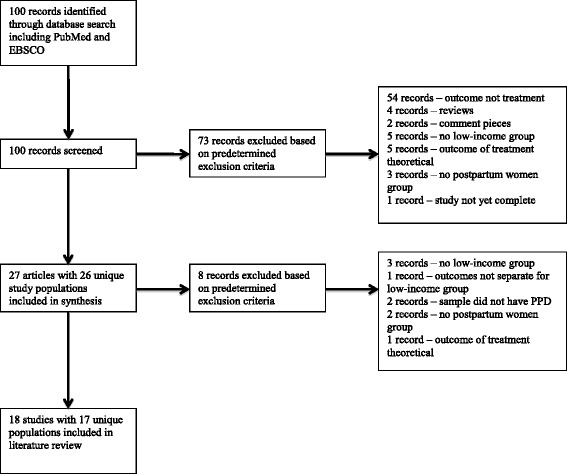
PROBLEM STATEMENT AND SIGNIFICANCE: Left undiagnosed and/or untreated, the short-and long-term sequelae of postpartum depression may negatively impact both mother and child. In Western countries, access to mental health care is influenced by socioeconomic factors. The objective of this systematic literature review is to compile factors that hinder and improve access to postpartum depression treatment in low-income women after a positive screen for postpartum depression. The key question of focus is: what are the characteristics associated with access to mental health treatment for low-income women with a positive postpartum depression screen in Western countries? METHODS: A PRISMA-based systematic literature review was conducted of studies published in English before February 2016 that looked at treatment for postpartum depression in low-income women who had been identified with the condition. PubMed and EBSCO databases were searched using MESH and key terms and found 100 articles that met the selection criteria. After review by two independent researchers, 18 studies with 17 unique populations were included in the literature review. RESULTS: Two independent abstractors searched the included articles for themes surrounding impediments and advantages for low-income women identified with postpartum depression in obtaining mental health treatment. Characteristics of successful mental health treatment included studies that employed the use of a home visitor and those that separated outcomes for women with previous mental health treatment. Themes that emerged as treatment obstacles included cultural barriers, physical barriers, systemic health care barriers, and social barriers. IMPLICATIONS FOR PRACTICE: This review will help to better inform screening and treatment priorities for those in the medical field who may encounter women experiencing postpartum depression and are not aware of the various barriers to care specific to low-income women. This review will also help policymakers identify specific obstacles that are not addressed in postpartum screening mandate policies which can affect the implementation of these policies.
Overview
The claims and statistics of this paper haven’t been checked yet.
Run the check — free, no account needed. It reads the open-access text and checks the sources it cites.
Integrity signals
Registry
Cites
Statistics
Figures
Verification
Claims the paper makes
The claims and statistics of this paper haven’t been checked yet.
Run the check — free, no account needed. It reads the open-access text and checks the sources it cites.
Claims other papers make about this one
Each is checked against this paper’s own text: does it say what the citing paper says it does?
The source backs part of the claim, not all of it — or backs it for a different population, condition or comparison.
In the citing paper
“Attendance is lower among marginalized populations who may have limited resources [64, 65]; these populations are also at increased risk for perinatal mental health conditions [9, 66].”
From Factors associated with postpartum depression symptoms following antepartum hospitalization (2026) · cites this paper as [66]
Experimental — accuracy not yet measured
Self-check
Percentages, sums and reported differences re-computed from the paper’s own numbers.
The self-check needs the paper’s full text.
Citations
Cites
Satcher, D. S. (2001) · University Libraries (University of Maryland) · doi:10.13016/jela-ckxw · Cited by 2,016
Postpartum depression: current status and future directions
O'Hara, M. W., & McCabe, J. E. (2013) · Annual Review of Clinical Psychology · doi:10.1146/annurev-clinpsy-050212-185612 · Cited by 1,750
(2001) · PsycEXTRA Dataset · doi:10.1037/e415842005-001 · Cited by 1,307
Gender, Poverty, and Postnatal Depression: A Study of Mothers in Goa, India
Patel, V., Rodrigues, M., & DeSouza, N. (2002) · American Journal of Psychiatry · doi:10.1176/appi.ajp.159.1.43 · Cited by 774
Postpartum Depression: A Metasynthesis
Beck, C. T. (2002) · Qualitative Health Research · doi:10.1177/104973202129120016 · Cited by 434
Miller, L. J. (2002) · JAMA · doi:10.1001/jama.287.6.762 · Cited by 367
Racial and Ethnic Disparities in Postpartum Depression Care Among Low-Income Women
Kozhimannil, K. B., Trinacty, C. M., Busch, A. B., Huskamp, H. A., & Adams, A. S. (2011) · Psychiatric Services · doi:10.1176/ps.62.6.pss6206_0619 · Cited by 331
New insights into perinatal depression: pathogenesis and treatment during pregnancy and postpartum
Meltzer-Brody, S. E. (2011) · Dialogues in Clinical Neuroscience · doi:10.31887/dcns.2011.13.1/smbrody · Cited by 304
Abrams, L. S., Dornig, K., & Curran, L. (2009) · Qualitative Health Research · doi:10.1177/1049732309332794 · Cited by 225
POSTPARTUM DEPRESSION: LITERATURE REVIEW OF RISK FACTORS AND INTERVENTIONS
Stewart, D. E., Robertson, E., Dennis, C., & Grace, S. L. (2003) · Cited by 223
Postpartum Depression and Help‐Seeking Behaviors in Immigrant Hispanic Women
Callister, L. C., Beckstrand, R. L., & Corbett, C. (2011) · Journal of Obstetric, Gynecologic & Neonatal Nursing · doi:10.1111/j.1552-6909.2011.01254.x · Cited by 149
Tandon, S. D., Leis, J. A., Mendelson, T., Perry, D. F., & Kemp, K. (2014) · Maternal and Child Health Journal · doi:10.1007/s10995-013-1313-y · Cited by 142 · cited 3×
“Studies have shown that PPD occurs two to four times as often for women living in poverty, as compared to middle-or-upper-income women; socioeconomic status is often thought to be the most consistent predictor of PPD [1, 2, 4, 7, 11, 12, 15].”
BackgroundPostpartum Depression and Help‐Seeking Behavior
McGarry, J., Kim, H., Sheng, X., Egger, M. J., & Baksh, L. (2008) · Journal of Midwifery & Women s Health · doi:10.1016/j.jmwh.2008.07.003 · Cited by 123
Prevalence of postpartum depression in a Moroccan sample
Agoub, M., Moussaoui, D., & Battas, O. (2005) · Archives of Women s Mental Health · doi:10.1007/s00737-005-0069-9 · Cited by 122
Concepts of social inclusion, exclusion and mental health: a review of the international literature
Wright, N., & Stickley, T. (2012) · Journal of Psychiatric and Mental Health Nursing · doi:10.1111/j.1365-2850.2012.01889.x · Cited by 113
Canadian Mothers’ Perceived Support Needs During Postpartum Depression
Letourneau, N., Duffett‐Leger, L., Stewart, M., Hegadoren, K., Dennis, C., Rinaldi, C. M., & Stoppard, J. M. (2007) · Journal of Obstetric, Gynecologic & Neonatal Nursing · doi:10.1111/j.1552-6909.2007.00174.x · Cited by 110
Postnatal depression in primary care populations in Nigeria
Abiodun, O. A. (2006) · General Hospital Psychiatry · doi:10.1016/j.genhosppsych.2005.11.002 · Cited by 100
O’Mahony, J. M., & Donnelly, T. T. (2012) · Journal of Psychiatric and Mental Health Nursing · doi:10.1111/jpm.12005 · Cited by 90
Theoretical Perspectives of Postpartum Depression and Their Treatment Implications
Beck, C. T. (2002) · MCN The American Journal of Maternal/Child Nursing · doi:10.1097/00005721-200209000-00008 · Cited by 88
Prevalence and Risk Factors for Postpartum Depressive Symptoms Among Women Enrolled in WIC
Pooler, J. A., Perry, D. F., & Ghandour, R. M. (2013) · Maternal and Child Health Journal · doi:10.1007/s10995-013-1224-y · Cited by 85
Kozhimannil, K., Adams, A., Soumerai, S., Busch, A., & Huskamp, H. (2011) · Health Affairs · doi:10.1377/hlthaff.2009.1075 · Cited by 81
The Community Child Health Network Investigators, Dolbier, C. L., Rush, T. E., Sahadeo, L., Shaffer, M. L., & Thorp, J. M. (2012) · Maternal and Child Health Journal · doi:10.1007/s10995-012-1123-7 · Cited by 80
O’Mahony, J. M., Donnelly, T. T., Bouchal, S. R., & Este, D. (2012) · Advances in Nursing Science · doi:10.1097/ans.0b013e3182626137 · Cited by 79
Crockett, K., Zlotnick, C., Davis, M., Payne, N., & Washington, R. (2008) · Archives of Women's Mental Health · doi:10.1007/s00737-008-0036-3 · Cited by 73
Song, D., Sands, R. G., & Wong, Y.-L. I. (2004) · Women & Health · doi:10.1300/j013v39n01_01 · Cited by 70
Broom, M. A., Ladley, A., Rhyne, E. A., & Halloran, D. R. (2015) · JMIR Mental Health · doi:10.2196/mental.4074 · Cited by 68
Detection and treatment rates for perinatal depression in a state Medicaid population
Geier, M., Hills, N. K., Gonzales, M., Tum, K., & Finley, P. R. (2014) · CNS Spectrums · doi:10.1017/s1092852914000510 · Cited by 64
Postpartum psychiatric disorders
Robinson, G. E., & Stewart, D. E. (2018) · Nature Reviews Disease Primers · doi:10.1038/nrdp.2018.23 · Cited by 63
Beeber, L. S., Holditch‐Davis, D., Belyea, M. J., Funk, S. G., & Canuso, R. (2004) · Health Care For Women International · doi:10.1080/07399330490444830 · Cited by 61
Prevalence of postnatal depression in Western Nigerian women: a controlled study
Adewuya, A. O., Eegunranti, B. A., & Lawal, A. M. (2005) · International Journal of Psychiatry in Clinical Practice · doi:10.1080/13651500510018211 · Cited by 61
Fattori di rischio nella depressione post partum
Marino, M., Battaglia, E., Massimino, M., & Aguglia, E. (2012) · Rivista di psichiatria · doi:10.1708/1128.12439 · Cited by 60
Risk factors for postpartum depression
Liu, J. (2012) · The Chinese Journal of Human Sexuality · Cited by 53
Price, S., & Proctor, E. K. (2009) · The Journal of Rural Health · doi:10.1111/j.1748-0361.2009.00212.x · Cited by 50
Chaudron, L. H., Kitzman, H. J., Peifer, K. L., Morrow, S. A., Perez, L. M., & Newman, M. C. (2005) · Journal of Women s Health · doi:10.1089/jwh.2005.14.331 · Cited by 49
Brown‐Bowers, A., McShane, K., Wilson‐Mitchell, K., & Gurevich, M. (2014) · Health An Interdisciplinary Journal for the Social Study of Health Illness and Medicine · doi:10.1177/1363459314554315 · Cited by 38
Impact of a Health Promotion Intervention on Maternal Depressive Symptoms at 15 months Postpartum
Surkan, P., Gottlieb, B., McCormick, M., Hunt, A., & Peterson, K. (2010) · Maternal and Child Health Journal · doi:10.1007/s10995-010-0729-x · Cited by 38
Held, L., & Rutherford, A. (2011) · History of Psychology · doi:10.1037/a0026219 · Cited by 37
Driscoll, J. W. (2006) · The Journal of Perinatal & Neonatal Nursing · doi:10.1097/00005237-200601000-00014 · Cited by 28
Logsdon, M. C., Hines-Martin, V. P., & Rakestraw, V. (2009) · Issues in Mental Health Nursing · doi:10.1080/01612840902722187 · Cited by 25
RAISING THE AWARENESS OF PRIMARY CARE PROVIDERS ABOUT POSTPARTUM DEPRESSION
Logsdon, M. C., Wisner, K. L., Billings, D. M., & Shanahan, B. (2005) · Issues in Mental Health Nursing · doi:10.1080/01612840500312860 · Cited by 23
Liu, C. H., & Tronick, E. (2011) · Maternal and Child Health Journal · doi:10.1007/s10995-011-0835-4 · Cited by 20
A Tricky Object to Classify: Evidence, Postpartum Depression and the DSM‐IV
Godderis, R. (2013) · Journal of the History of the Behavioral Sciences · doi:10.1002/jhbs.21590 · Cited by 9
Bobo, W. V., Wollan, P. C., Lewis, G. D., Bertram, S. L., Kurland, M., Vore, K., & Yawn, B. P. (2014) · Mayo Clinic Proceedings · doi:10.1016/j.mayocp.2014.05.011 · Cited by 9
Baisch, M. J., Carey, L. K., Conway, A. E., & Mounts, K. O. (2010) · Nursing for Women s Health · doi:10.1111/j.1751-486x.2010.01504.x · Cited by 8
Maternal Depression: The “Dual” Diagnosis of Mother and Child
Canuso, R. (2008) · Issues in Mental Health Nursing · doi:10.1080/01612840802129319 · Cited by 6
Cited by
Sorted by citations
Sex differences in depression: Insights from clinical and preclinical studies
Eid, R. S., Gobinath, A. R., & Galea, L. A. M. (2019) · Progress in Neurobiology · doi:10.1016/j.pneurobio.2019.01.006 · Cited by 486
ACOG Committee on Clinical Practice Guidelines–Obstetrics (2023) · Obstetrics & Gynecology · doi:10.1097/aog.0000000000005200 · Cited by 294
Ma, J., Wang, S., Yu, H., Li, D., Luo, S., Zheng, S., Wan, L., & Duan, K. (2019) · Psychiatry Research · doi:10.1016/j.psychres.2019.03.026 · Cited by 105
Meta-review of the barriers and facilitators to women accessing perinatal mental healthcare
Webb, R., Uddin, N., Constantinou, G., Ford, E. M., Easter, A., Shakespeare, J., Hann, A., Roberts, N. W., Alderdice, F. A., Sinesi, A., et al. (2023) · BMJ Open · doi:10.1136/bmjopen-2022-066703 · Cited by 106
Machine Learning Methods for Predicting Postpartum Depression: Scoping Review
Saqib, K., Khan, A. F., & Butt, Z. A. (2021) · JMIR Mental Health · doi:10.2196/29838 · Cited by 93
Metadata
- Authors
- Hansotte, E., Payne, S. I., & Babich, S. M.
- Affiliations
- Indiana University Indianapolis (US)
- Indiana University Bloomington (US)
- Corresponding author
- Hansotte, Elinor
- Venue
- Public Health Reviews
- Published
- 2017-01-31
- Volume
- 38
- Issue
- 1
- Pages
- 3-3
- ISSN
- 0301-0422 (ISSN-L)
- 2107-6952
- PMC
- PMC5809911
- OpenAlex
- W2585240890
- Cited by
- 105
- References
- 46
- Citations by year
- 2026: 10 · 2025: 8 · 2024: 18 · 2023: 16 · 2022: 13 · 2021: 20 · 2020: 9 · 2019: 9 · 2018: 1 · 2017: 1
- FWCI
- 0.89
- Type
- journal article
- Language
- en
- Open access
- gold
- doi.org
- Licence
- cc-by
- Locations
- Public health reviews (publishedVersion, cc-by)
- Europe PMC (PubMed Central) (publishedVersion, cc-by)
- PubMed Central (publishedVersion, cc-by)
- PubMed (publishedVersion)
- IUScholarWorks (Indiana University) (submittedVersion, cc-by)
- Publisher
- Topics
- Health Sciences › Medicine › Public Health, Environmental and Occupational Health › Maternal Mental Health During Pregnancy and Postpartum
- Health Sciences › Medicine › Psychiatry and Mental health › Mental Health Treatment and Access
- Health Sciences › Medicine › Pediatrics, Perinatology and Child Health › Maternal and Neonatal Healthcare
- Keywords
- postpartum depression, postpartum depression screening, low-income women, access to mental health care, barriers to care, home visiting, cultural barriers, socioeconomic factors, Western countries
About these checks
Registry, retraction, Cites and statistics results are computed, not judged, with one exception: a printed reference that no index lists is read once by a model before it counts as a citation error. Claims are extracted by a model and kept only when their quote appears verbatim in the text; each cited source is then checked, with a model’s help, for whether it says what the claim relies on. Those verdicts can be wrong — read the claim’s quote and the cited source before relying on one.
Statistics and arithmetic are recomputed, not judged.
Confidence bands are shown only for fields calibrated on our annotated test set. None is calibrated yet, so no band is shown.
What counts as a claim ›How we measure confidence ›How we check this ›
Are you an author, or do you see a problem with this page? Request a review
