

Biomedical journal speed and efficiency: a cross-sectional pilot survey of author experiences
Open accessThe DOI matches its Crossref record; 11 of the 12 references it cites were found in a registry or an index.
Abstract
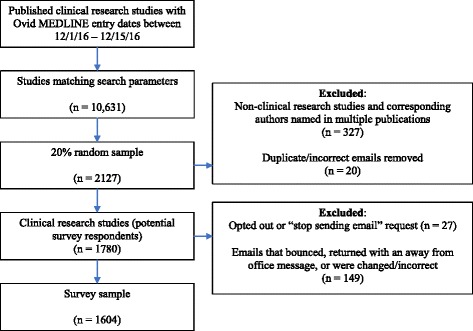
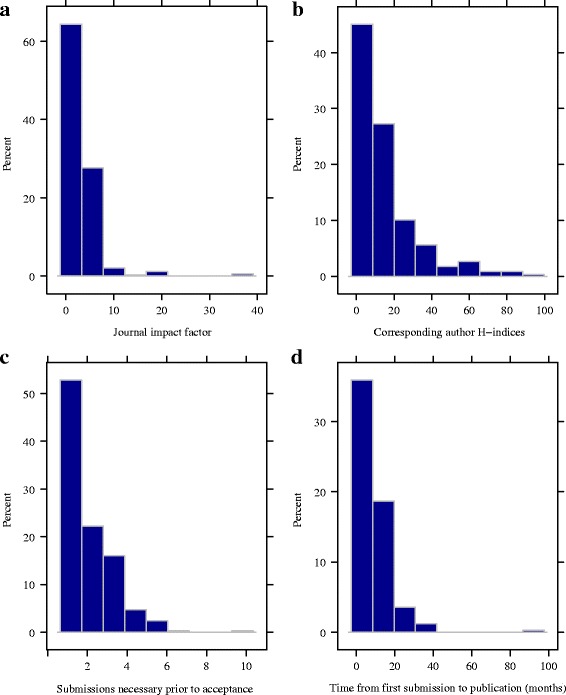
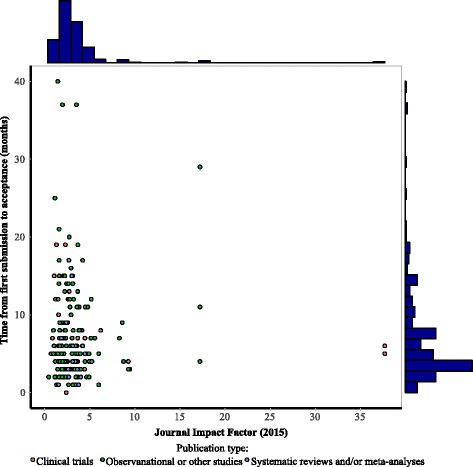
Although the peer review process is believed to ensure scientific rigor, enhance research quality, and improve manuscript clarity, many investigators are concerned that the process is too slow, too expensive, too unreliable, and too static. In this feasibility study, we sought to survey corresponding authors of recently published clinical research studies on the speed and efficiency of the publication process. Web-based survey of corresponding authors of a 20% random sample of clinical research studies in MEDLINE-indexed journals with Ovid MEDLINE entry dates between December 1 and 15, 2016. Survey addressed perceived manuscript importance before first submission, approximate first submission and final acceptance dates, and total number of journal submissions, external peer reviews, external peer reviewers, and revisions requested, as well as whether authors would have considered publicly sharing their manuscript on an online platform instead of submitting to a peer-reviewed journal. Of 1780 surveys distributed, 27 corresponding authors opted out or requested that we stop emailing them and 149 emails failed (e.g., emails that bounced n = 64, returned with an away from office message n = 70, or were changed/incorrect n = 15), leaving 1604 respondents, of which 337 completed the survey (21.0%). Respondents and non-respondents were similar with respect to study type and publication journals’ impact factor, although non-respondent authors had more publications ( p = 0.03). Among respondents, the median impact factor of the publications’ journal was 2.7 (interquartile range (IQR), 2.0–3.6) and corresponding authors’ median h-index and number of publications was 9 (IQR, 3–20) and 27 (IQR, 10–77), respectively. The median time from first submission to journal acceptance and publication was 5 months (IQR, 3–8) and 7 months (IQR, 5–12), respectively. Most respondents (62.0%, n = 209) rated the importance of their research as a 4 or 5 (5-point scale) prior to submission. Median number of journal submissions was 1 (IQR, 1–2), external peer reviews was 1 (IQR, 1–2), external peer reviewers was 3 (IQR, 2–4), and revisions requested was 1 (IQR, 1–1). Sharing manuscripts to a public online platform, instead of submitting to a peer-reviewed journal, would have been considered by 55.2% ( n = 186) of respondents. Corresponding authors have high perceptions of their research and reported requiring few manuscript submissions prior to journal acceptance, most commonly by lower impact factor journals.
Overview
The claims and statistics of this paper haven’t been checked yet.
Free: it reads the open-access text and checks the first 5 claims that cite a source we can check. Create a free account to check every claim.
Integrity signals
Registry
Cites
Statistics
Figures
Verification
Claims the paper makes
The claims and statistics of this paper haven’t been checked yet.
Free: it reads the open-access text and checks the first 5 claims that cite a source we can check. Create a free account to check every claim.
Self-check
Percentages, sums and reported differences re-computed from the paper’s own numbers.
The self-check needs the paper’s full text.
Citations
Cites
Increasing value and reducing waste in research design, conduct, and analysis
Ioannidis, J. P. A., Greenland, S., Hlatky, M. A., Khoury, M. J., Macleod, M. R., Moher, D., Schulz, K. F., & Tibshirani, R. (2014) · The Lancet · doi:10.1016/s0140-6736(13)62227-8 · Cited by 1,597
Does it take too long to publish research?
Powell, K. (2016) · Nature · doi:10.1038/530148a · Cited by 267 · cited 2×
“Evidence suggests that the manuscripts selected for peer review in the highest impact journals can have extensive review times [9].”
Peer review. Crude and understudied, but indispensable
Kassirer, J. P. (1994) · JAMA · doi:10.1001/jama.272.2.96 · Cited by 235 · cited 1×
“cerned that the process is too slow [1, 2], too expensive, too unreliable, and too static [3–6].”
BackgroundWhy do peer reviewers decline to review? A survey
Tite, L., & Schroter, S. (2007) · Journal of Epidemiology and Community Health · doi:10.1136/jech.2006.049817 · Cited by 192 · cited 2×
“cerned that the process is too slow [1, 2], too expensive, too unreliable, and too static [3–6].”
BackgroundResultAuthor Perception of Peer Review: Impact of Review Quality and Acceptance on Satisfaction
Weber, E. J., Katz, P. P., Waeckerle, J. F., & Callaham, M. L. (2002) · JAMA · doi:10.1001/jama.287.21.2790 · Cited by 140 · cited 2×
“Previous evaluations have focused on author perspectives and experiences submitting their work to one particular journal [4, 6].”
BackgroundResultThe fate of manuscripts rejected by a general medical journal
Ray, J. G., Berkwits, M., & Davidoff, F. (2000) · The American Journal of Medicine · doi:10.1016/s0002-9343(00)00450-2 · Cited by 76 · cited 1×
“According to an empirical evaluation of articles submitted to the Annals of Internal Medicine, the majority of rejected manuscripts were published in lower impact factor specialty journals after an average of 18 months [10].”
Krumholz, H. M. (2015) · Circulation Cardiovascular Quality and Outcomes · doi:10.1161/circoutcomes.115.002415 · Cited by 38 · cited 1×
“With the growing demand for faster dissemination of knowledge, journals as we know them may be “approaching their final act” [5].”
BackgroundSelf-citationData sharing through an NIH central database repository: a cross-sectional survey of BioLINCC users
Ross, J. S., Ritchie, J. D., Finn, E. B., Desai, N. R., Lehman, R., Krumholz, H. M., & Gross, C. P. (2016) · BMJ Open · doi:10.1136/bmjopen-2016-012769 · Cited by 37 · cited 4×
“platform (Qualtrics Labs, Provo, Utah, USA) [8].”
MethodResultInfluentialSelf-citationHow Well Does a Journal's Peer Review Process Function? A Survey of Authors' Opinions
Sweitzer, B. J. (1994) · JAMA · doi:10.1001/jama.1994.03520020078022 · Cited by 31 · cited 3×
“Previous evaluations have focused on author perspectives and experiences submitting their work to one particular journal [4, 6].”
Analysis for "the history of publishing delays" blog post v1.0
Himmelstein, D. S., & Powell, K. (2016) · Zenodo (CERN European Organization for Nuclear Research) · doi:10.5281/zenodo.45516 · Cited by 12
Cited by
Fraser, N., Brierley, L., Dey, G., Polka, J. K., Pálfy, M., Nanni, F., & Coates, J. A. (2021) · PLOS Biology · doi:10.1371/journal.pbio.3000959 · Cited by 555
“Even after this lengthy process is concluded, almost half of submissions are rejected and require resubmission to a different journal [7].”
BackgroundWallach, J. D., Egilman, A. C., Dhruva, S. S., McCarthy, M. E., Miller, J. E., Woloshin, S., Schwartz, L. M., & Ross, J. S. (2018) · BMJ · doi:10.1136/bmj.k2031 · Cited by 75
Self-citationMapping pharmacy journals: A lexicographic analysis
Mendes, A. M., Tonin, F. S., Buzzi, M. F., Pontarolo, R., & Fernández-Llimós, F. (2019) · Research in Social and Administrative Pharmacy · doi:10.1016/j.sapharm.2019.01.011 · Cited by 77
Wallach, J. D., Serghiou, S., Chu, L., Egilman, A. C., Vasiliou, V., Ross, J. S., & Ioannidis, J. P. A. (2020) · BMC Medical Research Methodology · doi:10.1186/s12874-020-0914-6 · Cited by 56
Self-citationGoodson, A. M. C., Kittur, M. A., Evans, P. L., & Williams, E. M. (2019) · Journal of Cranio-Maxillofacial Surgery · doi:10.1016/j.jcms.2019.02.010 · Cited by 47
Comparison of Clinical Study Results Reported in medRxiv Preprints vs Peer-reviewed Journal Articles
Janda, G., Khetpal, V., Shi, X., Ross, J. S., & Wallach, J. D. (2022) · JAMA Network Open · doi:10.1001/jamanetworkopen.2022.45847 · Cited by 49
Self-citationA tale of two 'opens': intersections between Free and Open Source Software and Open ScholarshipPreprint
Tennant, J., Agarwal, R., Baždarić, K., Brassard, D., Crick, T., Dunleavy, D. J., Evans, T. R., Gardner, N., González-Márquez, M., Graziotin, D., et al. (2020) · SocArXiv (OSF Preprints) · doi:10.31235/osf.io/2kxq8 · Cited by 59
“Here, we consider reproducibility to describe any measure that is taken to increase the verification of research results, which usually involves data sharing and thus falls under the banner of ‘Open Science’ (Baker 2016; Munafò et al. 2017; Wallach et al. 2018).”
BackgroundMethodRombey, T., Allers, K., Mathes, T., Hoffmann, F., & Pieper, D. (2019) · BMC Medical Research Methodology · doi:10.1186/s12874-019-0698-8 · Cited by 34
“This is how long it takes for a primary study from first submission to acceptance [20].”
BackgroundVazquez, E., Gouraud, H., Naudet, F., Gross, C. P., Krumholz, H. M., Ross, J. S., & Wallach, J. D. (2021) · Clinical Trials · doi:10.1177/17407745211038524 · Cited by 33
Self-citationData sharing during COVID-19 pandemic: what to take away
Rios, R. S., Zheng, K. I., & Zheng, M. (2020) · Expert Review of Gastroenterology & Hepatology · doi:10.1080/17474124.2020.1815533 · Cited by 33
“These emergency measures allowed quicker access to relevant information since one of the undisputable drawbacks of the peer review system is that it ends up being unnecessarily time-consuming (sometimes taking months from submission to acceptance and then to publication) [6,7].”
BackgroundThe high resource impact of reformatting requirements for scientific papers
Jiang, Y., Lerrigo, R., Ullah, A., Alagappan, M., Asch, S. M., Goodman, S. N., & Sinha, S. R. (2019) · PLoS ONE · doi:10.1371/journal.pone.0223976 · Cited by 31
Publication speed in pharmacy practice journals: A comparative analysis
Mendes, A. M., Tonin, F. S., Mainka, F. F., Pontarolo, R., & Fernández-Llimós, F. (2021) · PLoS ONE · doi:10.1371/journal.pone.0253713 · Cited by 24
“It seems that these post-acceptance delays are not important for authors when they ask for a more rapid editorial process, because at this point, they have already obtained a communication from the editor about the article’s acceptance [26].”
BackgroundCharacteristics of ‘mega’ peer-reviewers
Rice, D. B., Pham, B., Presseau, J., Tricco, A. C., & Moher, D. (2022) · Research Integrity and Peer Review · doi:10.1186/s41073-022-00121-1 · Cited by 20
The relevance of title, abstract, and keywords for scientific paper quality and potential impact
Chamorro-Padial, J., & Sánchez, R. M. R. (2023) · Multimedia Tools and Applications · doi:10.1007/s11042-023-14451-9 · Cited by 23
“For example, [22] concludes that “the authors do few manuscript submissions prior to journal acceptance, most commonly by lower impact factor journals”.”
BackgroundSebo, P., Fournier, J., & Maisonneuve, H. (2018) · Family Practice · doi:10.1093/fampra/cmy115 · Cited by 12
Research Integrity and Peer Review—past highlights and future directions
Boughton, S. L., Kowalczuk, M. K., Meerpohl, J. J., Wager, E., & Moylan, E. C. (2018) · Research Integrity and Peer Review · doi:10.1186/s41073-018-0047-1 · Cited by 13
“These include how research is funded [6] and reviewed [7, 8], guidelines on research integrity [9], researchers’ perceptions on research misbehaviour [10] and their views on the publishing process [11].”
BackgroundLi, L., Wu, Y., & Wang, Y. (2024) · Journal of Business Ethics · doi:10.1007/s10551-024-05866-x · Cited by 6
Blinding Models for Scientific Peer-Review of Biomedical Research Proposals: A Systematic Review
Qussini, S., MacDonald, R. S., Shahbal, S., & Dierickx, K. (2023) · Journal of Empirical Research on Human Research Ethics · doi:10.1177/15562646231191424 · Cited by 6
Clinicians’ Publication Output: Self-Report Survey and Bibliometric Analysis
Ganasegeran, K., Ch’ng, A. S. H., Jamil, M. F. A., & Looi, I. (2020) · Publications · doi:10.3390/publications8010015 · Cited by 5
“These associations were consistent with previous studies [9,40,41].”
BackgroundResultRogers, B. A. (2020) · Annals of The Royal College of Surgeons of England · doi:10.1308/rcsann.2020.0214 · Cited by 5
Judging Importance before Checking Correctness: Quick Opinions in Mathematical Peer Review
Greiffenhagen, C. (2023) · Science Technology & Human Values · doi:10.1177/01622439231203445 · Cited by 8
Inclusion and Exclusion Criteria for Automating Adherence to Scope of Conference Calls for Papers
Craig, A., & Taswell, C. (2022) · International Conference on Transdisciplinary AI (TransAI) · doi:10.1109/transai54797.2022.00018 · Cited by 6
“Given that a 2018 survey found that the median time between submission of an article to a biomedical journal and notification of acceptance was 5 months [6], clarifying to authors whether an article meets the basic requirements to receive more in-depth peer review before they submit could empower them to choose the mo…”
BackgroundRishniw, M., & White, M. E. (2018) · bioRxiv (Cold Spring Harbor Laboratory) · doi:10.1101/456327 · Cited by 3
Grieser, C. (2025) · Minerva · doi:10.1007/s11024-024-09560-0 · Cited by 2
“Peer review processes often take months; in the life sciences, for instance, it takes roughly five months from the submission to the publication of a paper (Wallach et al., 2018).”
Joubert, G., Mulder, T., Steinberg, W. J., & Botes, J. (2020) · Pan African Medical Journal · doi:10.11604/pamj.2020.36.212.24175 · Cited by 1
Information Sources for Pharmacy Practice Researchers
Tonin, F. S., Borba, H. H. L., Mendes, A. M., Wiens, A., Pontarolo, R., & Fernández-Llimós, F. (2020) · Springer eBooks · doi:10.1007/978-981-15-2993-1_11
Reston, E. D., & Jugar, R. R. (2023) · Mathematics education - an asian perspective · doi:10.1007/978-981-99-0643-7_1
What do Authors Expect from Journals? Improving the Publishing Experience
Pannu, A. K. (2025) · Journal of Postgraduate Medicine Education and Research · doi:10.5005/jp-journals-10028-1729
Identification and categorization of iterative preprints in the life sciencesPreprint
Besançon, L., Carmali, S., Castelloe, A. A., Dine, R. D., Manna, D., Nandi, S., Polka, J., Puebla, I., Shelley, R., Tsagakis, I., et al. (2023) · doi:10.31219/osf.io/sqeg4
Wallach, J. D., Serghiou, S., Chu, L., Egilman, A. C., Vasiliou, V., Ross, J. S., & Ioannidis, J. P. A. (2020) · Figshare · doi:10.6084/m9.figshare.11986608
Self-citationWallach, J. D., Serghiou, S., Chu, L., Egilman, A. C., Vasiliou, V., Ross, J. S., & Ioannidis, J. P. A. (2020) · Figshare · doi:10.6084/m9.figshare.11986581
Self-citationZona, N. E., Hewitt, M. A., Stark, S. D., Zhu, M., Myerson, M. S., & Hunt, K. J. (2025) · Foot & Ankle Specialist · doi:10.1177/19386400251407176
Metadata
- Authors
- Wallach, J. D., Egilman, A. C., Gopal, A. D., Swami, N., Krumholz, H. M., & Ross, J. S.
- Affiliations
- Yale New Haven Hospital (US)
- Yale University (US)
- Corresponding author
- Wallach, Joshua D.
- ORCID
- Venue
- Research Integrity and Peer Review
- Published
- 2018-01-05
- Volume
- 3
- Issue
- 1
- Pages
- 1-1
- ISSN
- 2058-8615 (ISSN-L)
- PMC
- PMC5803634
- OpenAlex
- W2781942656
- Semantic Scholar
- 7646f6d16ab4153ccc9f2a97af80d14dfc6ae6ee
- Cited by
- 32
- References
- 12
- Citations by year
- 2025: 3 · 2024: 1 · 2023: 5 · 2022: 3 · 2021: 3 · 2020: 9 · 2019: 4 · 2018: 4
- FWCI
- 7.10
- Type
- journal article
- Language
- en
- Open access
- gold
- doi.org
- Licence
- cc-by
- Locations
- Research Integrity and Peer Review (publishedVersion, cc-by)
- Europe PMC (PubMed Central) (publishedVersion, cc-by)
- PubMed Central (publishedVersion, cc-by)
- PubMed (publishedVersion)
- DOAJ (DOAJ: Directory of Open Access Journals) (submittedVersion, cc-by-sa)
- Funders
- Laura and John Arnold Foundation
- Topics
- Social Sciences › Library and Information Sciences › Academic Publishing and Open Access
- Social Sciences › Library and Information Sciences › Academic Writing and Publishing
- Social Sciences › Library and Information Sciences › Publishing and Scholarly Communication
- Keywords
- peer review, publication process, manuscript revision, corresponding authors, clinical research, open access publishing, preprint sharing, journal impact factor, author experience, scholarly communication costs, peer review quality, peer review fairness
About these checks
Registry, retraction, Cites and statistics results are computed, not judged, with one exception: a printed reference that no index lists is read once by a model before it counts as a citation error. Claims are extracted by a model and kept only when their quote appears verbatim in the text; each cited source is then checked, with a model’s help, for whether it says what the claim relies on. Those verdicts can be wrong — read the claim’s quote and the cited source before relying on one.
Statistics and arithmetic are recomputed, not judged.
Confidence bands are shown only for fields calibrated on our annotated test set. None is calibrated yet, so no band is shown.
What counts as a claim ›How we measure confidence ›How we check this ›
Are you an author, or do you see a problem with this page? Request a review
Data sources
Bibliographic data: Semantic Scholar, OpenAlex, Crossref.
Contains information from the Semantic Scholar Academic Graph Datasets, made available under the ODC Attribution License (ODC-BY 1.0).
Semantic Scholar’s data is described in: Kinney, R., et al. (2023). The Semantic Scholar Open Data Platform. arXiv:2301.10140.
