

A randomised controlled trial of an Intervention to Improve Compliance with the ARRIVE guidelines (IICARus)
Open accessPublished version of a preprint
The DOI matches its Crossref record; 26 of the 26 references it cites were found in a registry or an index.
Abstract
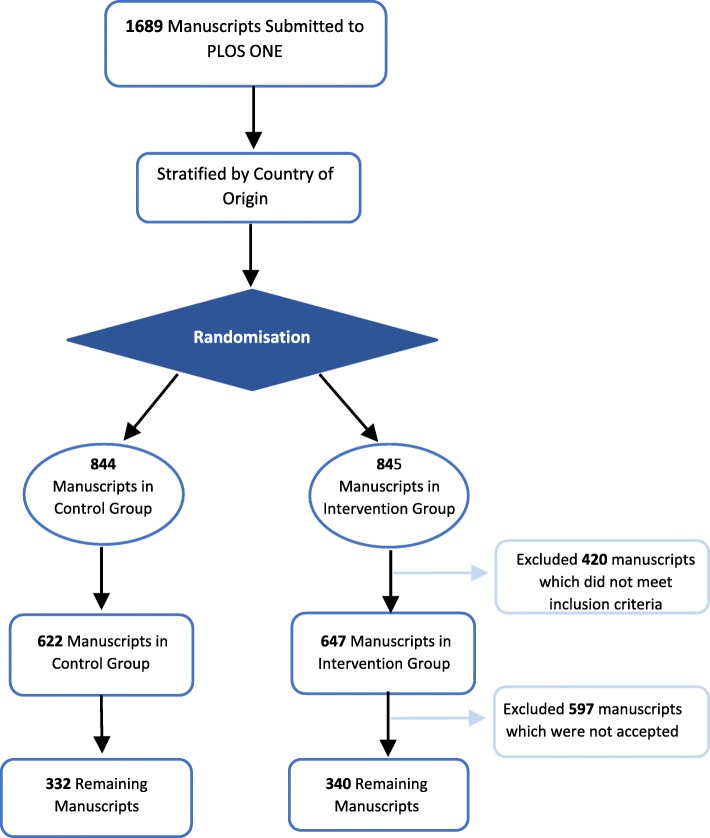
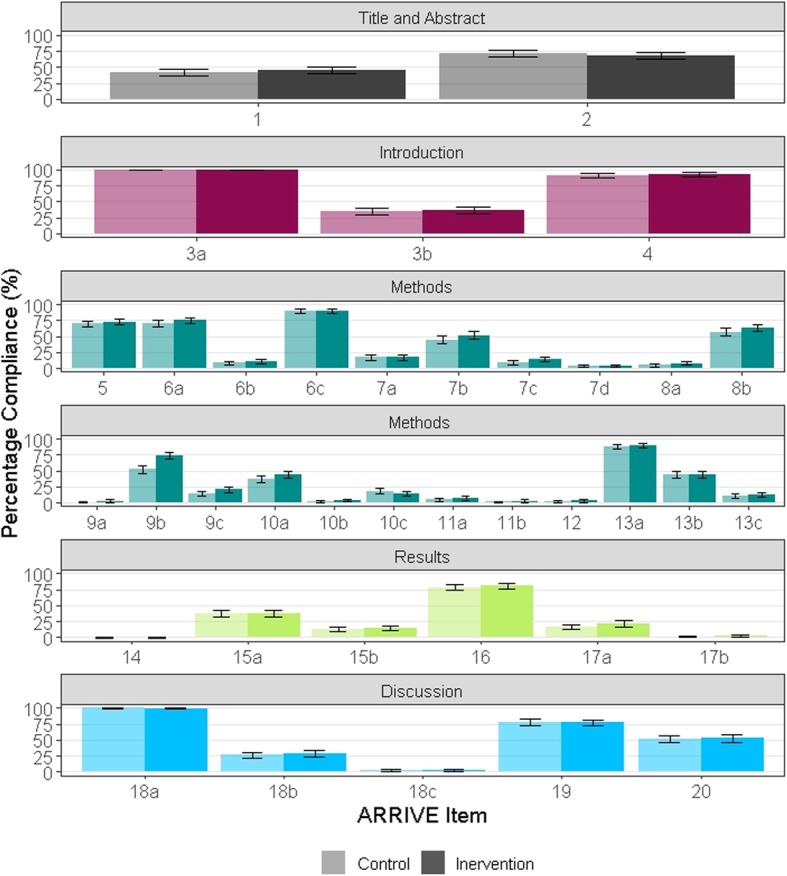
The ARRIVE (Animal Research: Reporting of In Vivo Experiments) guidelines are widely endorsed but compliance is limited. We sought to determine whether journal-requested completion of an ARRIVE checklist improves full compliance with the guidelines. In a randomised controlled trial, manuscripts reporting in vivo animal research submitted to PLOS ONE (March–June 2015) were randomly allocated to either requested completion of an ARRIVE checklist or current standard practice. Authors, academic editors, and peer reviewers were blinded to group allocation. Trained reviewers performed outcome adjudication in duplicate by assessing manuscripts against an operationalised version of the ARRIVE guidelines that consists 108 items. Our primary outcome was the between-group differences in the proportion of manuscripts meeting all ARRIVE guideline checklist subitems. We randomised 1689 manuscripts (control: n = 844, intervention: n = 845), of which 1269 were sent for peer review and 762 (control: n = 340; intervention: n = 332) accepted for publication. No manuscript in either group achieved full compliance with the ARRIVE checklist. Details of animal husbandry (ARRIVE subitem 9b) was the only subitem to show improvements in reporting, with the proportion of compliant manuscripts rising from 52.1 to 74.1% ( X 2 = 34.0, df = 1, p = 2.1 × 10 −7 ) in the control and intervention groups, respectively. These results suggest that altering the editorial process to include requests for a completed ARRIVE checklist is not enough to improve compliance with the ARRIVE guidelines. Other approaches, such as more stringent editorial policies or a targeted approach on key quality items, may promote improvements in reporting.
Overview
The claims and statistics of this paper haven’t been checked yet.
Free: it reads the open-access text and checks the first 5 claims that cite a source we can check. Create a free account to check every claim.
Integrity signals
Registry
Cites
Statistics
Figures
Verification
Claims the paper makes
The claims and statistics of this paper haven’t been checked yet.
Free: it reads the open-access text and checks the first 5 claims that cite a source we can check. Create a free account to check every claim.
Claims other papers make about this one
Each is checked against this paper’s own text: does it say what the citing paper says it does?
The source backs part of the claim, not all of it — or backs it for a different population, condition or comparison.
In the citing paper
“however, researchers are often unfamiliar with the much larger systemic bias in the publication of research and in the reliability of certain findings and even of entire fields [33, 38–40].”
From The ARRIVE guidelines 2.0: Updated guidelines for reporting animal research (2020) · cites this paper as [33]
Experimental — accuracy not yet measuredThe cited source says what the claim attributes to it.
In the citing paper
“Multi-pronged interventions, where more than one of these strategies are combined, may be more effective (such as completion of checklists coupled with editorial checks).68”
From The PRISMA 2020 statement: An updated guideline for reporting systematic reviews (2021) · cites this paper as [68]
The cited source says what the claim attributes to it.
In the citing paper
“For example, despite the first iteration of the ARRIVE guidelines being endorsed by over a thousand journals [22], they had limited impact on improving transparent reporting, even when authors were explicitly requested to use the ARRIVE checklist [23].”
From Open Science 2.0: Towards a truly collaborative research ecosystem (2023) · cites this paper as [23]
The cited source says what the claim attributes to it.
In the citing paper
“In many instances, interventions we hope would work turn out to be administrative burdens with negligible benefits [23,56,106].”
From Open Science 2.0: Towards a truly collaborative research ecosystem (2023) · cites this paper as [23]
The cited source says what the claim attributes to it.
In the citing paper
“Intervenciones multimodales, en las que se combinan varias de estas estrategias, pueden ser ma ´ s efectivas (por ejemplo, la aplicacio ´ n de las listas de verificacio ´ n junto con los controles editoriales) 64 .”
From Declaración PRISMA 2020: una guía actualizada para la publicación de revisiones sistemáticas (2021) · cites this paper as [64]
10 more claims about this paper
Create a free account to see every claim other papers make about this one.
Self-check
Percentages, sums and reported differences re-computed from the paper’s own numbers.
The self-check needs the paper’s full text.
Citations
Cites
Improving Bioscience Research Reporting: The ARRIVE Guidelines for Reporting Animal Research
Kilkenny, C., Browne, W. J., Cuthill, I. C., Emerson, M., & Altman, D. G. (2010) · PLoS Biology · doi:10.1371/journal.pbio.1000412 · Cited by 7,300
Improving bioscience research reporting: The ARRIVE guidelines for reporting animal research
Kilkenny, C., Browne, W. J., Cuthill, I. C., Emerson, M., & Altman, D. G. (2010) · Journal of Pharmacology and Pharmacotherapeutics · doi:10.4103/0976-500x.72351 · Cited by 6,277
Adjusting for multiple testing when reporting research results: the Bonferroni vs Holm methods.
Aickin, M., & Gensler, H. (1996) · American Journal of Public Health · doi:10.2105/ajph.86.5.726 · Cited by 1,346
McGrath, J. C., & Lilley, E. (2015) · British Journal of Pharmacology · doi:10.1111/bph.12955 · Cited by 1,321
A call for transparent reporting to optimize the predictive value of preclinical research
Landis, S. C., Amara, S. G., Asadullah, K., Austin, C. P., Blumenstein, R., Bradley, E. W., Crystal, R. G., Darnell, R. B., Ferrante, R. J., Fillit, H., et al. (2012) · Nature · doi:10.1038/nature11556 · Cited by 1,196
Self-citationKilkenny, C., Parsons, N., Kadyszewski, E., Festing, M. F. W., Cuthill, I. C., Fry, D., Hutton, J., & Altman, D. G. (2009) · PLoS ONE · doi:10.1371/journal.pone.0007824 · Cited by 860
Turner, L., Shamseer, L., Altman, D. G., Weeks, L., Peters, J., Kober, T., Dias, S., Schulz, K. F., Plint, A. C., & Moher, D. (2012) · Cochrane Database of Systematic Reviews · doi:10.1002/14651858.mr000030.pub2 · Cited by 740 · cited 1×
“Journal endorsement of these guidelines appear to have improved reporting quality [15, 18]; however, it is often unclear what actions journals take to promote adherence [17] and the extent of editorial involvement is likely to have an impact.”
BackgroundPREPARE: guidelines for planning animal research and testing
Smith, A. J., Clutton, R. E., Lilley, E., Hansen, K. E. A., & Brattelid, T. (2018) · Laboratory Animals · doi:10.1177/0023677217724823 · Cited by 587
Risk of bias in reports of in vivo research: a focus for improvement
Macleod, M. R., Lawson McLean, A., Kyriakopoulou, A., Serghiou, S., de Wilde, A., Sherratt, N., Hirst, T., Hemblade, R., Bahor, Z., Nunes-Fonseca, C., et al. (2015) · PLOS Biology · doi:10.1371/journal.pbio.1002273 · Cited by 358 · cited 2×
“Such omissions have been shown to be associated with overestimation of effect sizes [8, 13] and are likely to contribute, in part, to translational failure.”
BackgroundSelf-citationBaker, D., Lidster, K., Sottomayor, A., & Amor, S. (2014) · PLoS Biology · doi:10.1371/journal.pbio.1001756 · Cited by 305
Self-citation
Cited by
The PRISMA 2020 statement: An updated guideline for reporting systematic reviews
Page, M. J., McKenzie, J. E., Bossuyt, P. M., Boutron, I., Hoffmann, T. C., Mulrow, C. D., Shamseer, L., Tetzlaff, J. M., Akl, E. A., Brennan, S. E., et al. (2021) · BMJ · doi:10.1136/bmj.n71 · Cited by 108,283
The PRISMA 2020 statement: an updated guideline for reporting systematic reviews
Page, M. J., McKenzie, J. E., Bossuyt, P. M., Boutron, I., Hoffmann, T. C., Mulrow, C. D., Shamseer, L., Tetzlaff, J. M., Akl, E. A., Brennan, S. E., et al. (2021) · Systematic Reviews · doi:10.1186/s13643-021-01626-4 · Cited by 13,874
The PRISMA 2020 Statement: An Updated Guideline for Reporting Systematic Reviews
Page, M. J., McKenzie, J. E., Bossuyt, P. M., Boutron, I., Hoffmann, T. C., Mulrow, C. D., Shamseer, L., Tetzlaff, J. M., Akl, E. A., Brennan, S. E., et al. (2021) · International Journal of Surgery · doi:10.1016/j.ijsu.2021.105906 · Cited by 11,748
The ARRIVE guidelines 2.0: Updated guidelines for reporting animal research
Percie du Sert, N., Hurst, V., Ahluwalia, A., Alam, S., Avey, M. T., Baker, M., Browne, W. J., Clark, A., Cuthill, I. C., Dirnagl, U., et al. (2020) · PLOS Biology · doi:10.1371/journal.pbio.3000410 · Cited by 7,238
Self-citationThe PRISMA 2020 statement: An updated guideline for reporting systematic reviews
Page, M. J., McKenzie, J. E., Bossuyt, P. M., Boutron, I., Hoffmann, T. C., Mulrow, C. D., Shamseer, L., Tetzlaff, J. M., Akl, E. A., Brennan, S. E., et al. (2021) · PLoS Medicine · doi:10.1371/journal.pmed.1003583 · Cited by 5,148
“[60] Multi-pronged interventions, where more than one of these strategies are combined, may be more effective (such as completion of checklists coupled with editorial checks).[68] However, of 31 interventions proposed to increase adherence to reporting guidelines, the effects of only 11 have been evaluated, mostly in…”
BackgroundThe PRISMA 2020 statement: An updated guideline for reporting systematic reviews
Page, M. J., McKenzie, J. E., Bossuyt, P. M., Boutron, I., Hoffmann, T. C., Mulrow, C. D., Shamseer, L., Tetzlaff, J. M., Akl, E. A., Brennan, S. E., et al. (2021) · Journal of Clinical Epidemiology · doi:10.1016/j.jclinepi.2021.03.001 · Cited by 4,265
The ARRIVE guidelines 2.0: Updated guidelines for reporting animal research
Percie du Sert, N., Hurst, V., Ahluwalia, A., Alam, S., Avey, M. T., Baker, M., Browne, W. J., Clark, A., Cuthill, I. C., Dirnagl, U., et al. (2020) · Experimental Physiology · doi:10.1113/ep088870 · Cited by 3,497
Self-citationReporting animal research: Explanation and elaboration for the ARRIVE guidelines 2.0
Percie du Sert, N., Ahluwalia, A., Alam, S., Avey, M. T., Baker, M., Browne, W. J., Clark, A., Cuthill, I. C., Dirnagl, U., Emerson, M., et al. (2020) · PLOS Biology · doi:10.1371/journal.pbio.3000411 · Cited by 3,123
“However, abstracts often either do not contain enough information for this purpose [11] or contain information that is inconsistent with the results in the rest of the manuscript [154,155].”
ResultSelf-citationDeclaración PRISMA 2020: una guía actualizada para la publicación de revisiones sistemáticas
Page, M. J., McKenzie, J. E., Bossuyt, P. M., Boutron, I., Hoffmann, T. C., Mulrow, C. D., Shamseer, L., Tetzlaff, J. M., Akl, E. A., Brennan, S. E., et al. (2021) · Revista Española de Cardiología · doi:10.1016/j.recesp.2021.06.016 · Cited by 2,095
The ARRIVE guidelines 2.0: Updated guidelines for reporting animal research*
Percie du Sert, N., Hurst, V., Ahluwalia, A., Alam, S., Avey, M. T., Baker, M., Browne, W. J., Clark, A., Cuthill, I. C., Dirnagl, U., et al. (2020) · Journal of Cerebral Blood Flow & Metabolism · doi:10.1177/0271678x20943823 · Cited by 1,443
“However, abstracts often either do not contain enough information for this purpose [11] or contain information that is inconsistent with the results in the rest of the manuscript [154,155].”
Self-citationDeclaración PRISMA 2020: una guía actualizada para la publicación de revisiones sistemáticas
Page, M. J., McKenzie, J. E., Bossuyt, P. M., Boutron, I., Hoffmann, T. C., Mulrow, C. D., Shamseer, L., Tetzlaff, J. M., Akl, E. A., Brennan, S. E., et al. (2021) · Revista Española de Cardiología (English Edition) · doi:10.1016/j.rec.2021.07.010 · Cited by 1,313
“Multipronged interventions, where more than one of these strategies is combined, may be more effective (such as completion of checklists coupled with editorial checks) [68] .”
BackgroundThe ARRIVE guidelines 2.0: Updated guidelines for reporting animal research
Percie du Sert, N., Hurst, V., Ahluwalia, A., Alam, S., Avey, M. T., Baker, M., Browne, W. J., Clark, A., Cuthill, I. C., Dirnagl, U., et al. (2020) · British Journal of Pharmacology · doi:10.1111/bph.15193 · Cited by 1,081
Self-citationThe ARRIVE guidelines 2019: updated guidelines for reporting animal research
Percie du Sert, N., Hurst, V., Ahluwalia, A., Alam, S., Avey, M. T., Baker, M., Browne, W. J., Clark, A., Cuthill, I. C., Dirnagl, U., et al. (2019) · bioRxiv (Cold Spring Harbor Laboratory) · doi:10.1101/703181 · Cited by 1,036
Self-citationA declaração PRISMA 2020: diretriz atualizada para relatar revisões sistemáticas
Page, M. J., McKenzie, J. E., Bossuyt, P. M., Boutron, I., Hoffmann, T. C., Mulrow, C. D., Shamseer, L., Tetzlaff, J. M., Akl, E. A., Brennan, S. E., et al. (2022) · Revista Panamericana de Salud Pública · doi:10.26633/rpsp.2022.112 · Cited by 433
The ARRIVE guidelines 2.0: updated guidelines for reporting animal research
Percie du Sert, N., Hurst, V., Ahluwalia, A., Alam, S., Avey, M. T., Baker, M., Browne, W. J., Clark, A., Cuthill, I. C., Dirnagl, U., et al. (2020) · The Journal of Physiology · doi:10.1113/jp280389 · Cited by 593
Self-citationReporting animal research: Explanation and Elaboration for the ARRIVE guidelines 2019
Percie du Sert, N., Ahluwalia, A., Alam, S., Avey, M. T., Baker, M., Browne, W. J., Clark, A., Cuthill, I. C., Dirnagl, U., Emerson, M., et al. (2019) · bioRxiv (Cold Spring Harbor Laboratory) · doi:10.1101/703355 · Cited by 559
“Studies measuring the impact of ARRIVE on the quality of reporting have produced mixed results [6-11] and there is evidence that in vivo scientists are not sufficiently aware of the importance of reporting the information covered in the guidelines, and fail to appreciate the relevance to their work or their research f…”
BackgroundSelf-citationPlanning experiments: Updated guidance on experimental design and analysis and their reporting III
Curtis, M. J., Alexander, S. P. H., Cirino, G., George, C. H., Kendall, D. A., Insel, P. A., Izzo, A. A., Ji, Y., Panettieri, R. A., Patel, H. H., et al. (2022) · British Journal of Pharmacology · doi:10.1111/bph.15868 · Cited by 520
“It is now widely commented that there is an overreliance on P values in research and that they can often be misinterpreted (Lew, 2012).”
BackgroundThe ARRIVE guidelines 2.0: Updated guidelines for reporting animal research
Percie du Sert, N., Hurst, V., Ahluwalia, A., Alam, S., Avey, M. T., Baker, M., Browne, W. J., Clark, A., Cuthill, I. C., Dirnagl, U., et al. (2020) · BMC Veterinary Research · doi:10.1186/s12917-020-02451-y · Cited by 496
“This single editorial intervention, which did not include further verification from journal staff, failed to improve the disclosure of information in published papers [33].”
Self-citationPercie du Sert, N., Hurst, V., Ahluwalia, A., Alam, S., Avey, M. T., Baker, M., Browne, W. J., Clark, A., Cuthill, I. C., Dirnagl, U., et al. (2020) · BMJ Open Science · doi:10.1136/bmjos-2020-100115 · Cited by 273
Self-citationPravila PRISMA 2020.: ažurirane smjernice za izvještavanje u sustavnim pregledima
Page, M. J., Grimshaw, J. M., Hróbjartsson, A., Lalu, M. M., Li, T., Loder, E. W., Mayo-Wilson, E., McGuinness, L., McDonald, S., Stewart, L. A., et al. (2021) · Medicina Fluminensis · doi:10.21860/medflum2021_264903 · Cited by 163
A declaração PRISMA 2020: diretriz atualizada para relatar revisões sistemáticas
Page, M. J., McKenzie, J. E., Bossuyt, P. M., Boutron, I., Hoffmann, T., Mulrow, C. D., Shamseer, L., Tetzlaff, J., Akl, E. A., Brennan, S., et al. (2022) · Epidemiologia e Serviços de Saúde · doi:10.5123/s1679-49742022000200033 · Cited by 387
Carneiro, C. F. D., Queiroz, V. G. S., Moulin, T. C., Carvalho, C. A. M., Haas, C. B., Rayêe, D., Henshall, D. E., De-Souza, E. A., Amorim, F. E., Boos, F. Z., et al. (2020) · Research Integrity and Peer Review · doi:10.1186/s41073-020-00101-3 · Cited by 146
“Quality of reporting is used to evaluate study quality in meta-analyses (Ryan et al., 2013), as well as the effect of interventions focused on improving transparency (Han et al., 2017; Hair, Macleod and Sena, 2019; The NPQIP Collaborative group, 2019).”
BackgroundMethodInfluentialSelf-citationReproducibility and Rigor in Animal-Based Research
Macleod, M., & Mohan, S. (2019) · ILAR Journal · doi:10.1093/ilar/ilz015 · Cited by 104
Self-citationReporting guideline checklists are not quality evaluation forms: they are guidance for writing
Logullo, P., MacCarthy, A., Kirtley, S., & Collins, G. S. (2020) · Health Science Reports · doi:10.1002/hsr2.165 · Cited by 92
“Others assign three options, for example, ‘not reported’, ‘fully reported’, and ‘partially reported’ or ‘not applicable’.(15,17,20-24,26,27,31,33,37-40) Some studies also use more options, such as a five-point scale of quality for each item.”
BackgroundThe Rigor and Transparency Index Quality Metric for Assessing Biological and Medical Science Methods
Menke, J., Roelandse, M., Ozyurt, B., Martone, M., & Bandrowski, A. (2020) · iScience · doi:10.1016/j.isci.2020.101698 · Cited by 90
Signaling the trustworthiness of science
Jamieson, K. H., McNutt, M., Kiermer, V., & Sever, R. (2019) · Proceedings of the National Academy of Sciences · doi:10.1073/pnas.1913039116 · Cited by 89
Levelling the Translational Gap for Animal to Human Efficacy Data
Ferreira, G. S., Veening-Griffioen, D. H., Boon, W., Moors, E. H. M., & van Meer, P. J. K. (2020) · Animals · doi:10.3390/ani10071199 · Cited by 107
Is the future of peer review automated?
Schulz, R., Barnett, A., Bernard, R., Brown, N. J. L., Byrne, J. A., Eckmann, P., Gazda, M. A., Kilicoglu, H., Prager, E. M., Salholz-Hillel, M., et al. (2022) · BMC Research Notes · doi:10.1186/s13104-022-06080-6 · Cited by 80
“Some reviewers might uncritically rely on the reports, rather than using the reports as supplemental information and focusing on impact, innovation, and other factors that the existing tools cannot reliably assess [36].”
BackgroundCurrie, G. L., Angel-Scott, H. N., Colvin, L., Cramond, F., Hair, K., Khandoker, L., Liao, J., Macleod, M. R., McCann, S., Morland, R., et al. (2019) · PLoS Biology · doi:10.1371/journal.pbio.3000243 · Cited by 87
“However, requesting that submitting authors complete a reporting guideline without any other intervention is not associated with improved reporting [48].”
BackgroundSelf-citationMacleod, M., Collings, A. M., Graf, C., Kiermer, V., Mellor, D., Swaminathan, S., Sweet, D., & Vinson, V. (2021) · Proceedings of the National Academy of Sciences · doi:10.1073/pnas.2103238118 · Cited by 77
Self-citationhttps://www.altex.org/index.php/altex/article/view/1339
Krebs, A., Waldmann, T., Wilks, M. F., van Vugt-Lussenburg, B. M. A., van der Burg, B., Terron, A., Steger-Hartmann, T., Ruegg, J., Rovida, C., Pedersen, E., et al. (2019) · ALTEX · doi:10.14573/altex.1909271 · Cited by 77
Why we need to report more than 'Data were Analyzed by t-tests or ANOVA'
Weissgerber, T. L., Garcia-Valencia, O., Garovic, V. D., Milic, N. M., & Winham, S. J. (2018) · eLife · doi:10.7554/elife.36163 · Cited by 76
Creating clear and informative image-based figures for scientific publications
Jambor, H. K., Antonietti, A., Alicea, B., Audisio, T. L., Auer, S., Bhardwaj, V., Burgess, S., Ferling, I., Gazda, M. A., Hoeppner, L. H., et al. (2021) · PLoS Biology · doi:10.1371/journal.pbio.3001161 · Cited by 85
“In contrast, a randomized controlled trial of animal studies submitted to PLoS One demonstrated that randomizing authors to complete the ARRIVE checklist during submission did not improve reporting.(25) Some improvements in reporting of confidence intervals, sample size justification and inclusion and exclusion criter…”
ResultOpen Science 2.0: Towards a truly collaborative research ecosystem
Thibault, R. T., Amaral, O. B., Argolo, F., Bandrowski, A. E., Davidson, A. R., & Drude, N. I. (2023) · PLOS Biology · doi:10.1371/journal.pbio.3002362 · Cited by 72
Retrospective review of anesthetic and analgesic regimens used in animal research proposals
Herrmann, K., & Flecknell, P. (2018) · ALTEX · doi:10.14573/altex.1804011 · Cited by 71
Blanco, D., Schroter, S., Aldcroft, A., Moher, D., Boutron, I., Kirkham, J. J., & Cobo, E. (2020) · BMJ Open · doi:10.1136/bmjopen-2020-036799 · Cited by 62
Vollert, J., Schenker, E., Macleod, M. R., Bespalov, A., Würbel, H., Michel, M. C., Dirnagl, U., Potschka, H., Waldron, A., Wever, K. E., et al. (2020) · BMJ Open Science · doi:10.1136/bmjos-2019-100046 · Cited by 69
Self-citationThe Brazilian Reproducibility Initiative
Amaral, O. B., Neves, K., Wasilewska-Sampaio, A. P., & Carneiro, C. F. (2019) · eLife · doi:10.7554/elife.41602 · Cited by 49
Good publication practice in physiology 2021
Jensen, B. L., & Persson, P. B. (2021) · Acta Physiologica · doi:10.1111/apha.13741 · Cited by 56
Smits, A., Annaert, P., Cavallaro, G., De Cock, P. A. J. G., de Wildt, S. N., Kindblom, J. M., Lagler, F. B., Moreno, C., Pokorna, P., Schreuder, M. F., et al. (2022) · British Journal of Clinical Pharmacology · doi:10.1111/bcp.14958 · Cited by 55
“The absence of requirements for reporting standards in scientific publications has led to efforts in compiling facultative ARRIVE guidelines,(179) but the implementation of these guidelines is still very limited.(180) In the neuromuscular community, a (facultative) advisory board for clinical trials uncovered the”
BackgroundRecommendations for robust and reproducible preclinical research in personalised medicine
Fosse, V., Oldoni, E., Biétrix, F., Budillon, A., Daskalopoulos, E. P., Fratelli, M., Gerlach, B., Groenen, P. M. A., Hölter, S. M., Menon, J. M. L., et al. (2023) · BMC Medicine · doi:10.1186/s12916-022-02719-0 · Cited by 63
Eggel, M., & Würbel, H. (2020) · Laboratory Animals · doi:10.1177/0023677220968583 · Cited by 67
The design of animal experiments
Bate, S. T., & Stanford, S. C. (2024) · Wiley eBooks · doi:10.1002/9781119555278.ch3 · Cited by 55
Loss, C. M., Melleu, F. F., Domingues, K., Lino-de-Oliveira, C., & Viola, G. G. (2021) · Frontiers in Behavioral Neuroscience · doi:10.3389/fnbeh.2021.763428 · Cited by 44
“However, it seems that some of the most basic good practices described in these guidelines have been neglected or ignored (Goodman, 2008; Festing, 2014; Hair et al., 2019).”
BackgroundFergusson, D. A., Avey, M. T., Barron, C. C., Bocock, M., Biefer, K., Boet, S., Bourque, S. L., Conic, I., Chen, K., Dong, Y., et al. (2019) · PLoS ONE · doi:10.1371/journal.pone.0215221 · Cited by 40
“At the scientist and trainee level, specific barriers to the implementation of the methods described in reporting guidelines need to be assessed and addressed [41].”
MethodTranslational Block in Stroke: A Constructive and “Out-of-the-Box” Reappraisal
Lourbopoulos, A. I., Mourouzis, I. S., Xinaris, C., Zerva, N., Filippakis, K., Pavlopoulos, A., & Pantos, C. I. (2021) · Frontiers in Neuroscience · doi:10.3389/fnins.2021.652403 · Cited by 43
“…corresponding to an at least 48-year-old human) and these would have to be raised and studied in a "proper," "humanized" environment to account for at least a rich microbiome (Rosshart et al., 2017; Hamilton and Griffith, 2019) and environment (Mering and Jolkkonen, 2015; de Boer et al., 2020).”
BackgroundThe methodological rigour of systematic reviews in environmental health
Menon, J. M. L., Struijs, F., & Whaley, P. (2022) · Critical Reviews in Toxicology · doi:10.1080/10408444.2022.2082917 · Cited by 45
“showed that asking for a completed checklist of the ARRIVE guidelines did not alter the reporting quality of studies (Hair et al. 2019).”
BackgroundMcGuinness, L. A., & Sheppard, A. L. (2021) · PLOS ONE · doi:10.1371/journal.pone.0250887 · Cited by 33
“Recent work has shown that “requiring” a data availability statement was effective in ensuring that this element was completed [4], while “encouraging” authors to follow a reporting checklist (the ARRIVE checklist) had no effect on compliance [50, 51].”
BackgroundThe Role of the Three Rs in Improving the Planning and Reproducibility of Animal Experiments
Smith, A. J., & Lilley, E. J. (2019) · Animals · doi:10.3390/ani9110975 · Cited by 38
“The potential for planning and reporting guidelines, in combination, to promote a greater focus on experimental rigor at all stages of the research cycle has been pointed out by those who have demonstrated that journal endorsement of reporting guidelines has not yet significantly improved the situation [48].”
BackgroundRisk of bias assessment in preclinical literature using natural language processing
Wang, Q., Liao, J., Lapata, M., & Macleod, M. R. (2021) · Research Synthesis Methods · doi:10.1002/jrsm.1533 · Cited by 37
Self-citationA guide to open science practices for animal research
Diederich, K., Schmitt, K. D., Schwedhelm, P., Bert, B., & Heinl, C. (2022) · PLoS Biology · doi:10.1371/journal.pbio.3001810 · Cited by 35
“Furthermore, publications of animal studies too often show poor reporting that strongly impairs the reproducibility, validity, and usefulness of the results [18].”
BackgroundMoving towards less biased research
Yarborough, M. A. (2021) · BMJ Open Science · doi:10.1136/bmjos-2020-100116 · Cited by 45
Willmann, R., Lee, J., Turner, C., Nagaraju, K., Aartsma-Rus, A. M., Wells, D. J., Wagner, K. R., Csimma, C., Straub, V. W., Grounds, M. D., et al. (2020) · Disease Models & Mechanisms · doi:10.1242/dmm.042903 · Cited by 29
“Similarly, the absence of requirements for reporting standards in scientific publications has led to efforts in compiling ARRIVE guidelines (Kilkenny et al., 2010), but their implementation by journals is still very poor (Hair et al., 2019).”
BackgroundStatistical review of animal trials—A guideline
Piper, S. K., Zocholl, D., Toelch, U., Roehle, R., Stroux, A., Hößler, J. C., Zinke, A., & Konietschke, F. (2022) · Biometrical Journal · doi:10.1002/bimj.202200061 · Cited by 38
Twelve years after the ARRIVE guidelines: Animal research has not yet arrived at high standards
Song, J., Solmi, M., Carvalho, A. F., Shin, J. I., & Ioannidis, J. P. A. (2023) · Laboratory Animals · doi:10.1177/00236772231181658 · Cited by 28
“A randomized controlled trial to improve ARRIVE guidelines’ compliance indicated that the checklist itself is insufficient 17 and Nature journal’s editorial policy for a mandatory checklist improved conformity.”
BackgroundInfluentialKousholt, B. S., Præstegaard, K. F., Stone, J., Thomsen, A. F., Johansen, T. T., Ritskes-Hoitinga, M. J., & Wegener, G. (2022) · PLoS ONE · doi:10.1371/journal.pone.0275962 · Cited by 29
How Can Systematic Reviews Teach Us More about the Implementation of the 3Rs and Animal Welfare?
Ritskes-Hoitinga, M. J., & van Luijk, J. A. K. R. (2019) · Animals · doi:10.3390/ani9121163 · Cited by 30
The Synaptic Scaling Literature: A Systematic Review of Methodologies and Quality of Reporting
Moulin, T. C., Rayêe, D., Williams, M. J., & Schiöth, H. B. (2020) · Frontiers in Cellular Neuroscience · doi:10.3389/fncel.2020.00164 · Cited by 27
Technological advances in preclinical meta-research
Bannach‐Brown, A., Hair, K., Bahor, Z., Soliman, N., Macleod, M. R., & Liao, J. (2021) · BMJ Open Science · doi:10.1136/bmjos-2020-100131 · Cited by 28
Self-citationA minimal metadata set (MNMS) to repurpose nonclinical in vivo data for biomedical research
Moresis, A., Restivo, L., Bromilow, S., Flik, G., Rosati, G., Scorrano, F., Tsoory, M., O’Connor, E. C., Gaburro, S., & Bannach‐Brown, A. (2024) · Lab Animal · doi:10.1038/s41684-024-01335-0 · Cited by 26
“…which may facilitate future adoption of MNMS. Previous research on the ARRIVE 1.0 guidelines operationalized them into a list of over 100 items 29 , which can be difficult for authors to fully comply with; this extensive list also complicates the editorial staff’s task to check for compliance.”
MethodInfluentialHirst, T. C., Klasen, M. G., Rhodes, J. K. J., Macleod, M. R., & Andrews, P. (2020) · Journal of Neurotrauma · doi:10.1089/neu.2019.6923 · Cited by 25
“56 Indeed, it is unclear whether the simple adoption of such guidelines is sufficient, or whether more intensive editorial intervention is required.”
Self-citationRamirez, F. D., Jung, R. G., Motazedian, P., Perry‐Nguyen, D., Santo, P. D., MacDonald, Z., Clancy, A. A., Labinaz, A., Promislow, S., Simard, T., et al. (2019) · Stroke · doi:10.1161/strokeaha.119.026564 · Cited by 24
Improving rigor and reproducibility in nonhuman primate research
Bliss‐Moreau, E., Amara, R. R., Buffalo, E. A., Colman, R. J., Embers, M. E., Morrison, J. H., Quillen, E. E., Sacha, J. B., & Roberts, C. T. (2021) · American Journal of Primatology · doi:10.1002/ajp.23331 · Cited by 24
Improving the reproducibility and integrity of research: what can different stakeholders contribute?
Macleod, M. R. (2022) · BMC Research Notes · doi:10.1186/s13104-022-06030-2 · Cited by 29
“Where they have been tested, interventions may be without effect (see for instance [9]).”
BackgroundSelf-citationImproving neuropathic pain treatment – by rigorous stratification from bench to bedside
Soliman, N., Kersebaum, D., Lawn, T., Sachau, J., Sendel, M., & Vollert, J. (2023) · Journal of Neurochemistry · doi:10.1111/jnc.15798 · Cited by 25
“Their impact will depend on the uptake and accurate use, and to date, the impact of the guidelines is unclear (Hair et al., 2019 ).”
Moura, C., Totton, S. C., Sargeant, J. M., O’Sullivan, T. L., Linhares, D. C. L., & O'Connor, A. M. C. (2019) · Journal of Swine Health and Production · doi:10.54846/jshap/1125 · Cited by 25
Replacing bar graphs of continuous data with more informative graphics: are we making progress?
Riedel, N., Schulz, R., Kazezian, V., & Weissgerber, T. L. (2022) · Clinical Science · doi:10.1042/cs20220287 · Cited by 25
Refinement on the Way Towards Replacement: Are We Doing What We Can?
Herrmann, K. (2019) · BRILL eBooks · doi:10.1163/9789004391192_002 · Cited by 42
Assessing the Completeness of Reporting in Preclinical Oncolytic Virus Therapy Studies
Fergusson, D. A., Wesch, N. L., Leung, G. J., MacNeil, J. L., Conic, I., Presseau, J., Cobey, K. D., Diallo, J., Auer, R. C., Kimmelman, J., et al. (2019) · Molecular Therapy — Oncolytics · doi:10.1016/j.omto.2019.05.004 · Cited by 21
Martín, M. S., Moreno, E. M. O., Sánchez, M., & Navarro‐Mateu, F. (2024) · ESPIRAL CUADERNOS DEL PROFESORADO · doi:10.25115/ecp.v17i35.9529 · Cited by 17
GoodReports: developing a website to help health researchers find and use reporting guidelines
Struthers, C., Harwood, J., de Beyer, J. A., Dhiman, P., Logullo, P., & Schlüssel, M. M. (2021) · BMC Medical Research Methodology · doi:10.1186/s12874-021-01402-x · Cited by 19
Four erroneous beliefs thwarting more trustworthy research
Yarborough, M. A., Nadon, R., & Karlin, D. (2019) · eLife · doi:10.7554/elife.45261 · Cited by 17
Abbas, T. O., Elawad, A., Pullattayil, A. K., & Pennisi, C. P. (2021) · Animals · doi:10.3390/ani11082456 · Cited by 19
“As studies have shown, current measures such as endorsement by reviewers and editors to comply with the ARRIVE checklist did not appear to significantly improve the quality of reporting [71,73].”
BackgroundResultCunningham, C. J., Viskontas, M., Janowicz, K., Sani, Y., Håkansson, M., Heidari, A., Huang, W., & Bo, X. (2022) · Neural Regeneration Research · doi:10.4103/1673-5374.347941 · Cited by 20
“While many journals endorse these guidelines and began requiring authors to submit a completed ARRIVE checklist, a randomized controlled trial of manuscripts submitted to PLoS One showed that compliance with the guidelines was still lacking (Hair et al., 2019).”
BackgroundLeite, S. B., Brooke, M. A., Carusi, A., Collings, A., Deceuninck, P., Dechamp, J.-F., Dekker, B. A., Ranieri, E. D., Ganley, E., Gastaldello, A., et al. (2024) · PLoS Biology · doi:10.1371/journal.pbio.3002835 · Cited by 23
Quality of interventional animal experiments in Chinese journals: compliance with ARRIVE guidelines
Zhao, B. Q., Jiang, Y., Zhang, T., Shang, Z., Zhang, W., Hu, K., Chen, F., Mei, F., Gao, Q., Zhao, L., et al. (2020) · BMC Veterinary Research · doi:10.1186/s12917-020-02664-1 · Cited by 24
Animal welfare requirements in publishing guidelines
Novak, A., Shaw, D. J., & Clutton, R. E. (2022) · Laboratory Animals · doi:10.1177/00236772221097825 · Cited by 15
“Both formal journal endorsement and a recommendation that an ARRIVE checklist be part of the editorial process have failed to improve compliance with the ARRIVE guidelines, leading to a suggestion that more stringent editorial policies are required.(10,14) When the journal’s GTA of specific journal speciality (emergen…”
BackgroundMethodKim, S. H., Shin, Y., Choi, Y., Lim, K. M., Jeong, Y., Dayem, A. A., Lee, Y., An, J., Song, K., Jang, S. B., et al. (2023) · International Journal of Molecular Sciences · doi:10.3390/ijms24086964 · Cited by 15
Blanco, D., Donadio, M. V. F., & Cadellans-Arróniz, A. (2024) · Research Integrity and Peer Review · doi:10.1186/s41073-024-00147-7 · Cited by 16
“…peer review, and manuscript revision stages have been proven unsuccessful: requesting authors to submit a checklist together with the manuscripts (9), asking standard peer reviewers to check speci�c reporting guideline items (3), and implementing a web-based tool at the manuscript revision stage…”
BackgroundMapping strategies towards improved external validity in preclinical translational research
Carneiro, C. F. D., Drude, N., Hülsemann, M., Collazo, A., & Toelch, U. (2023) · Expert Opinion on Drug Discovery · doi:10.1080/17460441.2023.2251886 · Cited by 18
“In addition, the quality of reporting of preclinical experiments needs to be improved to allow further understanding of the variability and usefulness of experimental models [92,93,120,121].”
BackgroundLalu, M. M., Presseau, J., Foster, M., Hunniford, V. T., Cobey, K. D., Brehaut, J., Ilkow, C. S., Montroy, J. R., Cardenas, A., Sharif, A., et al. (2023) · PLoS Biology · doi:10.1371/journal.pbio.3001932 · Cited by 15
Blanco, D., Hren, D., Kirkham, J. J., Cobo, E., & Schroter, S. (2019) · F1000Research · doi:10.12688/f1000research.20556.3 · Cited by 11
“C) Interventions targeting editorial staff (8) This intervention was considered difficult to implement but potentially effective.”
Practical approaches to improving translatability and reproducibility in preclinical pain research
Soliman, N., & Denk, F. (2023) · Brain Behavior and Immunity · doi:10.1016/j.bbi.2023.09.023 · Cited by 10
“However, a randomized controlled trial found that journal-requested completion of an ARRIVE checklist did not improve compliance with the guidelines, suggesting that editorial policy alone is not sufficient to improve comprehensive and transparent reporting (Hair et al., 2019).”
BackgroundGöpel, T., & Burggren, W. W. (2022) · American Journal of Physiology-Regulatory, Integrative and Comparative Physiology · doi:10.1152/ajpregu.00026.2022 · Cited by 12
Reproducibility failure in biomedical research: problems and solutions
Haven, T. L., & Ioannidis, J. P. A. (2026) · Annual Review of Medicine · doi:10.1146/annurev-med-050124-050859 · Cited by 9
Misidentified biomedical resources: Journal guidelines are not a quick fix
Hepkema, W. M., Horbach, S. P. J. M., Hoek, J. M., & Halffman, W. (2021) · International Journal of Cancer · doi:10.1002/ijc.33882 · Cited by 10
“For all journals, the number of articles in which the organism used is identifiable does not seem to substantially increase or decrease over time, consistent with the generally low compliance with the ARRIVE guidelines as indicated in previous research.(14,26)”
ResultBlanco, D., Hren, D., Kirkham, J. J., Cobo, E., & Schroter, S. (2019) · F1000Research · doi:10.12688/f1000research.20556.1 · Cited by 9
Arriving again: 10 years on, ARRIVE 2.0 offers a simplified set of reporting guidelines
Katsnelson, A. (2020) · Lab Animal · doi:10.1038/s41684-020-0641-y · Cited by 9
Preclinical Research Reporting in Shock: Room for Improvement
Reynolds, P. S., & GARVAN, C. W. (2020) · Shock · doi:10.1097/shk.0000000000001544 · Cited by 8
“95 Concentration and carrier gas reported 2/14 (14) 17/46 (37) 2.”
BackgroundZhang, J.-J., Chen, Y.-K., Chen, Y.-Q., Zhang, Q.-Y., Liu, Y., Wang, Q., & Xie, X. (2025) · Toxics · doi:10.3390/toxics13080617 · Cited by 7
“The following supporting information can be downloaded at https://www. mdpi.com/article/10.3390/toxics13080617/s1, Supplementary Material S1: The ARRIVE Essential 10: Compliance Questionnaire; Supplementary Material S2: Primers for RT-qPCR analysis [23–28].”
InfluentialCastiglione, F., Çakır, Ö. O., Schifano, N., Corona, G., Reisman, Y., Bettocchi, C., Cellek, S., & Ilg, M. M. (2023) · Sexual Medicine · doi:10.1093/sexmed/qfad046 · Cited by 10
Williams, J. L., Chu, H., Lown, M. K., Daniel, J., Meckl, R. D., Patel, D. A., & Ibrahim, R. (2022) · Cureus · doi:10.7759/cureus.21086 · Cited by 11
“Since the ARRIVE guidelines were first published in 2010, numerous surveys of compliance to research guidelines have reported either no improvement in research practices and reporting or only modest improvements that were still inadequate for reproducibility [5,710,22].”
BackgroundResultSimon‐Tillaux, N., Gerard, A.-L., Rajendrabose, D., Tubach, F., & Dechartres, A. (2022) · Scientific Reports · doi:10.1038/s41598-022-24447-4 · Cited by 7
The ARRIVE 2.0 Guidelines: Importance and Full Adoption by AALAS Journals
Suckow, M. A., & Fallon, M. T. (2024) · Comparative Medicine · doi:10.30802/aalas-cm-24-061 · Cited by 6
Bannach‐Brown, A., Rackoll, T., Macleod, M. R., & McCann, S. (2025) · BMC Medical Research Methodology · doi:10.1186/s12874-025-02524-2 · Cited by 8
“Simply endorsing adherence to certain checklists in author submission guidelines does not ensure compliance and is no longer sufficient [42].”
Self-citationNunamaker, E. A., & Reynolds, P. S. (2022) · PLoS ONE · doi:10.1371/journal.pone.0274738 · Cited by 6
“Editorial and journal staff must be more actively involved in enforcing reporting standards [9, 20] and ensure that all relevant animal-based information (including details of ethical oversight) are described.”
BackgroundResultInfluentialThe effect of journal guidelines on the reporting of antibody validation
Hoek, J. M., Hepkema, W. M., & Halffman, W. (2020) · PeerJ · doi:10.7717/peerj.9300 · Cited by 6
Cunningham, C. J., Enrich, M. V., Pickford, M. M., MacIntosh-Smith, W., & Huang, W. (2020) · OBM Neurobiology · doi:10.21926/obm.neurobiol.2004080 · Cited by 6
“However, a recent study of manuscripts submitted to PLOS ONE [33] showed that this was not sufficient to ensure compliance.”
BackgroundHéroux, M. E., Diong, J. H. L., Bye, E., Fisher, G., Robertson, L. J., Butler, A. A., & Gandevia, S. C. (2023) · F1000Research · doi:10.12688/f1000research.142841.1 · Cited by 8
“Regarding the use of checklists as mentioned in the discussion, there is further evidence suggesting they are not very effective in improving quality of reporting which would make the argument against checklists for authors stronger (e.g. Hair et al. , 2019 3 ).”
MethodUsing reporting guidelines in sports and exercise medicine research: why and how to raise the bar?
Blanco, D., Cadellans-Arróniz, A., Donadio, M. V. F., Sharp, M. K., Casals, M., & Édouard, P. (2024) · British Journal of Sports Medicine · doi:10.1136/bjsports-2024-108101 · Cited by 6
“11 For this reason, we encourage journal editors to involve trained editorial staff in the check-list assessment or to include an RG expert in the peer review process to check for completeness and provide recommendations to authors for improvement, which has been shown to be effective.”
Background
Metadata
- Authors
- on behalf of the IICARus Collaboration, Hair, K., Macleod, M. R., & Sena, E. S.
- Affiliations
- University of Edinburgh (GB)
- Venue
- Research Integrity and Peer Review
- Published
- 2019-06-12
- Volume
- 4
- Issue
- 1
- Pages
- 12-12
- ISSN
- 2058-8615 (ISSN-L)
- PMC
- PMC6560728
- OpenAlex
- W2949899843
- Cited by
- 174
- References
- 26
- Citations by year
- 2026: 7 · 2025: 18 · 2024: 17 · 2023: 15 · 2022: 20 · 2021: 30 · 2020: 41 · 2019: 23
- FWCI
- 37.55
- Type
- journal article
- Language
- en
- Open access
- gold
- doi.org
- Licence
- cc-by
- creativecommons.org/licenses/by/4.0/ (tdm)
- creativecommons.org/licenses/by/4.0/ (vor)
- Locations
- Research Integrity and Peer Review (publishedVersion, cc-by)
- bioRxiv (Cold Spring Harbor Laboratory) (acceptedVersion, cc-by-nc)
- PubMed Central (publishedVersion, cc-by)
- PubMed (publishedVersion)
- Edinburgh Research Explorer (University of Edinburgh) (publishedVersion, cc-by)
- IRIS Research product catalog (Sapienza University of Rome) (submittedVersion, cc-by)
- Radboud Repository (Radboud University) (submittedVersion, other-oa)
- DOAJ (DOAJ: Directory of Open Access Journals) (submittedVersion, cc-by-sa)
- Radboud Repository (Radboud University) (submittedVersion)
- Funders
- Wellcome Trust
- Directorate for Biological Sciences
- Medical Research Council (MR/N004574/1)
- Biotechnology and Biological Sciences Research Council
- Topics
- Health Sciences › Veterinary › Small Animals › Animal testing and alternatives
- Social Sciences › Decision Sciences › Statistics, Probability and Uncertainty › Meta-analysis and systematic reviews
- Social Sciences › Library and Information Sciences › Academic Publishing and Open Access
- Keywords
- ARRIVE guidelines, reporting guidelines compliance, animal research reporting, in vivo animal experiments, editorial process, peer review, PLOS ONE
About these checks
Registry, retraction, Cites and statistics results are computed, not judged, with one exception: a printed reference that no index lists is read once by a model before it counts as a citation error. Claims are extracted by a model and kept only when their quote appears verbatim in the text; each cited source is then checked, with a model’s help, for whether it says what the claim relies on. Those verdicts can be wrong — read the claim’s quote and the cited source before relying on one.
Statistics and arithmetic are recomputed, not judged.
Confidence bands are shown only for fields calibrated on our annotated test set. None is calibrated yet, so no band is shown.
What counts as a claim ›How we measure confidence ›How we check this ›
Are you an author, or do you see a problem with this page? Request a review
Data sources
Bibliographic data: Semantic Scholar, OpenAlex, Crossref.
Contains information from the Semantic Scholar Academic Graph Datasets, made available under the ODC Attribution License (ODC-BY 1.0).
Semantic Scholar’s data is described in: Kinney, R., et al. (2023). The Semantic Scholar Open Data Platform. arXiv:2301.10140.
