

A randomised controlled trial of an Intervention to Improve Compliance with the ARRIVE guidelines (IICARus)
Open accessPublished version of a preprint
The DOI matches its Crossref record; 26 of the 26 references it cites were found in a registry or an index.
Abstract
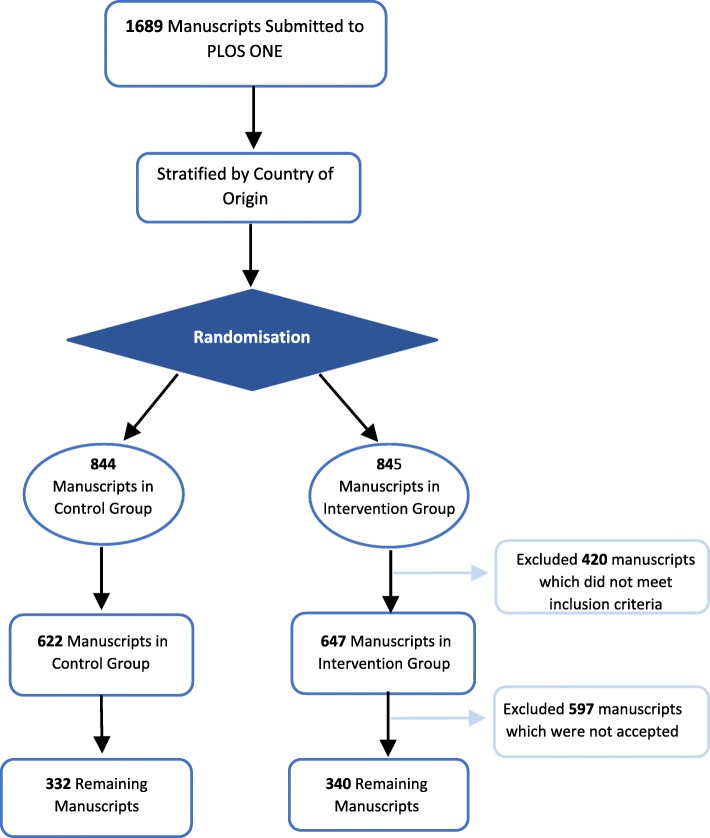
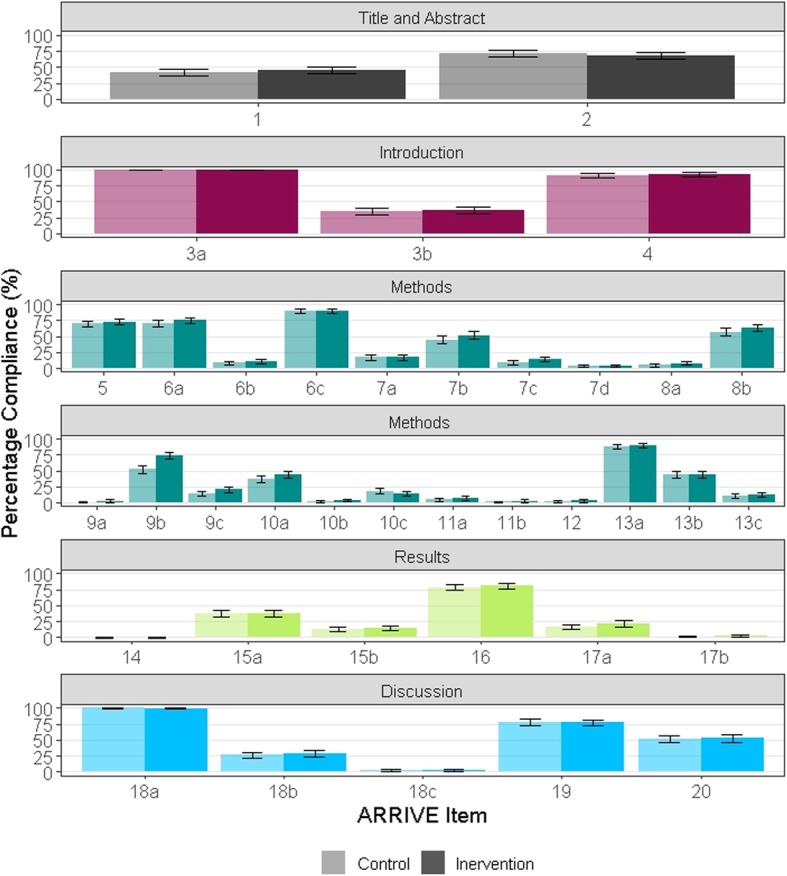
The ARRIVE (Animal Research: Reporting of In Vivo Experiments) guidelines are widely endorsed but compliance is limited. We sought to determine whether journal-requested completion of an ARRIVE checklist improves full compliance with the guidelines. In a randomised controlled trial, manuscripts reporting in vivo animal research submitted to PLOS ONE (March–June 2015) were randomly allocated to either requested completion of an ARRIVE checklist or current standard practice. Authors, academic editors, and peer reviewers were blinded to group allocation. Trained reviewers performed outcome adjudication in duplicate by assessing manuscripts against an operationalised version of the ARRIVE guidelines that consists 108 items. Our primary outcome was the between-group differences in the proportion of manuscripts meeting all ARRIVE guideline checklist subitems. We randomised 1689 manuscripts (control: n = 844, intervention: n = 845), of which 1269 were sent for peer review and 762 (control: n = 340; intervention: n = 332) accepted for publication. No manuscript in either group achieved full compliance with the ARRIVE checklist. Details of animal husbandry (ARRIVE subitem 9b) was the only subitem to show improvements in reporting, with the proportion of compliant manuscripts rising from 52.1 to 74.1% ( X 2 = 34.0, df = 1, p = 2.1 × 10 −7 ) in the control and intervention groups, respectively. These results suggest that altering the editorial process to include requests for a completed ARRIVE checklist is not enough to improve compliance with the ARRIVE guidelines. Other approaches, such as more stringent editorial policies or a targeted approach on key quality items, may promote improvements in reporting.
Overview
The claims and statistics of this paper haven’t been checked yet.
Free: it reads the open-access text and checks the first 5 claims that cite a source we can check. Create a free account to check every claim.
Integrity signals
Registry
Cites
Statistics
Figures
Verification
Claims the paper makes
The claims and statistics of this paper haven’t been checked yet.
Free: it reads the open-access text and checks the first 5 claims that cite a source we can check. Create a free account to check every claim.
Claims other papers make about this one
Each is checked against this paper’s own text: does it say what the citing paper says it does?
The source backs part of the claim, not all of it — or backs it for a different population, condition or comparison.
In the citing paper
“however, researchers are often unfamiliar with the much larger systemic bias in the publication of research and in the reliability of certain findings and even of entire fields [33, 38–40].”
From The ARRIVE guidelines 2.0: Updated guidelines for reporting animal research (2020) · cites this paper as [33]
Experimental — accuracy not yet measuredThe cited source says what the claim attributes to it.
In the citing paper
“Multi-pronged interventions, where more than one of these strategies are combined, may be more effective (such as completion of checklists coupled with editorial checks).68”
From The PRISMA 2020 statement: An updated guideline for reporting systematic reviews (2021) · cites this paper as [68]
The cited source says what the claim attributes to it.
In the citing paper
“For example, despite the first iteration of the ARRIVE guidelines being endorsed by over a thousand journals [22], they had limited impact on improving transparent reporting, even when authors were explicitly requested to use the ARRIVE checklist [23].”
From Open Science 2.0: Towards a truly collaborative research ecosystem (2023) · cites this paper as [23]
The cited source says what the claim attributes to it.
In the citing paper
“In many instances, interventions we hope would work turn out to be administrative burdens with negligible benefits [23,56,106].”
From Open Science 2.0: Towards a truly collaborative research ecosystem (2023) · cites this paper as [23]
The cited source says what the claim attributes to it.
In the citing paper
“Intervenciones multimodales, en las que se combinan varias de estas estrategias, pueden ser ma ´ s efectivas (por ejemplo, la aplicacio ´ n de las listas de verificacio ´ n junto con los controles editoriales) 64 .”
From Declaración PRISMA 2020: una guía actualizada para la publicación de revisiones sistemáticas (2021) · cites this paper as [64]
10 more claims about this paper
Create a free account to see every claim other papers make about this one.
Self-check
Percentages, sums and reported differences re-computed from the paper’s own numbers.
The self-check needs the paper’s full text.
Citations
Cites
Improving Bioscience Research Reporting: The ARRIVE Guidelines for Reporting Animal Research
Kilkenny, C., Browne, W. J., Cuthill, I. C., Emerson, M., & Altman, D. G. (2010) · PLoS Biology · doi:10.1371/journal.pbio.1000412 · Cited by 7,300
Improving bioscience research reporting: The ARRIVE guidelines for reporting animal research
Kilkenny, C., Browne, W. J., Cuthill, I. C., Emerson, M., & Altman, D. G. (2010) · Journal of Pharmacology and Pharmacotherapeutics · doi:10.4103/0976-500x.72351 · Cited by 6,277
Adjusting for multiple testing when reporting research results: the Bonferroni vs Holm methods.
Aickin, M., & Gensler, H. (1996) · American Journal of Public Health · doi:10.2105/ajph.86.5.726 · Cited by 1,346
McGrath, J. C., & Lilley, E. (2015) · British Journal of Pharmacology · doi:10.1111/bph.12955 · Cited by 1,321
A call for transparent reporting to optimize the predictive value of preclinical research
Landis, S. C., Amara, S. G., Asadullah, K., Austin, C. P., Blumenstein, R., Bradley, E. W., Crystal, R. G., Darnell, R. B., Ferrante, R. J., Fillit, H., et al. (2012) · Nature · doi:10.1038/nature11556 · Cited by 1,196
Self-citationKilkenny, C., Parsons, N., Kadyszewski, E., Festing, M. F. W., Cuthill, I. C., Fry, D., Hutton, J., & Altman, D. G. (2009) · PLoS ONE · doi:10.1371/journal.pone.0007824 · Cited by 860
Turner, L., Shamseer, L., Altman, D. G., Weeks, L., Peters, J., Kober, T., Dias, S., Schulz, K. F., Plint, A. C., & Moher, D. (2012) · Cochrane Database of Systematic Reviews · doi:10.1002/14651858.mr000030.pub2 · Cited by 740 · cited 1×
“Journal endorsement of these guidelines appear to have improved reporting quality [15, 18]; however, it is often unclear what actions journals take to promote adherence [17] and the extent of editorial involvement is likely to have an impact.”
BackgroundPREPARE: guidelines for planning animal research and testing
Smith, A. J., Clutton, R. E., Lilley, E., Hansen, K. E. A., & Brattelid, T. (2018) · Laboratory Animals · doi:10.1177/0023677217724823 · Cited by 587
Risk of bias in reports of in vivo research: a focus for improvement
Macleod, M. R., Lawson McLean, A., Kyriakopoulou, A., Serghiou, S., de Wilde, A., Sherratt, N., Hirst, T., Hemblade, R., Bahor, Z., Nunes-Fonseca, C., et al. (2015) · PLOS Biology · doi:10.1371/journal.pbio.1002273 · Cited by 358 · cited 2×
“Such omissions have been shown to be associated with overestimation of effect sizes [8, 13] and are likely to contribute, in part, to translational failure.”
BackgroundSelf-citationBaker, D., Lidster, K., Sottomayor, A., & Amor, S. (2014) · PLoS Biology · doi:10.1371/journal.pbio.1001756 · Cited by 305
Self-citation
Cited by
Items 101–172 of 172
Zhou, Y., Hong, Y., Wang, S., He, L., Cui, Y., Wu, Y., Yan, F., Long, C., & Gao, J. (2025) · Reproductive Toxicology · doi:10.1016/j.reprotox.2025.108945 · Cited by 6
Jordan, C. Y., Romanò, N., & Menzies, J. R. W. (2025) · Experimental Physiology · doi:10.1113/ep092884 · Cited by 5
Munteanu, R. A., Gulei, D., Moldovan, C. S., Azzoni, E., Belver, L., Feder, R., Pîrv, S., Buzoianu, A. D., Einsele, H., Mittelman, M., et al. (2025) · Cell Death and Disease · doi:10.1038/s41419-025-07861-0 · Cited by 5
“Other guidelines like the ARRIVE 2.0 [79] and PREPARE guidelines [80] provide foundational principles for transparent reporting and precise experimental design, but their application to MDS-speci fi c studies is inconsistent.”
InfluentialStruthers, C., Harwood, J., de Beyer, J. A., Logullo, P., & Collins, G. S. (2025) · BMC Medical Research Methodology · doi:10.1186/s12874-025-02518-0 · Cited by 8
“All previous randomized trials of interventions to improve reporting have been conducted as part of a journal editorial and peer review system [27, 28, 29, 2, 30, 31, 32, 33], or outside a real-world context [10].”
Mensch – Tier – Gott: Interdisziplinäre Annäherungen an eine christliche Tierethik
Brixen, I. V. F. M. U. S. 2., Lintner, M. M., & Verlagsgesellschaft, N. (2021) · Nomos Verlagsgesellschaft mbH & Co. KG eBooks · doi:10.5771/9783748907084 · Cited by 7
Maaloul, A., Pérez, C. I., Decara, J. M., Marí‐Beffa, M., Álvarez‐Torres, D., Redoli, S. L., Martínez‐Albardonedo, B., Araya‐Rojas, M., Fajardo, V., & Abdala‐Díaz, R. (2025) · Pharmaceutics · doi:10.3390/pharmaceutics17030335 · Cited by 5
Morahan, H., Hancock, N., Bero, L. A., & Rooney, K. B. (2024) · Laboratory Animals · doi:10.1177/00236772241242850 · Cited by 4
Improving quality of preclinical academic research through auditing: A feasibility study
Kurreck, C., Castaños‐Vélez, E., Freyer, D., Blumenau, S., Przesdzing, I., Bernard, R., & Dirnagl, U. (2020) · PLoS ONE · doi:10.1371/journal.pone.0240719 · Cited by 6
Checklists for Authors Improve the Reporting of Basic Science Research
Minnerup, J., Dirnagl, U., & Schäbitz, W. (2019) · Stroke · doi:10.1161/strokeaha.119.027626 · Cited by 4
“A positive effect of guidelines or checklists on reporting practice has also recently been demonstrated by others (The NPQIP Collaborative Group 2019),4 in addition to a general improvement in the reporting of study design elements in the field of focal cerebral ischemia research.5 A randomized controlled trial found…”
MethodAssessing the effects of a precommitment policy applied during peer review
Haber, N., Errington, T. M., Daley, M., Whaley, P., & Nosek, B. A. (2024) · Evidence-Based Toxicology · doi:10.1080/2833373x.2024.2386955 · Cited by 2
Rasmussen, C. L. M., Burkhart, A., Moos, T., & Thomsen, L. B. (2025) · Orphanet Journal of Rare Diseases · doi:10.1186/s13023-024-03479-1 · Cited by 4
Stanford, S. C. (2025) · Journal of Psychopharmacology · doi:10.1177/02698811251360754 · Cited by 4
“The ARRIVE Guidelines were developed to address that problem but despite most leading journals formally endorsing those guidelines, there is evidently scope for improving the compliance of the articles they publish (Hair et al., 2019; Lilley et al., 2020).”
Be CLEAR to ensure methodological and data transparency
George, C. H., Bate, S. T., Stanford, S. C., Ahluwalia, A., Curtis, M. J., Dehkhoda, F., Kolassa, J., Minervini, V., Nikam, V. S., Omotoso, T. O., et al. (2025) · Trends in Pharmacological Sciences · doi:10.1016/j.tips.2025.09.001 · Cited by 4
Bennett, K. A., Sutherland, C. D., & Savage, A. (2024) · Biochemical Pharmacology · doi:10.1016/j.bcp.2024.116300 · Cited by 3
“Nevertheless, recent work has high-lighted the limited requirement for, and reporting of, basic information required in the ARRIVE checklist in animal experimental studies [89], even when required at submission [90].”
BackgroundThe ARRIVE 2.0 Guidelines: Importance and Full Adoption by AALAS Journals
Suckow, M. A., & Fallon, M. T. (2024) · Journal of the American Association for Laboratory Animal Science · doi:10.30802/aalas-jaalas-24-083 · Cited by 3
Ameen‐Ali, K. E., & Allen, C. E. (2024) · CABI eBooks · doi:10.1079/9781800629431.0008 · Cited by 4
Lasagna, M., Mardirosian, M. N., Zappia, D., Enriquez, L., Miret, N. V., Dahir, L., Zotta, E., Randi, A. S., Núñez, M., & Cocca, C. (2025) · Toxicology · doi:10.1016/j.tox.2025.154059 · Cited by 3
Learning from Principles of Evidence-Based Medicine to Optimize Nonclinical Research Practices
Lefevre, I. A., & Balice‐Gordon, R. J. (2019) · Handbook of experimental pharmacology · doi:10.1007/164_2019_276 · Cited by 4
Dissemination of Research Results
Haven, T. L., & Strech, D. (2023) · Collaborative bioethics · doi:10.1007/978-3-031-29455-6_5 · Cited by 3
Preregistration in Animal Research
Heinl, C., Schönfelder, G., & Bert, B. (2022) · Springer eBooks · doi:10.1007/978-3-030-99680-2_37 · Cited by 2
Evaluating data sharing statements in leading emergency medicine journals: A mixed methods review
Hendrickson, F., Hossain, M. D., Duncan, J., Dennis, B., Hagood, A., Gardner, T., Oldham, E. P., Paul, E., Ford, A. I., & Vassar, M. B. (2024) · The American Journal of Emergency Medicine · doi:10.1016/j.ajem.2024.12.027 · Cited by 2
Wei, H., Du, T., Zhang, W., Ma, W., Yao, Y., & Li, J. (2025) · Pharmaceuticals · doi:10.3390/ph18010100 · Cited by 2
Raţiu, C. A., Sinescu, C. G., Dejeu, D., Ţică, O., Moisa, C., Croitoru, C. A., Rațiu, I. A., Duma, V.-F., Todor, A., Miclăuș, V., et al. (2025) · Medicina · doi:10.3390/medicina61101841 · Cited by 4
Scholarly Publishing and Scientific Reproducibility
Bomzon, A., & Tobin, G. (2021) · Laboratory animal science and medicine · doi:10.1007/978-3-030-66147-2_9 · Cited by 3
Bioethical aspects of hydrobiological research methodology
Romanenko, O., & Hrusha, M. (2021) · Ecological Sciences · doi:10.32846/2306-9716/2021.eco.6-39.14 · Cited by 2
Krebs, A. (2019) · ALTEX · doi:10.14573/altex.1909271s · Cited by 20
“In line with reports by many others (Freedman et al., 2015; Vogt et al., 2016; Hair et al., 2019), our own survey of the scientific literature has indicated that method descriptions still show an enormous heterogeneity in quality, detail and scope.”
BackgroundResultTraining in critical appraisal skills
Christopher, E., & Leow, H. W. (2020) · The Lancet · doi:10.1016/s0140-6736(19)33010-7 · Cited by 2
Synthetic Participants Generated by Large Language Models: A Systematic Literature Review
Kuric, E., Demcak, P., & Krajcovic, M. (2026) · doi:10.21203/rs.3.rs-9057643/v1 · Cited by 2
Better reporting of science to improve regulatory decision-making
Ågerstrand, M. (2020) · elni Review · doi:10.46850/elni.2020.003 · Cited by 1
Puljak, L., Pintur, S., Rombey, T., Lockwood, C. S., & Pieper, D. (2025) · Journal of Clinical Epidemiology · doi:10.1016/j.jclinepi.2025.112084 · Cited by 3
Data welfare is animal welfare: Building a WellFAIR research ecosystem
Petit‐Demoulière, B., & Huzard, D. (2026) · Neuroscience Applied · doi:10.1016/j.nsa.2026.106998 · Cited by 2
“1) ; and Enforcement: journals must move beyond passive checklists to active verification, making data quality a criterion for peer review (Hair et al., 2019).”
We need less animal research, better animal research, and animal research done for the right reasons
Ineichen, B. V. (2026) · Journal of Translational Medicine · doi:10.1186/s12967-026-08259-y · Cited by 1
“Unfortunately, adherence to reporting standards such as ARRIVE remains inconsistent in practice [39], suggesting that implementation barriers (potentially informed by behavioural and social science research) need to be better understood.”
Testing the usefulness of a quality system in preclinical research
Bernard, R., Gerlach, B., Haas, M., Macleod, M. R., Potschka, H., Rice, A. S. C., Steckler, T., Võikar, V., & Wever, K. E. (2024) · Neuroscience Applied · doi:10.1016/j.nsa.2024.105395 · Cited by 2
“Moreover, reporting guidelines alone, even when endorsed by publishers, mostly fall short of improving compliance by researchers (Hair et al., 2019), suggesting a need for additional interventions to achieve behavioural change.”
Self-citationARRIVE 2.0: Updated guidelines to improve the reporting of animal research
Carter, E. (2020) · Animal Welfare · doi:10.1017/s0962728600009039 · Cited by 1
Author response: Four erroneous beliefs thwarting more trustworthy research
Yarborough, M. A., Nadon, R., & Karlin, D. (2019) · eLife · doi:10.7554/elife.45261.003 · Cited by 1
Tools to enable animal to human translation: Assessing the value of disease models
Ferreira, G. S. (2020) · Utrecht University Repository (Utrecht University) · doi:10.33540/157 · Cited by 2
Karl, T., Nithianantharajah, J., & Weber‐Stadlbauer, U. (2022) · Frontiers in Behavioral Neuroscience · doi:10.3389/fnbeh.2022.905327 · Cited by 1
“They highlight the development of guidelines for good experimental practices, and that embracing open research practices does not necessarily assure compliance with the proposed guidelines (Baker et al., 2014; Hair et al., 2019).”
BackgroundNBS Hack Week: Pilot study on ARRIVE guidelines E10 compliancePreprint
Fernandes, J. C. R., Loss, C. M., Hajdu, K. L., Lira, R. C. P., & Tan, P. B. (2022) · BioHackrXiv (OSF Preprints) · doi:10.37044/osf.io/ybnx9 · Cited by 1
Smith, A. J. (2024) · Clinical Orthopaedics and Related Research · doi:10.1097/corr.0000000000003013 · Cited by 1
The Brazilian Reproducibility Initiative: a systematic assessment of Brazilian biomedical sciencePreprint
Amaral, O. B., Neves, K., Wasilewska‐Sampaio, A. P., & Carneiro, C. F. D. (2018) · OSF Preprints (OSF Preprints) · doi:10.31219/osf.io/ahf7t
Commentary: Improving our statistical inferences requires meta-research
Thibault, R. T., & Munafo, M. R. (2020) · International Journal of Epidemiology · doi:10.1093/ije/dyaa051
Assessing interventions to improve adherence to reporting guidelines in biomedical research
Blanco, D. (2020) · UPCommons institutional repository (Universitat Politècnica de Catalunya) · doi:10.5821/dissertation-2117-327395 · Cited by 1
Eggel, M. (2021) · Nomos Verlagsgesellschaft mbH & Co. KG eBooks · doi:10.5771/9783748907084-385
Farquhar-Smith, P. W., & Gordon-Williams, R. (2020) · Faculty Opinions – Post-Publication Peer Review of the Biomedical Literature · doi:10.3410/f.735799554.793571725
Improving quality of preclinical academic research through auditing:Preprint
Kurreck, C., Castaños‐Vélez, E., Freyer, D., Blumenau, S., Przesdzing, I., Bernard, R., & Dirnagl, U. (2020) · OSF Preprints (OSF Preprints) · doi:10.31219/osf.io/y8tpd
Kiermer, V. (2022) · Editorial Office News · doi:10.18243/eon/2022.15.3.4
Addressing the elephant in the T-maze: Developing experimental conduct guidelines for neuroscience
Vollert, J. (2023) · Journal of Neuroscience Methods · doi:10.1016/j.jneumeth.2023.109956
Open science interventions proposed or implemented to assess researcher impact: a scoping review
Ghannad, M., Armond, A. C. V., Ng, J. Y., Ayala, A. P., Khan, H., Grossman, M. R., Cormack, G. V., Pham, B., Leeflang, M., Bossuyt, P. M., et al. (2023) · F1000Research · doi:10.12688/f1000research.140556.1
Witowski, J., Sikorska, D., & Catar, R. A. (2024) · The Nephron journals/Nephron journals · doi:10.1159/000539892
“On the other hand, it has been demonstrated that even man-dating submission of a completed ARRIVE checklist does not guarantee that all required information is included in the manuscript [4].”
InfluentialStatistical considerations for the breeding of zebrafish and their use in experiments
Spencer, A., Laud, P. J., Allen, C. E., Bull, J. C., Stillman, E., & Hilditch, S. (2024) · CABI eBooks · doi:10.1079/9781800629431.0009
Rethlefsen, M. L. (2024) · Research Publications (Maastricht University) · doi:10.26481/dis.20250121mr
How Transparent and Reproducible Are Studies That Use Animal Models of Opioid Addiction?
Blackwell, J. C., Beitner, J., & Holcombe, A. O. (2025) · Addiction Biology · doi:10.1111/adb.70027
“Whereas requiring use of ARRIVE may seem simple, experiences at journals indicate otherwise [40, 51, 56].”
Strategies to Reduce Severe Perineal Lacerations
Marko, E. (2025) · Springer eBooks · doi:10.1007/978-3-031-92486-6_16
Additional file 1 of The ARRIVE guidelines 2.0: Updated guidelines for reporting animal research
Percie du Sert, N., Hurst, V., Ahluwalia, A., Alam, S., Avey, M. T., Baker, M., Browne, W. J., Clark, A., Cuthill, I. C., Dirnagl, U., et al. (2020) · Figshare · doi:10.6084/m9.figshare.12650470
Self-citationPage, M. J., McKenzie, J. E., Bossuyt, P. M., Boutron, I., Hoffmann, T., Mulrow, C. D., Shamseer, L., Tetzlaff, J., Akl, E. A., Brennan, S. E., et al. (2021) · Figshare · doi:10.6084/m9.figshare.14431751
Additional file 4 of The ARRIVE guidelines 2.0: Updated guidelines for reporting animal research
Percie du Sert, N., Hurst, V., Ahluwalia, A., Alam, S., Avey, M. T., Baker, M., Browne, W. J., Clark, A., Cuthill, I. C., Dirnagl, U., et al. (2020) · Figshare · doi:10.6084/m9.figshare.12650479
Self-citationPage, M. J., McKenzie, J. E., Bossuyt, P. M., Boutron, I., Hoffmann, T., Mulrow, C. D., Shamseer, L., Tetzlaff, J., Akl, E. A., Brennan, S. E., et al. (2021) · Figshare · doi:10.6084/m9.figshare.14431754
Additional file 2 of The ARRIVE guidelines 2.0: Updated guidelines for reporting animal research
Percie du Sert, N., Hurst, V., Ahluwalia, A., Alam, S., Avey, M. T., Baker, M., Browne, W. J., Clark, A., Cuthill, I. C., Dirnagl, U., et al. (2020) · Figshare · doi:10.6084/m9.figshare.12650473
Self-citationZhao, B., Jiang, Y., Zhang, T., Shang, Z., Zhang, W., Hu, K., Chen, F., Mei, F., Gao, Q., Zhao, L., et al. (2020) · Figshare · doi:10.6084/m9.figshare.13294768
Good publication practices: declaration, approval, and now enforcement of reporting standards
Saygitov, R. T., & Sinitsyn, V. E. (2025) · Digital Diagnostics · doi:10.17816/dd680847
Forrest, H., Huzard, D., Restivo, L., Baran, S. W., & Petit‐Demoulière, B. (2026) · Springer eBooks · doi:10.1007/978-3-032-19781-8_10
Reynolds, P. S., & Pearl, E. J. (2026) · Laboratory Animals · doi:10.1177/00236772261462343 · Cited by 1
The reporting of dental studies involving animal models requires improvement
Seehra, J., Meir, E., Alqabandi, N., Cockerham, J., Cobourne, M. T., & Pandis, N. (2026) · European Journal Of Oral Sciences · doi:10.1111/eos.70159
Ichana, C., Boulanger, C., Blanchard, C., Charuel, É., Ménini, T., Vaillant-Roussel, H., & Boussageon, R. (2026) · French Academic Journal of Primary Care · doi:10.46298/fajpc.18899
Blanco, D., Chen, D., Cadellans-Arróniz, A., Donadio, M. V. F., Édouard, P., Iatropoulos, S., Dandrieux, P., Casals, M., Cortés, J., Struthers, C., et al. (2026) · BMJ · doi:10.1136/bmj-2026-100917 · Cited by 1
“…in randomised controlled trials evaluating the effect of reminding peer reviewers of key SPIRIT items, 5 requiring authors to deliver reporting guideline checklists at submission, 7 or using a web based tool that combines reporting guideline extensions and generates a checklist at revision.”
Metadata
- Authors
- on behalf of the IICARus Collaboration, Hair, K., Macleod, M. R., & Sena, E. S.
- Affiliations
- University of Edinburgh (GB)
- Venue
- Research Integrity and Peer Review
- Published
- 2019-06-12
- Volume
- 4
- Issue
- 1
- Pages
- 12-12
- ISSN
- 2058-8615 (ISSN-L)
- PMC
- PMC6560728
- OpenAlex
- W2949899843
- Semantic Scholar
- acfcea0cb972bb8adb29b9381f05756cc342a3a6
- Cited by
- 174
- References
- 26
- Citations by year
- 2026: 7 · 2025: 18 · 2024: 17 · 2023: 15 · 2022: 20 · 2021: 30 · 2020: 41 · 2019: 23
- FWCI
- 37.55
- Type
- journal article
- Language
- en
- Open access
- gold
- doi.org
- Licence
- cc-by
- creativecommons.org/licenses/by/4.0/ (tdm)
- creativecommons.org/licenses/by/4.0/ (vor)
- Locations
- Research Integrity and Peer Review (publishedVersion, cc-by)
- bioRxiv (Cold Spring Harbor Laboratory) (acceptedVersion, cc-by-nc)
- PubMed Central (publishedVersion, cc-by)
- PubMed (publishedVersion)
- Edinburgh Research Explorer (University of Edinburgh) (publishedVersion, cc-by)
- IRIS Research product catalog (Sapienza University of Rome) (submittedVersion, cc-by)
- Radboud Repository (Radboud University) (submittedVersion, other-oa)
- DOAJ (DOAJ: Directory of Open Access Journals) (submittedVersion, cc-by-sa)
- Radboud Repository (Radboud University) (submittedVersion)
- Funders
- Wellcome Trust
- Directorate for Biological Sciences
- Medical Research Council (MR/N004574/1)
- Biotechnology and Biological Sciences Research Council
- Topics
- Health Sciences › Veterinary › Small Animals › Animal testing and alternatives
- Social Sciences › Decision Sciences › Statistics, Probability and Uncertainty › Meta-analysis and systematic reviews
- Social Sciences › Library and Information Sciences › Academic Publishing and Open Access
- Keywords
- ARRIVE guidelines, reporting guidelines compliance, animal research reporting, in vivo animal experiments, editorial process, peer review, PLOS ONE
About these checks
Registry, retraction, Cites and statistics results are computed, not judged, with one exception: a printed reference that no index lists is read once by a model before it counts as a citation error. Claims are extracted by a model and kept only when their quote appears verbatim in the text; each cited source is then checked, with a model’s help, for whether it says what the claim relies on. Those verdicts can be wrong — read the claim’s quote and the cited source before relying on one.
Statistics and arithmetic are recomputed, not judged.
Confidence bands are shown only for fields calibrated on our annotated test set. None is calibrated yet, so no band is shown.
What counts as a claim ›How we measure confidence ›How we check this ›
Are you an author, or do you see a problem with this page? Request a review
Data sources
Bibliographic data: Semantic Scholar, OpenAlex, Crossref.
Contains information from the Semantic Scholar Academic Graph Datasets, made available under the ODC Attribution License (ODC-BY 1.0).
Semantic Scholar’s data is described in: Kinney, R., et al. (2023). The Semantic Scholar Open Data Platform. arXiv:2301.10140.
