

The DOI matches its Crossref record; 31 of the 31 references it cites were found in a registry or an index; 10 of the 27 sources its claims cite were checked for support.
False authorship: an explorative case study around an AI-generated article published under my name
Open accessAbstract
BACKGROUND: The proliferation of generative artificial intelligence (AI) has facilitated the creation and publication of fraudulent scientific articles, often in predatory journals. This study investigates the extent of AI-generated content in the Global International Journal of Innovative Research (GIJIR), where a fabricated article was falsely attributed to me. METHODS: The entire GIJIR website was crawled to collect article PDFs and metadata. Automated scripts were used to extract the number of probable in-text citations, DOIs, affiliations, and contact emails. A heuristic based on the number of in-text citations was employed to identify the probability of AI-generated content. A subset of articles was manually reviewed for AI indicators such as formulaic writing and missing empirical data. Turnitin's AI detection tool was used as an additional indicator. The extracted data were compiled into a structured dataset, which was analyzed to examine human-authored and AI-generated articles. RESULTS: Of the 53 examined articles with the fewest in-text citations, at least 48 appeared to be AI-generated, while five showed signs of human involvement. Turnitin's AI detection scores confirmed high probabilities of AI-generated content in most cases, with scores reaching 100% for multiple papers. The analysis also revealed fraudulent authorship attribution, with AI-generated articles falsely assigned to researchers from prestigious institutions. The journal appears to use AI-generated content both to inflate its standing through misattributed papers and to attract authors aiming to inflate their publication record. CONCLUSIONS: The findings highlight the risks posed by AI-generated and misattributed research articles, which threaten the credibility of academic publishing. Ways to mitigate these issues include strengthening identity verification mechanisms for DOIs and ORCIDs, enhancing AI detection methods, and reforming research assessment practices. Without effective countermeasures, the unchecked growth of AI-generated content in scientific literature could severely undermine trust in scholarly communication.
Overview
AI snapshot
Written from the paper’s full text.
TL;DR
An AI-generated article falsely attributed to the author prompted an exploratory audit of the Global International Journal of Innovative Research (GIJIR), a suspected predatory journal. The audit found that most of the 53 lowest-citation articles appeared AI-generated, alongside fraudulent authorship and publication-record inflation.
Key findings
- Of the 53 GIJIR articles with the fewest in-text citations, at least 48 appeared mostly AI-generated, while five showed signs of human involvement; Turnitin scores for a subset were 97%, 100% (three papers), and 82%.
- Ten articles at the bottom of the citation ranking seemed human-authored, and Turnitin gave all a score below 20%.
- AI-generated articles were falsely attributed to researchers at prestigious institutions, with wrong or Gmail contact emails; at least two named authors, Christodoulos A. Floudas and Georges Guiochon, had died years before the articles under their names were published.
- The journal had 220 contact emails, of which 113 were Gmail addresses and 78 used the Indonesian academic domain “.ac.id”; it charged a $500 article processing charge and was not listed in DOAJ.
Methods
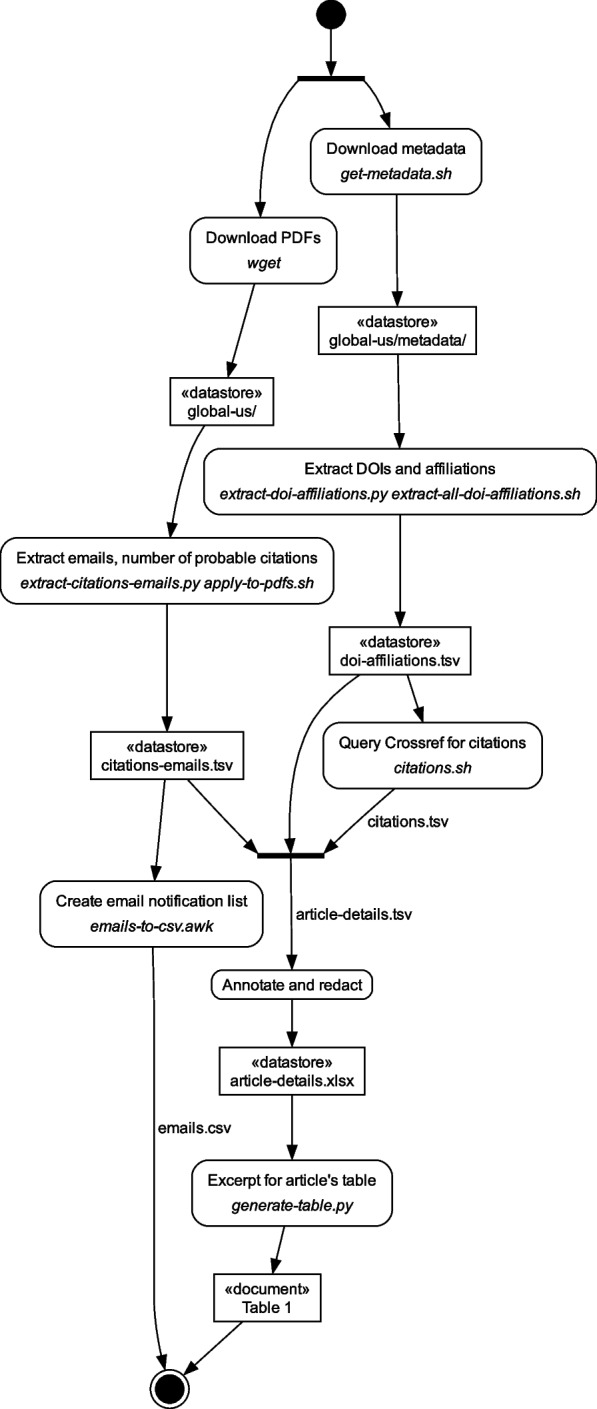
- The entire GIJIR website was crawled with wget to collect article PDFs and metadata; Python, shell, and awk scripts extracted probable in-text citations, DOIs, affiliations, and contact emails. Data were gathered on September 10–11, 2024.
- A heuristic counted probable in-text citation delimiters before the References section, with low counts indicating likely AI generation. The 53 papers with the fewest delimiters and ten papers at the bottom of the ranking were manually examined; systematically selected subsets were scored with Turnitin on September 24, 2024.
- Extracted data were compiled into a hand-curated Microsoft Excel dataset, and authors were notified of possible fraudulent use of their names.
Limitations
- The paper states that AI identification relied on heuristics, manual assessment, and Turnitin’s opaque models, which may produce false positives or negatives; classification involved subjective human judgment; the analyzed subset was non-random; and the study covered only one journal.
- The paper also states that manual curation and subjective assessments may hinder full reproduction, and that changes to Turnitin functionality or the journal’s website could challenge future verification.
- The text makes evident that the findings are not generalizable beyond GIJIR and that Turnitin does not report exact scores below 20%.
Model-written summary. Check it against the paper before relying on it.
Integrity signals
Registry
Cites
Statistics
Figures
Verification
Claims the paper makes
23 Own interpretation · 16 Own result · 11 Not checked yet · 6 Own method · 4 Supported · 4 Partly supported · 3 No full text of the sources · 3 No basis given · accuracy not yet measured
The cited sources support only part of this claim — read each source’s verdict below.
In the paper
“while automatically recognizing their AI provenance [2, 15] will likely become an uphill struggle as generative AI tools become more sophisticated and therefore produce output that will be increasingly difficult to detect.”
§ False authorship: an explorative case study around an AI-generated article published under my name > Discussion > Problems from AI-generated papers
What the sources say
- Partly supportedcites [2] Walters WH. The Effectiveness of Software Designed to Detect AI-Generated Writing: A Comparison of 16 AI Text Detectors. Open Inf Sci. 2023;7(1). https://doi.org/10.1515/opis-2022-0158. sourceExperimental — accuracy not yet measured
Section 4.1 (page unavailable) reports that most detectors performed poorly on GPT-4 text compared with GPT-3.5 text, supporting the concern that newer AI output can be harder to identify. But it also says the best detectors quickly matched improvements in text generators and performed just as well on GPT-4, so the paper does not support an ongoing trend toward increasingly difficult detection. (LLM, conf=0.86)
- Not checked yetcites [15] Knott A, Pedreschi D, Chatila R, Chakraborti T, Leavy S, Baeza-Yates R, et al. Generative AI Models Should Include Detection Mechanisms as a Condition for Public Release. Ethics Inf Technol. 2023;25(4). https://doi.org/10.1007/s10676-023-09728-4. source
Checked before — its earlier verdict is held back until a new check runs.
hedgedconditional- Asserted: passes — The authors put it forward as true.
- Checkable: unclear — It is unclear whether it could be checked against evidence.
- Load-bearing: unclear — It is unclear whether the paper’s conclusions depend on it.
- Based: passes — The paper gives a reason why it holds.
- Partly supported
Every source the paper cites for this claim was checked and supports it.
In the paper
“This term refers to the finding [20] that haphazardly training LLMs (large language models) with LLM-generated content is an irreversible process that results in faulty models lacking the tails of the original content distribution.”
§ False authorship: an explorative case study around an AI-generated article published under my name > Discussion > Problems from AI-generated papers
What the sources say
- Supportedcites [20] Shumailov I, Shumaylov Z, Zhao Y, Papernot N, Anderson R, Gal Y. AI Models Collapse when Trained on Recursively Generated Data. Nature. 2024;631(8022):755–9. https://doi.org/10.1038/s41586-024-07566-y. source
The Abstract says that indiscriminate use of model-generated content in training causes irreversible defects in which the tails of the original content distribution disappear. The Main section identifies this process as model collapse and says it occurs in LLMs. (LLM, conf=0.95)
plaindirect- Asserted: passes — The authors put it forward as true.
- Checkable: passes — It can be checked against evidence.
- Load-bearing: unclear — It is unclear whether the paper’s conclusions depend on it.
- Based: passes — The paper gives a reason why it holds.
- Supported
The cited sources support only part of this claim — read each source’s verdict below.
In the paper
“Setting up guardrails in large language models [23] to prevent their use for such purposes is tricky, because the generation of corresponding manuscripts overlaps with the legitimate use case of aiding scientific research.”
§ False authorship: an explorative case study around an AI-generated article published under my name > Discussion > The solution landscape
What the sources say
- Partly supportedcites [23] Rebedea T, Dinu R, Sreedhar MN, Parisien C, Cohen J. NeMo Guardrails: A Toolkit for Controllable and Safe LLM Applications with Programmable Rails. In: Proceedings of the 2023 Conference on Empirical Methods in Natural Language Processing: System Demonstrations. Kerrville: Association for Computational Linguistics; 2023. pp. 431–45. sourceExperimental — accuracy not yet measured
Section 7.1 says building safe LLM applications is difficult and that programmable rails are not a perfect safety solution. It does not discuss fraudulent manuscripts or say that overlap with legitimate scientific research makes guardrails difficult to set up. (LLM, conf=0.85)
plaindirect- Asserted: passes — The authors put it forward as true.
- Checkable: unclear — It is unclear whether it could be checked against evidence.
- Load-bearing: passes — The paper’s conclusions depend on it.
- Based: passes — The paper gives a reason why it holds.
- Partly supported
Every source the paper cites for this claim was checked and supports it.
In the paper
“The problems and their possible solutions overlap with those of paper mills — networks that sell to researchers authorships and low quality manuscripts [26].”
§ False authorship: an explorative case study around an AI-generated article published under my name > Discussion > The solution landscape
What the sources say
- Supportedcites [26] Abalkina A, Aquarius R, Bik E, Bimler D, Bishop D, Byrne J, et al. ‘Stamp out Paper Mills’ - Science Sleuths on how to Fight Fake Research. Nature. 2025;637(8048):1047–50. https://doi.org/10.1038/d41586-025-00212-1. source
The paper’s opening section (page unavailable) defines paper mills as networks that sell authorships and poor-quality or fabricated manuscripts to researchers, directly supporting the description beside the citation. The sentence’s broader comparison with correctly attributed AI-generated articles is the citing authors’ framing, not a claim the citation specifically attributes to this source. (LLM, conf=0.92)
plaincorrelational- Asserted: passes — The authors put it forward as true.
- Checkable: passes — It can be checked against evidence.
- Load-bearing: unclear — It is unclear whether the paper’s conclusions depend on it.
- Based: passes — The paper gives a reason why it holds.
- Supported
A result the paper reports from its own data — it cites no other source for it, so there is none to check. The quote shows it is in the paper.
In the paper
“Out of the 220 contact emails, apart from 113 Gmail addresses, 78 use the Indonesian academic domain “.ac.id”.”
§ False authorship: an explorative case study around an AI-generated article published under my name > Results
plain- Asserted: passes — The authors put it forward as true.
- Checkable: passes — It can be checked against evidence.
- Load-bearing: passes — The paper’s conclusions depend on it.
- Based: passes — The paper gives a reason why it holds.
A result the paper reports from its own data — it cites no other source for it, so there is none to check. The quote shows it is in the paper.
In the paper
“currently the article appears as the first result in a query for “Spinellis business”, as can be seen in the replication package’s file spinellis business - Google Scholar.pdf.”
§ False authorship: an explorative case study around an AI-generated article published under my name > Discussion > Problems from AI-generated papers
hedgedSingle case- Asserted: passes — The authors put it forward as true.
- Checkable: passes — It can be checked against evidence.
- Load-bearing: unclear — It is unclear whether the paper’s conclusions depend on it.
- Based: passes — The paper gives a reason why it holds.
A result the paper reports from its own data — it cites no other source for it, so there is none to check. The quote shows it is in the paper.
In the paper
“Also, the Turnitin AI writing detection service reports a 100% AI generation score.”
§ False authorship: an explorative case study around an AI-generated article published under my name > Background
plainSingle case- Asserted: passes — The authors put it forward as true.
- Checkable: passes — It can be checked against evidence.
- Load-bearing: unclear — It is unclear whether the paper’s conclusions depend on it.
- Based: passes — The paper gives a reason why it holds.
A result the paper reports from its own data — it cites no other source for it, so there is none to check. The quote shows it is in the paper.
In the paper
“In contrast to the articles of the first category, most of the author contact emails of these articles appear to be correct and accessible.”
§ False authorship: an explorative case study around an AI-generated article published under my name > Results
hedged- Asserted: passes — The authors put it forward as true.
- Checkable: passes — It can be checked against evidence.
- Load-bearing: unclear — It is unclear whether the paper’s conclusions depend on it.
- Based: passes — The paper gives a reason why it holds.
The paper states this without a source or data behind it here, so there is nothing to check it against. The quote shows it is in the paper.
In the paper
“The first five published articles of volume 1 issue 1 (10.59613/global.v1i1.1 to 10.59613/global.v1i1.5) are of this type.”
§ False authorship: an explorative case study around an AI-generated article published under my name > Results
plain- Asserted: passes — The authors put it forward as true.
- Checkable: passes — It can be checked against evidence.
- Load-bearing: passes — The paper’s conclusions depend on it.
- Based: passes — The paper gives a reason why it holds.
A result the paper reports from its own data — it cites no other source for it, so there is none to check. The quote shows it is in the paper.
In the paper
“This is substantiated by the fact that the practice was prevalent at the journal’s launch.”
§ False authorship: an explorative case study around an AI-generated article published under my name > Results
plain- Asserted: passes — The authors put it forward as true.
- Checkable: passes — It can be checked against evidence.
- Load-bearing: unclear — It is unclear whether the paper’s conclusions depend on it.
- Based: passes — The paper gives a reason why it holds.
None of the sources cited for this claim have been checked yet.
In the paper
“According to its publishers, it is an open access journal, but its ISSN does not appear in the Directory of Open Access Journals (DOAJ) [6].”
§ False authorship: an explorative case study around an AI-generated article published under my name > Results
What the sources say
- Not checked yetcites [6] Morrison H. Directory of Open Access Journals (DOAJ). Charleston Advis. 2017;18(3):25–8. source
Checked before — its earlier verdict is held back until a new check runs.
plain- Asserted: passes — The authors put it forward as true.
- Checkable: passes — It can be checked against evidence.
- Load-bearing: unclear — It is unclear whether the paper’s conclusions depend on it.
- Based: passes — The paper gives a reason why it holds.
- Not checked yet
The paper states this without a source or data behind it here, so there is nothing to check it against. The quote shows it is in the paper.
In the paper
“By that time the journal had published 52 out of its 220 articles.”
§ False authorship: an explorative case study around an AI-generated article published under my name > Results
plain- Asserted: passes — The authors put it forward as true.
- Checkable: passes — It can be checked against evidence.
- Load-bearing: unclear — It is unclear whether the paper’s conclusions depend on it.
- Based: passes — The paper gives a reason why it holds.
A result the paper reports from its own data — it cites no other source for it, so there is none to check. The quote shows it is in the paper.
In the paper
“The five papers selected as one out every ten from the 53 ones and submitted to Turnitin received generative AI detection scores of 97%, 3 × 100%, and 82%.”
§ False authorship: an explorative case study around an AI-generated article published under my name > Results
plain- Asserted: passes — The authors put it forward as true.
- Checkable: passes — It can be checked against evidence.
- Load-bearing: passes — The paper’s conclusions depend on it.
- Based: passes — The paper gives a reason why it holds.
- Rests on an assumption: Formulaic content, lack of empirical data, citations, tables, and figures are reliable signs of AI-generated articles.
A result the paper reports from its own data — it cites no other source for it, so there is none to check. The quote shows it is in the paper.
In the paper
“From that set of ten papers, one paper every two was also submitted to Turnitin, which gave to all a score of less than 20%.”
§ False authorship: an explorative case study around an AI-generated article published under my name > Results
plain- Asserted: passes — The authors put it forward as true.
- Checkable: passes — It can be checked against evidence.
- Load-bearing: unclear — It is unclear whether the paper’s conclusions depend on it.
- Based: passes — The paper gives a reason why it holds.
A result the paper reports from its own data — it cites no other source for it, so there is none to check. The quote shows it is in the paper.
In the paper
“At the bottom of the citation delimiters ranking, ten manually examined papers seem all to have been human authored.”
§ False authorship: an explorative case study around an AI-generated article published under my name > Results
hedged- Asserted: passes — The authors put it forward as true.
- Checkable: passes — It can be checked against evidence.
- Load-bearing: unclear — It is unclear whether the paper’s conclusions depend on it.
- Based: passes — The paper gives a reason why it holds.
- Rests on an assumption: Formulaic content, lack of empirical data, citations, tables, and figures are reliable signs of AI-generated articles.
A result the paper reports from its own data — it cites no other source for it, so there is none to check. The quote shows it is in the paper.
In the paper
“In a simple experiment, a 67-word pair of prompts to ChatGPT (model 4o) asking for an article in one of the GIJIR’s many topics was all that was required to obtain a 1900-word article — of similar length to the one published under in GIJIR under my name.”
§ False authorship: an explorative case study around an AI-generated article published under my name > Discussion > Problems from AI-generated papers
plaindirectSingle case- Asserted: passes — The authors put it forward as true.
- Checkable: passes — It can be checked against evidence.
- Load-bearing: passes — The paper’s conclusions depend on it.
- Based: passes — The paper gives a reason why it holds.
A conclusion the paper draws from its own results — it cites no other source for it, so there is none to check. The quote shows it is in the paper.
In the paper
“The second likely purpose for publishing AI-generated papers is to create publications for padding the CVs of their authors.”
§ False authorship: an explorative case study around an AI-generated article published under my name > Results
hedged- Asserted: passes — The authors put it forward as true.
- Checkable: passes — It can be checked against evidence.
- Load-bearing: unclear — It is unclear whether the paper’s conclusions depend on it.
- Based: passes — The paper gives a reason why it holds.
None of the sources cited for this claim have been checked yet.
In the paper
“In addition, for fraudulently attributed articles, the ease of their production means that they can be churned out in a large volume, without needing to resort to the more cumbersome method of populating fake journals by bootlegging and modifying existing material [9].”
§ False authorship: an explorative case study around an AI-generated article published under my name > Discussion > Problems from AI-generated papers
What the sources say
- Not checked yetcites [9] Siler K, Vincent-Lamarre P, Sugimoto CR, Lariviére V. Predatory Publishers’ Latest Scam: Bootlegged and Rebranded Papers. Nature. 2021;598(7882):563–5. https://doi.org/10.1038/d41586-021-02906-8. source
Checked before — its earlier verdict is held back until a new check runs.
plaindirect- Asserted: passes — The authors put it forward as true.
- Checkable: passes — It can be checked against evidence.
- Load-bearing: unclear — It is unclear whether the paper’s conclusions depend on it.
- Based: passes — The paper gives a reason why it holds.
- Not checked yet
A conclusion the paper draws from its own results — it cites no other source for it, so there is none to check. The quote shows it is in the paper.
In the paper
“Fraudulently attributed articles can also damage their ostensible authors’ reputations.”
§ False authorship: an explorative case study around an AI-generated article published under my name > Discussion > Problems from AI-generated papers
plaindirectSingle case- Asserted: passes — The authors put it forward as true.
- Checkable: passes — It can be checked against evidence.
- Load-bearing: passes — The paper’s conclusions depend on it.
- Based: passes — The paper gives a reason why it holds.
In the paper
“Moreover, correctly attributed AI-generated articles can be employed en masse by unethical authors to inflate their publication record, saving them the trouble and expense of procuring them from a paper mill [22].”
§ False authorship: an explorative case study around an AI-generated article published under my name > Discussion > Problems from AI-generated papers
What the sources say
- Not checked — no full text of the sourcecites [22] Else H, Van Noorden R. The Fight Against Fake-Paper Factories that Churn out Sham Science. Nature. 2021;591(7851):516–9. https://doi.org/10.1038/d41586-021-00733-5. source
plaindirect- Asserted: passes — The authors put it forward as true.
- Checkable: passes — It can be checked against evidence.
- Load-bearing: unclear — It is unclear whether the paper’s conclusions depend on it.
- Based: passes — The paper gives a reason why it holds.
None of the sources cited for this claim have been checked yet.
In the paper
“First, to create completely fake articles ostensibly by authors affiliated with well-known universities, probably to lend credence to the journal, as is also done with the bootlegging and rebranding of existing papers [9].”
§ False authorship: an explorative case study around an AI-generated article published under my name > Results
What the sources say
- Not checked yetcites [9] Siler K, Vincent-Lamarre P, Sugimoto CR, Lariviére V. Predatory Publishers’ Latest Scam: Bootlegged and Rebranded Papers. Nature. 2021;598(7882):563–5. https://doi.org/10.1038/d41586-021-02906-8. source
Checked before — its earlier verdict is held back until a new check runs.
hedgeddirect- Asserted: passes — The authors put it forward as true.
- Checkable: passes — It can be checked against evidence.
- Load-bearing: passes — The paper’s conclusions depend on it.
- Based: passes — The paper gives a reason why it holds.
- Not checked yet
What the paper did — it cites no source for this, so there is none to check. The quote shows it is in the paper.
In the paper
“The analysis is based on a non-random subset of articles (those with the fewest and most probable citations), which may not fully represent the entire journal’s content.”
§ False authorship: an explorative case study around an AI-generated article published under my name > Limitations
hedged- Asserted: passes — The authors put it forward as true.
- Checkable: passes — It can be checked against evidence.
- Load-bearing: unclear — It is unclear whether the paper’s conclusions depend on it.
- Based: passes — The paper gives a reason why it holds.
What the paper did — it cites no source for this, so there is none to check. The quote shows it is in the paper.
In the paper
“The study’s identification of AI-generated papers relies on heuristic methods, such as the absence of in-text citations, manual assessment regarding the absence of empirical data and similar signs, as well as the opaque models employed by Turnitin. All these may lead to false positives or negatives.”
§ False authorship: an explorative case study around an AI-generated article published under my name > Limitations
hedgedconditional- Asserted: passes — The authors put it forward as true.
- Checkable: passes — It can be checked against evidence.
- Load-bearing: passes — The paper’s conclusions depend on it.
- Based: passes — The paper gives a reason why it holds.
None of the sources cited for this claim have been checked yet.
In the paper
“Requiring model developers to release detection tools for their models’ generated text [15] is likely to be ineffective, due to the existence of open-source models that can be easily adjusted and run even on a laptop.”
§ False authorship: an explorative case study around an AI-generated article published under my name > Discussion > The solution landscape
What the sources say
- Not checked yetcites [15] Knott A, Pedreschi D, Chatila R, Chakraborti T, Leavy S, Baeza-Yates R, et al. Generative AI Models Should Include Detection Mechanisms as a Condition for Public Release. Ethics Inf Technol. 2023;25(4). https://doi.org/10.1007/s10676-023-09728-4. source
Checked before — its earlier verdict is held back until a new check runs.
hedgedconditional- Asserted: passes — The authors put it forward as true.
- Checkable: unclear — It is unclear whether it could be checked against evidence.
- Load-bearing: unclear — It is unclear whether the paper’s conclusions depend on it.
- Based: passes — The paper gives a reason why it holds.
- Not checked yet
- It may state two separate claims as one. 31
- Probably not a substantial claim. 23
The cited sources support only part of this claim — read each source’s verdict below.
In the paper
“Furthermore, machine-generated articles pollute the scientific communication landscape with trite platitudes, potentially incorrect facts [16], biased or discriminatory text ([17], p. 33), and often incorrect citations [18].”
§ False authorship: an explorative case study around an AI-generated article published under my name > Discussion > Problems from AI-generated papers
What the sources say
- Could not verifycites [16] Ji Z, Lee N, Frieske R, Yu T, Su D, Xu Y, et al. Survey of Hallucination in Natural Language Generation. ACM Comput Surv. 2023;55(12):1–38. https://doi.org/10.1145/3571730. sourceExperimental — accuracy not yet measured
Citation [17] is attached specifically to “biased or discriminatory text,” not to the sentence’s other claims. The passages found in §3.1 discuss factual hallucinations and a model’s tendency to repeat memorized phrases, but do not address discriminatory generated text. Searches for discriminatory, toxic, and stereotyped outputs found no passage establishing that point; the cited page number is not available in our copy. (LLM, conf=0.72)
- Supportedcites [17] Dwivedi YK, Kshetri N, Hughes L, Slade EL, Jeyaraj A, Kar AK, et al. Opinion Paper: “So what if ChatGPT wrote it?’’ Multidisciplinary perspectives on opportunities, challenges and implications of generative conversational AI for research, practice and policy. Int J Inf Manag. 2023;71:102642. https://doi.org/10.1016/j.ijinfomgt.2023.102642. source
The citation to this paper is attached to the risk of biased or discriminatory text, not to the sentence’s separate claims about facts or citations. Contribution 23 (p. 32) raises concerns about biased answers that reflect a limited worldview, and the implications section (p. 59) explicitly says generated text may be biased or favor specific perspectives. (LLM, conf=0.88)
- Supportedcites [18] Mugaanyi J, Cai L, Cheng S, Lu C, Huang J. Evaluation of Large Language Model Performance and Reliability for Citations and References in Scholarly Writing: Cross-Disciplinary Study. J Med Internet Res. 2024;26:e52935. https://doi.org/10.2196/52935. source
Citation [18] is attached specifically to “often incorrect citations,” not to the sentence’s claims about platitudes, facts, or bias. The Discussion (Principal Findings) reports that ChatGPT-generated citations were accurate in about 60% of cases, supporting the claim that they are often incorrect. (LLM, conf=0.90)
plaindirect- Asserted: passes — The authors put it forward as true.
- Checkable: passes — It can be checked against evidence.
- Load-bearing: passes — The paper’s conclusions depend on it.
- Based: passes — The paper gives a reason why it holds.
It may state two separate claims as one.
- Could not verify
Every source the paper cites for this claim was checked and supports it.
In the paper
“The linked article is a copy appearing on the Semantic Scholar [21] web site, demonstrating the insidious entrenchment possibilities of such fake articles.”
§ False authorship: an explorative case study around an AI-generated article published under my name > Discussion > Problems from AI-generated papers
What the sources say
- Supportedcites [21] Fricke S. Semantic Scholar. J Med Libr Assoc. 2018;106(1). https://doi.org/10.5195/jmla.2018.280. source
The citation is attached to “Semantic Scholar” and identifies the website, not the citing authors’ conclusion about a fake article. The Introduction describes Semantic Scholar as a search engine, and the Search Results section discusses searches on it. The source need not document the linked article to support this identification. (LLM, conf=0.90)
boosteddirectSingle case- Asserted: passes — The authors put it forward as true.
- Checkable: passes — It can be checked against evidence.
- Load-bearing: unclear — It is unclear whether the paper’s conclusions depend on it.
- Based: passes — The paper gives a reason why it holds.
It may state two separate claims as one.
- Supported
Every source the paper cites for this claim was checked and supports it.
In the paper
“(Although many generative AI detection services appear to have difficulty in detecting text generated by ChatGPT- 4.0, Turnitin has been reported to be generally accurate [2]).”
§ False authorship: an explorative case study around an AI-generated article published under my name > Background
What the sources say
- Supportedcites [2] Walters WH. The Effectiveness of Software Designed to Detect AI-Generated Writing: A Comparison of 16 AI Text Detectors. Open Inf Sci. 2023;7(1). https://doi.org/10.1515/opis-2022-0158. source
Section 3.1 reports that TurnItIn correctly classified all 126 documents in this study, and Section 4.2 says it achieved very high accuracy in five previous evaluations. Section 4.4 cautions that the study's results may not generalize to other kinds of documents. (LLM, conf=0.94)
hedged- Asserted: passes — The authors put it forward as true.
- Checkable: passes — It can be checked against evidence.
- Load-bearing: fails — The paper’s conclusions may not depend on it.
- Based: passes — The paper gives a reason why it holds.
Probably not a substantial claim. The paper’s conclusions may not depend on it.
- Supported
The cited sources support only part of this claim — read each source’s verdict below.
In the paper
“That the articles from well-known universities were not submitted by their authors is evidenced by wrong or Gmail contact emails and by at least two authors who had died several years before the articles under their name were published: Christodoulos A. Floudas [10] for 10.59613/global.v1i2.21 and Georges Guiochon [11] for 10.59613/global.v2i1.70.”
§ False authorship: an explorative case study around an AI-generated article published under my name > Results
What the sources say
- Not matchedcites [10] Sammons J, Christodoulos A. Floudas Obituary. Chem Eng News. 2016;94(34):40.
Couldn’t be matched to a paper in Crossref, so it can’t be checked.
- Supportedcites [11] Adlard ER. In Memoriam: Professor Georges Guiochon (Sept 6th 1931-Oct 21st 2014). Chromatographia. 2014;78(1–2):1. https://doi.org/10.1007/s10337-014-2810-x. source
The memorial’s title and opening paragraph (p. 1) establish that Georges Guiochon died on October 21, 2014. Citation [11] is attached to his name in the citing sentence and supports that death-date evidence; the citing authors’ conclusions about the later article and its submission are their own. (LLM, conf=0.90)
boosteddirect- Asserted: passes — The authors put it forward as true.
- Checkable: passes — It can be checked against evidence.
- Load-bearing: passes — The paper’s conclusions depend on it.
- Based: passes — The paper gives a reason why it holds.
It may state two separate claims as one.
- Not matched
The paper states this without a source or data behind it here, so there is nothing to check it against. The quote shows it is in the paper.
In the paper
“Its content is obviously AI-generated. The structure is formulaic, the claimed empirical evidence is missing, and the references, while real and influential, are not cited in the text.”
§ False authorship: an explorative case study around an AI-generated article published under my name > Background
boostedSingle case- Asserted: passes — The authors put it forward as true.
- Checkable: passes — It can be checked against evidence.
- Load-bearing: passes — The paper’s conclusions depend on it.
- Based: passes — The paper gives a reason why it holds.
Probably not a substantial claim. It may state two separate claims as one.
A result the paper reports from its own data — it cites no other source for it, so there is none to check. The quote shows it is in the paper.
In the paper
“In December 2023 an article titled “Global Business Strategies in the Digital Age” was published under my name and my primary affiliation in pp. 240–246 of the Global International Journal of Innovative Research (GIJIR), complete with a valid DOI (digital object identifier): 10.59613/global.v1i3.42.”
§ False authorship: an explorative case study around an AI-generated article published under my name > Background
plainSingle case- Asserted: passes — The authors put it forward as true.
- Checkable: passes — It can be checked against evidence.
- Load-bearing: passes — The paper’s conclusions depend on it.
- Based: passes — The paper gives a reason why it holds.
It may state two separate claims as one.
None of the sources cited for this claim have been checked yet.
In the paper
“The GIJIR, where the fake article under my name was published, has a valid ISSN (International Standard Serial Number — 2994 - 8312), is indexed by Google Scholar, and its articles receive Crossref [5] DOIs.”
§ False authorship: an explorative case study around an AI-generated article published under my name > Results
What the sources say
- Not checked yetcites [5] Lammey R. CrossRef Text and Data Mining Services. Insights UKSG J. 2015;28(2):62–8. https://doi.org/10.1629/uksg.233. source
Checked before — its earlier verdict is held back until a new check runs.
plain- Asserted: passes — The authors put it forward as true.
- Checkable: passes — It can be checked against evidence.
- Load-bearing: passes — The paper’s conclusions depend on it.
- Based: passes — The paper gives a reason why it holds.
It may state two separate claims as one.
- Not checked yet
A result the paper reports from its own data — it cites no other source for it, so there is none to check. The quote shows it is in the paper.
In the paper
“Crossref API (application programming interface) queries on the article’s DOI prefix (10.59613) and then the publisher’s Crossref member-id (39059) show that the GIJIR publisher is “Yayasan Banu Samsudin”, located in “Lombok Tengah, Nusa Tenggara Barat, Indonesia”.”
§ False authorship: an explorative case study around an AI-generated article published under my name > Results
plain- Asserted: passes — The authors put it forward as true.
- Checkable: passes — It can be checked against evidence.
- Load-bearing: unclear — It is unclear whether the paper’s conclusions depend on it.
- Based: passes — The paper gives a reason why it holds.
It may state two separate claims as one.
A result the paper reports from its own data — it cites no other source for it, so there is none to check. The quote shows it is in the paper.
In the paper
“I became aware of the article when a colleague pointed it out to me, as it was neither created nor submitted by me.”
§ False authorship: an explorative case study around an AI-generated article published under my name > Background
plainSingle case- Asserted: passes — The authors put it forward as true.
- Checkable: passes — It can be checked against evidence.
- Load-bearing: passes — The paper’s conclusions depend on it.
- Based: passes — The paper gives a reason why it holds.
It may state two separate claims as one.
None of the sources cited for this claim have been checked yet.
In the paper
“Matching findings by Kurt [12] regarding predatory journal authors, many appear to be based in a developing world country and at least one seemed unaware of the journal’s nature.”
§ False authorship: an explorative case study around an AI-generated article published under my name > Results
What the sources say
- Not checked yetcites [12] Kurt S. Why do Authors Publish in Predatory Journals? Learned Publ. 2018;31(2):141–7. https://doi.org/10.1002/leap.1150. source
Checked before — its earlier verdict is held back until a new check runs.
hedgedcorrelational- Asserted: passes — The authors put it forward as true.
- Checkable: passes — It can be checked against evidence.
- Load-bearing: unclear — It is unclear whether the paper’s conclusions depend on it.
- Based: passes — The paper gives a reason why it holds.
It may state two separate claims as one.
- Not checked yet
In the paper
“Furthermore, it contains several words that, according to an analysis by Stokel-Walker [1] and my experience, hint at AI-generated material: dynamic × 4, explore × 4, delve × 3, leverage × 2, intricate.”
§ False authorship: an explorative case study around an AI-generated article published under my name > Background
What the sources say
- Not checked — no full text of the sourcecites [1] Stokel-Walker C. Chatbot Invasion. Sci Am. 2024;331(1):16. https://doi.org/10.1038/scientificamerican072024-7bvpuvjnkzbj8iqrkgmtlr. source
hedgedcorrelationalSingle case- Asserted: passes — The authors put it forward as true.
- Checkable: passes — It can be checked against evidence.
- Load-bearing: fails — The paper’s conclusions may not depend on it.
- Based: passes — The paper gives a reason why it holds.
Probably not a substantial claim. The paper’s conclusions may not depend on it.
A result the paper reports from its own data — it cites no other source for it, so there is none to check. The quote shows it is in the paper.
In the paper
“A further query through the Crossref API for works published with the same DOI prefix, shows that the publisher is behind eleven titles in total, including “The Journal of Academic Science”, “Journal of Knowledge and Collaboration”, and “Journal of Social Science and Education Research”.”
§ False authorship: an explorative case study around an AI-generated article published under my name > Results
plain- Asserted: passes — The authors put it forward as true.
- Checkable: passes — It can be checked against evidence.
- Load-bearing: unclear — It is unclear whether the paper’s conclusions depend on it.
- Based: passes — The paper gives a reason why it holds.
It may state two separate claims as one.
None of the sources cited for this claim have been checked yet.
In the paper
“At least eight of the GIJIR’s journal’s articles have received a citation; an AI-generated article (10.59613/global.v1i1.2) has been cited in conference proceedings published by Springer Nature [19]; more have been cited in what appear to be predatory venues.”
§ False authorship: an explorative case study around an AI-generated article published under my name > Discussion > Problems from AI-generated papers
What the sources say
- Not checked yetcites [19] Idowu A. The Unequal World of Migrant Domestic Workers in the Middle East: The Paradoxical Role of Technology. In: Chigona W, Kabanda S, Seymour LF, editors. In International Conference on Implications of Information and Digital Technologies for Development. ICT4D 2024. IFIP Advances in Information and Communication Technology, vol 708. Cham: Springer Nature Switzerland; 2024. pp. 152–66. source
Checked before — its earlier verdict is held back until a new check runs.
hedged- Asserted: passes — The authors put it forward as true.
- Checkable: passes — It can be checked against evidence.
- Load-bearing: passes — The paper’s conclusions depend on it.
- Based: passes — The paper gives a reason why it holds.
It may state two separate claims as one.
- Not checked yet
A result the paper reports from its own data — it cites no other source for it, so there is none to check. The quote shows it is in the paper.
In the paper
“Furthermore, such articles were published only until volume 2 issue 1 (the last article appears to be 10.59613/global.v2i1.70).”
§ False authorship: an explorative case study around an AI-generated article published under my name > Results
hedged- Asserted: passes — The authors put it forward as true.
- Checkable: passes — It can be checked against evidence.
- Load-bearing: unclear — It is unclear whether the paper’s conclusions depend on it.
- Based: passes — The paper gives a reason why it holds.
It may state two separate claims as one.
A result the paper reports from its own data — it cites no other source for it, so there is none to check. The quote shows it is in the paper.
In the paper
“The manual examination of the 53 papers with the fewest in-text citation delimiters shows at least 48 are probably mostly AI-generated, while another five show signs of human involvement.”
§ False authorship: an explorative case study around an AI-generated article published under my name > Results
hedged- Asserted: passes — The authors put it forward as true.
- Checkable: passes — It can be checked against evidence.
- Load-bearing: passes — The paper’s conclusions depend on it.
- Based: passes — The paper gives a reason why it holds.
It may state two separate claims as one.
- Rests on an assumption: Formulaic content, lack of empirical data, citations, tables, and figures are reliable signs of AI-generated articles.
A result the paper reports from its own data — it cites no other source for it, so there is none to check. The quote shows it is in the paper.
In the paper
“The study presents an alarming case of AI-generated and fraudulently misattributed articles in the GIJIR.”
§ False authorship: an explorative case study around an AI-generated article published under my name > Conclusion
plain- Asserted: passes — The authors put it forward as true.
- Checkable: passes — It can be checked against evidence.
- Load-bearing: passes — The paper’s conclusions depend on it.
- Based: passes — The paper gives a reason why it holds.
It may state two separate claims as one.
- Rests on an assumption: Formulaic content, lack of empirical data, citations, tables, and figures are reliable signs of AI-generated articles.
A conclusion the paper draws from its own results — it cites no other source for it, so there is none to check. The quote shows it is in the paper.
In the paper
“This will impede processes for detecting them and rooting them out.”
§ False authorship: an explorative case study around an AI-generated article published under my name > Discussion > Problems from AI-generated papers
plaindirect- Asserted: passes — The authors put it forward as true.
- Checkable: passes — It can be checked against evidence.
- Load-bearing: fails — The paper’s conclusions may not depend on it.
- Based: passes — The paper gives a reason why it holds.
Probably not a substantial claim. The paper’s conclusions may not depend on it.
A conclusion the paper draws from its own results — it cites no other source for it, so there is none to check. The quote shows it is in the paper.
In the paper
“As the generated articles are not exact copies of others, they are difficult to identify with existing plagiarism detection tools based on text similarity”
§ False authorship: an explorative case study around an AI-generated article published under my name > Discussion > Problems from AI-generated papers
plaindirect- Asserted: passes — The authors put it forward as true.
- Checkable: passes — It can be checked against evidence.
- Load-bearing: passes — The paper’s conclusions depend on it.
- Based: passes — The paper gives a reason why it holds.
It may state two separate claims as one.
A conclusion the paper draws from its own results — it cites no other source for it, so there is none to check. The quote shows it is in the paper.
In the paper
“Once such articles are published, they mislead organizations that use them uncritically for hiring and promotion.”
§ False authorship: an explorative case study around an AI-generated article published under my name > Discussion > Problems from AI-generated papers
plaindirect- Asserted: passes — The authors put it forward as true.
- Checkable: passes — It can be checked against evidence.
- Load-bearing: fails — The paper’s conclusions may not depend on it.
- Based: fails — The paper may give no reason why it holds.
Probably not a substantial claim. The paper’s conclusions may not depend on it. The paper may give no reason why it holds.
A conclusion the paper draws from its own results — it cites no other source for it, so there is none to check. The quote shows it is in the paper.
In the paper
“One can hypothesize that generative AI is used in the journal’s papers for two purposes, both helping the publisher profit from the real authors’ desire to publish in a scientific journal.”
§ False authorship: an explorative case study around an AI-generated article published under my name > Results
hedgeddirect- Asserted: fails — The authors may not put it forward as true.
- Checkable: passes — It can be checked against evidence.
- Load-bearing: passes — The paper’s conclusions depend on it.
- Based: fails — The paper may give no reason why it holds.
Probably not a substantial claim. The authors may not put it forward as true. The paper may give no reason why it holds. It may state two separate claims as one.
- Rests on an assumption: Formulaic content, lack of empirical data, citations, tables, and figures are reliable signs of AI-generated articles.
A conclusion the paper draws from its own results — it cites no other source for it, so there is none to check. The quote shows it is in the paper.
In the paper
“Adding insult to injury, if the articles get removed from the publication record, the authors will have the corresponding retractions associated with their names.”
§ False authorship: an explorative case study around an AI-generated article published under my name > Discussion > Problems from AI-generated papers
plaincorrelational- Asserted: passes — The authors put it forward as true.
- Checkable: passes — It can be checked against evidence.
- Load-bearing: fails — The paper’s conclusions may not depend on it.
- Based: fails — The paper may give no reason why it holds.
Probably not a substantial claim. The paper’s conclusions may not depend on it. The paper may give no reason why it holds.
A conclusion the paper draws from its own results — it cites no other source for it, so there is none to check. The quote shows it is in the paper.
In the paper
“The publication of wrong author emails was probably employed to reduce the chance of readers contacting the authors regarding those articles.”
§ False authorship: an explorative case study around an AI-generated article published under my name > Results
hedgedconditional- Asserted: passes — The authors put it forward as true.
- Checkable: fails — It may be too vague to check against evidence.
- Load-bearing: fails — The paper’s conclusions may not depend on it.
- Based: fails — The paper may give no reason why it holds.
Probably not a substantial claim. It may be too vague to check against evidence. The paper’s conclusions may not depend on it. The paper may give no reason why it holds.
A conclusion the paper draws from its own results — it cites no other source for it, so there is none to check. The quote shows it is in the paper.
In the paper
“All authors in this category appear to be tenured professors, so there is also a lack of a motive to publish an article containing blatantly fake scientific research.”
§ False authorship: an explorative case study around an AI-generated article published under my name > Results
hedgeddirect- Asserted: passes — The authors put it forward as true.
- Checkable: passes — It can be checked against evidence.
- Load-bearing: unclear — It is unclear whether the paper’s conclusions depend on it.
- Based: passes — The paper gives a reason why it holds.
It may state two separate claims as one.
A conclusion the paper draws from its own results — it cites no other source for it, so there is none to check. The quote shows it is in the paper.
In the paper
“The journal seems to publish both AI-generated and humanauthored papers.”
§ False authorship: an explorative case study around an AI-generated article published under my name > Methods
hedged- Asserted: passes — The authors put it forward as true.
- Checkable: passes — It can be checked against evidence.
- Load-bearing: unclear — It is unclear whether the paper’s conclusions depend on it.
- Based: passes — The paper gives a reason why it holds.
It may state two separate claims as one.
A conclusion the paper draws from its own results — it cites no other source for it, so there is none to check. The quote shows it is in the paper.
In the paper
“The openly available AI-generated papers may be even used for training future AI models, potentially leading to model collapses.”
§ False authorship: an explorative case study around an AI-generated article published under my name > Discussion > Problems from AI-generated papers
hedgedconditional- Asserted: passes — The authors put it forward as true.
- Checkable: passes — It can be checked against evidence.
- Load-bearing: unclear — It is unclear whether the paper’s conclusions depend on it.
- Based: passes — The paper gives a reason why it holds.
It may state two separate claims as one.
A conclusion the paper draws from its own results — it cites no other source for it, so there is none to check. The quote shows it is in the paper.
In the paper
“This material gets picked up by non-selective search engines, such as Google Scholar and can thus get cited in other publications.”
§ False authorship: an explorative case study around an AI-generated article published under my name > Discussion > Problems from AI-generated papers
plaindirect- Asserted: passes — The authors put it forward as true.
- Checkable: passes — It can be checked against evidence.
- Load-bearing: passes — The paper’s conclusions depend on it.
- Based: passes — The paper gives a reason why it holds.
It may state two separate claims as one.
A conclusion the paper draws from its own results — it cites no other source for it, so there is none to check. The quote shows it is in the paper.
In the paper
“The creation and publication AI-generated scientific papers, as was done by the GIJIR, damages the scientific discourse in multiple ways.”
§ False authorship: an explorative case study around an AI-generated article published under my name > Discussion
plaindirect- Asserted: passes — The authors put it forward as true.
- Checkable: passes — It can be checked against evidence.
- Load-bearing: passes — The paper’s conclusions depend on it.
- Based: passes — The paper gives a reason why it holds.
Probably not a substantial claim.
None of the sources cited for this claim have been checked yet.
In the paper
“The content of the articles published in it, its charging of a $500 article processing charge, and the fact that it has been accused of listing individuals as editorial board members without their consent [7], suggest that it is a predatory journal [8].”
§ False authorship: an explorative case study around an AI-generated article published under my name > Results
What the sources say
- Not checked yetcites [7] Hacioglu U. Unmasking Deception: Exposing the Predatory Practices of the “Global International Journal of Innovative Research”. Int J Bus Ecosyst Strateg. 2023;5(4). https://doi.org/10.36096/ijbes.v5i4.469. source
Checked before — its earlier verdict is held back until a new check runs.
- Not checked yetcites [8] Beall J. Predatory Publishers are Corrupting Open Access. Nature. 2012;489(7415):179. https://doi.org/10.1038/489179a. source
Checked before — its earlier verdict is held back until a new check runs.
hedgeddirect- Asserted: passes — The authors put it forward as true.
- Checkable: passes — It can be checked against evidence.
- Load-bearing: unclear — It is unclear whether the paper’s conclusions depend on it.
- Based: passes — The paper gives a reason why it holds.
It may state two separate claims as one.
- Not checked yet
A conclusion the paper draws from its own results — it cites no other source for it, so there is none to check. The quote shows it is in the paper.
In the paper
“Specifically, the operation seems to be targeting or be used by Indonesian authors.”
§ False authorship: an explorative case study around an AI-generated article published under my name > Results
hedgedcorrelational- Asserted: passes — The authors put it forward as true.
- Checkable: passes — It can be checked against evidence.
- Load-bearing: unclear — It is unclear whether the paper’s conclusions depend on it.
- Based: passes — The paper gives a reason why it holds.
It may state two separate claims as one.
In the paper
“In the GIJIR articles, a lack of in-text citations appears to be a strong indication of an AI-generated article. This is probably related to the difficulty ChatGPT has in generating correct citations [4].”
§ False authorship: an explorative case study around an AI-generated article published under my name > Methods
What the sources say
- Not checked yetcites [4] Walters WH, Wilder EI. Fabrication and Errors in the Bibliographic Citations Generated by ChatGPT. Sci Rep. 2023;13(1). https://doi.org/10.1038/s41598-023-41032-5. source
hedgedcorrelational- Asserted: passes — The authors put it forward as true.
- Checkable: passes — It can be checked against evidence.
- Load-bearing: passes — The paper’s conclusions depend on it.
- Based: passes — The paper gives a reason why it holds.
It may state two separate claims as one.
A conclusion the paper draws from its own results — it cites no other source for it, so there is none to check. The quote shows it is in the paper.
In the paper
“Also, through them unscrupulous editors can easily entice large populations of misinformed authors into adding their name to an existing publication targeted to their interests and paying for their publication.”
§ False authorship: an explorative case study around an AI-generated article published under my name > Discussion > Problems from AI-generated papers
plaindirect- Asserted: passes — The authors put it forward as true.
- Checkable: fails — It may be too vague to check against evidence.
- Load-bearing: fails — The paper’s conclusions may not depend on it.
- Based: fails — The paper may give no reason why it holds.
Probably not a substantial claim. It may be too vague to check against evidence. The paper’s conclusions may not depend on it. The paper may give no reason why it holds.
In the paper
“For both types of machine-generated articles, generative AI [14] lowers the bar of producing them, making it easy to concoct entire articles in a few minutes, all for the price of a $20 subscription to ChatGPT or an equivalent service.”
§ False authorship: an explorative case study around an AI-generated article published under my name > Discussion > Problems from AI-generated papers
What the sources say
- Not checked — no full text of the sourcecites [14] Stokel-Walker C, Van Noorden R. What ChatGPT and Generative AI Mean for Science. Nature. 2023;614(7947):214–6. https://doi.org/10.1038/d41586-023-00340-6. source
plaindirectSingle case- Asserted: passes — The authors put it forward as true.
- Checkable: passes — It can be checked against evidence.
- Load-bearing: passes — The paper’s conclusions depend on it.
- Based: passes — The paper gives a reason why it holds.
It may state two separate claims as one.
A conclusion the paper draws from its own results — it cites no other source for it, so there is none to check. The quote shows it is in the paper.
In the paper
“Finally, the confusing mix of the three article types under the roof of one journal impairs the investigation of scientific misconduct associated with such publications and provides plausible deniability regarding the journal’s credentials to the authors publishing through the predatory publisher.”
§ False authorship: an explorative case study around an AI-generated article published under my name > Discussion > Problems from AI-generated papers
plaindirect- Asserted: passes — The authors put it forward as true.
- Checkable: passes — It can be checked against evidence.
- Load-bearing: fails — The paper’s conclusions may not depend on it.
- Based: fails — The paper may give no reason why it holds.
Probably not a substantial claim. The paper’s conclusions may not depend on it. The paper may give no reason why it holds. It may state two separate claims as one.
In the paper
“Moreover, because such articles are obviously AI-generated without appropriate acknowledgments and of an inferior quality, their authors and affiliated organizations suffer the reputational risk of appearing to publish drivel or to use generative AI in a fraudulent and unethical manner contrary to established policies ([17], p. 34).”
§ False authorship: an explorative case study around an AI-generated article published under my name > Discussion > Problems from AI-generated papers
What the sources say
- Not checked yetcites [17] Dwivedi YK, Kshetri N, Hughes L, Slade EL, Jeyaraj A, Kar AK, et al. Opinion Paper: “So what if ChatGPT wrote it?’’ Multidisciplinary perspectives on opportunities, challenges and implications of generative conversational AI for research, practice and policy. Int J Inf Manag. 2023;71:102642. https://doi.org/10.1016/j.ijinfomgt.2023.102642. source
plaindirect- Asserted: passes — The authors put it forward as true.
- Checkable: passes — It can be checked against evidence.
- Load-bearing: passes — The paper’s conclusions depend on it.
- Based: passes — The paper gives a reason why it holds.
It may state two separate claims as one.
What the paper did — it cites no source for this, so there is none to check. The quote shows it is in the paper.
In the paper
“While a replication package is provided, the combination of manual data curation and subjective assessments may hinder others to fully reproduce the findings, while changes to Turnitin functionality and the journal’s website could further challenge future verification efforts.”
§ False authorship: an explorative case study around an AI-generated article published under my name > Limitations
hedgedconditional- Asserted: passes — The authors put it forward as true.
- Checkable: passes — It can be checked against evidence.
- Load-bearing: fails — The paper’s conclusions may not depend on it.
- Based: passes — The paper gives a reason why it holds.
Probably not a substantial claim. The paper’s conclusions may not depend on it. It may state two separate claims as one.
What the paper did — it cites no source for this, so there is none to check. The quote shows it is in the paper.
In the paper
“Furthermore, the investigation is limited to a single journal (GIJIR), leaving open the question regarding the extent to which similar patterns occur across other predatory or fraudulent journals.”
§ False authorship: an explorative case study around an AI-generated article published under my name > Limitations
plainSingle case- Asserted: passes — The authors put it forward as true.
- Checkable: passes — It can be checked against evidence.
- Load-bearing: fails — The paper’s conclusions may not depend on it.
- Based: passes — The paper gives a reason why it holds.
Probably not a substantial claim. The paper’s conclusions may not depend on it. It may state two separate claims as one.
None of the sources cited for this claim have been checked yet.
In the paper
“Adopting more substantive research assessment methods may be difficult [32], especially in settings where there is a lack of the required knowledge, trust, and social capital.”
§ False authorship: an explorative case study around an AI-generated article published under my name > Discussion > The solution landscape
What the sources say
- Not checked yetcites [32] Hatch A, Curry S. Changing how we Evaluate Research is Difficult, but not Impossible. eLife. 2020;9. https://doi.org/10.7554/elife.58654. source
Checked before — its earlier verdict is held back until a new check runs.
hedgedconditional- Asserted: passes — The authors put it forward as true.
- Checkable: fails — It may be too vague to check against evidence.
- Load-bearing: fails — The paper’s conclusions may not depend on it.
- Based: passes — The paper gives a reason why it holds.
Probably not a substantial claim. It may be too vague to check against evidence. The paper’s conclusions may not depend on it.
- Not checked yet
What the paper did — it cites no source for this, so there is none to check. The quote shows it is in the paper.
In the paper
“While the output of all automated processes was manually examined for errors, faults in the employed programs cannot be entirely ruled out.”
§ False authorship: an explorative case study around an AI-generated article published under my name > Limitations
plain- Asserted: passes — The authors put it forward as true.
- Checkable: passes — It can be checked against evidence.
- Load-bearing: fails — The paper’s conclusions may not depend on it.
- Based: passes — The paper gives a reason why it holds.
Probably not a substantial claim. The paper’s conclusions may not depend on it.
A conclusion the paper draws from its own results — it cites no other source for it, so there is none to check. The quote shows it is in the paper.
In the paper
“While this is a challenging task, there is precedent for success, as demonstrated by the research community’s widespread adoption of ORCIDs, DOIs, and ROR identifiers.”
§ False authorship: an explorative case study around an AI-generated article published under my name > Discussion > The solution landscape
boostedcorrelational- Asserted: passes — The authors put it forward as true.
- Checkable: passes — It can be checked against evidence.
- Load-bearing: fails — The paper’s conclusions may not depend on it.
- Based: fails — The paper may give no reason why it holds.
Probably not a substantial claim. The paper’s conclusions may not depend on it. The paper may give no reason why it holds.
A conclusion the paper draws from its own results — it cites no other source for it, so there is none to check. The quote shows it is in the paper.
In the paper
“The implementation of such a scheme will require the cooperation of publishers, research organizations, and diverse registrars.”
§ False authorship: an explorative case study around an AI-generated article published under my name > Discussion > The solution landscape
plaindirect- Asserted: passes — The authors put it forward as true.
- Checkable: fails — It may be too vague to check against evidence.
- Load-bearing: fails — The paper’s conclusions may not depend on it.
- Based: passes — The paper gives a reason why it holds.
Probably not a substantial claim. It may be too vague to check against evidence. The paper’s conclusions may not depend on it.
A conclusion the paper draws from its own results — it cites no other source for it, so there is none to check. The quote shows it is in the paper.
In the paper
“The case demonstrates how the fraudulent use of generative AI undermines scientific integrity and discourse.”
§ False authorship: an explorative case study around an AI-generated article published under my name > Conclusion
boosteddirectSingle case- Asserted: passes — The authors put it forward as true.
- Checkable: fails — It may be too vague to check against evidence.
- Load-bearing: passes — The paper’s conclusions depend on it.
- Based: passes — The paper gives a reason why it holds.
Probably not a substantial claim. It may be too vague to check against evidence.
What the paper did — it cites no source for this, so there is none to check. The quote shows it is in the paper.
In the paper
“Additionally, the classification of articles involves subjective human judgment, introducing potential bias and inconsistency.”
§ False authorship: an explorative case study around an AI-generated article published under my name > Limitations
plaindirect- Asserted: passes — The authors put it forward as true.
- Checkable: fails — It may be too vague to check against evidence.
- Load-bearing: fails — The paper’s conclusions may not depend on it.
- Based: passes — The paper gives a reason why it holds.
Probably not a substantial claim. It may be too vague to check against evidence. The paper’s conclusions may not depend on it. It may state two separate claims as one.
A conclusion the paper draws from its own results — it cites no other source for it, so there is none to check. The quote shows it is in the paper.
In the paper
“The analysis of GIJIR’s content, uncovered systematic patterns of deception, where AI-generated articles are either falsely attributed to reputable scholars to boost the journal’s standing or published by authors to artificially inflate their publication records.”
§ False authorship: an explorative case study around an AI-generated article published under my name > Conclusion
plaindirectSingle case- Asserted: passes — The authors put it forward as true.
- Checkable: passes — It can be checked against evidence.
- Load-bearing: passes — The paper’s conclusions depend on it.
- Based: fails — The paper may give no reason why it holds.
Probably not a substantial claim. The paper may give no reason why it holds. It may state two separate claims as one.
- Rests on an assumption: Formulaic content, lack of empirical data, citations, tables, and figures are reliable signs of AI-generated articles.
A conclusion the paper draws from its own results — it cites no other source for it, so there is none to check. The quote shows it is in the paper.
In the paper
“These models also limit the applicability of any future guardrails.”
§ False authorship: an explorative case study around an AI-generated article published under my name > Discussion > The solution landscape
plaindirect- Asserted: passes — The authors put it forward as true.
- Checkable: passes — It can be checked against evidence.
- Load-bearing: passes — The paper’s conclusions depend on it.
- Based: passes — The paper gives a reason why it holds.
Probably not a substantial claim.
A conclusion the paper draws from its own results — it cites no other source for it, so there is none to check. The quote shows it is in the paper.
In the paper
“Limiting the publication of correctly attributed AI-generated articles is more difficult.”
§ False authorship: an explorative case study around an AI-generated article published under my name > Discussion > The solution landscape
plain- Asserted: passes — The authors put it forward as true.
- Checkable: fails — It may be too vague to check against evidence.
- Load-bearing: fails — The paper’s conclusions may not depend on it.
- Based: fails — The paper may give no reason why it holds.
Probably not a substantial claim. It may be too vague to check against evidence. The paper’s conclusions may not depend on it. The paper may give no reason why it holds.
A conclusion the paper draws from its own results — it cites no other source for it, so there is none to check. The quote shows it is in the paper.
In the paper
“Without proactive measures, the unchecked proliferation of AI-generated research content could erode trust in scholarly publishing, damage reputations, mislead institutions, and ultimately degrade the credibility of scientific discourse.”
§ False authorship: an explorative case study around an AI-generated article published under my name > Conclusion
hedgedconditionalSingle case- Asserted: passes — The authors put it forward as true.
- Checkable: fails — It may be too vague to check against evidence.
- Load-bearing: passes — The paper’s conclusions depend on it.
- Based: passes — The paper gives a reason why it holds.
Probably not a substantial claim. It may be too vague to check against evidence. It may state two separate claims as one.
The paper relies on this without support.
Formulaic content, lack of empirical data, citations, tables, and figures are reliable signs of AI-generated articles.
“For the GIJIR journal these signs include formulaic content, as well as lack of empirical data, citations, tables, and figures.”
“AI-generation was determined mainly through a manual examination of two sets of papers for corresponding signs.”
Citations
Cites
Survey of Hallucination in Natural Language Generation
Ji, Z., Lee, N., Frieske, R., Yu, T., Su, D., Xu, Y., Ishii, E., Bang, Y. J., Madotto, A., & Fung, P. (2023) · ACM Computing Surveys · doi:10.1145/3571730 · Cited by 5,025 · cited 1×
“Furthermore, machine-generated articles pollute the scientific communication landscape with trite platitudes, potentially incorrect facts [16], biased or discriminatory text ([17], p. 33), and often incorrect citations [18].”
Dwivedi, Y. K., Kshetri, N., Hughes, L., Slade, E. L., Jeyaraj, A., Kar, A. K., Baabdullah, A. M., Koohang, A., Raghavan, V., Ahuja, M., et al. (2023) · International Journal of Information Management · doi:10.1016/j.ijinfomgt.2023.102642 · Cited by 4,584
What ChatGPT and generative AI mean for science
Stokel-Walker, C., & Van Noorden, R. (2023) · Nature · doi:10.1038/d41586-023-00340-6 · Cited by 828
AI models collapse when trained on recursively generated data
Shumailov, I., Shumaylov, Z., Zhao, Y., Papernot, N., Anderson, R., & Gal, Y. (2024) · Nature · doi:10.1038/s41586-024-07566-y · Cited by 793 · cited 1×
“This term refers to the finding [20] that haphazardly training LLMs (large language models) with LLM-generated content is an irreversible process that results in faulty models lacking the tails of the original content distribution.”
Predatory publishers are corrupting open access
Beall, J. (2012) · Nature · doi:10.1038/489179a · Cited by 658
Fabrication and errors in the bibliographic citations generated by ChatGPT
Walters, W. H., & Wilder, E. I. (2023) · Scientific Reports · doi:10.1038/s41598-023-41032-5 · Cited by 499
The fight against fake-paper factories that churn out sham science
Else, H., & Van Noorden, R. (2021) · Nature · doi:10.1038/d41586-021-00733-5 · Cited by 251
NeMo Guardrails: A Toolkit for Controllable and Safe LLM Applications with Programmable Rails
Rebedea, T., Dinu, R., Sreedhar, M. N., Parisien, C., & Cohen, J. (2023) · Proceedings of the 2023 Conference on Empirical Methods in Natural Language Processing: System Demonstrations · doi:10.18653/v1/2023.emnlp-demo.40 · Cited by 220
Why do authors publish in predatory journals?
Kurt, S. (2018) · Learned Publishing · doi:10.1002/leap.1150 · Cited by 193
Walters, W. H. (2023) · Open Information Science · doi:10.1515/opis-2022-0158 · Cited by 109
Research works printed but not linked: 1
- Sammons J, Christodoulos A. Floudas Obituary. Chem Eng News. 2016;94(34):40.
Cited by
Sorted by citations
The trust crisis in artificial intelligence: AI hallucinations and human-AI collaboration
Cheng, Q., Dai, Y., Liu, X., & Peng, S. (2026) · Technology in Society · doi:10.1016/j.techsoc.2026.103286 · Cited by 33
Arzilli, G., Maggio, E. D., Angelis, L. D., Baglivo, F., Savoia, E., Privitera, G. P., & Rizzo, C. (2025) · Frontiers in Public Health · doi:10.3389/fpubh.2025.1680630 · Cited by 13
Geiger, C., & Lazzaro, F. D. (2025) · Discover Sustainability · doi:10.1007/s43621-025-01918-y · Cited by 10
Ayua, G. A., & KWAGH, T. C. (2026) · Journal of Studies in Science and Mathematics Education · doi:10.67203/jossme.2026.f7ovll68 · Cited by 8
How to spot fake scientists and stop them from publishing papers
Naddaf, M. (2025) · Nature · doi:10.1038/d41586-025-03341-9 · Cited by 4
Metadata
- Authors
- Spinellis, D.
- Affiliations
- Athens University of Economics and Business (GR)
- Corresponding author
- Spinellis, Diomidis
- ORCID
- Spinellis, Diomidis
- Venue
- Research Integrity and Peer Review
- Published
- 2025-05-27
- Volume
- 10
- Issue
- 1
- Pages
- 8-8
- ISSN
- 2058-8615 (ISSN-L)
- PMC
- PMC12107892
- OpenAlex
- W4410794423
- Semantic Scholar
- 817c93aef6b901d312a5c96bca665629312d9692
- Cited by
- 37
- References
- 30
- Citations by year
- 2026: 29 · 2025: 8
- FWCI
- 30.77
- Type
- journal article
- Language
- en
- Open access
- gold
- doi.org
- Licence
- Locations
- Research Integrity and Peer Review (publishedVersion, cc-by-nc-nd)
- PubMed Central (publishedVersion, cc-by-nc-nd)
- PubMed (publishedVersion)
- DOAJ (DOAJ: Directory of Open Access Journals) (submittedVersion, cc-by-sa)
- Funders
- HORIZON EUROPE Framework Programme (101070599)
- Topics
- Social Sciences › Education › Academic integrity and plagiarism
- Social Sciences › Sociology and Political Science › Misinformation and Its Impacts
- Social Sciences › Library and Information Sciences › Academic Publishing and Open Access
- Keywords
- AI-generated content, predatory journals, scientific fraud, AI detection tools, Turnitin, authorship attribution, research integrity, publication ethics
About these checks
Registry, retraction, Cites and statistics results are computed, not judged, with one exception: a printed reference that no index lists is read once by a model before it counts as a citation error. Claims are extracted by a model and kept only when their quote appears verbatim in the text; each cited source is then checked, with a model’s help, for whether it says what the claim relies on. Those verdicts can be wrong — read the claim’s quote and the cited source before relying on one.
A language model drew the claims from the paper on 2026-11-09, under version 3 of the claim definition (model deepseek-v4.1-flash, prompt extract-v3).
A second model labelled each claim on 2026-11-09 (model jev-1.13-20260917, definition revision gold-guideline-v0.2).
Cited sources are checked with a language model’s help (gpt-6-sol).
Statistics and arithmetic are recomputed, not judged.
Confidence bands are shown only for fields calibrated on our annotated test set. None is calibrated yet, so no band is shown.
What counts as a claim ›How we measure confidence ›How we check this ›
Are you an author, or do you see a problem with this page? Request a review
