

Does viewing a top-down map facilitate spatial learning from navigation in a virtual environment?
Open accessThe DOI matches its Crossref record; 30 of the 30 references it cites were found in a registry or an index; 11 of the 58 sources its claims cite were checked for support.
Abstract
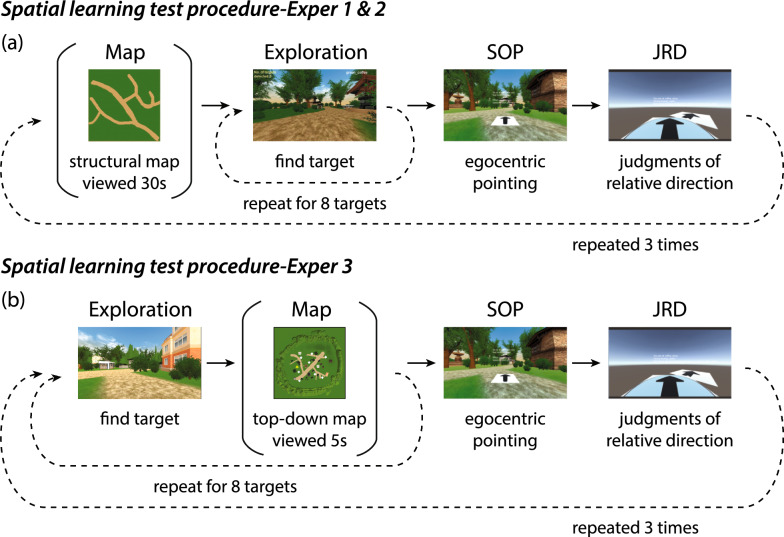
We tested whether viewing a top-down map before or while exploring an environment can facilitate spatial learning through first-person navigation. In three experiments, participants navigated in virtual environments to find a sequence of targets (exploration) and then performed three tasks to assess their spatial knowledge: scene and orientation-dependent pointing (SOP), judgments of relative direction (JRD), and map reconstruction. In separate sessions, we tested conditions with and without map viewing. In Experiments 1 and 2, participants viewed a structural map of the environment before performing exploration trials. Experiment 1 tested city environments with rectangular intersections, and Experiment 2 tested village environments with a main path and irregular side paths. We found no evidence that the structural map previews improved overall accuracy of spatial representations learned from navigation. Experiment 3 tested a village environment with more distinctive landmarks and presented a detailed map without targets labeled repeatedly throughout the exploration and still found no benefit from viewing a top-down map for first-person navigation in large-scale virtual spaces. We speculate that difficulty in translating between egocentric and allocentric representations might make it difficult to integrate information from a map and navigation experience.
Overview
CoChat Summary
TL;DR
Three experiments tested whether viewing a top-down map before or during first-person navigation improves spatial learning in virtual environments. Across city, village, and immersive VR settings, map viewing produced no overall accuracy benefit on judgments of relative direction, scene and orientation-dependent pointing, or map reconstruction, though one experiment found map preview influenced spatial alignment.
Key findings
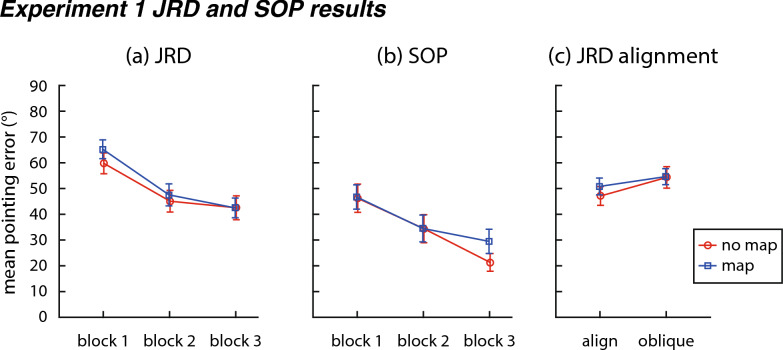
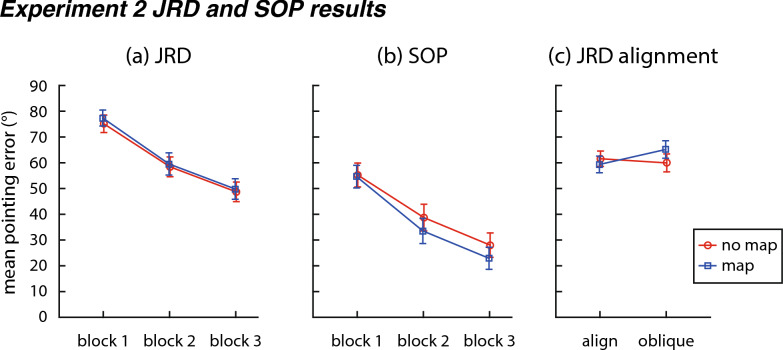
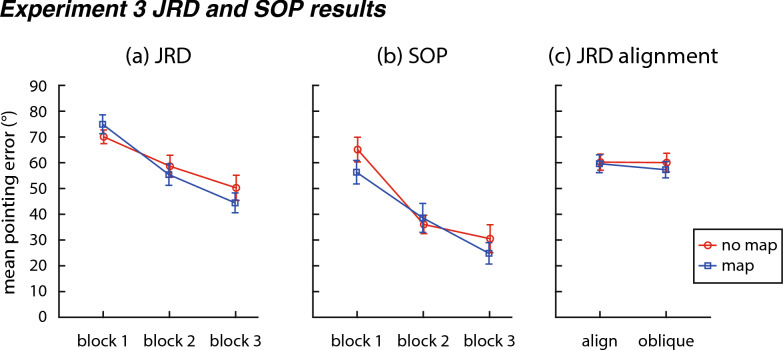
- No overall JRD benefit of map viewing: Experiment 1, F(1,31) = 0.347, p = .560, dz = 0.153; Experiment 2, F(1,31) = 0.230, p = .635, dz = 0.085; Experiment 3, F(1,35) = 0.134, p = .717, ηp² = 0.004. Learning improved across blocks in all experiments.
- No SOP benefit: Experiment 1, F(1,30) = 0.418, p = .523, dz = 0.116; Experiment 2, F(1,31) = 1.194, p = .283, dz = 0.193; Experiment 3, F(1,35) = 0.723, p = .401, ηp² = 0.020.
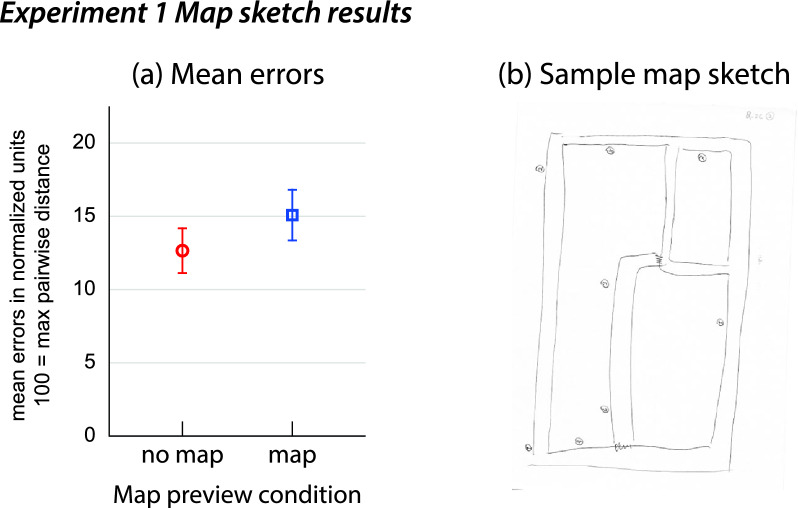
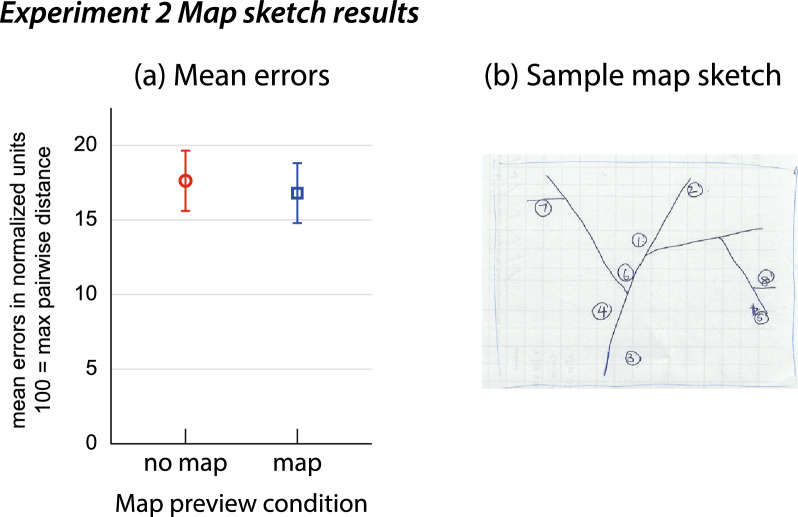
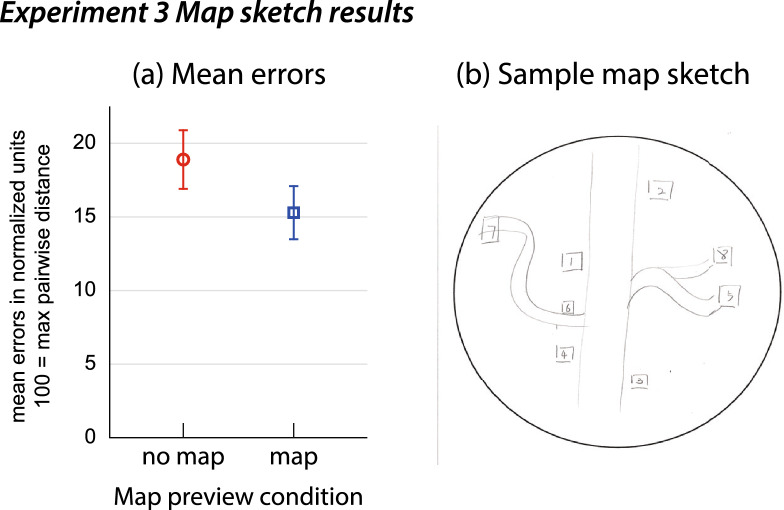
- No significant map-sketch accuracy benefit: Experiment 1, t(30) = –1.492, p = .146, dz = –0.268; Experiment 2, t(30) = 0.383, p = .705, dz = 0.069; Experiment 3, t(35) = 1.901, p = .066, dz = 0.317.
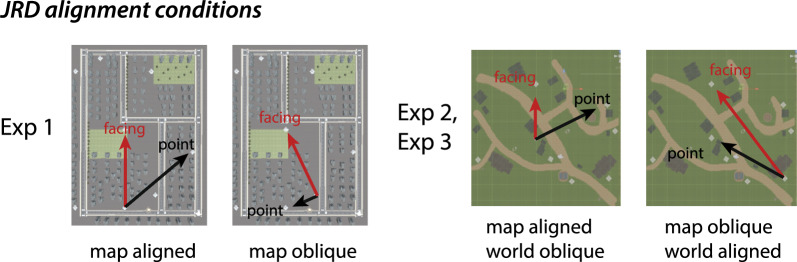
- Experiment 2 found a map-preview × JRD alignment interaction, F(1,31) = 6.29, p = .018, ηp² = 0.169, with better map-aligned performance when a map was previewed, t(31) = 2.70, p = .012, dz = 0.474; map-sketch orientation also depended on map preview, χ²(31) = 3.97, p = .046. Experiment 3 did not replicate the alignment interaction, F(1,35) = 0.417, p = .523.
Methods
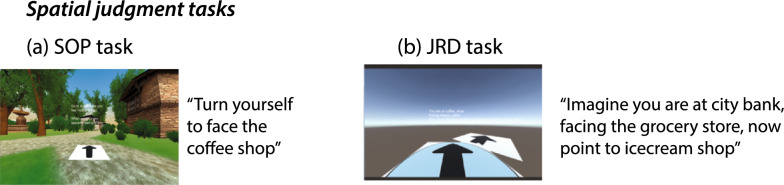
- Three fully within-subjects experiments: participants navigated virtual environments to find eight targets, then completed SOP, JRD, and map reconstruction tasks in separate map and no-map sessions.
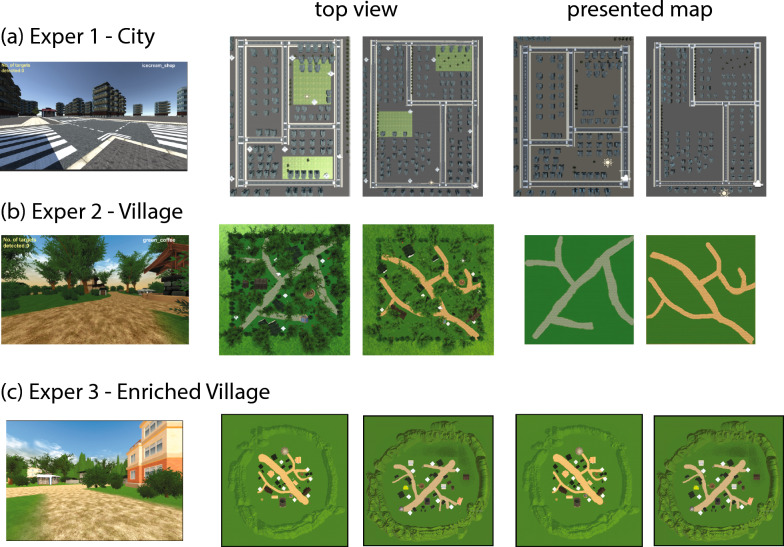
- Experiment 1 used a city grid environment with structural map previews before each block (N = 32); Experiment 2 used a village with irregular paths and structural map previews (N = 32); Experiment 3 used an immersive HMD village with distinctive landmarks and detailed unlabeled maps shown for 5 s after each exploration trial (N = 36, preregistered sequential sampling).
- Main analyses were ANOVAs on mean absolute pointing errors and normalized map-sketch errors, plus Bayesian posterior estimates of map-viewing effect sizes.
Limitations
- Stated by the paper: map exposure may have been insufficient (90 s total in Experiments 1 and 2; 120 s in Experiment 3), participants may not have had enough navigation experience to form allocentric representations, sample sizes could not test individual differences, participants were relatively homogeneous college students, and the Experiment 2 alignment interaction was not replicated in Experiment 3 and may not be reliable.
- Evident in the text: Experiments 1 and 2 were not preregistered; Experiment 1 lost complete SOP data for one participant; pointing tasks may have influenced later map reconstructions despite no feedback; and Experiment 3’s Bayesian intervals for SOP and map sketches did not rule out medium-to-large effects.
Model-written summary. Check it against the paper before relying on it.
Integrity signals
Registry
Cites
Statistics
Figures
Verification
Claims the paper makes
11 Valid · 1 Not valid · 31 Not checked · 207 Own results and interpretations
Every source the paper cites for this claim was checked and supports it.
In the paper
“Such switching cost has been commonly found in visual perspective taking tasks where change of view is involved (Segal, 2025).”
§ Does viewing a top-down map facilitate spatial learning from navigation in a virtual environment? > General discussion > Why no benefit from map viewing?
What the sources say
- Supportedcites Segal, 2025 matched to “The cost of perspective switching: Constraints on simultaneous activation” (2025) source
The General discussion reports a robust switching cost when participants changed visual perspectives rather than maintained the same one, and says this aligns with previous visual perspective-taking findings. The Introduction also describes an earlier task in which responses were slower on perspective-switch trials than on stay trials. (LLM, conf=0.92)
boosted- Asserted: passes — The authors put it forward as true.
- Checkable: passes — It can be checked against evidence.
- Load-bearing: unclear — It is unclear whether the paper’s conclusions depend on it.
- Based: passes — The paper gives a reason why it holds.
- Supported
The sources with a verdict support this claim; the rest weren’t checked yet, have no full text we could read, or their verdicts aren’t rated yet.
In the paper
“Some studies have compared spatial learning from studying maps and first-person navigation and found that these two learning methods had different effects on allocentric and egocentric spatial judgments (Meilinger et al., 2015; Starrett et al., 2019; Zhang et al., 2014).”
§ Does viewing a top-down map facilitate spatial learning from navigation in a virtual environment? > Introduction > Learning from map viewing vs. navigation
What the sources say
- Not checked — no full text of the sourcecites Meilinger et al., 2015 matched to “Reference frames in learning from maps and navigation” (2015) source
- Not checked — no full text of the sourcecites Starrett et al., 2019 matched to “Learning-dependent evolution of spatial representations in large-scale virtual environments.” (2019) source
- Supportedcites Zhang et al., 2014 matched to “Different “routes” to a cognitive map: dissociable forms of spatial knowledge derived from route and cartographic map learning” (2014) source
The Abstract reports that the authors compared route and cartographic-map learning in virtual environments using tasks for landmark-referenced (allocentric) and view-referenced (egocentric) knowledge. It found that map learning improved JRD accuracy faster, while route learning produced greater SOP improvement, with a significant interaction between task and learning method. (LLM, conf=0.94)
plainstates an association- Asserted: passes — The authors put it forward as true.
- Checkable: passes — It can be checked against evidence.
- Load-bearing: passes — The paper’s conclusions depend on it.
- Based: passes — The paper gives a reason why it holds.
The cited sources support only part of this claim — read each source’s verdict below.
In the paper
“In a more recent study, Yüksel et al. (2025) explored the effect of navigational aids including maps, compass, and GPS on spatial learning in large-scale virtual environments and found no difference between the groups with and without navigation aids.”
§ Does viewing a top-down map facilitate spatial learning from navigation in a virtual environment? > Introduction > Previous studies of map learning and navigation
What the sources say
- Partly supportedcites Yüksel et al. (2025) matched to “This is not the way: global directional cues do not improve spatial learning in an immersive virtual environment” (2025) sourceExperimental — accuracy not yet measured
The Abstract reports no evidence of a spatial-memory difference between participants with and without a compass in a large-scale immersive virtual environment. But the experiments tested a compass and a mountain-range directional cue, not maps or GPS, so the finding does not extend to all the aids named in the claim. (LLM, conf=0.90)
plain- Asserted: passes — The authors put it forward as true.
- Checkable: passes — It can be checked against evidence.
- Load-bearing: passes — The paper’s conclusions depend on it.
- Based: passes — The paper gives a reason why it holds.
- Partly supported
A result the paper reports from its own data — it cites no other source for it, so there is none to check. The quote shows it is in the paper.
In the paper
“There was no evidence that viewing the map improved performance of this egocentric spatial task.”
§ Does viewing a top-down map facilitate spatial learning from navigation in a virtual environment? > Results > SOP performance
plainn = 31- Asserted: passes — The authors put it forward as true.
- Checkable: passes — It can be checked against evidence.
- Load-bearing: passes — The paper’s conclusions depend on it.
- Based: passes — The paper gives a reason why it holds.
- Rests on an assumption not shown here.
A result the paper reports from its own data — it cites no other source for it, so there is none to check. The quote shows it is in the paper.
In the paper
“The mean errors were larger overall than in Experiment 1.”
§ Does viewing a top-down map facilitate spatial learning from navigation in a virtual environment? > Results > JRD overall performance
plain- Asserted: passes — The authors put it forward as true.
- Checkable: passes — It can be checked against evidence.
- Load-bearing: unclear — It is unclear whether the paper’s conclusions depend on it.
- Based: passes — The paper gives a reason why it holds.
137 more claims
Create a free account to see all 250 claims and every source verdict.
- Probably not a substantial claim. 60
- It may state two separate claims as one. 60
- The quote only partly states this claim. 1
Statistics that don’t add up
Each reported p-value recomputed from its test statistic and degrees of freedom, each partial η² from its F, and each ratio, mean difference or B printed with a p checked against its own confidence interval.
Rated minor: it would not touch a result — a value no result rests on, a p-value that stays on the same side of the significance level, or a conflict that is clerical, resolved elsewhere in the paper, or outside its own findings.
In the paper
“X2(35) = 1.532, p =.215”
§ Does viewing a top-down map facilitate spatial learning from navigation in a virtual environment? > Results > Map sketches
Reported p = .215 · recomputed p = 1.000
Statistics recomputed
Every reported test result, recomputed from its test statistic and degrees of freedom. A result shows as not adding up only once an independent check has confirmed it.
- Doesn’t add upχ²(35) = 1.532reported p = .215 · recomputed p = 1.000
“X2(35) = 1.532, p = .215”
- Not confirmedχ²(31) = 3.97reported p = .046 · recomputed p = 1.000
“X2(31) = 3.97, p = .046”
- ConsistentF(2, 62) = 22.82reported p < .001 · recomputed p < .001
“F(2,62) = 22.82, p < .001”
- ConsistentF(1, 31) = 0.347reported p = .56 · recomputed p = .560
“F(1,31) = 0.347, p = .560”
- ConsistentF(2, 62) = 0.372reported p = .691 · recomputed p = .691
“F(2,62) = 0.372, p = .691”
52 more recomputed tests
Create a free account to see every test the Stats check recomputed.
Self-check
Percentages, sums and reported differences re-computed from the paper’s own numbers.
Each contradiction between two passages listed here was confirmed by an independent check.
Rated minor: it would not touch a result — a value no result rests on, a p-value that stays on the same side of the significance level, or a conflict that is clerical, resolved elsewhere in the paper, or outside its own findings.
In the paper
§ Does viewing a top-down map facilitate spatial learning from navigation in a virtual environment? > Methods > Design
“For the map reconstructions, the dependent variable was the RMS errors in target positions, in normalized distance units.”
§ Does viewing a top-down map facilitate spatial learning from navigation in a virtual environment? > Methods > Procedure
“After normalizing the drawing coordinates, we computed the mean absolute difference between the normalized coordinates and the correct coordinates and used this as a measure of the overall accuracy of the drawings.”
Rated minor: it would not touch a result — a value no result rests on, a p-value that stays on the same side of the significance level, or a conflict that is clerical, resolved elsewhere in the paper, or outside its own findings.
In the paper
“no main effect of map preview (F(1,31) = 0.347, p =.560, ηp2 = 0.011, dz = 0.153)”
§ Does viewing a top-down map facilitate spatial learning from navigation in a virtual environment? > Results > JRD overall performance
Reported 0.347 · recomputed 0.749088
Rated minor: it would not touch a result — a value no result rests on, a p-value that stays on the same side of the significance level, or a conflict that is clerical, resolved elsewhere in the paper, or outside its own findings.
In the paper
§ Does viewing a top-down map facilitate spatial learning from navigation in a virtual environment? > Results > JRD overall performance
“for the map (red) and no map (blue) conditions”
§ Does viewing a top-down map facilitate spatial learning from navigation in a virtual environment? > Results > JRD overall performance
“The two lines on each graph correspond to the conditions with map preview (blue) and with no map preview (red)”
Rated minor: it would not touch a result — a value no result rests on, a p-value that stays on the same side of the significance level, or a conflict that is clerical, resolved elsewhere in the paper, or outside its own findings.
In the paper
§ Does viewing a top-down map facilitate spatial learning from navigation in a virtual environment? > Introduction > Current study
“In Experiments 1 and 2, the structural maps showed only the roads/paths.”
§ Does viewing a top-down map facilitate spatial learning from navigation in a virtual environment? > Methods > Apparatus and stimuli
“The structural maps presented in the map preview conditions showed the layout of roads, and the main buildings with the exception of the target kiosks.”
Citations
Cites
Cognitive maps in rats and men
Tolman, E. C. (1948) · Psychological Review · doi:10.1037/h0061626 · Cited by 6,641 · cited 1×
“An allocentric spatial representation is often referred to as survey knowledge or a cognitive map (O’Keefe & Nadel, 1978; Tolman, 1948).”
The Development of Spatial Representations of Large-Scale Environments
Siegel, A. W., & White, S. H. (1975) · Advances in Child Development and Behavior · doi:10.1016/s0065-2407(08)60007-5 · Cited by 1,830 · cited 1×
“People might need some level of allocentric spatial knowledge before they can associate map information with navigation experience. researchers have argued that formation of survey knowledge through navigation requires repetitive exposure (Montello et al., 2004; Siegel & White, 1975).”
Spatial memory: how egocentric and allocentric combine
Burgess, N. (2006) · Trends in Cognitive Sciences · doi:10.1016/j.tics.2006.10.005 · Cited by 827 · cited 1×
“Moving through the environment provides direct information about egocentric positions of objects and landmarks, but some further processing would be required to integrate this information into a cognitive map (Burgess, 2006; Ekstrom et al., 2017; Wang, 2017).”
Allocentric and Egocentric Spatial Representations: Definitions, Distinctions, and Interconnections
Klatzky, R. L. (1998) · Lecture Notes in Computer Science · doi:10.1007/3-540-69342-4_1 · Cited by 664 · cited 1×
“Klatzky (1998) distinguishes between egocentric and allocentric spatial representations.”
ISHIKAWA, T., & MONTELLO, D. (2006) · Cognitive Psychology · doi:10.1016/j.cogpsych.2005.08.003 · Cited by 640 · cited 1×
“People who can readily associate map information with egocentric views might derive more benefit from combining map viewing with navigation (Ishikawa & Montello, 2006; Van der Ham et al., 2020).”
Wayfinding with a GPS-based mobile navigation system: A comparison with maps and direct experience
Ishikawa, T., Fujiwara, H., Imai, O., & Okabe, A. (2008) · Journal of Environmental Psychology · doi:10.1016/j.jenvp.2007.09.002 · Cited by 445 · cited 1×
“Ishikawa et al. (2008) tested navigating with and without a global positioning system (GPS) tool and observed no difference in their spatial knowledge.”
Foo, P., Warren, W. H., Duchon, A., & Tarr, M. J. (2005) · Journal of Experimental Psychology: Learning, Memory, and Cognition · doi:10.1037/0278-7393.31.2.195 · Cited by 406
Allocentric and Egocentric Updating of Spatial Memories.
Mou, W., McNamara, T. P., Valiquette, C. M., & Rump, B. (2004) · Journal of Experimental Psychology: Learning, Memory, and Cognition · doi:10.1037/0278-7393.30.1.142 · Cited by 359 · cited 3×
“The results from Experiment 2 suggested that map viewing might influence how spatial orientation gets encoded, which would be consistent with previous findings by McNamara (2002) and Mou et al. (2004).”
Orientation and Perspective Dependence in Route and Survey Learning.
Shelton, A. L., & McNamara, T. P. (2004) · Journal of Experimental Psychology: Learning, Memory, and Cognition · doi:10.1037/0278-7393.30.1.158 · Cited by 195 · cited 1×
“Even if people were able to develop two frames of references in parallel, there may be a translation cost (Meilinger et al., 2015; Shelton & McNamara, 2004).”
Ekstrom, A. D., Huffman, D. J., & Starrett, M. (2017) · Journal of Neurophysiology · doi:10.1152/jn.00531.2017 · Cited by 186 · cited 2×
“Moving through the environment provides direct information about egocentric positions of objects and landmarks, but some further processing would be required to integrate this information into a cognitive map (Burgess, 2006; Ekstrom et al., 2017; Wang, 2017).”
How Are the Locations of Objects in the Environment Represented in Memory?
McNamara, T. P. (2003) · Lecture Notes in Computer Science · doi:10.1007/3-540-45004-1_11 · Cited by 174
Wormholes in virtual space: From cognitive maps to cognitive graphs
Warren, W. H., Rothman, D. B., Schnapp, B. H., & Ericson, J. D. (2017) · Cognition · doi:10.1016/j.cognition.2017.05.020 · Cited by 167 · cited 1×
“Some researchers have proposed that the mental representation of allocentric spatial information formed through direct experience is not map-like (Ekstrom et al., 2017; Wang, 2012; Warren et al., 2017).”
Egocentric and allocentric representations of space in the rodent brain
Wang, C., Chen, X., & Knierim, J. J. (2020) · Current Opinion in Neurobiology · doi:10.1016/j.conb.2019.11.005 · Cited by 141 · cited 1×
“Egocentric spatial representations are found mostly in regions upstream of the hippocampal–entorhinal allo-centric representations (e.g., primary sensory cortex), with some overlaps (e.g. in the hippocampus and lateral entorhinal cortex) (Wang et al., 2020).”
The cognitive map as a hippocampus
O'Keefe, J., & Nadel, L. (1979) · Behavioral and Brain Sciences · doi:10.1017/s0140525x00064256 · Cited by 125
Is the Map in Our Head Oriented North?
Frankenstein, J., Mohler, B. J., Bülthoff, H. H., & Meilinger, T. (2012) · Psychological Science · doi:10.1177/0956797611429467 · Cited by 85 · cited 2×
“Similar alignment effects have been observed in previous studies (Frankenstein et al., 2012; Meilinger et al., 2015; Starrett et al., 2019) Alignment effects were the same with and without map preview and did not vary as a function of block.”
Zhang, H., Zherdeva, K., & Ekstrom, A. D. (2014) · Memory & Cognition · doi:10.3758/s13421-014-0418-x · Cited by 80 · cited 5×
“This type of environment was used in most previous studies (e.g., Meilinger et al., 2015; Zhang et al., 2014).”
InfluentialLarge-scale assessment of human navigation ability across the lifespan
van der Ham, I. J. M., Claessen, M. H. G., Evers, A. W. M., & van der Kuil, M. N. A. (2020) · Scientific Reports · doi:10.1038/s41598-020-60302-0 · Cited by 76 · cited 1×
“People who can readily associate map information with egocentric views might derive more benefit from combining map viewing with navigation (Ishikawa & Montello, 2006; Van der Ham et al., 2020).”
(2004) · doi:10.4324/9781410609984 · Cited by 52
Theories of spatial representations and reference frames: What can configuration errors tell us?
Wang, R. F. (2012) · Psychonomic Bulletin & Review · doi:10.3758/s13423-012-0258-2 · Cited by 49 · cited 1×
“Some researchers have proposed that the mental representation of allocentric spatial information formed through direct experience is not map-like (Ekstrom et al., 2017; Wang, 2012; Warren et al., 2017).”
Reference frames in learning from maps and navigation
Meilinger, T., Frankenstein, J., Watanabe, K., Bülthoff, H. H., & Hölscher, C. (2015) · Psychological Research · doi:10.1007/s00426-014-0629-6 · Cited by 36 · cited 14×
“A previous study by Meilinger et al. (2015) found that alignment effects depended on whether participants first experienced navigation or map viewing.”
InfluentialThe Map in Our Head Is Not Oriented North: Evidence from a Real-World Environment
Brunyé, T. T., Burte, H., Houck, L. A., & Taylor, H. A. (2015) · PLoS ONE · doi:10.1371/journal.pone.0135803 · Cited by 30 · cited 1×
“Previous studies have found that JRDs about locations are more accurate when the imagined facing direction is aligned with its main axes (Brunyé et al., 2015; Mou et al., 2004; Starrett et al., 2019).”
Spatial updating and common misinterpretations of spatial reference frames
Wang, R. F. (2017) · Spatial Cognition & Computation · doi:10.1080/13875868.2017.1304394 · Cited by 26 · cited 1×
“Moving through the environment provides direct information about egocentric positions of objects and landmarks, but some further processing would be required to integrate this information into a cognitive map (Burgess, 2006; Ekstrom et al., 2017; Wang, 2017).”
Learning-dependent evolution of spatial representations in large-scale virtual environments.
Starrett, M. J., Stokes, J. D., Huffman, D. J., Ferrer, E., & Ekstrom, A. D. (2019) · Journal of Experimental Psychology: Learning, Memory, and Cognition · doi:10.1037/xlm0000597 · Cited by 25 · cited 9×
“Consistent with this possibility, Starrett et al. (2019) found that spatial judgments after map viewing alone had accuracy that was comparable to combined map viewing and navigation.”
InfluentialStites, M. C., Matzen, L. E., & Gastelum, Z. N. (2020) · Cognitive Research: Principles and Implications · doi:10.1186/s41235-020-00213-w · Cited by 12 · cited 1×
“Evidence from an indoor navigation study using real 2D and 3D maps showed that individuals with higher self-reported Santa Barbara Sense of Direction score (SBSOD) make better use of simple maps than those with lower scores (Stites et al., 2020).”
Jansen-Osmann, P., Wiedenbauer, G., Schmid, J., & Heil, M. (2007) · Spatial Cognition & Computation · doi:10.1080/13875860701544365 · Cited by 11 · cited 3×
“On the other hand, the exposure times we used are comparable to those of previous experiments of map learning (Dedetaş Şatır et al., 2026; Jansen-Osmann et al., 2007; Meilinger et al., 2015), and the pattern of repeated short exposures in Experiment 3 is an approximation of how people might refer…”
Spatial knowledge acquired from first-person and dynamic map perspectives
van der Kuil, M. N. A., Evers, A. W. M., Visser-Meily, J. M. A., & van der Ham, I. J. M. (2021) · Psychological Research · doi:10.1007/s00426-020-01389-y · Cited by 8 · cited 2×
“It is believed that spatial representation formed through direct navigation will initially be stored as route knowledge (egocentric representations), while spatial knowledge acquired through map learning will be developed into survey knowledge (allocentric representations) (Van der Kuil, 2021).”
The cost of perspective switching: Constraints on simultaneous activation
Segal, D. (2025) · Psychonomic Bulletin & Review · doi:10.3758/s13423-024-02633-x · Cited by 4 · cited 1×
“Such switching cost has been commonly found in visual perspective taking tasks where change of view is involved (Segal, 2025).”
Chan, H. M., Ding, J., & Saunders, J. A. (2023) · Journal of Environmental Psychology · doi:10.1016/j.jenvp.2023.102156 · Cited by 4 · cited 3×
“The null findings in these experiments are consistent with a previous study from our laboratory that found no benefit from providing vista views during navigation (Chan et al., 2023).”
InfluentialSelf-citationYüksel, E., Boogaart, Z., & Weisberg, S. M. (2025) · Cognitive Research: Principles and Implications · doi:10.1186/s41235-025-00654-1 · Cited by 2 · cited 1×
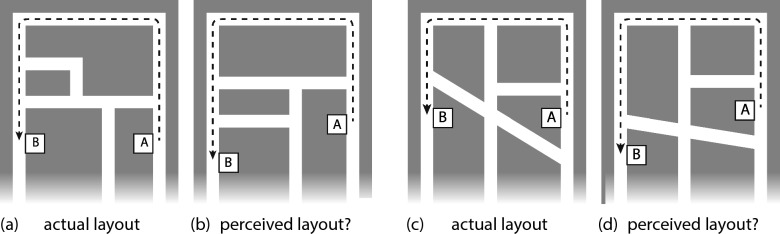
“In a more recent study, Yüksel et al. (2025) explored the effect of navigational aids including maps, compass, and GPS on spatial learning in Crossing multiple intersections tends to expand perceived distance, so the distance from corner to B may be perceived as longer than the distance from A to…”
Dedetaş Şatır, H., Fehringer, B. C. O. F., & Münzer, S. (2026) · Journal of Experimental Psychology: Applied · doi:10.1037/xap0000573 · Cited by 1 · cited 1×
“On the other hand, the exposure times we used are comparable to those of previous experiments of map learning (Dedetaş Şatır et al., 2026; Jansen-Osmann et al., 2007; Meilinger et al., 2015), and the pattern of repeated short exposures in Experiment 3 is an approximation of how people might refer…”
Metadata
- Authors
- Ding, J., Chan, H. M., & Saunders, J. A.
- Affiliations
- University of Hong Kong (HK)
- Corresponding author
- Saunders, Jeffrey Allen
- Venue
- Cognitive Research: Principles and Implications
- Published
- 2026-06-04
- Volume
- 11
- Issue
- 1
- ISSN
- 2365-7464 (ISSN-L)
- PMC
- PMC13462025
- OpenAlex
- W7163546007
- Cited by
- 0
- References
- 28
- FWCI
- 0.00
- Type
- journal article
- Language
- en
- Open access
- gold
- doi.org
- Licence
- cc-by
- creativecommons.org/licenses/by/4.0 (tdm)
- creativecommons.org/licenses/by/4.0 (vor, 69 d)
- Locations
- Cognitive Research Principles and Implications (publishedVersion, cc-by)
- PubMed (publishedVersion)
- PubMed Central (publishedVersion, cc-by)
- DOAJ (DOAJ: Directory of Open Access Journals) (submittedVersion)
- Funders
- University of Hong Kong (17407914)
- Topics
- Social Sciences › Psychology › Experimental and Cognitive Psychology › Spatial Cognition and Navigation
- Social Sciences › Geography, Planning and Development › Geography Education and Pedagogy
- Life Sciences › Neuroscience › Cognitive Neuroscience › Memory and Neural Mechanisms
- Keywords
- spatial learning, navigation, virtual worlds, map reconstruction, landmarks
- MeSH terms
- Virtual Reality, Adult, Female, Humans, Male, Maps as Topic, Space Perception, Young Adult, Spatial Learning, Spatial Navigation
About these checks
Registry, retraction, Cites and statistics results are computed, not judged, with one exception: a printed reference that no index lists is read once by a model before it counts as a citation error. Claims are extracted by a model and kept only when their quote appears verbatim in the text; each cited source is then checked, with a model’s help, for whether it says what the claim relies on. Those verdicts can be wrong — read the claim’s quote and the cited source before relying on one.
The claim verdicts this report counts are experimental: their accuracy is not yet measured.
A language model drew the claims from the paper on 2026-10-10, under version 3 of the claim definition (model deepseek-v4.1-flash, prompt extract-v3).
A second model labelled each claim on 2026-10-10 (model jev-1.13-20260917, definition revision gold-guideline-v0.2).
Cited sources are checked with a language model’s help (gpt-6-sol).
Statistics and arithmetic are recomputed, not judged.
Confidence bands are shown only for fields calibrated on our annotated test set. None is calibrated yet, so no band is shown.
What counts as a claim ›How we measure confidence ›How we check this ›
Are you an author, or do you see a problem with this page? Request a review
Data sources
Bibliographic data: Semantic Scholar, OpenAlex, Crossref.
Contains information from the Semantic Scholar Academic Graph Datasets, made available under the ODC Attribution License (ODC-BY 1.0).
Semantic Scholar’s data is described in: Kinney, R., et al. (2023). The Semantic Scholar Open Data Platform. arXiv:2301.10140.
