

Prompt engineering in higher education: a systematic review to help inform curricula
Open accessThe DOI matches its Crossref record; 51 of the 53 references it cites were found in a registry or an index, and 2 are not checked yet.
Abstract
This paper presents a systematic review of the role of prompt engineering during interactions with Generative Artificial Intelligence (GenAI) in Higher Education (HE) to discover potential methods of improving educational outcomes. Drawing on a comprehensive search of academic databases and relevant literature, key trends, including multiple framework designs, are presented and explored to review the role, relevance, and applicability of prompt engineering to purposefully improve GenAI-generated responses in higher education contexts. Multiple experiments using a variety of prompt engineering frameworks are compared, contrasted and discussed. Analysis reveals that well-designed prompts have the potential to transform interactions with GenAI in higher education teaching and learning. Further findings show it is important to develop and teach pragmatic skills in AI interaction, including meaningful prompt engineering, which is best managed through a well-designed framework for creating and evaluating GenAI applications that are aligned with pre-determined contextual educational goals. The paper outlines some of the key concepts and frameworks that educators should be aware of when incorporating GenAI and prompt engineering into their teaching practices, and when teaching students the necessary skills for successful GenAI interaction.
Overview
The claims and statistics of this paper haven’t been checked yet.
Free: it reads the open-access text and checks the first 5 claims that cite a source we can check. Create a free account to check every claim.
Integrity signals
Registry
Cites
Statistics
Figures
Verification
Claims the paper makes
The claims and statistics of this paper haven’t been checked yet.
Free: it reads the open-access text and checks the first 5 claims that cite a source we can check. Create a free account to check every claim.
Claims other papers make about this one
Each is checked against this paper’s own text: does it say what the citing paper says it does?
In the citing paper
“Although prompting has been widely studied in computer science (Debnath et al. 2025), research in non-expert settings remains limited (Dierickx et al. 2026;Lee and Palmer 2025;Zamfirescu-Pereira et al. 2023).”
From A Taxonomy of LLM-Supported Tasks for Critical AI Literacy in Journalism (2026) · cites this paper as Lee and Palmer 2025
In the citing paper
“In educational settings, task definition presupposes that users already possess some prerequisite knowledge relevant to the task in order to use the system meaningfully (Lee and Palmer 2025).”
From A Taxonomy of LLM-Supported Tasks for Critical AI Literacy in Journalism (2026) · cites this paper as Lee and Palmer 2025
In the citing paper
“In this light, prompting represents an emerging skill set that enables trainees to engage critically with GenAI systems (Lee and Palmer 2025;Walter 2024).”
From A Taxonomy of LLM-Supported Tasks for Critical AI Literacy in Journalism (2026) · cites this paper as Lee and Palmer 2025
Self-check
Percentages, sums and reported differences re-computed from the paper’s own numbers.
The self-check needs the paper’s full text.
Citations
Cites
Guidelines for performing Systematic Literature Reviews in Software Engineering
Kitchenham, B. A., & Charters, S. (n.d.) · Cited by 10,073
Control problems of grey systems
Ju-Long, D. (1982) · Systems & Control Letters · doi:10.1016/s0167-6911(82)80025-x · Cited by 4,487 · cited 4×
“Abdlushahed found by combining Grey Theory with prompt engineering techniques enhances decision makers’ abilities to make informed choices which consider case specific needs and conditions.”
InfluentialGuidance on Conducting a Systematic Literature Review
Xiao, Y., & Watson, M. (2019) · Journal of Planning Education and Research · doi:10.1177/0739456x17723971 · Cited by 3,467 · cited 1×
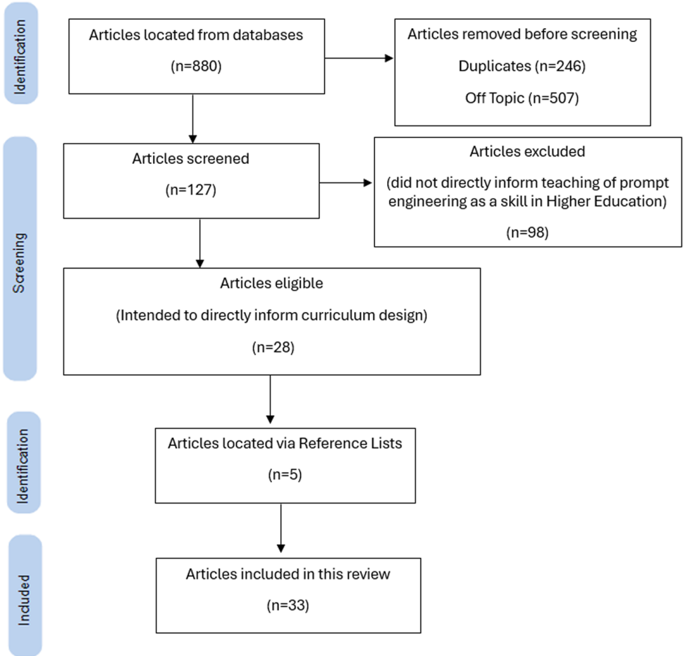
“The research was conducted using the protocols of a systematic literature review, as out-lined by Kitchenham and Charters (2007), Xiao and Watson (2019), and Tawfik et al. (2019), to determine the current state of discourse surrounding the topic of prompt engineering in HE.”
What if the devil is my guardian angel: ChatGPT as a case study of using chatbots in education
Tlili, A., Shehata, B., Adarkwah, M. A., Bozkurt, A., Hickey, D. T., Huang, R., & Agyemang, B. (2023) · Smart Learning Environments · doi:10.1186/s40561-023-00237-x · Cited by 2,003 · cited 2×
“Tlili et al. (2023), observed participants felt their chatbot became their “personal assistant” (p. 9) inducing emotional responses in the user including gratitude.”
Walter, Y. (2024) · International Journal of Educational Technology in Higher Education · doi:10.1186/s41239-024-00448-3 · Cited by 1,113 · cited 6×
“Developing skills in prompt engineering improves students’ abilities to transform AI from a “mere repository of information into an interactive tool that stimulates deeper learning and understanding” (Walter, 2024, p. 14).”
InfluentialA Prompt Pattern Catalog to Enhance Prompt Engineering with ChatGPT
White, J., Fu, Q., Hays, S., Sandborn, M., Olea, C., Gilbert, H., Elnashar, A., Spencer-Smith, J., & Schmidt, D. C. (2023) · arXiv · doi:10.48550/arxiv.2302.11382 · Cited by 838 · cited 1×
“(p. 142) This example shows the personification technique which was prevalent among the literature and found to be a common successful strategy (Fotaris et al., 2023; White et al., 2023).”
A step by step guide for conducting a systematic review and meta-analysis with simulation data
Tawfik, G. M., Dila, K. A. S., Mohamed, M. Y. F., Tam, D. N. H., Kien, N. D., Ahmed, A. M., & Huy, N. T. (2019) · Tropical Medicine and Health · doi:10.1186/s41182-019-0165-6 · Cited by 808 · cited 1×
“The research was conducted using the protocols of a systematic literature review, as out-lined by Kitchenham and Charters (2007), Xiao and Watson (2019), and Tawfik et al. (2019), to determine the current state of discourse surrounding the topic of prompt engineering in HE.”
Prompt Engineering as an Important Emerging Skill for Medical Professionals: Tutorial
Meskó, B. (2023) · Journal of Medical Internet Research · doi:10.2196/50638 · Cited by 709 · cited 1×
“In a discussion about prompt engineering as an important emerging skill, Meskó (2023) provides the following example: “What prompt could I use right now to get a better output from you in this thread/task?””
AI-generated feedback on writing: insights into efficacy and ENL student preference
Escalante, J., Pack, A., & Barrett, A. (2023) · International Journal of Educational Technology in Higher Education · doi:10.1186/s41239-023-00425-2 · Cited by 589 · cited 2×
“An emerging terminology among the literature was the concept of “shots” which was discussed in nine papers (Clavié et al., 2023; Escalante et al., 2023; Henrickson & Meroño-Peñuela, 2023; Heston & Kuhn, 2023; Korzynski et al., 2023; Schäffer & Lieder, 2023; Walter, 2024; Wang et al., 2021; Zheng et…”
ChatGPT Chemistry Assistant for Text Mining and the Prediction of MOF Synthesis
Zheng, Z., Zhang, O., Borgs, C., Chayes, J. T., & Yaghi, O. M. (2023) · Journal of the American Chemical Society · doi:10.1021/jacs.3c05819 · Cited by 536 · cited 3×
“For example, Zheng et al. (2023) used prompt engineering to guide ChatGPT in the automation of text mining of metal − organic framework synthesis conditions from diverse formats and styles of scientific literature.”
Research works printed but not linked: 1
- Hutson, J. (2024). Integrating art and AI: Evaluating the educational impact of AI tools in digital art history learning. Forum for Art Studies, 1(1), 393.
Cited by
Artificial intelligence in educational leadership: a comprehensive taxonomy and future directions
Sposato, M. (2025) · International Journal of Educational Technology in Higher Education · doi:10.1186/s41239-025-00517-1 · Cited by 271
Prompt Engineering in Education: A Systematic Review of Approaches and Educational Applications
Qian, Y. (2025) · Journal of Educational Computing Research · doi:10.1177/07356331251365189 · Cited by 156
Pham, T. D., Karunaratne, N., Exintaris, B., Liu, D., Lay, T., Yuriev, E., & Lim, A. (2025) · Medical Education · doi:10.1111/medu.15746 · Cited by 100
Çelik, İ., Kontkanen, S., Laru, J., & Dalyanci, A. A. (2025) · Computers & Education · doi:10.1016/j.compedu.2025.105485 · Cited by 89
Yan, W., Nakajima, T., & Sawada, R. (2025) · Computers and Education Artificial Intelligence · doi:10.1016/j.caeai.2025.100465 · Cited by 71
Metadata
- Authors
- Lee, D., & Palmer, E.
- Venue
- International Journal of Educational Technology in Higher Education
- Published
- 2025-02-10
- Volume
- 22
- Issue
- 1
- ISSN
- 2365-9440 (ISSN-L)
- OpenAlex
- W4407284288
- Cited by
- 234
- References
- 49
- FWCI
- 39.71
- Type
- journal article
- Language
- en
- Open access
- diamond
- Licence
- creativecommons.org/licenses/by/4.0 (tdm)
- creativecommons.org/licenses/by/4.0 (vor)
About these checks
Registry, retraction, Cites and statistics results are computed, not judged, with one exception: a printed reference that no index lists is read once by a model before it counts as a citation error. Claims are extracted by a model and kept only when their quote appears verbatim in the text; each cited source is then checked, with a model’s help, for whether it says what the claim relies on. Those verdicts can be wrong — read the claim’s quote and the cited source before relying on one.
Statistics and arithmetic are recomputed, not judged.
Confidence bands are shown only for fields calibrated on our annotated test set. None is calibrated yet, so no band is shown.
What counts as a claim ›How we measure confidence ›How we check this ›
Are you an author, or do you see a problem with this page? Request a review
Data sources
Bibliographic data: Semantic Scholar, OpenAlex, Crossref.
Contains information from the Semantic Scholar Academic Graph Datasets, made available under the ODC Attribution License (ODC-BY 1.0).
Semantic Scholar’s data is described in: Kinney, R., et al. (2023). The Semantic Scholar Open Data Platform. arXiv:2301.10140.
