

Prompt engineering in higher education: a systematic review to help inform curricula
Open accessThe DOI matches its Crossref record; 51 of the 53 references it cites were found in a registry or an index, and 2 are not checked yet.
Abstract
This paper presents a systematic review of the role of prompt engineering during interactions with Generative Artificial Intelligence (GenAI) in Higher Education (HE) to discover potential methods of improving educational outcomes. Drawing on a comprehensive search of academic databases and relevant literature, key trends, including multiple framework designs, are presented and explored to review the role, relevance, and applicability of prompt engineering to purposefully improve GenAI-generated responses in higher education contexts. Multiple experiments using a variety of prompt engineering frameworks are compared, contrasted and discussed. Analysis reveals that well-designed prompts have the potential to transform interactions with GenAI in higher education teaching and learning. Further findings show it is important to develop and teach pragmatic skills in AI interaction, including meaningful prompt engineering, which is best managed through a well-designed framework for creating and evaluating GenAI applications that are aligned with pre-determined contextual educational goals. The paper outlines some of the key concepts and frameworks that educators should be aware of when incorporating GenAI and prompt engineering into their teaching practices, and when teaching students the necessary skills for successful GenAI interaction.
Overview
The claims and statistics of this paper haven’t been checked yet.
Free: it reads the open-access text and checks the first 5 claims that cite a source we can check. Create a free account to check every claim.
Integrity signals
Registry
Cites
Statistics
Figures
Verification
Claims the paper makes
The claims and statistics of this paper haven’t been checked yet.
Free: it reads the open-access text and checks the first 5 claims that cite a source we can check. Create a free account to check every claim.
Claims other papers make about this one
Each is checked against this paper’s own text: does it say what the citing paper says it does?
In the citing paper
“Although prompting has been widely studied in computer science (Debnath et al. 2025), research in non-expert settings remains limited (Dierickx et al. 2026;Lee and Palmer 2025;Zamfirescu-Pereira et al. 2023).”
From A Taxonomy of LLM-Supported Tasks for Critical AI Literacy in Journalism (2026) · cites this paper as Lee and Palmer 2025
In the citing paper
“In educational settings, task definition presupposes that users already possess some prerequisite knowledge relevant to the task in order to use the system meaningfully (Lee and Palmer 2025).”
From A Taxonomy of LLM-Supported Tasks for Critical AI Literacy in Journalism (2026) · cites this paper as Lee and Palmer 2025
In the citing paper
“In this light, prompting represents an emerging skill set that enables trainees to engage critically with GenAI systems (Lee and Palmer 2025;Walter 2024).”
From A Taxonomy of LLM-Supported Tasks for Critical AI Literacy in Journalism (2026) · cites this paper as Lee and Palmer 2025
Self-check
Percentages, sums and reported differences re-computed from the paper’s own numbers.
The self-check needs the paper’s full text.
Citations
Cites
Guidelines for performing Systematic Literature Reviews in Software Engineering
Kitchenham, B. A., & Charters, S. (n.d.) · Cited by 10,073
Control problems of grey systems
Ju-Long, D. (1982) · Systems & Control Letters · doi:10.1016/s0167-6911(82)80025-x · Cited by 4,487 · cited 4×
“Abdlushahed found by combining Grey Theory with prompt engineering techniques enhances decision makers’ abilities to make informed choices which consider case specific needs and conditions.”
InfluentialGuidance on Conducting a Systematic Literature Review
Xiao, Y., & Watson, M. (2019) · Journal of Planning Education and Research · doi:10.1177/0739456x17723971 · Cited by 3,467 · cited 1×
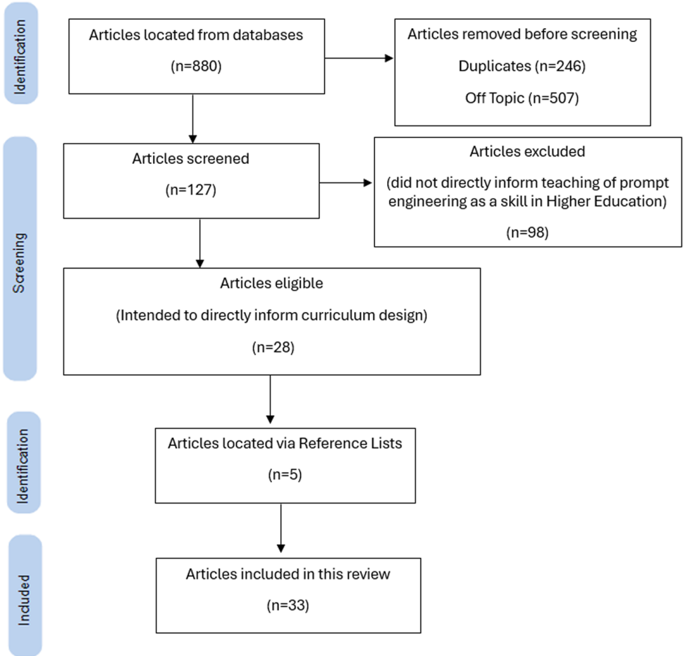
“The research was conducted using the protocols of a systematic literature review, as out-lined by Kitchenham and Charters (2007), Xiao and Watson (2019), and Tawfik et al. (2019), to determine the current state of discourse surrounding the topic of prompt engineering in HE.”
What if the devil is my guardian angel: ChatGPT as a case study of using chatbots in education
Tlili, A., Shehata, B., Adarkwah, M. A., Bozkurt, A., Hickey, D. T., Huang, R., & Agyemang, B. (2023) · Smart Learning Environments · doi:10.1186/s40561-023-00237-x · Cited by 2,003 · cited 2×
“Tlili et al. (2023), observed participants felt their chatbot became their “personal assistant” (p. 9) inducing emotional responses in the user including gratitude.”
Walter, Y. (2024) · International Journal of Educational Technology in Higher Education · doi:10.1186/s41239-024-00448-3 · Cited by 1,113 · cited 6×
“Developing skills in prompt engineering improves students’ abilities to transform AI from a “mere repository of information into an interactive tool that stimulates deeper learning and understanding” (Walter, 2024, p. 14).”
InfluentialA Prompt Pattern Catalog to Enhance Prompt Engineering with ChatGPT
White, J., Fu, Q., Hays, S., Sandborn, M., Olea, C., Gilbert, H., Elnashar, A., Spencer-Smith, J., & Schmidt, D. C. (2023) · arXiv · doi:10.48550/arxiv.2302.11382 · Cited by 838 · cited 1×
“(p. 142) This example shows the personification technique which was prevalent among the literature and found to be a common successful strategy (Fotaris et al., 2023; White et al., 2023).”
A step by step guide for conducting a systematic review and meta-analysis with simulation data
Tawfik, G. M., Dila, K. A. S., Mohamed, M. Y. F., Tam, D. N. H., Kien, N. D., Ahmed, A. M., & Huy, N. T. (2019) · Tropical Medicine and Health · doi:10.1186/s41182-019-0165-6 · Cited by 808 · cited 1×
“The research was conducted using the protocols of a systematic literature review, as out-lined by Kitchenham and Charters (2007), Xiao and Watson (2019), and Tawfik et al. (2019), to determine the current state of discourse surrounding the topic of prompt engineering in HE.”
Prompt Engineering as an Important Emerging Skill for Medical Professionals: Tutorial
Meskó, B. (2023) · Journal of Medical Internet Research · doi:10.2196/50638 · Cited by 709 · cited 1×
“In a discussion about prompt engineering as an important emerging skill, Meskó (2023) provides the following example: “What prompt could I use right now to get a better output from you in this thread/task?””
AI-generated feedback on writing: insights into efficacy and ENL student preference
Escalante, J., Pack, A., & Barrett, A. (2023) · International Journal of Educational Technology in Higher Education · doi:10.1186/s41239-023-00425-2 · Cited by 589 · cited 2×
“An emerging terminology among the literature was the concept of “shots” which was discussed in nine papers (Clavié et al., 2023; Escalante et al., 2023; Henrickson & Meroño-Peñuela, 2023; Heston & Kuhn, 2023; Korzynski et al., 2023; Schäffer & Lieder, 2023; Walter, 2024; Wang et al., 2021; Zheng et…”
ChatGPT Chemistry Assistant for Text Mining and the Prediction of MOF Synthesis
Zheng, Z., Zhang, O., Borgs, C., Chayes, J. T., & Yaghi, O. M. (2023) · Journal of the American Chemical Society · doi:10.1021/jacs.3c05819 · Cited by 536 · cited 3×
“For example, Zheng et al. (2023) used prompt engineering to guide ChatGPT in the automation of text mining of metal − organic framework synthesis conditions from diverse formats and styles of scientific literature.”
Research works printed but not linked: 1
- Hutson, J. (2024). Integrating art and AI: Evaluating the educational impact of AI tools in digital art history learning. Forum for Art Studies, 1(1), 393.
Cited by
Artificial intelligence in educational leadership: a comprehensive taxonomy and future directions
Sposato, M. (2025) · International Journal of Educational Technology in Higher Education · doi:10.1186/s41239-025-00517-1 · Cited by 271
Prompt Engineering in Education: A Systematic Review of Approaches and Educational Applications
Qian, Y. (2025) · Journal of Educational Computing Research · doi:10.1177/07356331251365189 · Cited by 156
Pham, T. D., Karunaratne, N., Exintaris, B., Liu, D., Lay, T., Yuriev, E., & Lim, A. (2025) · Medical Education · doi:10.1111/medu.15746 · Cited by 100
Çelik, İ., Kontkanen, S., Laru, J., & Dalyanci, A. A. (2025) · Computers & Education · doi:10.1016/j.compedu.2025.105485 · Cited by 89
Yan, W., Nakajima, T., & Sawada, R. (2025) · Computers and Education Artificial Intelligence · doi:10.1016/j.caeai.2025.100465 · Cited by 71
Reimagining teacher development in the era of generative AI: A scoping review
Tan, Q. (2025) · Teaching and Teacher Education · doi:10.1016/j.tate.2025.105236 · Cited by 67
Exploring students’ experiences and perceptions of human-AI collaboration in digital content making
Hwang, Y., & Lee, J. H. (2025) · International Journal of Educational Technology in Higher Education · doi:10.1186/s41239-025-00542-0 · Cited by 66
Farrokhnia, M., Latifi, S., Papadopoulos, P. M., Hogenkamp, L., Gijlers, H., Khosravi, H., & Noroozi, O. (2026) · International Journal of Educational Technology in Higher Education · doi:10.1186/s41239-026-00579-9 · Cited by 55
Ren, J., Guo, J., & Li, H. (2025) · Scientific Reports · doi:10.1038/s41598-025-18873-3 · Cited by 52
Evaluating AI-assisted creative ideation: A crossover study in higher education
Baltà‐Salvador, R., Brasó‐Vives, E., & Peña, M. (2025) · Thinking Skills and Creativity · doi:10.1016/j.tsc.2025.101958 · Cited by 53
Huang, T., Wu, C., & Wu, M. (2025) · Discover Artificial Intelligence · doi:10.1007/s44163-025-00435-1 · Cited by 48
Liu, M., & Zhang, L. J. (2025) · System · doi:10.1016/j.system.2025.103826 · Cited by 44
Seran, C. E., Tan, M. J. T., Karim, H. B. A., & AlDahoul, N. (2025) · Frontiers in Artificial Intelligence · doi:10.3389/frai.2025.1573368 · Cited by 41
Allison, J. (2025) · Journal of Educational Computing Research · doi:10.1177/07356331251377430 · Cited by 37
Medel-Vera, C., Britton, S., & Gates, W. F. (2025) · Computers and Education Artificial Intelligence · doi:10.1016/j.caeai.2025.100501 · Cited by 35
Hoomanfard, M. H., & Shamsi, Y. (2025) · Journal of English for Academic Purposes · doi:10.1016/j.jeap.2025.101570 · Cited by 33
ChatGPT in education: A systematic review of its impact on critical thinking skills and dispositions
Guo, Y., Huang, L., Zhang, C., Li, Q., & Chen, M. (2025) · Thinking Skills and Creativity · doi:10.1016/j.tsc.2025.102106 · Cited by 29
Carrasco-Sáez, J. L., Contreras-Saavedra, C., San-Martín-Quiroga, S., Contreras-Saavedra, C. E., & Viveros-Muñoz, R. (2025) · Applied Sciences · doi:10.3390/app15147651 · Cited by 29
Morán, R. C. D., Soto, J. M. S., Gomez, H. E. L., Infantes, M. S., Lizares, A. A., Rojas, L. M. H., & Flores, S. J. C. (2025) · Education Sciences · doi:10.3390/educsci15081010 · Cited by 26
Zhou, Z., Guo, H., Ma, F., Yang, C., & Gao, Y. (2025) · Scientific Reports · doi:10.1038/s41598-025-21132-0 · Cited by 26
Plaatjies, B. O., & van Wyk, M. M. (2025) · Journal of Teaching and Learning · doi:10.22329/jtl.v19i4.10017 · Cited by 26
A Comprehensive Survey of Prompt Engineering Techniques in Large Language ModelsPreprint
Debnath, T., Siddiky, M. N. A., Rahman, M. E., Das, P., Guha, A. K., Rahman, M., & Kabir, H. M. D. (2025) · TechRxiv · doi:10.36227/techrxiv.174140719.96375390/v2 · Cited by 25
Pangestu, F. N. N., Hamidah, I., Widaningsih, L., Abdullah, A. G., & Saputra, N. A. (2026) · Computers and Education Artificial Intelligence · doi:10.1016/j.caeai.2026.100581 · Cited by 21
Developing prompt engineering skills in the pre-service training of foreign language educator
Evstigneev, M. N., & Алексеевна, Е. И. (2025) · Вестник Тамбовского университета. Серия: Гуманитарные науки · doi:10.20310/1810-0201-2025-30-4-795-813 · Cited by 21
Tres escenarios para la IA en educación: del apoyo responsable a la cocreación
García‐Peñalvo, F. J. (2025) · Education in the Knowledge Society (EKS) · doi:10.14201/eks.32932 · Cited by 20
Generative AI use and self-learning in higher education: the role of learning difficulties
Saleh, D., & ElSayary, A. (2026) · Frontiers in Education · doi:10.3389/feduc.2025.1737928 · Cited by 20
Between Interest and Skill: How Students Perceive and Use AI
Евгеньевна, И. А., Tarasova, K., & Павлович, Т. Д. (2025) · Высшее образование в России · doi:10.31992/0869-3617-2025-34-8-9-9-32 · Cited by 18
Zhou, X., Liu, G., & Chiu, T. K. F. (2026) · Interactive Learning Environments · doi:10.1080/10494820.2026.2614080 · Cited by 17
Comparative performance of large language models for patient-initiated ophthalmology consultations
Huang, M., Wang, X., Zhou, S., Cui, X., Zhang, Z., Xu, Y., Yang, W., & Chi, W. (2025) · Frontiers in Public Health · doi:10.3389/fpubh.2025.1673045 · Cited by 17
Dahò, M., & Caci, B. (2025) · BMC Psychology · doi:10.1186/s40359-025-03729-2 · Cited by 17
Syahputri, I. W., Budiardjo, E. K., & Putra, P. O. H. (2025) · AI · doi:10.3390/ai6090206 · Cited by 17
García, C. G., & Pallarés, N. (2025) · RIED Revista Iberoamericana de Educación a Distancia · doi:10.5944/ried.45533 · Cited by 17
Co-Creating With AI: How Communication Students Learn, Think, and Rely on Intelligent Systems
Lin, L. C.-S. (2025) · Journal of Educational Computing Research · doi:10.1177/07356331251385944 · Cited by 16
Terzimehić, N., Bühler, B., & Kasneci, E. (2026) · Computers and Education Artificial Intelligence · doi:10.1016/j.caeai.2026.100634 · Cited by 16
Prompt Engineering in Large Language Models for Patient Education: A Systematic ReviewPreprint
Mudrik, A., Nadkarni, G. N., Efros, O., Soffer, S., & Klang, E. (2025) · medRxiv · doi:10.1101/2025.03.28.25324834 · Cited by 15
Fu, Y., Lin, Y., Wang, Y., Tran, S., & Hiniker, A. (2026) · arXiv (Cornell University) · doi:10.48550/arxiv.2602.17720 · Cited by 14
Melanou, C., & Beege, M. (2026) · Education Sciences · doi:10.3390/educsci16040651 · Cited by 12
Shrestha, S., & Yi, J. (2026) · Journal of Mathematics Teacher Education · doi:10.1007/s10857-026-09747-0 · Cited by 12
The CLARIFIES+ Framework: A Contextualized Prompting Approach for Generative Artificial Intelligence
Barrot, J. S. (2026) · International Journal of TESOL Studies · doi:10.58304/ijts.260215 · Cited by 11
Generative AI for Collaborative Learning: Fostering Critical Thinking in Teacher Education
Lehtinen, A., Channa, F. R., Näykki, P., Ahlström, E., & Hiljanen, M. (2026) · Journal of Computer Assisted Learning · doi:10.1002/jcal.70256 · Cited by 10
Plataformización educativa con IA Generativa: Impactos en la autonomía docente
Bederode, I. R., & Ribeiro, L. O. M. (2025) · Alteridad · doi:10.17163/alt.v20n2.2025.02 · Cited by 10
Fang, L., & Zhou, X. (2025) · Evaluation Review · doi:10.1177/0193841x251411618 · Cited by 9
Castro, M. P., & Castillo-Martínez, I. M. (2026) · Frontiers in Education · doi:10.3389/feduc.2026.1729156 · Cited by 9
Ivanova, T., & Terzieva, V. T. (2026) · Information · doi:10.3390/info17050433 · Cited by 8
Sabani, A., Farah, M. H., Catyanadika, P. E., Dewi, D. R. S., & Tawani, V. (2026) · Computers and Education Artificial Intelligence · doi:10.1016/j.caeai.2026.100667 · Cited by 8
Uzun, Y., Gauthier, A., & Cukurova, M. (2026) · International Conference on Learning Analytics and Knowledge (LAK) · doi:10.1145/3785022.3785028 · Cited by 8
Higher Mathematics Education and AI Prompt Patterns: Examples from Selected University Classes
Brandibur, O., Filipowicz-Chomko, M., Girejko, E., Kaslik, É., Mozyrska, D., Mureșan, R., Pappas, N., Tănasie, A. L., & Zaharia, C. (2025) · Applied Sciences · doi:10.3390/app16010339 · Cited by 8
Bacelar, A. (2026) · Educação & Inovação · doi:10.64326/educao.v2i12.467 · Cited by 8
Zhang, L., Fang, C., Wang, S. J., Wang, Y., & Luo, S. (2025) · Interactive Learning Environments · doi:10.1080/10494820.2025.2545964 · Cited by 7
Valencia, J. M. C., Martínez-Rolán, X., & Seoane, J. P. (2026) · EDU REVIEW International Education and Learning Review / Revista Internacional de Educación y Aprendizaje · doi:10.62701/revedu.v13.5514 · Cited by 7
Putri, M. R. (2025) · International Conference on Artificial Intelligence and Teacher Education (ICAITE) · doi:10.1109/icaite68636.2025.11442554 · Cited by 7
Wu, J., Pan, J., Zhou, Y., Liu, M., Li, Y., & Huang, R. (2025) · The Internet and Higher Education · doi:10.1016/j.iheduc.2025.101056 · Cited by 7
Leveraging ChatGPT for L2 Writing: Teacher Cognition and the Impact of Professional Development
Rahmati, P., Hoomanfard, M. H., & Saeli, H. (2025) · International Journal of Applied Linguistics · doi:10.1111/ijal.70011 · Cited by 7
Prompt engineering in education: A systematic review of theory, applications, and future directions
Anowar, S., & Khatun, R. (2026) · Journal of Education Society & Sustainable Practice · doi:10.63697/jessp.2026.10093 · Cited by 6
Xu, M., Li, X., Lan, T., Zeng, X., Wang, T., Sheng, S., Deng, X., Sun, J., Fiebrink, R. A., Bryan–Kinns, N., et al. (2026) · Interactive Learning Environments · doi:10.1080/10494820.2025.2604649 · Cited by 6
Conti, D., Romeo, G., & Nuovo, S. D. (2025) · De Gruyter eBooks · doi:10.1515/9783112206393-002 · Cited by 6
Qinjie, S. (2026) · Computers and Education Artificial Intelligence · doi:10.1016/j.caeai.2026.100601 · Cited by 6
Dagamseh, A. M., Aldamen, H. A. K., & Al‐Batineh, M. (2026) · Cogent Arts and Humanities · doi:10.1080/23311983.2026.2684795 · Cited by 6
AI-assisted divergent pedagogy: Understanding human-AI co-creativity in design thinking education
Yuan, M., Cai, Y., & Chen, J. (2026) · Design Studies · doi:10.1016/j.destud.2026.101407 · Cited by 6
Hubungan Antara Ketepatan Berbahasa dan Akurasi Respons AI: Studi Pada Prompt Bahasa Indonesia
Pangestu, D., & Kovit, Z. (2025) · Karimah Tauhid. · doi:10.30997/karimahtauhid.v4i8.20298 · Cited by 6
Rosado, J. L. G., Flores, K., Pullas, M. J. C., & Oyarvide, W. R. V. (2025) · RECIAMUC · doi:10.26820/reciamuc/9.(3).julio.2025.209-223 · Cited by 6
Huang, S.-Y., Lin, Y.-J., Sheu, S., & Chu, W. (2026) · BMC Medical Education · doi:10.1186/s12909-026-08851-2 · Cited by 5
Nugumanova, A., Alzhanov, A., Mansurova, A., & Мансурова, М. (2025) · Electronics · doi:10.3390/electronics14112098 · Cited by 5
Prompt Engineering as an AI Literacy Competence: A Framework for Learners and Educators
Oreški, D., Kišić, A., & Rožman, M. (2025) · International Conference on e-Learning (eLearning) · doi:10.46793/elearning2025.160o · Cited by 5
Schotter, T., Kawas, S., Prather, J. E., Leinonen, J., Ippolito, J., & Nelson, G. L. (2025) · arXiv (Cornell University) · doi:10.48550/arxiv.2505.18771 · Cited by 5
Hanifatunnisa, F. A., & Septiadi, J. (2026) · JOURNAL OF EDUCATIONAL SCIENCES · doi:10.31258/jes.10.5.p.112-125 · Cited by 5
Impact of Prompt Engineering Skills on Cognitive Load: A Qualitative Approach
Nagori, V., Mahmud, S. A., & Iyer, L. S. (2025) · AIS Electronic Library (AISeL) · Cited by 5
Leveraging generative AI to facilitate peer feedback in collaborative argumentation learning
Chang, Y., Liu, Q., Lu, Y., & Miao, E. (2026) · International Journal of Educational Technology in Higher Education · doi:10.1186/s41239-026-00586-w · Cited by 4
Discipline-Sensitive Generative AI in Higher Education
López-López, E. M., Bru-Cordero, O., & Correa-Álvarez, C. D. (2026) · Encyclopedia · doi:10.3390/encyclopedia6060119 · Cited by 4
Debnath, T., Siddiky, M. N. A., Rahman, M. E., Das, P., Guha, A. K., Rahman, M. R., & Kabir, H. M. D. (2026) · Computer Science Review · doi:10.1016/j.cosrev.2026.100979 · Cited by 4
Students’ multimodal prompting practices as epistemic work in AI literacy development
Hashemi, S. S. (2026) · Computers and Education Artificial Intelligence · doi:10.1016/j.caeai.2026.100635 · Cited by 4
Prompt Engineering and Multimodal Tasks in AI-Supported EFL Education: A Mixed Methods Study
Roy, D., Fragulis, G. F., & Surbhi, A. (2026) · Sustainability · doi:10.3390/su18052415 · Cited by 4
Explainable AI, Academic Confidence, and Decision-Making Quality in Physics Learning
Hidayah, N., & Sodikin, S. (2026) · Digital Learning Social Science and Life-course Studies · doi:10.70211/disolife.v2i1.777 · Cited by 4
Haviana, S. F. C., Riyadi, M. A., & Kusumaningrum, R. (2025) · Proceeding of the Electrical Engineering Computer Science and Informatics · doi:10.1109/eecsi67060.2025.11290624 · Cited by 4
Xue, J., & Chen, M. (2026) · Frontiers in Psychology · doi:10.3389/fpsyg.2026.1786221 · Cited by 4
Tianle, D. O. N. G., Yau, K. W., Chai, C. S., Chiu, T. K. F., Meng, H. M. L., King, I., Wong, S. W. H., & Yeung, Y. A. M. (2025) · International Symposium on Educational Technology · doi:10.1109/iset65607.2025.00034 · Cited by 4
Cook, D. A. (2026) · arXiv (Cornell University) · doi:10.48550/arxiv.2604.14197 · Cited by 4
Islam, A., Bansal, M., Stephanie, F. L., Gunawan, P., Sian, P. T., Luk, S. C. Y., Tan, E., & Ferrand, H. L. (2026) · Trends in Higher Education · doi:10.48550/arxiv.2509.01128 · Cited by 4
Prompt Engineering Frameworks and Their Educational Value in Higher Education
Mohamad, S. K., & Singh, H. K. D. (2025) · Innovative Teaching and Learning Journal · doi:10.11113/itlj.v9.204 · Cited by 4
Sukma, A. A., & Hikmawan, R. (2026) · JOURNAL OF EDUCATIONAL SCIENCES · doi:10.31258/jes.10.3.p.772-790 · Cited by 4
Chen, S., & Zhou, T. (2026) · Cogent Arts and Humanities · doi:10.1080/23311983.2026.2631304 · Cited by 4
Ranieri, M., & Biagini, G. (2025) · Florence Research (University of Florence) · Cited by 4
Karataş, F., Gür, R., Eriçok, B., BAŞARIR, F., & TANRIKULU, L. (2026) · Computers & Education · doi:10.1016/j.compedu.2026.105700 · Cited by 3
Cho, M., & Merkebu, J. (2026) · New Directions for Adult and Continuing Education · doi:10.1002/ace.70031 · Cited by 3
The New Literacies: Prompt Engineering Skills and AI Literacy Among Librarians in Industry 5.0
Oladokun, B. D., Ukubeyinje, S. E., Oyighan, D., & Yahaya, D. O. (2025) · New Review of Information Networking · doi:10.1080/13614576.2025.2592157 · Cited by 3
Xu, T., Meng, Y. H., Guo, F., Luo, N., & Chen, Y. (2026) · Asia Pacific Journal of Innovation and Entrepreneurship · doi:10.1108/apjie-11-2025-0175 · Cited by 3
Comparison of NLP and Generative AI Models for Recommendation and Resume Screening
Singh, R. P., Goswami, A. G., Pawar, S., & Chourawar, S. (2025) · International Conference on Automation, Computing and Renewable Systems (ICACRS) · doi:10.1109/icacrs67045.2025.11324216 · Cited by 3
Academic Integrity in the Age of AI: University Students’ Study Practices and Ethical Judgments
López-López, E. M., Bru-Cordero, O., & Correa-Álvarez, C. D. (2026) · Trends in Higher Education · doi:10.3390/higheredu5020049 · Cited by 3
Yang, C. C., Bai, S., & Yeung, S. S. (2025) · IEEE International Conference on Teaching, Assessment, and Learning for Engineering · doi:10.1109/tale66047.2025.11346605 · Cited by 3
Guo, Q. (2026) · Thinking Skills and Creativity · doi:10.1016/j.tsc.2026.102336 · Cited by 3
Prompt to Podcast: Reimagining Assessment with Generative AI
Buckland, P., & Purcell, R. (2026) · Irish Journal of Technology Enhanced Learning · doi:10.22554/v3h7jn42 · Cited by 3
An empirical study of ChatGPT use in engineering education: Prompting and performance
Domínguez, L. G. I., Robles-Gómez, A., & Pastor-Vargas, R. (2026) · The Internet and Higher Education · doi:10.1016/j.iheduc.2026.101105 · Cited by 3
Prompting for Teachability: Designing Novice Personas in LLMs for Learning by Teaching Contexts
Miller, S., & Bosch, N. (2026) · International Conference on Learning Analytics and Knowledge (LAK) · doi:10.1145/3785022.3785067 · Cited by 3
Hwang, W., Nguyen, Q.-V., & Sun, M.-T. (2025) · Expert Systems with Applications · doi:10.1016/j.eswa.2025.129939 · Cited by 3
Chen, H., & Langenau, E. E. (2026) · The Journal of Academic Librarianship · doi:10.1016/j.acalib.2026.103217 · Cited by 3
Prompting, privilege, and pedagogy: A decolonial position on Generative AI in the university
McInnes, R., & Airey, L. (2025) · ASCILITE Publications · doi:10.65106/apubs.2025.2665 · Cited by 3
Brandthav, T., & Elzaki Adam, S. (2025) · DiVA at Umeå University (Umeå University) · Cited by 3
Xiao, R., Ye, R., Hou, X., Wen, J., Kumar, H., Liut, M., & Stamper, J. C. (2026) · arXiv (Cornell University) · doi:10.48550/arxiv.2602.16033 · Cited by 3
dos Santos, E. C. (2025) · International Journal of Innovative Teaching and Learning in Higher Education · doi:10.4018/ijitlhe.397015 · Cited by 3
A Taxonomy of LLM-Supported Tasks for Critical AI Literacy in Journalism
Dierickx, L., Bjerknes, F., Opdahl, A. L., & Lindén, C.-G. (2026) · Postdigital Science and Education · doi:10.1007/s42438-026-00690-0 · Cited by 2
Metadata
- Authors
- Lee, D., & Palmer, E.
- Venue
- International Journal of Educational Technology in Higher Education
- Published
- 2025-02-10
- Volume
- 22
- Issue
- 1
- ISSN
- 2365-9440 (ISSN-L)
- OpenAlex
- W4407284288
- Cited by
- 234
- References
- 49
- FWCI
- 39.71
- Type
- journal article
- Language
- en
- Open access
- diamond
- Licence
- creativecommons.org/licenses/by/4.0 (tdm)
- creativecommons.org/licenses/by/4.0 (vor)
About these checks
Registry, retraction, Cites and statistics results are computed, not judged, with one exception: a printed reference that no index lists is read once by a model before it counts as a citation error. Claims are extracted by a model and kept only when their quote appears verbatim in the text; each cited source is then checked, with a model’s help, for whether it says what the claim relies on. Those verdicts can be wrong — read the claim’s quote and the cited source before relying on one.
Statistics and arithmetic are recomputed, not judged.
Confidence bands are shown only for fields calibrated on our annotated test set. None is calibrated yet, so no band is shown.
What counts as a claim ›How we measure confidence ›How we check this ›
Are you an author, or do you see a problem with this page? Request a review
Data sources
Bibliographic data: Semantic Scholar, OpenAlex, Crossref.
Contains information from the Semantic Scholar Academic Graph Datasets, made available under the ODC Attribution License (ODC-BY 1.0).
Semantic Scholar’s data is described in: Kinney, R., et al. (2023). The Semantic Scholar Open Data Platform. arXiv:2301.10140.
