

Investigating the higher education institutions’ guidelines and policies regarding the use of generative AI in teaching, learning, research, and administration
Open accessThe DOI matches its Crossref record; 32 of the 32 references it cites were found in a registry or an index; 6 of the 79 sources its claims cite were checked for support.
Abstract
This study examined the guidelines issued by the top 50 U.S. universities regarding the use of Generative AI (GenAI) in academic and administrative activities. Employing a mixed methods approach, the research combined topic modeling, sentiment analysis, and qualitative thematic analysis to provide a comprehensive understanding of institutional responses to GenAI. Topic modeling identified four core topics: Integration of GenAI in Learning and Assessment, GenAI in Visual and Multimodal Media, Security and Ethical Considerations in GenAI, and GenAI in Academic Integrity. These themes were further explored through sentiment analysis, which revealed highly positive attitudes towards GenAI across all institution types, with significant differences between faculty and student-targeted guidelines. Qualitative thematic analysis corroborated these findings and provided deeper insights, revealing that 94% of universities had faculty guidelines emphasizing the importance of establishing and communicating course-specific GenAI policies. This analysis also highlighted recurring themes such as academic integrity and privacy concerns, which aligned with the security and ethical considerations identified in the topic modeling. The study highlights the rapid evolution of GenAI guidelines in higher education and the need for flexible, stakeholder-specific policies that address both the opportunities and challenges presented by this technology.
Overview
CoChat Summary
TL;DR
This study analyzed publicly available generative AI guidelines from the top 50 U.S. universities using topic modeling, sentiment analysis, and qualitative thematic analysis of 214 documents. It found four dominant topics and highly positive sentiment overall, with significant differences by target audience and uneven coverage across stakeholder groups.
Key findings
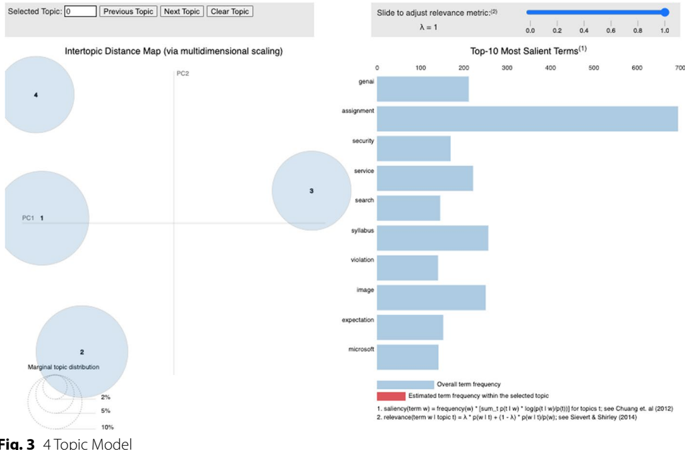
- LDA identified four topics: Integration of GenAI in Learning and Assessment (30% of tokens), GenAI in Visual, Interactive, and Multimodal Media (28.8%), Security and Ethical Considerations in GenAI (21.3%), and GenAI in Academic Integrity (20%).
- Sentiment was highly positive across institution types: private institutions mean = 0.945355, public = 0.963464, with no significant difference (Mann-Whitney U = 5664.5000, p = 0.9664). Audience differences were significant (Kruskal-Wallis = 22.7987, p = 0.0004), with a significant faculty-vs-student difference (Dunn’s p = 0.000460); administrators had the highest mean (0.996750), while researchers (0.898900) and students (0.910272) were lower.
- Faculty guidelines were most common: 47 of 50 universities (94%) provided them; 56% offered syllabus statement guidance, 54% advised setting and communicating course policy, 48% advised redesigning assignments/assessments, and 38% discouraged AI detection tools.
- Coverage varied by audience: 34 of 50 universities (70%) had all-stakeholder guidelines, 21 (42%) had student guidelines, 9 (18%) had researcher guidelines, and 7 (14%) had staff/administrator guidelines.
Methods
- Data: top 50 U.S. universities from Times Higher Education’s 2024 list; manual searches of official websites using GenAI/ChatGPT guideline and policy keywords; inclusion criteria were university-wide, publicly available, English-language guidelines. The corpus contained 214 documents, 9,475 sentences, and 235,118 words.
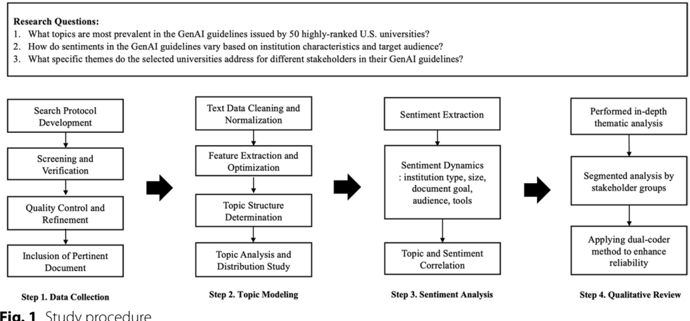
- Analysis: a four-step procedure of data collection, topic modeling, sentiment analysis, and qualitative thematic analysis. Topic modeling used TF/TF-IDF and optimized LDA; sentiment analysis used NLTK’s VADER Sentiment Intensity Analyzer compound scores from -1 to +1; qualitative thematic analysis coded guidelines by target audience, with two researchers coding a subset and reaching consensus.
- Statistical comparisons included normality tests, Mann-Whitney U tests, Kruskal-Wallis tests, and post-hoc Dunn’s tests.
Limitations
- Stated: the study reviewed only publicly available guidelines from the top 50 U.S. universities, so non-public guidelines were excluded and findings may not generalize to other U.S. or international institutions.
- Stated: the number of guidelines for staff and administrators was relatively small, and data were collected during Spring 2024; because GenAI guidelines evolve, longitudinal and cross-cultural research is needed.
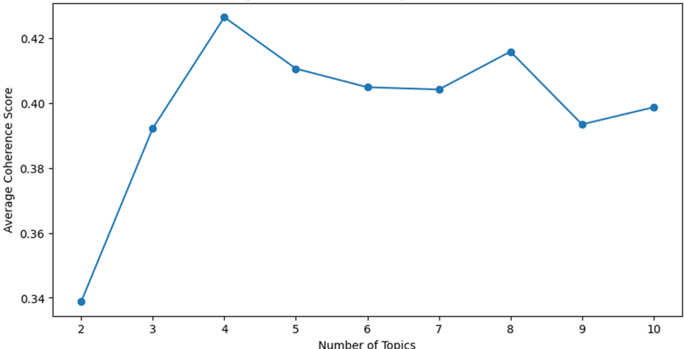
- Evident: the analysis captures guideline text rather than implementation, compliance, or effects on pedagogy and student outcomes; VADER was designed for social media sentiment and adapted to academic texts; LDA topic number and labels were determined by coherence scores and domain knowledge, so interpretations may be sensitive to modeling choices.
Model-written summary. Check it against the paper before relying on it.
Integrity signals
Registry
Cites
Statistics
Figures
Verification
Claims the paper makes
4 Valid · 1 Not valid · 53 Not checked · 96 Own results and interpretations
The cited sources support only part of this claim — read each source’s verdict below.
In the paper
“The primary concerns regarding the use of GenAI in higher education have been the issues of academic integrity and academic dishonesty”
§ Investigating the higher education institutions' guidelines and policies regarding the use of generative AI in teaching, learning, research, and administration > Potential benefits and pitfalls of GenAI
What the sources say
- Partly supportedcites Chan, 2023 matched to “The AI generation gap: Are Gen Z students more interested in adopting generative AI such as ChatGPT in teaching and learning than their Gen X and millennial generation teachers?” (2023) sourceExperimental — accuracy not yet measured
The 'Concerns' section of our copy confirms that academic dishonesty and integrity are prominent concerns in higher education: participants from both groups 'were concerned about unethical, dishonest, and irresponsible uses of GenAI including cheating, plagiarism, and even copyright issues', and about 'the undermining of academic degrees and integrity'. However, the paper presents these alongside misinformation and bias, low-quality output, job displacement, privacy and transparency, skills erosion, assessment redesign and threats to human values, and never ranks integrity/dishonesty as 'the primary' concerns — indeed it opens by saying participants 'expressed a number of similar concerns'. The 'Concerns and considerations for the future' section similarly groups plagiarism with misinformation and biased content as co-equal themes. So the superlative 'primary' is not attributable to this source. (LLM, conf=0.78)
- Supportedcites Cotton et al., 2023 matched to “Chatting and cheating: Ensuring academic integrity in the era of ChatGPT” (2024) source
The Abstract (p. 1) states that ChatGPT 'raises concerns regarding academic honesty and plagiarism' and that the paper 'considers the difficulties of detecting and preventing academic dishonesty' in higher education. The Conclusion repeats that these tools 'raise a number of challenges and concerns, particularly in relation to academic honesty and plagiarism', and the challenges section frames plagiarism/cheating as the key issue (noting, additionally, unfair advantage/inequity). This matches the claim that academic integrity and dishonesty are the primary concerns about GenAI in higher education. (LLM, conf=0.85)
- Not checked — no full text of the sourcecites Moorhouse et al., 2023 matched to “Generative AI tools and assessment: Guidelines of the world's top-ranking universities” (2023) source
plain- Asserted: passes — The authors put it forward as true.
- Checkable: passes — It can be checked against evidence.
- Load-bearing: unclear — It is unclear whether the paper’s conclusions depend on it.
- Based: passes — The paper gives a reason why it holds.
- Partly supported
The cited sources support only part of this claim — read each source’s verdict below.
In the paper
“The increased adoption of GenAI has had a disruptive effect on the assessment practices in HEIs worldwide”
§ Investigating the higher education institutions' guidelines and policies regarding the use of generative AI in teaching, learning, research, and administration > The need for institutional guidelines and policies
What the sources say
- Supportedcites Luo, 2024 matched to “A critical review of GenAI policies in higher education assessment: a call to reconsider the “originality” of students’ work” (2024) source
The source's section 'GenAI and the changing assessment landscape in higher education' states that 'groundbreaking advancements in GenAI have also presented significant challenges to the field of assessment', and 'University policies on GenAI and assessment' explicitly refers to pressure on universities to 'bring order' to the 'disrupted assessment landscape', with GenAI tools 'rapidly being used at scale among students'. The worldwide scope is carried by the same section's reference to policies showing 'how universities around the world conceive and approach the impacts, benefits and risks associated with GenAI in assessment', and by its review of the 20 top-ranked universities' policies. This is a broad background statement and our copy treats the topic that way. (LLM, conf=0.85)
- Supportedcites Rudolph et al., 2023 matched to “ChatGPT: Bullshit spewer or the end of traditional assessments in higher education?” (2023) source
Our copy supports both halves of the claim: the ChatGPT section documents rapid uptake ("reached one million users only five days after its initial launch", with full-capacity error messages from high traffic), and the Challenges and Opportunities sections treat the tool as "this disruptive AI application" whose essay-generation "threatens the essay as an assessment method". The Recommendations sections then document the practical effect on HE assessment: reactions "on a continuum between the extremes of banning or prohibiting the use of the software and including it in the curricula", major Australian universities adding rules declaring AI use cheating while others permit disclosed use, and advice to redesign assignments and closed-book exams. The paper addresses this at the level of higher education/institutions generally rather than a single country, matching the broad background framing of the citing sentence. (LLM, conf=0.80)
- Not matchedcites Sullivan et al., 2023
An author–year citation the paper’s reference list doesn’t settle. We don’t search these by name.
plainstates a cause- Asserted: passes — The authors put it forward as true.
- Checkable: passes — It can be checked against evidence.
- Load-bearing: passes — The paper’s conclusions depend on it.
- Based: passes — The paper gives a reason why it holds.
- Supported
The sources with a verdict support this claim; the rest weren’t checked yet, have no full text we could read, or their verdicts aren’t rated yet.
In the paper
“the disruptive nature of GenAI places significant pressure on universities to develop policies and guidelines in response to GenAI”
§ Investigating the higher education institutions' guidelines and policies regarding the use of generative AI in teaching, learning, research, and administration > The need for institutional guidelines and policies
What the sources say
- Not checked yetcites Luo, 2024 matched to “A critical review of GenAI policies in higher education assessment: a call to reconsider the “originality” of students’ work” (2024) source
Checked before — its earlier verdict is held back until a new check runs.
- Supportedcites Rudolph et al., 2023 matched to “ChatGPT: Bullshit spewer or the end of traditional assessments in higher education?” (2023) source
Our copy repeatedly characterises ChatGPT/GenAI as disruptive ('this disruptive AI application', 'While ChatGPT is perceived as a disruptive technology in the teaching and learning process', Use of ChatGPT for education: Opportunities) and ties that to institutional urgency: the Challenges section warns that once ChatGPT becomes mainstream 'it may be too late for educational institutions to adjust policies to guide their students in using it appropriately'. The Recommendations for higher education institutions section then explicitly calls for updating academic integrity policies and 'develop policies and clear, easy-to-understand guidelines for the use of language models in learning and teaching'. Together these state the claim's content; the source voices the pressure as its own recommendations and a timing warning rather than as a literal phrase 'significant pressure'. (LLM, conf=0.85)
- Not matchedcites Sullivan et al., 2023
An author–year citation the paper’s reference list doesn’t settle. We don’t search these by name.
plainstates a cause- Asserted: passes — The authors put it forward as true.
- Checkable: passes — It can be checked against evidence.
- Load-bearing: passes — The paper’s conclusions depend on it.
- Based: passes — The paper gives a reason why it holds.
- Not checked yet
Every source the paper cites for this claim was checked and supports it.
In the paper
“Conversely, positive topics centered on the trust and hope in GenAI tools to improve job efficiency and educational outcomes.”
§ Investigating the higher education institutions' guidelines and policies regarding the use of generative AI in teaching, learning, research, and administration > Discussion and conclusion
What the sources say
- Supportedcites Stracqualursi and Agati (2024) matched to “Twitter users perceptions of AI-based e-learning technologies” (2024) source
The Abstract states that 'among the topics with a positive outlook, trust and hope in AI tools for improving efficiency in jobs and the educational world are identified', and the Conclusions repeat this ('topics with a positive outlook indicate trust and hope in AI tools that can improve efficiency in jobs and the educational world'). The Results > The topic model section backs it with the LDA positive topics (Table 4): topic 1 ('learn', 'help', 'technology', 'student', 'job') is read as the potential to improve the job world and educational system, and topics 2-3 centre on ChatGPT ('chatgpt', 'write', 'create', 'love', 'good', 'answer', 'believe'), i.e. trust that generative AI provides good answers and solutions. The only wording shift is that the source says 'AI tools' (of which generative tools such as ChatGPT are the prominent positive examples) rather than 'GenAI tools' exclusively. (LLM, conf=0.85)
plain- Asserted: passes — The authors put it forward as true.
- Checkable: passes — It can be checked against evidence.
- Load-bearing: unclear — It is unclear whether the paper’s conclusions depend on it.
- Based: passes — The paper gives a reason why it holds.
- Supported
A result the paper reports from its own data — it cites no other source for it, so there is none to check. The quote shows it is in the paper.
In the paper
“This analysis also highlighted recurring themes such as academic integrity and privacy concerns, which aligned with the security and ethical considerations identified in the topic modeling.”
§ Investigating the higher education institutions' guidelines and policies regarding the use of generative AI in teaching, learning, research, and administration > Abstract
plainstates an association- Asserted: passes — The authors put it forward as true.
- Checkable: passes — It can be checked against evidence.
- Load-bearing: unclear — It is unclear whether the paper’s conclusions depend on it.
- Based: passes — The paper gives a reason why it holds.
59 more claims
Create a free account to see all 154 claims and to verify the 62 references still open.
- Probably not a substantial claim. 70
- It may state two separate claims as one. 36
Self-check
Percentages, sums and reported differences re-computed from the paper’s own numbers.
Each contradiction between two passages listed here was confirmed by an independent check.
Rated major: it would touch a result — a value a result rests on, reported and recomputed p-values on opposite sides of the significance level, two passages that conflict with no sign which is right, or a cited work retracted before this paper was published.
In the paper
§ Investigating the higher education institutions' guidelines and policies regarding the use of generative AI in teaching, learning, research, and administration > Abstract
“revealing that 94% of universities had faculty guidelines emphasizing the importance of establishing and communicating course-specific GenAI policies.”
§ Investigating the higher education institutions' guidelines and policies regarding the use of generative AI in teaching, learning, research, and administration > Guidelines for faculty: key themes
“Twentyseven universities (54%) advised their faculty to set their own policies related to GenAI and communicate the policy to their students.”
Rated minor: it would not touch a result — a value no result rests on, a p-value that stays on the same side of the significance level, or a conflict that is clerical, resolved elsewhere in the paper, or outside its own findings.
In the paper
§ Investigating the higher education institutions' guidelines and policies regarding the use of generative AI in teaching, learning, research, and administration > Discussion and conclusion
“While most universities had guidelines for faculty and students, less than 20% of the universities provided GenAI guidelines for researchers.”
§ Investigating the higher education institutions' guidelines and policies regarding the use of generative AI in teaching, learning, research, and administration > Guidelines for students: key themes
“Twenty-one out of 50 universities (42%) provided guidelines for students on the use of GenAI.”
Citations
Cites
Chatting and cheating: Ensuring academic integrity in the era of ChatGPT
Cotton, D. R. E., Cotton, P. A., & Shipway, J. R. (2024) · Innovations in Education and Teaching International · doi:10.1080/14703297.2023.2190148 · Cited by 3,087 · cited 3×
“Universities appear to promote GenAI’s benefits among faculty, who are instrumental in educational delivery and innovation, while adopting a more cautious tone with students to mitigate risks of misuse (Cotton et al., 2023).”
Chatting and Cheating. Ensuring academic integrity in the era of ChatGPT
Cotton, D., Cotton, P., & Shipway, J. R. (2023) · doi:10.35542/osf.io/mrz8h · Cited by 3,079
ChatGPT: Bullshit spewer or the end of traditional assessments in higher education?
(2023) · Journal of Applied Learning & Teaching · doi:10.37074/jalt.2023.6.1.9 · Cited by 1,806 · cited 5×
“The primary concerns regarding the use of GenAI in higher education have been the issues of academic integrity and academic dishonesty (Chan, 2023; Cotton et al., 2023; Moorhouse et al., 2023; Rudolph et al., 2023; Sullivan et al., 2023).”
InfluentialA comprehensive AI policy education framework for university teaching and learning
Chan, C. K. Y. (2023) · International Journal of Educational Technology in Higher Education · doi:10.1186/s41239-023-00408-3 · Cited by 1,577 · cited 3×
“The primary concerns regarding the use of GenAI in higher education have been the issues of academic integrity and academic dishonesty (Chan, 2023; Cotton et al., 2023; Moorhouse et al., 2023; Rudolph et al., 2023; Sullivan et al., 2023).”
Ethics of AI in Education: Towards a Community-Wide Framework
Holmes, W., Porayska-Pomsta, K., Holstein, K., Sutherland, E., Baker, T., Shum, S. B., Santos, O. C., Rodrigo, M. T., Cukurova, M., Bittencourt, I. I., et al. (2022) · International Journal of Artificial Intelligence in Education · doi:10.1007/s40593-021-00239-1 · Cited by 1,437 · cited 1×
“Holmes et al. (2022) emphasized the importance of explicitly considering issues such as fairness, accountability, transparency, bias, autonomy, agency, and inclusion in AI in education (AIED).”
Practical and ethical challenges of large language models in education: A systematic scoping review
Yan, L., Sha, L., Zhao, L., Li, Y., Martinez‐Maldonado, R., Chen, G., Li, X., Jin, Y., & Gašević, D. (2024) · British Journal of Educational Technology · doi:10.1111/bjet.13370 · Cited by 1,435 · cited 2×
“There are also concerns about unequal access to GenAI tools, student privacy and data security, biases in AI algorithms, and the spread of fraudulent information generated by AI (Ghimire & Edwards, 2024; Luo, 2024; Rudolph et al., 2023; Sullivan et al., 2023; UNESCO, 2023; Yan et al., 2024b).”
ChatGPT for Language Teaching and Learning
Kohnke, L., Moorhouse, B. L., & Zou, D. (2023) · RELC Journal · doi:10.1177/00336882231162868 · Cited by 1,371 · cited 10×
“The primary concerns regarding the use of GenAI in higher education have been the issues of academic integrity and academic dishonesty (Chan, 2023; Cotton et al., 2023; Moorhouse et al., 2023; Rudolph et al., 2023; Sullivan et al., 2023).”
InfluentialEthical principles for artificial intelligence in education
Nguyen, A., Ngo, H. N., Hong, Y., Dang, B., & Nguyen, B.-P. T. (2023) · Education and Information Technologies · doi:10.1007/s10639-022-11316-w · Cited by 1,228 · cited 1×
“Although many AI-related guidelines were published before the release of ChatGPT, most are generic and do not specifically address issues and challenges caused by GenAI in higher education (Nguyen et al., 2023; Schiff, 2022;).”
Revolutionizing education with AI: Exploring the transformative potential of ChatGPT
Adiguzel, T., Kaya, M. H., & Cansu, F. K. (2023) · Contemporary Educational Technology · doi:10.30935/cedtech/13152 · Cited by 975
ChatGPT in higher education: considerations for academic integrity and student learning
(2023) · Journal of Applied Learning & Teaching · doi:10.37074/jalt.2023.6.1.17 · Cited by 853
Research works printed but not linked: 3
- Miles, M.B., Huberman, A.M., & Saldana, J. (2014). Qualitative data analysis: A methods sourcebook (3 rd ed.) Sage.
- Nietzel, M. T. (2023). More than half of college students believe using ChatGPT to complete assignments is cheating. Forbes. https:// www. forbes. com/ sites/ micha eltni etzel/ 2023/ 03/ 20/ more-than-half-of-colle ge-stude nts-belie ve- using-chatg pt-to-compl ete-assig nments-is-cheat ing OECD. (2023). Opportunities, guidelines and guardrails for effective and equitable use of AI in Education. OECD Digital Education Outlook. https:// doi. org/ 10. 1787/ 2b39e 98b-en · doi:10.1787/2b39e98b-en · Paper page
- Sleator, L. (2023). Almost half of Cambridge students admit they have used ChatGPT. The Times. https:// www. theti mes. com/ busin ess-money/ techn ology/ artic le/ cambr idge-unive rsity-stude nts-chatg pt-ai-degree-2023-rnsv7 mw7z
Cited by
Adamakis, M., & Rachiotis, T. (2025) · Encyclopedia · doi:10.3390/encyclopedia5040180 · Cited by 76
“…bias awareness, prompt-planning, verification, and data-privacy basics; and establish governance guardrails—bias audits, Data Protection Impact Assessments, GDPR-aligned data minimization, and multi-stakeholder oversight—to ensure equitable, transparent implementation across disciplines [95].”
Students’ Trust in AI and Their Verification Strategies: A Case Study at Camilo José Cela University
Martín-Moncunill, D., & Martínez, D. A. (2025) · Education Sciences · doi:10.3390/educsci15101307 · Cited by 52
Governing generative AI in higher education: a global Delphi study on policy and practice
Crompton, H., Burke, D., Nickel, C. E., Bozkurt, A., Miao, F., Sharples, M., Greene, J. A., Parsons, D., Gill-Simmen, L., Edmett, A., et al. (2026) · International Journal of Educational Technology in Higher Education · doi:10.1186/s41239-026-00602-z · Cited by 60
Géring, Z., Fehér, K., Harmat, V., & Tamássy, R. (2025) · International journal of organizational analysis · doi:10.1108/ijoa-09-2024-4850 · Cited by 54
Azevedo, L., Robles, P., Best, E., & Mallinson, D. J. (2025) · New Directions for Adult and Continuing Education · doi:10.1002/ace.70013 · Cited by 41
Wang, S., & Zhang, H. (2026) · International Journal of Educational Technology in Higher Education · doi:10.1186/s41239-026-00585-x · Cited by 38
Effects of GenAI Interventions on Student Academic Performance: A Meta-Analysis
Gu, J., & Yan, Z. (2025) · Journal of Educational Computing Research · doi:10.1177/07356331251349620 · Cited by 30
“These policies should emphasise the distinct value of human instructors and the limitations of GenAI tools (An et al., 2025).”
Enhancing faculty members’ technology-enhanced teaching practices through leadership
Zhang, Y., & Chen, D. (2025) · Frontiers in Education · doi:10.3389/feduc.2025.1586296 · Cited by 31
Generative AI Integration in K-12 Settings: Teachers’ Perceptions and Levels of Integration
An, Y., & James, S. (2025) · TechTrends · doi:10.1007/s11528-025-01114-9 · Cited by 30
Self-citationAI and the psychology of educational disruption: Historical patterns and cognitive implications
Promsiri, T. (2025) · Acta Psychologica · doi:10.1016/j.actpsy.2025.105637 · Cited by 30
Šević, N. P., Šević, A., Slijepčević, M., & Krstić, J. (2025) · Online Journal of Communication and Media Technologies · doi:10.30935/ojcmt/17246 · Cited by 29
Prompting Better Feedback: A Study of Custom GPT for Formative Assessment in Undergraduate Physics
Mills, E., Mizouri, A., & Peach, A. (2025) · Education Sciences · doi:10.3390/educsci15081058 · Cited by 24
Artificial intelligence in the context of teacher education: emerging themes and critical issues
Carrillo, C., Flores, M. A., & Mena, J. (2025) · European Journal of Teacher Education · doi:10.1080/02619768.2025.2584283 · Cited by 27
Jayasinghe, S., Gamage, K. A. A., Yang, D., Cheng, C., Disanayake, C., & Apeji, U. D. (2026) · Education Sciences · doi:10.3390/educsci16010137 · Cited by 23
Athanassopoulos, S., Tzavara, A., Aravantinos, S., Lavidas, K., Komis, V., & Papadakis, S. (2026) · Education Sciences · doi:10.3390/educsci16020228 · Cited by 26
Kangwa, D., Msafiri, M. M., & Fute, A. (2025) · Journal of Computer Assisted Learning · doi:10.1111/jcal.70109 · Cited by 22
Elkhodr, M., & Gide, E. (2025) · Discover Education · doi:10.1007/s44217-025-00935-3 · Cited by 24
Ahangama, N. (2026) · International Journal of Educational Technology in Higher Education · doi:10.1186/s41239-026-00582-0 · Cited by 21
“Similarly, research by Khreibi (2025), An et al. (2025), and Christodorescu et al. (2024) supports the revision of institutional policies to ensure equitable access, provide student support, and address emerging risks such as data privacy and security.”
Reimagining pedagogy for the GenAI era: Frameworks, challenges and institutional strategies
Jha, M., & Atif, A. (2025) · Australasian Journal of Educational Technology · doi:10.14742/ajet.10645 · Cited by 24
Olszak, C. M., & Sączewska-Piotrowska, A. (2025) · Sustainability · doi:10.3390/su17198530 · Cited by 20
AI-Assisted Teaching in Higher Education: Challenges and Opportunities
Medina, R. H. (2025) · Ceniiac · doi:10.64923/ceniiac.e0003 · Cited by 19
Wu, C., & Carroll, J. M. (2025) · TechTrends · doi:10.1007/s11528-025-01150-5 · Cited by 16
Sallam, M., Al‐Adwan, A. S., Mijwil, M. M., Abdelaziz, D. H., Al-Qaisi, A., Ibrahim, O. M., & Sallam, M. (2025) · Journal of Education and Development · doi:10.20849/jed.v9i3.1511 · Cited by 21
Addressing the Efficacy of Quality in Qualitative Research: A Review of the Current Discourse
Mutanana, N., & Shoko, C. T. (2026) · International Journal of Qualitative Methods · doi:10.1177/16094069261432368 · Cited by 17
Who wrote this? Evaluating the reliability of AI detection tools in higher education
Van Vlasselaer, M., Van Droogenbroeck, F., & Spruyt, B. (2026) · International Journal for Educational Integrity · doi:10.1007/s40979-026-00226-w · Cited by 14
“What matters is how GenAI is being used and whether students critically engage with those tools, ensuring they are transparent about the role of those tools in their work as part of maintaining academic integrity (An et al., 2025).”
Liang, H., & Mao, X. (2025) · International Journal of Educational Development · doi:10.1016/j.ijedudev.2025.103434 · Cited by 19
Luo, Y., Zhou, G., & Cui, Y. (2026) · Education and Information Technologies · doi:10.1007/s10639-025-13885-y · Cited by 15
Navigating the Ethical and Societal Impacts of Generative AI in Higher Computing Education
Mak, J., Nakatumba-Nabende, J., Clear, T., Clear, A., Abluwi, I., Andrei, O., Angeli, L., MacNeil, S., Oyelere, S. S., Hale Rattigan, M., et al. (2025) · Proceedings of the 2025 Working Group Reports on Innovation and Technology in Computer Science Education · doi:10.1145/3760545.3783975 · Cited by 12
Altamirano, S. F. S., Maquen‐Niño, G. L. E., Roldán, C. M. G., Herrera, A. P., & Cárdenas, D. M. C. (2026) · Review of Education · doi:10.1002/rev3.70152 · Cited by 12
Jacobs-Basadien, M., & Pather, S. (2026) · Universal Access in the Information Society · doi:10.1007/s10209-026-01340-9 · Cited by 11
Dai, W., & Chan, C. K. Y. (2026) · International Journal of Educational Technology in Higher Education · doi:10.1186/s41239-026-00609-6 · Cited by 11
Factors influencing the use of ChatGPT in student learning in Vietnam
Linh, T. T. (2025) · International Journal of ADVANCED AND APPLIED SCIENCES · doi:10.21833/ijaas.2025.07.007 · Cited by 12
Rush, E., Byram, J. N., Garnett, C. N., DeVaul, N., Smith, L., Checchi, M., Martin, D., Hoffman, L. A., Brown, K., Mumbower, D. J., et al. (2025) · Medical Teacher · doi:10.1080/0142159x.2025.2564869 · Cited by 10
Mudenda, S. (2025) · Creative Education · doi:10.4236/ce.2025.1611112 · Cited by 13
Vélez, J. P. C., García, R. V. L., & Bonilla-Fierro, L. F. (2026) · Frontiers in Education · doi:10.3389/feduc.2026.1796556 · Cited by 10
Chamba-Eras, L., Cumbicus-Pineda, O. M., Romero, E. L. C., Alvarado, J. K. G., & Guamán, L. R. B. (2026) · IEEE Technology and Engineering Management Conference - Latin America (TEMSCON LATAM) · doi:10.48550/arxiv.2602.09246 · Cited by 17
Alvira, N. B., Bannister, P., & Urbieta, A. S. (2025) · Higher Education Quarterly · doi:10.1111/hequ.70056 · Cited by 9
How college students use ChatGPT
Mohammad, N. M., Demers, M., McCubbin, E., Mitchell, J., & Fulmer, S. M. (2025) · Pedagogical Research · doi:10.29333/pr/17428 · Cited by 12
The transparency trap: Generative AI and the rise of interpretive load
Gonsalves, C. (2026) · Review of Education · doi:10.1002/rev3.70139 · Cited by 11
Assessment validity in the age of generative artificial intelligence: a critical review
Ali, R., & Maroulis, J. (2026) · Assessment & Evaluation in Higher Education · doi:10.1080/02602938.2026.2683046 · Cited by 11
Kaşarcı, İ., Akın Demircan, Z., Çeliker Ercan, G., & İnci, T. (2025) · International Journal of Current Educational Studies · doi:10.46328/ijces.223 · Cited by 24
“Some institutions have developed comprehensive AI policies that articulate ethical principles, guidelines for acceptable use, and governance responsibilities (Chan, 2023; Humble, 2025; An et al., 2025).”
AI in Higher Education: Opportunities and Challenges
Torrisi‐Steele, G. (2025) · Advances in computational intelligence and robotics book series · doi:10.4018/979-8-3373-2397-8.ch007 · Cited by 9
How are faculty and college students embracing AI? — A multi-informant mixed method study
Xie, L., Jiang, Y., Chang, C., Zeng, X.-Y., Hong, J. S., & Mo, F. (2025) · Computers and Education Artificial Intelligence · doi:10.1016/j.caeai.2025.100506 · Cited by 10
Generative AI in Sociological Research: State of the Discipline
Alvero, A., Stoltz, D. S., Stuhler, O., & Taylor, M. A. (2026) · Sociological Science · doi:10.15195/v13.a3 · Cited by 8
Lipsou, E., Keravnos, N., & Eteokleous, N. (2026) · Artificial Intelligence in Education · doi:10.1108/aiie-08-2025-0240 · Cited by 9
What Does YouTube Advise Students About Bypassing AI-Text Detection Tools? A Pragmatic Analysis
Foltýnek, T., & Newton, P. M. (2025) · Journal of Academic Ethics · doi:10.1007/s10805-025-09675-3 · Cited by 7
ВИКОРИСТАННЯ ІНСТРУМЕНТУ DEEP RESEARCH AI В ПЕДАГОГІЧНІЙ І НАУКОВО-ПЕДАГОГІЧНІЙ ДІЯЛЬНОСТІ
Spirin, O. M., Коломієць, А. М., Громов, Є., Жовнич, О. В., Коломієць, Д. І., & Кушнір, О. І. (2025) · Information Technologies and Learning Tools · doi:10.33407/itlt.v110i6.6240 · Cited by 11
Mudenda, S., Mukosha, M., Mfune, R. L., Kathewera, B. S., Mutanekelwa, I., Mwanza, B., Mufwambi, W., Hampango, M., Kamvuma, K. M., Mwaba, M., et al. (2026) · Frontiers in Education · doi:10.3389/feduc.2026.1814033 · Cited by 8
Yang, J., Öge, K., von Mühlenen, A., Akbulut, A. B., Carey, T. S., & Okorro, C. (2026) · Education Sciences · doi:10.3390/educsci16060838 · Cited by 8
Academic Integrity vs. Artificial Intelligence: a tale of two AIs
Premat, C. E., & Farazouli, A. (2025) · Praxis Educativa · doi:10.5212/praxeduc.v.20.24871.016 · Cited by 9
Academic Integrity in the Age of AI
Gallant, T. B., Davis, M., & Khan, Z. R. (2026) · Cambridge University Press eBooks · doi:10.1017/9781009672078 · Cited by 11
Zhang, H., & Jiang, R. (2026) · Education and Information Technologies · doi:10.1007/s10639-026-14026-9 · Cited by 6
AI Literacy and Scenario-based Ethical Judgment About Generative AI Among Undergraduate Students
Reed, J. M., Ferdig, R. E., Dodson, T. M., Gunstad, J., & Hughes, J. W. (2026) · Journal of Academic Ethics · doi:10.1007/s10805-026-09757-w · Cited by 8
Nikolic, S., Faculty of Engineering and Information Sciences, U. O. W., Ros, M., Al-Abdeli, Y. M., Fairweather, H., School of Engineering, E. C. U., & Head of Accreditation, E. A. (2025) · STEM Education · doi:10.3934/steme.2025027 · Cited by 5
Defining and assessing AI literacy for researchers across the research lifecycle
Parker, J. L., & Becker, K. P. (2026) · Frontiers in Education · doi:10.3389/feduc.2026.1827603 · Cited by 5
Rughiniş, C., Matei, Ș., & Corcaci, A. (2025) · International Conference on Control Systems and Computer Science · doi:10.1109/cscs66924.2025.00094 · Cited by 6
Krishnan, S. (2025) · Indian Journal of Computer Science · doi:10.17010/ijcs/2025/v10/i4/175747 · Cited by 8
Bouaziz, K., & Eddouada, S. (2026) · Arab World English Journal · doi:10.24093/awej/a3.17 · Cited by 5
Yang, Z., & Li, Y. (2026) · Sustainability · doi:10.3390/su18083831 · Cited by 7
Mota, F. B., Cabral, B. P., Pinto, C. D., Braga, L. A. M., Comarú, M. W., & Lopes, R. M. (2026) · Frontiers in Education · doi:10.3389/feduc.2026.1813497 · Cited by 6
Factors influencing faculty decision-making on student use of generative AI in higher education
Dilinika, J. M. S. (2026) · Journal of Interdisciplinary Studies in Education · doi:10.32674/ksb6gv95 · Cited by 6
A Comprehensive Review of Strategies and Policies Toward AI-Resistant Education
Teo, T. H., & Chew, D. (2025) · Journal of Sociology and Education · doi:10.63887/jse.2025.1.6.15 · Cited by 5
Wang, Y. (2025) · Security and Privacy · doi:10.1002/spy2.70089 · Cited by 4
Trends, Trajectories and Tomorrows of AI Regulations in Philippine Higher Educational Institutions
Toquero, C. M. D. (2025) · Higher Education Quarterly · doi:10.1111/hequ.70090 · Cited by 4
Le, M. T. T., & Tran, V. K. (2025) · rEFLections · doi:10.61508/refl.v32i3.285294 · Cited by 6
Suchikova, Y., & Omelchuk, S. A. (2026) · Knowledge and Performance Management · doi:10.21511/kpm.10(2).2026.01 · Cited by 4
“When Gen Z meets GenAI”: The perfect storm in higher education
Leite, H., Luna‐Nevarez, C., Baruca, A., & Joubert, A. M. (2026) · Technological Forecasting and Social Change · doi:10.1016/j.techfore.2026.124692 · Cited by 4
Generative Artificial Intelligence Policy: A Qualitative UNESCO Framework Analysis
Adarkwah, M. A., Ercan, A. M., Schneider, K., & Bayar, E. (2026) · Journal of University Teaching and Learning Practice · doi:10.53761/801ryw41 · Cited by 5
LaFrance, J. A. (2026) · Educational Policy · doi:10.1177/08959048261450995 · Cited by 5
Woodworth, J., & Ballantyne, E. (2026) · American Journal of STEM Education · doi:10.32674/ndvc6674 · Cited by 4
Elkhodr, M., & Gide, E. (2026) · STEM Education · doi:10.3934/steme.2026024 · Cited by 5
Explainable AI, Academic Confidence, and Decision-Making Quality in Physics Learning
Hidayah, N., & Sodikin, S. (2026) · Digital Learning Social Science and Life-course Studies · doi:10.70211/disolife.v2i1.777 · Cited by 4
Amplifier and Risk: Extending the Community of Inquiry (CoI) for Student AI Use
Baksh, S. (2025) · Review of Artificial Intelligence in Education · doi:10.37497/rev.artif.intell.educ.v6ii.57 · Cited by 4
Salman, H., Ahmad, M. A., Ibrahim, R. B., & Mahmood, J. (2026) · PeerJ Computer Science · doi:10.7717/peerj-cs.3417 · Cited by 4
A Multi-Year Survey of Use and Perceptions of Generative AI in Higher Education
Crescenzi, A., Choi, B., Huang, P.-P., Gautier, E., Little, R., & Pandya, S. (2026) · Conference on Human Information Interaction and Retrieval · doi:10.1145/3786304.3787867 · Cited by 3
Kan, L., Kamal, S. S. L. A., Osman, S. Z. M., Yan, Y., & Liu, J. (2026) · Arab World English Journal · doi:10.24093/awej/vol17no1.9 · Cited by 3
Delvenne, J. (2026) · Psychology Learning & Teaching · doi:10.1177/14757257261427151 · Cited by 4
Are university teachers ready for AI under anxiety? Self-efficacy mediation and gender moderation
Wu, H., Wenfu, L., He, J., & Wu, T. (2026) · Interactive Learning Environments · doi:10.1080/10494820.2026.2643795 · Cited by 5
Joshi, A., McGoldrick, B., Mittal, N., Roy, S., Zeba, Z., Ofori, M. A., Dockery, S., Jha, N., Auerbach, J. M., Cadet, J. A., et al. (2026) · Frontiers in Public Health · doi:10.3389/fpubh.2026.1796810 · Cited by 4
From Awareness to Action? The Impact of CO2 Emission Feedback on Student LLM Usage
Andersen, L. B., Herklotz, M., Liu, A., Goeke, M., Jülich, M., Kern, C. A., & Kreuter, F. (2026) · CHI Conference Extended Abstracts on Human Factors in Computing Systems (CHI EA) · doi:10.1145/3772363.3798840 · Cited by 4
Baig, M., & Paparo, J. (2026) · Teaching in Higher Education · doi:10.1080/13562517.2026.2663440 · Cited by 4
Wegerif, R. (2026) · Journal for the Study of Education and Development Infancia y Aprendizaje · doi:10.1177/02103702261439739 · Cited by 3
Xiao, J., & Lim, D. C. L. (2026) · Journal of Applied Learning & Teaching · doi:10.37074/jalt.2026.9.1.14 · Cited by 3
AI literacy of pre-service English teachers: Proficiency, strategies, and barriers
Febriyanti, Nurchurifiani, E., Hastomo, T., Wicaksono, A., & Nasution, S. S. (2026) · JEELS (Journal of English Education and Linguistics Studies) · doi:10.30762/jeels.v13i1.6293 · Cited by 6
Yilmaz, A. (2026) · Frontiers in Psychology · doi:10.3389/fpsyg.2026.1853790 · Cited by 3
Large language models in software development learning
Hernández, S. C., Cruz, M. P. T., Sánchez, J. M. E., Luna-Gómez, A. A., Orozco, A. M. P., & Medina, R. H. (2026) · Discover Education · doi:10.1007/s44217-026-01750-0 · Cited by 3
Elkhodr, M., & Gide, E. (2026) · Education Sciences · doi:10.3390/educsci16060986 · Cited by 3
Kim, J., Lee, C., & Lim, J. S. (2026) · Telematics and Informatics · doi:10.1016/j.tele.2026.102436 · Cited by 4
Mapping the landscape of AI governance in higher education
Khoza, M. S., Wamba, S. F., & Nyawa, S. (2026) · Assessment & Evaluation in Higher Education · doi:10.1080/02602938.2026.2712521 · Cited by 4
Governing generative AI in digital education: how institutional guidance becomes course-level policy
Wu, E. (2026) · Frontiers in Education · doi:10.3389/feduc.2026.1886876 · Cited by 4
Teaching in the Age of AI: Exploring Faculty Perceptions and Practices
Nelson, K., Marshall, D. T., Manning, K. Q., & Hong, H. B. (2026) · AI in Education · doi:10.31219/osf.io/nqb84_v1 · Cited by 2
Silvennoinen, M., Aksovaara, S., & Alanko-Turunen, M. (2025) · Bled eConference · doi:10.18690/um.fov.4.2025.29 · Cited by 3
BETWEEN ALGORITHMS AND KNOWLEDGE: ARTIFICIAL INTELLIGENCE IN TEACHER EDUCATION IN HIGHER EDUCATION
Medeiros, R. D. O., Mascarin, A. M. N., dos Santos, J. P., Galhardi, C. M., Pozenato, C. G. D. A., Rodrigues, J. R. G., Orso, L. F., Mazzetto, F. M. C., Marín, M. J. S., Donadai, K. C. E. D. V., et al. (2025) · INTERFERENCE A JOURNAL OF AUDIO CULTURE · doi:10.36557/2009-3578.2025v11n2p3167-3183 · Cited by 2
Chukwuere, J. E., & Chukwuere, G. C. J. (2025) · Journal of Community Psychosocial Research · doi:10.36386/jcpr.v2i1.753 · Cited by 2
Large Language Model Failures in Higher Education: Causes and Prevention
Ternikov, A. (2025) · Computer · doi:10.1109/mc.2025.3595485 · Cited by 2
He, P., Hamid, A. H. A., & Nor, M. Y. M. (2025) · Journal of Applied Science Engineering Technology and Education · doi:10.35877/454ri.asci4270 · Cited by 2
Natural intelligence, not artificial: a Confucian reframing of generative AI in higher education
Hou, Y. (2026) · Ethics and Education · doi:10.1080/17449642.2026.2629430 · Cited by 2
Umaya, S., Hernawan, A. H., & Dewi, L. (2026) · International Journal of Learning Teaching and Educational Research · doi:10.26803/ijlter.25.2.20 · Cited by 2
Ethical awareness versus actual practices: Chinese doctoral students in AI-assisted academic writing
Feng, H., & Li, K. (2026) · Applied Linguistics · doi:10.1093/applin/amag013 · Cited by 3
Meza-Cascante, L. G., Bogantes, M. R., & Chavarría, L. Á. M. (2026) · Revista Tecnología en Marcha · doi:10.18845/tm.v39i5.8502 · Cited by 2
Metadata
- Authors
- An, Y., Yu, J. H., & James, S.
- Affiliations
- University of North Texas (US)
- Corresponding author
- An, Yunjo
- ORCID
- Venue
- International Journal of Educational Technology in Higher Education
- Published
- 2025-02-21
- Volume
- 22
- Issue
- 1
- ISSN
- 2365-9440 (ISSN-L)
- OpenAlex
- W4407778399
- Semantic Scholar
- 7e4dfefcbacb639faa8a6fc8224ab7e0d7acf827
- Cited by
- 403
- References
- 28
- Citations by year
- 2026: 319 · 2025: 84
- FWCI
- 321.82
- Type
- journal article
- Language
- en
- Open access
- diamond
- doi.org
- Licence
- cc-by
- creativecommons.org/licenses/by/4.0 (tdm)
- creativecommons.org/licenses/by/4.0 (vor)
- Locations
- International Journal of Educational Technology in Higher Education (publishedVersion, cc-by)
- DOAJ (DOAJ: Directory of Open Access Journals) (submittedVersion, cc-by-sa)
- Topics
- Social Sciences › Education › Artificial Intelligence in Education
- Health Sciences › Medicine › Health Informatics › Artificial Intelligence in Healthcare and Education
- Social Sciences › Education › Academic integrity and plagiarism
- Keywords
- generative AI, higher education institutions, institutional policy, AI guidelines, academic integrity, AI-assisted assessment, multimodal media, AI ethics, data security, privacy concerns, American universities
About these checks
Registry, retraction, Cites and statistics results are computed, not judged, with one exception: a printed reference that no index lists is read once by a model before it counts as a citation error. Claims are extracted by a model and kept only when their quote appears verbatim in the text; each cited source is then checked, with a model’s help, for whether it says what the claim relies on. Those verdicts can be wrong — read the claim’s quote and the cited source before relying on one.
The claim verdicts this report counts are experimental: their accuracy is not yet measured.
A language model drew the claims from the paper on 2026-11-13, under version 3 of the claim definition (model deepseek-v4.1-flash, prompt extract-v3).
A second model labelled each claim on 2026-11-13 (model jev-1.13-20260917, definition revision gold-guideline-v0.2).
Cited sources are checked with a language model’s help (qwen3.8-omni-flash).
Statistics and arithmetic are recomputed, not judged.
Confidence bands are shown only for fields calibrated on our annotated test set. None is calibrated yet, so no band is shown.
What counts as a claim ›How we measure confidence ›How we check this ›
Are you an author, or do you see a problem with this page? Request a review
Data sources
Bibliographic data: Semantic Scholar, OpenAlex, Crossref.
Contains information from the Semantic Scholar Academic Graph Datasets, made available under the ODC Attribution License (ODC-BY 1.0).
Semantic Scholar’s data is described in: Kinney, R., et al. (2023). The Semantic Scholar Open Data Platform. arXiv:2301.10140.
