

Investigating the higher education institutions’ guidelines and policies regarding the use of generative AI in teaching, learning, research, and administration
Open accessThe DOI matches its Crossref record; 32 of the 32 references it cites were found in a registry or an index; 6 of the 79 sources its claims cite were checked for support.
Abstract
This study examined the guidelines issued by the top 50 U.S. universities regarding the use of Generative AI (GenAI) in academic and administrative activities. Employing a mixed methods approach, the research combined topic modeling, sentiment analysis, and qualitative thematic analysis to provide a comprehensive understanding of institutional responses to GenAI. Topic modeling identified four core topics: Integration of GenAI in Learning and Assessment, GenAI in Visual and Multimodal Media, Security and Ethical Considerations in GenAI, and GenAI in Academic Integrity. These themes were further explored through sentiment analysis, which revealed highly positive attitudes towards GenAI across all institution types, with significant differences between faculty and student-targeted guidelines. Qualitative thematic analysis corroborated these findings and provided deeper insights, revealing that 94% of universities had faculty guidelines emphasizing the importance of establishing and communicating course-specific GenAI policies. This analysis also highlighted recurring themes such as academic integrity and privacy concerns, which aligned with the security and ethical considerations identified in the topic modeling. The study highlights the rapid evolution of GenAI guidelines in higher education and the need for flexible, stakeholder-specific policies that address both the opportunities and challenges presented by this technology.
Overview
CoChat Summary
TL;DR
This study analyzed publicly available generative AI guidelines from the top 50 U.S. universities using topic modeling, sentiment analysis, and qualitative thematic analysis of 214 documents. It found four dominant topics and highly positive sentiment overall, with significant differences by target audience and uneven coverage across stakeholder groups.
Key findings
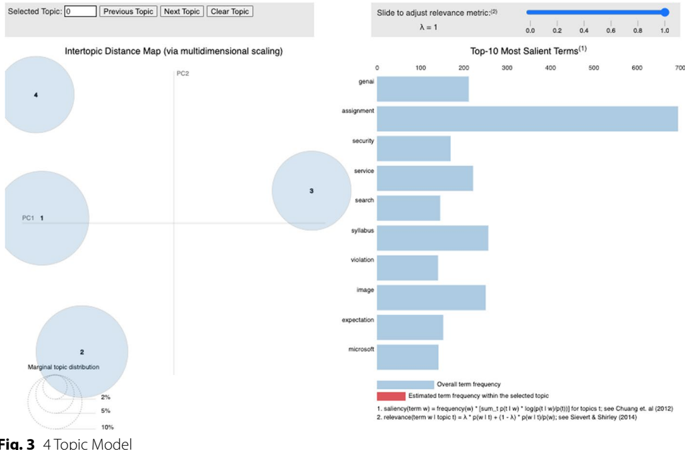
- LDA identified four topics: Integration of GenAI in Learning and Assessment (30% of tokens), GenAI in Visual, Interactive, and Multimodal Media (28.8%), Security and Ethical Considerations in GenAI (21.3%), and GenAI in Academic Integrity (20%).
- Sentiment was highly positive across institution types: private institutions mean = 0.945355, public = 0.963464, with no significant difference (Mann-Whitney U = 5664.5000, p = 0.9664). Audience differences were significant (Kruskal-Wallis = 22.7987, p = 0.0004), with a significant faculty-vs-student difference (Dunn’s p = 0.000460); administrators had the highest mean (0.996750), while researchers (0.898900) and students (0.910272) were lower.
- Faculty guidelines were most common: 47 of 50 universities (94%) provided them; 56% offered syllabus statement guidance, 54% advised setting and communicating course policy, 48% advised redesigning assignments/assessments, and 38% discouraged AI detection tools.
- Coverage varied by audience: 34 of 50 universities (70%) had all-stakeholder guidelines, 21 (42%) had student guidelines, 9 (18%) had researcher guidelines, and 7 (14%) had staff/administrator guidelines.
Methods
- Data: top 50 U.S. universities from Times Higher Education’s 2024 list; manual searches of official websites using GenAI/ChatGPT guideline and policy keywords; inclusion criteria were university-wide, publicly available, English-language guidelines. The corpus contained 214 documents, 9,475 sentences, and 235,118 words.
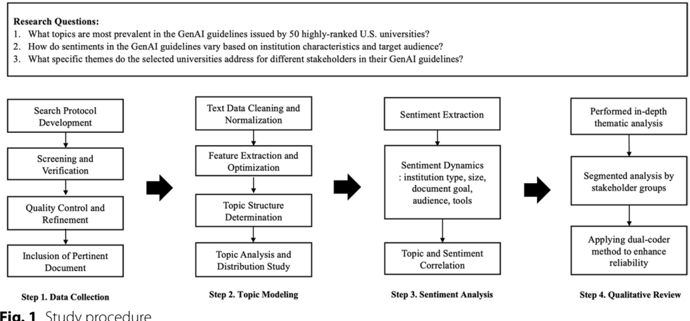
- Analysis: a four-step procedure of data collection, topic modeling, sentiment analysis, and qualitative thematic analysis. Topic modeling used TF/TF-IDF and optimized LDA; sentiment analysis used NLTK’s VADER Sentiment Intensity Analyzer compound scores from -1 to +1; qualitative thematic analysis coded guidelines by target audience, with two researchers coding a subset and reaching consensus.
- Statistical comparisons included normality tests, Mann-Whitney U tests, Kruskal-Wallis tests, and post-hoc Dunn’s tests.
Limitations
- Stated: the study reviewed only publicly available guidelines from the top 50 U.S. universities, so non-public guidelines were excluded and findings may not generalize to other U.S. or international institutions.
- Stated: the number of guidelines for staff and administrators was relatively small, and data were collected during Spring 2024; because GenAI guidelines evolve, longitudinal and cross-cultural research is needed.
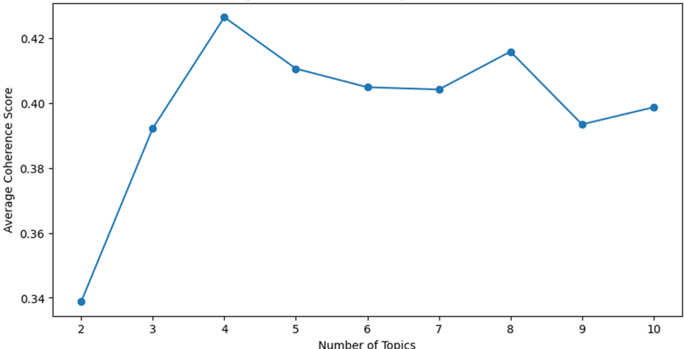
- Evident: the analysis captures guideline text rather than implementation, compliance, or effects on pedagogy and student outcomes; VADER was designed for social media sentiment and adapted to academic texts; LDA topic number and labels were determined by coherence scores and domain knowledge, so interpretations may be sensitive to modeling choices.
Model-written summary. Check it against the paper before relying on it.
Integrity signals
Registry
Cites
Statistics
Figures
Verification
Claims the paper makes
4 Valid · 1 Not valid · 53 Not checked · 96 Own results and interpretations
The cited sources support only part of this claim — read each source’s verdict below.
In the paper
“The primary concerns regarding the use of GenAI in higher education have been the issues of academic integrity and academic dishonesty”
§ Investigating the higher education institutions' guidelines and policies regarding the use of generative AI in teaching, learning, research, and administration > Potential benefits and pitfalls of GenAI
What the sources say
- Partly supportedcites Chan, 2023 matched to “The AI generation gap: Are Gen Z students more interested in adopting generative AI such as ChatGPT in teaching and learning than their Gen X and millennial generation teachers?” (2023) sourceExperimental — accuracy not yet measured
The 'Concerns' section of our copy confirms that academic dishonesty and integrity are prominent concerns in higher education: participants from both groups 'were concerned about unethical, dishonest, and irresponsible uses of GenAI including cheating, plagiarism, and even copyright issues', and about 'the undermining of academic degrees and integrity'. However, the paper presents these alongside misinformation and bias, low-quality output, job displacement, privacy and transparency, skills erosion, assessment redesign and threats to human values, and never ranks integrity/dishonesty as 'the primary' concerns — indeed it opens by saying participants 'expressed a number of similar concerns'. The 'Concerns and considerations for the future' section similarly groups plagiarism with misinformation and biased content as co-equal themes. So the superlative 'primary' is not attributable to this source. (LLM, conf=0.78)
- Supportedcites Cotton et al., 2023 matched to “Chatting and cheating: Ensuring academic integrity in the era of ChatGPT” (2024) source
The Abstract (p. 1) states that ChatGPT 'raises concerns regarding academic honesty and plagiarism' and that the paper 'considers the difficulties of detecting and preventing academic dishonesty' in higher education. The Conclusion repeats that these tools 'raise a number of challenges and concerns, particularly in relation to academic honesty and plagiarism', and the challenges section frames plagiarism/cheating as the key issue (noting, additionally, unfair advantage/inequity). This matches the claim that academic integrity and dishonesty are the primary concerns about GenAI in higher education. (LLM, conf=0.85)
- Not checked — no full text of the sourcecites Moorhouse et al., 2023 matched to “Generative AI tools and assessment: Guidelines of the world's top-ranking universities” (2023) source
plain- Asserted: passes — The authors put it forward as true.
- Checkable: passes — It can be checked against evidence.
- Load-bearing: unclear — It is unclear whether the paper’s conclusions depend on it.
- Based: passes — The paper gives a reason why it holds.
- Partly supported
The cited sources support only part of this claim — read each source’s verdict below.
In the paper
“The increased adoption of GenAI has had a disruptive effect on the assessment practices in HEIs worldwide”
§ Investigating the higher education institutions' guidelines and policies regarding the use of generative AI in teaching, learning, research, and administration > The need for institutional guidelines and policies
What the sources say
- Supportedcites Luo, 2024 matched to “A critical review of GenAI policies in higher education assessment: a call to reconsider the “originality” of students’ work” (2024) source
The source's section 'GenAI and the changing assessment landscape in higher education' states that 'groundbreaking advancements in GenAI have also presented significant challenges to the field of assessment', and 'University policies on GenAI and assessment' explicitly refers to pressure on universities to 'bring order' to the 'disrupted assessment landscape', with GenAI tools 'rapidly being used at scale among students'. The worldwide scope is carried by the same section's reference to policies showing 'how universities around the world conceive and approach the impacts, benefits and risks associated with GenAI in assessment', and by its review of the 20 top-ranked universities' policies. This is a broad background statement and our copy treats the topic that way. (LLM, conf=0.85)
- Supportedcites Rudolph et al., 2023 matched to “ChatGPT: Bullshit spewer or the end of traditional assessments in higher education?” (2023) source
Our copy supports both halves of the claim: the ChatGPT section documents rapid uptake ("reached one million users only five days after its initial launch", with full-capacity error messages from high traffic), and the Challenges and Opportunities sections treat the tool as "this disruptive AI application" whose essay-generation "threatens the essay as an assessment method". The Recommendations sections then document the practical effect on HE assessment: reactions "on a continuum between the extremes of banning or prohibiting the use of the software and including it in the curricula", major Australian universities adding rules declaring AI use cheating while others permit disclosed use, and advice to redesign assignments and closed-book exams. The paper addresses this at the level of higher education/institutions generally rather than a single country, matching the broad background framing of the citing sentence. (LLM, conf=0.80)
- Not matchedcites Sullivan et al., 2023
An author–year citation the paper’s reference list doesn’t settle. We don’t search these by name.
plainstates a cause- Asserted: passes — The authors put it forward as true.
- Checkable: passes — It can be checked against evidence.
- Load-bearing: passes — The paper’s conclusions depend on it.
- Based: passes — The paper gives a reason why it holds.
- Supported
The sources with a verdict support this claim; the rest weren’t checked yet, have no full text we could read, or their verdicts aren’t rated yet.
In the paper
“the disruptive nature of GenAI places significant pressure on universities to develop policies and guidelines in response to GenAI”
§ Investigating the higher education institutions' guidelines and policies regarding the use of generative AI in teaching, learning, research, and administration > The need for institutional guidelines and policies
What the sources say
- Not checked yetcites Luo, 2024 matched to “A critical review of GenAI policies in higher education assessment: a call to reconsider the “originality” of students’ work” (2024) source
Checked before — its earlier verdict is held back until a new check runs.
- Supportedcites Rudolph et al., 2023 matched to “ChatGPT: Bullshit spewer or the end of traditional assessments in higher education?” (2023) source
Our copy repeatedly characterises ChatGPT/GenAI as disruptive ('this disruptive AI application', 'While ChatGPT is perceived as a disruptive technology in the teaching and learning process', Use of ChatGPT for education: Opportunities) and ties that to institutional urgency: the Challenges section warns that once ChatGPT becomes mainstream 'it may be too late for educational institutions to adjust policies to guide their students in using it appropriately'. The Recommendations for higher education institutions section then explicitly calls for updating academic integrity policies and 'develop policies and clear, easy-to-understand guidelines for the use of language models in learning and teaching'. Together these state the claim's content; the source voices the pressure as its own recommendations and a timing warning rather than as a literal phrase 'significant pressure'. (LLM, conf=0.85)
- Not matchedcites Sullivan et al., 2023
An author–year citation the paper’s reference list doesn’t settle. We don’t search these by name.
plainstates a cause- Asserted: passes — The authors put it forward as true.
- Checkable: passes — It can be checked against evidence.
- Load-bearing: passes — The paper’s conclusions depend on it.
- Based: passes — The paper gives a reason why it holds.
- Not checked yet
Every source the paper cites for this claim was checked and supports it.
In the paper
“Conversely, positive topics centered on the trust and hope in GenAI tools to improve job efficiency and educational outcomes.”
§ Investigating the higher education institutions' guidelines and policies regarding the use of generative AI in teaching, learning, research, and administration > Discussion and conclusion
What the sources say
- Supportedcites Stracqualursi and Agati (2024) matched to “Twitter users perceptions of AI-based e-learning technologies” (2024) source
The Abstract states that 'among the topics with a positive outlook, trust and hope in AI tools for improving efficiency in jobs and the educational world are identified', and the Conclusions repeat this ('topics with a positive outlook indicate trust and hope in AI tools that can improve efficiency in jobs and the educational world'). The Results > The topic model section backs it with the LDA positive topics (Table 4): topic 1 ('learn', 'help', 'technology', 'student', 'job') is read as the potential to improve the job world and educational system, and topics 2-3 centre on ChatGPT ('chatgpt', 'write', 'create', 'love', 'good', 'answer', 'believe'), i.e. trust that generative AI provides good answers and solutions. The only wording shift is that the source says 'AI tools' (of which generative tools such as ChatGPT are the prominent positive examples) rather than 'GenAI tools' exclusively. (LLM, conf=0.85)
plain- Asserted: passes — The authors put it forward as true.
- Checkable: passes — It can be checked against evidence.
- Load-bearing: unclear — It is unclear whether the paper’s conclusions depend on it.
- Based: passes — The paper gives a reason why it holds.
- Supported
A result the paper reports from its own data — it cites no other source for it, so there is none to check. The quote shows it is in the paper.
In the paper
“This analysis also highlighted recurring themes such as academic integrity and privacy concerns, which aligned with the security and ethical considerations identified in the topic modeling.”
§ Investigating the higher education institutions' guidelines and policies regarding the use of generative AI in teaching, learning, research, and administration > Abstract
plainstates an association- Asserted: passes — The authors put it forward as true.
- Checkable: passes — It can be checked against evidence.
- Load-bearing: unclear — It is unclear whether the paper’s conclusions depend on it.
- Based: passes — The paper gives a reason why it holds.
59 more claims
Create a free account to see all 154 claims and to verify the 62 references still open.
- Probably not a substantial claim. 70
- It may state two separate claims as one. 36
Self-check
Percentages, sums and reported differences re-computed from the paper’s own numbers.
Each contradiction between two passages listed here was confirmed by an independent check.
Rated major: it would touch a result — a value a result rests on, reported and recomputed p-values on opposite sides of the significance level, two passages that conflict with no sign which is right, or a cited work retracted before this paper was published.
In the paper
§ Investigating the higher education institutions' guidelines and policies regarding the use of generative AI in teaching, learning, research, and administration > Abstract
“revealing that 94% of universities had faculty guidelines emphasizing the importance of establishing and communicating course-specific GenAI policies.”
§ Investigating the higher education institutions' guidelines and policies regarding the use of generative AI in teaching, learning, research, and administration > Guidelines for faculty: key themes
“Twentyseven universities (54%) advised their faculty to set their own policies related to GenAI and communicate the policy to their students.”
Rated minor: it would not touch a result — a value no result rests on, a p-value that stays on the same side of the significance level, or a conflict that is clerical, resolved elsewhere in the paper, or outside its own findings.
In the paper
§ Investigating the higher education institutions' guidelines and policies regarding the use of generative AI in teaching, learning, research, and administration > Discussion and conclusion
“While most universities had guidelines for faculty and students, less than 20% of the universities provided GenAI guidelines for researchers.”
§ Investigating the higher education institutions' guidelines and policies regarding the use of generative AI in teaching, learning, research, and administration > Guidelines for students: key themes
“Twenty-one out of 50 universities (42%) provided guidelines for students on the use of GenAI.”
Citations
Cites
Chatting and cheating: Ensuring academic integrity in the era of ChatGPT
Cotton, D. R. E., Cotton, P. A., & Shipway, J. R. (2024) · Innovations in Education and Teaching International · doi:10.1080/14703297.2023.2190148 · Cited by 3,087 · cited 3×
“Universities appear to promote GenAI’s benefits among faculty, who are instrumental in educational delivery and innovation, while adopting a more cautious tone with students to mitigate risks of misuse (Cotton et al., 2023).”
Chatting and Cheating. Ensuring academic integrity in the era of ChatGPT
Cotton, D., Cotton, P., & Shipway, J. R. (2023) · doi:10.35542/osf.io/mrz8h · Cited by 3,079
ChatGPT: Bullshit spewer or the end of traditional assessments in higher education?
(2023) · Journal of Applied Learning & Teaching · doi:10.37074/jalt.2023.6.1.9 · Cited by 1,806 · cited 5×
“The primary concerns regarding the use of GenAI in higher education have been the issues of academic integrity and academic dishonesty (Chan, 2023; Cotton et al., 2023; Moorhouse et al., 2023; Rudolph et al., 2023; Sullivan et al., 2023).”
InfluentialA comprehensive AI policy education framework for university teaching and learning
Chan, C. K. Y. (2023) · International Journal of Educational Technology in Higher Education · doi:10.1186/s41239-023-00408-3 · Cited by 1,577 · cited 3×
“The primary concerns regarding the use of GenAI in higher education have been the issues of academic integrity and academic dishonesty (Chan, 2023; Cotton et al., 2023; Moorhouse et al., 2023; Rudolph et al., 2023; Sullivan et al., 2023).”
Ethics of AI in Education: Towards a Community-Wide Framework
Holmes, W., Porayska-Pomsta, K., Holstein, K., Sutherland, E., Baker, T., Shum, S. B., Santos, O. C., Rodrigo, M. T., Cukurova, M., Bittencourt, I. I., et al. (2022) · International Journal of Artificial Intelligence in Education · doi:10.1007/s40593-021-00239-1 · Cited by 1,437 · cited 1×
“Holmes et al. (2022) emphasized the importance of explicitly considering issues such as fairness, accountability, transparency, bias, autonomy, agency, and inclusion in AI in education (AIED).”
Practical and ethical challenges of large language models in education: A systematic scoping review
Yan, L., Sha, L., Zhao, L., Li, Y., Martinez‐Maldonado, R., Chen, G., Li, X., Jin, Y., & Gašević, D. (2024) · British Journal of Educational Technology · doi:10.1111/bjet.13370 · Cited by 1,435 · cited 2×
“There are also concerns about unequal access to GenAI tools, student privacy and data security, biases in AI algorithms, and the spread of fraudulent information generated by AI (Ghimire & Edwards, 2024; Luo, 2024; Rudolph et al., 2023; Sullivan et al., 2023; UNESCO, 2023; Yan et al., 2024b).”
ChatGPT for Language Teaching and Learning
Kohnke, L., Moorhouse, B. L., & Zou, D. (2023) · RELC Journal · doi:10.1177/00336882231162868 · Cited by 1,371 · cited 10×
“The primary concerns regarding the use of GenAI in higher education have been the issues of academic integrity and academic dishonesty (Chan, 2023; Cotton et al., 2023; Moorhouse et al., 2023; Rudolph et al., 2023; Sullivan et al., 2023).”
InfluentialEthical principles for artificial intelligence in education
Nguyen, A., Ngo, H. N., Hong, Y., Dang, B., & Nguyen, B.-P. T. (2023) · Education and Information Technologies · doi:10.1007/s10639-022-11316-w · Cited by 1,228 · cited 1×
“Although many AI-related guidelines were published before the release of ChatGPT, most are generic and do not specifically address issues and challenges caused by GenAI in higher education (Nguyen et al., 2023; Schiff, 2022;).”
Revolutionizing education with AI: Exploring the transformative potential of ChatGPT
Adiguzel, T., Kaya, M. H., & Cansu, F. K. (2023) · Contemporary Educational Technology · doi:10.30935/cedtech/13152 · Cited by 975
ChatGPT in higher education: considerations for academic integrity and student learning
(2023) · Journal of Applied Learning & Teaching · doi:10.37074/jalt.2023.6.1.17 · Cited by 853
Research works printed but not linked: 3
- Miles, M.B., Huberman, A.M., & Saldana, J. (2014). Qualitative data analysis: A methods sourcebook (3 rd ed.) Sage.
- Nietzel, M. T. (2023). More than half of college students believe using ChatGPT to complete assignments is cheating. Forbes. https:// www. forbes. com/ sites/ micha eltni etzel/ 2023/ 03/ 20/ more-than-half-of-colle ge-stude nts-belie ve- using-chatg pt-to-compl ete-assig nments-is-cheat ing OECD. (2023). Opportunities, guidelines and guardrails for effective and equitable use of AI in Education. OECD Digital Education Outlook. https:// doi. org/ 10. 1787/ 2b39e 98b-en · doi:10.1787/2b39e98b-en · Paper page
- Sleator, L. (2023). Almost half of Cambridge students admit they have used ChatGPT. The Times. https:// www. theti mes. com/ busin ess-money/ techn ology/ artic le/ cambr idge-unive rsity-stude nts-chatg pt-ai-degree-2023-rnsv7 mw7z
Cited by
Items 101–200 of 402
Challenges and Risks of AI in Academic Writing Based on Student Perspectives
Giray, L., Fabros, B. G., & Digo, G. S. (2026) · Journal of Academic Ethics · doi:10.1007/s10805-026-09723-6 · Cited by 2
Leading through transformation: University responses to generative AI in Romanian higher education
Cernicova-Bucă, M., & Palea, A. (2026) · Professional Communication and Translation Studies · doi:10.59168/ddjk2862 · Cited by 2
Bridging the Skills Gap: A Course Model for Modern Generative AI Education
Bardach, A., & Murrah, H. (2026) · Proceedings of the AAAI Conference on Artificial Intelligence · doi:10.1609/aaai.v40i47.41502 · Cited by 2
Storey, V. A. (2026) · International Journal of AI in Pedagogy Innovation and Learning Futures · doi:10.46787/ijaipil.v2026i1.6971 · Cited by 3
miller, A. (2026) · World Journal of Advanced Research and Reviews · doi:10.30574/wjarr.2026.29.3.0738 · Cited by 2
Alshaie, F. S., Alshdokhi, K. A., & Alrefaee, Y. M. H. (2026) · Discover Sustainability · doi:10.1007/s43621-026-03172-2 · Cited by 3
Adaptive Learning and Generative AI in Mathematics Teacher Education: A Systematic Review
Maryati, I., Harun, M. H., Gumilar, S., & Rahayu, A. P. (2026) · International Journal of Review in Mathematics Education · doi:10.23917/ijrime.15936 · Cited by 2
Almugren, I., Varghese, I. K., Agarwal, S., Kurucz, A., Fontana, D., & Nobis, M. (2026) · Journal of Knowledge Management · doi:10.1108/jkm-09-2025-1318 · Cited by 3
Jing, Y., Hu, R., & Shadiev, R. (2026) · Interactive Learning Environments · doi:10.1080/10494820.2026.2657517 · Cited by 2
Graduate Students at the Frontier of GenAI: Emerging Trends from a Southwest Borderland University
Parra, J., Chatterjee, S., Okoye, E., & Lucero, L. (2026) · Online Learning · doi:10.24059/olj.v30i2.5529 · Cited by 3
Operationalising AI governance in higher education: A stepwise policy-development method
Nguyen, H. N. (2026) · MethodsX · doi:10.1016/j.mex.2026.104063 · Cited by 3
Qian, Y. (2026) · International Journal for Educational Integrity · doi:10.1007/s40979-026-00233-x · Cited by 4
Dringó-Horváth, I. (2026) · Educatio · doi:10.1556/2063.2026.00139 · Cited by 2
Savvidou, C. (2026) · Education Sciences · doi:10.3390/educsci16091568 · Cited by 2
Mapping generative AI in higher education teaching and learning: a scoping review
Lin, M. P.-C., Chang, D., Winne, P. H., Bowen, G. M., & Ryoo, J. (2026) · International Journal of Educational Technology in Higher Education · doi:10.1186/s41239-026-00630-9 · Cited by 5
Alshahrani, B. T., Karimi, F., & Pileggi, S. F. (2026) · Discover Education · doi:10.1007/s44217-026-01458-1 · Cited by 3
Social media is teaching children how to use AI. How can teachers keep up?
Woodworth, J. (2025) · The Conversation · doi:10.64628/aam.dvdxvhufr · Cited by 2
Bridging the Skills Gap: A Course Model for Modern Generative AI EducationPreprint
Bardach, A., & Murrah, H. (2025) · AAAI Publications (The Association for the Advancement of Artificial Intelligence (AAAI)) · doi:10.48550/arxiv.2511.11757 · Cited by 2
Hu, W. W. (2026) · Studies in Higher Education · doi:10.1080/03075079.2026.2658738 · Cited by 2
Toward Partnership Ethics for Generative Artificial Intelligence in Higher Education
Gillette, M., Wackenhut, A., & Olsson, E. (2026) · Journal of University Teaching and Learning Practice · doi:10.53761/yf2gt848 · Cited by 1
ETHICAL USE OF ChatGPT IN RESEARCH WRITING
Namoco, S. O., & Ifedayo, A. E. (2026) · Veredas do Direito · doi:10.18623/rvd.v23.4903 · Cited by 1
Encheva, A., van Es, K., & Nguyen, D. (2025) · Learning, Media and Technology · doi:10.1080/17439884.2025.2578625 · Cited by 1
KRISHNAN, D. S. (2025) · Journal of Emerging Technologies and Innovative Research · doi:10.56975/jetir.v12i8.568737 · Cited by 1
Batani, J., & Mbunge, E. (2025) · Lecture notes in networks and systems · doi:10.1007/978-3-032-00236-5_29 · Cited by 2
Exploring Senior High School Students’ Use and Misuse of ChatGPT
Tutor, B. O. D., Bustos, G. P., Tadique, J. M. V., Pangilinan, J. B., Tobias, A. D., & Borda, N. C. A. (2025) · International Conference on Distance Education and Learning (ICDEL) · doi:10.1109/icdel65868.2025.11193550 · Cited by 1
Ética y desafíos de la inteligencia artificial en la sociedad contemporánea
Icesi, U., Román, A. M. A., Quenguan, H. A. T., Icesi, U., Quintero, J. F. C., Icesi, U., Corrales, E. L., Icesi, U., Jaramillo, J. F. A., Icesi, U., et al. (2025) · Editorial Universidad Icesi eBooks · doi:10.18046/eui/vc.8.2025 · Cited by 1
Stazi, A. (2025) · Journal of Digital Educational Technology · doi:10.30935/jdet/17488 · Cited by 1
Organisation Hochschule unter Druck: KI-Policies und isomorphe Prozesse im Hochschulsystem
Graceva, V., Goerke, P., & Breiter, A. (2025) · Zeitschrift für Hochschulentwicklung · doi:10.21240/zfhe/20-4/08 · Cited by 1
Eren, S. U. N. A., & Özer, M. (2025) · Advances in computational intelligence and robotics book series · doi:10.4018/979-8-3373-7579-3.ch008 · Cited by 1
The Policy Landscape: Charting a Course for Ethical AI Integration in Turkish Higher Education
Bilgin, H. (2025) · Advances in computational intelligence and robotics book series · doi:10.4018/979-8-3373-7569-4.ch005 · Cited by 1
ChatGPT in Education: A Critical Overview of Breakthroughs and Challenges
Troussas, C., Krouska, A., Mylonas, P., & Sgouropoulou, C. (2026) · Lecture notes in networks and systems · doi:10.1007/978-3-032-10824-1_12 · Cited by 1
Utjecaj umjetne inteligencije na razvoj komunikacijskih strategija u akademskoj zajednici
Radovanović, D. J. (2025) · Media culture and public relations · doi:10.63191/mcpr.16.1.1 · Cited by 1
Dahlan, S., Dollah, S., Weda, S., & Sunra, L. (2026) · Theory and Practice in Language Studies · doi:10.17507/tpls.1602.17 · Cited by 1
Smart and Ethical Education in the Age of GenAI
Shi, G., & Dixon, R. (2025) · IEEE Smart World Congress (SWC) · doi:10.1109/swc65939.2025.00062 · Cited by 1
Adapting the AI Ecological Education Policy Framework to the Canadian Context
Woodworth, J., & Ballantyne, E. (2025) · IEEE Smart World Congress (SWC) · doi:10.1109/swc65939.2025.00061 · Cited by 2
Student Perceptions of AI-Assisted Institutional Emails
Huynh, M. K., Tran-Pham, T. A., & Nguyễn, H. K. (2026) · Business and Professional Communication Quarterly · doi:10.1177/23294906261418213 · Cited by 1
Li, X., Park, J. M., & Mitchell, J. (2026) · Student Success · doi:10.63608/ssj.3877 · Cited by 2
Cultivating Responsible Artificial Intelligence Practices in Malaysian Higher Education
Raime, S., Rahman, N. A., Hashim, R. A., & Shamsudin, M. F. (2026) · International Journal of Management Finance and Accounting · doi:10.33093/ijomfa.2026.7.1.16 · Cited by 1
Undergraduate mathematics faculty attitudes and experiences with generative AI integration
Joung, E., Brinkerhoff, R., Lee, I., Wong, A., & Ioane, O. (2026) · Eurasia Journal of Mathematics Science and Technology Education · doi:10.29333/ejmste/18126 · Cited by 1
Yoo, T.-A., Yang, H.-S., Kim, M., & Chung, J. (2026) · Interactive Learning Environments · doi:10.1080/10494820.2026.2646275 · Cited by 1
Williams, K. Z., & Rudchenko, T. (2026) · Decision Sciences Journal of Innovative Education · doi:10.1111/dsji.70019 · Cited by 1
Antoine, G., Mtonga, K., Martin, K., Bosco, T. J., & Bosco, N. J. (2026) · Progress in IS · doi:10.1007/978-3-031-99219-3_31 · Cited by 2
Participatory, not Punitive: Student-Driven AI Policy Recommendations in a Design Classroom
Seki, K., Vijay, M., & Kotturi, Y. (2026) · CHI Conference on Human Factors in Computing Systems · doi:10.1145/3772318.3790691 · Cited by 3
Sweden’s quiet revolution: rethinking ai training in business schools
Öztürkcan, S. (2026) · Computers and Education Open · doi:10.1016/j.caeo.2026.100363 · Cited by 1
Munsell, C. W., Malaney‐Brown, V. K., Martini, C., & Brown, A. (2026) · Journal of Real Estate Practice and Education · doi:10.1080/15214842.2026.2659409 · Cited by 1
Huang, Y. T., Hsiung, H.-F., Lin, H., Chang, L., & Liao, L.-L. (2026) · Nurse Education Today · doi:10.1016/j.nedt.2026.107162 · Cited by 1
Nair, S., Rasul, T., Arpacı, İ., Saadouli, N., Ladeira, W. J., & Santini, F. O. (2026) · Journal of Applied Learning & Teaching · doi:10.37074/jalt.2026.9.2.5 · Cited by 1
Mostafa, T. (2026) · Artificial Intelligence in Lifelong and Life-Course Education · doi:10.66053/aillce.v1i2.35 · Cited by 1
‘A bit of chaos and madness’: the AI assessment scale and the work of assessment reform
Perkins, M., Postma, D., Roe, J., Sisay, S., & Holdcroft, C. (2026) · Assessment & Evaluation in Higher Education · doi:10.1080/02602938.2026.2724300 · Cited by 1
Educational Promptization as Pedagogical Practice: Applying CLEAR Framework in the Secondary School
Perseghin, E., & Foresti, G. L. (2026) · IEEE Global Engineering Education Conference (EDUCON) · doi:10.1109/educon67543.2026.11574311 · Cited by 1
A framework for AI and vocational assessment in higher education
Balducci, B. (2026) · Frontiers in Education · doi:10.3389/feduc.2026.1703130 · Cited by 2
Governance alignment and institutional reform in generative AI enabled higher education
Sunendar, D., Hardini, T. I., Mudzakir, A., Stofiana, T., Siregar, I. W., Maulana, C., & Yanti, D. (2026) · Journal of Applied Research in Higher Education · doi:10.1108/jarhe-02-2026-0299 · Cited by 1
From roadmap to practice: a document-based toolkit for ethical GenAI use in higher education
Zlotnikova, I., Maupong, T., Bagai, K., Jamisola, R. S., Kandjou, V., Mafa, K. R., Mazebedi, R. R., Mokgetse, T., & Mpoeleng, D. (2026) · Tertiary Education and Management · doi:10.1007/s11233-026-09176-x · Cited by 1
Kennedy, M., Benini, S., O’Sullivan, V., McGrath, F. A., Rísquez, A., Breen, M. D., & Moloney, D. F. (2026) · Artificial Intelligence in Education · doi:10.1108/aiie-08-2025-0211 · Cited by 2
Claver, J. M. Z. R., Tajdini, M., & Merino, M. V. (2026) · ACM/IEEE International Conference on Software Engineering: Companion Proceedings (ICSE-Companion) · doi:10.1145/3786580.3786955 · Cited by 1
Moradi, H. (2026) · Journal of Educational Computing Research · doi:10.1177/07356331261468164 · Cited by 1
Remache, R., Refae, G. A., Stephany, E., & Remache, A. (2026) · International Conference on Emerging and Intelligent Technologies and Systems (EITS) · doi:10.1109/eits70066.2026.11609605 · Cited by 1
Jiang, J., & Ghilani, J. (2026) · Postdigital Science and Education · doi:10.1007/s42438-026-00683-z · Cited by 1
A theoretical model for the ethical use of generative AI tools in higher education assessments
Baig, M. I., & Yadegaridehkordi, E. (2026) · International Journal of Ethics and Systems · doi:10.1108/ijoes-09-2025-0538 · Cited by 1
Wright, C. (2026) · International Journal for Educational Integrity · doi:10.1007/s40979-026-00234-w · Cited by 3
Pérez, R. J. P., Alvarado, C. I. L., GOMEZ, B. S., & PEREZ, C. L. (2026) · Research Club Scientia · doi:10.65415/g4d29j67 · Cited by 1
Dozier, V., & Molina, S. (2026) · New Directions for Student Leadership · doi:10.1002/yd.70077 · Cited by 1
Predictors of the ethical use of generative artificial intelligence in higher education
Cruz, Y. B. T., Sánchez, H. A. C., Pita, I. G. A., Rodríguez-Álava, L. A., Carreño-Mendoza, Á. L., Cedeño-Barreto, M., Castillo, G., Villavicencio, J. C., & Moreira-Chóez, J. S. (2026) · Frontiers in Education · doi:10.3389/feduc.2026.1942426 · Cited by 2
Li, X., & Razak, R. A. (2026) · Interactive Learning Environments · doi:10.1080/10494820.2026.2729788 · Cited by 1
Bi, T., Dalelovna, S. A., Lyu, A., & Xiu, S. (2026) · Frontiers in Psychology · doi:10.3389/fpsyg.2026.1890508 · Cited by 1
Jácome, J. P. J., Anco, R. J. A., Chávez-Rodríguez, M. A., Espinel-Bermeo, A. C., Ávila-Guaman, D. E., Sornoza-Bravo, J. C., Pico-Chavarría, V. F., Sánchez-Vásquez, M. C., Zambrano-Zambrano, A. B., & Sánchez-Vásquez, M. C. (2026) · doi:10.63618/omeditorial/l33 · Cited by 1
Ullah, M., & Boulos, M. N. K. (2026) · Future Internet · doi:10.3390/fi18090492 · Cited by 1
Guidance over guidelines? Unpacking the uses and concerns of generative AI in communication science
Ho, J. C., Cools, H., Strycharz, J., Möller, A. M., van Berlo, Z. M. C., Stolwijk, S. B., Trilling, D., & Araujo, T. (2026) · Information Communication & Society · doi:10.1080/1369118x.2026.2736810 · Cited by 1
FURAT, F. (2026) · Üniversite Araştırmaları Dergisi · doi:10.32329/uad.1975935 · Cited by 2
Li, Y., & Mao, E. (2026) · SAGE Open · doi:10.1177/21582440261493838 · Cited by 1
Examining Generative AI Policies in Japanese Universities: A Qualitative PerspectivePreprint
Abir, M. G. H., & Zhou, K. Z. (2025) · SSRN Electronic Journal · doi:10.2139/ssrn.5374222 · Cited by 3
Editorial: Generative AI in business education: some future research directions
Nguyen, N. (2026) · Journal of Trade Science · doi:10.1108/jts-03-2026-076 · Cited by 1
Vald, G., Sermet, Y., & Demir, İ. (2026) · medRxiv · doi:10.64898/2026.03.11.26348161 · Cited by 2
Trinh, V. Q., Pham, T. N., Nguyen, D., & Mavrikis, M. (2026) · International Journal of Educational Management · doi:10.1108/ijem-02-2026-911 · Cited by 1
Xingjian, Santo, W. L., Dumlao, J. M. Z., & Ericson, B. J. (2026) · arXiv (Cornell University) · doi:10.48550/arxiv.2607.16475 · Cited by 2
Elmadani, A., Tabib, F. M., Muallem, N. A., Yousif, M., Sameer, R., Alshehhi, K., & Alsuwidi, A. (2026) · Research Square · doi:10.21203/rs.3.rs-10886848/v1 · Cited by 1
Tao, Y., Ryan, M., Bialy, F., & Zhang, X. (2026) · Research Square (preprint) · doi:10.21203/rs.3.rs-10029667/v1
AI Policy as Writing Center Praxis
Zaleski, M., & Courtois, M. (2025) · IGI Global eBooks · doi:10.4018/979-8-3693-8059-8.ch002
Bannor, G. A., & Arthur, Y. D. (2025) · Research Square · doi:10.21203/rs.3.rs-7253585/v1
Sánchez, M. C., Steverlynck, M. V., Valdés, C. A., Borga, M. S., & Silvetti, R. (2025) · Research Square · doi:10.21203/rs.3.rs-7539154/v1
La inteligencia artificial generativa y su impacto en la educación universitaria en Ecuador
Angamarca, A. P. C., Anchaguano, C. P. P., & Varela, P. M. R. (2025) · Revista Ingeniería e Innovación del Futuro. · doi:10.62465/riif.v4n2.2025.191 · Cited by 2
From Restriction to Responsibility: AI Guideline Development in a Project-based English Program
Goto, H., Oga, M., Inoue, T. K., Hattori, T., & Kondo, Y. (2025) · English Language Teaching · doi:10.5539/elt.v18n11p168
From mechanics to meaning: Designing writing assignments in political science education
Pittoors, G. (2025) · Politics · doi:10.1177/02633957251393144
Mina, M. A. E., & Vargas, A. M. C. (2025) · Editorial Grupo AEA eBooks · doi:10.55813/egaea.l.143
Inteligencia Artificial Generativa para Calificar Trabajos Académicos
Ferran, C. (2025) · AIS Electronic Library (AISeL) · Cited by 1
Challenges of Educational Evaluation in the Era of Generative Artificial Intelligence
Ruiz, J. A. C., Hurtado, M. E. Z., & Espinosa, É. O. C. (2025) · Advances in computational intelligence and robotics book series · doi:10.4018/979-8-3373-7579-3.ch009
Barsom, L. S., & Zengil, M. (2025) · DiVA - University of Borås (Högskolan i Borås)
Kahenya, N. P. (2026) · IGI Global eBooks · doi:10.4018/979-8-3373-8795-6.ch010
Kostanek, E., & Li, F. (2026) · Advances in computational intelligence and robotics book series · doi:10.4018/979-8-3373-4377-8.ch005
GenAI Paradox: Balancing Creative Innovation with Authenticity, Ethics, and Legal Compliance
Perseghin, E., & Foresti, G. L. (2026) · Lecture notes in computer science · doi:10.1007/978-3-032-11381-8_33 · Cited by 1
Prompt-Based Assessment of Generative Artificial Intelligence Tools for Scholarly Use
Yaniasih, Y., Yoganingrum, A., & Fajri, R. (2025) · International Conference on Computer, Control, Informatics and its Applications · doi:10.1109/ic3ina68387.2025.11325696
How is the use of Artificial Intelligence regulated at public universities in Austria?
Haumer, A. (2025) · reposiTUm (TU Wien) · doi:10.34726/hss.2025.134692
Wanigasingha, C. B., & Aththanayaka, A. (2025) · International Conference on Advancements in Computing (ICAC) · doi:10.1109/icac69156.2025.11361427
The Role of ChatGPT in the Educational Process: The Perspective of Sociology Students
Zelić, M., Dunaj, A. M., & Mraović, I. C. (2025) · Društvene i humanističke studije · doi:10.51558/2490-3647.2025.10.2.937
University AI at Work: The Impact on Personal Document Creation
Reyes, V., & Mullender, A. (2025) · Proceedings from the Document Academy · doi:10.35492/docam/12/2/23
Designing Microcredentials with AI: Lecturer Perspective
Wihendro, Gaol, F. L., Legowo, N., & Soewito, B. (2025) · International Conference on ICT for Smart Society (ICISS) · doi:10.1109/iciss66954.2025.11389553
Mahama, I., Edjah, J. O., Kwaw, R., Seibu, M., Danquah, S. A., & Eshun, P. A. (2026) · Research Square · doi:10.21203/rs.3.rs-8855662/v1
Cayetano, J. L. R. (2025) · Tampere University Institutional Repository (Tampere University)
Metadata
- Authors
- An, Y., Yu, J. H., & James, S.
- Affiliations
- University of North Texas (US)
- Corresponding author
- An, Yunjo
- ORCID
- Venue
- International Journal of Educational Technology in Higher Education
- Published
- 2025-02-21
- Volume
- 22
- Issue
- 1
- ISSN
- 2365-9440 (ISSN-L)
- OpenAlex
- W4407778399
- Semantic Scholar
- 7e4dfefcbacb639faa8a6fc8224ab7e0d7acf827
- Cited by
- 403
- References
- 28
- Citations by year
- 2026: 319 · 2025: 84
- FWCI
- 321.82
- Type
- journal article
- Language
- en
- Open access
- diamond
- doi.org
- Licence
- cc-by
- creativecommons.org/licenses/by/4.0 (tdm)
- creativecommons.org/licenses/by/4.0 (vor)
- Locations
- International Journal of Educational Technology in Higher Education (publishedVersion, cc-by)
- DOAJ (DOAJ: Directory of Open Access Journals) (submittedVersion, cc-by-sa)
- Topics
- Social Sciences › Education › Artificial Intelligence in Education
- Health Sciences › Medicine › Health Informatics › Artificial Intelligence in Healthcare and Education
- Social Sciences › Education › Academic integrity and plagiarism
- Keywords
- generative AI, higher education institutions, institutional policy, AI guidelines, academic integrity, AI-assisted assessment, multimodal media, AI ethics, data security, privacy concerns, American universities
About these checks
Registry, retraction, Cites and statistics results are computed, not judged, with one exception: a printed reference that no index lists is read once by a model before it counts as a citation error. Claims are extracted by a model and kept only when their quote appears verbatim in the text; each cited source is then checked, with a model’s help, for whether it says what the claim relies on. Those verdicts can be wrong — read the claim’s quote and the cited source before relying on one.
The claim verdicts this report counts are experimental: their accuracy is not yet measured.
A language model drew the claims from the paper on 2026-11-13, under version 3 of the claim definition (model deepseek-v4.1-flash, prompt extract-v3).
A second model labelled each claim on 2026-11-13 (model jev-1.13-20260917, definition revision gold-guideline-v0.2).
Cited sources are checked with a language model’s help (qwen3.8-omni-flash).
Statistics and arithmetic are recomputed, not judged.
Confidence bands are shown only for fields calibrated on our annotated test set. None is calibrated yet, so no band is shown.
What counts as a claim ›How we measure confidence ›How we check this ›
Are you an author, or do you see a problem with this page? Request a review
Data sources
Bibliographic data: Semantic Scholar, OpenAlex, Crossref.
Contains information from the Semantic Scholar Academic Graph Datasets, made available under the ODC Attribution License (ODC-BY 1.0).
Semantic Scholar’s data is described in: Kinney, R., et al. (2023). The Semantic Scholar Open Data Platform. arXiv:2301.10140.
