

In GenAI we trust: An investigation of university students’ reliance on and resistance to generative AI in language learning.
Open accessThe DOI matches its Crossref record; 114 of the 114 references it cites were found in a registry or an index.
Abstract
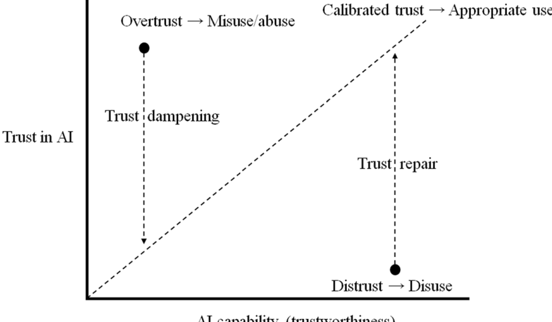
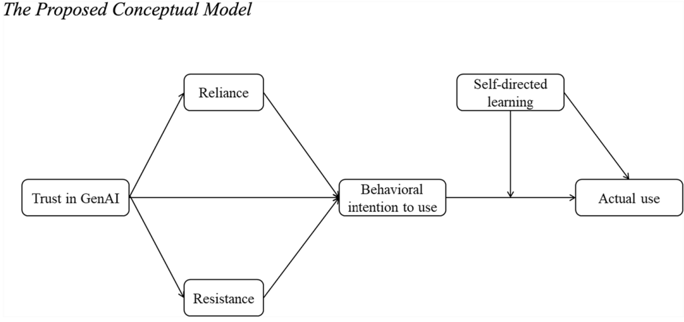
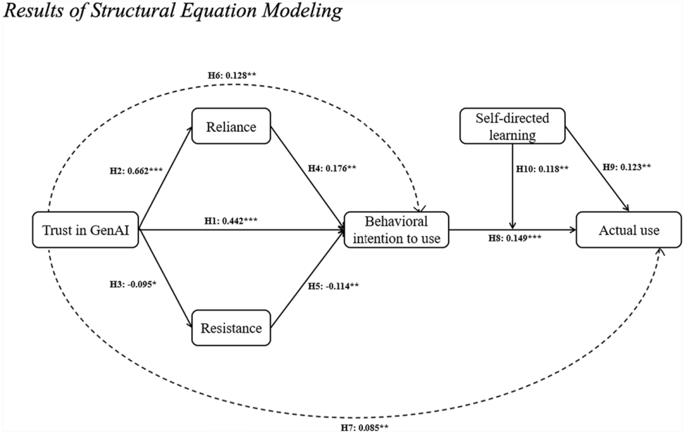
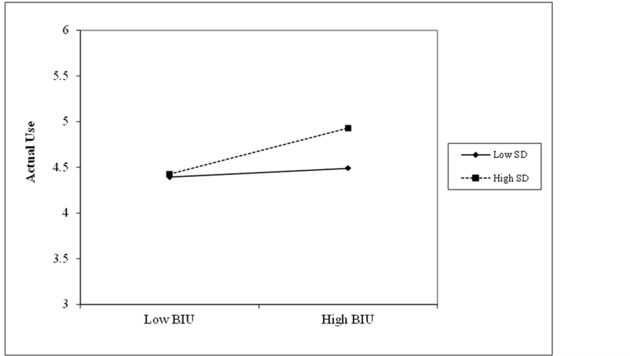
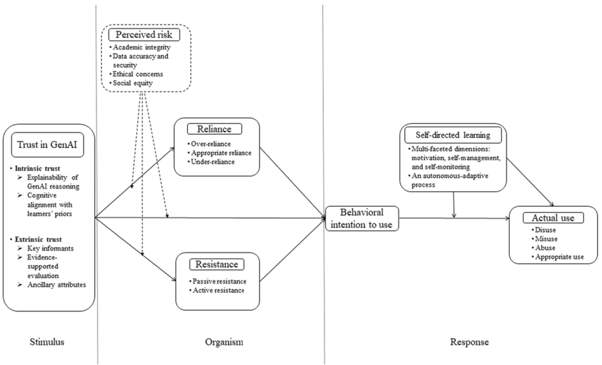
Advances in generative artificial intelligence (GenAI) have the potential to transform learning. As research increasingly calls for transforming the human-GenAI relationship from mere tool use to a collaborative partnership, there remains a notable gap in exploring an important factor influencing this relationship: trust in GenAI, being crucial amidst growing concerns about disuse, misuse, and abuse of GenAI in learner-GenAI interaction primarily via language. This study seeks to address the gap by investigating university students’ trust in GenAI, its related factors of reliance and resistance, and boundary conditions in using GenAI for language learning. The research utilized an explanatory sequential mixed-methods design. In Study 1, a proposed conceptual model within the stimulus-organism-response framework was quantitatively tested through structural equation modeling using a survey. Data were collected from 682 university students who used GenAI in language learning. Study 2 further confirmed the results through 40 qualitative interviews and refined the conceptual model by offering a deeper understanding of the relationships. The findings indicate that trust in GenAI is a significant factor in university students’ use of GenAI for language learning, with its influence on behavioral intention to use mediated through reliance and resistance. Moreover, forms of the five factors are identified: trust in GenAI, reliance, resistance, perceived risk, and actual use. Additionally, two boundary conditions are identified: perceived risk between trust in GenAI and reliance/resistance, and self-directed learning between behavioral intention to use and actual use. These findings provide theoretical, research, and practical implications regarding the appropriate use of GenAI in education.
Overview
The claims and statistics of this paper haven’t been checked yet.
Free: it reads the open-access text and checks the first 5 claims that cite a source we can check. Create a free account to check every claim.
Integrity signals
Registry
Cites
Statistics
Figures
Verification
Claims the paper makes
The claims and statistics of this paper haven’t been checked yet.
Free: it reads the open-access text and checks the first 5 claims that cite a source we can check. Create a free account to check every claim.
Claims other papers make about this one
Each is checked against this paper’s own text: does it say what the citing paper says it does?
The cited source says what the claim attributes to it.
In the citing paper
“Educational work likewise models trust, reliance, resistance, and actual use as distinct constructs (Wang et al., 2025), while HCI reviews note heterogeneous definitions of appropriate reliance (Raees et al., 2026).”
From Beyond checking: verification quality, reliance calibration, and learning in generative AI-assisted higher education (2026) · cites this paper as Wang et al., 2025
The check wasn’t confident either way, so it gives no verdict — never disputed.
In the citing paper
“These findings are consistent with those of Zhang and Wang (2025) and Wang et al. (2025).”
From A two-step structural equation modeling and explainable machine learning framework for understanding university students’ adoption of generative AI: balancing intrinsic motivations and perceived risks (2026) · cites this paper as Wang et al. (2025)
Experimental — accuracy not yet measured
Self-check
Percentages, sums and reported differences re-computed from the paper’s own numbers.
The self-check needs the paper’s full text.
Citations
Cites
Principles and Practice of Structural Equation Modeling
Tabri, N., & Elliott, C. M. (2012) · Canadian Graduate Journal of Sociology and Criminology · doi:10.15353/cgjsc-rcessc.v1i1.25 · Cited by 38,891
(1980) · Medical Entomology and Zoology · Cited by 25,810
(2001) · Cited by 25,534
Designing and Conducting Mixed Methods Research
Robinson, P. (2007) · Australian and New Zealand Journal of Public Health · doi:10.1111/j.1753-6405.2007.00096.x · Cited by 23,258
Venkatesh, V., Thong, J. Y. L., & Xu, X. (2012) · MIS Quarterly · doi:10.2307/41410412 · Cited by 15,756 · cited 2×
“Next, with the advent of the Internet, research on trust expanded from a focus on interpersonal trust to encompass trust in technology (e.g., Benbasat & Wang, 2005; Venkatesh et al., 2012).”
How to Design and Evaluate Research in Education
Fraenkel, J. R., & Wallen, N. E. (1990) · Cited by 15,027
Designing and Conducting Mixed Methods Research, 3rd ed.
Creswell, J. W. (2018) · Cited by 13,713
Mixed Methods Research: A Research Paradigm Whose Time Has Come
Johnson, R. B., & Onwuegbuzie, A. J. (2004) · Educational Researcher · doi:10.3102/0013189x033007014 · Cited by 11,170 · cited 1×
“…by combining deduction (i.e., testing theories and hypotheses), induction (i.e., discovering patterns and rich meanings), and abduction (i.e., uncovering the best set of explanations for understandings results) within a pragmatic rationale (Johnson & Onwuegbuzie, 2004; Venkatesh et al., 2016).”
An integrative model of organizational trust
Mayer, R. C., Davis, J. H., & Schoorman, F. D. (1995) · The Academy of Management Review · doi:10.2307/258792 · Cited by 10,736 · cited 4×
“The relationships have also been theoretically and empirically supported in other studies (e.g., Cheng et al., 2022; Klingbeil et al., 2024; Mayer et al., 1995; Solberg et al., 2022).”
Influential(1974) · Medical Entomology and Zoology · Cited by 7,295
Research works printed but not linked: 1
- 29. Fishbein, M., & Ajzen, I. (1975). Beliefs, attitude, intention, and behavior: An introduction to theory and research. Addison- Wesley Publishing.
Cited by
Alghamdi, A. A. (2025) · Innovations in Education and Teaching International · doi:10.1080/14703297.2025.2600476 · Cited by 67
Zhang, Y., Guo, J., Wang, Y., Li, S., Yang, Q., Zhang, J., & Lu, Z. (2025) · Systems · doi:10.3390/systems13100855 · Cited by 16
卢, 亚. (2026) · 教育发展论坛 · doi:10.65976/3080-0374.2026.08.046 · Cited by 13
Liu, Z., Yan, Z., Zuo, H., & Lu, Y. (2025) · Frontiers in Psychology · doi:10.3389/fpsyg.2025.1599478 · Cited by 13
“A possible explanation is that university students develop foundational computer and AI interaction skills during their studies, leading to an almost negligible level of computer illiteracy in this population (Zhang and Wang, 2025).”
Zeng, D., Xu, X., Zhu, T., Li, Y., & Li, Q. (2026) · Frontiers in Psychology · doi:10.3389/fpsyg.2026.1743722 · Cited by 7
“These findings are consistent with those of Zhang and Wang (2025) and Wang et al. (2025).”
Sahebi, S., Formosa, P., & Bankins, S. (2026) · Computers in Human Behavior Artificial Humans · doi:10.1016/j.chbah.2026.100304 · Cited by 26
Essel, H. B., Vlachopoulos, D., Johnson, E. E., & Quansah, E. K. (2026) · Discover Artificial Intelligence · doi:10.1007/s44163-025-00725-8 · Cited by 10
“Wang et al. [61] explored students’ trust and resistance toward GenAI in language learning, showing that balanced trust mediates responsible use and autonomy.”
Zhu, M., & Sari, A. R. (2026) · Learning and Individual Differences · doi:10.1016/j.lindif.2026.102917 · Cited by 10
A Multidimensional Psychometric Scale for Measuring AI Dependency in Academic Research
Sultana, A., Saleh, M. A. K., Sellami, A., & Ahmad, Z. (2026) · International Journal of Human-Computer Interaction · doi:10.1080/10447318.2026.2629522 · Cited by 7
“As trust deepens, researchers may shift from using AI as a supplementary aid to depending on it as a primary source of interpretation, problem-solving, and evaluative judgment (Wang et al., 2025).”
Nguyen, M., Tuân, N. P., Alghafes, R. A., Rahman, O., & Imre, G. (2026) · Acta Psychologica · doi:10.1016/j.actpsy.2026.106271 · Cited by 14
From credibility to reliance: Trust in generative AI as an academic information source.
Pudasaini, S. (2026) · Information Development · doi:10.1177/02666669261468286 · Cited by 3
Guo, H., & Zheng, M. (2026) · Frontiers in Psychology · doi:10.3389/fpsyg.2026.1807643 · Cited by 7
“Emerging empirical studies suggest that AI-related beliefs, such as AI trust and AI self-efficacy, are associated with learners’ willingness to persist, invest effort, and engage more actively in AI-supported language learning tasks (Tram et al., 2024; Wang and Wang, 2025; Yu et al., 2026).”
InfluentialDevelopment and Validation of the Academic AI Usage Scale (AAIUS)Preprint
Chakraborty, D., & Subramani, D. (2025) · Research Square · doi:10.21203/rs.3.rs-7605472/v1 · Cited by 4
Designing Generative AI-Based Agents to Empower Collaborative Self-Learning in Higher Education
Banh, L., Holldack, F., & Strobel, G. (2026) · Business & Information Systems Engineering · doi:10.1007/s12599-026-01012-1 · Cited by 3
“Moreover, persistent model limitations (e.g., hallucinations, bias, and limited transparency) can foster mis-placed trust and weaken source-critical judgment even when explanatory and sourcing features are provided (Klingbeil et al. 2024; Wang et al. 2025).”
Hu, W. W. (2026) · Studies in Higher Education · doi:10.1080/03075079.2026.2658738 · Cited by 2
“…of GenAI uptake – including academic self-efficacy, trust, motivation, and anxiety (Chai et al. 2024; Choung, David, and Ross 2023; Ma 2025; Shahzad, Xu, and Zahid 2025; Wang et al. 2025; Wang, Sun, and Chen 2023) – providing useful baseline insights into user acceptance and system design.”
Ma, R., & Guo, M. (2026) · Behavioral Sciences · doi:10.3390/bs16040577 · Cited by 2
“Their work also highlights that students’ use of GenAI depends on multiple factors, with no single factor being decisive (Wang et al., 2025).”
Nguyen, T. H., Truong, L. T., & Nguyen, N. H. T. (2026) · Computers and Education Artificial Intelligence · doi:10.1016/j.caeai.2026.100618 · Cited by 4
A study on the application of ChatGPT in teaching Mandarin near-synonyms
Yu, A., & Hsiao, H. S. (2026) · Asian-Pacific Journal of Second and Foreign Language Education · doi:10.1186/s40862-026-00437-1 · Cited by 1
Kim, J., Lee, C., & Lim, J. S. (2026) · Telematics and Informatics · doi:10.1016/j.tele.2026.102436 · Cited by 4
Uden, L., & Hsia, L. (2026) · Journal of Computers in Education · doi:10.1007/s40692-026-00398-x · Cited by 4
Shi, W., Ramzy, M. I., & Ali, S. K. S. (2026) · African Journal of Science Technology Innovation and Development · doi:10.1080/20421338.2026.2692491 · Cited by 2
“This finding aligns with what DIT posits about ‘the experience of decision participation influencing the degree of trust and reliance in decision-making’ (F. Wang et al. 2025a; Xu, Murthy, and Jia 2025).”
AI Usage as a Mediator Between Study Habits, Academic Procrastination, and Academic Self-EsteemPreprint
Chakraborty, D., & Subramani, D. (2026) · Research Square · doi:10.21203/rs.3.rs-9043305/v1 · Cited by 1
Wei, J., & Shang, Y. (2026) · Frontiers in Psychology · doi:10.3389/fpsyg.2026.1965371 · Cited by 1
“Educational work likewise models trust, reliance, resistance, and actual use as distinct constructs (Wang et al., 2025), while HCI reviews note heterogeneous definitions of appropriate reliance (Raees et al., 2026).”
How Chatbot Support and Anthropomorphism Shape Loneliness in Young AdultsPreprint
Chiu, C., Cheng, H., Hsu, J. S., Hu, P. J., & Wang, Y.-S. (2026) · SSRN Electronic Journal · doi:10.2139/ssrn.6052260
Model of Acceptance of Artificial Intelligence Devices in Higher Education
Salazar, L., & Rivera, L. (2026) · Computers · doi:10.3390/computers15010046 · Cited by 1
“For their part, Wang et al. [100] found that trust is vital for Chinese university students to adopt or reject AI.”
Dynamic Monitoring Model of English Classroom Attention Driven by Generative Artificial Intelligence
Chen, P., & Wang, T. (2026) · International Journal of Information Technologies and Systems Approach · doi:10.4018/ijitsa.400907
Nguyen, T. M. C., & Lee, C. S. (2026) · SSRN Electronic Journal · doi:10.2139/ssrn.6427311
CaseMaster: Designing and Evaluating a Probe for Oral Case Presentation Training with LLM Assistance
Ouyang, Y., Xu, Y., Jiang, C., Jin, Y., Jiang, H., & Li, Q. (2026) · CHI Conference on Human Factors in Computing Systems · doi:10.1145/3772318.3790304 · Cited by 3
Academic Integrity in the Age of Artificial Intelligence
Salendab, F. A., Baraguir, R. S., Cabato, C. J., & Lumogdang, J. C. (2026) · Advances in computational intelligence and robotics book series · doi:10.4018/979-8-3373-7097-2.ch012
Du, X., Ling, C., Yang, L., & Liusi, W. (2026) · Digital Health · doi:10.1177/20552076261450815 · Cited by 1
“47,48,52 In hospital administration, staff handle formal documentation, internal reporting, and sensitive information under stringent accuracy and confidentiality requirements.”
Gonçalves, A. D. S., Pereira, S., Junior, J. D. O., & Ulfa, S. U. (2026) · International Conference on Educational and Information Technology · doi:10.1109/iceit68991.2026.11521406
“Transparency & Explainability [23] AIT2 I rely on recommendations from Generative AI tools Reliance on Generative AI Advice [24] AIT3 I believe that Generative AI will act in accordance with applicable professional values and ethics.”
Lay, S. E., Sophat, P., Lang, S., Chin, D., Ngin, P., Khen, S., Serey, M., & Em, S. (2026) · Advances in computational intelligence and robotics book series · doi:10.4018/979-8-3373-6571-8.ch009
Yıldız, M., & MERZİFONLUOĞLU, A. (2026) · International Journal of Human-Computer Interaction · doi:10.1080/10447318.2026.2682912 · Cited by 1
Chaaban, Y., Jung, S., & Jansen, B. J. J. (2026) · European Journal of Teacher Education · doi:10.1080/02619768.2026.2692989
Vertrauen ist kein Feature: Fünf Gestaltungsempfehlungen für autonome KI-Agenten
Hiske, P., Wittholz, V., & Robra-Bissantz, S. (2026) · HMD Praxis der Wirtschaftsinformatik · doi:10.1365/s40702-026-01298-5
“Empirisch prägt Vertrauen die Nutzungsabsicht maßgeblich (Wang et al. 2025).”
Zhang, Q., Chen, G., Wu, X., Niu, X., & Chiang, F. (2026) · Interactive Learning Environments · doi:10.1080/10494820.2026.2680593
Zubtsova, Y. Y., Sushchenko, L., Шульга, Л., Andryushchenko, O., & Шульга, О. (2026) · Journal of Interdisciplinary Studies in Education · doi:10.32674/n7pdhe28
Fang, F., Meng, Y., Tang, L., & Cui, Y. H. (2026) · BMC Psychology · doi:10.1186/s40359-026-05198-7
“Grit may bridge this gap by enabling learners to continue, revise strategies, and derive value across repeated learning episodes [55–57].”
InfluentialJiang, L., & Yan, S. (2026) · Sustainability · doi:10.3390/su18157770
Košuta, N., & Patekar, J. (2026) · 2018 International Conference on Multidisciplinary Research · doi:10.26803/myres.2026.08
Luo, Y., Fan, Y., Wang, T., Xu, Q., & Zhao, W. (2026) · Behavioral Sciences · doi:10.3390/bs16081313 · Cited by 1
“In educational contexts, insufficient trust in AI tools may substantially attenuate the anticipated benefits of AI adoption in higher education (F. Wang et al., 2025).”
Trust, transparency, and learning outcomes in AI-mediated language education platforms
Liu, N., & Ingram, C. (2026) · Interactive Learning Environments · doi:10.1080/10494820.2026.2690105
Chu, X., & Dai, H. (2026) · Educational Psychology · doi:10.1080/01443410.2026.2717335
Alamri, H. (2026) · Cognitive Processing · doi:10.1007/s10339-026-01389-7
“Studies on GenAI adoption suggest that appropriate levels of trust facilitate effective use, whereas both overtrust and distrust can hinder optimal outcomes (Glikson and Woolley 2020; Wang et al. 2025).”
Imperial, R. M. A., & Artiola, A. S. (2026) · Psychology and Education A Multidisciplinary Journal · doi:10.70838/pemj.610409
Banga, C., Kincar, A., & Mustafa, H. (2026) · Research Square · doi:10.21203/rs.3.rs-9993353/v1
Generative AI in Education: Practical and Ethical Teaching Approaches
Barreto, D., & Colon, A. (2026) · Advances in computational intelligence and robotics book series · doi:10.4018/979-8-3373-7902-9.ch006
Explainable AI, Academic Confidence, and Decision-Making Quality in Physics Learning
Hidayah, N., & Sodikin, S. (2026) · Digital Learning Social Science and Life-course Studies · doi:10.70211/disolife.v2i1.777 · Cited by 4
“Students can develop both productive reliance and problematic over-reliance on generative AI [12], and intensive use can co-occur with procrastination or weaker academic patterns in some contexts [11].”
Nguyễn, C. T. N., & Hà, T. A. (2026) · SAGE Open · doi:10.1177/21582440261486175
Ibrahim, F. M., Shahrour, G., Dabou, E. A. R., Toubeh, L., Jamal, H., & Said, K. (2026) · doi:10.2196/preprints.111365
The importance of creativity in higher education for the development of modern business
Kovač, D., Terek, E., Ugrinov, S., Ćoćkalo-Hronjec, M., & Cvjetković, M. (2026) · International Symposium Engineering Management and Competitiveness (EMC) · doi:10.5937/emc26138k
Huo, H., & Zhang, L. J. (2026) · Innovation in Language Learning and Teaching · doi:10.1080/17501229.2026.2729888 · Cited by 1
Negricea, D. (2026) · Religions · doi:10.3390/rel17091090
Trusting AI feedback in EFL writing: Anxiety, feedback literacy, and writing self-efficacy
Hou, J., & Wang, X. (2026) · Acta Psychologica · doi:10.1016/j.actpsy.2026.107862 · Cited by 1
Mensah, F. S., Acheampong, P. A., Amewonye, V. K. A., Sam, T., Emilio, D. K., Baidoo, S., Oppong, K., & Baidoo, P. K. (2026) · Frontiers in Education · doi:10.3389/feduc.2026.1941201
Zou, M., Reinders, H., & Wang, W. (2026) · Computer Assisted Language Learning · doi:10.1080/09588221.2026.2733006 · Cited by 2
Yin, C., Chen, G., & Sheng, C. (2026) · Education and Information Technologies · doi:10.1007/s10639-026-14158-y
“…2025 ), social factors like anxiety (Hu, Mao et al., 2023b ) or loneliness (Liao et al., 2025 ), fear of failure (Kayar et al., 2025 ), trust in AI (Wang et al., 2025 ), negative academic emotions (Zhang et al. 2024a, b; Zhong et al. 2024 ), and personality traits (Athar, 2025; Zhong et al., 2024…”
Fišer, Z. (2026) · Education Sciences · doi:10.3390/educsci16101613
Tien, H. N., Nguyen, K. A., & Nguyen, L. T. (2025) · International Conference on Digital Technology in Education (ICDTE) · doi:10.1145/3796159.3796167
Vinh, L. Q., & Lan, N. N. C. (2026) · International Journal of Learning Teaching and Educational Research · doi:10.26803/ijlter.25.9.21
Liu, W., & Blin, F. (2026) · Journal of China Computer-Assisted Language Learning · doi:10.1515/jccall-2026-0001
“However, the e ff ectiveness of this adoption largely depends on learners ’ trust in GenAI, which has been identi fi ed as a key factor shaping students ’ engagement with the technology and in fl uencing their behavioural intentions through both reliance and resistance (Wang et al. 2025).”
Galindo‐Domínguez, H., Campo, L., Delgado, N., & Urruzola, M. V. (2026) · Thinking Skills and Creativity · doi:10.1016/j.tsc.2026.102385
Yang, S., Vishnoi, S. K., Mehrotra, A., Albishri, N. A., & Rácz, I. P. (2026) · Journal of Enterprise Information Management · doi:10.1108/jeim-11-2025-1129
Generative AI, Friend or Foe: Exploring GenAI Use for Supporting Diverse Student Needs
Wang, Y., Bown, A., Albinson, P., Fan, S., & Khara, A. (2026) · Young people and learning processes in school and everyday life · doi:10.1007/978-3-032-32479-5_13
Qi, Y., Mohamad, E. M. W., Azlan, A. A., Zhang, C., Zhao, X., Wu, A., & Ma, Y. (2026) · Digital Health · doi:10.1177/20552076261490720
Supporting creative agency: metacognitive control and trust in generative AI art education
Zhu, R. (2026) · Frontiers in Psychology · doi:10.3389/fpsyg.2026.1997631
Kenneth, C. S. M. (2026) · International Journal of Learning Teaching and Educational Research · doi:10.26803/ijlter.25.10.26
Metadata
- Authors
- Wang, F., Li, N., Cheung, A. C. K., & Wong, G. K. W.
- Affiliations
- University of Hong Kong (HK)
- Chinese University of Hong Kong (HK)
- Venue
- International Journal of Educational Technology in Higher Education
- Published
- 2025-08-20
- Volume
- 22
- Issue
- 1
- ISSN
- 2365-9440 (ISSN-L)
- OpenAlex
- W4413317945
- Cited by
- 69
- References
- 114
- Citations by year
- 2026: 64 · 2025: 5
- FWCI
- 71.43
- Type
- journal article
- Language
- en
- Open access
- diamond
- doi.org
- Licence
- cc-by
- creativecommons.org/licenses/by/4.0 (tdm)
- creativecommons.org/licenses/by/4.0 (vor)
- Locations
- International Journal of Educational Technology in Higher Education (publishedVersion, cc-by)
- DOAJ (DOAJ: Directory of Open Access Journals) (submittedVersion, cc-by-sa)
- The HKU Scholars Hub (University of Hong Kong) (submittedVersion)
- Topics
- Social Sciences › Education › Artificial Intelligence in Education
- Social Sciences › Decision Sciences › Information Systems and Management › Technology Adoption and User Behaviour
- Social Sciences › Arts and Humanities › Language and Linguistics › EFL/ESL Teaching and Learning
- Keywords
- generative AI, trust in AI, AI reliance, resistance to AI, language learning, university students, behavioral intention, risk perception, self-directed learning, stimulus-organism-response model, human-AI collaboration, boundary conditions
About these checks
Registry, retraction, Cites and statistics results are computed, not judged, with one exception: a printed reference that no index lists is read once by a model before it counts as a citation error. Claims are extracted by a model and kept only when their quote appears verbatim in the text; each cited source is then checked, with a model’s help, for whether it says what the claim relies on. Those verdicts can be wrong — read the claim’s quote and the cited source before relying on one.
Statistics and arithmetic are recomputed, not judged.
Confidence bands are shown only for fields calibrated on our annotated test set. None is calibrated yet, so no band is shown.
What counts as a claim ›How we measure confidence ›How we check this ›
Are you an author, or do you see a problem with this page? Request a review
Data sources
Bibliographic data: Semantic Scholar, OpenAlex, Crossref.
Contains information from the Semantic Scholar Academic Graph Datasets, made available under the ODC Attribution License (ODC-BY 1.0).
Semantic Scholar’s data is described in: Kinney, R., et al. (2023). The Semantic Scholar Open Data Platform. arXiv:2301.10140.
