

The green soul of the concrete jungle: the urban century, the urban psychological penalty, and the role of nature
Open accessThe DOI matches its Crossref record; 110 of the 112 references it cites were found in a registry or an index.
Abstract
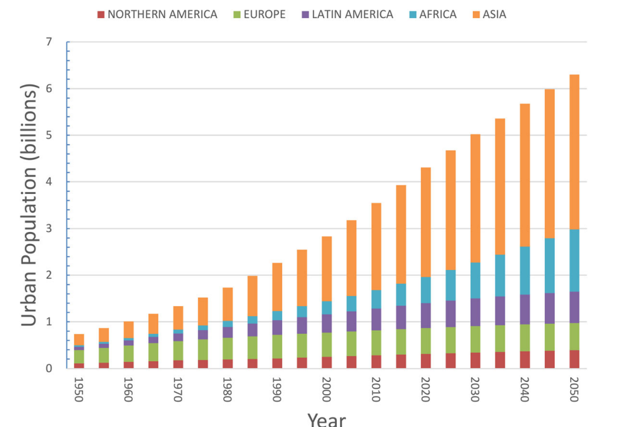
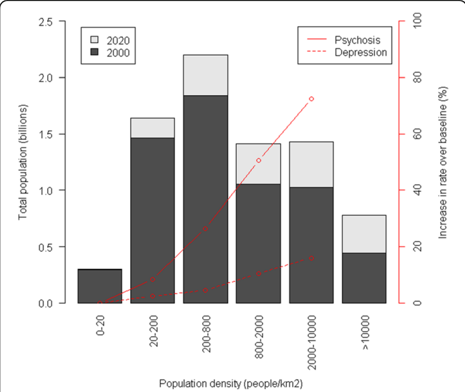
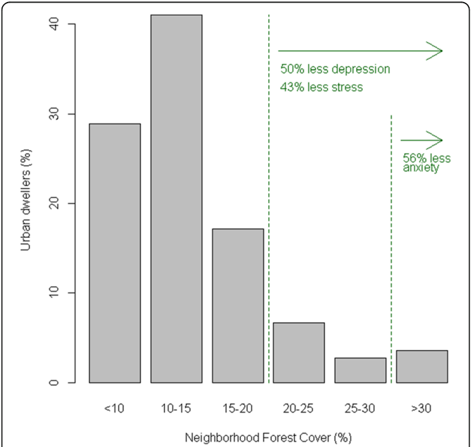
By 2050, there are forecast to be 2.4 billion more people in cities, and this century could rightly be called the urban century. This paper argues that, paradoxically, without the use of nature the urban century will fail. We review three literatures to assess the scientific support for this proposition. First, studies from economics show that it is the extreme potential for interaction that makes cities centers of productivity, innovation, and creativity. Second, many health studies document the increase in stress and greater prevalence of some mental disorders in cities, and we argue that it is the constant interaction of urban life that leads to this urban psychological penalty. Here we show that 46% of humans are living at population densities where global datasets suggest that this psychological penalty may be an issue, a fraction that will only grow as urbanization continues. Third, ecosystem service research shows that even a brief interaction with nature has mental health benefits, alleviating symptoms of this psychological penalty. Global datasets suggest that currently, only 13% of urban dwellers may be living in close enough proximity to nature to experience its mental health benefits. We argue that natural features in cities will be an essential part of the urban century, a way to have all the benefits of our urban, connected world yet also have that urban home be a place where we can psychologically flourish. We discuss two specific ways governments are trying to integrate nature into citizens’ lives, through Green Prescriptions and the Biophilic Cities Network.
Overview
The claims and statistics of this paper haven’t been checked yet.
Free: it reads the open-access text and checks the first 5 claims that cite a source we can check. Create a free account to check every claim.
Integrity signals
Registry
Cites
Statistics
Figures
Verification
Claims the paper makes
The claims and statistics of this paper haven’t been checked yet.
Free: it reads the open-access text and checks the first 5 claims that cite a source we can check. Create a free account to check every claim.
Self-check
Percentages, sums and reported differences re-computed from the paper’s own numbers.
The self-check needs the paper’s full text.
Citations
Cites
Lim, S. S., Vos, T., Flaxman, A. D., Danaei, G., Shibuya, K., Adair-Rohani, H., AlMazroa, M. A., Amann, M., Anderson, H. R., Andrews, K. G., et al. (2012) · The Lancet · doi:10.1016/s0140-6736(12)61766-8 · Cited by 11,805
Stress recovery during exposure to natural and urban environments
Ulrich, R. S., Simons, R. F., Losito, B. D., Fiorito, E., Miles, M. A., & Zelson, M. (1991) · Journal of Environmental Psychology · doi:10.1016/s0272-4944(05)80184-7 · Cited by 5,990 · cited 1×
“Stress Reduction Theory [95] argues that time in natural areas is correlated with reduced exposure to environmental stresses like noise and light pollution.”
BackgroundWorld Urbanization Prospects: The 1996 Revision
Brockerhoff, M., & Nations, U. (1998) · Population and Development Review · doi:10.2307/2808041 · Cited by 5,881
Global forecasts of urban expansion to 2030 and direct impacts on biodiversity and carbon pools
Seto, K. C., Güneralp, B., & Hutyra, L. R. (2012) · Proceedings of the National Academy of Sciences · doi:10.1073/pnas.1211658109 · Cited by 5,086 · cited 1×
“2 million km(2) by 2030, the size of the country of South Africa, will be developed for urban use [2].”
BackgroundThe global obesity pandemic: shaped by global drivers and local environments
Swinburn, B. A., Sacks, G., Hall, K. D., McPherson, K., Finegood, D. T., Moodie, M. L., & Gortmaker, S. L. (2011) · The Lancet · doi:10.1016/s0140-6736(11)60813-1 · Cited by 4,888 · cited 1×
“calorie-rich foods and less physical activity [49].”
“Sticky Information” and the Locus of Problem Solving: Implications for Innovation
von Hippel, E. (1994) · Management Science · doi:10.1287/mnsc.40.4.429 · Cited by 3,718
Hartig, T., Mitchell, R., de Vries, S., & Frumkin, H. (2014) · Annual Review of Public Health · doi:10.1146/annurev-publhealth-032013-182443 · Cited by 3,638
Korcelli-Olejniczak, E. (2017) · RCIN (Digital Repository of the Scientifics Institutes) (Institute of Archaeology and Ethnology of the Polish Academy of Sciences) · Cited by 3,244
Wirth, L. (1938) · American Journal of Sociology · doi:10.1086/217913 · Cited by 2,995
Ecosystems and human well-being: a framework for assessment
(2004) · Choice Reviews Online · doi:10.5860/choice.41-4645 · Cited by 2,846
Research works printed but not linked: 4
- 16. Aristotle, Politics. "trans. Ernest Barker." New York: Oxford University Press 3, no. 16 (1958): 296.
- 39. WHO UNICEF. Progress on drinking water, sanitation, and hygiene. Geneva: World Health Organization; 2017.
- 78. NRDC. Financing stormwater retrofits in Philadelphia and beyond. New York: National Resources Defense Council; 2012.
- 95. Kaplan R, Kaplan S. The experience of nature: a psychological perspective. New York: Cambridge University Press; 1989.
Cited by
Nature inequity and higher COVID-19 case rates in less-green neighbourhoods in the United States
Spotswood, E. N., Benjamin, M., Stoneburner, L., Wheeler, M. M., Beller, E. E., Balk, D., McPhearson, T., Kuo, M., & McDonald, R. I. (2021) · Nature Sustainability · doi:10.1038/s41893-021-00781-9 · Cited by 212
Self-citationDenser and greener cities: Green interventions to achieve both urban density and nature
McDonald, R. I., Aronson, M. F. J., Beatley, T., Beller, E. E., Bazo, M., Grossinger, R. M., Jessup, K., Mansur, A. V., de Oliveira, J. A. P., Panlasigui, S., et al. (2023) · People and Nature · doi:10.1002/pan3.10423 · Cited by 187
Self-citationMcDonald, R. I., Biswas, T., Sachar, C., Housman, I., Boucher, T. M., Balk, D., Nowak, D., Spotswood, E., Stanley, C. K., & Leyk, S. (2021) · PLOS ONE · doi:10.1371/journal.pone.0249715 · Cited by 159
“Tree cover provides a variety of ecosystem service benefits in cities [6, 7], including reducing air pollutant concentrations [8], mitigating stormwater runoff [7], maintaining water quality [9], encouraging physical recreation [10], and improving mental health [11].”
BackgroundSelf-citationVisitors to urban greenspace have higher sentiment and lower negativity on Twitter
Schwartz, A. J., Dodds, P. S., O'Neil‐Dunne, J. P. M., Danforth, C. M., & Ricketts, T. H. (2019) · People and Nature · doi:10.1002/pan3.10045 · Cited by 92
Walking Green: Developing an Evidence Base for Nature Prescriptions
Koselka, E. P. D., Weidner, L. C., Minasov, A., Berman, M. G., Leonard, W. R., Santoso, M. V., de Brito, J. N., Pope, Z. C., Pereira, M. A., & Horton, T. H. (2019) · International Journal of Environmental Research and Public Health · doi:10.3390/ijerph16224338 · Cited by 89
Cities, planetary boundaries, and degrowth
Kronenberg, J., Andersson, E., Elmqvist, T., Łaszkiewicz, E., Xue, J., & Khmara, Y. (2024) · The Lancet Planetary Health · doi:10.1016/s2542-5196(24)00025-1 · Cited by 81
Self-citationThomson, G., & Newman, P. W. G. (2021) · Urban Planning · doi:10.17645/up.v6i1.3633 · Cited by 66
Felappi, J. F., Sommer, J. H., Falkenberg, T., Terlau, W., & Kötter, T. (2024) · Scientific Reports · doi:10.1038/s41598-024-55357-2 · Cited by 59
The Potential of Green Schoolyards for Healthy Child Development: A Conceptual Framework
van den Bogerd, N., Hovinga, D., Hiemstra, J. A., & Maas, J. (2023) · Forests · doi:10.3390/f14040660 · Cited by 49
A Scoping Review of the Health Benefits of Nature-Based Physical Activity
Christiana, R. W., Besenyi, G. M., Gustat, J., Horton, T. H., Penbrooke, T. L., & Schultz, C. L. (2021) · Journal of Healthy Eating and Active Living · doi:10.51250/jheal.v1i3.25 · Cited by 50
Asim, F., Chani, P. S., & Shree, V. (2021) · Building and Environment · doi:10.1016/j.buildenv.2021.108107 · Cited by 49
Biophilia Upscaling: A Systematic Literature Review Based on a Three-Metric Approach
Lefosse, D. C., van Timmeren, A., & Ratti, C. (2023) · Sustainability · doi:10.3390/su152215702 · Cited by 47
de Carvalho, C. M., Giatti, L. L., Fagerholm, N., Bedran-Martins, A. M., & Kyttä, M. (2021) · International Journal of Urban Sustainable Development · doi:10.1080/19463138.2021.2019041 · Cited by 34
Enabling urban systems transformations: co-developing national and local strategies
Webb, R. J., O’Donnell, T., Auty, K., Bai, X., Barnett, G., Costanza, R., Dodson, J., Newman, P. W. G., Newton, P., Robson, E., et al. (2023) · Urban Transformations · doi:10.1186/s42854-023-00049-9 · Cited by 34
Gauging the happiness benefit of US urban parks through Twitter
Schwartz, A. J., Dodds, P. S., O’Neil-Dunne, J. P. M., Ricketts, T. H., & Danforth, C. M. (2022) · PLoS ONE · doi:10.1371/journal.pone.0261056 · Cited by 31
Boyd, F. (2022) · Frontiers in Psychology · doi:10.3389/fpsyg.2022.865422 · Cited by 32
Unveiling the duality of cement and concrete addressing microplastic pollution: a review
Prasittisopin, L. (2025) · Environmental Science and Pollution Research · doi:10.1007/s11356-025-36267-w · Cited by 27
Fishing in the city for food—a paradigmatic case of sustainability in urban blue space
Joosse, S., Hensle, L., Boonstra, W. J., Ponzelar, C., & Olsson, J. (2021) · npj Urban Sustainability · doi:10.1038/s42949-021-00043-9 · Cited by 27
Urgent Biophilia: Green Space Visits in Wellington, New Zealand, during the COVID-19 Lockdowns
MacKinnon, M., MacKinnon, R. B., Zari, M. P., Glensor, K., & Park, T. (2022) · Land · doi:10.3390/land11060793 · Cited by 26
Russo, A., & Cirella, G. T. (2024) · Land · doi:10.3390/land13060786 · Cited by 24
What are green prescriptions? A scoping review
Stanhope, J., & Weinstein, P. (2023) · Journal of Primary Health Care · doi:10.1071/hc23007 · Cited by 23
Saint‐Onge, K., Coulombe, S., Philibert, M. D., Wiesztort, L., & Houle, J. (2022) · Wellbeing Space and Society · doi:10.1016/j.wss.2022.100095 · Cited by 21
Nature-based solutions for changing urban landscapes: Lessons from Australia
Frantzeskaki, N., Ossola, A., & Bush, J. (2022) · Urban forestry & urban greening · doi:10.1016/j.ufug.2022.127611 · Cited by 18
Kim, Y. H., Hwang, I. H., Hong, J. Y., & Lee, S. C. (2019) · Building and Environment · doi:10.1016/j.buildenv.2019.03.046 · Cited by 17
Constructing a virtual destination: Li Ziqi’s Chinese rural idyll on YouTube
Yang, J., Meng, Z., & Zhang, Y. (2022) · Journal of Teaching in Travel & Tourism · doi:10.1080/15313220.2022.2096178 · Cited by 15
Geomorphodiversity and anthropization indices for Italian urban areas
Burnelli, M., Melelli, L., & Alvioli, M. (2024) · Geomorphology · doi:10.1016/j.geomorph.2024.109532 · Cited by 13
Biophilic architecture and designs for mental well-being
Alam, M. (2023) · IOP Conference Series Earth and Environmental Science · doi:10.1088/1755-1315/1218/1/012020 · Cited by 12
A Framework to Evaluate Land Take Control Policy Efficiency in Friuli Venezia Giulia, Italy
Salata, S., Peccol, E., & Borsato, O. (2019) · Sustainability · doi:10.3390/su11226406 · Cited by 12
Guo, Y., & Chen, W. Y. (2024) · Journal of Environmental Management · doi:10.1016/j.jenvman.2024.120542 · Cited by 10
URBAN LOW-COST HOUSING EFFECT MENTAL HEALTH
Ghazali, N. M., Marzukhi, M. A., & Ling, O. H. L. (2021) · PLANNING MALAYSIA · doi:10.21837/pm.v19i18.1049 · Cited by 10
Indigenous landscaping and biophilic urbanism: case studies in Noongar Six Seasons
Cabanek, A., Newman, P. W. G., & Nannup, N. (2023) · Sustainable Earth Reviews · doi:10.1186/s42055-023-00054-7 · Cited by 9
Роговський, С. В., Іщук, Л. П., Strutynska, Y. V., Yarmola, M., & Krutsilov, A. (2023) · Agrobìologìâ · doi:10.33245/2310-9270-2023-179-1-215-229 · Cited by 9
Connecting land. A transdisciplinary workshop to envision a nature-connecting human habitat
Giusti, M., Wang, W., & Marriott, T. (2020) · Cities & Health · doi:10.1080/23748834.2020.1742491 · Cited by 9
Verheyen, L., van Engelen, B., Winkens, B., Vanbrabant, K., Hannes, E., Nawrot, T. S., Malina, R. M., van Schayck, O. C. P., & Plusquin, M. (2025) · Frontiers in Public Health · doi:10.3389/fpubh.2025.1620199 · Cited by 8
Microbiological aspects of sewage odor problems in the urban environment - a review
Felföldi, T. (2024) · Biologia Futura · doi:10.1007/s42977-024-00242-2 · Cited by 8
An Introduction to Nature Prescribing: Health Benefits of Nature
Rariden, C. A., & Kuhn, A. (2024) · The Journal for Nurse Practitioners · doi:10.1016/j.nurpra.2024.105161 · Cited by 8
Than, K. T., Yu, L. J., Chen, S., Tarawneh, M. A., & Lai, N. Y. G. (2022) · Journal of Applied Polymer Science · doi:10.1002/app.52879 · Cited by 8
Urban Habitats: Cities and Their Potential for Nature Protection
Jansen, J., & Hobohm, C. (2021) · Environmental challenges and solutions · doi:10.1007/978-3-030-57710-0_18 · Cited by 7
Green Pause in a City: Design elements of a pocket park in Kuala Lumpur
Hussein, H., Jhung, L. K., & Zhang, H. (2022) · Environment-Behaviour Proceedings Journal · doi:10.21834/ebpj.v7i19.3206 · Cited by 6
Cristaldi, M. A., Sarquis, J. A., Leveau, L. M., & Giraudo, A. R. (2022) · El Hornero · doi:10.56178/eh.v37i2.399 · Cited by 6
Дендрофлора сучасного парку та її роль у формуванні сакрально-меморіального ландшафту
Роговський, С. В., & Масальський, В. П. (2023) · Науковий вісник НЛТУ України · doi:10.36930/40330202 · Cited by 5
The Ideal City: A Planning Approach to Sustainable Urban Place Making
Zumaya, J. Q., Alrobaee, T. R., Abuali, A. M., Al-Khafaji, A. S., & Althabhawi, G. J. (2025) · Journal of Human Earth and Future · doi:10.28991/hef-2025-06-04-011 · Cited by 3
Dario, Y. D., & Attaianese, E. (2024) · E3S Web of Conferences · doi:10.1051/e3sconf/202458501019 · Cited by 3
Cities as Inhumane: The Urban Health Penalty
McDonald, R. I., & Beatley, T. (2020) · Springer eBooks · doi:10.1007/978-3-030-51665-9_3 · Cited by 3
Self-citationSustainable Earth begins its journey
Newman, P. W. G. (2018) · Sustainable Earth Reviews · doi:10.1186/s42055-018-0005-2 · Cited by 3
ROGOVSKYI, S., Іщук, Л. П., & Ishchuk, H. (2023) · Trakya University Journal of Natural Sciences · doi:10.23902/trkjnat.1246847 · Cited by 2
Lu, Y.-C., & Tu, H. (2025) · HortScience · doi:10.21273/hortsci18587-25 · Cited by 2
Tailoring Engagement with Urban Nature for University of Sheffield Students’ Wellbeing
Boyd, F. (2020) · White Rose eTheses Online (University of Leeds, The University of Sheffield, University of York) · Cited by 3
Castrillo-Sarralde, J., & Rodríguez‐Negro, J. (2025) · Ágora/Ágora para la educación física y el deporte · doi:10.24197/pwc7q039 · Cited by 1
The Landscape Strategies and Usage of Laman Tun Perak as a Pocket Park in Kuala Lumpur
Hussein, H., Jhung, L. K., & Zhang, H. (2021) · Asian Journal of Environment-Behaviour Studies · doi:10.21834/ajebs.v6i20.398 · Cited by 1
Brownfield Regeneration: A possible Panacea to Zambia’s Housing Deficit and Urban Decay?
Makashini, L., Munshifwa, E. K., & Adewunmi, Y. A. (2021) · African Real Estate Society Conference (AfRES) · doi:10.15396/afres2021_012 · Cited by 1
Buddhadhamma to the Path to Low-Carbon Urban Development: A Case Study of Bangkok
Phookhokwai, P. T., Thitasubo, P. I., & Kaewwilai, M. K. (2024) · The Journal of International Buddhist Studies College · Cited by 1
MacKinnon, M. (2024) · Open Access Victoria University of Wellington | Te Herenga Waka (Figshare) · doi:10.26686/wgtn.26156785 · Cited by 1
Träd som verktyg för att anpassa staden till dess framtida klimat
Perander, S. (2019) · Epsilon Archive for Student Projects (Swedish University of Agricultural Sciences)
Quantifying the health benefits of nature contact in cities across the US
Schwartz, A. J. (2020) · ScholarWorks -A service of University of Vermont Libraries (University of Vermont)
McDonald, R. I., & Beatley, T. (2020) · Springer eBooks · doi:10.1007/978-3-030-51665-9_4
Self-citationLord, E. (2021) · Cronfa (Swansea University) · doi:10.23889/suthesis.057768
McDonald, R. I., & Beatley, T. (2020) · Springer eBooks · doi:10.1007/978-3-030-51665-9_7
Self-citationMa, Y., & Chen, X. (2021) · ISOCARP World Planning Congress · doi:10.47472/i86ecuiw
Greenprinting: Urban Planning for Ecosystem Services
McDonald, R. I., & Edgecomb, M. (2023) · Springer eBooks · doi:10.1007/978-3-031-35692-6_14
Self-citationPetherick, L.-M. (2024) · The Plymouth Student Scientist · doi:10.70156/1754-2383.1485
Conflating “green prescriptions” and “nature prescriptions”
Stanhope, J., & Weinstein, P. (2025) · Environmental Research · doi:10.1016/j.envres.2025.120873
Effects of investments in GI on buyers' Interest in a Swedish residential apartment development
Zalejska‐Jonsson, A., Wahlund, R., Wilkinson, S. J., & Cunningham, R. (2025) · Cities · doi:10.1016/j.cities.2025.106419
(2025) · Scientific Access · doi:10.26855/sa
Corpuz, Z. F. (2025) · Urbani izziv · doi:10.5379/urbani-izziv-2025-36-02-05
Corpuz, Z. F. (2025) · Urbani izziv · doi:10.5379/urbani-izziv-en-2025-36-02-05
Brown, T. (. (2025) · cIRcle (University of British Columbia) · doi:10.14288/1.0448266
Can biodiverse streetscapes mitigate the effects of noise and air pollution on human wellbeing?
Rankin, E. (2022) · Kent Academic Repository (University of Kent) · doi:10.22024/unikent/01.02.96713
Tsagkis, P. (2025) · DSpace - NTUA (National Technical University of Athens) · doi:10.26240/heal.ntua.28930
Lord, E. (2021) · Cronfa (Swansea University)
Managing Tourism Systems in Smart territories developing Smart Sustainable Places
Escobar, S. D. (2025) · Libera Università di Bolzano
Development and initial validation of the Urban Restorative Potential Scale
Corpuz, Z. F. (2025) · DiRROS repository (University of Maribor)
Technological alternatives for the use of urban pruning waste as higher value-added products
Ribaski, N. G. (2023) · LA Referencia (Red Federada de Repositorios Institucionales de Publicaciones Científicas)
Huang, J., & Tang, B. (2025) · Scientific Access · doi:10.26855/sa.2025.09.002
Alwi, N. M., Mukhtar, S. N., Anuar, N. H., & Hassan, K. (2026) · PLANNING MALAYSIA · doi:10.21837/pm.v24i41.1994
Paananen, P. (2026) · Research Studies in Music Education · doi:10.1177/1321103x261440835
Global urban forest cover and nature access is insufficient for human wellbeing and worseningPreprint
McDonald, R. I., Marsagishvili, M., Seegmiller, L., & Olsson, P. (2026) · bioRxiv (Cold Spring Harbor Laboratory) · doi:10.64898/2026.09.10.750750
Self-citationEffects of schoolyard greening and health promoting school programs on child development
Wilhelmina, V. E. B. H. (2026) · Research Publications (Maastricht University) · doi:10.26481/dis.20260702be
Verheyen, L., Alfano, R., Sleurs, H., Giesberts, N., Bijnens, E. M., Reimann, B., Martens, D. S., Ottoy, S., Malina, R. M., Nawrot, T. S., et al. (2026) · Environmental Science & Technology · doi:10.1021/acs.est.6c04150
Complementary factors in agricultural investment and food security
Nyanzu, F. (2025) · Illinois Digital Environment for Access to Learning and Scholarship (University of Illinois at Urbana-Champaign)
Nature-Based Interventions: Untapped Strategies for Geriatric Rehabilitation?
Capodaglio, P., & Antoniadou, E. (2026) · Annals of Geriatric Medicine and Research · doi:10.4235/agmr.26.0150
Gao, L., Yao, L., Jiang, X., Wu, C., Jiao, J., Xiao, H., & Wen, C. (2026) · Forests · doi:10.3390/f17111303
Han, B., Wu, T., Polasky, S., Cai, Z., Pan, X., Wang, H., Daily, G. C., & Ouyang, Z. (2026) · Proceedings of the National Academy of Sciences · doi:10.1073/pnas.2619288123
Stipanović, V. B., Stamenkovska, I. J., & Sotirovski, K. (2026) · Land · doi:10.3390/land15112096
Metadata
- Authors
- McDonald, R. I., Beatley, T., & Elmqvist, T.
- Affiliations
- The Nature Conservancy (US)
- University of Virginia (US)
- Stockholm Resilience Centre (SE)
- Corresponding author
- McDonald, Robert Ian
- Venue
- Sustainable Earth
- Published
- 2018-10-25
- Volume
- 1
- Issue
- 1
- ISSN
- 2520-8748 (ISSN-L)
- OpenAlex
- W2895034959
- Cited by
- 61
- References
- 112
- Citations by year
- 2026: 4 · 2025: 5 · 2024: 9 · 2023: 11 · 2022: 10 · 2021: 12 · 2020: 4 · 2019: 5 · 2018: 1
- FWCI
- 2.71
- Type
- journal article
- Language
- en
- Open access
- gold
- doi.org
- Licence
- cc-by
- creativecommons.org/licenses/by/4.0/ (tdm)
- Locations
- Sustainable Earth Reviews (publishedVersion, cc-by)
- DOAJ (DOAJ: Directory of Open Access Journals) (submittedVersion)
- Topics
- Social Sciences › Urban Studies › Urban Green Space and Health
- Physical Sciences › Environmental Science › Global and Planetary Change › Land Use and Ecosystem Services
- Physical Sciences › Environmental Science › Management, Monitoring, Policy and Law › Urban Arborization and Environmental Studies
- Keywords
- urbanization, mental health, nature exposure, ecosystem services, urban stress, population density, green prescriptions, biophilic cities, urban green space, urban productivity, urban mental health
About these checks
Registry, retraction, Cites and statistics results are computed, not judged, with one exception: a printed reference that no index lists is read once by a model before it counts as a citation error. Claims are extracted by a model and kept only when their quote appears verbatim in the text; each cited source is then checked, with a model’s help, for whether it says what the claim relies on. Those verdicts can be wrong — read the claim’s quote and the cited source before relying on one.
Statistics and arithmetic are recomputed, not judged.
Confidence bands are shown only for fields calibrated on our annotated test set. None is calibrated yet, so no band is shown.
What counts as a claim ›How we measure confidence ›How we check this ›
Are you an author, or do you see a problem with this page? Request a review
Data sources
Bibliographic data: Semantic Scholar, OpenAlex, Crossref.
Contains information from the Semantic Scholar Academic Graph Datasets, made available under the ODC Attribution License (ODC-BY 1.0).
Semantic Scholar’s data is described in: Kinney, R., et al. (2023). The Semantic Scholar Open Data Platform. arXiv:2301.10140.
