

The green soul of the concrete jungle: the urban century, the urban psychological penalty, and the role of nature
Open accessThe DOI matches its Crossref record; 110 of the 112 references it cites were found in a registry or an index.
Abstract
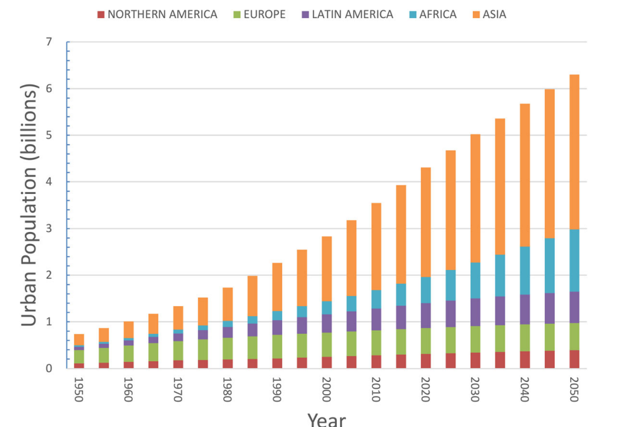
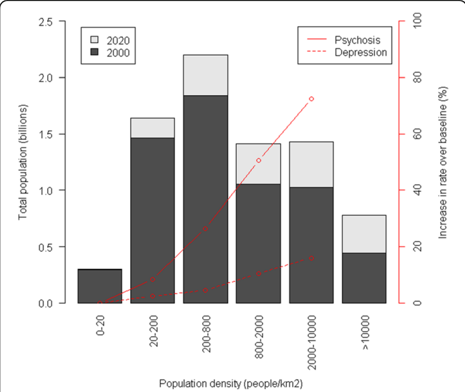
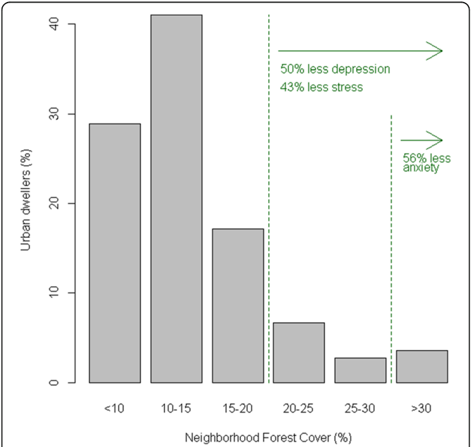
By 2050, there are forecast to be 2.4 billion more people in cities, and this century could rightly be called the urban century. This paper argues that, paradoxically, without the use of nature the urban century will fail. We review three literatures to assess the scientific support for this proposition. First, studies from economics show that it is the extreme potential for interaction that makes cities centers of productivity, innovation, and creativity. Second, many health studies document the increase in stress and greater prevalence of some mental disorders in cities, and we argue that it is the constant interaction of urban life that leads to this urban psychological penalty. Here we show that 46% of humans are living at population densities where global datasets suggest that this psychological penalty may be an issue, a fraction that will only grow as urbanization continues. Third, ecosystem service research shows that even a brief interaction with nature has mental health benefits, alleviating symptoms of this psychological penalty. Global datasets suggest that currently, only 13% of urban dwellers may be living in close enough proximity to nature to experience its mental health benefits. We argue that natural features in cities will be an essential part of the urban century, a way to have all the benefits of our urban, connected world yet also have that urban home be a place where we can psychologically flourish. We discuss two specific ways governments are trying to integrate nature into citizens’ lives, through Green Prescriptions and the Biophilic Cities Network.
Overview
The claims and statistics of this paper haven’t been checked yet.
Free: it reads the open-access text and checks the first 5 claims that cite a source we can check. Create a free account to check every claim.
Integrity signals
Registry
Cites
Statistics
Figures
Verification
Claims the paper makes
The claims and statistics of this paper haven’t been checked yet.
Free: it reads the open-access text and checks the first 5 claims that cite a source we can check. Create a free account to check every claim.
Self-check
Percentages, sums and reported differences re-computed from the paper’s own numbers.
The self-check needs the paper’s full text.
Citations
Cites
Lim, S. S., Vos, T., Flaxman, A. D., Danaei, G., Shibuya, K., Adair-Rohani, H., AlMazroa, M. A., Amann, M., Anderson, H. R., Andrews, K. G., et al. (2012) · The Lancet · doi:10.1016/s0140-6736(12)61766-8 · Cited by 11,805
Stress recovery during exposure to natural and urban environments
Ulrich, R. S., Simons, R. F., Losito, B. D., Fiorito, E., Miles, M. A., & Zelson, M. (1991) · Journal of Environmental Psychology · doi:10.1016/s0272-4944(05)80184-7 · Cited by 5,990 · cited 1×
“Stress Reduction Theory [95] argues that time in natural areas is correlated with reduced exposure to environmental stresses like noise and light pollution.”
BackgroundWorld Urbanization Prospects: The 1996 Revision
Brockerhoff, M., & Nations, U. (1998) · Population and Development Review · doi:10.2307/2808041 · Cited by 5,881
Global forecasts of urban expansion to 2030 and direct impacts on biodiversity and carbon pools
Seto, K. C., Güneralp, B., & Hutyra, L. R. (2012) · Proceedings of the National Academy of Sciences · doi:10.1073/pnas.1211658109 · Cited by 5,086 · cited 1×
“2 million km(2) by 2030, the size of the country of South Africa, will be developed for urban use [2].”
BackgroundThe global obesity pandemic: shaped by global drivers and local environments
Swinburn, B. A., Sacks, G., Hall, K. D., McPherson, K., Finegood, D. T., Moodie, M. L., & Gortmaker, S. L. (2011) · The Lancet · doi:10.1016/s0140-6736(11)60813-1 · Cited by 4,888 · cited 1×
“calorie-rich foods and less physical activity [49].”
“Sticky Information” and the Locus of Problem Solving: Implications for Innovation
von Hippel, E. (1994) · Management Science · doi:10.1287/mnsc.40.4.429 · Cited by 3,718
Hartig, T., Mitchell, R., de Vries, S., & Frumkin, H. (2014) · Annual Review of Public Health · doi:10.1146/annurev-publhealth-032013-182443 · Cited by 3,638
Korcelli-Olejniczak, E. (2017) · RCIN (Digital Repository of the Scientifics Institutes) (Institute of Archaeology and Ethnology of the Polish Academy of Sciences) · Cited by 3,244
Wirth, L. (1938) · American Journal of Sociology · doi:10.1086/217913 · Cited by 2,995
Ecosystems and human well-being: a framework for assessment
(2004) · Choice Reviews Online · doi:10.5860/choice.41-4645 · Cited by 2,846
Research works printed but not linked: 4
- 16. Aristotle, Politics. "trans. Ernest Barker." New York: Oxford University Press 3, no. 16 (1958): 296.
- 39. WHO UNICEF. Progress on drinking water, sanitation, and hygiene. Geneva: World Health Organization; 2017.
- 78. NRDC. Financing stormwater retrofits in Philadelphia and beyond. New York: National Resources Defense Council; 2012.
- 95. Kaplan R, Kaplan S. The experience of nature: a psychological perspective. New York: Cambridge University Press; 1989.
Cited by
Nature inequity and higher COVID-19 case rates in less-green neighbourhoods in the United States
Spotswood, E. N., Benjamin, M., Stoneburner, L., Wheeler, M. M., Beller, E. E., Balk, D., McPhearson, T., Kuo, M., & McDonald, R. I. (2021) · Nature Sustainability · doi:10.1038/s41893-021-00781-9 · Cited by 212
Self-citationDenser and greener cities: Green interventions to achieve both urban density and nature
McDonald, R. I., Aronson, M. F. J., Beatley, T., Beller, E. E., Bazo, M., Grossinger, R. M., Jessup, K., Mansur, A. V., de Oliveira, J. A. P., Panlasigui, S., et al. (2023) · People and Nature · doi:10.1002/pan3.10423 · Cited by 187
Self-citationMcDonald, R. I., Biswas, T., Sachar, C., Housman, I., Boucher, T. M., Balk, D., Nowak, D., Spotswood, E., Stanley, C. K., & Leyk, S. (2021) · PLOS ONE · doi:10.1371/journal.pone.0249715 · Cited by 159
“Tree cover provides a variety of ecosystem service benefits in cities [6, 7], including reducing air pollutant concentrations [8], mitigating stormwater runoff [7], maintaining water quality [9], encouraging physical recreation [10], and improving mental health [11].”
BackgroundSelf-citationVisitors to urban greenspace have higher sentiment and lower negativity on Twitter
Schwartz, A. J., Dodds, P. S., O'Neil‐Dunne, J. P. M., Danforth, C. M., & Ricketts, T. H. (2019) · People and Nature · doi:10.1002/pan3.10045 · Cited by 92
Walking Green: Developing an Evidence Base for Nature Prescriptions
Koselka, E. P. D., Weidner, L. C., Minasov, A., Berman, M. G., Leonard, W. R., Santoso, M. V., de Brito, J. N., Pope, Z. C., Pereira, M. A., & Horton, T. H. (2019) · International Journal of Environmental Research and Public Health · doi:10.3390/ijerph16224338 · Cited by 89
Metadata
- Authors
- McDonald, R. I., Beatley, T., & Elmqvist, T.
- Affiliations
- The Nature Conservancy (US)
- University of Virginia (US)
- Stockholm Resilience Centre (SE)
- Corresponding author
- McDonald, Robert Ian
- Venue
- Sustainable Earth
- Published
- 2018-10-25
- Volume
- 1
- Issue
- 1
- ISSN
- 2520-8748 (ISSN-L)
- OpenAlex
- W2895034959
- Cited by
- 61
- References
- 112
- Citations by year
- 2026: 4 · 2025: 5 · 2024: 9 · 2023: 11 · 2022: 10 · 2021: 12 · 2020: 4 · 2019: 5 · 2018: 1
- FWCI
- 2.71
- Type
- journal article
- Language
- en
- Open access
- gold
- doi.org
- Licence
- cc-by
- creativecommons.org/licenses/by/4.0/ (tdm)
- Locations
- Sustainable Earth Reviews (publishedVersion, cc-by)
- DOAJ (DOAJ: Directory of Open Access Journals) (submittedVersion)
- Topics
- Social Sciences › Urban Studies › Urban Green Space and Health
- Physical Sciences › Environmental Science › Global and Planetary Change › Land Use and Ecosystem Services
- Physical Sciences › Environmental Science › Management, Monitoring, Policy and Law › Urban Arborization and Environmental Studies
- Keywords
- urbanization, mental health, nature exposure, ecosystem services, urban stress, population density, green prescriptions, biophilic cities, urban green space, urban productivity, urban mental health
About these checks
Registry, retraction, Cites and statistics results are computed, not judged, with one exception: a printed reference that no index lists is read once by a model before it counts as a citation error. Claims are extracted by a model and kept only when their quote appears verbatim in the text; each cited source is then checked, with a model’s help, for whether it says what the claim relies on. Those verdicts can be wrong — read the claim’s quote and the cited source before relying on one.
Statistics and arithmetic are recomputed, not judged.
Confidence bands are shown only for fields calibrated on our annotated test set. None is calibrated yet, so no band is shown.
What counts as a claim ›How we measure confidence ›How we check this ›
Are you an author, or do you see a problem with this page? Request a review
Data sources
Bibliographic data: Semantic Scholar, OpenAlex, Crossref.
Contains information from the Semantic Scholar Academic Graph Datasets, made available under the ODC Attribution License (ODC-BY 1.0).
Semantic Scholar’s data is described in: Kinney, R., et al. (2023). The Semantic Scholar Open Data Platform. arXiv:2301.10140.
