

Implementation science made too simple: a teaching tool
Open accessThe DOI matches its Crossref record; 7 of the 9 references it cites were found in a registry or an index.
Abstract
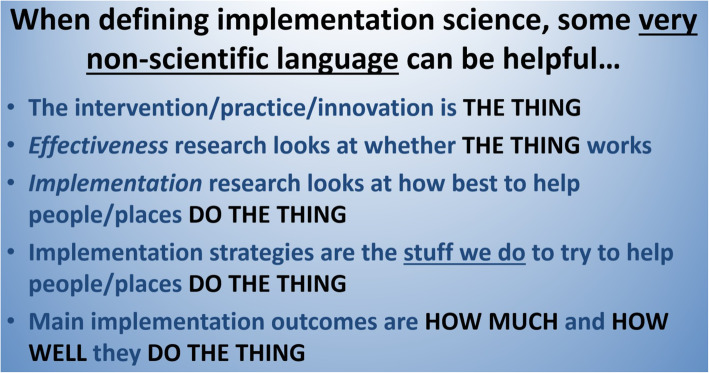
Background: The field of implementation science is growing and becoming more complex. When teaching new learners, providing a clear definition of implementation science and a description of “its place” among related fields can be difficult. The author developed a teaching tool using very simple language to help learners grasp key concepts in implementation science. The teaching tool: The tool consists of a slide (visual aid) which provides simple and jargon-free definitions of implementation science, implementation strategies, and implementation outcomes, as well as a description of how implementation science relates to “effectiveness” research focusing on clinical/preventive interventions. Conclusion: The tool could be useful to new students in the field, as well as other scholars or stakeholders in need of a brief and plain language introduction to key concepts in implementation science.
Overview
The claims and statistics of this paper haven’t been checked yet.
Free: it reads the open-access text and checks the first 5 claims that cite a source we can check. Create a free account to check every claim.
Integrity signals
Registry
Cites
Statistics
Figures
Verification
Claims the paper makes
The claims and statistics of this paper haven’t been checked yet.
Free: it reads the open-access text and checks the first 5 claims that cite a source we can check. Create a free account to check every claim.
Claims other papers make about this one
Each is checked against this paper’s own text: does it say what the citing paper says it does?
The cited source says what the claim attributes to it.
In the citing paper
“the updated CFIR guides users to define the innovation (aka “the thing” [20, 25] being implemented), including the boundary between the innovation and implementation strategies.”
From The updated consolidated framework for implementation research based on user feedback (2022) · cites this paper as [20]
Self-check
Percentages, sums and reported differences re-computed from the paper’s own numbers.
The self-check needs the paper’s full text.
Citations
Cites
Damschroder, L. J., Aron, D. C., Keith, R. E., Kirsh, S. R., Alexander, J. A., & Lowery, J. C. (2009) · Implementation Science · doi:10.1186/1748-5908-4-50 · Cited by 14,496
Proctor, E., Silmere, H., Raghavan, R., Hovmand, P., Aarons, G., Bunger, A., Griffey, R., & Hensley, M. (2011) · Administration and Policy in Mental Health and Mental Health Services Research · doi:10.1007/s10488-010-0319-7 · Cited by 8,721
Powell, B. J., Waltz, T. J., Chinman, M. J., Damschroder, L. J., Smith, J. L., Matthieu, M. M., Proctor, E. K., & Kirchner, J. E. (2015) · Implementation Science · doi:10.1186/s13012-015-0209-1 · Cited by 4,963
Welcome to Implementation Science
Eccles, M. P., & Mittman, B. S. (2006) · Implementation Science · doi:10.1186/1748-5908-1-1 · Cited by 2,254 · cited 1×
“” This is my attempt at boiling down a more detailed definition [6] into the simplest and most basic of language.”
BackgroundBridging Research and Practice
Tabak, R. G., Khoong, E. C., Chambers, D. A., & Brownson, R. C. (2012) · American Journal of Preventive Medicine · doi:10.1016/j.amepre.2012.05.024 · Cited by 1,386
An updated protocol for a systematic review of implementation-related measures
Lewis, C. C., Mettert, K. D., Dorsey, C. N., Martinez, R. G., Weiner, B. J., Nolen, E., Stanick, C., Halko, H., & Powell, B. J. (2018) · Systematic Reviews · doi:10.1186/s13643-018-0728-3 · Cited by 118
Stacey, D., Pomey, M.-P., O'Connor, A. M., & Graham, I. D. (2006) · Implementation Science · doi:10.1186/1748-5908-1-17 · Cited by 63
Research works printed but not linked: 2
- Biedas RS Lewis CC Powell BJ Orientation to the science of dissemination and implementation 2018 Washington, DC Pre-conference workshop, 11th Annual Conference on the Science of Dissemination and Implementation in Health
- Øvretveit J Improve-mentation science and practice for more effective care and research 2019 London Presentation at the Implementation Science Masterclass, King’s College
Cited by
Items 101–200 of 285
Wellmann, I. A., Ayala, L. F., Rodríguez, J. J., Guetterman, T. C., Irazola, V. E., Palacios, E., Huffman, M. D., Rohloff, P. J., Heisler, M., Ramírez‐Zea, M., et al. (2024) · Implementation Science Communications · doi:10.1186/s43058-023-00539-8 · Cited by 8
“In this protocol, we use the name “Integrated Hypertension and Diabetes Primary Care Model” to refer to this evidence‑based intervention as implemented in Guatemala • This study will not evaluate implementation strategies (“the stuff we do to try to help people and places to do ‘the thing’” [24]).”
MethodApplication of dissemination and implementation science frameworks to surgical research
Yi, J. A., Hakimi, A., & Vavra, A. K. (2022) · Seminars in Vascular Surgery · doi:10.1053/j.semvascsurg.2022.10.001 · Cited by 6
McGovern, M. P., Garneau, H. C., Gotham, H. J., & Rossi, F. S. (2025) · Journal of Substance Use and Addiction Treatment · doi:10.1016/j.josat.2025.209753 · Cited by 7
Annaswamy, T. M., Grover, P., Douglas, N., Poploski, K. M., Anderson, C. A., Clark, M. A., Flores, A. M., Hafner, B. J., Hoffman, J. M., Kinney, A. R., et al. (2024) · PM&R · doi:10.1002/pmrj.13213 · Cited by 5
“10 The main role of IS in LHSs is to reduce avoidable variation in process and outcomes and to ensure the systematic uptake and update of research findings in a health system.”
van Bodegom‐Vos, L., & Vlieland, T. P. M. V. (2024) · RMD Open · doi:10.1136/rmdopen-2024-004259 · Cited by 4
Community-Based Efforts to Reduce Violence: A Scoping Review on the Implementation of Cure Violence
Solomon, S. R., Roman, C. G., Davey-Rothwell, M. A., Abaya, R., Webster, D. W., & Frattorolli, S. (2025) · INQUIRY The Journal of Health Care Organization Provision and Financing · doi:10.1177/00469580251360956 · Cited by 9
“16 In the field of IS, implementation strategies are “methods or techniques used to enhance the adoption, implementation, and sustainability of a program or practice.””
Schueller, S. M., & Boustani, M. M. (2020) · Journal of Community Psychology · doi:10.1002/jcop.22340 · Cited by 8
Health equity and Hospital at Home programs
Goyal, A. A., & Taylor, S. P. (2024) · Journal of Hospital Medicine · doi:10.1002/jhm.13326 · Cited by 5
Vandrevala, T., Montague, A., Boulton, R., Coxon, K., & Jones, C. E. (2024) · BMC Pregnancy and Childbirth · doi:10.1186/s12884-024-06715-5 · Cited by 6
Kemp, A. M., & O’Brien, K. H. (2025) · American Journal of Speech-Language Pathology · doi:10.1044/2024_ajslp-24-00100 · Cited by 5
A Practical Guide to Incorporating Health Equity Domains in Implementation FrameworksPreprint
Woodward, E. N., Singh, R. S., Ndebele‐Ngwenya, P., Castillo, A. M., Dickson, K. S., & Kirchner, J. E. (2020) · Research Square · doi:10.21203/rs.3.rs-32704/v1 · Cited by 5
“Innovation refers to the treatment, intervention, or practice or new “thing” to be implemented, adopted by providers and staff, and delivered to patients.[30] The innovation may be a program, practice, principle, procedure, product, pill, or policy.”
BackgroundHealthcare quality measures in implementation research: advantages, risks and lessons learned
Gustavson, A. M., Hagedorn, H., Jesser, L. E., Kenny, M. E., Clothier, B. A., Bounthavong, M., Ackland, P. E., Gordon, A. J., & Harris, A. H. S. (2022) · Health Research Policy and Systems · doi:10.1186/s12961-022-00934-y · Cited by 4
“One way to evaluate how much and how well an evidence-based clinical practice is implemented in a realworld healthcare setting or system is to use existing healthcare quality measures [2].”
Background“How to Save a Life”: A Premortem for Pediatric Digital Health
Psihogios, A. M., Moscato, E. L., Cummings, C., Canter, K. S., Chen, D., Coburn, S. S., Duncan, C. L., Eaton, C. K., Essner, B. S., Hannan, S., et al. (2024) · Clinical Practice in Pediatric Psychology · doi:10.1037/cpp0000527 · Cited by 5
“Implementation science refers to the study of how to successfully promote and sustain evidence-based practices/policies in speci fi c settings to achieve population health (Curran, 2020).”
Exploring Strategies to Promote Exercise as a Viable Obesity and Chronic Disease Treatment
Flack, K. D., Stults‐Kolehmainen, M., Anderson, R. E., Handlery, R., Creasy, S. A., & Catenacci, V. A. (2025) · Nutrients · doi:10.3390/nu17121997 · Cited by 5
Applications of Human‐Centered Design to Food Is Medicine Interventions: The THRIVE Pilot Trial
Adeleye, K. K., McDaniel, K., Iribe, I., Assani‐Uva, A., Dugbartey, J. A., Sinyan, A., Bhattarai, B., DeMarco, S., Tomiwa, T., Olusola-Bello, M. A., et al. (2025) · Journal of the American Heart Association · doi:10.1161/jaha.125.041846 · Cited by 6
“40,41 Process metrics will include implementation fidelity, adoption across clinical settings, reach within target populations, and cost-effectiveness.”
What Is Implementation Science
Fayaz-Bakhsh, A., Tania, J., Lutfi, S. L., Jha, A. K., & Rahmim, A. (2025) · PET Clinics · doi:10.1016/j.cpet.2025.09.002 · Cited by 10
Panteghini, M. (2026) · Clinical Chemistry and Laboratory Medicine (CCLM) · doi:10.1515/cclm-2025-1632 · Cited by 4
“To close the loop, all the elements of Implementation Science should be applied to metrological traceability concepts (Table 1) [8].”
Yildirim‐Toruner, C., Pooni, R., Goh, Y. I., Becker‐Haimes, E. M., Dearing, J. W., Fernández, M. E., Morgan, E. M., Parry, G. J., Burnham, J. M., Ardoin, S. P., et al. (2022) · Pediatric Rheumatology · doi:10.1186/s12969-022-00665-y · Cited by 5
“The Hexagon Tool [49] can be used to facilitate making this appraisal.”
MethodZeldman, J., Salloum, R. G., & Mobley, A. R. (2023) · Journal of the Academy of Nutrition and Dietetics · doi:10.1016/j.jand.2023.05.025 · Cited by 4
Collective Health in Brazil and Implementation Science: Challenges and Potentialities
Silva, A. A., Lopes, G. P. D., Claro, H. G., Menezes, P. R., Tanaka, O. Y., & Campos, R. T. O. (2023) · Global Implementation Research and Applications · doi:10.1007/s43477-023-00095-2 · Cited by 8
“Curran (2020) shows that the need for understanding the processes around what is to be implemented is global.”
Nicoll, A., Roulstone, S., Williams, B., & Maxwell, M. (2023) · International Journal of Language & Communication Disorders · doi:10.1111/1460-6984.12979 · Cited by 8
“They take a ‘thing’ (which has been shown to work through effectiveness research) and look at ‘the stuff we do’ to try to help people in different places ‘do the thing’ well (Curran, 2020).”
BackgroundCommunity-Engaged Implementation Strategies in Occupational Therapy: A Scoping Review
Kang, E., Chen, J. Y., Lipsey, K. L., & Foster, E. R. (2024) · American Journal of Occupational Therapy · doi:10.5014/ajot.2024.050526 · Cited by 4
“…may influence the implementation of EBIs or other innovations (e.g., clinical guidelines, practice models, theories, assessments), developing implementation strategies to target these factors, and assessing implementation success to improve the uptake of EBIs in real-world settings (Curran, 2020).”
InfluentialCampbell, A., & Cassidy, C. E. (2024) · Journal of Advanced Nursing · doi:10.1111/jan.16651 · Cited by 6
“In implementation science, a policy can be ‘the thing’ (i.e., evidence-informed innovation) that is central to the research study, or it can be viewed as a contextual factor that may influence the implementation of an evidence-informed innovation (Curran 2020).”
Davis, J. L., Ayakaka, I., Ggita, J. M., Ochom, E., Babirye, D., Turimumahoro, P., Gupta, A. J., Mugabe, F., Armstrong-Hough, M. J., Cattamanchi, A., et al. (2022) · Frontiers in Public Health · doi:10.3389/fpubh.2022.837211 · Cited by 5
“Implementation strategies are specific techniques used to promote adoption, uptake, implementation, and sustainability of innovations and evidence-based practices previously known or believed to improve individual or public health outcomes (11, 12).”
MethodRouleau, G., Thiruganasambandamoorthy, V., Wu, K., Ghaedi, B. B., Nguyen, P. A., & Desveaux, L. (2023) · JMIR Human Factors · doi:10.2196/44089 · Cited by 4
“Health services research shows that many evidence-based practices or interventions fail to demonstrate the anticipated impact as they were not properly implemented, precluding them from achieving a positive impact on clinical practice and patient outcomes [12,13].”
Frazier, M. C., Balis, L. E., Armbruster, S. D., Estabrooks, P. A., & Harden, S. M. (2023) · Translational Behavioral Medicine · doi:10.1093/tbm/ibad052 · Cited by 4
When is enough enough? Implementation science models and frameworks
Carey, T. A. (2024) · International Journal of Evidence-Based Healthcare · doi:10.1097/xeb.0000000000000447 · Cited by 4
Bridging the Gap: Wie Implementierungsforschung die Physiotherapie verbessern kann
Scheffler, B., Bahns, C., & Kopkow, C. (2025) · physioscience · doi:10.1055/a-2527-8921 · Cited by 3
“Abzugrenzen ist dann das tatsächliche Ausführen im Sinne der Implementierungsstrategie, also Menschen oder Orte zu befähi-gen, etwas zu tun [9].”
Brooks, S. P., Alba, C., Montesanti, S. R., Thomson, D., Davison, S. N., Graham, K., & Storey, K. (2025) · Implementation Science Communications · doi:10.1186/s43058-025-00765-2 · Cited by 4
“The timeline illustrated a co-design process that aligned with implementation science planning principles, including exploring the initiative, identifying key partners, and assessing the initiative’s fit to context [7].”
Rodgers, N. H., Zhang, Y., Combiths, P. N., & Walker, E. A. (2025) · Language Speech and Hearing Services in Schools · doi:10.1044/2025_lshss-25-00001 · Cited by 4
Hybrid type 1 effectiveness-implementation studies: why and how to do them
Baloh, J., Landes, S. J., Smith, J. L., & Curran, G. M. (2026) · Frontiers in Health Services · doi:10.3389/frhs.2026.1678257 · Cited by 4
“…provider, organization, community), and implementation outcomes, which indicate the extent (how much) and quality (how well) of intervention implementation (e.g., intervention adoption, reach, fidelity) and are thus necessary preconditions and antecedents of intervention effectiveness (20, 25, 26).”
Self-citationFetal alcohol spectrum disorders prevention and clinical guidelines research - workshop report
Koehlmoos, T. P., Lee, E. H., Rivera, I., Wisdahl, J., Erdman, K., & Donaldson, T. (2024) · BMC Proceedings · doi:10.1186/s12919-024-00298-x · Cited by 3
“Finally, the outcomes of the intervention are evaluated to inform ongoing and future efforts [2].”
Touchett, H. N., Arredondo, K., Hines‐Munson, C., Poon, I. O., Holmes, S. A., Trautner, B. W., & Skelton, F. (2024) · PM&R · doi:10.1002/pmrj.13279 · Cited by 4
“12 It was originally developed for medical-surgical and older adult settings in 2011.”
Smith, S., Paull, S., Iwanowski, K. M., Harris, T., Moullin, J. C., Jane, M., Bill, J., Kerr, D. A., Pollard, C. M., Pearson, G., et al. (2025) · Frontiers in Health Services · doi:10.3389/frhs.2025.1604809 · Cited by 5
“Implementation strategies are noted to be essential when developing an intervention (38) 41) and abides by the guiding principles of partnership and access, and equality in health services.”
From Research to Practice in OBGYN: How to Critically Interpret Studies in Implementation
Hamm, R. F., & Moniz, M. H. (2022) · Clinical Obstetrics & Gynecology · doi:10.1097/grf.0000000000000706 · Cited by 3
“Robust implementation science involves four key steps: (1) measuring the evidence to practice gap (ie, the difference between recommended intervention and the care actually delivered), (2) determining barriers and facilitators to implementing the intervention, (3) selecting strategies to improve implementation that ma…”
BackgroundLuft, H., Brown, R., & Lauver, D. (2023) · Applied Nursing Research · doi:10.1016/j.apnr.2023.151686 · Cited by 5
De-implementation of Low-Value Practices for Autism Spectrum Disorder
Friedman, N. R., Watkins, L., Barnard-Brak, L. M., Barber, A. B., & White, S. W. (2023) · Clinical Child and Family Psychology Review · doi:10.1007/s10567-023-00447-2 · Cited by 4
“Implementation science seeks to promote the broad use of EST, through the identification of practices that help bridge the gap from science to practice (Curran, 2020; Shelton et al., 2020), moving from passive knowledge dissemination to active intervention support with involvement from funders, leaders, providers, and…”
BackgroundTreating self-harm behaviors in prisons: implementation of the STEPPS program
Lorente-Català, R., Jaén, I., Buscà-Huertas, X., Ferrer, B. F., & García‐Palacios, A. (2025) · BMC Psychology · doi:10.1186/s40359-024-02342-z · Cited by 3
Halm, M. A., Ruppel, H., & Sexton, J. R. (2025) · American Journal of Critical Care · doi:10.4037/ajcc2025906 · Cited by 3
Rejon, C. S., Hollingworth, W., Opmeer, B. C., Luyt, K., & McLeod, H. (2025) · Applied Health Economics and Health Policy · doi:10.1007/s40258-025-00993-6 · Cited by 11
“A useful starting point may be Curran’s teaching tool [42] that distinguishes between the intervention/treatment, ‘the thing’, and the implementation strategy to ‘do the thing’.”
Proof of concept studies in mental health systems research: strategy and steps
Salvador‐Carulla, L., Tabatabaei‐Jafari, H., Woods, C., & Lukersmith, S. (2025) · International Journal of Mental Health Systems · doi:10.1186/s13033-025-00682-w · Cited by 5
Gloving in medicine: a boon for infection prevention or a hindrance?
Vilar‐Compte, D., Garciadiego-Fossas, P., & Ibanes-Gutiérrez, C. (2025) · Antimicrobial Stewardship & Healthcare Epidemiology · doi:10.1017/ash.2025.10145 · Cited by 2
“47 The environmental impact of gloves is driven by their reliance on materials such as nitrile, latex, and vinyl, which are non-biodegradable.”
Seterelv, S. S., Gupta, S., Kouri, A., Flórez, I. D., Agoritsas, T., Vandvik, P. O., & de Velde, S. V. (2025) · BMJ Open · doi:10.1136/bmjopen-2025-114609 · Cited by 4
“79 80 This insight has direct implications for practice, as can be seen in a recent BMJ Rapid Recommendation which provides detailed guidance on implementability in the full, online version of the guideline.”
Roth, C., Kostrzewa, M., Collatuzzo, G., Biagioli, V., Seyyedsalehi, M. S., Giordani, S., Godono, A., Oțelea, M. R., Mates, D., Popescu, F. G., et al. (2026) · BMC Cancer · doi:10.1186/s12885-026-15607-0 · Cited by 3
“From an implementation science perspective, the protocols for preventive interventions or prevention programs describe specific actions that need to be put into practice and scaled-up [11, 12].”
Domlyn, A. M., Dodge, J., Pfeiffer, P. N., Robinson, C., Evans, L., Damschroder, L. J., Stewart, M. A., Garlick, B., Sussman, J. B., & Nevedal, A. (2026) · Implementation Science Communications · doi:10.1186/s43058-026-00956-5 · Cited by 3
“As we continue building the science of implementation and finding balance between rigor and feasibility [31], the field must be clear about which determinant studies are useful for syntheses to build grand theories [32] and which studies solely served the need for that specific setting or partner.”
InfluentialAwad, M. H., Furdich, K., & Webb, D. (2023) · American Journal of Health-System Pharmacy · doi:10.1093/ajhp/zxad148 · Cited by 2
Krupp, A. E., & Lopez, K. D. (2023) · Nurse Leader · doi:10.1016/j.mnl.2023.08.003 · Cited by 2
Ford, J. H., Nora, A., & Crnich, C. J. (2023) · Implementation Science Communications · doi:10.1186/s43058-023-00535-y · Cited by 3
“In this study, the focus of the change efforts or the “thing” was the implementation of an evidence-based UTI toolkit in NHs [25].”
Dolansky, M. A., Davey, C. H., & Moore, S. M. (2024) · Journal of Nursing Care Quality · doi:10.1097/ncq.0000000000000760 · Cited by 4
“The Model can be used in IS research as many researchers have difficulty in conceptualizing the IS framing (see publication “Implementation Science Made Too Simple: A Teaching Tool” 54 ) and can expand the partnerships among clinicians and researchers.”
MethodTraining and Capacity Building in Dissemination and Implementation Science
Davis, R. E., Sevdalis, N., & Baumann, A. A. (2023) · Oxford University Press eBooks · doi:10.1093/oso/9780197660690.003.0030 · Cited by 4
Kelly, Y., O’Rourke, N., Hegarty, J. M., Gannon, J., Flynn, R., & Keyes, L. M. (2024) · BMC Health Services Research · doi:10.1186/s12913-024-12075-9 · Cited by 4
Köhler, M., Thaqi, Q., Kuske, S., Schwalbach, T., Riguzzi, M., & Naef, R. (2025) · International Journal of Nursing Studies Advances · doi:10.1016/j.ijnsa.2025.100305 · Cited by 4
“In theory, it is important to clearly distinguish between the clinical intervention, which is “ the thing ” , and the implementation activities, which is the “ stuff that is done to try to help people / places do the thing ” (Curran, 2020).”
Beres, L. K., Harkness, A., Corcoran, J. L., Datar, R. S., Corneli, A. L., Ross, J., Pyra, M. N., Rucinski, K. B., Betancourt, G., Marotta, P. L., et al. (2025) · JAIDS Journal of Acquired Immune Deficiency Syndromes · doi:10.1097/qai.0000000000003618 · Cited by 3
Wesolowicz, D. M., Becker, W. C., Alegria, M. M., Chin-Purcell, L., Glass, J. E., Knudsen, H. K., Dow, P. M., Seal, K. H., & McGinty, E. B. (2025) · Journal of General Internal Medicine · doi:10.1007/s11606-025-09551-1 · Cited by 5
Falb, K., Blackwell, A., Balanchander, M., Bourey, C., Yuan, C. T., & Decker, M. R. (2025) · Trauma Violence & Abuse · doi:10.1177/15248380251340640 · Cited by 4
“…D r i v e r s ( 4 ) I m p r o v e m e n t C yc l e s ( 5 ) I m p l e m e n t a t i o n T e a m s ( 6 ) S y s t e m i c C h a n g e A dd r e ss w h a t n ee d s t o b e i m p l e m e n t e d , h o w a n d b y w h o m , a n d i n w h a t t y p e o f s e tt i n g ( P o ll a s t r i e t a l., 2020 ) .”
InfluentialTennakoon, M., Chileshe, N., Rameezdeen, R., Ochoa, J. J., & Samaraweera, A. (2025) · International Journal of Construction Management · doi:10.1080/15623599.2025.2515493 · Cited by 4
“As explained by Curran (2020), these innovations are developed as frameworks or tangible outputs and continue to be after successful implementation.”
Galvin-McLaughlin, D., Cochran, E., Atkins, K. L., Crawford, S., Case, F., & Sloane, B. M. (2025) · Disability and Rehabilitation Assistive Technology · doi:10.1080/17483107.2025.2530673 · Cited by 2
“…systematically investigate the extent to which evidenced-based interventions have been implemented in authentic clinical contexts is through implementation science methodology [46–48]. there is limited research on the implementation strategies utilized to implement at in real-world settings [49].”
Juckett, L., DeMott, L., & Oliver, H. V. (2021) · Journal of Hand Therapy · doi:10.1016/j.jht.2021.04.004 · Cited by 2
Implementing change in the care of the complex cardiac patient
Rus, I. A., Kudela, M., Suffredini, G., Ariyo, P. T., Hensley, N. B., & Abernathy, J. H. (2022) · Current Opinion in Anaesthesiology · doi:10.1097/aco.0000000000001213 · Cited by 2
“The research analyzes whether ‘‘the thing’’works effectively [7].”
BackgroundInfluentialImplementation should be a standard component of practice guidelines and guidance documents
Schaffzin, J. K., Sickbert-Bennett, E. E., Deloney, V. M., & Weber, D. J. (2023) · Infection Control and Hospital Epidemiology · doi:10.1017/ice.2022.294 · Cited by 2
Khan, S., Lewis, C. C., Zhang, X., Ilias, M. R., & Mensah, G. A. (2023) · Ethnicity & Disease · doi:10.18865/ed.decipher.135 · Cited by 2
LaGrone, L. N., Glasgow, R. E., & Haut, E. R. (2023) · Injury · doi:10.1016/j.injury.2023.111251 · Cited by 2
Emergency department buprenorphine program: staff concerns and recommended implementation strategies
Ajumobi, O. O., Friedman, S. A., Granner, M. L., Lucero, J. E., Westhoff, J., Koch, B., & Wagner, K. D. (2024) · Implementation Science Communications · doi:10.1186/s43058-024-00649-x · Cited by 3
“CFIR 2.0 describes the concept of “innovation” as the new clinical treatment or service being implemented [29, 31, 32].”
BackgroundInfluentialA guide to utilizing implementation science for genetic counseling
Rahm, A. K., & Cragun, D. L. (2025) · Journal of Genetic Counseling · doi:10.1002/jgc4.70039 · Cited by 2
“Recently, Curran (Curran, 2020) created a teaching tool to introduce the central concepts of implementation science in plain language that we have found useful for introducing IS concepts to ge-netic counselors (GCs), who are often already implementers in practice.”
An Implementation Science Approach to Promote Bedside Interprofessional Rounding
Riley, E., Peeples, S. E., Williams, M., Nienaber, T., Reeves, N., Steele, T., Schay, H., & Curran, G. M. (2025) · Advances in Neonatal Care · doi:10.1097/anc.0000000000001267 · Cited by 1
Self-citationUsing Social Network Analysis to Inform Implementation Science Infrastructure Development
Brooks, S. P., Nooraie, R. Y., Hejri, S. M., Thomson, D., Davison, S. N., & Storey, K. (2025) · Global Implementation Research and Applications · doi:10.1007/s43477-025-00180-8 · Cited by 1
Ashcraft, L. E., & Lane-Fall, M. B. (2025) · Frontiers in Health Services · doi:10.3389/frhs.2025.1654516 · Cited by 2
“Implementation strategies are “the stuff” we do to help people, places, groups, organizations, and communities do “the thing” (1).”
Delaney, A., McCarthy, S., James, K., & Fleming, A. (2025) · Human Factors in Healthcare · doi:10.1016/j.hfh.2025.100112 · Cited by 2
Effectiveness of Patient-Directed Education to Sustain Deprescribing: A Pragmatic Trial
Jones, K. F., Stolzmann, K. L., Wormwood, J. B., Pendergast, J. N., Miller, C. J., Still, M., Bokhour, B. G., Hanlon, J. T., Simon, S. R., Rosen, A. K., et al. (2025) · Drugs & Aging · doi:10.1007/s40266-025-01251-z · Cited by 4
“Implementation strategies try and help people “do the thing,” and implementation outcomes are “how much” and “how well” people “do the thing” [7, 8].”
Integrating Decision Science and Implementation Science to Inform Policy Decision Making
Smith, N., Doan, T. T., Yuan, C. T., & Cruden, G. (2025) · MDM Policy & Practice · doi:10.1177/23814683251386876 · Cited by 4
Sjoberg, H., Lujan, D. V., McCreight, M. S., & Battaglia, C. T. (2025) · Global Implementation Research and Applications · doi:10.1007/s43477-025-00193-3 · Cited by 1
Aizawa, K., Kobayashi, K., Yonekura, Y., Yoshida, C., Hirata, M., Yamaji, N., & Oku, H. (2025) · Comprehensive Child and Adolescent Nursing · doi:10.1080/24694193.2025.2602645 · Cited by 1
“Accordingly, appropriate educational tools are needed to help nurse managers champion C&FCC (Curran, 2020).”
Evidence-Based Practice Implementation, Part 1: Selecting Interventions
Halm, M. A. (2026) · Critical Care Nurse · doi:10.4037/ccn2026779 · Cited by 1
Designing an implementation study: rationale and considerations for design
Lewis, K. B., Straiton, N., Graham, I. D., & Lauck, S. (2026) · European Journal of Cardiovascular Nursing · doi:10.1093/eurjcn/zvag078 · Cited by 1
Integrating theory and practice: the core components guide for rigorous quality improvement design
Howard, P. D., Arrieta, J., Leruth, C., Bones, K., Steinfield, R., Figueroa, J. C., Panjwani, S., & Barker, P. (2026) · Frontiers in Health Services · doi:10.3389/frhs.2026.1751580 · Cited by 1
“Third, the absence of a content theory limits the adoption, adaptation, and reliable implementation of evidence-based interventions (12).”
Creagh, N. S., Brownson, R. C., Chow, C. K., Shi, J., & Sarkies, M. (2026) · Heart · doi:10.1136/heartjnl-2025-325941 · Cited by 1
Togami, E., Thévenon, A. D., Galang, E. I. N. E., Yean, H. R. A., Isa, N. F., Shaw, C. N., Connell, N., Lim, K., Peterson, J., Veerakumarasivam, A., et al. (2026) · Health Security · doi:10.1177/23265094261434687 · Cited by 1
“…scientist participant presented the importance of the adaptability, trialability, complexity, and design of the innovation (ie, constructs of the CFIR innovation domain) at Workshop 5 to prompt participants to identify ideal characteristics of the guidebook (the “ thing ” being implemented 35 ).”
Lorente-Català, R., Castro, A., Fernández‐Martínez, S., Moreno, E. V., Guerrero-Pertiñez, G., Forteza-Rey, I., Gili, M., del Hoyo, Y. L., Mayoral, F., García‐Campayo, J., et al. (2026) · BMC Public Health · doi:10.1186/s12889-026-27573-0 · Cited by 1
“The ultimate aim is to inform strategies to support the integration of digital mental health interventions into routine clinical practice [12, 13].”
Jensen, T. M., & Papernow, P. L. (2026) · Family Transitions · doi:10.1080/28375300.2026.2707440 · Cited by 2
The Dissemination Research Logic Model for advancing dissemination science and practice
Merrill, K. G., Gamarel, K. E., Naar, S., Hightow‐Weidman, L., & Hosek, S. (2026) · Implementation Science · doi:10.1186/s13012-026-01530-2 · Cited by 1
“As in Baker et al.’s work [19], we can draw on Curran’s simplified terminology for understanding implementation science [46] to refer to this as “the thing” being disseminated.”
Adsul, P., & Adcock, R. (2026) · JNCI Monographs · doi:10.1093/jncimonographs/lgag012 · Cited by 1
Research with children and youth
Waters, D. (2022) · Cambridge University Press eBooks · doi:10.1017/9781108980944.006 · Cited by 1
Moise, N., & Bauer, A. M. (2022) · General Hospital Psychiatry · doi:10.1016/j.genhosppsych.2022.05.001 · Cited by 1
PRO: Implementation Science Has Value in Anesthesiology and Cardiothoracic Surgery
Navare, S. R., Rozental, O., & Girardi, L. N. (2023) · Journal of Cardiothoracic and Vascular Anesthesia · doi:10.1053/j.jvca.2023.11.008 · Cited by 1
Bacon, S., & Lavoie, K. (2024) · Annals of Behavioral Medicine · doi:10.1093/abm/kaad059 · Cited by 1
Courtney, R. E., Schadegg, M. J., Hicks, N., Truitt, M., Bolton, R. E., Dezzutti, B. P., Cannizzo, F., Darnall, B. D., Radatz, M., & Harden, S. M. (2024) · Global Advances in Integrative Medicine and Health · doi:10.1177/27536130241290798 · Cited by 3
“To use the concept described by Curran, 20 “ the thing ” is the intervention intended to be integrated in a practice setting and the implementation strategies such as conduct cyclical small tests of change 21 are “ the stuff ” that helps systems do “ the thing.”
MethodDias, E., Walker, T. J., Balasubramanian, B. A., Cuccaro, P. M., Workman, L. M., Wandersman, A., & Fernández, M. E. (2024) · Journal of Clinical and Translational Science · doi:10.1017/cts.2024.689 · Cited by 2
“Implementation outcomes refer to the effects (how well or how much) of actions taken to implement innovations [10,11].”
Spencer, K. C., McDaniels, M., Hyun, S. H., Rogers, J. G., Utzerath, E., & Pfund, C. (2025) · Journal of Clinical and Translational Science · doi:10.1017/cts.2025.41 · Cited by 3
“The innovation [18,20] at the heart of this work is Entering Mentoring , a research mentor training curriculum, which has been studied consistently over the past 15 years.”
Israel should build capacity in implementation science
Rose, A. J., Spitzer, S., & Ellen, M. (2025) · Israel Journal of Health Policy Research · doi:10.1186/s13584-025-00669-5 · Cited by 2
“By bridging the gap between what we know works and how to make it work in practice, IS accelerates the impact of healthcare innovations [5, 6].”
Determining the uptake of best practices in pain interdisciplinary teams: a scoping review
Courtney, R. E., Schadegg, M. J., Curry, L., Johns, W. B., Walters-Threat, L., Tirado, D., Epperly, R., Naylor, J. C., Lentz, T. A., & Harden, S. M. (2025) · Journal of Public Health · doi:10.1007/s10389-025-02505-1 · Cited by 1
Dougherty, K., Kirby, R. P., Claud, K., Palamountain, K. M., Asma, E., Alooh, M., Kumara, D., Gate, V., Bisceglia, N., Banda, G., et al. (2025) · BMC Global and Public Health · doi:10.1186/s44263-025-00185-3 · Cited by 2
“Implementation research (IR) seeks to understand and work in “real world” or usual practice settings, paying particular attention to the “how” of implementation [13].”
Educación interprofesional en salud: atravesando el contexto neoliberal
Consuegra, M. P. (2023) · Interface - Comunicação Saúde Educação · doi:10.1590/interface.230446 · Cited by 1
Implementation Science in Schools
Montgomery, K. L., & Connors, E. H. (2024) · Oxford University Press eBooks · doi:10.1093/oso/9780197603413.003.0054 · Cited by 1
Miech, E. J., Rattray, N. A., Bravata, D. M., Myers, J. L., & Damush, T. M. (2021) · Journal of Visualized Experiments · doi:10.3791/61738
Implementation Science: Developing a Common Understanding for Use in Mental Health
Gutner, C. A., & Wells, S. Y. (2021) · Elsevier eBooks · doi:10.1016/b978-0-12-818697-8.00086-8
Merle, J. L. (2021) · University of Minnesota Digital Conservancy (University of Minnesota) · Cited by 3
Rouleau, G., Thiruganasambandamoorthy, V., Wu, K., Ghaedi, B. B., Nguyen, P. A., & Desveaux, L. (2021) · Research Square · doi:10.21203/rs.3.rs-1107283/v1
(2022) · Cambridge University Press eBooks · doi:10.1017/9781108980944.002
BN, M. M. B. H., & Graham, F. I. D. (2021) · Wiley eBooks · doi:10.1002/9781119123316.ch10
The Science of Instruction: Contributions of Special Education Research to Reading SciencePreprint
Toste, J. R., & Lindström, E. R. (2022) · EdArXiv (OSF Preprints) · doi:10.35542/osf.io/abqfn
Metadata
- Authors
- Curran, G. M.
- Affiliations
- Central Arkansas Veterans Healthcare System (US)
- Corresponding author
- Curran, Geoffrey M.
- ORCID
- Curran, Geoffrey M.
- Venue
- Implementation Science Communications
- Published
- 2020-02-25
- Volume
- 1
- Issue
- 1
- Pages
- 27-27
- ISSN
- 2662-2211 (ISSN-L)
- PMC
- PMC7427844
- OpenAlex
- W3031560769
- Semantic Scholar
- 112be96b7b10d0cf3ddbf75826a36392b2927a13
- Cited by
- 285
- References
- 9
- Citations by year
- 2026: 41 · 2025: 55 · 2024: 68 · 2023: 46 · 2022: 39 · 2021: 24 · 2020: 12
- FWCI
- 31.59
- Type
- journal article
- Language
- en
- Open access
- gold
- doi.org
- Licence
- cc-by
- creativecommons.org/licenses/by/4.0/ (tdm)
- creativecommons.org/licenses/by/4.0/ (vor)
- Locations
- Implementation Science Communications (publishedVersion, cc-by)
- PubMed Central (publishedVersion, cc-by)
- PubMed (publishedVersion)
- DOAJ (DOAJ: Directory of Open Access Journals) (submittedVersion, cc-by-sa)
- Topics
- Health Sciences › Health Professions › General Health Professions › Health Policy Implementation Science
- Health Sciences › Health Professions › General Health Professions › Health Sciences Research and Education
- Social Sciences › Education › Innovations in Medical Education
- Keywords
- implementation science, teaching aids, plain language, slide presentation, implementation strategies, implementation outcomes, effectiveness research, clinical intervention, preventive interventions, conceptual definitions
About these checks
Registry, retraction, Cites and statistics results are computed, not judged, with one exception: a printed reference that no index lists is read once by a model before it counts as a citation error. Claims are extracted by a model and kept only when their quote appears verbatim in the text; each cited source is then checked, with a model’s help, for whether it says what the claim relies on. Those verdicts can be wrong — read the claim’s quote and the cited source before relying on one.
Statistics and arithmetic are recomputed, not judged.
Confidence bands are shown only for fields calibrated on our annotated test set. None is calibrated yet, so no band is shown.
What counts as a claim ›How we measure confidence ›How we check this ›
Are you an author, or do you see a problem with this page? Request a review
Data sources
Bibliographic data: Semantic Scholar, OpenAlex, Crossref.
Contains information from the Semantic Scholar Academic Graph Datasets, made available under the ODC Attribution License (ODC-BY 1.0).
Semantic Scholar’s data is described in: Kinney, R., et al. (2023). The Semantic Scholar Open Data Platform. arXiv:2301.10140.
