

Implementation science made too simple: a teaching tool
Open accessThe DOI matches its Crossref record; 7 of the 9 references it cites were found in a registry or an index.
Abstract
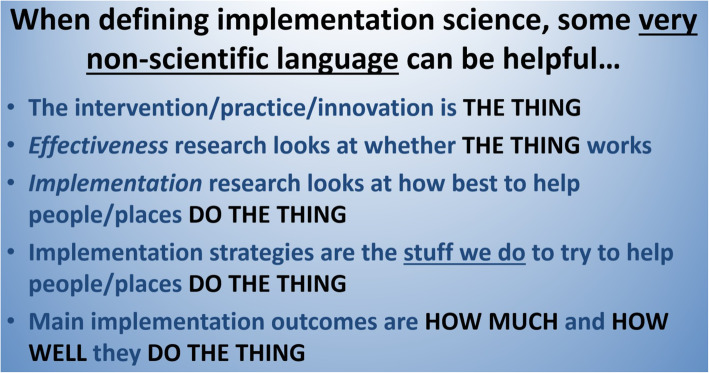
Background: The field of implementation science is growing and becoming more complex. When teaching new learners, providing a clear definition of implementation science and a description of “its place” among related fields can be difficult. The author developed a teaching tool using very simple language to help learners grasp key concepts in implementation science. The teaching tool: The tool consists of a slide (visual aid) which provides simple and jargon-free definitions of implementation science, implementation strategies, and implementation outcomes, as well as a description of how implementation science relates to “effectiveness” research focusing on clinical/preventive interventions. Conclusion: The tool could be useful to new students in the field, as well as other scholars or stakeholders in need of a brief and plain language introduction to key concepts in implementation science.
Overview
The claims and statistics of this paper haven’t been checked yet.
Free: it reads the open-access text and checks the first 5 claims that cite a source we can check. Create a free account to check every claim.
Integrity signals
Registry
Cites
Statistics
Figures
Verification
Claims the paper makes
The claims and statistics of this paper haven’t been checked yet.
Free: it reads the open-access text and checks the first 5 claims that cite a source we can check. Create a free account to check every claim.
Claims other papers make about this one
Each is checked against this paper’s own text: does it say what the citing paper says it does?
The cited source says what the claim attributes to it.
In the citing paper
“the updated CFIR guides users to define the innovation (aka “the thing” [20, 25] being implemented), including the boundary between the innovation and implementation strategies.”
From The updated consolidated framework for implementation research based on user feedback (2022) · cites this paper as [20]
Self-check
Percentages, sums and reported differences re-computed from the paper’s own numbers.
The self-check needs the paper’s full text.
Citations
Cites
Damschroder, L. J., Aron, D. C., Keith, R. E., Kirsh, S. R., Alexander, J. A., & Lowery, J. C. (2009) · Implementation Science · doi:10.1186/1748-5908-4-50 · Cited by 14,496
Proctor, E., Silmere, H., Raghavan, R., Hovmand, P., Aarons, G., Bunger, A., Griffey, R., & Hensley, M. (2011) · Administration and Policy in Mental Health and Mental Health Services Research · doi:10.1007/s10488-010-0319-7 · Cited by 8,721
Powell, B. J., Waltz, T. J., Chinman, M. J., Damschroder, L. J., Smith, J. L., Matthieu, M. M., Proctor, E. K., & Kirchner, J. E. (2015) · Implementation Science · doi:10.1186/s13012-015-0209-1 · Cited by 4,963
Welcome to Implementation Science
Eccles, M. P., & Mittman, B. S. (2006) · Implementation Science · doi:10.1186/1748-5908-1-1 · Cited by 2,254 · cited 1×
“” This is my attempt at boiling down a more detailed definition [6] into the simplest and most basic of language.”
BackgroundBridging Research and Practice
Tabak, R. G., Khoong, E. C., Chambers, D. A., & Brownson, R. C. (2012) · American Journal of Preventive Medicine · doi:10.1016/j.amepre.2012.05.024 · Cited by 1,386
An updated protocol for a systematic review of implementation-related measures
Lewis, C. C., Mettert, K. D., Dorsey, C. N., Martinez, R. G., Weiner, B. J., Nolen, E., Stanick, C., Halko, H., & Powell, B. J. (2018) · Systematic Reviews · doi:10.1186/s13643-018-0728-3 · Cited by 118
Stacey, D., Pomey, M.-P., O'Connor, A. M., & Graham, I. D. (2006) · Implementation Science · doi:10.1186/1748-5908-1-17 · Cited by 63
Research works printed but not linked: 2
- Biedas RS Lewis CC Powell BJ Orientation to the science of dissemination and implementation 2018 Washington, DC Pre-conference workshop, 11th Annual Conference on the Science of Dissemination and Implementation in Health
- Øvretveit J Improve-mentation science and practice for more effective care and research 2019 London Presentation at the Implementation Science Masterclass, King’s College
Cited by
The updated consolidated framework for implementation research based on user feedback
Damschroder, L. J., Reardon, C. M., Widerquist, M. A. O., & Lowery, J. (2022) · Implementation Science · doi:10.1186/s13012-022-01245-0 · Cited by 4,452
“Distinguish the innovation (the “thing” that continues when implementation is complete) [20, 25] from the implementation process and strategies used to implement the innovation [26, 27] (activities that end after implementation is complete) [28].”
BackgroundMethodInfluentialDamschroder, L. J., Reardon, C. M., Opra Widerquist, M. A., & Lowery, J. (2022) · Implementation Science · doi:10.1186/s13012-021-01181-5 · Cited by 784
Woodward, E. N., Singh, R. S., Ndebele-Ngwenya, P., Melgar Castillo, A., Dickson, K. S., & Kirchner, J. E. (2021) · Implementation Science Communications · doi:10.1186/s43058-021-00146-5 · Cited by 270
Reardon, C. M., Damschroder, L. J., Ashcraft, L. E., Kerins, C., Bachrach, R. L., Nevedal, A. L., Domlyn, A. M., Dodge, J., Chinman, M., & Rogal, S. (2025) · Implementation Science · doi:10.1186/s13012-025-01450-7 · Cited by 172
“This is a broad definition and includes any “thing” that is being implemented [8].”
Rudd, B. N., Davis, M., & Beidas, R. S. (2020) · Implementation Science · doi:10.1186/s13012-020-01060-5 · Cited by 157
Porritt, K. A., McArthur, A., Lockwood, C. S., & Munn, Z. (2022) · International Journal of Evidence-Based Healthcare · doi:10.1097/xeb.0000000000000361 · Cited by 197
Crable, E. L., Lengnick‐Hall, R., Stadnick, N. A., Moullin, J. C., & Aarons, G. A. (2022) · Implementation Science · doi:10.1186/s13012-022-01256-x · Cited by 143
“Health policies can also represent the evidence-based law, rule, or “thing” [10] at the center of implementation efforts [5, 11–14], act as determinants that enable or constrain D&I strategies from achieving desired outcomes [5, 15–17], and potentially serve in other causal pathway roles (e.”
BackgroundRapport, F., Smith, J. A., Hutchinson, K., Clay‐Williams, R., Churruca, K., Bierbaum, M., & Braithwaite, J. (2021) · Journal of Evaluation in Clinical Practice · doi:10.1111/jep.13600 · Cited by 124
Moise, N., Cené, C. W., Tabak, R. G., Young, D. R., Mills, K. T., Essien, U. R., Anderson, C. A. M., & López-Jiménez, F. A. (2022) · Circulation · doi:10.1161/cir.0000000000001096 · Cited by 112
FAST: A Framework to Assess Speed of Translation of Health Innovations to Practice and Policy
Proctor, E., Ramsey, A. T., Saldana, L., Maddox, T. M., Chambers, D. A., & Brownson, R. C. (2022) · Global Implementation Research and Applications · doi:10.1007/s43477-022-00045-4 · Cited by 95
“Implementation strategies are the “how to” for moving guidelines, policies, and practices into adoption and use (Curran, 2020; Proctor et al., 2009).”
BackgroundSix practical recommendations for improved implementation outcomes reporting
Lengnick-Hall, R., Gerke, D. R., Proctor, E. K., Bunger, A. C., Phillips, R. J., Martin, J. K., & Swanson, J. C. (2022) · Implementation Science · doi:10.1186/s13012-021-01183-3 · Cited by 86
“As such, our third recommendation is to specify “the thing” [20] that each implementation outcome will be measured in relation to.”
BackgroundInfluentialBalis, L. E., Houghtaling, B., & Harden, S. M. (2022) · Translational Behavioral Medicine · doi:10.1093/tbm/ibac061 · Cited by 63
Evidence-based practice implementation in healthcare in China: a living scoping review
Zhao, J., Bai, W., Zhang, Q., Su, Y., Wang, J., Xiao-ning, D., Zhou, Y., Kong, C., Qing, Y., Gong, S., et al. (2022) · The Lancet Regional Health - Western Pacific · doi:10.1016/j.lanwpc.2021.100355 · Cited by 81
Four very basic ways to think about policy in implementation science
Purtle, J., Moucheraud, C., Yang, L. H., & Shelley, D. (2023) · Implementation Science Communications · doi:10.1186/s43058-023-00497-1 · Cited by 68
“Here, a specific policy proposal is the focus of the research question and conceptualized as “the thing” per Curran’s terminology [18] (Curran defines “the thing” as the intervention, practice, or innovation which is in need of dissemination or implementation support).”
BackgroundMethodLeveraging implementation science to advance antibiotic stewardship practice and research
Livorsi, D. J., Drainoni, M., Reisinger, H. S., Nanda, N., McGregor, J. C., Barlam, T. F., Morris, A. M., & Szymczak, J. E. (2021) · Infection Control and Hospital Epidemiology · doi:10.1017/ice.2021.480 · Cited by 51
My 35 Years in Mixed Methods Research
Creswell, J. W. (2024) · Journal of Mixed Methods Research · doi:10.1177/15586898241253892 · Cited by 123
“With great interest, I read the implementation science article by Curran (2020), where he advanced “ Implementation Science Made Too Simple: A Teaching Tool.”
Nevedal, A. L., Reardon, C. M., Jackson, G. L., Cutrona, S. L., White, B., Gifford, A. L., Orvek, E., DeLaughter, K., White, L., King, H. A., et al. (2020) · Implementation Science Communications · doi:10.1186/s43058-020-00053-1 · Cited by 44
“Implementation science is the systematic study of methods to encourage the integration of evidence-based practices (EBPs) into routine care to improve outcomes [1, 2].”
BackgroundSmith, J. D., Li, D. H., Merle, J. L., Keiser, B., Mustanski, B. S., & Benbow, N. (2024) · Implementation Science · doi:10.1186/s13012-024-01345-z · Cited by 53
A research agenda to advance the study of implementation mechanisms
Lewis, C. C., Frank, H. E., Cruden, G., Kim, B., Stahmer, A. C., Lyon, A. R., Albers, B., Aarons, G. A., Beidas, R. S., Mittman, B. S., et al. (2024) · Implementation Science Communications · doi:10.1186/s43058-024-00633-5 · Cited by 51
“The MNoE articulated numerous manuscripts that would be helpful such as Mechanisms Made Too Simple , inspired by Curran’s article [118].”
The Updated Consolidated Framework for Implementation Research: CFIR 2.0Preprint
Damschroder, L. J., Reardon, C. M., Widerquist, M. A. O., & Lowery, J. C. (2022) · Research Square · doi:10.21203/rs.3.rs-1581880/v1 · Cited by 42
Implementation of digital health interventions in rehabilitation: A scoping review
Pearce, L. M. N., Costa, N., Sherrington, C., & Hassett, L. M. (2023) · Clinical Rehabilitation · doi:10.1177/02692155231172299 · Cited by 57
“Implementation outcomes and determinants Implementation outcomes are measures used to evaluate the success of implementation,(43) and in this context can be viewed as how much and how well the digital intervention is used.(39) Meanwhile, implementation determinants refer to factors that 1536 Clinical Rehabilitation 37…”
BackgroundDissemination Science in School Mental Health: A Framework for Future Research
Baker, E. A., Brewer, S. K., Owens, J. S., Cook, C. R., & Lyon, A. R. (2021) · School Mental Health · doi:10.1007/s12310-021-09446-6 · Cited by 46
Yakovchenko, V., Chinman, M. J., Lamorte, C., Powell, B. J., Waltz, T. J., Merante, M., Gibson, S., Neely, B., Morgan, T. R., & Rogal, S. S. (2023) · Implementation Science Communications · doi:10.1186/s43058-023-00409-3 · Cited by 38
Lewis, C. C., Mettert, K., & Lyon, A. R. (2021) · Implementation Research and Practice · doi:10.1177/2633489521994197 · Cited by 38
“The current study confirms that intervention characteristics are understudied in behavioral health implementation research, at least with regard to the development and testing of measures intended to assess “the thing” being implemented (Curran, 2020).”
BackgroundEngell, T., Stadnick, N. A., Aarons, G. A., & Barnett, M. L. (2023) · Global Implementation Research and Applications · doi:10.1007/s43477-023-00077-4 · Cited by 37
“…is deconstructing “the thing” to be implemented (e.g., the clinical intervention, program, or policy implemented) or “the stuff that we do to get people and places to do the thing” (implementation strategies; Curran, 2020) into its smaller meaningful entities (e.g., elements and components).”
BackgroundFirm, yet flexible: a fidelity debate paper with two case examples
Albers, B., Verweij, L., Blum, K., Oesch, S., Schultes, M.-T., Clack, L., & Naef, R. (2024) · Implementation Science · doi:10.1186/s13012-024-01406-3 · Cited by 37
“…clearly differentiating between clinical intervention activities and the implementation strategies applied to make these actions happen remains challenging for researchers [28–30], further limiting opportunities to contemplate implementation fidelity-related phenomena in healthcare studies.”
Trinkley, K. E., Glasgow, R. E., D’Mello, S. K., Fort, M. P., Ford, B. S., & Rabin, B. A. (2023) · Implementation Science Communications · doi:10.1186/s43058-023-00494-4 · Cited by 42
“Despite its promise and potential benefits, a key reason for the lack of IS uptake by the broad community of researchers and implementers lies in its complexity which can make it difficult to grasp for newcomers [15, 16].”
BackgroundTildy, B. E., McNeill, A. D., Perman‐Howe, P. R., & Brose, L. S. (2023) · BMC Family Practice · doi:10.1186/s12875-023-01981-2 · Cited by 47
Guerin, R. J., Harden, S. M., Rabin, B. A., Rohlman, D. S., Cunningham, T. R., TePoel, M. R. W., Parish, M., & Glasgow, R. E. (2021) · International Journal of Environmental Research and Public Health · doi:10.3390/ijerph182111050 · Cited by 41
“The following sections use the Curran [15] tool to expand on important concepts in the D&I field for TWH researchers to consider when planning/conducting D&I studies.”
BackgroundMethodInfluentialUsing Implementation Science in Nursing Research
Roberts, N. A., Young, A., & Duff, J. S. (2023) · Seminars in Oncology Nursing · doi:10.1016/j.soncn.2023.151399 · Cited by 41
Reese, T. J., Schlechter, C. R., Kramer, H., Kukhareva, P., Weir, C. R., Fiol, G. D., Caverly, T. J., Hess, R., Flynn, M. C., Taft, T., et al. (2021) · Translational Behavioral Medicine · doi:10.1093/tbm/ibab115 · Cited by 33
Balis, L. E., Houghtaling, B., Clausen, W., Lane, H., Wende, M. E., Pereira, E. L., McLoughlin, G. M., & Harden, S. M. (2024) · International Journal of Behavioral Nutrition and Physical Activity · doi:10.1186/s12966-024-01685-5 · Cited by 39
“”) [94].”
Conceptual Confusion Leads Policy Evaluation Astray
Burris, S. C., Pacula, R. L., & Wagenaar, A. C. (2024) · JAMA Health Forum · doi:10.1001/jamahealthforum.2024.1180 · Cited by 28
Wiener, R. S., Barker, A. M., Carter‐Harris, L., Caverly, T. J., Crocker, D. A., Denietolis, A., Doherty, C., Fagerlin, A., Gallagher-Seaman, M., Gould, M. K., et al. (2022) · American Journal of Respiratory and Critical Care Medicine · doi:10.1164/rccm.202201-0126st · Cited by 30
Wensing, M., Sales, A. E., Aarons, G. A., Xu, D. R., & Wilson, P. M. (2022) · Implementation Science · doi:10.1186/s13012-022-01249-w · Cited by 36
“It is incumbent on study authors to be clear about the research evidence supporting the “thing” [4] or “implementation object” that is being implemented and how that was assessed.”
BackgroundStrategies to Integrate Genomic Medicine into Clinical Care: Evidence from the IGNITE Network
Sperber, N. R., Dong, O. M., Roberts, M. C., Dexter, P. R., Elsey, A. R., Ginsburg, G. S., Horowitz, C. R., Johnson, J. A., Levy, K. D., Ong, H. H., et al. (2021) · Journal of Personalized Medicine · doi:10.3390/jpm11070647 · Cited by 31
“As such, implementation research starts with an underutilized evidence-based practice and focuses on processes to deliver the practice, providing a frame for defining, measuring, and reproducing strategies to improve use of the clinical practice—the “how”—in different contexts [10,11].”
BackgroundImplementing Health Related Social Needs Screening in an Outpatient Clinic
Nohria, R., Xiao, N., Guardado, R., Drainoni, M., Smith, C. L., Nokes, K., & Byhoff, E. (2022) · Journal of Primary Care & Community Health · doi:10.1177/21501319221118809 · Cited by 28
del Pozo, B., Belenko, S. R., Pivovarova, E., Ray, B. R., Martins, K. F., & Taxman, F. S. (2024) · Police Quarterly · doi:10.1177/10986111241265290 · Cited by 30
“The approach may be best conveyed by a series of questions that relate to different parts of the undertaking, presented here by adapting the concept of “ THE THING, ” an IS teaching tool developed by Curran (2020): · What is the THE THING that an agency seeks to implement?”
Tabak, R. G., Kandula, N. R., Angell, S. Y., Brewer, L. C., Grandner, M. A., Hayman, L. L., Ing, C. T., Joseph, J. J., Moise, N., Nelson, S. E., et al. (2025) · Circulation · doi:10.1161/cir.0000000000001349 · Cited by 24
Implementation Science and Practice-Oriented Research: Convergence and Complementarity
Youn, S. J., Boswell, J. F., Douglas, S. R., Harris, B. A., Aajmain, S. T., Arnold, K. T., Creed, T. A., Gutner, C. A., Orengo‐Aguayo, R., Oswald, J. M., et al. (2023) · Administration and Policy in Mental Health and Mental Health Services Research · doi:10.1007/s10488-023-01296-5 · Cited by 25
“Implementation outcomes help to assess “how much” and “how well” an organization, provider, or healthcare system uses the intervention being implemented (Curran, 2020).”
Knox, J., Schwartz, S., Duncan, D. T., Curran, G. M., Schneider, J. A., Stephenson, R. B., Wilson, P. A., Nash, D., Sullivan, P. S., & Geng, E. (2023) · Annals of Epidemiology · doi:10.1016/j.annepidem.2023.03.008 · Cited by 27
Self-citationDissemination and Implementation Science in Cardiothoracic Surgery: A Review and Case Study
Heiden, B. T., Tetteh, E., Robbins, K. J., Tabak, R. G., Nava, R. G., Marklin, G. F., Kreisel, D., Meyers, B. F., Kozower, B. D., McKay, V., et al. (2021) · The Annals of Thoracic Surgery · doi:10.1016/j.athoracsur.2021.08.007 · Cited by 21
Harden, S. M., Balis, L. E., Strayer, T. E., & Wilson, M. L. (2021) · Preventing Chronic Disease · doi:10.5888/pcd18.200513 · Cited by 22
“Finally, intervention costs are often a barrier to increasing the scale of a program (44).”
Stuermer, N., Gani, S. M. D., Beese, A.-S., Evack, J. G., Jaks, R., & Nicca, D. (2022) · International Journal of Environmental Research and Public Health · doi:10.3390/ijerph192315916 · Cited by 20
Feasibility of Implementation Mapping for Integrative Medical Group Visits
Roth, I., Tiedt, M., Barnhill, J. L., Karvelas, K. R., Faurot, K. R., Gaylord, S. A., Gardiner, P. M., Miller, V. E., & Leeman, J. (2021) · The Journal of Alternative and Complementary Medicine · doi:10.1089/acm.2020.0393 · Cited by 22
“Implementation mapping offers a systematic process for selecting the implementation strategies needed to overcome barriers to implementation by considering relevant behavioral theories and stakeholder input.(23) Utilizing a systematic process enhances replicability, while utilizing relevant theory enhances the potenti…”
Taylor, S. P., & Kowalkowski, M. A. (2020) · Journal of General Internal Medicine · doi:10.1007/s11606-020-06220-3 · Cited by 22
Implementation science: why should we care?
Chu, F. (2024) · Journal of the Medical Library Association JMLA · doi:10.5195/jmla.2024.1919 · Cited by 26
“Curran [8] describes implementation science versus efficacy/effectiveness research in simplified terms.”
BackgroundLau, A. S., Huey, S. J., & Baumann, A. A. (2023) · Behaviour Research and Therapy · doi:10.1016/j.brat.2023.104377 · Cited by 19
Advancing the science of integrating multiple interventions by blending and bundling
Villalobos, A. V. K., & Chambers, D. (2023) · JNCI Cancer Spectrum · doi:10.1093/jncics/pkad070 · Cited by 15
Wortham, W. K., Rodwin, A. H., Purtle, J., Munson, M. R., & Raghavan, R. (2023) · Implementation Science · doi:10.1186/s13012-023-01309-9 · Cited by 20
“EBPs—not policies— are “the thing” of focus per Curran’s terminology [10].”
Integrating Implementation Science with Quality Improvement to Improve Perinatal Outcomes
Callaghan‐Koru, J. A., Farzin, A., Ridout, E., & Curran, G. M. (2023) · Clinics in Perinatology · doi:10.1016/j.clp.2023.01.002 · Cited by 17
Self-citationAsada, Y., Kroll‐Desrosiers, A., Chriqui, J. F., Curran, G. M., Emmons, K. M., Haire-Joshu, D. L., & Brownson, R. C. (2023) · Frontiers in Health Services · doi:10.3389/frhs.2023.1220629 · Cited by 19
Self-citationAshcraft, L. E., Cabrera, K. I., Lane-Fall, M. B., & South, E. C. (2024) · Annual Review of Public Health · doi:10.1146/annurev-publhealth-060222-033003 · Cited by 17
A Guide to Implementation Science for Phase 3 Clinical Trialists
Spall, H. G. C. V., Desveaux, L., Finch, T. L., Lewis, C. C., Mensah, G. A., Rosenberg, Y., Singh, K., Venter, F., Weiner, B. J., & Zannad, F. M. (2024) · Journal of the American College of Cardiology · doi:10.1016/j.jacc.2024.08.068 · Cited by 16
Implementation Strategies to Support Built Environment Approaches in Community Settings
Balis, L. E., & Vincent, J. (2022) · Health Promotion Practice · doi:10.1177/15248399221081835 · Cited by 16
“As simplified by Curran, implementation strategies are “the stuff we do to try to help people/places do the thing (intervention/practice/innovation)” (Curran, 2020).”
BackgroundMethodStephenson, L., Gergel, T., Keene, A. R., Rifkin, L., & Owen, G. S. (2022) · Wellcome Open Research · doi:10.12688/wellcomeopenres.17947.1 · Cited by 17
Implementation Science to Improve Quality of Neurological Care
Samanta, D., & Landes, S. J. (2021) · Pediatric Neurology · doi:10.1016/j.pediatrneurol.2021.05.009 · Cited by 16
Simpson, M. L., Ruru, S., OETZEL, J. G., Meha, P., Nock, S., Holmes, K., Adams, H., Akapita, N., Clark, M., Ngaia, K., et al. (2022) · Implementation Science Communications · doi:10.1186/s43058-022-00374-3 · Cited by 17
“The fundamental purpose of implementation science is to examine how to best support communities in accessing and adapting evidence-based interventions, programmes, or innovations that will benefit them [11].”
BackgroundStreet, A., Maynou, L., & Conroy, S. (2023) · BMJ Quality & Safety · doi:10.1136/bmjqs-2022-015832 · Cited by 14
Terminology for Dissemination and Implementation Research
Rabin, B. A., Viglione, C., & Brownson, R. C. (2023) · Oxford University Press eBooks · doi:10.1093/oso/9780197660690.003.0002 · Cited by 18
Research and scholarly methods: Implementation science studies
Kuo, G. M., Trinkley, K. E., & Rabin, B. A. (2022) · JACCP JOURNAL OF THE AMERICAN COLLEGE OF CLINICAL PHARMACY · doi:10.1002/jac5.1673 · Cited by 20
Houghtaling, B., Misyak, S. A., Serrano, E. L., Dombrowski, R. D., Holston, D., Singleton, C. R., & Harden, S. M. (2023) · Journal of Nutrition Education and Behavior · doi:10.1016/j.jneb.2022.10.002 · Cited by 17
Implementation science in plain language: The use of nonjargon terms to facilitate collaboration
Dorsey, S., Johnson, C. M., Soi, C., Meza, R. D., Whetten, K., & Mbwayo, A. (2023) · Implementation Research and Practice · doi:10.1177/26334895231177474 · Cited by 14
“As an indicator of our fields’ interest, colleagues long encouraged Geoff Curran to publish his simplified implementation science teaching tool that uses plain language to describe key concepts and implementation science’s place among related fields (Curran, 2020) (accessed > 12,000 times).”
BackgroundWellmann, I. A., Ayala, L. F., Valley, T. M., Irazola, V. E., Huffman, M. D., Heisler, M., Rohloff, P. J., Donis, R., Palacios, E., Ramírez‐Zea, M., et al. (2025) · Global Heart · doi:10.5334/gh.1397 · Cited by 16
Singh, M. A., Sanchez, V., Kenzie, E. S., Sullivan, E., McCormack, J. L., Larson, J. H., Robbins, A., Weekley, T., Hatch, B., Dickinson, C., et al. (2022) · PLoS ONE · doi:10.1371/journal.pone.0269635 · Cited by 13
Implementation and Impact of Perinatal Food Is Medicine Programs: A Qualitative Research Study
Balis, L. E., Yaroch, A. L., Palmer, S., Shaw, E., Santos, P. L. D., & Shanks, C. B. (2024) · Journal of the Academy of Nutrition and Dietetics · doi:10.1016/j.jand.2024.02.007 · Cited by 16
Implementation science for dietitians: The ‘what, why and how’ using multiple case studies
Young, A., Hickman, I. J., Campbell, K. L., & Wilkinson, S. A. (2021) · Nutrition & Dietetics · doi:10.1111/1747-0080.12677 · Cited by 17
Implementation science promotes clinical practice of guidelines: a scoping review
Zhang, J., Xue, X., Liang, S., Bao, Y., & Chen, Z. (2025) · BMC Health Services Research · doi:10.1186/s12913-025-13317-0 · Cited by 19
“Although multiple frameworks have been developed and advocated—corroborating the findings of Tinkle et al. [140] and Kirk et al. [141]—the lack of standardized selection criteria and application protocols contributes to their underutilization and suboptimal application [133, 134, 142, 143].”
Fahim, C., Courvoisier, M., Somani, N., Matas, F. D., & Straus, S. E. (2023) · Implementation Science Communications · doi:10.1186/s43058-023-00480-w · Cited by 14
Dowd, A. J. (2024) · International Journal of Educational Development · doi:10.1016/j.ijedudev.2024.103068 · Cited by 15
Harnessing Implementation Science in Clinical Psychology: Past, Present, and Future
Beidas, R. S., Boyd, M. R., Casline, E. P., Scott, K., Patel, Z. S., Mills, C., Mustanski, B. S., Schriger, S. H., Williams, F. S., Waller, C., et al. (2025) · Annual Review of Clinical Psychology · doi:10.1146/annurev-clinpsy-081423-021727 · Cited by 14
“…manner that clinical psychologists have innovated in intervention science to examine how, when, and for whom interventions work (Kazdin 2007), innovation is needed in IS to understand how, when, and for whom implementation strategies work (Kazdin 2007; Klasnja et al. 2024; Lewis et al. 2018, 2020).”
Implementing Implementation Research: Teaching Implementation Research to HIV Researchers
Schwartz, S., Smith, J. D., Hoffmann, C. J., Hansoti, B., Mishra, S., Means, A. R., Go, V. F.-L., Sherr, K., Nash, D., Sullivan, P. S., et al. (2021) · Current HIV/AIDS Reports · doi:10.1007/s11904-021-00551-4 · Cited by 11
Smith, J. A., Braithwaite, J., O'Brien, T. A., Smith, S., Tyrrell, V. J., Mould, E. V. A., Long, J. C., & Rapport, F. (2022) · Qualitative Health Research · doi:10.1177/10497323221120501 · Cited by 13
“…(Damschroder et al., 2022; Nevedal et al., 2021) and enhance our ability to rapidly understand both implementation and trial outcomes (Anderson et al., 2021; Chambers et al., 2013; Curran, 2020; Palsola et al., 2020; Price et al., 2019; Proctor et al., 2011; Smith, Rapport, et al., 2020).”
BackgroundInfluentialLane, H., Turner, L. R., Dunn, C. G., Hager, E. R., & Fleischhacker, S. E. (2020) · Public Health Reports · doi:10.1177/0033354920959285 · Cited by 14
Expanding methods to address RE-AIM metrics in hybrid effectiveness-implementation studies
Harden, S. M., Galaviz, K. I., & Estabrooks, P. A. (2024) · Implementation Science Communications · doi:10.1186/s43058-024-00646-0 · Cited by 19
“…is to clearly specify and distinguish an intervention intended to result in health improvements among beneficiaries versus dissemination and implementation strategies applied at the level of setting, organization, and/or staff with a goal to improve adoption, implementation, and maintenance [21].”
BackgroundBragge, P., McNett, M., Bayley, M., Dobbins, M., Nakase-Richardson, R., Peek-Asa, C., Turgeon, A. F., Awwad, H., Dams-O’Connor, K., Doperalski, A., et al. (2025) · Journal of Neurotrauma · doi:10.1089/neu.2024.0576 · Cited by 10
Rudd, B. N., & Beidas, R. S. (2021) · Family Court Review · doi:10.1111/fcre.12606 · Cited by 10
Kearney, C. A., Fensken, M., & Dupont, R. (2025) · Frontiers in Education · doi:10.3389/feduc.2025.1553528 · Cited by 23
Sustainability via Active Garden Education: The Sustainability Action Plan Model and Process
Lee, R. E., Szeszulski, J., Lorenzo, E., Arriola, A., Bruening, M. M., Estabrooks, P. A., Hill, J. L., O’Connor, T. M., Shaibi, G. Q., Soltero, E. G., et al. (2022) · International Journal of Environmental Research and Public Health · doi:10.3390/ijerph19095511 · Cited by 11
“, Early Care and Education Centers [ECECs]) deliver an intervention [18].”
BackgroundSmith, J. A., van der Groen, O., & Learmonth, Y. C. (2023) · International Journal of Qualitative Methods · doi:10.1177/16094069231180162 · Cited by 14
“The implementation strategies in the MS context based on our document sources are the strategies (reminders, education etc.) used to support the uptake of the exercise intervention (Curran, 2020; Smith et al., 2022).”
MethodMunn, Z., McArthur, A., Klugar, M., Stannard, D., Cooper, A. S., Enuameh, Y., & Porritt, K. A. (2023) · International Journal of Evidence-Based Healthcare · doi:10.1097/xeb.0000000000000397 · Cited by 10
“…(and tailored strategies to achieve this behavioral change), consideration of the culture and a potential cultural change, social action, conducive and supportive environments, justifiable interventions (ie, the “ thing ” that is being introduced), 37 supportive leadership, and facilitation. p.4)”
BackgroundImplementing a Clinical Pathway for Needs Assessment and Supportive Care Interventions
Stout, N. L., Alfano, C. M., Liu, R., Dixit, N., & Jefford, M. (2024) · JCO Oncology Practice · doi:10.1200/op.23.00482 · Cited by 11
Lauck, S., Saarijärvi, M., Sousa, I. D., Straiton, N., Borregaard, B., & Lewis, K. B. (2023) · European Journal of Cardiovascular Nursing · doi:10.1093/eurjcn/zvad077 · Cited by 9
“17”
Designing and Conducting Q Methodology in Implementation Research: A Methodological Discussion
Younas, A., Maddigan, J., Moore, J. E., & Whitehead, D. (2024) · Global Implementation Research and Applications · doi:10.1007/s43477-023-00113-3 · Cited by 14
“Col-loquially, in implementation research innovation refers to “The THING” and the implementation strategies are the approaches to help individuals and organizations “DO the THING” (Curran, 2020).”
Wrobel, A., Beasy, K. M., Fiedler, T., Mann, A., Morrison, B., Towle, N., Wood, G., Doyle, R., Peterson, C., & Bettiol, S. S. (2024) · International Journal of Sustainability in Higher Education · doi:10.1108/ijshe-04-2024-0242 · Cited by 12
Larsson, R. (2024) · Frontiers in Public Health · doi:10.3389/fpubh.2024.1424900 · Cited by 12
“Recently, a “new” research-practice gap seems to have emerged in implementation research and practice despite commendable attempts to simplify the sometimes inaccessible and jargon-ridden implementation literature for practitioners (13).”
BackgroundAn evidence cycle framework for community development initiatives
Browne, G. R. (2022) · Community Development Journal · doi:10.1093/cdj/bsac011 · Cited by 17
Revisiting systematic reviews on deprescribing trials to better inform future practice and research
Spinewine, A., Reeve, E., & Thompson, W. (2023) · British Journal of Clinical Pharmacology · doi:10.1111/bcp.15864 · Cited by 10
“Using the simple language of G.M. Curran 20 adapted to deprescribing, effectiveness research looks at whether discontinuing a medication works, while implementation research looks at how to help trials), and the language used should be unequivocal.”
MethodRethinking Physical Activity Promotion During the COVID-19 Pandemic: Focus on a 24-hour Day
LI, L. C., Feehan, L. M., & Hoens, A. M. (2021) · The Journal of Rheumatology · doi:10.3899/jrheum.201595 · Cited by 8
Lost in translation: key lessons from conducting dissemination and implementation science in Zambia
Maritim, P., Munakampe, M. N., Nglazi, M. D., Mweemba, C., Sikombe, K., Mbewe, W., Silumbwe, A., Jacobs, C. N., Zulu, J. M., Herce, M. E., et al. (2024) · Implementation Science Communications · doi:10.1186/s43058-024-00663-z · Cited by 7
Implementation Science for the Practice-Oriented Nurse Leader
Nelson‐Brantley, H. V., & Chipps, E. M. (2023) · Nursing Administration Quarterly · doi:10.1097/naq.0000000000000572 · Cited by 8
Chays‐Amania, A., Schwingrouber, J., Melnyk, B. M., Haller, P. H., Soler, J., & Colson, S. (2025) · Worldviews on Evidence-Based Nursing · doi:10.1111/wvn.70050 · Cited by 10
Rodriguez, B., Prinzi, A. M., Hill, B. K., Tibbetts, R. J., Salazar, H., McAdams, D., Rivera-Acosta, A. M., Wungwattana, M., Silbert, S., & Niles, D. T. (2025) · Antimicrobial Stewardship & Healthcare Epidemiology · doi:10.1017/ash.2025.10039 · Cited by 10
The “D&I Bridge”: introducing a teaching tool to define the D, the I, and the why
Becker, S. J., DiClemente-Bosco, K., Scott, K., Helseth, S. A., Patel, Z. S., & Li, D. H. (2024) · Implementation Science Communications · doi:10.1186/s43058-024-00558-z · Cited by 7
“In a seminal 2020 article, Geoff Curran shared a simple teaching tool to help investigators understand the difference between an intervention and implementation strategy [4].”
BackgroundInfluentialWoodward, E. N., Singh, R. S., Ndebele‐Ngwenya, P., Castillo, A. M., Dickson, K. S., & Kirchner, J. E. (2020) · Research Square · doi:10.21203/rs.3.rs-32704/v2 · Cited by 11
Common Elements of Trauma-Informed Schools and Attention to Racial Equity: A Scoping Review
Onipede, Z. A., Park, A. L., & Lau, A. S. (2024) · School Mental Health · doi:10.1007/s12310-024-09721-2 · Cited by 15
“…to be implemented, the content of a trauma-informed change to practice within schools (e.g., educational and clinical practice innovations for trauma-affected students, prescribed content for staff training in trauma, reform of discipline practices that retraumatize students) (Curran, 2020).”
Designing an intervention to improve cognitive evaluations in primary care
O’Brien, K. S., Harkins, K. A., Peifer, M. K., Kleid, M., Coykendall, C., Shea, J. A., Karlawish, J. H., & Burke, R. E. (2025) · Implementation Science Communications · doi:10.1186/s43058-025-00693-1 · Cited by 8
Roseen, E. J., Bussières, A., Reichman, R., Bora, C., Trieu, J., Austad, K., Williams, C., Fischer, R. A., Parrilla, D., Laird, L. D., et al. (2025) · Chiropractic & Manual Therapies · doi:10.1186/s12998-024-00565-w · Cited by 7
“We designate ‘chiropractic care’ as the evidence-based treatment for LBP to be adopted by the primary care clinics [37].”
Woodward, E. N., Willging, C. E., Landes, S. J., Hausmann, L. R. M., Drummond, K. L., Ounpraseuth, S., Ball, I. A., & Kirchner, J. E. (2022) · BMJ Open · doi:10.1136/bmjopen-2021-050107 · Cited by 7
Distilling Check-in/Check-Out into Its Core Practice Elements Through an Expert Consensus Process
Filter, K. J., Ford, A. L. B., Bullard, S. J., Cook, C. R., Sowle, C. A., Johnson, L., Kloos, E. T., & Dupuis, D. (2022) · School Mental Health · doi:10.1007/s12310-021-09495-x · Cited by 6
“Curran (2020) differentiates the features of an intervention from the implementation strategies that are put in place to ensure implementation of the intervention.”
Background
Metadata
- Authors
- Curran, G. M.
- Affiliations
- Central Arkansas Veterans Healthcare System (US)
- Corresponding author
- Curran, Geoffrey M.
- ORCID
- Curran, Geoffrey M.
- Venue
- Implementation Science Communications
- Published
- 2020-02-25
- Volume
- 1
- Issue
- 1
- Pages
- 27-27
- ISSN
- 2662-2211 (ISSN-L)
- PMC
- PMC7427844
- OpenAlex
- W3031560769
- Semantic Scholar
- 112be96b7b10d0cf3ddbf75826a36392b2927a13
- Cited by
- 285
- References
- 9
- Citations by year
- 2026: 41 · 2025: 55 · 2024: 68 · 2023: 46 · 2022: 39 · 2021: 24 · 2020: 12
- FWCI
- 31.59
- Type
- journal article
- Language
- en
- Open access
- gold
- doi.org
- Licence
- cc-by
- creativecommons.org/licenses/by/4.0/ (tdm)
- creativecommons.org/licenses/by/4.0/ (vor)
- Locations
- Implementation Science Communications (publishedVersion, cc-by)
- PubMed Central (publishedVersion, cc-by)
- PubMed (publishedVersion)
- DOAJ (DOAJ: Directory of Open Access Journals) (submittedVersion, cc-by-sa)
- Topics
- Health Sciences › Health Professions › General Health Professions › Health Policy Implementation Science
- Health Sciences › Health Professions › General Health Professions › Health Sciences Research and Education
- Social Sciences › Education › Innovations in Medical Education
- Keywords
- implementation science, teaching aids, plain language, slide presentation, implementation strategies, implementation outcomes, effectiveness research, clinical intervention, preventive interventions, conceptual definitions
About these checks
Registry, retraction, Cites and statistics results are computed, not judged, with one exception: a printed reference that no index lists is read once by a model before it counts as a citation error. Claims are extracted by a model and kept only when their quote appears verbatim in the text; each cited source is then checked, with a model’s help, for whether it says what the claim relies on. Those verdicts can be wrong — read the claim’s quote and the cited source before relying on one.
Statistics and arithmetic are recomputed, not judged.
Confidence bands are shown only for fields calibrated on our annotated test set. None is calibrated yet, so no band is shown.
What counts as a claim ›How we measure confidence ›How we check this ›
Are you an author, or do you see a problem with this page? Request a review
Data sources
Bibliographic data: Semantic Scholar, OpenAlex, Crossref.
Contains information from the Semantic Scholar Academic Graph Datasets, made available under the ODC Attribution License (ODC-BY 1.0).
Semantic Scholar’s data is described in: Kinney, R., et al. (2023). The Semantic Scholar Open Data Platform. arXiv:2301.10140.
