

What Do I Want to Be with My PhD? The Roles of Personal Values and Structural Dynamics in Shaping the Career Interests of Recent Biomedical Science PhD Graduates.
Open accessThe DOI matches its Crossref record; 60 of the 62 references it cites were found in a registry or an index.
Abstract
Interest in faculty careers decreases as graduate training progresses; however, the process underlying career-interest formation remains poorly defined. To better understand this process and whether/how it differs across social identity (i.e., race/ethnicity, gender), we conducted focus groups with 38 biomedical scientists who received PhDs between 2006 and 2011, including 23 women and 18 individuals from underrepresented minority (URM) backgrounds. Objective performance and quality of advisor relationships were not significantly different between scientists with high versus low interest in faculty careers. Career interests were fluid and formed in environments that generally lacked structured career development. Vicarious learning shaped similar outcome expectations about academic careers for all scientists; however, women and URMs recounted additional, distinct experiences and expectations. Scientists pursuing faculty careers described personal values, which differed by social identity, as their primary driver. For scientists with low interest in faculty careers, a combination of values, shared across social identity, and structural dynamics of the biomedical workforce (e.g., job market, grant funding, postdoc pay, etc.) played determinative roles. These findings illuminate the complexity of career choice and suggest attracting the best, most diverse academic workforce requires institutional leaders and policy makers go beyond developing individual skill, attending to individuals’ values and promoting institutional and systemic reforms.
Overview
The claims and statistics of this paper haven’t been checked yet.
Free: it reads the open-access text and checks the first 5 claims that cite a source we can check. Create a free account to check every claim.
Integrity signals
Registry
Cites
Statistics
Figures
Verification
Claims the paper makes
The claims and statistics of this paper haven’t been checked yet.
Free: it reads the open-access text and checks the first 5 claims that cite a source we can check. Create a free account to check every claim.
Claims other papers make about this one
Each is checked against this paper’s own text: does it say what the citing paper says it does?
The cited source says what the claim attributes to it.
In the citing paper
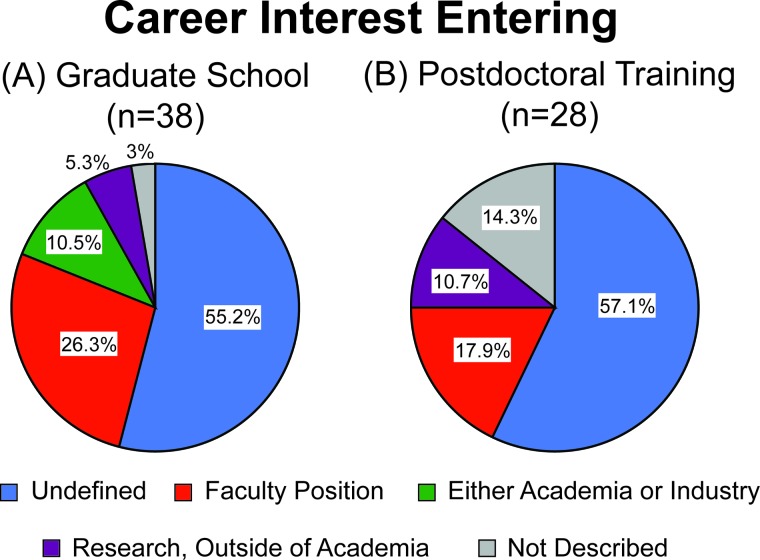
“Specifically, one study found that out of 38 recently graduated biomedical PhD students, more than half (55.2%) of them described entering their PhD program without clearly defined career goals [46].”
From "It let me merge my love of teaching with research": A qualitative investigation of the career pathways of biology education researchers. (2024) · cites this paper as [46]
The cited source says what the claim attributes to it.
In the citing paper
“One study exploring why recent biomedical science PhD graduates left academia to pursue other ventures also cited their desire to make a difference in the world [46].”
From "It let me merge my love of teaching with research": A qualitative investigation of the career pathways of biology education researchers. (2024) · cites this paper as [46]
The cited source says what the claim attributes to it.
In the citing paper
“Despite having the same motivations for leaving disciplinary biology research in academia, the participants in our study pivoted towards biology education research, staying in academia, rather than pursuing nonacademic career pathways as the PhD graduates did in previous literature [46].”
From "It let me merge my love of teaching with research": A qualitative investigation of the career pathways of biology education researchers. (2024) · cites this paper as [46]
The cited source says what the claim attributes to it.
In the citing paper
“Our finding that faculty members joined biology education research to make a difference in the world aligns with previous literature.”
From "It let me merge my love of teaching with research": A qualitative investigation of the career pathways of biology education researchers. (2024) · cites this paper as [46]
Self-check
Percentages, sums and reported differences re-computed from the paper’s own numbers.
The self-check needs the paper’s full text.
Citations
Cites
The Discovery of Grounded Theory: Strategies for Qualitative Research.
Wagner, H. R., Glaser, B. G., & Strauss, A. L. (1968) · Social Forces · doi:10.2307/2575405 · Cited by 46,361
(1998) · Medical Entomology and Zoology · Cited by 18,397
Qualitative Research for Education: An Introduction to Theory and Methods
Bogdan, R., & Biklen, S. K. (1997) · Medical Entomology and Zoology · Cited by 15,168
An index to quantify an individual’s scientific research output
Hirsch, J. E. (2005) · Proceedings of the National Academy of Sciences · doi:10.1073/pnas.0507655102 · Cited by 11,669 · cited 2×
“Scientists with high interest in faculty careers had a median of two firstauthor and seven total peer-reviewed publications (indexed in Scopus 2 ); the journals in which they published had an average impact factor of 5.8; and these scientists had a mean h-index of 5 (Hirsch, 2005).”
BackgroundInfluential(1996) · Cited by 11,584
Focus Groups: A Practical Guide for Applied Research
Billson, J. M. (1989) · Human Biology · Cited by 8,560
Toward a Unifying Social Cognitive Theory of Career and Academic Interest, Choice, and Performance.
Lent, R. W., Brown, S. D., & Hackett, G. (1994) · Journal of Vocational Behavior · doi:10.1006/jvbe.1994.1027 · Cited by 7,715 · cited 1×
“SCCT frames career attainment as a developmental process in which individuals make a series of personal decisions shaped by social and institutional context (Lent et al., 1994).”
BackgroundScience faculty’s subtle gender biases favor male students
Moss-Racusin, C. A., Dovidio, J. F., Brescoll, V. L., Graham, M. J., & Handelsman, J. (2012) · Proceedings of the National Academy of Sciences · doi:10.1073/pnas.1211286109 · Cited by 3,150 · cited 2×
“…and climates have been cited as barriers to diversifying the faculty (NAS, 2011), and very recent evidence suggests that evaluation biases based on race/ethnicity and gender still exist, even when controlling for training and prior productivity (Ginther et al., 2011; Moss-Racusin et al., 2012).”
BackgroundScience and Engineering Indicators
Washington, E., & Warren, M. E. (2004) · Cited by 2,822
Groups of diverse problem solvers can outperform groups of high-ability problem solvers
Hong, L., & Page, S. E. (2004) · Proceedings of the National Academy of Sciences · doi:10.1073/pnas.0403723101 · Cited by 2,103 · cited 1×
“…in many respects (including but not limited to, or exclusive of, personal demographic characteristics, such as race/ethnicity and gender) can improve research outcomes— broadening the scope of inquiry and increasing creativity in problem solving (Hong and Page, 2004; Schiebinger, 2008; NIH, 2012b).”
Background
Research works printed but not linked: 9
- 1. Adams HG. Mentoring: An Essential Factor in the Doctoral Process for Minority Students. Notre Dame, IN: National Consortium for Graduate Degrees for Minorities in Engineering and Science (GEM); 1992.
- 17. Goulden MF, Frasch K, Mason MA. Staying Competitive: Patching America's Leaky Pipeline in the Sciences. Berkeley, CA: Center for American Progress; 2009.
- 45. Meyers SL, Turner C. Faculty of Color in Academe: Bittersweet Success. Upper Saddle River, NJ: Allyn & Bacon; 2000.
- 47. National Academy of Sciences (NAS) Enhancing the Postdoctoral Experience for Scientists and Engineers: A Guide for Postdoctoral Scholars, Advisers, Institutions, Funding Organizations, and Disciplinary Societies. Washington, DC: National Academies Press; 2000.
- 48. NAS Book review: Beyond Bias and Barriers: Fulfilling the Promise of Women in Academic Science and Engineering. Res Technol Manage. 2007;50:70–70. http://www.nap.edu/openbook.php?record_id=11741.
- 49. NAS. Expanding Underrepresented Minority Participation. Washington, DC: National Academies Press; 2011.
- 55. NRC. Bridges to Independence: Fostering the Independence of New Investigators in Biomedical Research. Washington, DC: National Academies Press; 2005b.
- 56. NRC. Research Training in the Biomedical, Behavioral and Clinical Sciences. Washington, DC: National Academies Press; 2011.
- 58. Nelson DJ, Brammer CN. A National Analysis of Minorities in Science and Engineering Faculties at Research Universities. Norman: University of Oklahoma; 2010.
Cited by
Items 101–200 of 305
Agency and career indecision among biological science graduate students
Griffin, K. A., Miller, C. N., & Roksa, J. (2022) · Studies in Graduate and Postdoctoral Education · doi:10.1108/sgpe-02-2022-0014 · Cited by 17
Self-citationCareer self-efficacy disparities in underrepresented biomedical scientist trainees
Chatterjee, D., Jacob, G. A., Varvayanis, S. S., Wefes, I., Chalkley, R. G., Nogueira, A. T., Fuhrmann, C. N., Varadarajan, J., Hubbard, N. M., Gaines, C. H., et al. (2023) · PLoS ONE · doi:10.1371/journal.pone.0280608 · Cited by 17
“Furthermore, previous studies have identified differences in values impacting career choice amongst women and trainees from UR groups who might otherwise choose to stay in academia [4,23,73].”
Howe, M. E., Schaffer, L. V., Styles, M. J., & Pazicni, S. (2021) · Journal of Chemical Education · doi:10.1021/acs.jchemed.1c00502 · Cited by 17
Feldon, D. F., Wofford, A. M., & Blaney, J. M. (2022) · Higher education · doi:10.1007/978-3-030-94844-3_4-1 · Cited by 16
Challenges, Successes, and the Future of Firearm Injury Prevention
ROCHE, J. S., CARTER, P. M., ZEOLI, A. M., CUNNINGHAM, R. M., & ZIMMERMAN, M. A. (2023) · The Milbank Quarterly · doi:10.1111/1468-0009.12621 · Cited by 15
The influencing mechanism of research training on Chinese STEM Ph.D. students’ career interests
Zheng, X. M., Zhou, W., Ni, C., & Wang, C. (2022) · Asia Pacific Education Review · doi:10.1007/s12564-022-09775-4 · Cited by 14
“To cultivate the next generation of scientists, policymakers should strategize to engender STEM Ph.D. students’ career interest in research and pave the way to further translate this interest into career pursuits (Gibbs & Griffin, 2013; Roach & Sauermann, 2017).”
Ritchie, T. S., Perez, M. T., & Ganapati, S. (2018) · Journal of Chemical Education · doi:10.1021/acs.jchemed.8b00337 · Cited by 14
Lebovitz, L., Swaan, P. W., & Eddington, N. D. (2020) · American Journal of Pharmaceutical Education · doi:10.5688/ajpe7641 · Cited by 14
“Those URMs that are interested in faculty careers, or are already in academia, state that they are motivated by the importance of being a role model, mentoring others, and serving their communities.(7) In the same report, major drivers for WR candidates include academic freedom.”
BackgroundClement, L., Dorman, J. B., & McGee, R. (2020) · CBE—Life Sciences Education · doi:10.1187/cbe.19-11-0235 · Cited by 14
Norman, M. K., Mayowski, C. A., Wendell, S. K., Forlenza, M. J., Proulx, C. N., & Rubio, D. M. (2021) · International Journal of Environmental Research and Public Health · doi:10.3390/ijerph18094793 · Cited by 14
“We know, too, that mentors play an important role in retaining UR researchers [21,23,24].”
BackgroundMatsui, J. (2018) · CBE—Life Sciences Education · doi:10.1187/cbe.17-12-0276 · Cited by 14
Schauer, A. M. K., Liu, Z. J., Saldaña, C., & Fu, K. K. (2025) · International Journal of STEM Education · doi:10.1186/s40594-025-00528-4 · Cited by 13
“Even among students that decided to pursue nonacademic careers, several women of color cited their desire to make an impact as the reason they left academia (Gibbs & Griffin, 2013).”
Badrie, R., MacDonnell, J., & Patel, B. A. (2023) · Equity in Education & Society · doi:10.1177/27526461231158814 · Cited by 13
“These studies have attributed the barriers towards PGR study to a variety of factors of which four core themes are widely highlighted (Gibbs and Griffin, 2013; Lynam et al., 2019; McPherson et al., 2017; Mellors-Bourne et al., 2014).”
Claydon, J., Farley‐Barnes, K. I., & Baserga, S. J. (2021) · FASEB BioAdvances · doi:10.1096/fba.2021-00087 · Cited by 13
Garibay, J. C. (2022) · Journal of Latinos and Education · doi:10.1080/15348431.2022.2144863 · Cited by 12
“Additionally, addressing health problems in their own communities often drives graduate students of color pursuing medical research careers (Carlone & Johnson, 2007; Gibbs & Griffin, 2013; Johnson, 2007).”
BackgroundA new paradigm for the scientific enterprise: nurturing the ecosystem
Lancaster, A. K., Thessen, A., & Virapongse, A. (2018) · F1000Research · doi:10.12688/f1000research.15078.1 · Cited by 12
University and Department Influences on Scientists’ Occupational Outcomes
Kim, J., Ott, M., & Dippold, L. (2019) · Research in Higher Education · doi:10.1007/s11162-019-09584-6 · Cited by 13
Religion, Family, and Career among Graduate Students in the Sciences
Scheitle, C. P., Kowalski, B. M., Hudnall, E. B., & Dabbs, E. (2020) · Journal for the Scientific Study of Religion · doi:10.1111/jssr.12693 · Cited by 12
Family formation and the career trajectories of women engineering PhDs
Main, J. B. (2022) · Studies in Graduate and Postdoctoral Education · doi:10.1108/sgpe-05-2020-0026 · Cited by 11
Fuesting, M. A., Diekman, A. B., & Bautista, N. U. (2021) · School Science and Mathematics · doi:10.1111/ssm.12457 · Cited by 11
Grim, J. K., Kim, H., Morton, C. S., & DeMonbrun, R. (2021) · International journal of doctoral studies · doi:10.28945/4805 · Cited by 11
“…of Color, especially those with more collectivist orientations, value incongruence between the independence of faculty career activities and those of their home communities can divert faculty career intentions (Gibbs & Griffin, 2013; Haley et al., 2014; Jaeger et al., 2016; Levin et al., 2013).”
BackgroundMusgrove, M. M. C., Petrie, K., Cooley, A., & Schussler, E. E. (2025) · Journal of Microbiology and Biology Education · doi:10.1128/jmbe.00032-25 · Cited by 10
“…holistic professional development (27) that emphasizes the complementary nature of teaching and research, so that graduate students do not view them as oppositional roles, but opportunities that can contribute to a cohesive professional identity (28) that can benefit their career prospects (62).”
Templer, P. H., Atherton, K. F., Conrad-Rooney, E., Ho, H., Hutyra, L. R., Ianniello, C. F., Kashian, D. R., Levy, J. I., Meshoulam, D., & Urban, M. C. (2024) · Sustainable Earth Reviews · doi:10.1186/s42055-024-00074-x · Cited by 9
“Creating access to information on non-academic careers especially benefits students from underrepresented minority (URM) groups who are more likely to follow non-academic career paths than their peers from well-represented groups [11].”
BackgroundThomas, S. D., Ali, A. A., Alcover, K. C., Augustin, D., & Wilson, N. (2021) · Frontiers in Psychology · doi:10.3389/fpsyg.2021.734414 · Cited by 9
Brockman, A. J., Naphan-Kingery, D. E., & Pitt, R. (2022) · Studies in Graduate and Postdoctoral Education · doi:10.1108/sgpe-12-2020-0079 · Cited by 9
Strategies to Address Gendered Racism in Science Research Careers: a Scoping Review
Salmon, U. (2022) · Journal for STEM Education Research · doi:10.1007/s41979-022-00079-1 · Cited by 9
Busch, C. A., Nadile, E. M., Mohammed, T. F., Gin, L. E., Brownell, S. E., & Cooper, K. M. (2024) · Journal of Research in Science Teaching · doi:10.1002/tea.21965 · Cited by 9
Katsumoto, S., Stroup, N. R., & Barnhardt, C. L. (2023) · AERA Open · doi:10.1177/23328584231164407 · Cited by 9
“Some evidence suggests that after spending time in academia, doctoral students may shun faculty careers due to concerns about work-life balance, extensive competition and stress, scarcity of faculty positions, or hardship of attaining research grants (Gibbs & Griffin, 2013).”
BackgroundDevelopmental Trajectories of Student Self-Perception over a Yearlong Introductory Biology Sequence
Cole, M. F., & Beck, C. W. (2022) · CBE—Life Sciences Education · doi:10.1187/cbe.21-12-0326 · Cited by 9
White, G. E., Proulx, C. N., Rubio, D. M., Thakar, M. S., Morone, N. E., Mitchell-Miland, C., Althouse, A. D., & Murrell, A. J. (2022) · Journal of Clinical and Translational Science · doi:10.1017/cts.2022.445 · Cited by 9
“Introduction Early-career scientists from underrepresented (UR) backgrounds encounter more challenges than those who are well represented as they progress through biomedical research careers [1] and they disproportionately leave their careers [2–4].”
BackgroundWhat your PI forgot to tell you: why you actually might want a job running a research lab
Gladfelter, A. S., & Peifer, M. A. (2017) · Molecular Biology of the Cell · doi:10.1091/mbc.e17-02-0091 · Cited by 9
“Did you see the series of articles about that by Kenny Gibbs and colleagues (Gibbs and Griffin, 2013; Gibbs et al., 2014, 2015)?”
Backgroundvon Arnim, A. G., & Missra, A. (2017) · CBE—Life Sciences Education · doi:10.1187/cbe.17-02-0038 · Cited by 8
Shanachilubwa, K., Sallai, G. M., & Berdanier, C. (2024) · Journal of Engineering Education · doi:10.1002/jee.20624 · Cited by 8
“…students conceptualize the academic setting as a potential career path, with students typically showing interest in academic careers when they seem to be the optimal venue for their personal goals and aligned with their values (Blaney et al., 2022; De Rond & Miller, 2005; Gibbs & Griffin, 2013).”
Miller, A. N., & Orsillo, S. M. (2020) · Higher Education Research & Development · doi:10.1080/07294360.2020.1845618 · Cited by 8
“A small body of literature suggests the career interests of URM students are most typically shaped by altruistic values (Gibbs & Griffin, 2013; Jackson et al., 2016; Thoman et al., 2015; Villarejo et al., 2008).”
BackgroundResultInfluentialCultivating PhD Aspirations during College
Jones, D., Gillette, D. D., Cooper, P., Salinas, R. Y., Hill, J., Black, S. J., Lew, D. J., & Canelas, D. A. (2022) · CBE—Life Sciences Education · doi:10.1187/cbe.20-06-0111 · Cited by 8
“Other contributing factors include economic disparities, which can disproportionally impact UR students and those who are first-generation scientists (Terenzini et al., 1996; Thayer, 2000) and a perceived misalignment between personal values and academic success (Gibbs and Griffin, 2013).”
BackgroundHernández-Matías, L., Díaz-Muñoz, G., & Guerrero, G. (2023) · The Journal of STEM Outreach · doi:10.15695/jstem/v6i2.03 · Cited by 8
“Women and underrepresented minorities frequently cite community-oriented values as motivators for pursuing STEM careers (Gibbs and Griffin, 2013; Kozoll and Osborne, 2004; Thoman et al., 2014).”
Spronken‐Smith, R., Brown, K., & Cameron, C. (2024) · Studies in Graduate and Postdoctoral Education · doi:10.1108/sgpe-05-2023-0048 · Cited by 8
Beasley, S. T., & Hernandez, A. J. (2024) · Journal of Career Development · doi:10.1177/08948453241309020 · Cited by 8
“…assist and mentor other students of color in STEM due to their underrepresentation in these fi elds, and to use their education to reduce inequities and address societal injustice that affected communities of color (Gibbs & Grif fi n, 2013; Naphan-Kingery et al., 2019; Uriostegui et al., 2021).”
The Sociotechnical Core Curriculum: An Interdisciplinary Engineering Studies Degree Program
Rossmann, J. S., Bernhardt, K. L. S., Nicodemus, J. H., & Cohen, B. (2020) · ASEE Annual Conference & Exposition · doi:10.18260/1-2--35373 · Cited by 8
“Working on socially relevant problems is important to a range of minoritized STEM students including women and students of color, which has been shown by research including studies linking students’ personal values to their STEM trajectories [31].”
BackgroundAn exploratory full-text analysis of Science Careers in a changing academic job market
Boothby, C., & Milojević, S. (2021) · Scientometrics · doi:10.1007/s11192-021-03905-2 · Cited by 8
Hammer, J., To, A., & Cruz, E. P. (2020) · CHI Conference Extended Abstracts on Human Factors in Computing Systems (CHI EA) · doi:10.1145/3334480.3381824 · Cited by 8
“Graduate student women of color also feel disproportionate pressure to perform, sacrificing their well-being to avoid being cast under stereotypes [15].”
BackgroundFleming, G. C., Cobb, S. A., & Borrego, M. J. (2024) · Journal of Engineering Education · doi:10.1002/jee.20607 · Cited by 9
Bangasser, D. A., Rozensky, R. H., Fowler, G. A., Kraha, A., Lopez, A. A., O’Connor, M., Worrell, F. C., & Kaslow, N. J. (2016) · Training and Education in Professional Psychology · doi:10.1037/tep0000117 · Cited by 8
Career development for doctoral and postdoctoral trainees in Canada
Chen, C. P., & Lalovic, A. (2019) · Australian Journal of Career Development · doi:10.1177/1038416219828087 · Cited by 8
Tofel‐Grehl, C., MacDonald, B. L., & Searle, K. A. (2022) · Education Sciences · doi:10.3390/educsci12050342 · Cited by 8
Workforce Diversity and Capacity Building to Address Health Disparities
Valantine, H. A., & Davis, A. F. (2021) · Wiley eBooks · doi:10.1002/9781119374855.ch26 · Cited by 7
Kim, D., Kim, S.-H., Flores, A., & Palek, A. M. (2022) · The Journal of Higher Education · doi:10.1080/00221546.2022.2031706 · Cited by 7
“This finding is surprising given that faculty work in academia is considered highly competitive, demanding, and requires extensive time commitments (Gibbs & Griffin, 2013).”
BackgroundSchaller, M. D. (2023) · FASEB BioAdvances · doi:10.1096/fba.2022-00117 · Cited by 7
Black Women in Ocean Science: Barriers to Advancement and Strategies to Move Forward
Isma, L., Bernard, M. L., Layton, J., Santana, R., Wilkins, K. W., & Nembhard, D. (2023) · Oceanography · doi:10.5670/oceanog.2024.129 · Cited by 7
Factors Influencing Dental Hygienists' Decisions to Pursue Doctoral Degrees.
Carpenter, E., Lazar, A., Essex, G., Davis, C. A., & Rowe, D. J. (2018) · PubMed · Cited by 7
Santos, L. M. D. (2023) · International Journal of Instruction · doi:10.29333/iji.2023.16235a · Cited by 6
Martin, R., Nasir, N., & Carusi, A. (2023) · Wellcome Open Research · doi:10.12688/wellcomeopenres.19567.1 · Cited by 6
“In our research, we have aimed to build on the research of Dhirasasna et al. (2021), Gibbs and Griffin (2013), and Lee et al .”
BackgroundMethodEtomes, S. E., & Molua, E. L. (2023) · Heliyon · doi:10.1016/j.heliyon.2023.e21679 · Cited by 6
“These experiences are different to research findings in other contexts such as that of Gibbs and Griffin [60] who found that PhD graduates in biomedical science had greater opportunities to teach in higher education institutions, grant funding and postdoc pay.”
ResultProfessorial fit: perceptions of engineering postdoctoral scholars
Mendez, S., Cooksey, S. E., Starkey, K. E., & Conley, V. M. (2022) · Studies in Graduate and Postdoctoral Education · doi:10.1108/sgpe-07-2021-0052 · Cited by 6
White, G. E., Proulx, C. N., Morone, N. E., Thakar, M. S., Murrell, A. J., Althouse, A. D., & Rubio, D. M. (2022) · Academic Medicine · doi:10.1097/acm.0000000000004948 · Cited by 6
Prediction of transformative breakthroughs in biomedical researchPreprint
Davis, M. T., Busse, B. L., Arabi, S., Meyer, P., Hoppe, T. A., Meseroll, R. A., Hutchins, B. I., Willis, K. A., & Santangelo, G. M. (2025) · bioRxiv (Cold Spring Harbor Laboratory) · doi:10.64898/2025.12.16.694385 · Cited by 6
“…intensive in all but the earliest stages of a career, and personal connections to a particular problem can further decrease the likelihood a practitioner will change fields ( 60, 61 ); many funders and publishers likewise focus on a narrowly defined mission, often a particular disease or condition.”
Pham, T., & Tsai, Y.-Y. (2024) · Research in Higher Education · doi:10.1007/s11162-024-09810-w · Cited by 5
“Meanwhile, the path to academic career advancement is tougher with a “chilly climate” work environment (Myers & Turners, 2004), and new doctorates show disinterest in working in academia (Gibbs & Griffin, 2013; Gibbs et al., 2016).”
Gender Equality Barriers in Agriculture and Life Sciences in Central European Universities
Paksi, V., Tardos, K., Takács, J., Suhajda, C. J., Mazancová, J., Bojnec, Š., & Kobolák, J. (2025) · Social Inclusion · doi:10.17645/si.10086 · Cited by 5
“Gender bias in hiring practices is frequently underpinned by misbeliefs regarding women’s competence and leadership potential (Gibbs & Griffin, 2013; Wilson & Kittleson, 2013).”
Employment trends among postgraduate students: a bibliometric analysis
Wider, W., Tatt, W. C., Fong, W. Y., Nor, N. B. M., Fauzi, M. A., Tanucan, J. C. M., & Sawitri, D. R. (2025) · Asian Education and Development Studies · doi:10.1108/aeds-10-2024-0245 · Cited by 5
Ferguson, C. L., & McHenry‐Sorber, E. (2025) · Journal of College Student Retention Research Theory & Practice · doi:10.1177/15210251251383061 · Cited by 5
Thakar, M. S., Mitchell-Miland, C., Morone, N. E., Althouse, A. D., Murrell, A. J., Rubio, D. M., & White, G. E. (2023) · Journal of Clinical and Translational Science · doi:10.1017/cts.2023.523 · Cited by 5
A Retrospective Analysis of Career Outcomes in Neuroscience
Ullrich, L. E., Ogawa, J. R., & Jones-London, M. D. (2024) · eNeuro · doi:10.1523/eneuro.0054-24.2024 · Cited by 5
“…of belonging, interactions with one ’ s advisor, perceptions of con fl icting time demands of work and family, and institutional climate or culture (Estrada et al., 2011, 2019; Gibbs and Grif fi n, 2013; Gazley et al., 2014; Kahn and Ginther, 2017; Hayter and Parker, 2018; Curry and DeBoer, 2020).”
BackgroundUnmet Expectations: Life Scientists’ Views on Biorisk and Responsibility
Greene, D., Relman, D. A., & Palmer, M. J. (2025) · Applied Biosafety · doi:10.1089/apb.2024.0052 · Cited by 5
Centering Latinx students in STEM education research through pláticas methodology
Garcia, K. A. (2024) · International Journal of Qualitative Studies in Education · doi:10.1080/09518398.2024.2323492 · Cited by 5
“Furthermore, focus groups are another tool that has been used, such as, Gibbs and Griffin (2013), to examine a student’s career choice.”
Diversifying the STEM Professoriate: Defining the issue at hand
York, T., & Griffin, K. A. (2017) · Cited by 5
Self-citationA Study on Undergraduate Community at a Historically Black College and University (HBCU)
Henderson, D. X., Martin, P. P., & Harris, K. (2019) · Global Journal of Community Psychology Practice · doi:10.17161/gjcpp.v10i1.20707 · Cited by 5
NIH’s Essential 21st-Century Research Challenge: Enhancing Scientific Workforce Diversity
Valantine, H. A. (2016) · Journal of Investigative Dermatology · doi:10.1016/j.jid.2016.07.042 · Cited by 5
Epstein, N. (2016) · Elektronische Hochschulschriften der LMU München (Ludwig-Maximilians-Universität München) · doi:10.5282/edoc.20131 · Cited by 5
Priniski, S. J., & Thoman, D. B. (2020) · OSF Preprints (OSF Preprints) · doi:10.31219/osf.io/wsx9d · Cited by 5
Fleming, G. C., Richardson, A., Knight, D. B., Borrego, M. J., Deters, J. R., & Grote, D. M. (2025) · Higher Education · doi:10.1007/s10734-025-01553-6 · Cited by 4
“Instead, frameworks typically center on students and their career interests and pursuits, as in the case of social cognitive career theory (Gibbs & Griffin, 2013; Lent et al., 1994).”
Synergy as a strategy to strengthen biomedical mentoring ecosystems
Packard, B. W., Montgomery, B. L., & Mondisa, J. (2025) · Frontiers in Education · doi:10.3389/feduc.2025.1474063 · Cited by 4
Reinen, L. A., & Kortz, K. M. (2019) · Journal of Geoscience Education · doi:10.1080/10899995.2019.1630885 · Cited by 4
“…in other STEM fields show that, in addition to a passion for the specific discipline involved, altruism and personal values play an important role in URM students’ motivations to pursue a STEM career (e.g., Gibbs & Griffin, 2013; McGee et al., 2016; Thoman, Brown, Mason, Harmsen, & Smith, 2015).”
BackgroundSingh, H., Bankston, A., & McDowell, G. S. (2025) · Frontiers in Education · doi:10.3389/feduc.2025.1477016 · Cited by 5
Chatterjee, D., Nogueira, A. T., Wefes, I., Chalkley, R. G., Varvayanis, S. S., Fuhrmann, C. N., Varadarajan, J., Jacob, G. A., Gaines, C. H., Hubbard, N., et al. (2024) · PLoS ONE · doi:10.1371/journal.pone.0296246 · Cited by 4
Broadening and Strengthening Underrepresented Group Inclusion in Immunological Research
Smolock, E. M., & Robert, J. (2020) · Frontiers in Immunology · doi:10.3389/fimmu.2020.00465 · Cited by 4
“It is also critical to introduce URGs to the career opportunities afforded to them upon receiving their doctorates (1, 8, 9).”
BackgroundMcCullough, E. A., Ma, E. Y., Al‐Noori, S., & Price, R. (2020) · The Journal of STEM Outreach · doi:10.15695/jstem/v3i1.12 · Cited by 4
Evaluating the factors that influence female STEM doctoral student persistence
Fernandez, S. J. (2021) · Digital Repository Service (Northeastern University) · doi:10.17760/d20429203 · Cited by 4
Crenças Desadaptativas e Comportamento Violento dos Jovens Adultos Portugueses
Araújo, E. G. (2023) · Portuguese National Funding Agency for Science, Research and Technology (RCAAP Project by FCT) · Cited by 4
Scheitle, C. P., Dabbs, E., & Darragh, R. (2021) · SAGE Open · doi:10.1177/21582440211060832 · Cited by 4
Hennessey, E., Smolina, A., Hennessey, S., Tassone, A., Jay, A., Ghose, S., & Hewitt, K. (2025) · FACETS · doi:10.1139/facets-2025-0126 · Cited by 3
“Gibbs and Griffin (2013) found that among post-doctoral scholars non-URM (underrepresented minority) scientists often cited freedom to choose their own research topics as a main reason to pursue a faculty career, whereas URM post-doctoral scholars were more often driven by goals such as mentoring…”
Liu, X., Zhang, X., & Li, Y. (2024) · Education Sciences · doi:10.3390/educsci14121333 · Cited by 3
Aspiration versus outcome: the career intentions of PhD students in an Australian university
Lane, M., Dooley, K., Cavu, K., & Jaatinen, E. A. (2025) · Studies in Graduate and Postdoctoral Education · doi:10.1108/sgpe-12-2024-0125 · Cited by 3
Silencing the scholar: bureaucratic logic and the revaluation of the PhD in Kazakhstan
Shakuliyeva, A., Bedeker, M., & Hwami, M. (2025) · Studies in Higher Education · doi:10.1080/03075079.2025.2573882 · Cited by 3
CBE—Life Sciences Education: the story of a “great journal scientists might be caught reading”
Dolan, E. L. (2018) · Molecular Biology of the Cell · doi:10.1091/mbc.e18-06-0410 · Cited by 3
Platt, L. F., Scheitle, C. P., & Dabbs, E. (2021) · Sexuality & Culture · doi:10.1007/s12119-021-09923-9 · Cited by 3
“…are, in part, motivated by evidence that women and racial or ethnic minority individuals experience numerous explicit and implicit oppressive situations that ultimately deter their long-term success in STEM (Gibbs & Griffin, 2013; Johnson, 2011; Malone & Barabino, 2008; Ong, 2005; Steinke, 2013).”
BackgroundSchauer, A. M. K., Kohls, A., & Fu, K. K. (2024) · ASEE Annual Conference & Exposition · doi:10.18260/1-2--43996 · Cited by 3
Navigating Systemic Racism: A Critical Race Analysis of Doctoral Students’ Career Choices in the USA
Hou, Y. (2024) · International journal of doctoral studies · doi:10.28945/5399 · Cited by 3
Bryson, T., Kowalske, M., Wilkins‐Yel, K. G., & Housh, K. (2023) · Journal of STEM Education Innovations and Research · Cited by 3
Factors shaping engineering PhD students’ career preferences for academia y industry
Celis, J., & Duque, M. (2016) · Investigación & Desarrollo · doi:10.14482/indes.24.2.7706 · Cited by 3
Islanders Come Back to the Mainland: Social Identity in the People of Jeju in Mainland Korea
Santos, L. M. D., Lo, H. F., & Kwee, C. T. T. (2023) · Island Studies Journal · doi:10.24043/001c.88050 · Cited by 3
“…social class, place of origin, nationality, language, sexual orientation, status, religious practice, and belief (Dwertmann & Kunze, 2021; Erisen, 2017; Gibbs & Griffin, 2013; Mullin et al., 2018) are some of the elements that categorize people’s backgrounds and identities (Tajfel & Turner, 1979).”
A kutatónők helyzete és támogatási lehetőségei hazai és nemzetközi jó gyakorlatok alapján
Kovács, K. E., Biró, K., Fröhlich, G., Mátyás-Rausch, P., Modrián-Horváth, B., Szalma, I., Gselmann, E., & Solymosi, K. (2025) · Educatio · doi:10.1556/2063.2025.00005 · Cited by 3
Learning by Doing: Student Experiences in a Mixed Methods Research Course
Myers-Coffman, K., Ibrahim, M., Bryl, K., Junkin, J. S., & Bradt, J. (2021) · International journal of doctoral studies · doi:10.28945/4683 · Cited by 3
Hennessey, E., Smolina, A., Hennessey, S., Tassone, A., Jay, A., Ghose, S., & Hewitt, K. (2024) · arXiv (Cornell University) · doi:10.48550/arxiv.2403.04679 · Cited by 3
“Gibbs and Griffin (2013) found that among post-doctoral scholars non-URM (underrepresented minority) scientists often cited freedom to choose their own research topics as a main reason to pursue a faculty career, whereas URM post-doctoral scholars were more often driven by goals such as mentoring…”
Cropps, T. A. (2020) · Purdue e-Pubs (Purdue University System) · doi:10.25394/pgs.11833302 · Cited by 3
Goodwin, P. R., Gunsalus, K. T. W., Walsh, E. M., & McDowell, G. S. (2015) · doi:10.15200/winn.143664.41987 · Cited by 3
Driessen, E. P., Steele, A. L., Costello, R. A., Brewer, P., & Ballen, C. J. (2024) · PLOS ONE · doi:10.1371/journal.pone.0312243 · Cited by 2
“%) of them described entering their PhD program without clearly defined career goals [46].”
BackgroundInfluentialHernandez, I. A., Smith, J. L., Villodas, M. T., Sohl, C. D., & Thoman, D. B. (2025) · Communications Psychology · doi:10.1038/s44271-025-00223-8 · Cited by 2
Doctoral Education in Context: Perspectives from Africa
Botha, J., Frick, L., & Tshuma, N. (2025) · African Minds eBooks · doi:10.47622/9781067253530 · Cited by 2
A Systematic Literature Review on STEM and HSS PhD Degree Holders' Careers Outside Academia
Sundström, L., Rönkkönen, S., García-Morante, M., Virtanen, V., Tikkanen, L., Anttila, H., McAlpine, L., & Pyhältö, K. (2026) · Routledge eBooks · doi:10.4324/9781003785262-9 · Cited by 2
Metadata
- Authors
- Gibbs, K. D., & Griffin, K. A.
- Affiliations
- U.S. National Science Foundation (US)
- University of Maryland, College Park (US)
- Corresponding author
- Gibbs, Kenneth D.
- Venue
- CBE—Life Sciences Education
- Published
- 2013-12
- Volume
- 12
- Issue
- 4
- Pages
- 711-723
- ISSN
- 1931-7913 (ISSN-L)
- PMC
- PMC3846521
- OpenAlex
- W2161422359
- Cited by
- 261
- References
- 62
- Citations by year
- 2026: 9 · 2025: 25 · 2024: 21 · 2023: 29 · 2022: 26 · 2021: 26 · 2020: 31 · 2019: 17 · 2018: 24 · 2017: 15 · 2016: 27 · 2015: 6 · 2014: 5
- FWCI
- 22.82
- Type
- journal article
- Language
- en
- Open access
- hybrid
- doi.org
- Licence
- cc-by-nc-sa
- Locations
- CBE—Life Sciences Education (publishedVersion, cc-by-nc-sa)
- Europe PMC (PubMed Central) (publishedVersion, cc-by-nc-sa)
- PubMed Central (publishedVersion, cc-by-nc-sa)
- PubMed (publishedVersion)
- Funders
- National Science Foundation
- University of Maryland, Baltimore County
- Johns Hopkins University
- Pennsylvania State University
- Directorate for Education and Human Resources
- Topics
- Social Sciences › Education › Doctoral Education Challenges and Solutions
- Social Sciences › Psychology › Applied Psychology › Career Development and Diversity
- Social Sciences › Gender Studies › Diversity and Career in Medicine
- Keywords
- career interest, doctoral graduates, biomedical sciences, personal values, social identity, underrepresented minorities, women in science, academic careers, observational learning, career development, grant funding, labor market, career choice
- MeSH terms
- Biological Science Disciplines, Career Choice, Female, Humans, Male, Social Identification, Biomedical Research
About these checks
Registry, retraction, Cites and statistics results are computed, not judged, with one exception: a printed reference that no index lists is read once by a model before it counts as a citation error. Claims are extracted by a model and kept only when their quote appears verbatim in the text; each cited source is then checked, with a model’s help, for whether it says what the claim relies on. Those verdicts can be wrong — read the claim’s quote and the cited source before relying on one.
Statistics and arithmetic are recomputed, not judged.
Confidence bands are shown only for fields calibrated on our annotated test set. None is calibrated yet, so no band is shown.
What counts as a claim ›How we measure confidence ›How we check this ›
Are you an author, or do you see a problem with this page? Request a review
Data sources
Bibliographic data: Semantic Scholar, OpenAlex, Crossref.
Contains information from the Semantic Scholar Academic Graph Datasets, made available under the ODC Attribution License (ODC-BY 1.0).
Semantic Scholar’s data is described in: Kinney, R., et al. (2023). The Semantic Scholar Open Data Platform. arXiv:2301.10140.
