

What Do I Want to Be with My PhD? The Roles of Personal Values and Structural Dynamics in Shaping the Career Interests of Recent Biomedical Science PhD Graduates.
Open accessThe DOI matches its Crossref record; 60 of the 62 references it cites were found in a registry or an index.
Abstract
Interest in faculty careers decreases as graduate training progresses; however, the process underlying career-interest formation remains poorly defined. To better understand this process and whether/how it differs across social identity (i.e., race/ethnicity, gender), we conducted focus groups with 38 biomedical scientists who received PhDs between 2006 and 2011, including 23 women and 18 individuals from underrepresented minority (URM) backgrounds. Objective performance and quality of advisor relationships were not significantly different between scientists with high versus low interest in faculty careers. Career interests were fluid and formed in environments that generally lacked structured career development. Vicarious learning shaped similar outcome expectations about academic careers for all scientists; however, women and URMs recounted additional, distinct experiences and expectations. Scientists pursuing faculty careers described personal values, which differed by social identity, as their primary driver. For scientists with low interest in faculty careers, a combination of values, shared across social identity, and structural dynamics of the biomedical workforce (e.g., job market, grant funding, postdoc pay, etc.) played determinative roles. These findings illuminate the complexity of career choice and suggest attracting the best, most diverse academic workforce requires institutional leaders and policy makers go beyond developing individual skill, attending to individuals’ values and promoting institutional and systemic reforms.
Overview
The claims and statistics of this paper haven’t been checked yet.
Free: it reads the open-access text and checks the first 5 claims that cite a source we can check. Create a free account to check every claim.
Integrity signals
Registry
Cites
Statistics
Figures
Verification
Claims the paper makes
The claims and statistics of this paper haven’t been checked yet.
Free: it reads the open-access text and checks the first 5 claims that cite a source we can check. Create a free account to check every claim.
Claims other papers make about this one
Each is checked against this paper’s own text: does it say what the citing paper says it does?
The cited source says what the claim attributes to it.
In the citing paper
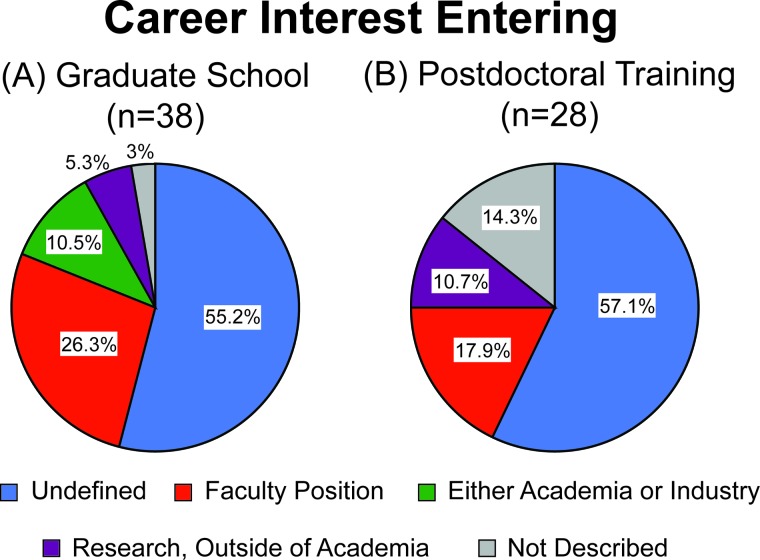
“Specifically, one study found that out of 38 recently graduated biomedical PhD students, more than half (55.2%) of them described entering their PhD program without clearly defined career goals [46].”
From "It let me merge my love of teaching with research": A qualitative investigation of the career pathways of biology education researchers. (2024) · cites this paper as [46]
The cited source says what the claim attributes to it.
In the citing paper
“One study exploring why recent biomedical science PhD graduates left academia to pursue other ventures also cited their desire to make a difference in the world [46].”
From "It let me merge my love of teaching with research": A qualitative investigation of the career pathways of biology education researchers. (2024) · cites this paper as [46]
The cited source says what the claim attributes to it.
In the citing paper
“Despite having the same motivations for leaving disciplinary biology research in academia, the participants in our study pivoted towards biology education research, staying in academia, rather than pursuing nonacademic career pathways as the PhD graduates did in previous literature [46].”
From "It let me merge my love of teaching with research": A qualitative investigation of the career pathways of biology education researchers. (2024) · cites this paper as [46]
The cited source says what the claim attributes to it.
In the citing paper
“Our finding that faculty members joined biology education research to make a difference in the world aligns with previous literature.”
From "It let me merge my love of teaching with research": A qualitative investigation of the career pathways of biology education researchers. (2024) · cites this paper as [46]
Self-check
Percentages, sums and reported differences re-computed from the paper’s own numbers.
The self-check needs the paper’s full text.
Citations
Cites
The Discovery of Grounded Theory: Strategies for Qualitative Research.
Wagner, H. R., Glaser, B. G., & Strauss, A. L. (1968) · Social Forces · doi:10.2307/2575405 · Cited by 46,361
(1998) · Medical Entomology and Zoology · Cited by 18,397
Qualitative Research for Education: An Introduction to Theory and Methods
Bogdan, R., & Biklen, S. K. (1997) · Medical Entomology and Zoology · Cited by 15,168
An index to quantify an individual’s scientific research output
Hirsch, J. E. (2005) · Proceedings of the National Academy of Sciences · doi:10.1073/pnas.0507655102 · Cited by 11,669 · cited 2×
“Scientists with high interest in faculty careers had a median of two firstauthor and seven total peer-reviewed publications (indexed in Scopus 2 ); the journals in which they published had an average impact factor of 5.8; and these scientists had a mean h-index of 5 (Hirsch, 2005).”
BackgroundInfluential(1996) · Cited by 11,584
Focus Groups: A Practical Guide for Applied Research
Billson, J. M. (1989) · Human Biology · Cited by 8,560
Toward a Unifying Social Cognitive Theory of Career and Academic Interest, Choice, and Performance.
Lent, R. W., Brown, S. D., & Hackett, G. (1994) · Journal of Vocational Behavior · doi:10.1006/jvbe.1994.1027 · Cited by 7,715 · cited 1×
“SCCT frames career attainment as a developmental process in which individuals make a series of personal decisions shaped by social and institutional context (Lent et al., 1994).”
BackgroundScience faculty’s subtle gender biases favor male students
Moss-Racusin, C. A., Dovidio, J. F., Brescoll, V. L., Graham, M. J., & Handelsman, J. (2012) · Proceedings of the National Academy of Sciences · doi:10.1073/pnas.1211286109 · Cited by 3,150 · cited 2×
“…and climates have been cited as barriers to diversifying the faculty (NAS, 2011), and very recent evidence suggests that evaluation biases based on race/ethnicity and gender still exist, even when controlling for training and prior productivity (Ginther et al., 2011; Moss-Racusin et al., 2012).”
BackgroundScience and Engineering Indicators
Washington, E., & Warren, M. E. (2004) · Cited by 2,822
Groups of diverse problem solvers can outperform groups of high-ability problem solvers
Hong, L., & Page, S. E. (2004) · Proceedings of the National Academy of Sciences · doi:10.1073/pnas.0403723101 · Cited by 2,103 · cited 1×
“…in many respects (including but not limited to, or exclusive of, personal demographic characteristics, such as race/ethnicity and gender) can improve research outcomes— broadening the scope of inquiry and increasing creativity in problem solving (Hong and Page, 2004; Schiebinger, 2008; NIH, 2012b).”
Background
Research works printed but not linked: 9
- 1. Adams HG. Mentoring: An Essential Factor in the Doctoral Process for Minority Students. Notre Dame, IN: National Consortium for Graduate Degrees for Minorities in Engineering and Science (GEM); 1992.
- 17. Goulden MF, Frasch K, Mason MA. Staying Competitive: Patching America's Leaky Pipeline in the Sciences. Berkeley, CA: Center for American Progress; 2009.
- 45. Meyers SL, Turner C. Faculty of Color in Academe: Bittersweet Success. Upper Saddle River, NJ: Allyn & Bacon; 2000.
- 47. National Academy of Sciences (NAS) Enhancing the Postdoctoral Experience for Scientists and Engineers: A Guide for Postdoctoral Scholars, Advisers, Institutions, Funding Organizations, and Disciplinary Societies. Washington, DC: National Academies Press; 2000.
- 48. NAS Book review: Beyond Bias and Barriers: Fulfilling the Promise of Women in Academic Science and Engineering. Res Technol Manage. 2007;50:70–70. http://www.nap.edu/openbook.php?record_id=11741.
- 49. NAS. Expanding Underrepresented Minority Participation. Washington, DC: National Academies Press; 2011.
- 55. NRC. Bridges to Independence: Fostering the Independence of New Investigators in Biomedical Research. Washington, DC: National Academies Press; 2005b.
- 56. NRC. Research Training in the Biomedical, Behavioral and Clinical Sciences. Washington, DC: National Academies Press; 2011.
- 58. Nelson DJ, Brammer CN. A National Analysis of Minorities in Science and Engineering Faculties at Research Universities. Norman: University of Oklahoma; 2010.
Cited by
Edwards, M. A., & Roy, S. (2017) · Environmental Engineering Science · doi:10.1089/ees.2016.0223 · Cited by 688
“…toward STEM fields for altruistic motives, including serving society and one’s community (Diekman et al. , 2010, Thoman et al. , 2014), many leave STEM to seek careers and work that is more in keeping with their values (e.g., Diekman et al. , 2010; Gibbs and Griffin, 2013; Campbell, et al. , 2014).”
Race and Ethnicity in Higher Education: A Status Report
Espinosa, L. L., Turk, J. M., Taylor, M., & Chessman, H. M. (2019) · VTechWorks (Virginia Tech) · Cited by 551
Estrada, M., Hernandez, P. R., & Schultz, P. W. (2018) · CBE—Life Sciences Education · doi:10.1187/cbe.17-04-0066 · Cited by 507
“…research on these constructs does suggest, however, that as students progress in their academic journeys, endorsing the values of the scientific community may become increasingly unique from having a scientific identity when predicting STEM career choice and persistence (Gibbs and Griffin, 2013).”
BackgroundNo progress on diversity in 40 years
Bernard, R. E., & Cooperdock, E. H. G. (2018) · Nature Geoscience · doi:10.1038/s41561-018-0116-6 · Cited by 432
The Equity Ethic: Black and Latinx College Students Reengineering Their STEM Careers toward Justice
McGee, E., & Bentley, L. (2017) · American Journal of Education · doi:10.1086/693954 · Cited by 291
Brown, E. R., Smith, J. L., Thoman, D. B., Allen, J. M., & Muragishi, G. (2015) · Journal of Educational Psychology · doi:10.1037/edu0000033 · Cited by 255
“Likewise, interviews and anecdotal reports from scientists indicate that many successful scientists are motivated by agentic aspects of science such as curiosity, intrinsic motivation, and the thrill of discovery (Gibbs & Griffin, 2013; Hargittai, 2011; McGee & Keller, 2007).”
Undergraduate Research Experiences Broaden Diversity in the Scientific Workforce
Hernandez, P. R., Woodcock, A., Estrada, M., & Schultz, P. W. (2018) · BioScience · doi:10.1093/biosci/bix163 · Cited by 249
Biomedical Science Ph.D. Career Interest Patterns by Race/Ethnicity and Gender
Gibbs, K. D., McGready, J., Bennett, J. C., & Griffin, K. (2014) · PLoS ONE · doi:10.1371/journal.pone.0114736 · Cited by 221
“The instrument was developed utilizing themes emerging from our previous work [21], as well as the instruments used by Fuhrmann et al.”
BackgroundMethodSelf-citationThe Role of Altruistic Values in Motivating Underrepresented Minority Students for Biomedicine
Thoman, D. B., Brown, E. R., Mason, A. Z., Harmsen, A. G., & Smith, J. L. (2015) · BioScience · doi:10.1093/biosci/biu199 · Cited by 196
“2011, Gibbs and Griffin 2013).”
Hayter, C. S., & Parker, M. A. (2018) · Research Policy · doi:10.1016/j.respol.2018.09.009 · Cited by 179
Gibbs, K. D., Basson, J., Xierali, I. M., & Broniatowski, D. A. (2016) · eLife · doi:10.7554/elife.21393 · Cited by 172
Self-citationGriffin, K. A. (2019) · Higher education · doi:10.1007/978-3-030-11743-6_4-1 · Cited by 132
Self-citationJackson, M. C., Galvez, G., Landa, I., Buonora, P., & Thoman, D. B. (2016) · CBE—Life Sciences Education · doi:10.1187/cbe.16-01-0067 · Cited by 128
“Interviews with URM scientists who have chosen against academic careers indicate that they are questioning the direct relevance of their pursuit of science (Gibbs and Griffin, 2013).”
BackgroundInfluentialCareer Development among American Biomedical Postdocs
Gibbs, K. D., McGready, J., & Griffin, K. (2015) · CBE—Life Sciences Education · doi:10.1187/cbe.15-03-0075 · Cited by 115
“Our previous work indicated that PhD scientists often pursued graduate and postdoctoral training without clear career goals and without full knowledge about their potential career options (Gibbs and Griffin, 2013).”
Self-citationThe “new normal”: Adapting doctoral trainee career preparation for broad career paths in science
Clair, R. S., Hutto, T., MacBeth, C. E., Newstetter, W., McCarty, N. A., & Melkers, J. E. (2017) · PLoS ONE · doi:10.1371/journal.pone.0177035 · Cited by 113
“Existing research points to the culture of academe [47] and complexity of career choice as compounding factors in minimizing this gap, with scholars like Gibbs and Griffin [48] highlighting the need for reforms to be institutional in nature [48].”
BackgroundGriffin, K. A. (2020) · Higher education · doi:10.1007/978-3-030-31365-4_4 · Cited by 107
Self-citationCabay, M., Bernstein, B. L., Rivers, M., & Fabert, N. (2018) · Social Sciences · doi:10.3390/socsci7020023 · Cited by 102
Guiding the Way: Mentoring Graduate Students and Junior Faculty for Sustainable Academic Careers
Montgomery, B. L., Dodson, J. E., & Johnson, S. M. (2014) · SAGE Open · doi:10.1177/2158244014558043 · Cited by 93
“Structured opportunities for developing and practicing successful career skills have been noted as lacking during graduate and post-doctoral training, and generally are left to individual observation and/or incorporation (Gibbs & Griffin, 2013).”
BackgroundCoaching to Augment Mentoring to Achieve Faculty Diversity: A Randomized Controlled Trial
Williams, S. N., Thakore, B. K., & McGee, R. (2015) · Academic Medicine · doi:10.1097/acm.0000000000001026 · Cited by 91
Shuler, H. D., Cazares, V. A., Marshall, A. G., Lopez, E. G., Hultman, R. C., Francis, T.-K., Rolle, T., Byndloss, M. X., Starbird, C. A., Hicsasmaz, I., et al. (2021) · Pathogens and Disease · doi:10.1093/femspd/ftab038 · Cited by 92
Career choices of underrepresented and female postdocs in the biomedical sciences
Lambert, W. M., Wells, M. T., Cipriano, M. F., Sneva, J. N., Morris, J. A., & Golightly, L. M. (2020) · eLife · doi:10.7554/elife.48774 · Cited by 86
McGee, R. (2016) · AIDS and Behavior · doi:10.1007/s10461-016-1486-7 · Cited by 83
Exploring Early Exits: Doctoral Attrition in the Biomedical Sciences
Maher, M., Wofford, A. M., Roksa, J., & Feldon, D. F. (2017) · Journal of College Student Retention Research Theory & Practice · doi:10.1177/1521025117736871 · Cited by 82
“For example, in a study of recent biomedical science doctoral recipients, Gibbs and Griffin (2013) found that most recipients had no clear career goal when they began their doctoral training.”
BackgroundDuke, D. C., & Denicolo, P. M. (2017) · FEMS Microbiology Letters · doi:10.1093/femsle/fnx090 · Cited by 77
“Preparation for jobs outside of academia and the provision of high-quality careers support for doctoral researchers and for postdocs has been identified as critical for biomedical doctorates (Gibbs and Griffin 2013).”
Inclusive STEAM education in diverse disciplines of sustainable energy and AI
Skowronek, M., Gilberti, R. M., Petro, M., Sancomb, C., Maddern, S., & Jankovic, J. (2022) · Energy and AI · doi:10.1016/j.egyai.2021.100124 · Cited by 49
The Value of Scientific Knowledge Dissemination for Scientists—A Value Capture Perspective
Beck, S., Mahdad, M., Beukel, K., & Poetz, M. K. (2019) · Publications · doi:10.3390/publications7030054 · Cited by 71
“For example, Gibbs and Griffin [33] found that the main reason for staying in academia is the flexibility and freedom to research.”
BackgroundFearon, C., Nachmias, S., McLaughlin, H. L., & Jackson, S. (2016) · Studies in Higher Education · doi:10.1080/03075079.2016.1162781 · Cited by 66
Williams, S. N., Thakore, B. K., & McGee, R. (2017) · CBE—Life Sciences Education · doi:10.1187/cbe.17-01-0021 · Cited by 61
“Critical to graduate students’ success is whether they receive adequate support from their mentors and peers (Byars-Winston et al., 2010; McGee et al., 2012; Gibbs and Griffin, 2013).”
BackgroundInfluentialAnalysis of Postdoctoral Training Outcomes That Broaden Participation in Science Careers
Rybarczyk, B. J., Lerea, L. S., Whittington, D., & Dykstra, L. (2016) · CBE—Life Sciences Education · doi:10.1187/cbe.16-01-0032 · Cited by 61
Toward a Theory of Engineering Professorial Intentions: The Role of Research Group Experiences
Burt, B. A. (2018) · American Educational Research Journal · doi:10.3102/0002831218791467 · Cited by 60
“Different disciplines have different socializing practices that may encourage or discourage interest in the professoriate (Gibbs & Griffin, 2013; Lindholm, 2004; (Baker) Sweitzer, 2009).”
BackgroundThakore, B. K., Naffziger‐Hirsch, M. E., Richardson, J. L., Williams, S. N., & McGee, R. (2014) · BMC Medical Education · doi:10.1186/1472-6920-14-160 · Cited by 59
“But even in program CoPs, URM students can face greater barriers establishing their legitimacy and face greater risks of marginalization [18,19].”
Pinheiro, D. L., Melkers, J. E., & Newton, S. H. (2017) · PLoS ONE · doi:10.1371/journal.pone.0176977 · Cited by 60
Afonja, S., Salmon, D. G., Quailey, S. I., & Lambert, W. M. (2021) · PLoS ONE · doi:10.1371/journal.pone.0250662 · Cited by 58
Investigation of an equity ethic in engineering and computing doctoral students
Naphan-Kingery, D. E., Miles, M. L., Brockman, A. J., McKane, R. G., Botchway, P. K., & McGee, E. O. (2019) · Journal of Engineering Education · doi:10.1002/jee.20284 · Cited by 58
“Finally, we examine how students' career interests relate to their equity ethic, or lack thereof. generally concerned with helping others and reducing inequity (Gibbs & Griffin, 2013; Jackson, Galvez, Landa, Buonora, & Thoman, 2016).”
BackgroundEnhancing Graduate and Postdoctoral Education To Create a Sustainable Biomedical Workforce
Fuhrmann, C. N. (2016) · Human Gene Therapy · doi:10.1089/hum.2016.154 · Cited by 56
Research Microcultures as Socialization Contexts for Underrepresented Science Students
Thoman, D. B., Muragishi, G. A., & Smith, J. L. (2017) · Psychological Science · doi:10.1177/0956797617694865 · Cited by 52
“…for URM students, the extent to which science careers are seen to fulfill goals that have a prosocial purpose or communal utility predicts the extent of interest in science (Diekman, Clark, Johnston, Brown, & Steinberg, 2011; Gibbs & Griffin, 2013; Thoman, Brown, Mason, Harmsen, & Smith, 2015).”
BackgroundCareer planning courses increase career readiness of graduate and postdoctoral trainees
Layton, R. L., Solberg, V. S. H., Jahangir, A. E., Hall, J. D., Ponder, C. A., Micoli, K., & Vanderford, N. L. (2020) · F1000Research · doi:10.12688/f1000research.26025.1 · Cited by 55
The prospective shift away from academic career aspirations
Etmanski, B. (2018) · Higher Education · doi:10.1007/s10734-018-0278-6 · Cited by 53
Seo, G., Ahn, J., Huang, W. D., Makela, J. P., & Yeo, H. T. (2020) · Journal of Career Development · doi:10.1177/0894845320907968 · Cited by 55
“As doctoral students often start their graduate training with pliable career interests, their doctoral training environments influence the individual’s professional identity and their professional aspirations (Fuhrmann et al., 2011; Gibbs & Griffin, 2013).”
BackgroundResultInfluentialCastro, M. R., HEIJDEN, B. I. J. M. V. D., & Henderson, E. L. (2020) · Journal of Vocational Behavior · doi:10.1016/j.jvb.2020.103479 · Cited by 54
Tan‐Wilson, A. L., & Stamp, N. E. (2015) · CBE—Life Sciences Education · doi:10.1187/cbe.14-11-0210 · Cited by 51
Layton, R. L., Brandt, P. D., Freeman, A. M., Harrell, J. R., Hall, J. D., & Sinche, M. V. (2016) · CBE—Life Sciences Education · doi:10.1187/cbe.16-01-0066 · Cited by 51
“This is comparable with previous focus group commentary indicating the importance of autonomy for faculty career interest in at least some trainees (identified especially for WR male trainee trends using qualitative data; Gibbs and Griffin, 2013), but to our knowledge, this is the first time this has been demonstrated…”
BackgroundMethodResultInfluentialA model of the factors influencing teaching identity among life sciences doctoral students
Lane, A. K., Hardison, C., Simon, A., & Andrews, T. C. (2018) · Journal of Research in Science Teaching · doi:10.1002/tea.21473 · Cited by 51
Burt, B. A. (2020) · Journal of Engineering Education · doi:10.1002/jee.20353 · Cited by 47
“Similarly, Gibbs and Griffin (2013) found differences in the professional career decisions of biomedical doctoral degree holders across race/ethnicity and gender: individuals from historically underrepresented racial populations considered careers that allowed them to give back to their…”
BackgroundDenton, M., Borrego, M. J., & Knight, D. B. (2022) · PLoS ONE · doi:10.1371/journal.pone.0263185 · Cited by 48
“Additionally, doctorates often take postdoc positions “without a clearly defined career goal” [25] and open to careers in different sectors.”
BackgroundWilliams, S. N., Thakore, B. K., & McGee, R. (2016) · PLoS ONE · doi:10.1371/journal.pone.0160038 · Cited by 46
“Mentoring is one of the most critical determinants of a graduate student’s success and, for many URM students in particular, traditional mentoring may be inadequate [7].”
BackgroundAddressing the Need for Ethnic and Racial Diversity in the Pipeline for Pharmacy Faculty
Campbell, H. E., Hagan, A. M., & Gaither, C. A. (2021) · American Journal of Pharmaceutical Education · doi:10.5688/ajpe8586 · Cited by 46
McGee, E. O., Naphan-Kingery, D. E., Miles, M. L., & Joseph, O. (2022) · The Journal of Higher Education · doi:10.1080/00221546.2022.2031704 · Cited by 46
“This framework is grounded in research on racially minoritized STEM undergraduate (Garibay, 2018; McGee & Bentley, 2017; Jackson et al., 2016; Ortiz et al., 2020), doctoral (McGee et al., 2016; Naphan-Kingery et al., 2019) and postdoctoral scholars (Gibbs & Griffin, 2013).”
Wrighting, D. M., Dombach, J. L., Walker, M., Cook, J. M., Duncan, M., Vélez-Ruiz, G. A., Colón‐Carmona, A., & Birren, B. W. (2021) · CBE—Life Sciences Education · doi:10.1187/cbe.20-03-0052 · Cited by 43
“…peer support, a paucity of professional networking opportunities, low personal or societal expectations, discouragement, unwelcoming environments, and the absence of an appreciation for diversity (Summers and Hrabowski, 2006; Gibbs and Griffin, 2013; Gibbs et al. , 2016; Seymour and Hewitt, 2018).”
Carter, S. C., Griffith, E. M., Jorgensen, T. A., Coifman, K. G., & Griffith, W. A. (2021) · Communications Earth & Environment · doi:10.1038/s43247-021-00287-4 · Cited by 43
McGee, E. O., Naphan-Kingery, D. E., Mustafaa, F. N., Houston, S. L., Botchway, P. K., & Lynch, J. M. (2019) · International journal of doctoral studies · doi:10.28945/4250 · Cited by 43
Pfeiffer, M., Fischer, M. R., & Bauer, D. (2016) · BMC Medical Education · doi:10.1186/s12909-016-0712-3 · Cited by 42
“In this context, it is above all the lack of mentoring programs [30], discrimination against women [33, 34], as well as difficulties to combine family and career [35, 36] which are mentioned as reasons.”
BackgroundNavigating the path to a biomedical science career
Zimmerman, A. M. (2018) · PLoS ONE · doi:10.1371/journal.pone.0203783 · Cited by 41
Cameron, C. A., Lee, H. Y., Anderson, C. B., Byars‐Winston, A. M., Baldwin, C. D., & Chang, S. (2015) · CBE—Life Sciences Education · doi:10.1187/cbe.14-09-0152 · Cited by 40
“…mentors how to give high-quality, constructive, and encouraging feedback some are likely to pursue postdoctoral training to clarify their career goals or to avoid leaving school, because they are unsure of what they should do next (National Academy of Science, 2000; Gibbs and Griffin, 2013).”
BackgroundLimeri, L. B., Asif, M. Z., & Dolan, E. L. (2019) · CBE—Life Sciences Education · doi:10.1187/cbe.18-10-0219 · Cited by 40
“Testing these hypotheses may yield unique insights into how to address recognized shortcomings and problems with graduate and postdoctoral education in the United States, including concerns about graduate student well-being and how to prepare postgraduates to pursue diverse career paths (Gibbs and Griffin, 2013; Gibbs…”
BackgroundJeong, S., Blaney, J. M., & Feldon, D. F. (2019) · CBE—Life Sciences Education · doi:10.1187/cbe.19-05-0089 · Cited by 39
“…universities differs substantially along demographic lines, with fewer females and individuals from historically underrepresented racial/ethnic groups remaining interested in becoming professors after doctoral and postdoctoral training (Gibbs and Griffin, 2013; Gibbs et al., 2014).”
BackgroundHernandez, P. R., Agocha, V. B., Carney, L. M., Estrada, M., Lee, S. Y., Loomis, D., Williams, M., & Park, C. L. (2020) · PLoS ONE · doi:10.1371/journal.pone.0238250 · Cited by 39
“Data drawn from graduate students and postdoctoral fellows finds that values become a strong predictor when scholars are choosing to stay or leave academia [118, 119].”
Curando La Comunidad [Healing the Community]: Community-Centered STEM Identity
Herrera, F. A., & Sánchez, G. K. (2022) · Journal of Hispanic Higher Education · doi:10.1177/15381927211069543 · Cited by 37
“Nevertheless, students of color with collectivist orientations (Guiffrida et al., 2012) are likely to choose STEM majors for altruistic reasons (Espinosa, 2011; Garibay, 2013; Gibbs & Griffin, 2013).”
BackgroundMaher, M., Wofford, A. M., Roksa, J., & Feldon, D. F. (2020) · CBE—Life Sciences Education · doi:10.1187/cbe.19-05-0105 · Cited by 36
Broadening Participation in the Life Sciences: Current Landscape and Future Directions
Gibbs, K. D., & Marsteller, P. (2016) · CBE—Life Sciences Education · doi:10.1187/cbe.16-06-0198 · Cited by 36
“At the same time, there is significant evidence that students from these groups continue to face challenges within the classroom and training environments (Gibbs and Griffin, 2013; Eddy et al., 2014; Grunspan et al., 2016; Lauer et al., 2016).”
BackgroundSelf-citationProfessional, Personal, and Relational: Exploring the Salience of Identity in Academic Careers
Pifer, M. J., & Baker, V. L. (2016) · Identity · doi:10.1080/15283488.2016.1190729 · Cited by 35
“For example, Gibbs and Griffin (2013) explored how interest in academic careers developed among doctoral students in the STEM fields and gave particular attention to whether social identity influenced those decisions.”
BackgroundPsychosocial Pathways to STEM Engagement among Graduate Students in the Life Sciences
Clark, S. L., Dyar, C., Maung, N., & London, B. E. (2016) · CBE—Life Sciences Education · doi:10.1187/cbe.16-01-0036 · Cited by 37
“Combined with emerging literature demonstrating the importance of one’s personal values in career choice (e.g., Diekman et al., 2010; Gibbs and Griffin, 2013; Smith et al., 2014; Thoman et al., 2015), understanding the behavioral outcomes associated with lower STEM engagement and how these outcomes may affect career p…”
BackgroundInfluentialIdul, J. J. A., & Fajardo, M. T. M. (2023) · Journal of Mathematics and Science Teacher · doi:10.29333/mathsciteacher/13700 · Cited by 35
“…academic discrimination even with the increased advocacy on inclusive education (Bonilla-Silva, 2006; Cole & Espinoza, 2008; Williams & Dempsey, 2014) – thus leading to various negative educational outcomes of these learners (Gibbs & Griffin, 2013; Greenhalgh et al., 2004; Hurtado et al., 2007).”
BackgroundCampbell, A. G., Skvirsky, R. C., Wortis, H. H., Thomas, S. Μ., Kawachi, I. I., & Höhmann, C. F. (2014) · CBE—Life Sciences Education · doi:10.1187/cbe.14-04-0068 · Cited by 34
“Interest in faculty careers decreases as training progresses (Gibbs and Griffin, 2013).”
BackgroundPrunuske, A. J., Wilson, J. L., Walls, M. L., Marrin, H., & Clarke, B. L. (2016) · CBE—Life Sciences Education · doi:10.1187/cbe.16-01-0024 · Cited by 34
“It appears that, consistent with social cognitive career theory, some of the mentors are recommending career decisions based on their personal values, which may not be consistent with those of the students (Gibbs and Griffin, 2013).”
Mathur, A., Caño, A., Kohl, M., Muthunayake, N. S., Vaidyanathan, P., Wood, M. E., & Ziyad, M. (2018) · PLoS ONE · doi:10.1371/journal.pone.0197473 · Cited by 34
A prosocial value intervention in gateway STEM courses.
Harackiewicz, J. M., Hecht, C. A., Asher, M. W., Beymer, P. N., Lamont, L. B., Wheeler, N., Else-Quest, N. M., Priniski, S. J., Smith, J. L., Hyde, J. S., et al. (2023) · Journal of Personality and Social Psychology · doi:10.1037/pspa0000356 · Cited by 33
Jung, J., Horta, H., Zhang, L., & Postiglione, G. A. (2021) · Higher Education · doi:10.1007/s10734-020-00664-6 · Cited by 32
Wood, C. V., Campbell, P. B., & McGee, R. (2016) · Journal of Women and Minorities in Science and Engineering · doi:10.1615/jwomenminorscieneng.2016014000 · Cited by 30
“…with the prospect of a career in academic research as they progress through their graduate training, and increasing numbers of PhDs pursue jobs outside of academia as opportunities in industry and other areas become more available and attractive (Fuhrmann et al. 2011; Gibbs and Griffin, 2013).”
BackgroundInfluentialMargherio, C., Horner‐Devine, M. C., Mizumori, S. J. Y., & Yen, J. W. (2016) · CBE—Life Sciences Education · doi:10.1187/cbe.16-01-0058 · Cited by 30
Motivations and Paths to Becoming Faculty at Minority Serving Institutions
Blake, D. J. (2018) · Education Sciences · doi:10.3390/educsci8010030 · Cited by 29
“Gibbs and Griffin found that the main motivator to pursue a faculty career for biomedical science PhD graduates from majority racial/ethnic backgrounds was research freedom, while participants of color were motivated by externally focused values [23].”
BackgroundWood, C. V., Jones, R. F., Remich, R., Caliendo, A. E., Langford, N. C., Keller, J. L., Campbell, P. B., & McGee, R. (2020) · PLoS ONE · doi:10.1371/journal.pone.0234259 · Cited by 28
“Others have pointed to identification with the values and roles of a profession as the main factor leading to career decisions [19].”
BackgroundMendez, S., Starkey, K. E., Cooksey, S. E., & Conley, V. M. (2021) · Journal of Hispanic Higher Education · doi:10.1177/1538192721992436 · Cited by 28
“…this new environment, participants’ STEM identity improved, as well as their commitment to train the next generation of Latinx scholars (Bancroft, 2018; Gibbs & Griffin, 2013; Kim & Sinatra, 2018; Luna & Prieto, 2009; Malone & Barabino, 2009; Russell et al., 2018; Shueths & Carranza, 2012).”
BackgroundFaupel‐Badger, J. M., Nelson, D. E., & Izmirlian, G. (2017) · PLoS ONE · doi:10.1371/journal.pone.0169859 · Cited by 28
Clement, L., Leung, K., Lewis, J. B., & Saul, N. M. (2020) · Journal of Microbiology and Biology Education · doi:10.1128/jmbe.v21i1.1911 · Cited by 27
White, G. E., Proulx, C. N., Morone, N. E., Murrell, A. J., & Rubio, D. M. (2021) · Journal of Clinical and Translational Science · doi:10.1017/cts.2021.843 · Cited by 27
Facilitating pipeline progress from doctoral degree to first job.
Kaslow, N. J., Bangasser, D. A., GRUS, C. L., McCutcheon, S. R., & Fowler, G. A. (2018) · American Psychologist · doi:10.1037/amp0000120 · Cited by 28
Beyond inclusion: Enacting team equity in precision medicine research
Jeske, M., Vasquez, E. E., Fullerton, S. M., Saperstein, A., Bentz, M., Foti, N., Shim, J. K., & Lee, S. S. (2022) · PLoS ONE · doi:10.1371/journal.pone.0263750 · Cited by 26
Metcalf, H. E. (2016) · CBE—Life Sciences Education · doi:10.1187/cbe.16-01-0064 · Cited by 26
Allen, J. M., Brown, E. R., Ginther, A., Graham, J. E., Mercurio, D. G., & Smith, J. L. (2021) · Social Psychology of Education · doi:10.1007/s11218-021-09639-6 · Cited by 26
Risner, L. E., Morin, X. K., Erenrich, E. S., Clifford, P. S., Franke, J., Hurley, I., & Schwartz, N. B. (2020) · PLoS ONE · doi:10.1371/journal.pone.0238518 · Cited by 26
Howe, M. E., Kim, M. M., & Pazicni, S. (2022) · JACS Au · doi:10.1021/jacsau.2c00175 · Cited by 24
Exposure to multiple career pathways by biomedical doctoral students at a public research university
Mathur, A., Chow, C. S., Feig, A. L., Kenaga, H., Moldenhauer, J. A., Muthunayake, N. S., Ouellett, M. L., Pence, L. E., & Straub, V. (2018) · PLoS ONE · doi:10.1371/journal.pone.0199720 · Cited by 24
Seo, G., & Yeo, H. T. (2020) · International journal of doctoral studies · doi:10.28945/4652 · Cited by 24
“Given the importance of personal career values in career decision making (Fuhrmann et al., 2011; Gaule & Piacentini, 2018; K. D. Gibbs & Griffin, 2013), as the current study indicates, doctoral students are responsible for identifying what matters to them personally and professionally and…”
BackgroundResultInfluentialRoberts, T. S., Gutiérrez, L., Grey, T. G., & Stanbrough, R. J. (2020) · The Journal of Higher Education · doi:10.1080/00221546.2020.1803027 · Cited by 21
Hemming, J., Eide, K., Harwood, E. M., Ali, R., Zhu, Z., & Cutler, J. (2019) · Ethnicity & Disease · doi:10.18865//ed.29.s1.123 · Cited by 20
Hall, C. D. X., Wood, C. V., Hurtado, M., Moskowitz, D., Dyar, C., & Mustanski, B. S. (2022) · PLoS ONE · doi:10.1371/journal.pone.0268769 · Cited by 20
Factors That Influence Career Choice among Different Populations of Neuroscience Trainees
Ullrich, L. E., Ogawa, J. R., & Jones-London, M. D. (2021) · eNeuro · doi:10.1523/eneuro.0163-21.2021 · Cited by 20
“…to professional development resources or mentorship, or may be implicit, in the form of differing values (Aelenei, Martinot, Sicard, & Darnon, 2020; Gibbs & Griffin, 2013) or alienating cultural assumptions such as a culture perceived as masculine, focused on self-enhancement, or individualistic…”
BackgroundMethodInfluentialSchmidt, J. M., Porter, J. T., Rivera‐Amill, V., & Appleyard, C. B. (2023) · AJP Advances in Physiology Education · doi:10.1152/advan.00125.2023 · Cited by 20
Carmichael, M. C., Clair, C. S., Edwards, A., Barrett, P., McFerrin, H. E., Davenport, I. R., Awad, M., Kundu, A. K., & Ireland, S. K. (2016) · CBE—Life Sciences Education · doi:10.1187/cbe.16-01-0078 · Cited by 19
“…lack of confidence/motivation; inadequate time management and study skills; family expectations; having to hold down a job while in school; and more (Seymour and Hewitt, 1997; Boundaoui, 2011; PCAST, 2012; Gibbs and Griffin, 2013; NSB, 2014; AAC&U, 2015a,b; Figueroa, 2015; Witham et al., 2015).”
BackgroundHuang, Q., & Jung, J. (2023) · Higher Education Quarterly · doi:10.1111/hequ.12475 · Cited by 19
Tiller, N. B., & Ekkekakis, P. (2023) · Kinesiology Review · doi:10.1123/kr.2022-0039 · Cited by 19
Illuminating systematic differences in no job offers for STEM doctoral recipients
Kinoshita, T. J., Knight, D. B., Borrego, M. J., & Bortz, W. W. (2020) · PLoS ONE · doi:10.1371/journal.pone.0231567 · Cited by 19
“Also, similar to women, URM students and graduates can experience implicit or explicit biases in the evaluation of their work [29]; a values misalignment with certain types of faculty work [30] contributes to these disparities.”
BackgroundPreparing future professionals by enhancing workforce readiness
Norman‐Burgdolf, H., & Vanderford, N. L. (2016) · Nature Biotechnology · doi:10.1038/nbt.3459 · Cited by 19
Feldon, D. F., Wofford, A. M., & Blaney, J. M. (2023) · Higher education · doi:10.1007/978-3-031-06696-2_4 · Cited by 18
Park, H., Berkowitz, O., Symes, K., & Dasgupta, S. (2018) · PLoS ONE · doi:10.1371/journal.pone.0193901 · Cited by 18
Motivating Proactive Biorisk Management
Greene, D., Palmer, M. J., & Relman, D. A. (2023) · Health Security · doi:10.1089/hs.2022.0101 · Cited by 18
Highlighting Prosocial Affordances of Science in Textbooks to Promote Science Interest
Zambrano, J., Lee, G., Leal, C. C., & Thoman, D. B. (2020) · CBE—Life Sciences Education · doi:10.1187/cbe.19-09-0176 · Cited by 18
“…and underrepresented minorities (URMs; i.e., African Americans, Latinos, and Native Americans; e.g., Tyler et al. , 2006; Fryberg and Markus, 2007; Gibbs and Griffin, 2013; Smith et al. , 2014; Thoman et al. , 2015; Jackson et al. , 2016), the communal goal congruity logic has also been applied…”
Thakar, M. S., Rubio, D. M., Murrell, A. J., Morone, N. E., Mitchell-Miland, C., & White, G. E. (2024) · Journal of Clinical and Translational Science · doi:10.1017/cts.2024.504 · Cited by 17
“Although this cohort has a high level of grit [26], individuals from underrepresented backgrounds face systemic discrimination, lack of representation in the biomedical workforce, and stereotypes [28,29].”
BackgroundThe meaning of autonomy: How artists justify career paths
Liu, Y. (2024) · Poetics · doi:10.1016/j.poetic.2024.101915 · Cited by 17
Metadata
- Authors
- Gibbs, K. D., & Griffin, K. A.
- Affiliations
- U.S. National Science Foundation (US)
- University of Maryland, College Park (US)
- Corresponding author
- Gibbs, Kenneth D.
- Venue
- CBE—Life Sciences Education
- Published
- 2013-12
- Volume
- 12
- Issue
- 4
- Pages
- 711-723
- ISSN
- 1931-7913 (ISSN-L)
- PMC
- PMC3846521
- OpenAlex
- W2161422359
- Cited by
- 261
- References
- 62
- Citations by year
- 2026: 9 · 2025: 25 · 2024: 21 · 2023: 29 · 2022: 26 · 2021: 26 · 2020: 31 · 2019: 17 · 2018: 24 · 2017: 15 · 2016: 27 · 2015: 6 · 2014: 5
- FWCI
- 22.82
- Type
- journal article
- Language
- en
- Open access
- hybrid
- doi.org
- Licence
- cc-by-nc-sa
- Locations
- CBE—Life Sciences Education (publishedVersion, cc-by-nc-sa)
- Europe PMC (PubMed Central) (publishedVersion, cc-by-nc-sa)
- PubMed Central (publishedVersion, cc-by-nc-sa)
- PubMed (publishedVersion)
- Funders
- National Science Foundation
- University of Maryland, Baltimore County
- Johns Hopkins University
- Pennsylvania State University
- Directorate for Education and Human Resources
- Topics
- Social Sciences › Education › Doctoral Education Challenges and Solutions
- Social Sciences › Psychology › Applied Psychology › Career Development and Diversity
- Social Sciences › Gender Studies › Diversity and Career in Medicine
- Keywords
- career interest, doctoral graduates, biomedical sciences, personal values, social identity, underrepresented minorities, women in science, academic careers, observational learning, career development, grant funding, labor market, career choice
- MeSH terms
- Biological Science Disciplines, Career Choice, Female, Humans, Male, Social Identification, Biomedical Research
About these checks
Registry, retraction, Cites and statistics results are computed, not judged, with one exception: a printed reference that no index lists is read once by a model before it counts as a citation error. Claims are extracted by a model and kept only when their quote appears verbatim in the text; each cited source is then checked, with a model’s help, for whether it says what the claim relies on. Those verdicts can be wrong — read the claim’s quote and the cited source before relying on one.
Statistics and arithmetic are recomputed, not judged.
Confidence bands are shown only for fields calibrated on our annotated test set. None is calibrated yet, so no band is shown.
What counts as a claim ›How we measure confidence ›How we check this ›
Are you an author, or do you see a problem with this page? Request a review
Data sources
Bibliographic data: Semantic Scholar, OpenAlex, Crossref.
Contains information from the Semantic Scholar Academic Graph Datasets, made available under the ODC Attribution License (ODC-BY 1.0).
Semantic Scholar’s data is described in: Kinney, R., et al. (2023). The Semantic Scholar Open Data Platform. arXiv:2301.10140.
