

The DOI matches its Crossref record; 33 of the 33 references it cites were found in a registry or an index.
Graduate Training at the Interface of Computational and Experimental Biology: An Outcome Report from a Partnership of Volunteers between a University and a National Laboratory
Open accessAbstract
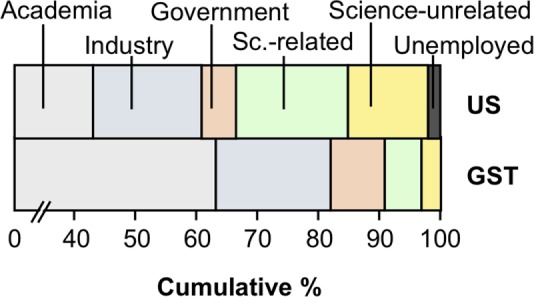
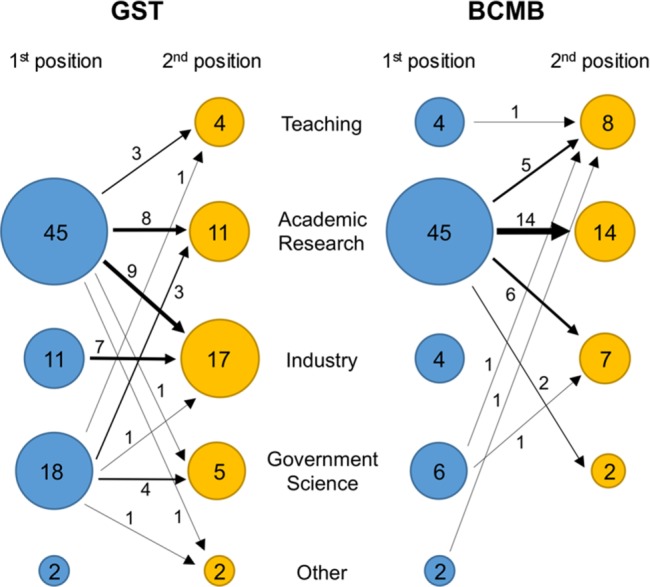
Leading voices in the biological sciences have called for a transformation in graduate education leading to the PhD degree. One area commonly singled out for growth and innovation is cross-training in computational science. In 1998, the University of Tennessee (UT) founded an intercollegiate graduate program called the UT-ORNL Graduate School of Genome Science and Technology in partnership with the nearby Oak Ridge National Laboratory. Here, we report outcome data that attest to the program’s effectiveness in graduating computationally enabled biologists for diverse careers. Among 77 PhD graduates since 2003, the majority came with traditional degrees in the biological sciences, yet two-thirds moved into computational or hybrid (computational–experimental) positions. We describe the curriculum of the program and how it has changed. We also summarize how the program seeks to establish cohesion between computational and experimental biologists. This type of program can respond flexibly and dynamically to unmet training needs. In conclusion, this study from a flagship, state-supported university may serve as a reference point for creating a stable, degree-granting, interdepartmental graduate program in computational biology and allied areas.
Overview
The claims and statistics of this paper haven’t been checked yet.
Run the check — free, no account needed. It reads the open-access text and checks the sources it cites.
Integrity signals
Registry
Cites
Statistics
Figures
Verification
Claims the paper makes
The claims and statistics of this paper haven’t been checked yet.
Run the check — free, no account needed. It reads the open-access text and checks the sources it cites.
Self-check
Percentages, sums and reported differences re-computed from the paper’s own numbers.
The self-check needs the paper’s full text.
Citations
Cites
Toward a Unifying Social Cognitive Theory of Career and Academic Interest, Choice, and Performance.
Lent, R. W., Brown, S. D., & Hackett, G. (1994) · Journal of Vocational Behavior · doi:10.1006/jvbe.1994.1027 · Cited by 7,715
Motivational beliefs, values, and goals
Eccles, J. S., & Wigfield, A. (2002) · Annual Review of Psychology · doi:10.1146/annurev.psych.53.100901.135153 · Cited by 7,587
Science PhD Career Preferences: Levels, Changes, and Advisor Encouragement
Sauermann, H., & Roach, M. (2012) · PLoS ONE · doi:10.1371/journal.pone.0036307 · Cited by 388
Byars-Winston, A., Estrada, Y., Howard, C., Davis, D., & Zalapa, J. (2010) · Journal of counseling and psychology · doi:10.1037/a0018608 · Cited by 332
Fuhrmann, C. N., Halme, D. G., O’Sullivan, P., & Lindstaedt, B. (2011) · CBE—Life Sciences Education · doi:10.1187/cbe.11-02-0013 · Cited by 308
Gibbs, K. D., & Griffin, K. A. (2013) · CBE—Life Sciences Education · doi:10.1187/cbe.13-02-0021 · Cited by 261
Biomedical Science Ph.D. Career Interest Patterns by Race/Ethnicity and Gender
Gibbs, K. D., McGready, J., Bennett, J., & Griffin, K. A. (2014) · PLoS ONE · doi:10.1371/journal.pone.0114736 · Cited by 221
A generation at risk: Young investigators and the future of the biomedical workforce
Daniels, R. J. (2015) · Proceedings of the National Academy of Sciences · doi:10.1073/pnas.1418761112 · Cited by 203
Math and Science Social Cognitive Variables in College Students
Byars‐Winston, A. M., & Fouad, N. A. (2008) · Journal of Career Assessment · doi:10.1177/1069072708318901 · Cited by 136
Influence of a Freshman-year Panel Presentation on Medical Students' Attitudes toward Homosexuality
Wallick, M. M., Cambre, K. M., & Townsend, M. H. (1995) · Academic Medicine · doi:10.1097/00001888-199509000-00028 · Cited by 127
Research works printed but not linked: 7
- Griffiths P. A., 1995, Reshaping the graduate education of scientists and engineers
- Hogan A., 2015, Monthly Labor Reviews, 1
- Johnson C. Y., 2014, Boston Globe, A-1
- Kuehnle K., 2009, Swiss Medical Weekly, 139, 540
- Lacey T. A., 2009, Monthy Labor Reports, 132, 82
- Teitelbaum M. S., 2014, The Atlantic
- Yamamoto K., 2014, iBiomagazine
Cited by
Sorted by citations
Driscoll, M., & Zaritsky, A. (2021) · Journal of Cell Science · doi:10.1242/jcs.254292 · Cited by 30
Scientific Discovery at the Press of a Button: Navigating Emerging Cloud Laboratory Technology
Arias, D. S., & Taylor, R. E. (2024) · Advanced Materials Technologies · doi:10.1002/admt.202400084 · Cited by 12
Clair, R. S., Melkers, J. E., Rojewski, J., Ford, K., Dahl, T., McCarty, N. A., Watts, S. W., & Chatterjee, D. (2019) · International journal of doctoral studies · doi:10.28945/4436 · Cited by 16
Student‐led workshops: Filling skills gaps in computational research for life scientists
LaTourrette, K., Stengel, A., & Clarke, J. (2021) · Natural Sciences Education · doi:10.1002/nse2.20052 · Cited by 6
Value of Collaboration among Multi-Domain Experts in Analysis of High-Throughput Genomics Data
Meerzaman, D. M., & Dunn, B. K. (2019) · Cancer Research · doi:10.1158/0008-5472.can-19-0769 · Cited by 5
Metadata
- Authors
- von Arnim, A. G., & Missra, A.
- Affiliations
- Oak Ridge National Laboratory (US)
- Corresponding author
- von Arnim, Albrecht G.
- Venue
- CBE—Life Sciences Education
- Published
- 2017-12
- Volume
- 16
- Issue
- 4
- Pages
- ar61
- ISSN
- 1931-7913 (ISSN-L)
- PMC
- PMC5749963
- OpenAlex
- W2770242051
- Cited by
- 8
- References
- 33
- Citations by year
- 2026: 1 · 2024: 1 · 2023: 1 · 2021: 3 · 2019: 2
- FWCI
- 0.22
- Type
- journal article
- Language
- en
- Open access
- hybrid
- doi.org
- Licence
- cc-by-nc-sa
- Locations
- CBE—Life Sciences Education (publishedVersion, cc-by-nc-sa)
- Europe PMC (PubMed Central) (publishedVersion, cc-by-nc-sa)
- PubMed Central (publishedVersion, cc-by-nc-sa)
- PubMed (publishedVersion)
- OSTI OAI (U.S. Department of Energy Office of Scientific and Technical Information) (submittedVersion)
- Funders
- National Science Foundation (1546402, 1456988)
- National Institutes of Health
- Topics
- Life Sciences › Biochemistry, Genetics and Molecular Biology › Molecular Biology › Genetics, Bioinformatics, and Biomedical Research
- Social Sciences › Arts and Humanities › History and Philosophy of Science › Interdisciplinary Research and Collaboration
- Social Sciences › Education › Doctoral Education Challenges and Solutions
- Keywords
- computational biology education, graduate education, doctoral programs, curriculum development, career outcomes, Oak Ridge National Laboratory, University of Tennessee
- MeSH terms
- Career Choice, Cooperative Behavior, Curriculum, Demography, Education, Graduate, Female, Humans, Laboratories, Male, Universities, Volunteers, Computational Biology, Research Report
About these checks
Registry, retraction, Cites and statistics results are computed, not judged, with one exception: a printed reference that no index lists is read once by a model before it counts as a citation error. Claims are extracted by a model and kept only when their quote appears verbatim in the text; each cited source is then checked, with a model’s help, for whether it says what the claim relies on. Those verdicts can be wrong — read the claim’s quote and the cited source before relying on one.
Statistics and arithmetic are recomputed, not judged.
Confidence bands are shown only for fields calibrated on our annotated test set. None is calibrated yet, so no band is shown.
What counts as a claim ›How we measure confidence ›How we check this ›
Are you an author, or do you see a problem with this page? Request a review
