

Reading Primary Scientific Literature: Approaches for Teaching Students in the Undergraduate STEM Classroom
Open accessThe DOI matches its Crossref record; 148 of the 148 references it cites were found in a registry or an index; 70 of the 137 sources its claims cite were checked for support.
Abstract
, we conduct a systematic search to compile these approaches in an easily accessible manner for instructors, using a framework to sort the identified approaches by target level, time required, assessment population, and more. We also provide a brief review of the literature surrounding the reading of PSL in undergraduate STEM classrooms and conclude with some general recommendations for both instructors and education researchers on future areas of investigation.
Overview
CoChat Summary
TL;DR
This essay systematically reviews published approaches for teaching undergraduate STEM students to read primary scientific literature (PSL), organizing 74 approaches by features like duration, modality, student level, and assessment evidence. It argues that PSL instruction can benefit students cognitively and affectively, but the evidence base is uneven and needs broader, more rigorous assessment.
Key findings
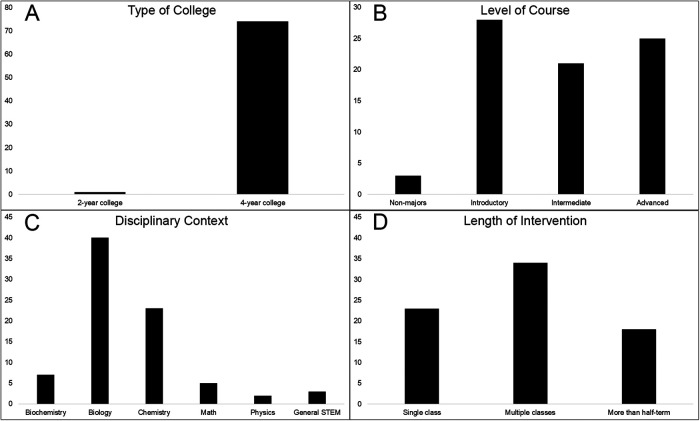
- The authors identified 74 approaches for teaching PSL, and these varied widely in length of intervention, modality, target student population, and assessment evidence.
- Most approaches were developed and tested in 4-year colleges and universities; only one approach also reported implementation/effectiveness evidence from 2-year colleges.
- Only three approaches were developed for STEM nonmajors, despite the authors noting calls for scientific literacy training in that population.
- Most published approaches were in biology; the authors identified only a small number in engineering, math, or physics.
- The authors report that about one-third of published approaches required only a single class session, while many others involved multiple class sessions or more than half a term.
Methods
- The paper is a systematic essay/review of published instructional approaches for teaching PSL in undergraduate STEM courses.
- The authors searched Google Scholar, PubMed, and ERIC, and also added papers by following references in relevant studies; they included peer-reviewed manuscripts describing instructional techniques aimed at guiding students to read and/or interpret PSL.
- They classified each approach by discipline, intervention length, modality, class size, course level, institution type, and assessment evidence.
Limitations
- The authors state the review is limited to published strategies for teaching PSL in undergraduate STEM courses; they did not review non-STEM courses or interventions focused on searching/finding/using PSL.
- They note they did not examine disciplinary differences in how PSL is structured, instead focusing on broad approaches across STEM.
- Evident from the text: the review relies on the published literature only, so it likely reflects the same biases the authors describe—especially the scarcity of 2-year college studies, limited nonmajors work, and limited assessment data.
Model-written summary. Check it against the paper before relying on it.
Integrity signals
Registry
Cites
Statistics
Figures
Verification
Claims the paper makes
48 Valid · 2 Not valid · 34 Not checked · 52 Own results and interpretations
The cited sources support only part of this claim — read each source’s verdict below.
In the paper
“Similarly, instructors of science, technology, engineering, and math (STEM) courses report that science process skills associated with the reading of PSL, such as the interpretation of graphs and tables, are among the most important skills for undergraduate students to acquire (Coil et al., 2010).”
§ Reading Primary Scientific Literature: Approaches for Teaching Students in the Undergraduate STEM Classroom > INTRODUCTION
What the sources say
- Partly supportedcites Coil et al., 2010 matched to “Teaching the process of science: faculty perceptions and an effective methodology” (2010) sourceExperimental — accuracy not yet measured
In “Faculty Views of Undergraduates’ Acquisition of Science Process Skills” (page not provided), Table 1 ranks interpreting graphs and tables among the most important skills and also rates reading and evaluating primary literature highly. The survey, however, asked life-science faculty and postdoctoral fellows about students majoring in the life sciences; it does not establish this ranking for STEM instructors or undergraduates generally. (LLM, conf=0.84)
plainstates an association- Asserted: passes — The authors put it forward as true.
- Checkable: passes — It can be checked against evidence.
- Load-bearing: unclear — It is unclear whether the paper’s conclusions depend on it.
- Based: passes — The paper gives a reason why it holds.
- Partly supported
The cited sources support only part of this claim — read each source’s verdict below.
In the paper
“academic scientists report reading several hundred articles a year, and most scientists surveyed identify the reading of PSL as important for scientific training (Tenopir et al., 2009, 2015; Hubbard and Dunbar, 2017).”
§ Reading Primary Scientific Literature: Approaches for Teaching Students in the Undergraduate STEM Classroom > INTRODUCTION
What the sources say
- Not matchedcites Tenopir et al., 2009, 2015
A range of references, not one source.
- Supportedcites Hubbard and Dunbar, 2017 matched to “Perceptions of scientific research literature and strategies for reading papers depend on academic career stage” (2017) source
The Results section reports that reading research papers was considered important for general scientific training across career stages; only 10 of 300 respondents expressed any disagreement. The Discussion likewise says participants agreed on its importance. This supports the attributed claim about the surveyed group, not a generalization to all scientists. (LLM, conf=0.94)
plain- Asserted: passes — The authors put it forward as true.
- Checkable: passes — It can be checked against evidence.
- Load-bearing: unclear — It is unclear whether the paper’s conclusions depend on it.
- Based: passes — The paper gives a reason why it holds.
- Not matched
The cited sources support only part of this claim — read each source’s verdict below.
In the paper
“other studies identified that master’s students in biology report having similar challenges as undergraduates in comprehending the experiments, figures, and language used in PSL, and may also have relatively low self-efficacy in some of the skills needed to read PSL (Abdullah et al., 2015; Lie et al., 2016; Hubbard and Dunbar, 2017).”
§ Reading Primary Scientific Literature: Approaches for Teaching Students in the Undergraduate STEM Classroom > BENEFITS AND CHALLENGES OF TEACHING PSL
What the sources say
- Partly supportedcites Abdullah et al., 2015 matched to “Critical Analysis of Primary Literature in a Master’s-Level Class: Effects on Self-Efficacy and Science-Process Skills” (2015) sourceExperimental — accuracy not yet measured
The Introduction says the biology master’s students often felt unprepared to interpret primary literature. Methods > Course Activities reports survey-identified difficulties with unfamiliar background and experimental techniques, supporting the claim about challenges with experiments. Our copy does not report comparable difficulties with figures or language, or establish that the master’s students’ challenges were similar to undergraduates’. (LLM, conf=0.85)
- Supportedcites Lie et al., 2016 matched to “Perceived Challenges in Primary Literature in a Master’s Class: Effects of Experience and Instruction” (2016) source
The Methods identify the participants as students in a biology BS/MS program. The Results report their difficulties understanding experimental methods and figures, while the Discussion identifies scientific language as another challenge and compares several of their difficulties with those previously reported for undergraduates. Page numbers are not available in our copy. (LLM, conf=0.91)
- Partly supportedcites Hubbard and Dunbar, 2017 matched to “Perceptions of scientific research literature and strategies for reading papers depend on academic career stage” (2017) sourceExperimental — accuracy not yet measured
The Results list undergraduates and PhD students, but no master’s students; the Discussion does not report that master’s students have the same difficulties with experiments, figures, and language as undergraduates. The Discussion does support the sentence’s separate, hedged point about low self-efficacy among undergraduate and graduate students encountering complex literature. Page numbers are unavailable in our copy. (LLM, conf=0.86)
hedged- Asserted: passes — The authors put it forward as true.
- Checkable: passes — It can be checked against evidence.
- Load-bearing: unclear — It is unclear whether the paper’s conclusions depend on it.
- Based: passes — The paper gives a reason why it holds.
- Partly supported
Every source the paper cites for this claim was checked and supports it.
In the paper
“For example, expert readers of PSL rely on more complex schemas—that is, mental structures and strategies for engaging with a cognitive task (Piaget, 2003)—when reading PSL, thus lowering the cognitive load of reading such articles (Nelms and Segura-Totten, 2019).”
§ Reading Primary Scientific Literature: Approaches for Teaching Students in the Undergraduate STEM Classroom > HOW DO STUDENTS READ, PROCESS, AND LEARN ABOUT PSL? Learning to read PSL is a complex cognitive activity that is influenced by multiple factors (Nelms and Segura-Totten, 2019; Hubbard, 2021). Several theoretical frameworks explain how students develop skills to read PSL, including Alexander’s model of domain learning (MDL; Lie et al., 2016; Hubbard and Dunbar, 2017; Hubbard, 2021). Under the MDL framework, students undergo three phases of development when learning to read PSL: acclimation, competency, and proficiency (Alexander, 1997, 2003, 2005). Students first must become familiar with new concepts and new jargon presented by the paper they are reading (acclimation). Given their unfamiliarity with such concepts and jargon, students largely rely on “superficial processing strategies” that lead to poorly formed mental frameworks of the concepts of the paper (Brill et al., 2004; Lie et al., 2016; Hubbard, 2021). Consequently, students report gaining only a superficial understanding of papers they read in class if they are not provided with explicit instruction or guidance on how to read a paper (Brill et al., 2004). However, given guidance, students can progress to forming more complex mental models of the concepts and can develop more personal interest in the topics (competency), before engaging with the concepts in a deeper and broader manner (proficiency; Alexander, 1997, 2003, 2005). These differences between those who are at the acclimation stage and those who are at the proficiency stage become apparent when comparing how novice readers of PSL and “expert” readers of PSL (e.g., faculty and instructors) approach PSL. For example, expert readers of PSL rely on more complex schemas—that is, mental structures and strategies for engaging with a cognitive task (Piaget, 2003)—when reading PSL, thus lowering the cognitive load of reading such articles (Nelms and Segura-Totten, 2019). Faculty tend to reread sentences more frequently and are more likely to summarize and take notes when reading PSL than novice readers of PSL (Nelms and Segura-Totten, 2019). Novice readers, in contrast, tend to ignore unfamiliar terms or concepts and need to be prompted more frequently to aid their comprehension by taking notes and creating diagrams when reading PSL (Brill et al., 2004). Similarly, novice readers perceive methods and results as the most challenging sections of PSL to read and understand and thus underemphasize the importance of the results section. Novice readers are also likely to identify incorrect conclusions and supporting evidence for those conclusions (van Lacum et al., 2012; Hubbard and Dunbar, 2017). Expert readers, in contrast, focused on a more holistic approach to reading PSL and reported using selective reading of different sections of PSL to guide their comprehension (Hubbard and Dunbar, 2017). As students acquire practice in reading and processing PSL, they experience affective changes as well. For instance, many students report reading PSL for extrinsic reasons, for example, reading PSL to identify answers to homework assignments and to prepare for examinations, although there are differences in students’ levels of interest and perceived utility for reading PSL (Hubbard and Dunbar, 2017; Chatzikyriakidou and McCartney, 2022). However, some students and expert readers of PSL report more intrinsic motivations for reading PSL, citing innate interest and enjoyment of reading the PSL and wanting to learn more about a given study (Hubbard and Dunbar, 2017; Howard et al., 2021). These differences suggest that instruction on reading PSL can also influence how students perceive PSL and impact their motivations for reading PSL. Indeed, PSL-based interventions in single courses have been shown to change students’ motivations and interests in reading PSL (Chatzikyriakidou and McCartney, 2022).
What the sources say
- Supportedcites Nelms and Segura-Totten, 2019 matched to “Expert–Novice Comparison Reveals Pedagogical Implications for Students’ Analysis of Primary Literature” (2019) source
The Abstract reports that faculty experts have more complex schemas than students and describes those schemas as effectively lowering cognitive load. The Discussion’s cognitive load theory section explains that these schemas help experts retrieve relevant knowledge while placing fewer demands on short-term memory. (LLM, conf=0.93)
plainstates a cause- Asserted: passes — The authors put it forward as true.
- Checkable: passes — It can be checked against evidence.
- Load-bearing: unclear — It is unclear whether the paper’s conclusions depend on it.
- Based: passes — The paper gives a reason why it holds.
- Supported
The cited sources support only part of this claim — read each source’s verdict below.
In the paper
“other studies identified that master’s students in biology report having similar challenges as undergraduates in comprehending the experiments, figures, and language used in PSL, and may also have relatively low self-efficacy in some of the skills needed to read PSL (Abdullah et al., 2015; Lie et al., 2016; Hubbard and Dunbar, 2017).”
§ Reading Primary Scientific Literature: Approaches for Teaching Students in the Undergraduate STEM Classroom > BENEFITS AND CHALLENGES OF TEACHING PSL
What the sources say
- Supportedcites Abdullah et al., 2015 matched to “Critical Analysis of Primary Literature in a Master’s-Level Class: Effects on Self-Efficacy and Science-Process Skills” (2015) source
The Introduction identifies the participants as biology master’s students. The Discussion, under “Summary and the Implications of the Increase in Students’ Self-Efficacy,” says they initially rated their self-efficacy in science-process skills quite low; it identifies several of those skills as involved in engaging with primary literature. (LLM, conf=0.93)
- Partly supportedcites Lie et al., 2016 matched to “Perceived Challenges in Primary Literature in a Master’s Class: Effects of Experience and Instruction” (2016) sourceExperimental — accuracy not yet measured
The Methods (Surveys; page unavailable) say the master’s students were asked about self-efficacy in skills related to primary literature. The Results (What Do the Students Perceive as the Most Difficult Aspects of Primary Literature?; page unavailable) document perceived difficulties with techniques and interpreting data, but the passages found do not report self-efficacy levels or establish that they were relatively low. (LLM, conf=0.78)
- Partly supportedcites Hubbard and Dunbar, 2017 matched to “Perceptions of scientific research literature and strategies for reading papers depend on academic career stage” (2017) sourceExperimental — accuracy not yet measured
The Discussion says many undergraduate and graduate students have low self-efficacy when encountering complex literature, supporting the general point. But the Results list undergraduates, PhD students, postdoctoral researchers and academics—not master’s students—so the paper does not establish that finding specifically for master’s students in biology. (LLM, conf=0.86)
hedged- Asserted: passes — The authors put it forward as true.
- Checkable: passes — It can be checked against evidence.
- Load-bearing: unclear — It is unclear whether the paper’s conclusions depend on it.
- Based: passes — The paper gives a reason why it holds.
- Supported
76 more claims · 20 with their cited sources checked
Create a free account to see all 136 claims and to verify the 11 references still open.
- It may state two separate claims as one. 31
- Probably not a substantial claim. 33
Citations
Cites
The Journal of College Science Teaching
(1971) · Journal of Chemical Education · doi:10.1021/ed048p284 · Cited by 3,332
Part I: Cognitive development in children: Piaget development and learning
Piaget, J. (1964) · Journal of Research in Science Teaching · doi:10.1002/tea.3660020306 · Cited by 1,802 · cited 1×
“For example, expert readers of PSL rely on more complex schemas—that is, mental structures and strategies for engaging with a cognitive task (Piaget, 2003)—when reading PSL, thus lowering the cognitive load of reading such articles (Nelms and Segura-Totten, 2019).”
BackgroundHenderson, C., Beach, A., & Finkelstein, N. (2011) · Journal of Research in Science Teaching · doi:10.1002/tea.20439 · Cited by 1,055 · cited 1×
“This reflection on teaching is critical and has been identified as a key part of improving undergraduate STEM courses (Henderson et al., 2011).”
BackgroundThe International Journal of Environmental and Science Education
(2016) · doi:10.12973/ijese · Cited by 824
Brownell, S. E., & Tanner, K. D. (2012) · CBE—Life Sciences Education · doi:10.1187/cbe.12-09-0163 · Cited by 797
The Development of Expertise: The Journey From Acclimation to Proficiency
Alexander, P. A. (2003) · Educational Researcher · doi:10.3102/0013189x032008010 · Cited by 700 · cited 2×
“However, given guidance, students can progress to forming more complex mental models of the concepts and can develop more personal interest in the topics (competency), before engaging with the concepts in a deeper and broader manner (proficiency; Alexander, 1997, 2003, 2005).”
BackgroundMethodBiology in Bloom: Implementing Bloom's Taxonomy to Enhance Student Learning in Biology
Crowe, A., Dirks, C., & Wenderoth, M. P. (2008) · CBE—Life Sciences Education · doi:10.1187/cbe.08-05-0024 · Cited by 629 · cited 2×
“Bloom’s taxonomy provides a hierarchical list of cognitive domains that range from lower-order (remembering and understanding) to higher-order cognitive skills (applying, analyzing, synthesizing, and evaluating; Bloom, 1956; Crowe et al., 2008; Larsen et al., 2022).”
BackgroundMethodGormally, C., Brickman, P., & Lutz, M. (2012) · CBE—Life Sciences Education · doi:10.1187/cbe.12-03-0026 · Cited by 437 · cited 1×
“For instance, the Test of Scientific Literacy Skills measures students’ scientific literacy (Gormally et al., 2012), while there are separate instruments focusing specifically on STEM students’ critical thinking (e.”
BackgroundEvolution: Education and Outreach
(2013) · Evolution Education and Outreach · doi:10.1007/12052.1936-6434 · Cited by 373
Advances in Motivation and Achievement
(2012) · Advances in Motivation and Achievement · doi:10.1108/s0749-7423(2012)0000017018 · Cited by 332
Research works printed but not linked: 19
- Alpern, R. J. Long, S. Akerfeldt, K. Ares, M. Bond, J. Dalley, A. F., … & Friedlander, M. J. (2009). Scientific foundations for future physicians (Report of the AAMC-HHMI Committee). Washington, DC: Association of American Medical Colleges.
- American Association for the Advancement of Science. (2011). Vision and change in undergraduate biology education: A view for the 21st century. Washington, DC. Retrieved February 25, 2022, from https://visionandchange.org/about-vc-a-call-to-action-2011/
- American Chemical Society. (2023). ACS guidelines for bachelor’s degree programs. Retrieved January 12, 2023, from www.acs.org/education/policies/acs-approval-program/guidelines-supplements.html
- American Physical Society. (2016). J-TUPP. Retrieved January 11, 2023, from www.aps.org/programs/education/undergrad/jtupp.cfm
- Bloom, B. (1956). Taxonomy of educational objectives: The classification of educational goals by a committee of college and university examiners. Handbook I: Cognitive domain. New York, NY: David McKay.
- Carson, S. Miller, E. (2013). Introducing primary scientific literature to first-year undergraduate researchers. Council on Undergraduate Research, 34(4), 17– 22. www.cur.org/assets/1/23/Summer2013_V34.4_Carson-Miller_web.pdf
- de Silva, C. (2018). Using primary and secondary literature to introduce interdisciplinary science to undergraduate students. Bioscene: Journal of College Biology Teaching, 44(2), 24– 28.
- Eslinger, M. Kent, E. (2018). Improving scientific literacy through a structured primary literature project. Bioscene, 44(1), 13– 27. www.acube.org/wp-content/uploads/2018/07/2018_1.compressed.pdf
- Fortner, R. (1999). Using cooperative learning to introduce undergraduates to professional literature. Journal of College Science Teaching, 28(4), 261– 265.
- Glazer, F. (2000). Journal Clubs—A successful vehicle to science literacy. Journal of College Science Teaching, 29(5), 320– 324.
- Houde, A. (2000). Student symposia on primary research articles. Journal of College Science Teaching, 30, 184– 187. www.nsta.org/journal-college-science-teaching/journal-college-science-teaching-november-2000/student-symposia
- Jacques-Fricke, B. T. Hubert, A. Miller, S. (2009). A versatile module to improve understanding of scientific literature through peer instruction. Journal of College Science Teaching, 39(2), 24– 32. www.jstor.org/stable/42993334
- Janick-Buckner, D. (1997). Getting undergraduates to critically read and discuss primary literature. Journal of College Science Teaching, 27(1), 29– 32. www.nsta.org/resources/getting-undergraduates-critically-read-and-discuss-primary-literature-cultivating
- Levine, E. (2001). Reading your way to scientific literacy. Journal of College Science Teaching, 31(2), 122– 125. www.nsta.org/journal-college-science-teaching/journal-college-science-teaching-october-2001/reading-your-way
- Muench, S. B. (2000). Choosing primary literature in biology to achieve specific educational goals. Journal of College Science Teaching, 29(4), 255– 260.
- Smith, G. R. (2001). Guided literature explorations: introducing students to the primary literature. Journal of College Science Teaching, 30(7), 465– 469. www.nsta.org/journal-college-science-teaching/journal-college-science-teaching-may-2001/guided-literature
- Tribe, L. Cooper, E. L. (2008). Independent research projects in general chemistry classes as an introduction to peer-reviewed literature. Journal of College Science Teaching, 37(4), 38– 42. https://my.nsta.org/resource/?id=10.2505/4/jcst08_037_04_38 · doi:10.2505/4/jcst08_037_04_38
- Wenk, L. Tronsky, L. (2011). First-year students benefit from reading primary research articles. Journal of College Science Teaching, 40(4), 60– 67.
- White, B. Stains, M. Escriu-Sune, M. Medaglia, E. Rostamnjad, L. Chinn, C. Sevian, H. (2011). A novel instrument for assessing students’ critical thinking abilities. Journal of College Science Teaching, 40(5), 102– 107. doi: 10.2505/3/jcst11_040_05&print=true · doi:10.2505/3/jcst11_040_05
Cited by
Morgan, D. E. (2024) · Journal of Microbiology and Biology Education · doi:10.1128/jmbe.00132-24 · Cited by 14
Jablonski, G., & Grinath, A. S. (2023) · CBE—Life Sciences Education · doi:10.1187/cbe.22-11-0218 · Cited by 3
“The articles reviewed by Goudsouzian & Hsu (2023) (e.g., Goldey et al. 2012; Murray, 2013; Sato et al. , 2014; He & Masuda, 2015;”
BackgroundVISUAL ATTENTION ALLOCATION AND FIXATION TRANSACTIONS IN READING PRIMARY SCIENTIFIC LITERATURE
Ban, S., Lan, X., Li, Z., & Mao, Y. (2024) · Journal of Baltic Science Education · doi:10.33225/jbse/24.23.826 · Cited by 7
“Through reading and studying primary scientific literature, students learn how to design experiments, analyze data, and draw conclusions (Coil et al., 2010; Goudsouzian & Hsu, 2023).”
BackgroundLa investigación en las escuelas de las ciencias de la salud
Universidad Autónoma del Estado de México, F. D. M., & Vojvodic-Hernández, I. M. (2024) · Horizonte Médico (Lima) · doi:10.24265/horizmed.2024.v24n1.13 · Cited by 5
Machrone, A., Duenas, M., Acosta, A., Alvarez, R., Bruce‐Opris, H., Castellano, R., Chatzikyriakidou, K., Concepcion, K., Colon, J., Hawks, S., et al. (2024) · CBE—Life Sciences Education · doi:10.1187/cbe.24-08-0209 · Cited by 3
Johnson, K. C. (2025) · Journal of Microbiology and Biology Education · doi:10.1128/jmbe.00057-25 · Cited by 3
Katzman, S. D., Carrion, C. A., & Hurst-Kennedy, J. (2024) · Trends in Higher Education · doi:10.3390/higheredu3030041 · Cited by 3
Hippee, C. E., Klingelhutz, A. J., & Wu, L. J. (2024) · Journal of Microbiology and Biology Education · doi:10.1128/jmbe.00184-24 · Cited by 2
Science Comics in STEM Higher Education Instruction: A Literature Review
Ford–Baxter, T. (2025) · Innovative Higher Education · doi:10.1007/s10755-025-09868-z · Cited by 3
Li, Y., & Chen, H. (2026) · Journal of English for Academic Purposes · doi:10.1016/j.jeap.2026.101704 · Cited by 1
PubNavigator as an undergraduate teaching toolPreprint
Marroquín-Flores, R. A., Campbell, M. A., Grimes, S., & Limeri, L. B. (2023) · bioRxiv (Cold Spring Harbor Laboratory) · doi:10.1101/2023.09.18.558293
eaching Synaptic Transmission Using Primary Literature: A Skills-Focused Pedagogical Approach
Payne, A. J., Bills, K. B., & Steffensen, S. C. (2023) · Journal of Undergraduate Neuroscience Education · doi:10.59390/nyor9047 · Cited by 1
Empowering Student Authorship in Synthetic BiologyPreprint
Roberts, L. A., & Farny, N. G. (2024) · bioRxiv (Cold Spring Harbor Laboratory) · doi:10.1101/2024.03.30.587442
“Several excellent tools have been developed to teach scientific literacy and to measure competency in reading and interpreting primary scientific literature (Goudsouzian & Hsu, 2023; Hoskins, 2008; Hoskins et al., 2007, 2011; Krufka et al., 2020).”
MethodFostering student authorship skills in synthetic biology
Roberts, L. A., & Farny, N. G. (2024) · Frontiers in Bioengineering and Biotechnology · doi:10.3389/fbioe.2024.1409763 · Cited by 1
Hannah, R. M., & Schaefer, J. E. (2025) · Frontiers in Education · doi:10.3389/feduc.2025.1481415 · Cited by 1
Worthington, D., & Kelp, N. (2025) · Journal of Microbiology and Biology Education · doi:10.1128/jmbe.00078-25 · Cited by 1
Strategies for navigating primary scientific literature in undergraduate immunology courses
Bergerson, R. J., Basta, H. A., Coleman, S. T., & Pandey, S. (2025) · Frontiers in Education · doi:10.3389/feduc.2025.1606578
ԲՈՒՀԻ ԿՐԹԱԿԱՆ ԾՐԱԳՐԵՐՈՒՄ ՎԻՐՈՒՍԱԲԱՆՈՒԹՅԱՆ ԴԱՍԱՎԱՆԴՄԱՆ ԱՌԱՆՁՆԱՀԱՏԿՈՒԹՅՈՒՆՆԵՐԸ
Panosyan, H. (2025) · Education in the 21st Century · doi:10.46991/educ-21st-century.v7.i1.200
A multi-perspective qualitative study on robotic-assisted surgery training demand
Tian, X., Nong, K., Tang, X., et al. (2025) · Scientific Reports · doi:10.1038/s41598-025-13323-6
“Juniors specifically advocated early-stage literature reading to cultivate critical analysis skills 50 reflecting medical education’s emphasis on professional literature engagement 52 .”
Acercamiento epistemológico y bibliométrico de la lectura crítica en la Educación Secundaria
Giler-Medina, P., & Consuegra, G. D. L. P. (2025) · REFCalE: Revista Electrónica Formación y Calidad Educativa · doi:10.56124/refcale.v13i3.0014
Scientific Mini-Chats: Connecting Students to Scientists in the Classroom
Garcia‐Vedrenne, A. E., Weinstein, S. B., McCauley, D. J., & Emery, N. C. (2026) · Journal of Parasitology · doi:10.1645/25-10
Neely, S. H., Irizarry, H. G. L., McCartney, M. L., & Siltberg-Liberles, J. (2026) · Journal of Microbiology and Biology Education · doi:10.1128/jmbe.00297-25 · Cited by 1
An “Avian” Strategy to Improve Biology Students’ Metacognition
Romanó, L. (2026) · The journal of college science teaching · doi:10.1080/0047231x.2026.2693934
Casey, J. R., Babu, D., Beurskens, M., Todorovska, M., & Boersma, A. J. (2026) · Journal of Microbiology and Biology Education · doi:10.1128/jmbe.00322-25
“In fact, the collaborative activities that are done around PSL tend to be ways for students to communicate their insights from reading PSL, rather than as a way for students to learn how to better engage with PSL (9).”
Metadata
- Authors
- Goudsouzian, L. K., & Hsu, J. L.
- Affiliations
- DeSales University (US)
- Chapman University (US)
- Corresponding author
- Goudsouzian, Lara K.
- Hsu, Jeremy L.
- Venue
- CBE - Life Sciences Education
- Published
- 2023-09
- Volume
- 22
- Issue
- 3
- Pages
- es3-es3
- ISSN
- 1931-7913 (ISSN-L)
- PMC
- PMC10424225
- OpenAlex
- W4379531769
- Cited by
- 26
- References
- 144
- Citations by year
- 2026: 6 · 2025: 9 · 2024: 8 · 2023: 3
- FWCI
- 1.58
- Type
- journal article
- Language
- en
- Open access
- diamond
- doi.org
- Licence
- cc-by-nc-sa
- Locations
- CBE—Life Sciences Education (publishedVersion, cc-by-nc-sa)
- PubMed Central (publishedVersion, other-oa)
- PubMed (publishedVersion)
- Chapman University Digital Commons (Chapman University) (submittedVersion, cc-by-nc-nd)
- Topics
- Social Sciences › Education › Science Education and Pedagogy
- Social Sciences › Education › Innovative Teaching Methods
- Social Sciences › Library and Information Sciences › Library Science and Information Literacy
- Keywords
- scientific reading, undergraduate STEM education, teaching methods, literature-based learning, science education
- MeSH terms
- Engineering, Humans, Mathematics, Reading, Students, Teaching, Technology
About these checks
Registry, retraction, Cites and statistics results are computed, not judged, with one exception: a printed reference that no index lists is read once by a model before it counts as a citation error. Claims are extracted by a model and kept only when their quote appears verbatim in the text; each cited source is then checked, with a model’s help, for whether it says what the claim relies on. Those verdicts can be wrong — read the claim’s quote and the cited source before relying on one.
The claim verdicts this report counts are experimental: their accuracy is not yet measured.
A language model drew the claims from the paper on 2026-10-11, under version 3 of the claim definition (model deepseek-v4.1-flash, prompt extract-v3).
A second model labelled each claim on 2026-10-11 (model jev-1.13-20260917, definition revision gold-guideline-v0.2).
Cited sources are checked with a language model’s help (gpt-6-sol).
Statistics and arithmetic are recomputed, not judged.
Confidence bands are shown only for fields calibrated on our annotated test set. None is calibrated yet, so no band is shown.
What counts as a claim ›How we measure confidence ›How we check this ›
Are you an author, or do you see a problem with this page? Request a review
Data sources
Bibliographic data: Semantic Scholar, OpenAlex, Crossref.
Contains information from the Semantic Scholar Academic Graph Datasets, made available under the ODC Attribution License (ODC-BY 1.0).
Semantic Scholar’s data is described in: Kinney, R., et al. (2023). The Semantic Scholar Open Data Platform. arXiv:2301.10140.
