

The DOI matches its Crossref record; 52 of the 52 references it cites were found in a registry or an index.
Mass spectrometry-directed structure elucidation and total synthesis of ultra-long chain (O-acyl)-ω-hydroxy fatty acids
Abstract
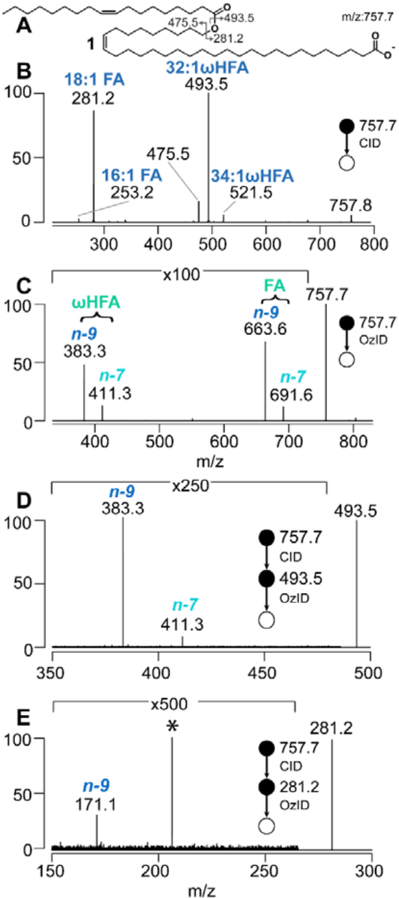
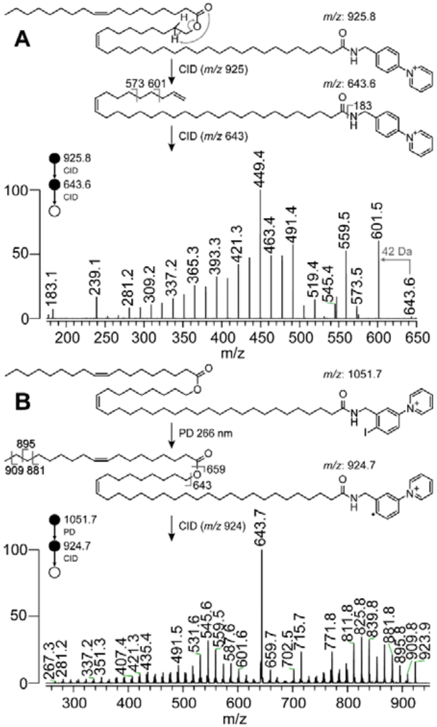
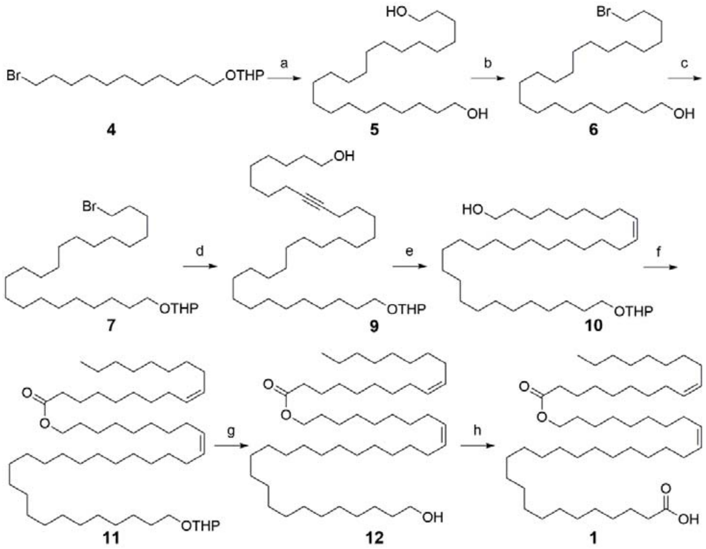
-acyl)-ω-hydroxy FAs (OAHFAs) comprise an unusual lipid subclass present in the skin, vernix caseosa, and meibomian gland secretions. Although they are structurally related to the general class of FA esters of hydroxy FAs (FAHFAs), the ultra-long chain (30-34 carbons) and the putative ω-substitution of the backbone hydroxy FA suggest that OAHFAs have unique biochemistry. Complete structural elucidation of OAHFAs has been challenging because of their low abundance within complex lipid matrices. Furthermore, because these compounds occur as a mixture of closely related isomers, insufficient spectroscopic data have been obtained to guide structure confirmation by total synthesis. Here, we describe the full molecular structure of ultra-long chain OAHFAs extracted from human meibum by exploiting the gas-phase purification of lipids through multi-stage MS and novel multidimensional ion activation methods. The analysis elucidated sites of unsaturation, the stereochemical configuration of carbon-carbon double bonds, and ester linkage regiochemistry. Such isomer-resolved MS guided the first total synthesis of an ultra-long chain OAHFA, which, in turn, confirmed the structure of the most abundant OAHFA found in human meibum, OAHFA 50:2. The availability of a synthetic OAHFA opens new territory for future investigations into the unique biophysical and biochemical properties of these lipids.
Overview
The claims and statistics of this paper haven’t been checked yet.
Run the check — free, no account needed. It reads the open-access text and checks the sources it cites.
Integrity signals
Registry
Cites
Statistics
Figures
Verification
Claims the paper makes
The claims and statistics of this paper haven’t been checked yet.
Run the check — free, no account needed. It reads the open-access text and checks the sources it cites.
Claims other papers make about this one
Each is checked against this paper’s own text: does it say what the citing paper says it does?
The cited source says what the claim attributes to it.
In the citing paper
“Charge-switch derivatization strategies have been successfully used to improve detection in a range of lipid species (50, 51) and there is a chemical derivatization strategy that can impart a fixed positive charge on PE and phosphatidylserine aminophospholipids and increase sensitivity for such lipid species (52, 53, 54, 55).”
From FACS-assisted single-cell lipidome analysis of phosphatidylcholines and sphingomyelins in cells of different lineages (2023) · cites this paper as [51]
Self-check
Percentages, sums and reported differences re-computed from the paper’s own numbers.
The self-check needs the paper’s full text.
Citations
Cites
Lipid extraction by methyl-tert-butyl ether for high-throughput lipidomics
Matyash, V., Liebisch, G., Kurzchalia, T. V., Shevchenko, A., & Schwudke, D. (2008) · Journal of Lipid Research · doi:10.1194/jlr.d700041-jlr200 · Cited by 2,598
Membrane lipid homeostasis in bacteria
Zhang, Y.-M., & Rock, C. O. (2008) · Nature Reviews Microbiology · doi:10.1038/nrmicro1839 · Cited by 1,393
Discovery of a Class of Endogenous Mammalian Lipids with Anti-Diabetic and Anti-inflammatory Effects
Yore, M. M., Syed, I., Moraes-Vieira, P. M., Zhang, T., Herman, M. A., Homan, E. A., Patel, R. T., Lee, J., Chen, S., Peroni, O. D., et al. (2014) · Cell · doi:10.1016/j.cell.2014.09.035 · Cited by 842
Shorthand notation for lipid structures derived from mass spectrometry
Liebisch, G., Vizcaíno, J. A., Köfeler, H., Trötzmüller, M., Griffiths, W. J., Schmitz, G., Spener, F., & Wakelam, M. J. O. (2013) · Journal of Lipid Research · doi:10.1194/jlr.m033506 · Cited by 833
Functional aspects of the tear film lipid layer
Bron, A. J., Tiffany, J. M., Gouveia, S. M., Yokoi, N., & Voon, L. W. (2004) · Experimental Eye Research · doi:10.1016/j.exer.2003.09.019 · Cited by 782
Coupling of Grignard Reagents with Organic Halides
Tamura, M., & Kochi, J. K. (1971) · Synthesis · doi:10.1055/s-1971-35043 · Cited by 489
Ozone-Induced Dissociation: Elucidation of Double Bond Position within Mass-Selected Lipid Ions
Thomas, M. C., Mitchell, T. W., Harman, D. G., Deeley, J. M., Nealon, J. R., & Blanksby, S. J. (2008) · Analytical Chemistry · doi:10.1021/ac7017684 · Cited by 375
Self-citationMeibomian gland studies: comparison of steer and human lipids.
Nicolaides, N. C., Kaitaranta, J. K., Rawdah, T. N., Macy, J. I., Boswell, F. M., & Smith, R. E. (1981) · PubMed · Cited by 277
Vasireddy, V., Uchida, Y., Salem, N., Kim, S. Y., Mandal, M. N. A., Reddy, G. B., Bodepudi, R., Alderson, N. L., Brown, J. C., Hama, H., et al. (2007) · Human Molecular Genetics · doi:10.1093/hmg/ddl480 · Cited by 251
t’Kindt, R., Jorge, L., Dumont, E., Couturon, P., David, F., Sandra, P., & Sandra, K. (2012) · Analytical Chemistry · doi:10.1021/ac202646v · Cited by 202
Cited by
Hancock, S. E., Ding, E., Johansson Beves, E., Mitchell, T., & Turner, N. (2023) · Journal of Lipid Research · doi:10.1016/j.jlr.2023.100341 · Cited by 13
Self-citation
Metadata
- Authors
- Hancock, S. E., Ailuri, R., Marshall, D. L., Brown, S. J., Saville, J. T., Narreddula, V. R., Boase, N. R., Poad, B. J., Trevitt, A. J., Willcox, M. P., Kelso, M. J., Mitchell, T. W., & Blanksby, S. J.
- ORCID
- Hancock, Sarah E.
- Venue
- Journal of Lipid Research
- Publisher
- Elsevier BV
- Published
- 2018-08
- Volume
- 59
- Issue
- 8
- Pages
- 1510-1518
- ISSN
- 0022-2275
- Cited by
- 48
- References
- 52
- Language
- en
- Licence
- www.elsevier.com/tdm/userlicense/1.0/ (tdm)
- creativecommons.org/licenses/by/4.0/ (vor, 764 d)
- Funders
- Australian Research Council (LP140100711, FT110100249)
- Queensland University of Technology
About these checks
Registry, retraction, Cites and statistics results are computed, not judged, with one exception: a printed reference that no index lists is read once by a model before it counts as a citation error. Claims are extracted by a model and kept only when their quote appears verbatim in the text; each cited source is then checked, with a model’s help, for whether it says what the claim relies on. Those verdicts can be wrong — read the claim’s quote and the cited source before relying on one.
Statistics and arithmetic are recomputed, not judged.
Confidence bands are shown only for fields calibrated on our annotated test set. None is calibrated yet, so no band is shown.
What counts as a claim ›How we measure confidence ›How we check this ›
Are you an author, or do you see a problem with this page? Request a review
Data sources
Bibliographic data: Semantic Scholar, OpenAlex, Crossref.
Contains information from the Semantic Scholar Academic Graph Datasets, made available under the ODC Attribution License (ODC-BY 1.0).
Semantic Scholar’s data is described in: Kinney, R., et al. (2023). The Semantic Scholar Open Data Platform. arXiv:2301.10140.
